

QUICK ANSWER
Being the most senior person in the room and feeling the least prepared is a real, recurring scenario in senior careers. The technique is not to fake confidence. It is a structured response: name the moment internally, slow the pace, ask one targeted question that buys preparation time without losing authority, and route the discussion to the part you are strongest on while the room helps fill the gap. Senior credibility survives lack of preparation. It does not survive pretending.
JUMP TO
Why this happens to senior people ·
The wrong instinct ·
The four-step recovery ·
Targeted questions that buy time ·
Letting the room help ·
Prevention next time ·
FAQ
Yusuf was a partner at a London consultancy, dropped into a client meeting an hour before it started because the lead engagement partner had been called to a regulator. The client expected a recommendation on a topic Yusuf knew at one level of remove and was now meant to chair. Twelve people around the table. Yusuf, technically, was the most senior of them. He was also the least prepared person in the room.
That gap — senior-by-role, junior-by-readiness — arrives in every senior career, often more than once. Sometimes it is structural, like Yusuf’s. Sometimes it is a meeting that turned in an unexpected direction. Sometimes it is a presentation that gets to a slide you did not personally build. The detail varies. The pattern is the same: you are the senior name in the room, and the work has just outrun your preparation.
This article is about how to handle that moment without spending senior credibility — and how to set up your preparation discipline so it happens to you less often. Both halves matter. The recovery technique is for now. The discipline is for next time.
When the question lands and you do not have the answer
The Executive Q&A Handling System is the structured framework for handling difficult, unexpected, and high-stakes questions in the moment without losing authority. Designed for senior professionals who present at board level.
Why this scenario keeps happening at senior levels
The senior-but-unprepared moment is not a sign of poor planning. It is a structural feature of senior work. Senior professionals are pulled into meetings on short notice precisely because they are senior. Crises route to seniority. Escalations route to seniority. Topics outside your specialism get routed to you because you are the senior name available.
The other structural factor is the breadth of senior remit. The work covered by a senior role is wider than any one person can hold in working memory. Junior specialists know their area cold and rarely encounter something outside it. Senior generalists handle a portfolio that crosses functions, clients, geographies, and stakeholder types. The probability that any given meeting will surface a topic where your preparation is thin is much higher at senior level than at any other point in a career.
This means the underprepared moment is not avoidable in the long run. The discipline is not “be perfectly prepared for every meeting” — it is “have a reliable response for the moments where you are not.” The senior leaders who handle this well are not the ones who are always prepared. They are the ones who have a structured way to operate when they are not.
The wrong instinct: faking confidence
The most expensive instinct in this moment is to project full confidence and answer anyway. Senior credibility, in front of professional audiences, does not survive a fabricated answer. The audience usually knows. Even if no one says anything in the moment, the room recalibrates. The reading of you shifts from “senior person with deep grip” to “senior person who guesses when cornered.” That recalibration is hard to reverse and very expensive to carry.
The instinct to project full confidence comes from the wrong assumption: that admitting any gap is admitting weakness. At senior level, the opposite is closer to true. The professionals who maintain credibility under pressure are the ones who can name a gap precisely without appearing flustered, and route around it cleanly. That requires confidence, but it is confidence in your own authority over the conversation rather than confidence in a specific answer you do not have.
The other wrong instinct is to apologise excessively. A single, clean acknowledgement of the gap is fine. Repeated apologies, hedging language, or framing yourself as the wrong person for the meeting drains authority faster than the unprepared moment itself ever could. The room tolerates a senior person handling a gap competently. It does not tolerate a senior person performing inadequacy.
The four-step recovery
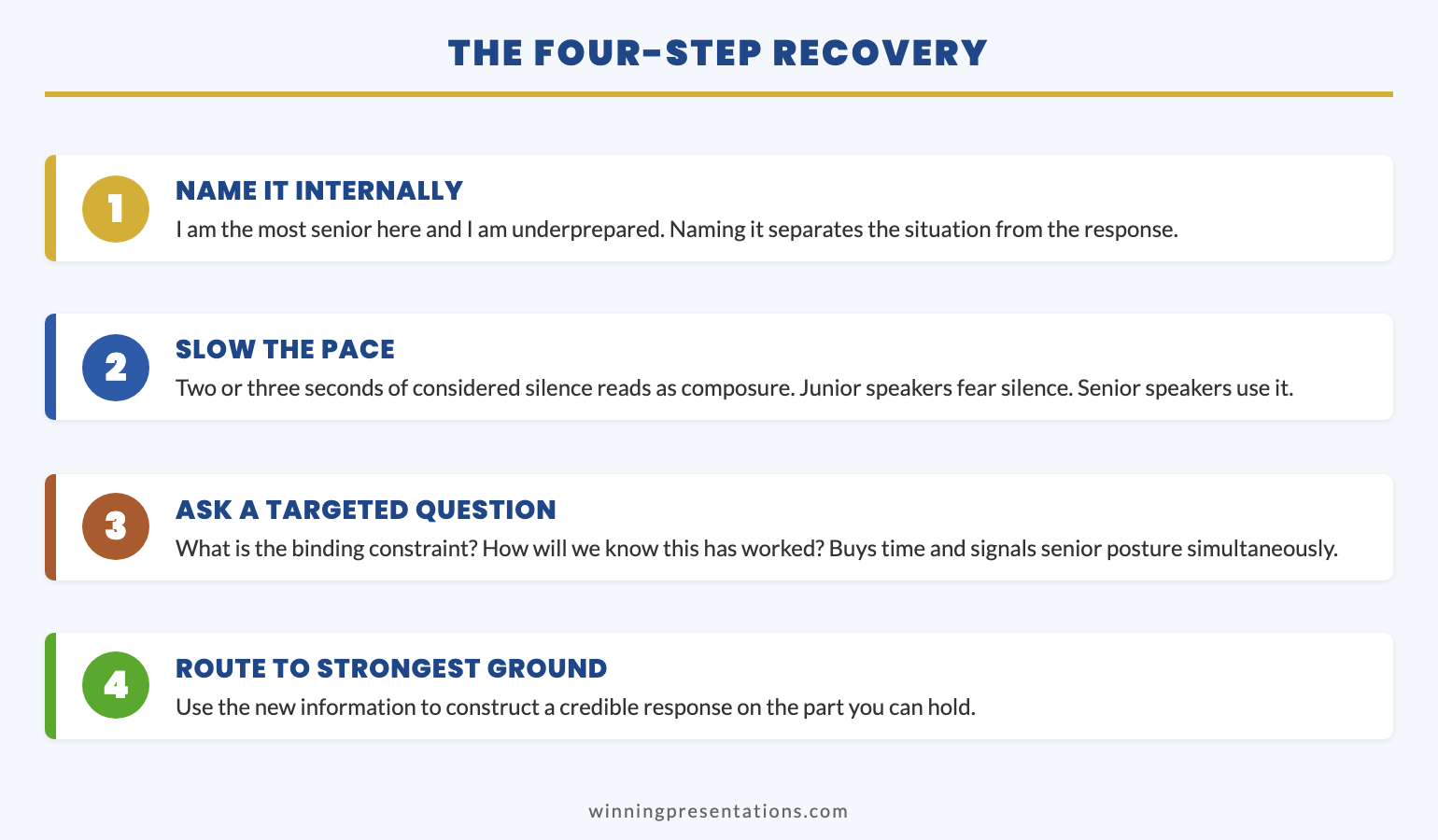
Step one: name the moment internally. Before you respond externally, name what is happening inside your own head: I am the most senior person here and I am underprepared on this. That internal naming is critical. It separates the situation from the response. Senior leaders who skip this step often respond to the situation as if it were a threat, which produces the wrong external behaviours — defensiveness, fabrication, performative confidence. Naming it internally allows you to handle it as a structural problem, which is what it is.
Step two: slow the pace. The room is reading your tempo as much as your words. A senior leader who slows the pace by half a second before responding signals composure. A senior leader who responds at speed signals stress. Slowing the pace also gives you time to think, which is the literal thing you need most in this moment. Two or three seconds of considered silence in a senior meeting is not awkward — it is what the room expects from a senior person who is thinking carefully. Junior speakers fear silence. Senior speakers use it.
Step three: ask a targeted question. This is the move that buys you the most time and authority simultaneously. Not “could you say more?” — that reads as deflection. A targeted question signals that you have a structured frame for thinking about the topic, even if you do not yet have the specific answer. For example, “Before I respond, what is driving the urgency on this from your side?” or “What is the constraint we are most worried about — cost, timing, or stakeholder alignment?” Each of these moves the conversation forward, gives you information you needed, and signals senior posture. Handling difficult board questions covers the linguistic patterns for this in more depth.
Step four: route to your strongest ground. Once the targeted question has produced a response, you have both information and a framing to work with. Route the conversation to the part of the topic you can speak to with full grip, and use that to construct a credible response to the original question. You are not faking the answer. You are giving the genuinely strong answer to the part you are strongest on, and being honest about the parts that need follow-up.
EXECUTIVE Q&A HANDLING SYSTEM
Decision-safe answers in 45 seconds, even on questions you didn’t see coming
The Executive Q&A Handling System gives you the structured frameworks senior professionals use when the room asks something they have not fully prepared for. Calm authority, decision-safe responses, and the linguistic patterns that hold up under pressure.
- Frameworks for answering tough, hostile, or unexpected questions
- Linguistic patterns for buying time without sounding evasive
- Scenario playbooks for common senior Q&A situations
- Designed for board, investment committee, and executive client meetings
- Instant download, no subscription
£39, instant access. Designed for senior professionals navigating high-stakes Q&A.
Designed for senior professionals presenting to boards and investment committees.
Targeted questions that buy time without losing authority
Not every question buys you time at senior level. Some readbacks make the situation worse. The questions that work share three properties: they sound like the kind of question a senior person would ask, they produce information you genuinely need, and they shift the conversation in a direction that helps you.
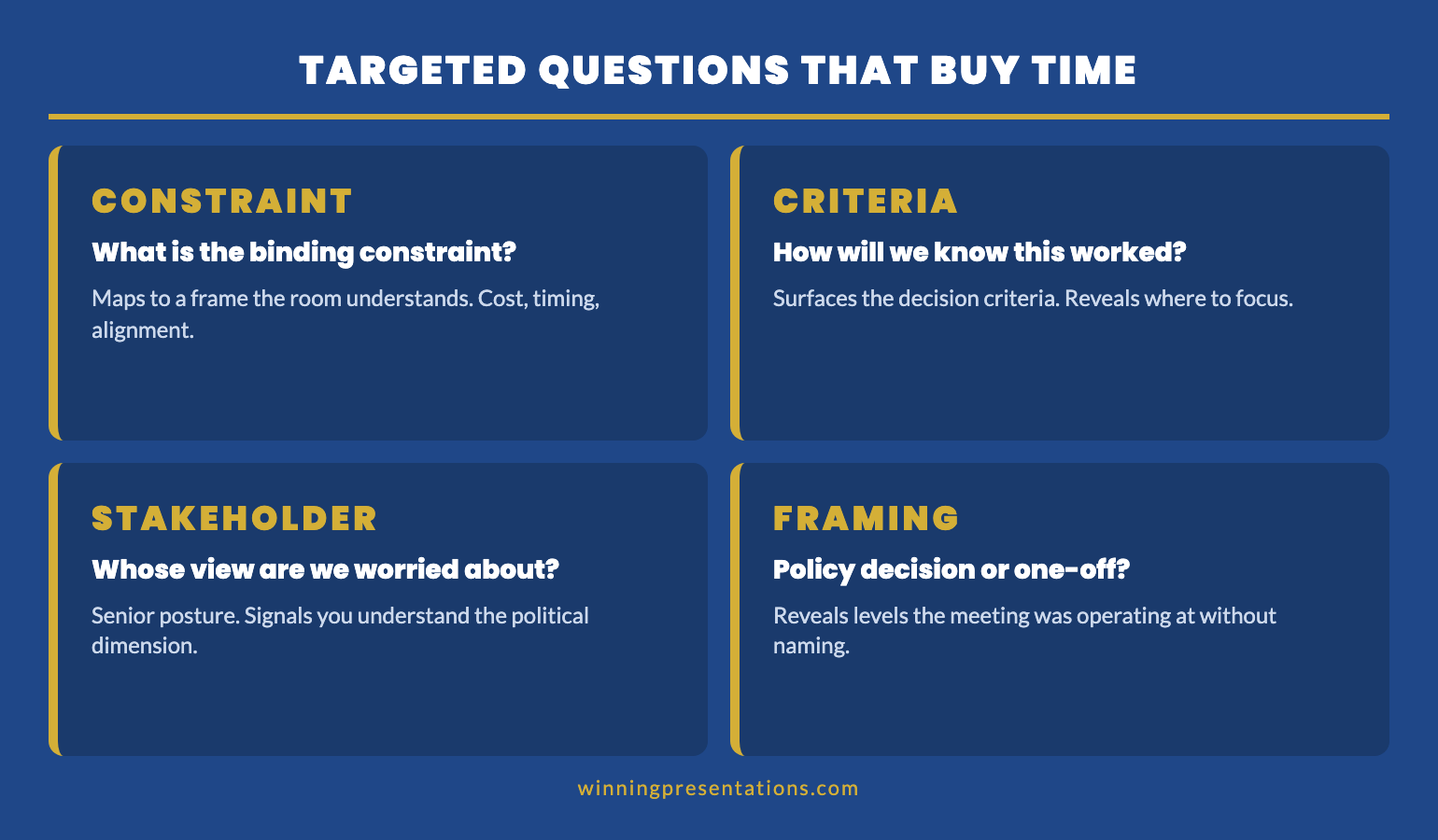
Constraint questions. “What is the binding constraint here — budget, timing, or stakeholder alignment?” These are good because they map to a frame the room understands and gives you a structural starting point for the response.
Decision-criteria questions. “How will we know this has worked?” or “What does success look like from your side?” These are useful when the meeting is moving toward a decision but the criteria have not been made explicit. The answer almost always reveals where to focus.
Stakeholder questions. “Who else needs to be aligned on this?” or “Whose view are we most worried about losing?” These work in meetings where the substance is unclear but the politics are doing real work. The question signals you understand the political dimension — which is itself a senior posture.
Clarification questions on framing. “Are we discussing this as a policy decision or a one-off?” or “Is the question whether to do it, or how to do it?” These are particularly useful when the meeting itself has not been clear about the level of discussion. The answer often reveals that the room itself was operating at different levels, which lets you contribute meaningfully without needing the specific knowledge you do not have.
What these have in common is that they are not deflection. They are structurally useful questions that the meeting needed someone to ask. Asking them positions you as the senior thinker in the room even when your subject-matter preparation is thin.
Letting the room do part of the work
Senior leaders who handle these moments well usually have one further move: they let other people in the room contribute to the response without losing the chair of the conversation. This is structurally different from punting the question to a colleague (which signals you cannot answer) and from chairing it formally (which can feel ceremonial in a working meeting). It is closer to inviting expertise into the conversation while continuing to direct it.
The phrasing matters. “Stefan, you have done more recent work on this — what is the current state?” allows Stefan to contribute the specific knowledge while you continue to hold the senior posture. Once Stefan has answered, you weave his contribution into the senior frame: “That tracks with the strategic position. Given that, the trade-off we are really looking at is X.” The room sees a senior leader using the team well, not a senior leader hiding behind the team.
This works only when there is genuinely someone in the room with the relevant expertise. If there is not, the move does not work, and trying it makes the gap more visible. The fallback in that case is honesty plus structure: “I want to give you a properly grounded answer rather than improvise. I will come back to you on that specific point by Friday. The structural question I can speak to now is…” That is also a senior move, performed correctly.
Buy-in mastery covers the broader curriculum of senior approval work, including the stakeholder analysis that makes targeted questions land more reliably in real meetings.
When the underlying issue is preparation discipline, not Q&A technique
If the senior-but-underprepared moments are happening too often, the gap is usually upstream of the meeting. The Executive Buy-In Presentation System works through the structural disciplines — stakeholder analysis, case construction, objection pre-handling — that prevent these moments from arriving at all.
Prevention next time: the discipline that reduces frequency
You cannot prevent every senior-but-underprepared moment. You can reduce how often they happen. The discipline is structural, not heroic.
The first preventive move is the pre-meeting brief. For any meeting where you are the most senior person and the topic is not your daily area, request a fifteen-minute pre-brief from the colleague closest to the work. Three questions: what is the meeting actually deciding, who needs to be aligned, what is the most likely awkward question. That brief, done in fifteen minutes the day before, removes most of the underprepared scenarios that would otherwise have arrived in the meeting.
The second is calendar discipline. Most senior leaders accept too many short-notice meetings on topics they cannot prepare for. A simple rule helps: any meeting that is going to ask you to take a public position on something you have not engaged with in the last quarter requires a pre-brief, or it gets pushed to allow time for one. The professional cost of pushing the meeting back twenty-four hours is much smaller than the credibility cost of being underprepared in it. Executive presentation skills covers this part of senior professional discipline more broadly.
The third is structural reading. Senior leaders who run on a healthy preparation cycle usually have a small portfolio of structures they can use to reason about almost any topic on first encounter — constraint maps, stakeholder grids, decision-criteria frames, risk-and-mitigation patterns. When the meeting surfaces a topic you have not specifically prepared for, those structures let you contribute usefully even on first contact. They are the senior version of having a method ready when the content is unfamiliar.
EXECUTIVE Q&A HANDLING SYSTEM
Calm authority on the questions you didn’t see coming
Frameworks, scenario playbooks, and linguistic patterns for senior Q&A. Designed for board, investment committee, and high-stakes client meetings. £39, instant access.
Designed for senior professionals navigating tough Q&A.
Why composure beats coverage
Senior credibility is not built on always being prepared. It is built on handling whatever the meeting brings with consistent professional posture. The leaders the room trusts most are not the ones who never get caught short. They are the ones who, when they do, slow down, ask the right targeted question, and route the conversation to ground they can hold. That is a teachable competence. It is also the part of senior presence that scales across topics, audiences, and decades.
Frequently asked questions
Is it ever right to admit “I do not have an answer to that” in a senior meeting?
Yes, when it is paired with structure. “I do not have a properly grounded answer to that today — I will come back to you by Friday. The framework I would use to think about it is…” preserves credibility. The bare admission, without follow-up structure, drains authority. The pairing matters.
Will the room respect a senior leader who slows the pace before answering?
Almost always. Considered silence in a senior meeting reads as composure, not hesitation, provided the body language and eye contact stay steady. Junior speakers worry about awkward silence. Senior speakers use silence as a tool. Two to three seconds is usually optimal — long enough to signal thought, short enough to maintain pace.
What if my colleague’s contribution makes me look less prepared by comparison?
That risk exists, and the framing is what handles it. Inviting a colleague to contribute the specific subject-matter detail and weaving it into the senior frame (“That tracks with the strategic position. Given that, the trade-off we are looking at is…”) keeps you positioned as the senior thinker. The room sees a leader using the team well. It does not see a leader being outshone, unless your re-framing is weak. The re-framing is the part to rehearse.
How do I prevent these moments from happening as often?
The strongest prevention is the fifteen-minute pre-brief from the colleague closest to the work, on any meeting where you will be the most senior person on a topic outside your daily area. Three questions: what is the meeting deciding, who needs to be aligned, what is the most likely awkward question. The pre-brief removes most of the senior-but-underprepared scenarios before they arrive. The leaders who do this consistently rarely get caught short, even when their portfolio is broad.
The Winning Edge
A weekly newsletter for senior professionals who present at board level. One specific structural idea per issue, drawn from real boardroom and committee work. No filler.
If this article landed, the natural companion is High-stakes presentation burnout. It covers the related pattern that arrives when senior leaders run the high-stakes cycle for years without restoring the recovery phase.
Next step: rehearse the four-step recovery once, out loud, on a topic you do not know well. The rehearsal is what makes it usable when you actually need it.
Mary Beth Hazeldine is the Owner & Managing Director of Winning Presentations. With 24 years of corporate banking experience at JPMorgan Chase, PwC, Royal Bank of Scotland, and Commerzbank, she advises senior professionals across financial services, healthcare, technology, and government on structuring presentations for high-stakes funding rounds and approvals. She speaks German and works extensively with the German-speaking financial markets.