

QUICK ANSWER
A board decline is a delay; a pattern of declines is a credibility problem. Senior professionals who move from declined to approved on the same kind of proposal almost always change four things: how they map the room before the meeting, how the case is structured on the page, which objections they pre-handle, and how they re-enter the conversation after the previous refusal. The track record is repairable. It just is not repairable by re-presenting a stronger version of the same deck.
JUMP TO
What a decline really means ·
Diagnosis before redrafting ·
Re-mapping the room ·
Restructuring the case ·
Re-entering the conversation ·
Rebuilding the track record ·
FAQ
Refilwe was the head of risk transformation at a UK retail bank. Her risk operating model proposal had been declined twice. The third presentation went a different way. Halfway through, the chair said: “I see what changed. Continue.”
What changed was not the recommendation. The recommendation was almost identical to the version that had been declined three months earlier. What changed was where the case opened, which slides were cut, which objections were placed in the body of the deck rather than being left for Q&A, and the order in which two committee members were briefed before the meeting. Refilwe later said the new version was less work, not more. It was just more correctly arranged.
This is the experience most senior professionals do not get walked through after a decline. The instinct is to make the next version better — more research, more analysis, sharper visuals, more compelling delivery. The room politely declines that version too, often for reasons that look unrelated to the work that went in. The shift from declined to approved usually involves doing different work, not more of the same work.
Need to rebuild a board approval track record?
If a recent decline (or sequence of them) is the reason you are reading this, the Executive Buy-In Presentation System walks through the structural choices that turn declines into approvals. Self-paced, no deadlines, monthly cohort enrolment.
What a board decline really means
A decline is not a verdict on the proposal. It is a signal about how the room is reading the proposer. That distinction matters because the two require different responses.
If the decline is purely about the proposal — the numbers do not work, the timing is wrong, the strategic fit is unclear — the next version can be a refined version of the same case. The data improves, the assumptions tighten, the framing sharpens, and the proposal goes back through. This is the situation senior professionals usually assume they are in.
If the decline is about how the room is reading the proposer, refining the same case will not work. The room is now slightly less inclined to lean in next time, which raises the bar the next version has to clear. A second decline on the same kind of proposal compounds the effect. Senior approvers begin to read your name on the agenda differently. Not unfairly — they have evidence. They have seen you propose something twice. They have declined it twice. The third version arrives with a heavier set of priors than the first did.
This is the credibility dimension of buy-in. It is rarely talked about in those terms. But every senior professional who has rebuilt a track record from a sequence of declines understands it intuitively. The work is not just sharpening the case. The work is changing how your name lands when it appears on next quarter’s agenda.
Diagnosis before redrafting
The most expensive mistake after a decline is rebuilding the deck before diagnosing the decline. The diagnosis takes longer than the redrafting and is harder to do honestly. It is also where the rebuild happens.
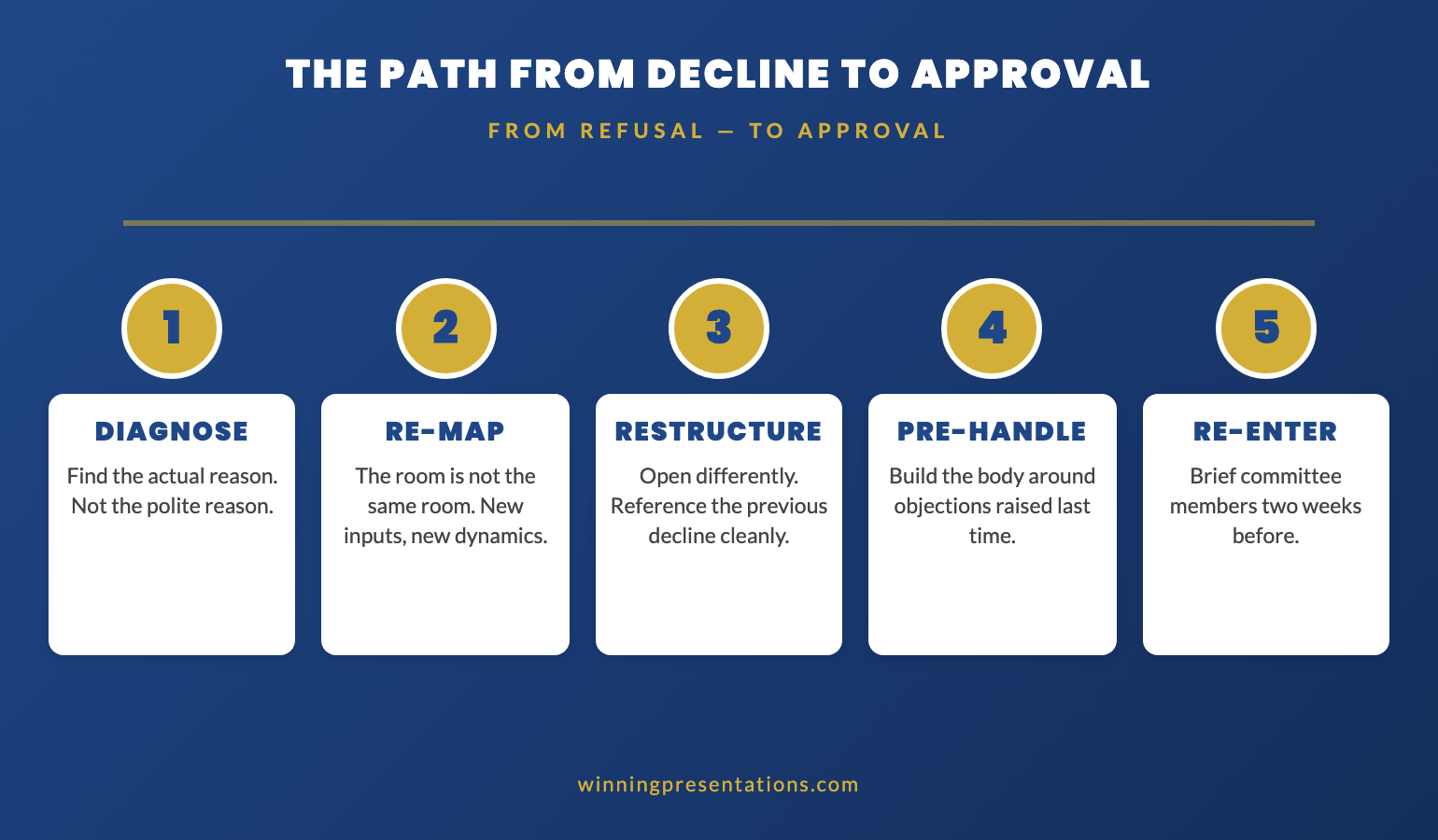
The diagnostic asks four questions. What was the actual reason the proposal did not pass? Not the polite reason. Not the reason captured in the minutes. The reason a candid sponsor would tell you over a coffee. Whose vote was the swing vote? Boards rarely move as a block. Usually one or two members were close to “yes” and tipped the room toward “no” with a question or a reservation. What was the underlying objection that did not get fully addressed? The decline almost always traces back to one or two specific concerns that were not pre-handled. And what was your relationship to the room when you presented? Were you reading as a confident presenter of a structured case, or as a presenter trying to convince a room that was already drifting?
Most senior professionals who do this diagnosis honestly find that the answer is uncomfortable but specific. The proposal was not the problem. The third question was the problem. Or the fourth. Once the actual answer is identified, the rebuild is targeted — not a wholesale redraft but a structural adjustment to the part that did not hold.
Re-mapping the room before the second presentation
The room you present to the second time is not the same room you presented to the first time. Membership may be identical. The dynamics are not. Senior professionals who skip the re-mapping step often present a version of the proposal that would have been ideal for the first room and is exactly wrong for the second.
What has shifted? The decline itself has shifted things. So has whatever happened in the months between presentations — budget pressures, regulatory updates, performance against last quarter’s targets, a new strategic priority that did not exist when you first presented. Each of these changes the room’s appetite for what you are proposing, often without anyone naming it explicitly.
Re-mapping the room is a structured exercise. List every member of the deciding group. For each one: what did they say at the previous meeting (literally, if minutes are available)? What is their current operating environment? What did they fund or decline in the most recent decisions you have visibility on? What is the most likely question they will ask you, given all of the above? This list is not for the presentation. It is for the design of the presentation. Each member’s likely question becomes a structural input into where the case opens, which evidence is foregrounded, and which slides survive.
Restructuring the case for the second time around
The biggest structural mistake on a re-presentation is opening the deck the same way it opened the first time. The room remembers the previous opening. Walking it through the same setup signals that the proposer has not absorbed the previous decline — and the room reads that as either tone-deafness or stubbornness, neither of which earns approval.
The re-presentation needs an opening that explicitly references the gap between the previous version and this one. Not in a defensive way. In a clean, structural way: “When we presented this in February, the committee raised three specific concerns. Today’s version addresses each one directly, in this order.” Then the body of the presentation follows that order. The committee gets to see, on slide one, that you have heard them. The room relaxes. The presentation becomes a continuation of the previous conversation, not a repetition of it.
The body slides change accordingly. The slides that did the load-bearing work on the original proposal — the strategic rationale, the financial case, the implementation plan — are revisited but they are not repeated. They are compressed. The space they used to take is now occupied by the slides that resolve the previous objections. Board presentation credibility covers the underlying structural choices in more depth, particularly the slide patterns senior approvers respond to on second-pass material.
EXECUTIVE BUY-IN PRESENTATION SYSTEM
Stop rewriting the proposal three times only to hear “we’ll think about it”
The Executive Buy-In Presentation System teaches the structure that earns decisions, not delays. 7 self-paced modules covering stakeholder analysis, case construction, objection pre-handling, and the presentation patterns that hold up to senior scrutiny.
- 7 modules of self-paced course content
- Optional live Q&A / coaching calls (fully recorded — watch back anytime)
- No deadlines, no mandatory session attendance
- New cohort opens every month
- Lifetime access to all course materials
£499, lifetime access. Self-paced with monthly cohort enrolment — optional recorded Q&A sessions available.
Designed for senior professionals rebuilding board approval track records.
Pre-handling objections that surfaced last time
The objections that surfaced in the previous decline are not optional inputs to the next deck. They are the central design constraints. Every objection raised in the previous meeting needs an answer in the body of the new presentation, in a slide the committee will see before they get to the recommendation.
This is structurally different from the way most senior professionals handle previously raised concerns. The instinct is to address them in Q&A. The committee asks again, you answer again, and you hope the answer lands cleanly enough this time to shift the vote. The problem is that the room has already given you the chance to address the concern in your prepared material. By holding the answer for Q&A, you signal that the concern was not central enough to warrant a slide. That signal alone is often enough to lose the vote a second time.
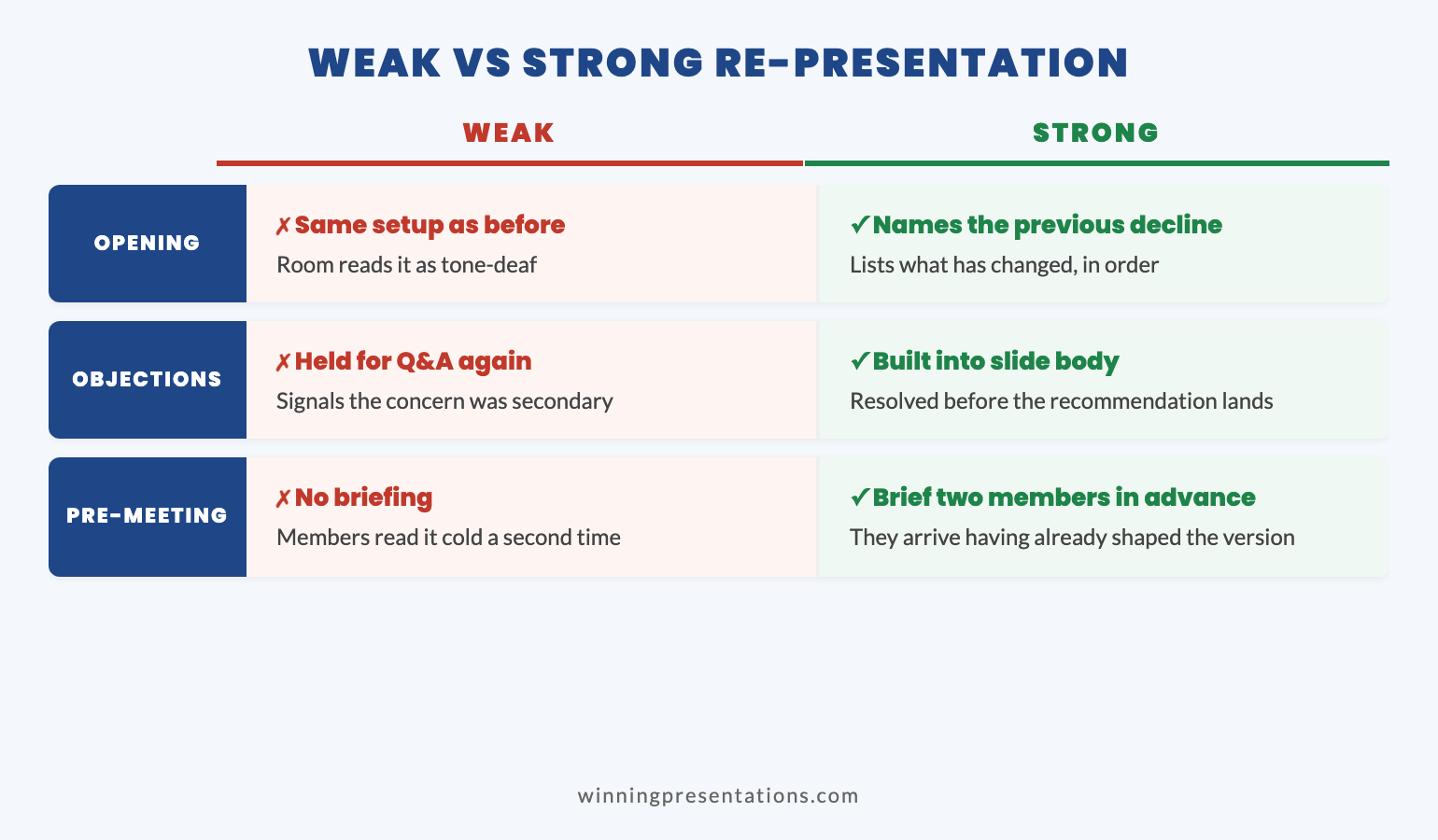
Building the body of the deck around the previously raised objections does something else, too. It changes what the room is comparing the new version to. They are no longer comparing it to “an ideal proposal” — they are comparing it to “the version that didn’t pass.” That is a much easier benchmark to clear, and it is a fairer one. Handling board objections covers the technique side of pre-handling in more detail, particularly the linguistic patterns that absorb objections without sounding defensive.
Re-entering the conversation: the briefing work that happens before the meeting
The work that decides a re-presentation is rarely the presentation itself. It is the briefing work in the two to three weeks before. Senior professionals who move from declined to approved usually do significant pre-meeting work with at least two committee members. Not lobbying. Not pre-selling. Briefing.
The structure of an effective pre-brief is short. You acknowledge the previous decline. You walk the member through what has changed in the new version, with particular attention to the objection they raised (or that you suspect was theirs, even if it was raised by someone else). You ask one question: “Given those changes, is there anything else you would want to see addressed in the deck before the meeting?” Then you listen, take notes, and adjust.
This conversation does two things. It surfaces objections you did not anticipate — before the meeting, when you have time to handle them on the slide rather than in the room. It also gives the committee member ownership of part of the new version. The second time the proposal lands in front of them, they are not reading it cold. They are reading a version they helped shape. That changes how they vote, even on cases that look identical to the previous one. Buy-in mastery goes deeper on stakeholder analysis as a discipline — the upstream work that makes briefing conversations effective rather than awkward.
Need the slide structures to back up the rebuild?
The Executive Slide System is the templates and patterns side of the same picture — 26 templates, 93 AI prompts, and 16 scenario playbooks designed for senior approval rooms. Pairs naturally with the buy-in curriculum.
Rebuilding the track record over multiple cycles
One approval after a decline is a recovery. A track record is built over several cycles. Senior professionals who consistently earn approval at board level usually have a pattern most peers do not see: they apply the same structural disciplines to small approvals as well as large ones, which means the room’s reading of them — the cumulative credibility — keeps improving even on cases that look unimportant.
This matters because boards do not really vote on individual proposals in isolation. They vote on the proposal in the context of the proposer’s recent track record, even when nobody phrases it that way. A senior professional who has earned three small approvals in the last six months arrives at a major proposal with a different reading than one whose recent record is mixed. The deck on the day matters. The reading the deck arrives into matters more.
The discipline, then, is treating every senior approval — large and small — as a structural exercise. Stakeholder analysis. Case construction. Objection pre-handling. Presentation patterns that hold up to scrutiny. Done consistently across cycles, the track record rebuilds itself almost as a side-effect of the work.
JOIN THE NEXT COHORT
Stop guessing what your stakeholders need to say yes
The Executive Buy-In Presentation System is the self-paced framework for decoding resistance and building the case that addresses it. 7 modules, monthly cohort enrolment, optional recorded Q&A. £499, lifetime access.
Self-paced with monthly cohort enrolment. No deadlines.
Why it pays to treat the rebuild as a discipline
The senior professionals who recover quickly from declines are not the ones who absorb the refusal as a personal verdict. They are the ones who treat it as structural feedback — expensive, specific, and useful. The decline tells you exactly which discipline of the curriculum was thinnest in the previous round. The next round is where you strengthen it.
Done over two or three cycles, this turns into a competence that compounds. The track record stops being a fragile thing built on individual proposals and becomes a stable read of you as a senior professional who handles approval work to a consistent standard. That is what the room is really voting on.
THE COMPLETE FRAMEWORK
Built for senior professionals presenting to boards and investment committees
The Executive Buy-In Presentation System — 7 self-paced modules covering the psychology and structure that earn senior approval. Built on 24 years in corporate banking and 16 years coaching senior professionals across financial services, insurance, consulting, and technology. £499, lifetime access. Monthly cohort enrolment, optional recorded Q&A calls.
Designed for senior professionals rebuilding approval track records.
Frequently asked questions
How long should I wait before re-presenting a declined proposal?
Long enough to do the diagnostic and the structural rebuild properly. That usually means at least one full quarter, sometimes two, depending on how significant the rebuild needs to be. Re-presenting too quickly with a lightly revised version is the most common cause of a second decline. Boards read short turnaround as low absorption of their previous feedback.
What if the official reason for the decline does not feel like the real reason?
The official reason captured in minutes is usually the most diplomatic version of the actual concern. The actual concern is often more pointed and specific. A candid conversation with your sponsor or a friendly committee member usually surfaces the real reason. Build the rebuild around that — not around the minute. The room will recognise which one you have responded to.
Should I change the recommendation, or just the way it is presented?
Often the recommendation does not need to change at all — the structural choices around it do. Stakeholder analysis, case construction, objection pre-handling, and slide patterns can carry the same recommendation through to approval that previously did not pass. If the diagnostic genuinely surfaces a flaw in the recommendation itself, change it. But the assumption that the recommendation must be wrong because it was declined is rarely correct.
Is briefing committee members before a re-presentation appropriate?
Yes, when it is framed as briefing rather than lobbying. The conversation is not “please support this” — it is “we declined this in February, here is what has changed, what else would you want to see addressed before the meeting?” That is professional courtesy, and most committee members appreciate it. The line is crossed when the conversation becomes a vote-counting exercise. Stay in the briefing posture.
The Winning Edge
A weekly newsletter for senior professionals who present at board level. One specific structural idea per issue, drawn from real boardroom and committee work. No filler.
Not ready for the full system? Start here instead: download the free Executive Presentation Checklist — the pre-flight checks that catch the structural mistakes most senior professionals make in the last 24 hours before a high-stakes meeting.
If this article landed, the natural companion is Buy-in mastery: why executive approval is learnable. It covers the broader curriculum the rebuild work draws on.
Next step: if you have a recent decline, set aside an hour this week and run the four-question diagnostic on it. The honest version of those answers is where the rebuild starts.
Mary Beth Hazeldine is the Owner & Managing Director of Winning Presentations. With 24 years of corporate banking experience at JPMorgan Chase, PwC, Royal Bank of Scotland, and Commerzbank, she advises senior professionals across financial services, healthcare, technology, and government on structuring presentations for high-stakes funding rounds and approvals. She speaks German and works extensively with the German-speaking financial markets.