
Tag: q&a anxiety

22 May 2026
Featured image for Q&A Dread: Why Question Sessions Trigger More Anxiety Than Presentations

Q&A Dread: Why Question Sessions Trigger More Anxiety Than Presentations

Quick answer: Q&A dread is more common at senior level than stage fright. The question session triggers more anxiety than the presentation because it is structurally less controllable: the presenter has prepared for what they will say, but every Q&A is partially unrehearsable, audience-paced, and public. The dread is rational. It is also addressable. The anxiety comes down when the structure of the question session becomes more predictable — through pattern recognition, response shapes, and a small number of physiological techniques that work in the moment.

Tomás had given the same kind of presentation more than a hundred times. Investment committees. Quarterly reviews. Internal strategy sessions. The presentation itself was the part he had stopped fearing years ago. The Q&A was different. He could feel the shift in his body in the last minute of his closing slide, before he had even said the words “happy to take questions”. Heart rate climbing. Throat constricting. Hands going slightly cold. It happened every time, and the presentation in front of him made no difference.

When he described this to a colleague over coffee, she laughed and said: “I would much rather give a forty-minute presentation to two hundred strangers than do twenty minutes of Q&A with twelve senior peers.” Three other senior leaders at the same meeting nodded. Tomás was not unusual. He was the norm.

Q&A dread is one of the most under-discussed forms of presentation anxiety at senior level. People talk about stage fright. They rarely talk about the specific spike that happens in the moment a presentation ends and the questions begin. Yet the second one is more common, more persistent, and arguably more rational — because the Q&A is structurally less controllable than the presentation, in three specific ways.

If the question session is where your nerves spike

Conquer Your Fear of Public Speaking is a structured programme for senior professionals whose anxiety shows up around presenting and the Q&A that follows. Practical tools designed for use before, during, and after high-stakes meetings — not generic confidence advice.

Explore the programme →

Why Q&A is harder than the presentation

The presentation is rehearsable. Every word can be drafted in advance, every transition tested, every example chosen for clarity. By the time you are in the room, the script is in muscle memory and your brain is mostly executing rather than composing. Anxiety still shows up, but it is anxiety against a known shape.

The Q&A is different in three structural ways. First, it is partially unrehearsable. You cannot know in advance which questions will be asked, in what order, by whom, or with what tone. Even a thorough preparation only covers a portion of the question space. The brain registers this as uncertainty, and uncertainty is the largest single driver of anxiety responses in the human nervous system.

Second, the Q&A is audience-paced rather than presenter-paced. During the presentation, you control the rhythm. You can slow down, pause, repeat. In the Q&A, the pace is set by the room. The next question can come three seconds after your last answer, or ninety seconds later, or in the middle of your sentence. The loss of pace control raises physiological arousal in a way the presentation rarely does.

Third, the Q&A is publicly composed. Every sentence the presenter speaks during the questions is improvised in front of an audience that is watching them think. This is unusual. Most senior professionals spend their working day either thinking privately and then reporting, or thinking out loud in trusted small groups. Public composition under time pressure, in front of seniors, is structurally rare in normal work — and the body responds to it as a high-stakes novel situation.

All three factors are real. The dread is not irrational. Telling yourself “you have nothing to be nervous about” is unhelpful because the brain knows you do. The intervention has to be in the structure itself, not in self-talk.

The three anxiety spikes in a Q&A session

Q&A anxiety is not constant across the session. Most senior presenters describe three distinct spikes, each with a different physiological signature. Knowing where they are reduces their power, because the brain is no longer surprised by the rise.

Spike one: the moment the presentation ends. The transition from “presenter speaks, audience listens” to “audience speaks, presenter listens” is one of the largest mode-switches in any meeting. The body registers it as a loss of control. The signature is a rapid heart-rate increase in the last twenty seconds before the words “happy to take questions”. Most senior presenters can feel it physically.

Spike two: the moment a hostile question lands. Not every question. The specific one that questions the premise, the integrity, or the personal credibility of the presenter. The signature is a quick adrenaline pulse, narrowed peripheral vision, and a strong urge to fill the silence. Most poor answers in board-level Q&A are given in the first three seconds of this spike, before the body has settled.

Spike three: the silence after a question, when the presenter is composing. This is the most under-acknowledged spike. The body interprets the silence as exposure. Cortisol rises. The presenter feels the urge to start speaking before they have a complete thought, which produces meandering or defensive answers. The spike happens roughly every ninety seconds in a typical Q&A and is cumulative across the session.
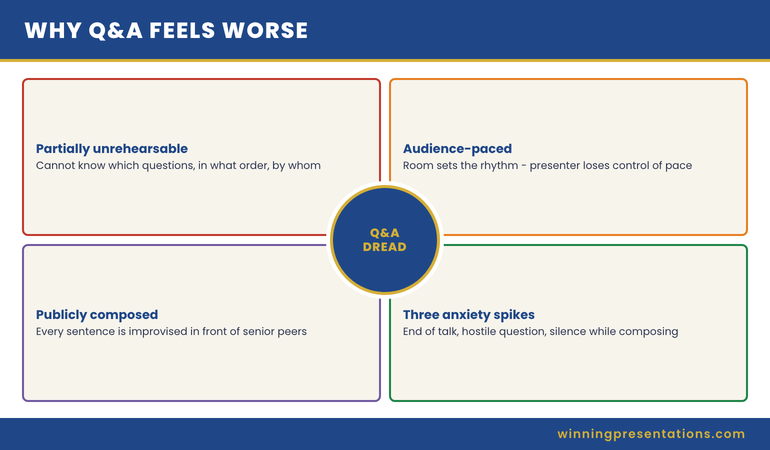
Diagram showing the three Q&A anxiety spikes: presentation-end transition, hostile question landing, and the silence-while-composing moment, with physiological signature for each

For senior professionals whose anxiety shows up in Q&A

Practical tools for the part of the meeting you cannot fully rehearse

Conquer Your Fear of Public Speaking is structured around the specific physiological and psychological patterns that drive presentation anxiety — including the Q&A spike that most generic confidence training ignores. Designed for senior professionals who present regularly and need tools that work in the room.

  • Physiological techniques for the in-the-moment spike
  • Pre-meeting preparation routines that reduce baseline arousal
  • Cognitive frameworks for the silence-while-composing moment
  • Designed for repeat use across high-stakes meetings

£39 · Instant access · Designed for executive presentation anxiety

Get Conquer Your Fear of Public Speaking →

What works in the moment

In-the-moment techniques have to be invisible to the audience and fast enough to land within the spike. The three below meet both criteria. They work whether or not the presenter has any history with anxiety. They are most useful at spike one and spike three.

Lengthen the exhale. The single most reliable physiological intervention for in-room arousal is to extend the out-breath relative to the in-breath. A four-second inhale followed by a six-second exhale, repeated twice, can drop heart rate by ten to fifteen beats per minute within thirty seconds. The technique is invisible from across a table. It can be done while listening to the question, while drinking water, while looking at the questioner. It does not require closing your eyes or any visible behaviour.

Anchor in a physical point of contact. Place your feet flat on the floor and feel the contact through the soles of your shoes. Or rest your hand on the table and feel the temperature of the surface. This grounds attention in the body, which interrupts the catastrophising loop the brain runs during arousal. The technique is invisible, takes two seconds, and can be repeated as often as needed.

Use the question repetition. Repeating the question briefly back to the asker — “you are asking about the confidence interval, is that right?” — does three things at once. It buys composition time. It signals respect to the asker. And it uses speaking, which is calming for many people, instead of silence, which is destabilising. The repetition is a structural move, not a tic. Used once or twice in a Q&A session, it is invisible. Used every question, it becomes a recognisable pattern.

What works in preparation

In-the-moment techniques manage the spikes when they happen. Preparation reduces the spikes themselves. Three preparation moves consistently bring Q&A anxiety down for senior presenters who use them across multiple meetings.

Build a question pattern playbook. The brain treats unknown territory as more threatening than known territory, even when the known is unpleasant. Spending an hour before a high-stakes meeting writing down the questions you are afraid of — and writing the response shape you would use for each — converts unknown territory into known territory. The reduction in baseline arousal in the meeting is large. Most senior presenters who do this say it is the single most effective preparation move they have found.

Rehearse one or two answers out loud, then stop. Counter-intuitively, over-rehearsing answers makes Q&A worse. The brain expects the rehearsed answer and freezes when the question deviates. Rehearsing two answers out loud — once each — is enough to put the response shape in muscle memory without locking in the words. The second time you say it, you should already be modifying the phrasing.

Reduce the cognitive load on presentation day. Q&A spikes are larger when baseline arousal is already high. The day of a high-stakes presentation, reducing other commitments, eating earlier rather than later, and avoiding new high-stakes conversations in the morning are not soft advice — they are arousal management. Every other meeting in the morning increases the height of the Q&A spike that afternoon. Senior presenters who consistently handle Q&A well tend to manage their schedule on presentation days deliberately.
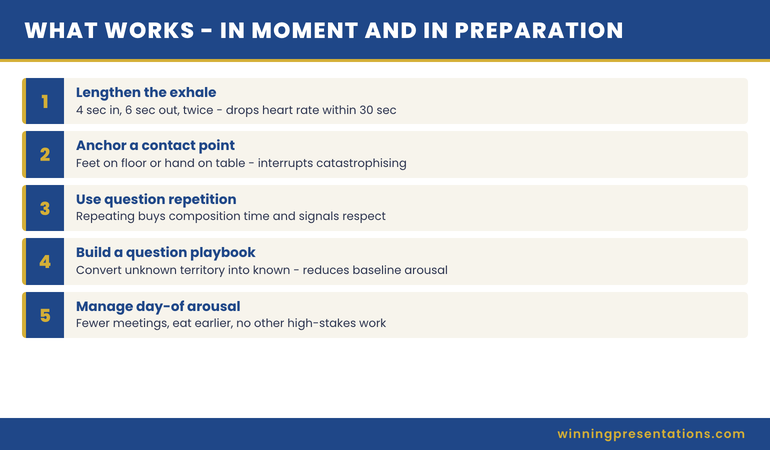
Two-column diagram showing in-the-moment techniques such as lengthened exhale and anchor points alongside preparation techniques such as question playbook and arousal management

Companion: Q&A handling technique

Pair anxiety reduction with structured response shapes

Reducing the anxiety is one half of the work. The other half is having a structured response in place. The Executive Q&A Handling System gives you the question pattern library, response shapes, and bridging and blocking mechanics that go alongside the physiological tools. £39, instant access. Three files designed for repeat use before high-stakes meetings.

See the Q&A Handling System →

What to do after a bad Q&A

Most senior presenters who handle Q&A badly do not address what happened afterwards. The unprocessed bad Q&A becomes the reference point for the next high-stakes meeting, which raises baseline anxiety. The cycle compounds. Three steps break it.

Write down what actually happened within twenty-four hours. Not what you wish had happened. The exact questions, your exact answers, the moment the spike hit. Memory distorts within a few days, usually toward the worst version. A written account anchors the experience in what really occurred, which is almost always less catastrophic than the recalled version.

Identify the one structural move that would have changed the outcome. Not five moves. One. Most bad Q&A sessions have a single pivot point — a question handled poorly, a moment of defensiveness, a silence that ran too long — that determined the rest. Identifying that one move turns the experience from “I was bad at Q&A” into “I missed one specific structural opportunity”, which is far more recoverable.

Practise the alternative move on a low-stakes occasion. Within the next two weeks, deliberately use the move you missed in a setting where the consequence is small. The reps build the muscle memory and reduce the height of the spike the next time the same situation arises. Most senior presenters who do this consistently report a measurable reduction in Q&A anxiety within three to four meetings.

If anxiety around the question session is a persistent pattern, there is also useful structured support designed specifically for executive presentation work. The companion piece on overcoming presentation anxiety covers a wider range of techniques. The piece on presentation anxiety for executives covers when self-directed work is enough and when external support is appropriate.

Frequently asked questions

Is Q&A dread something I can fix on my own?

For most senior professionals, yes. The combination of preparation moves, in-the-moment techniques, and post-meeting processing addresses the majority of cases. If the dread is severe enough to interfere with sleep before meetings, or to cause physical symptoms that persist for days, structured external support is worth considering. Most cases sit between these two extremes and respond well to self-directed practice.

Why does experience not eliminate Q&A anxiety?

Because the structural conditions that drive the anxiety — partial unrehearsability, audience pacing, public composition — do not change with experience. They are properties of the Q&A format itself. Experience helps with pattern recognition and reduces the catastrophising of bad outcomes, but it does not eliminate the underlying physiological response. Senior presenters with twenty years of experience often still feel the spike. They have just learned what to do in it.

Will the audience notice if I am anxious?

Less than you think. Anxiety is felt internally as overwhelming and read externally as subtle. The audience usually notices small cues such as a faster speaking pace, less eye contact, or shorter answers — but rarely identifies them as anxiety. They are usually attributed to “the presenter is in a hurry” or “they are being concise”. This is one reason the in-the-moment techniques are so effective: they address the internal experience without needing to mask it.

Should I tell the audience I am nervous?

Generally no, at senior level. Naming nerves to a senior peer audience tends to reduce credibility rather than build connection. The exception is small-group internal settings where the audience is already an ally. In external or board-level settings, the better move is to manage the anxiety quietly using the techniques described, and let the audience read your composure as confidence — which it functionally becomes.

If Q&A is the part of the meeting that drains you

Practical anxiety techniques designed for senior presenters, not general audiences

Conquer Your Fear of Public Speaking is the structured programme behind the techniques in this article — physiological tools, preparation routines, post-meeting processing, and the cognitive frameworks that hold up under pressure in board-level Q&A. Designed for senior professionals who present regularly and want the dread to come down meeting by meeting.

  • In-the-moment techniques for the three Q&A spikes
  • Pre-meeting preparation routines that reduce baseline arousal
  • Post-meeting processing to break the catastrophising loop
  • Designed for senior professional presentation contexts

£39 · Instant access · Designed for executive presentation anxiety

Get Conquer Your Fear of Public Speaking →

The Winning Edge — weekly

One short note each Thursday on speaking anxiety, Q&A composure, and the practical moves senior professionals use under pressure. Written for people who do not have time for newsletters that read like newsletters.

Subscribe to The Winning Edge →

Want a structural starting point first? The free 7 Presentation Frameworks Quick Reference Card covers the structures that reduce anxiety by giving the brain a place to land in the room.

For a wider view of confidence-building for senior professionals, see the companion article on confident presenting for executives.

Next step: Before your next high-stakes meeting, write down the three questions you are most afraid of being asked. For each, draft a short response shape — not a script. That is one hour of work that will reduce the height of the Q&A spike on the day.

Mary Beth Hazeldine is the Owner & Managing Director of Winning Presentations. With 24 years of corporate banking experience at JPMorgan Chase, PwC, Royal Bank of Scotland, and Commerzbank, she advises senior professionals across financial services, healthcare, technology, and government on presentation anxiety, Q&A composure, and the behaviours that hold up in high-stakes meetings. She speaks German and works extensively with the German-speaking financial markets.

04 Mar 2026
Executive at podium facing unexpected questions during Q&A session in corporate boardroom

Why Q&A Terrifies You More Than the Presentation Itself

A senior banker delivered a flawless 20-minute strategy presentation. Slides were crisp. Narrative flowed. The room was engaged. Then came the words every executive dreads: “Any questions?”

Forty-seven seconds into the first question—an unexpected probe from a board member about risk assumptions—she froze. Not because she didn’t know the answer. Not because the question was hostile. But because the presentation had shifted from scripted performance to unscripted performance. Control had evaporated. She had practised every slide. She hadn’t practised uncertainty.

That freeze—and the cascading panic that followed—was not a presentation failure. It was a control failure.

The Quick Answer

Your Q&A anxiety is worse than your presentation anxiety because your brain treats them as fundamentally different threats. A presentation is scripted, rehearsed, and contained. Q&A is unscripted, unpredictable, and exposes gaps in your expertise in real time. Control—not competence—is what your nervous system is actually tracking. When you lose the ability to predict what’s coming next, threat activation shoots upward, even when your actual knowledge is solid.

Q&A session coming up and dreading the questions more than the presentation?

The anxiety you’re feeling isn’t about what you don’t know—it’s about losing control of the narrative. Your brain is primed to detect threats in unscripted exchanges. But this threat response can be rewired through prediction and structure.

  • Map likely questions before the room opens for Q&A
  • Practise response frameworks, not word-for-word answers
  • Shift your mindset from “defence” to “demonstration”

→ Want the system that predicts questions before they’re asked? Get the Executive Q&A Handling System (£39)

The Control Theory of Q&A Anxiety

There is a psychological principle called “threat of the unknown.” Your brain’s threat-detection system (the amygdala) is exceptionally sensitive to unpredictability. Not actual danger—unpredictability.

When you deliver a presentation, you have rehearsed it. You know what slide comes next. You know your transition words. You’ve practised your pacing. You’ve anticipated where the audience attention might flag. This rehearsal creates narrative control. Your brain can predict the next 60 seconds. Prediction dampens threat activation.

Q&A removes prediction. A question lands that you didn’t anticipate. Your brain doesn’t know what’s coming. You don’t know what follow-up will land. You can’t script your way out because every response generates new uncertainty. This unpredictability is what triggers the panic—not the intellectual challenge of answering.

This is why some of the most competent, knowledgeable executives report that Q&A feels more threatening than delivering the presentation itself. It’s not about expertise. It’s about the loss of control over the information landscape.

Why Your Brain Treats Q&A Differently: The Scripted vs. Unscripted Divide

Your nervous system operates on two different threat-assessment channels when comparing presentations to Q&A:

The Presentation Channel: Scripted, contained, predictable. You have engineered certainty. Your body recognises this as “practised performance,” which carries lower threat weight. Even if you feel nervous, your body knows the structure. The outcome is bounded. You finish at slide 20. The threat window closes.

The Q&A Channel: Unscripted, open-ended, unpredictable. You have engineered uncertainty. Your body recognises this as “real-time performance,” which carries higher threat weight. You don’t know when it ends. You don’t know what angle the next question takes. Every answer you give creates new exposure points. The threat window stays open.

This is not weakness. This is neurobiology. Your amygdala is doing what it evolved to do: flag unpredictable situations as higher-threat than predictable ones—regardless of actual risk.

A carefully scripted presentation about organisational risks feels safer than an unscripted discussion of those same risks, even though the latter is the real conversation where your judgment actually matters. Your brain hasn’t caught up to this paradox.

The Three Types of Q&A Anxiety Executives Face

Not all Q&A anxiety feels the same because not all threats are the same. Understanding which threat you’re actually experiencing helps you target your preparation differently.

1. Competence Threat

This is the fear that you don’t know the answer and will be exposed as unprepared or uninformed. “What if they ask me something I can’t answer?” This anxiety often strikes executives who are new to a role, presenting in unfamiliar domains, or speaking to highly technical audiences.

Competence threat is the easiest to address because it responds to preparation. Map likely questions. Research gaps. Build answer frameworks. When you’ve done the work, competence threat drops significantly because you’ve reduced actual unpredictability. You’ve moved from “I don’t know what questions will come” to “I’ve considered 80% of likely questions already.”

2. Status Threat

This is the fear that answering poorly will damage your reputation, credibility, or standing in the room. “If I stumble, will they lose confidence in me? Will this affect my next promotion?” Status threat is particularly acute for executives presenting upwards (to boards, investors, executives several levels above) or to peers during high-stakes decisions.

Status threat is about self-image projection. You’re not just answering a question. You’re managing how others perceive your competence, judgment, and authority. This amplifies anxiety because the stakes feel personal, not just professional. A stumbled answer during Q&A feels like it broadcasts weakness directly to decision-makers.

3. Ambush Threat

This is the fear that a question will be hostile, loaded, or designed to trap you. “What if someone deliberately tries to make me look bad?” Ambush threat surfaces most often in adversarial contexts: contentious board meetings, regulatory presentations, stakeholder challenges to your strategy, or internal politics where approval isn’t guaranteed.

Ambush threat creates hypervigilance. You’re scanning for hostile intent rather than preparing substantive answers. This diverts cognitive resources away from actual Q&A preparation toward threat-detection, making you less prepared for the meeting itself.

Understanding which threat is dominant in your situation matters because the preparation strategy differs. Competence threat requires knowledge work. Status threat requires confidence work (anchoring your self-worth separately from a single answer). Ambush threat requires strategic preparation (anticipating hostile angles and having response frameworks ready).

How Preparation Shifts the Control Equation

The antidote to Q&A anxiety is not confidence-building in the generic sense. It’s control restoration through prediction.

When you prepare for Q&A properly, you’re not trying to memorise answers. You’re doing something more strategic: you’re shrinking the threat window by reducing unpredictability.

This happens in stages:

Stage 1: Prediction Mapping

You identify the likely questions before the room opens for Q&A. What will this specific audience care about? What gaps might they spot? What assumptions might they challenge? What decisions hinge on your presentation?

This single step—moving from “I don’t know what will be asked” to “I’ve considered the likely angles”—begins shifting control back to you. Your brain is no longer scanning blindly for threat. It’s working with a bounded set of scenarios.

Stage 2: Response Frameworks

You don’t memorise answers. You build flexible frameworks for responding. This distinction matters. A memorised answer breaks if the question lands at a slightly different angle. A framework adapts. Frameworks give you control because you can handle variations without feeling unprepared.

Stage 3: Narrative Anchoring

You anchor every Q&A response back to your core presentation narrative. This prevents Q&A from becoming a disconnected interrogation and keeps you in the role of presenter explaining your thesis, not defendant justifying your position. Narrative anchoring restores psychological control because you’re still in charge of the conversation direction.

When executives go through this three-stage preparation properly, something shifts neurologically. Q&A still feels different from the presentation. But it no longer feels like walking into an ambush. It feels like continuing a conversation you’ve already shaped.

Reframing Q&A as Your Advantage (Not Your Vulnerability)

The most overlooked insight about Q&A anxiety is this: Q&A is actually your competitive advantage if you reframe what’s happening.

During a presentation, you’re broadcasting. The audience is receiving. You set the pace, the narrative, the framing. They have minimal agency.

During Q&A, the audience reveals what actually matters to them. Their questions expose gaps, concerns, priorities, and objections that you can now address in real time. You get direct feedback on what’s resonating and what’s still unclear.

If you’re prepared, Q&A isn’t a threat-exposure session. It’s an opportunity to demonstrate thinking, flexibility, and depth in real time. It’s where you move from “presenting information” to “thinking with your audience.”

This reframe doesn’t eliminate the nervousness. But it redirects it. Instead of defending your position, you’re demonstrating your confidence in it. Instead of dreading what you’ll be asked, you’re curious about what matters to them.

Executives who make this shift report that Q&A becomes the part of the presentation where they feel most like themselves—because they’re no longer performing a script. They’re having a genuine conversation with people who are invested in what they have to say.

Walk Into Q&A Knowing 80% of Questions Before They’re Asked

Preparation that restores control isn’t about cramming information. It’s about strategic prediction and response architecture. When you know the likely angles your audience will probe, your nervous system shifts from hypervigilance to readiness.

  • Map the questions your specific audience will ask (not generic Q&A)
  • Build flexible response frameworks that adapt to variations
  • Anchor every answer back to your core narrative
  • Practice thinking on your feet within structured boundaries
  • Transform Q&A from ambush to advantage

Get the Executive Q&A Handling System → £39

Used by 4,000+ executives across banking, technology, and investment. Includes question mapping templates and response frameworks for high-stakes Q&A.

Need the Q&A prep system?

The Executive Q&A Handling System walks you through prediction mapping, response frameworks, and real-time thinking techniques. Get it now (£39).

Control equation diagram showing how preparation reduces Q&A unpredictability and restores executive confidence

Stop Dreading the Words “Any Questions?”

The physical dread that hits when those words are spoken doesn’t disappear through willpower. It dissolves through preparation that proves to your nervous system that you’re not walking into unknown territory. You’re walking into a conversation you’ve already mapped.

  • Your Q&A anxiety is a signal that your preparation has focused on delivery, not dialogue
  • Shift preparation toward the questions, not just the presentation

Get the Executive Q&A Handling System → £39

Includes a specific diagnostic to identify whether you’re facing competence threat, status threat, or ambush threat—and the preparation strategy for each.

Different threat, different strategy.

The system walks you through identifying your primary Q&A threat and the exact preparation steps that address it. Learn your strategy (£39).

Common Questions About Q&A Anxiety

What’s the difference between presentation nerves and Q&A nerves?

Presentation nerves typically peak before you start speaking and then settle as you get into flow. Q&A nerves build throughout the presentation as you anticipate the unknown. They’re driven by unpredictability, not the act of speaking. Even confident presenters report elevated Q&A anxiety because the threat model is different—you’re no longer controlling the narrative.

Can you really prepare for questions you haven’t anticipated?

Yes, through response frameworks rather than memorised answers. When you know your core narrative deeply and have thought through the likely angles your audience will probe, you can adapt to unexpected questions because you’re not relying on script. You’re thinking within a prepared structure. This is qualitatively different from trying to memorise answers to “unknown” questions.

Does anxiety about Q&A mean I’m not ready for the presentation?

No. Q&A anxiety and presentation readiness are separate dimensions. You can be thoroughly prepared on content and still experience control threat during Q&A because the formats trigger different nervous system responses. Addressing Q&A anxiety requires specific preparation for dialogue, not just delivery.

Is This Right For You?

Q&A anxiety becomes your focal point if you recognise yourself in any of these scenarios:

  • You’ve rehearsed your presentation meticulously, but the thought of Q&A still triggers physical dread
  • You perform well in scripted delivery but feel exposed once the audience can ask anything
  • You freeze or stumble when an unexpected question lands, even on topics you know well
  • You’ve delivered dozens of presentations, but Q&A still feels like the uncontrolled part
  • You worry that how you answer in the moment will damage your credibility or authority
  • You sense that your presentation would land harder if you were more confident fielding questions

If your Q&A anxiety is higher than your presentation anxiety—or if you’re avoiding high-stakes Q&A situations because of it—this is a control issue, not a competence issue. The solution is preparation that specifically addresses unpredictability and response flexibility.

Proven Q&A Preparation System for Senior Executives

Developed over 24 years of high-stakes boardroom presentations and refined through clinical work with presentation anxiety, this system gives you the exact prediction and response architecture that transforms Q&A from threat to advantage.

  • Question mapping templates customised for your audience and industry
  • Response frameworks that adapt to variations and follow-up probes
  • Narrative anchoring technique to keep control of the conversation
  • Real-time thinking protocols for handling ambush questions
  • Diagnostic tools to identify your specific Q&A threat type

Get the Executive Q&A Handling System → £39

4,000+ executives have used this system to transform Q&A from the most dreaded part of presentations into their competitive advantage.

FAQ: Q&A Anxiety and Control

Why do executives with deep expertise still freeze during Q&A?

Because expertise addresses competence threat, not control threat. You can know your subject deeply and still experience panic when the narrative shifts from scripted delivery to unpredictable dialogue. Your nervous system is responding to loss of predictability, not lack of knowledge. Preparation that specifically addresses Q&A scenarios—not just deeper content mastery—is what settles the nervous system.

Can you overcome Q&A anxiety through breathing techniques or mindset alone?

Breathing and grounding techniques can help manage the physical activation in the moment. But they don’t address the underlying threat: unpredictability. Without preparation that actually reduces unpredictability (question mapping, response frameworks), the anxiety resurfaces. Mindset shifts (“Q&A is an opportunity”) help reframe the threat, but they work best alongside structural preparation that proves to your nervous system that you’re ready.

How long before Q&A anxiety actually decreases?

Most executives report noticeable shifts within 2-3 presentations after implementing proper Q&A preparation. The first presentation using question mapping and response frameworks still feels slightly uncertain. But by the second or third, your nervous system recognises the pattern: you’ve prepared, you’ve anticipated the likely angles, and you handle follow-ups confidently. This repetition builds a new template. Your brain learns that Q&A preparation works.

Want more on executive communication?

Join The Winning Edge newsletter for weekly insights on presentation strategy, Q&A mastery, and high-stakes communication. Sent every Friday to 8,000+ executives and communicators.

Subscribe Now

Related Reading:

The Shift From Dread to Confidence

Q&A anxiety won’t disappear completely. But it can shift from “dread of the unknown” to “readiness for dialogue.” That shift happens when your nervous system has evidence that you’ve prepared for likely scenarios and have flexible frameworks for handling the rest.

The senior executive who froze mid-Q&A in the opening story didn’t return to her team and memorise more content. She spent two hours mapping the likely questions her board would ask, building response frameworks, and practising how to anchor answers back to her strategic narrative. At her next presentation, the same type of unexpected question landed. This time, she didn’t freeze. She recognised it as a variation of an anticipated angle, adapted her response within a prepared framework, and brought the conversation back to her core thesis. Her answer wasn’t perfect. But her confidence was.

That confidence came from control—not overconfidence in having all the answers, but earned confidence in having done the preparation that matters.

About the Author

Mary Beth Hazeldine is the Owner and Managing Director of Winning Presentations. With 24 years of corporate banking experience at JPMorgan Chase, PwC, Royal Bank of Scotland, and Commerzbank, she has delivered high-stakes presentations in boardrooms across three continents.

A qualified clinical hypnotherapist and NLP practitioner, Mary Beth combines executive communication expertise with evidence-based techniques for managing presentation anxiety. She has trained thousands of executives and supported presentations for high-stakes funding rounds and approvals.

Book a discovery call | View services

14 Jan 2026
Professional woman in a navy blazer speaks and uses hand gestures during a meeting with colleagues around a table.

Q&A Anxiety Presentation: The Technique That Turns Hostile Questions Into Opportunities

Quick Answer: Q&A anxiety stems from loss of control, not lack of knowledge. The reframe that changes everything: hostile questions aren’t attacks—they’re opportunities to demonstrate expertise and build credibility. Use the Acknowledge-Bridge-Control technique: validate the concern, find common ground, then guide the conversation where you want it to go.

The question came like a punch to the chest.

“Given that your last two projects ran over budget, why should we trust these numbers?”

I was presenting to the PwC leadership team, and a senior partner had just challenged my credibility in front of everyone. My face flushed. My mind raced to defend, to explain, to justify.

But I’d been training for this moment.

Instead of defending, I paused. Took a breath. And said: “You’re right to ask that. Trust has to be earned. Let me show you exactly what’s different this time.”

The room shifted. What could have been a career-damaging moment became the most credibility-building two minutes of my presentation.

That’s when I learned: hostile questions aren’t threats. They’re opportunities—if you know how to reframe them.

Dreading the Q&A More Than the Presentation Itself?

You are not alone. Most executives say the Q&A is where their confidence collapses — not during the slides. The difference between freezing and flourishing under fire? A structured system for handling any question, including the hostile ones. The Executive Q&A Handling System gives you that system: question prediction frameworks, real-time response techniques, and 51 AI prompts to stress-test your answers before the room does.

Explore the System →

Why Hostile Questions Trigger Panic

When someone challenges you publicly, your brain doesn’t distinguish between professional criticism and physical threat. The amygdala fires. Cortisol floods your system. You’re in fight-or-flight before you’ve processed the actual question.

This is why smart, knowledgeable people freeze under hostile questioning. It’s not about competence—it’s about biology.

The solution isn’t to suppress the response. It’s to reframe the situation before your threat system takes over.

Here’s the reframe that changed everything for me: A hostile question is a gift.

Think about it. The questioner has just told you exactly what concerns them. They’ve revealed their objection, their fear, their agenda. Now you can address it directly instead of guessing what resistance exists in the room.

For a complete guide to managing the Q&A, see our hub article on presentation Q&A techniques.

Reframing hostile questions - from threat to opportunity mindset shift for presentation Q&A

The Acknowledge-Bridge-Control Technique

This three-step technique transforms any hostile question into an opportunity:

Step 1: Acknowledge

Validate the concern genuinely. Not defensively, not dismissively—genuinely.

  • “You’re right to raise that.”
  • “That’s a fair challenge.”
  • “I understand why that’s concerning.”

Acknowledgment disarms hostility. The questioner expected resistance. When you validate instead, the temperature drops immediately.

Step 2: Bridge

Find common ground before presenting your perspective.

  • “We both want this project to succeed…”
  • “Like you, I’m focused on minimising risk…”
  • “The underlying concern—getting this right—is one I share…”

Bridging moves you from opposition to collaboration. You’re no longer adversaries; you’re two people trying to solve the same problem.

Step 3: Control

Now guide the conversation to your key point.

  • “…which is why this approach includes three safeguards we didn’t have before.”
  • “…and here’s specifically what’s different this time.”
  • “…let me show you the data that addresses that directly.”

You’ve validated, connected, and now you’re leading. The hostile question has become your platform.

This technique is part of a broader framework for handling presentation Q&A with confidence.

The Questions Behind the Questions

Most hostile questions aren’t really about what they seem to be about:

  • “Why should we trust these numbers?” = “I’m worried about being burned again.”
  • “This seems overly optimistic.” = “I need reassurance about downside scenarios.”
  • “Have you considered X?” = “I want to feel heard and included.”
  • “This is the third time we’ve discussed this.” = “I’m frustrated with the pace of progress.”

When you address the emotion behind the question—not just the words—you transform the interaction. The questioner feels understood, and understanding builds trust faster than data ever can.

For more strategies on managing challenging interactions, explore our guide to presentation Q&A.

Stop Dreading the Questions

Turn Every Hostile Question Into a Credibility-Building Moment

The Executive Q&A Handling System (£39, instant access): seven field-tested Q&A techniques that signal leadership under pressure, scripts for hostile and loaded questions, the Parking Lot method and four other frameworks for managing derailing questions, and 51 AI prompts to rehearse difficult scenarios before you face them live.

Designed for executives who present to boards, investors, and senior leadership — where the questions matter more than the slides.

Get the Q&A Handling System →

The Winning Edge — Weekly Presentation Insights

Weekly techniques for high-stakes presentations, Q&A preparation, and executive communication from 25 years in corporate boardrooms.

Subscribe Free →

If you present to boards, investors, or senior leadership, the Executive Q&A Handling System gives you a structured approach to preparing for and handling any question — including the ones designed to test you.

Frequently Asked Questions

Why does the Q&A cause more anxiety than the presentation?

During the presentation, you control content, timing, and direction. In Q&A, that control vanishes—questions are unpredictable, and you’re reacting in real-time. Your brain interprets this loss of control as threat, triggering anxiety even when you know your material. More techniques in our full presentation Q&A guide.

How do I stop feeling attacked during hostile questions?

Reframe the question as information-seeking, not attack. Most hostile questions stem from the questioner’s frustration, fear, or agenda—not from your failure. Responding with curiosity instead of defensiveness transforms the dynamic.

What’s the best technique for handling aggressive questions?

The Acknowledge-Bridge-Control technique: Acknowledge the concern genuinely, Bridge to common ground, then Control the direction by offering your perspective. This validates the questioner while keeping you in command of the response.

Prepare for the Unpredictable

Know What They Will Ask Before They Ask It

The Executive Q&A Handling System (£39) includes a question prediction framework that maps the 5 categories of questions your audience will ask — so you walk in with answers ready, not hoping for the best.

Get the Q&A Handling System →

About the Author

Mary Beth Hazeldine is the Owner & Managing Director of Winning Presentations. With 25 years of corporate banking experience at JPMorgan Chase, PwC, Royal Bank of Scotland, and Commerzbank, she has delivered high-stakes presentations in boardrooms across three continents.

A qualified clinical hypnotherapist and NLP practitioner, Mary Beth combines executive communication expertise with evidence-based techniques for managing presentation anxiety. She advises executives across financial services, healthcare, technology, and government on structuring presentations for high-stakes Q&A sessions.

Book a discovery call | View services