

Quick answer: “Can you show me that prompt?” is a question that often arrives mid-presentation when an executive has just demonstrated something built with AI. It can be entirely well-intentioned and it can also be a status move from a junior colleague testing whether you know what you are talking about. The answer that protects your authority is short, calm, redirects the room back to the decision being made, and offers to share the prompt offline. Three sentences, total. Never improvise the prompt aloud.
In this article
- Why this question disproportionately destabilises senior presenters
- The two versions of the question (and how to tell them apart)
- The three-sentence response that protects authority and the agenda
- Three things never to do when this question lands
- Pre-meeting preparation: the prompt-card you bring with you
- The follow-up that turns the question into a relationship asset
- FAQ
Kenji is a director on the leadership team of a UK telecoms operator. He had built a customer-segmentation analysis using a series of Copilot prompts, and he was presenting the resulting board pre-read in a leadership session. Forty seconds in, a senior manager from a different function — newer, technically fluent, two layers down from Kenji — raised a hand: “Sorry to interrupt — can you show me that prompt? I would love to see how you got Copilot to do that.” Kenji felt the room shift. The prompt was on the screen of his desktop in his office, not in his head. He hesitated for two seconds longer than was comfortable, then said, “I will send it round after the meeting” — and watched the room interpret his hesitation.
Nothing about that exchange was disastrous. But Kenji left the meeting knowing he had not handled it as well as he could have, and the small ambiguity about whether he actually knew his own prompt sat uncomfortably with him for the rest of the day. The question is harder than it looks because it has two layers — what is being asked, and what the room is hearing. The response has to handle both.
If you want a structured starting point
The Executive Q&A Handling System is the structured framework for the questions that knock senior presenters off course — including the new pattern of AI-related challenges that have emerged over the last 18 months.
Why this question disproportionately destabilises senior presenters
Most well-prepared executives have rehearsed answers for the obvious challenges — assumption questions, methodology questions, financial counter-cases. “Can you show me that prompt?” is in a different category. It does not test the analysis. It tests whether the executive built the analysis themselves. And it does so in front of a room where the assumed answer is yes.
The destabilisation comes from three places at once. First, the prompt itself is rarely something senior people memorise — it is the output that matters, not the keystrokes. Second, the question lands in real-time and there is no comfortable way to say “I do not remember the exact wording.” Third, the implicit framing of the question — “show me how you did this” — sounds collaborative on the surface but can read to a senior audience as “let’s see if this person actually knows what they are talking about.”
The discomfort is not a weakness. It is an accurate read of a complicated social moment. The fix is not to memorise prompts; it is to have a practiced response that handles the moment without trying to satisfy the underlying request in real time.
The two versions of the question (and how to tell them apart)
The same words can carry two very different intentions. Reading the room correctly determines which response to give.
Version 1: Genuine interest. A colleague — often more junior, often more technically fluent than they need to be in their own role — is genuinely curious about your method. They have probably tried something similar themselves and want to see how you approached it. The body language is open, the tone is warm, the timing is usually after you have made a strong point. The room is on your side. The response can be brief and warm.
Version 2: Status check. A colleague is testing whether the analysis is yours or whether it was handed to you. The body language is more measured, the tone is more flat, the timing is often right after you have demonstrated something visually impressive. The question is not really about the prompt. It is about provenance. The room is watching to see how you respond. The response has to be confident and brief, not defensive and elaborate.
The same three-sentence response works for both — but the energy underneath it shifts. For genuine interest, the energy is “happy to share.” For a status check, the energy is “happy to share, and let’s keep moving.” The structural fix is the same; only the warmth dial moves.
The three-sentence response that protects authority and the agenda
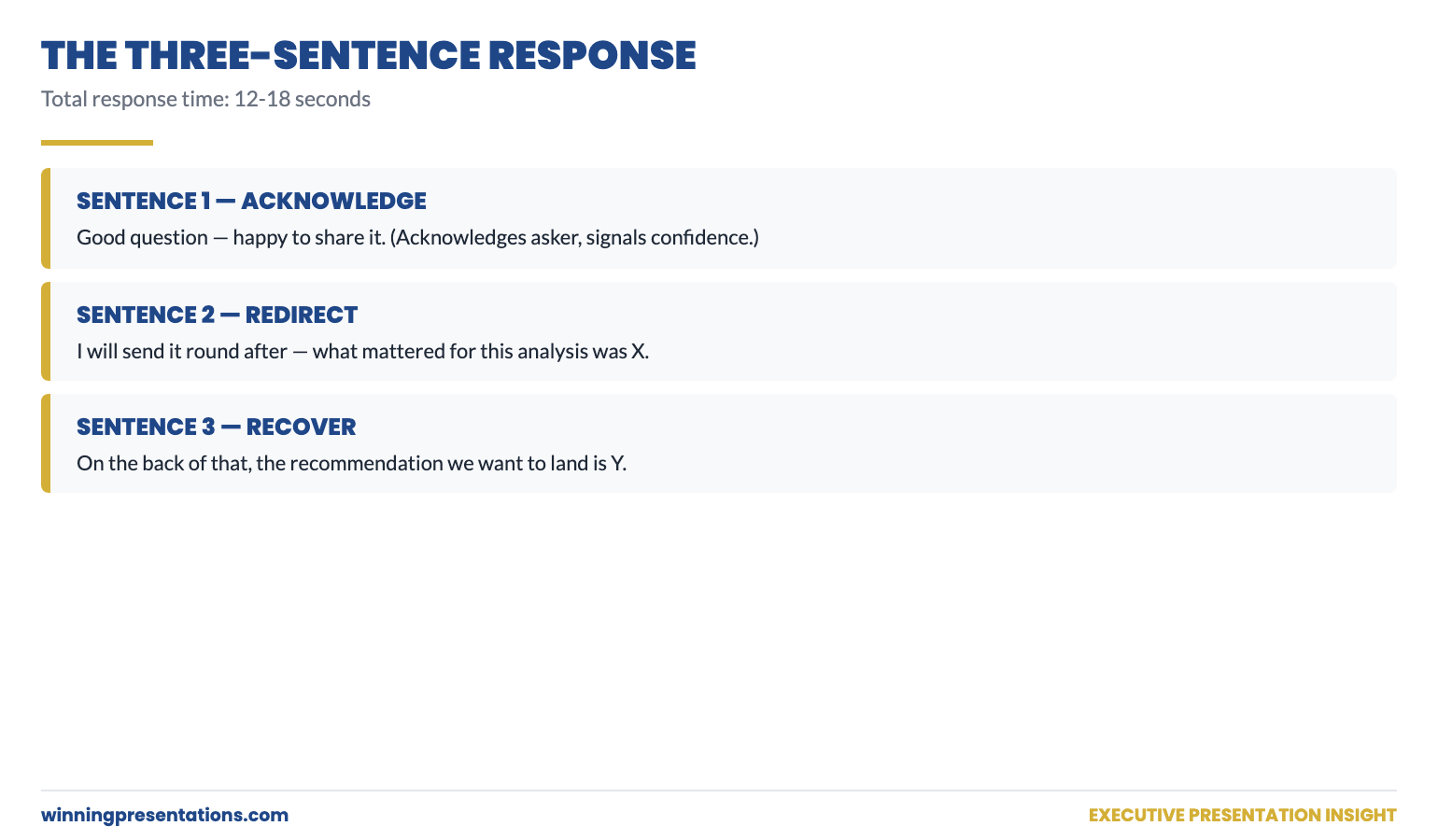
The response is short, calm, redirects the room back to the decision being made, and offers to share offline. In that order.
Sentence 1 — acknowledge. “Good question — happy to share it.” (Acknowledges the asker, signals confidence, takes 2 seconds.)
Sentence 2 — redirect. “I will send the full prompt round after the session — for now, the bit that mattered for this analysis was [one sentence describing the analytical step the prompt produced — not the prompt itself].” (Returns the room’s attention to the analysis. The asker gets confirmation they will get the prompt; the room gets confirmation that you understand what the prompt produced, which is what they actually care about.)
Sentence 3 — recover the agenda. “On the back of that segmentation, the recommendation we want to land in the next 10 minutes is [primary recommendation].” (Closes the side conversation and re-opens the main conversation. The room follows you back.)
Total: 12–18 seconds. Nobody is left feeling brushed off. The asker has a clear path to what they wanted. The agenda is back on track. And the room has watched you handle an unexpected question with the calm of someone who understands the analysis well enough not to need the prompt in front of them.
Three things never to do when this question lands
Mistake 1: trying to recall the prompt aloud. If you remember the exact wording, fine. If you do not, do not try to reconstruct it on the fly. Every “I think it was something like…” erodes the room’s confidence further than just saying “I will send it round.” Improvising a prompt out loud is a low-upside, high-downside move.
Mistake 2: deflecting to a colleague. “Actually, my analyst built that — Priya, do you want to take this?” might feel collaborative but reads to the room as confirmation that the analysis is not really yours. There are situations where shared credit is the right move, but a mid-presentation interruption is not one of them. Take the question yourself. Share credit later, in writing, where it lands properly.
Mistake 3: getting defensive about the question itself. “Why are you asking that?” or “Is there a particular concern?” makes the room aware there might be a concern. The fastest way to make a status-check question land harder is to react as if it landed hard. Treat both versions of the question as genuine interest — your tone alone determines whether the room reads it as a friendly exchange or an awkward moment.
A structured way through every question that knocks executives off course
“Can you show me that prompt?” is one of a growing family of AI-era questions that did not exist five years ago. The Executive Q&A Handling System is the structured framework for the full range of board-level questions — including the newer ones that catch senior presenters out.
- Frameworks for the question patterns that most reliably destabilise executive presenters
- The 45-second response structure for tough questions where you need authority and brevity
- Pre-meeting preparation tools for anticipating and rehearsing hostile or awkward questions
- £39, instant access, lifetime access
Get the Executive Q&A Handling System — £39 →
Built for senior professionals who present to boards and executive committees.
Pre-meeting preparation: the prompt-card you bring with you
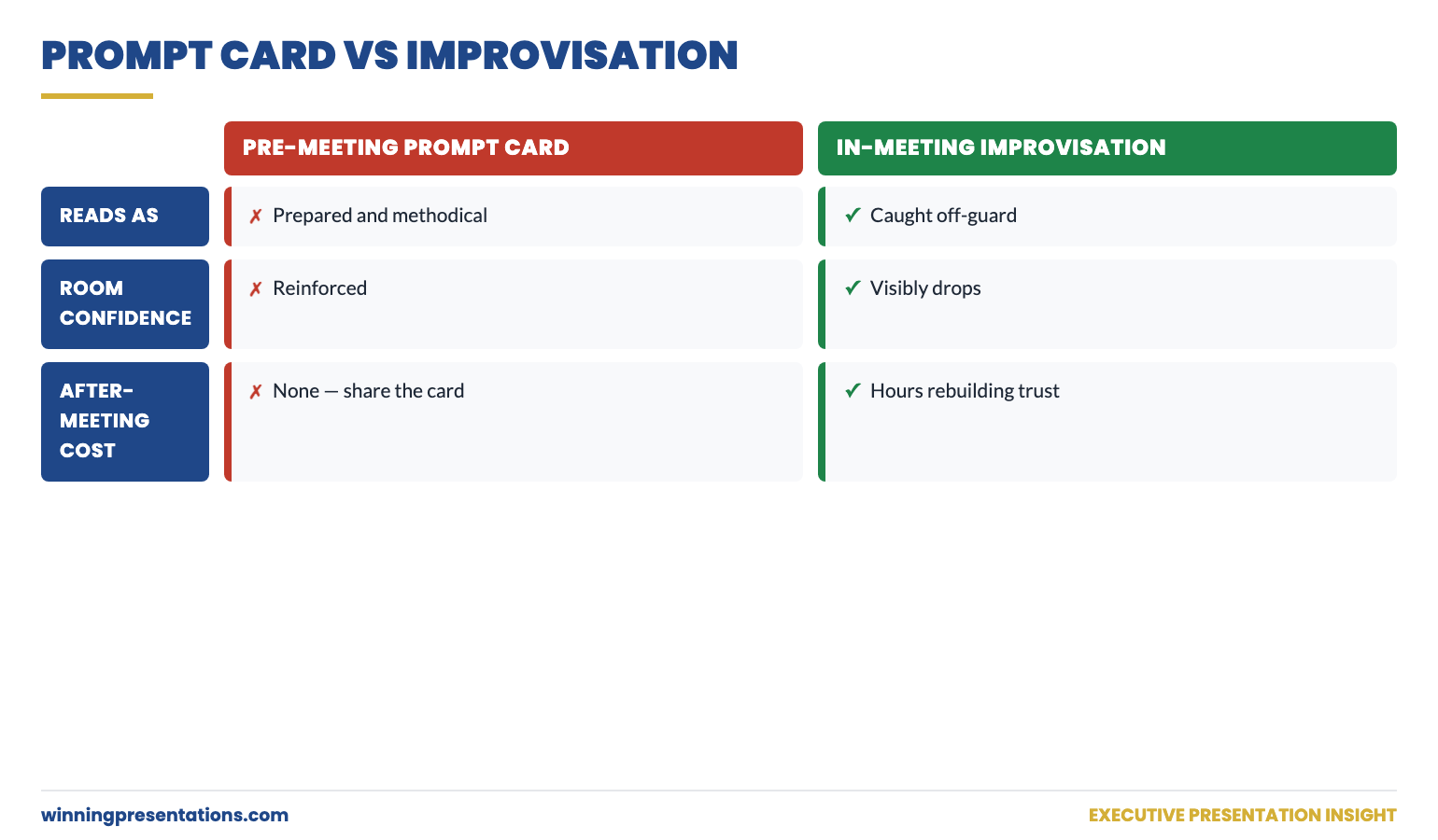
The cleanest way to handle this question is to have prepared for it before the meeting. Not by memorising prompts, but by carrying a one-page document that lists every prompt you used to build the analysis, with the analytical purpose of each prompt next to it. Print it. Bring it.
If the question lands, you can pause briefly, glance at the card, and reference the relevant prompt with a level of accuracy that no one would remember from memory. The room reads the glance not as “you forgot” but as “you brought the working.” The implicit message is that you have been doing this work seriously and methodically — which is the message you want the room to receive.
The prompt-card has a second use. After the meeting, you can hand it to the colleague who asked. They get more than they actually wanted — every prompt, with its purpose. You get the credit for being prepared, organised, and willing to share your method. The interaction that started as a status check ends as a goodwill exchange.
The follow-up that turns the question into a relationship asset
Within 24 hours of the meeting, send the prompt to the asker — by email or chat, with a short note. Two sentences are enough. “Here is the prompt I used for the segmentation step we discussed yesterday. Happy to walk you through how I iterated on it if useful — drop me a line.” That is it.
The follow-up does three things. It honours the commitment you made in the meeting. It opens a relationship channel with someone who clearly cares about how the work is done. And — most importantly — it frames you as the kind of senior leader who shares method generously, which is exactly the read you want the rest of the room to take from any version of “can you show me that prompt?”
Done well, this question becomes one of the easiest opportunities you get all week to model executive composure under unexpected scrutiny. Done badly, it becomes the moment the room starts wondering. The framework is small. The repetition matters. Practice the three-sentence response out loud, alone, until it lands without effort.
For executives who are increasingly building presentations with AI assistance and want to be ready for the full spectrum of related questions, the practical primer on how to make Copilot prompts produce executive-grade output is a useful companion piece — most of the questions that arise in the room are easier to handle when the underlying work is genuinely yours and genuinely strong.
For the broader set of board-level question handling — beyond AI-specific questions — the foundational article on handling difficult questions in executive presentations covers the wider response patterns that this article specialises.
Be ready for the full range of board-room questions
The Executive Q&A Handling System — frameworks for the questions that most reliably catch senior presenters out. £39, instant access, lifetime access.
Get the Executive Q&A Handling System →
Designed for senior professionals presenting to boards and executive committees.
Want sharper Copilot prompts to share when you do?
If colleagues are asking to see your prompts, the answer is more useful when the prompts are genuinely good. The Executive Prompt Pack contains 71 ChatGPT and Copilot prompts written for senior-level presentation work — the kind worth sharing.
FAQ
What if the asker keeps pushing for the prompt right then in the room?
Hold the line. “I want to do it justice — I will send the full prompt with the working after the session, and we can pick it up there.” Said calmly, this is the senior response. The room reads persistence after a clear redirect as the asker’s problem, not yours.
What if I genuinely cannot remember the analytical purpose of the prompt either?
Then there is a deeper problem than the question itself — you do not own the analysis well enough to be presenting it. In that situation the safest move is to acknowledge it directly: “Honestly, my team led on the prompt design — let me get you the full method after this.” The room respects honesty about provenance. It does not respect bluffing.
Should I share the prompt with the whole room, or only the asker?
With the whole room — and frame it as such: “I will send the prompt round to everyone after the session.” This costs you nothing, removes any lingering perception that you are guarding something, and turns the prompt into a shared resource rather than a private one.
Does this same response work for “what tool did you use?” or “did you use AI for this?”
The structure works; the words shift. “What tool did you use?” — answer briefly, then redirect to the analysis. “Did you use AI for this?” — answer honestly (“yes, Copilot built the first draft and I edited”), then redirect. The principle is the same: short answer, redirect to the substance, recover the agenda.
Get The Winning Edge — weekly
One sharp, story-led idea every Thursday on executive presentation craft, the questions that reliably catch senior presenters out, and the small habits that change how senior audiences receive you.
If you want a primer on the structures that hold any executive presentation together — including the Q&A section — download the free 7 Presentation Frameworks Quick Reference Card.
Practice the three-sentence response out loud tonight. Once. Twice. Three times. The next time the question lands in a meeting, you will hear yourself give the answer before you have consciously chosen to.
About the author. Mary Beth Hazeldine is Owner & Managing Director of Winning Presentations Ltd, founded 1990. With 24 years of corporate banking experience at JPMorgan Chase, PwC, Royal Bank of Scotland, and Commerzbank, she advises executives across financial services, healthcare, technology, and government on structuring presentations for high-stakes funding rounds and approvals.