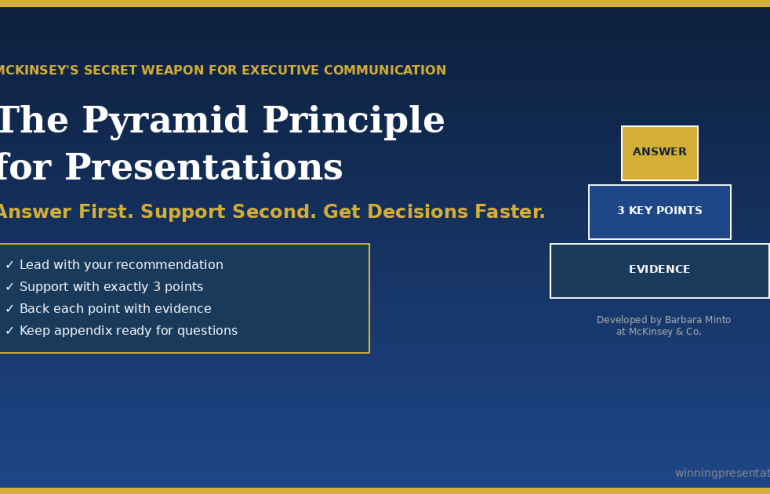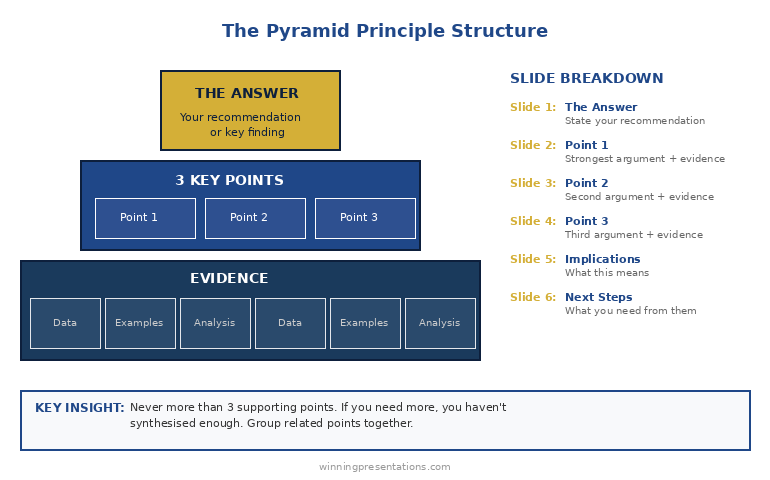
Quick answer: The summary slide is the one slide a senior audience is guaranteed to read, because it is the slide they will use to decide whether to keep listening. Most presenters write it first, before they know what they are actually recommending, so it ends up as a table of contents — a list of what the deck contains rather than what the deck concludes. Build it last instead, once the analysis is done and you finally know the answer, and write it as an answer-first summary: the recommendation in one line, the two or three reasons it holds, and the specific decision you are asking for. Then put that slide first. To check it works, run the thirty-second test — hand the summary slide alone to a colleague, give them half a minute, and ask them to tell you back what you want and why. If they can, the rest of the deck is support. If they cannot, you have not finished the slide.
JUMP TO:
In 2011 I watched a marketing director present the conclusion of a six-month pricing review to a strategy committee. He had done genuinely good work, and he wanted the committee to see all of it. So he started at the beginning: the market context, the competitor scan, the customer research, the segmentation, the elasticity modelling. Slide after slide of careful build, each one earned. His recommendation — a restructure of the entire pricing tier system — sat on slide twenty-three. The trouble was that the committee chair, a woman who had sat through several hundred of these, opened the printed pack the moment he started speaking, turned to the last few pages looking for the recommendation, did not immediately find it stated plainly, and then spent the next twenty minutes asking questions that the deck would eventually have answered — if she had been willing to wait for slide twenty-three. She was not. By the time he reached it, the committee had formed three separate half-views from fragments, and the meeting had become a negotiation between those fragments rather than a hearing of his actual case. The recommendation was sound. It was deferred anyway, for ‘a clearer version’.
What the chair wanted was on a slide he had not built: a single slide that said, before anything else, what he was recommending, why, and what he needed her committee to decide. He had a summary slide — it was slide two — but it was a contents page. It listed the sections of the deck: ‘Market context. Competitive position. Customer research. Pricing options. Recommendation. Next steps.’ It told the room what was coming. It did not tell the room anything. And it could not have, because he had written it at the start, before the analysis was finished, when he himself did not yet know what the deck would conclude.
(This article was created with AI assistance; all stories and insights are based on 35 years of real client work.)
That is the core mistake, and it is almost universal: the summary is written first, so it summarises the plan rather than the findings. The fix is small to describe and surprisingly hard to do — build the summary slide last, after you know the answer, and write it as an answer-first summary. Then open with it. It is the single highest-leverage change most senior presenters can make to a deck, and it costs nothing but the discipline to write one slide at the end instead of the beginning.
If your recommendation keeps arriving too late in the deck for a busy room to wait for it:
The Executive Slide System ships 26 executive templates built around the way senior audiences actually read — including a recommendation-first opening layout that gives the answer-first summary a slide of its own, with room for the one-line recommendation, the supporting reasons, and the decision being asked for. It also includes 93 AI prompts for compressing a finished analysis down to its load-bearing conclusion, and 16 scenario playbooks covering board approvals, strategy reviews, and investment committees. You stop hoping the room reaches your conclusion in time and start handing it to them on the first slide.
Why the first-written summary fails
The summary slide written at the start of the process is doomed by its timing, not its author. When you build a deck, the natural order is to assemble the evidence first and let the conclusion emerge from it. That is good analysis. But it means that on day one, when you create the title slide and the summary slide as a frame for the work ahead, you do not yet have a conclusion to summarise. So you summarise the only thing you have: the structure of the work. You write a contents page and call it a summary. And because it sits at the front of the deck and never gets revisited — who goes back to rewrite slide two once the analysis is done? — it ships exactly as it was: a list of sections that tells the room nothing it could act on.
This matters more at senior levels than anywhere else, because of how senior people read. A junior audience reads a deck the way you built it, front to back, willing to follow the argument to its conclusion. A senior audience reads a deck the way it reads a contract: conclusion first, then back to the clauses that matter. The chair in my 2011 meeting was not being rude when she flipped to the back of the pack. She was doing what experienced decision-makers always do — looking for the answer so she could spend her attention testing it, rather than spend it waiting to find out what it was. When she could not find the answer stated plainly, she did not switch to patient mode. She started reconstructing the answer from fragments, out loud, in the form of questions, and the presenter lost control of his own meeting before he reached slide ten.
There is a second cost, subtler and more expensive. A deck that withholds its conclusion reads as a deck that is not sure of its conclusion. When you make a room wait twenty-two slides for the recommendation, the room does not experience suspense; it experiences doubt. It starts to wonder whether you are building toward a strong answer or hoping to assemble enough evidence that some answer becomes defensible. Leading with the recommendation signals the opposite: I know what I think, I am putting it in front of you first, and I am inviting you to test it. That confidence is itself persuasive, and it is the same instinct behind saying the number out loud before you show the chart — you lead with the thing the room most wants, rather than making it wait while you build to it.
Open every deck with a slide that states your answer, so the room spends its attention testing your case instead of reconstructing it.
The Executive Slide System gives you a recommendation-first deck structure as a starting point, not a blank page: an answer-first summary layout, a signposted body where every section tells the room where it is, and a close that restates the ask. It ships 26 executive templates, 93 AI prompts for turning a finished analysis into a one-line recommendation and its supporting reasons, 16 scenario playbooks covering board approval, strategy review, and investment committee, plus 7 checklists. Built for senior presenters who take a real decision to a real room more than once a quarter. £39, instant download, lifetime access.
- 26 executive templates — including a recommendation-first opening built to carry the whole argument on one slide
- 93 AI prompts — for compressing a six-month analysis down to its load-bearing conclusion and reasons
- 16 scenario playbooks — board approval, strategy review, investment committee, finance review
- 7 checklists — including a pre-flight pass that tests whether your first slide states the answer
The answer-first summary
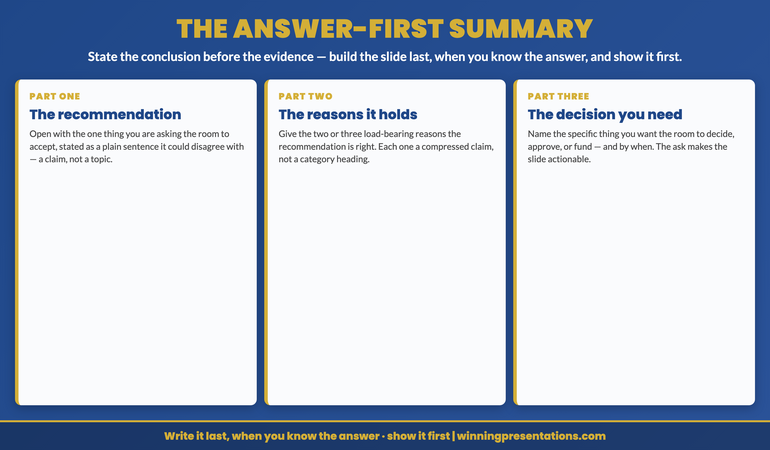
An answer-first summary slide has three parts, and the order is the whole point. First, the recommendation, stated as a single plain sentence. Not a topic — a claim. ‘We should consolidate the three regional pricing tiers into one, taking effect from the next financial year.’ Not ‘Pricing structure options’. The test of this line is whether someone could disagree with it. A topic cannot be disagreed with; only a claim can. If your opening line is something the room could not possibly argue against, it is a heading, not a recommendation, and it is doing no work.
Second, the reasons it holds — two or three, no more. These are the load-bearing supports, the points that, if the room accepted them, would make the recommendation follow almost automatically. ‘Because the current three tiers cost more to administer than they generate in differentiation; because customers consistently misread which tier they are in; and because a single tier lets us move price once a year instead of negotiating three.’ Each reason is itself a claim, compressed. The discipline of choosing only two or three forces you to decide what your case actually rests on, which is exactly the thing a contents-page summary lets you avoid. A presenter who lists six reasons has not done the work of finding the two that matter; he has handed the room the work of sorting them.
Third, the decision you need. This is the part presenters most often leave off the summary slide, and its absence is why so many good presentations end with a room that nods, thanks you, and decides nothing. State the specific thing you are asking for: ‘We are asking the committee to approve the move to a single tier and the £1.2m implementation budget, with a decision today so we can hit the financial-year start.’ The ask makes the slide actionable. Without it, the summary is an interesting position; with it, it is a request the room has to respond to. This is the bridge into the companion discipline of making the decision you want explicit rather than implied — the summary names it, and the close returns to it.
Written this way, the summary slide carries the entire argument in miniature. A reader who saw only that slide would know what you want, why, and what you need from them — which is precisely the position you want a senior reader to be in when they decide whether to keep listening. The rest of the deck does not introduce the argument; it defends it. Every subsequent section is the evidence behind one of the reasons, and the room can choose which reason to interrogate because it can see all three from the start. You have turned a linear deck the room must endure into a structured case the room can navigate. The reason this is hard is not that the structure is complicated. It is that you can only write this slide once the analysis is finished and you genuinely know the answer — which is why it has to be built last.
When the hard part is compressing a mass of analysis down to the one line that carries it:
Turning a finished, sprawling analysis into a single defensible recommendation is exactly the skill AI tools can accelerate — if you know how to direct them. The AI-Enhanced Presentation Mastery course is a self-paced programme of 8 modules and 83 lessons for senior professionals using AI to structure, draft, and pressure-test executive presentations, including the prompt and workflow patterns for distilling a recommendation from a wall of evidence. It runs at your own pace with monthly cohort enrolment and 2 optional live coaching sessions, both fully recorded so you can watch back anytime. Lifetime access to materials. £499.
The thirty-second test
A summary slide can look complete and still fail, because the author is the worst possible judge of whether it communicates. You know what you mean, so the slide always reads clearly to you. The only way to find out whether it reads clearly to a stranger is to give it to one. That is the thirty-second test, and it is the diagnostic that separates a summary slide that works from one that merely exists.
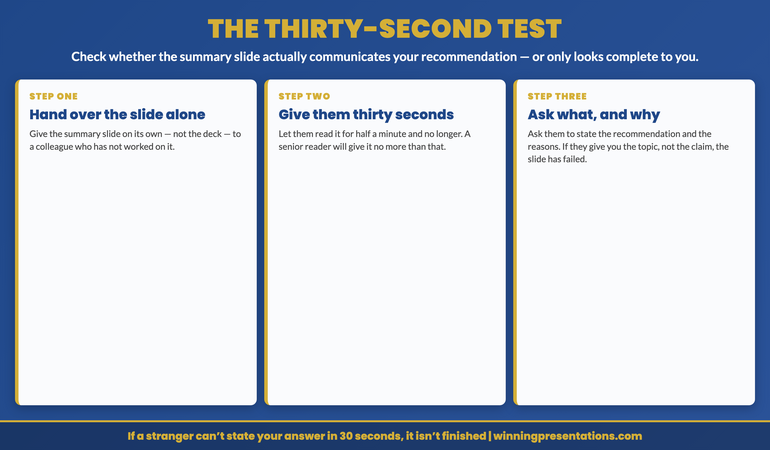
Take the summary slide on its own — not the deck, just the one slide — and hand it to a colleague who has not been involved in the work. Give them thirty seconds to read it. Then take it back and ask them two questions: what am I recommending, and why? If they can tell you, in their own words, the recommendation and the reasons behind it, the slide is doing its job and the rest of the deck is support. If they hesitate, or give you the topic instead of the claim — ‘something about pricing tiers’ — the slide has failed the test, and it would have failed in the room too, except that in the room the person failing it would have been the one deciding your proposal. The thirty seconds matters: a summary slide that needs two minutes of study is not a summary, it is another content slide, and a senior reader will give it thirty seconds at most.
I ran this with a head of operations in 2018 who was preparing to take a supply-chain restructuring to her board. Her summary slide was dense and proud — nine bullet points, three small charts, the entire programme on one page. I asked a colleague to read it for thirty seconds and tell us what she was recommending. He could not. He could see that it was about the supply chain, and that there was a lot of it, but he could not state the recommendation, because the recommendation was the fourth bullet, sandwiched between two findings and a risk. We rebuilt the slide answer-first: one line of recommendation at the top — consolidate from four distribution centres to two — three reasons beneath it, and the ask at the bottom. We deleted the charts; they belonged in the body. The new slide had perhaps a quarter of the content. The same colleague read it and answered both questions in one breath. At the board, the chair read the slide, looked up, and said ‘so this is a four-to-two consolidation question’ — which was exactly the frame she wanted. The board spent its time on the two-versus-three debate that actually mattered, rather than on working out what the proposal was. It approved that afternoon. For the high-stakes decks where the cost of a deferred decision is measured in quarters, the executive presentation coaching work uses the thirty-second test as a standard checkpoint before any deck is considered finished.
Buy the structure once and open every future deck from a layout that already puts the answer first. No subscription, nothing to renew.
The Executive Slide System is a one-time £39 with lifetime access — 26 templates, 93 AI prompts, 16 scenario playbooks, 7 checklists. There is nothing to track and nothing to renew; you buy it once and every future board deck starts from a recommendation-first opening rather than a blank slide that quietly turns into a contents page. Built for the senior presenter who would rather state the answer on slide one than make a busy room wait for slide twenty-three. The pre-flight checklist alone will catch the contents-page summary before it ever reaches the room.
Frequently asked questions
If I give away the recommendation on the first slide, why would the room sit through the rest of the deck?
Because the room is not sitting through the deck to find out the recommendation — it is there to decide whether the recommendation is sound. Stating the answer first does not remove the reason to keep listening; it sharpens it. A senior audience that knows your conclusion from slide one spends the rest of the presentation testing your reasoning, which is exactly the engagement you want, rather than passively waiting to learn what you think. The decks that lose the room are not the ones that reveal the answer early; they are the ones that withhold it, because a room that does not know where you are heading cannot follow you there. Suspense is for thrillers. A decision-maker wants the ending on page one.
Doesn’t building the summary slide last mean I cannot start the deck until everything else is finished?
You can sketch a placeholder summary at the start — that is useful as a working hypothesis to aim at. The rule is not that you never touch the summary until the end; it is that the version you present is written last, after the analysis is done, so it summarises what you found rather than what you planned to look at. In practice this means treating your early summary as a draft to be overwritten, not a slide to be preserved. Most failed summary slides are simply the day-one draft that nobody went back to rewrite once the work changed the answer. Build a rough one to steer by, then replace it entirely when you know what you are actually recommending.
What if the analysis is genuinely complex and cannot be reduced to one recommendation and three reasons?
Complexity is the reason for the discipline, not an exception to it. The more complex the analysis, the more a senior room needs you to tell it where the complexity lands — what, on balance, it should do. If you truly cannot state a single recommendation, that is usually a sign the work is not finished, or that you are presenting a decision that has genuine sub-parts, in which case each sub-part gets its own answer-first treatment. What does not work is offering the room the full complexity and asking it to find the answer inside. That is delegating your job to the audience, and a board will either decline the work and defer, or do it badly and decide on a fragment. Your value is the compression. If the answer were obvious from the evidence, they would not need you to present it.
Does this apply to an informational update, or only to a decision presentation?
It applies to both, with a change of emphasis. A decision presentation leads with the recommendation and the ask. An informational update leads with the headline — the single most important thing the audience needs to take away — and then supports it. The failure mode is identical in each case: opening with a contents page rather than the point. Even an update that asks for no decision should start by telling the room the one thing that has changed and why it matters, not by listing the sections of the briefing. If your update has no single headline, it may not need to be a presentation at all; it may be a document the room can read in its own time.
The Winning Edge — weekly newsletter
The Winning Edge is a weekly newsletter for senior professionals who present at the executive level. One short email a week on the structural moves that separate proposals a room approves from proposals it defers for ‘a clearer version’. Subscribe to The Winning Edge →
For the wider library of presentation assets senior leaders draw on — slide system, storytelling primer, Q&A taxonomy, delivery references — the complete presenter library (£99) bundles seven products plus three bundle-only bonuses, worth over £190, covering slides, storytelling, confidence, and delivery in one place. See the wider board-readiness work on the services page, and the companion article on turning a data dump into a recommendation.
About the author
Mary Beth Hazeldine is Owner & Managing Director of Winning Presentations Ltd. With 24 years of corporate banking experience at JPMorgan Chase, PwC, Royal Bank of Scotland, and Commerzbank, she advises executives across financial services, healthcare, technology, and government on structuring presentations for high-stakes funding rounds, board approvals, and strategic decisions.
The next time you finish a deck, do not ship the summary slide you wrote on day one. Build a new one last, now that you know the answer: the recommendation in a sentence the room could argue with, the two or three reasons it holds, and the decision you need from them. Then hand that slide alone to someone who was not in the room, give them thirty seconds, and ask them what you want and why. When they can tell you back in one breath, put the slide first — and the chair who flips to the back of the pack will find, this time, that the answer was already on the page in front of her. Write the summary last, when you know what you are recommending, and show it first.