

Quick answer: Copilot produces “corporate mush” — the bland, hedged, generically optimistic prose that reads like a transformation deck from 2018 — because the prompt has not given it enough context to write specifically. The fix is context-stacking: layering five pieces of information into a single prompt before you ask for output. Audience, decision being made, what you have already tried, what to avoid, and the precise format you want back. Skip any layer and Copilot fills the gap with mush.
In this article
- What “corporate mush” actually sounds like (and why senior readers spot it instantly)
- The five layers of context that fix the output
- A worked example: the same request, with and without context-stacking
- The one-paragraph shortcut for time-pressed executives
- How to refine the output without starting over
- FAQ
Mei runs the European product portfolio for a global pharmaceuticals company. She had a board strategy session coming up — a 25-minute slot to present three portfolio scenarios and recommend one. She fed Copilot a clean prompt: “Help me write a board presentation on three portfolio scenarios for our European business, and recommend the strongest one.” Copilot produced eleven slides of what her chief of staff later called “corporate mush”: directional headlines, hedged conclusions, three nearly identical scenarios written in identical voice, and a recommendation that read like all three had been picked.
Mei asked again, more specifically. The output got slightly less mushy. She asked again. It improved marginally. By the fifth iteration she had spent forty minutes and had something she could not use without a complete rewrite.
She had not done anything wrong with Copilot. She had simply skipped the step that separates AI drafts that need light editing from AI drafts that need rewriting. That step is context-stacking — and it is closer to writing a brief than writing a prompt.
If you want a structured starting point
The Executive Prompt Pack contains 71 ChatGPT and Copilot prompts written specifically for senior-level presentation work — every prompt is structured around the context layers described in this article, so you skip the briefing step and go straight to usable output.
What “corporate mush” actually sounds like (and why senior readers spot it instantly)
Corporate mush has identifiable markers. Sentences that begin with “in today’s rapidly evolving landscape.” Verbs like “leverage,” “unlock,” “drive,” and “empower” appearing within three sentences of each other. Conclusions phrased as “this presents a unique opportunity to…” Recommendations hedged with “could potentially” and “may consider exploring.” Section transitions using the words “moreover” and “furthermore.” Slide headlines that are categories rather than statements (“Strategic Considerations” rather than “Scenario B is the only one that protects margin in 2027”).
Senior readers do not spot mush by analysing it. They feel it. The voice signals “this was written for nobody in particular” — and the entire slide deck loses authority within the first 30 seconds of reading. This is true even when the underlying content is correct. The voice carries a credibility tax.
Mush happens because Copilot is solving an impossible problem: produce a presentation for an unspecified audience, in an unspecified industry, addressing an unspecified decision, in an unspecified voice. When all four variables are blank, Copilot pattern-matches on the average corporate presentation it has been trained on. That average is mush.
The five layers of context that fix the output
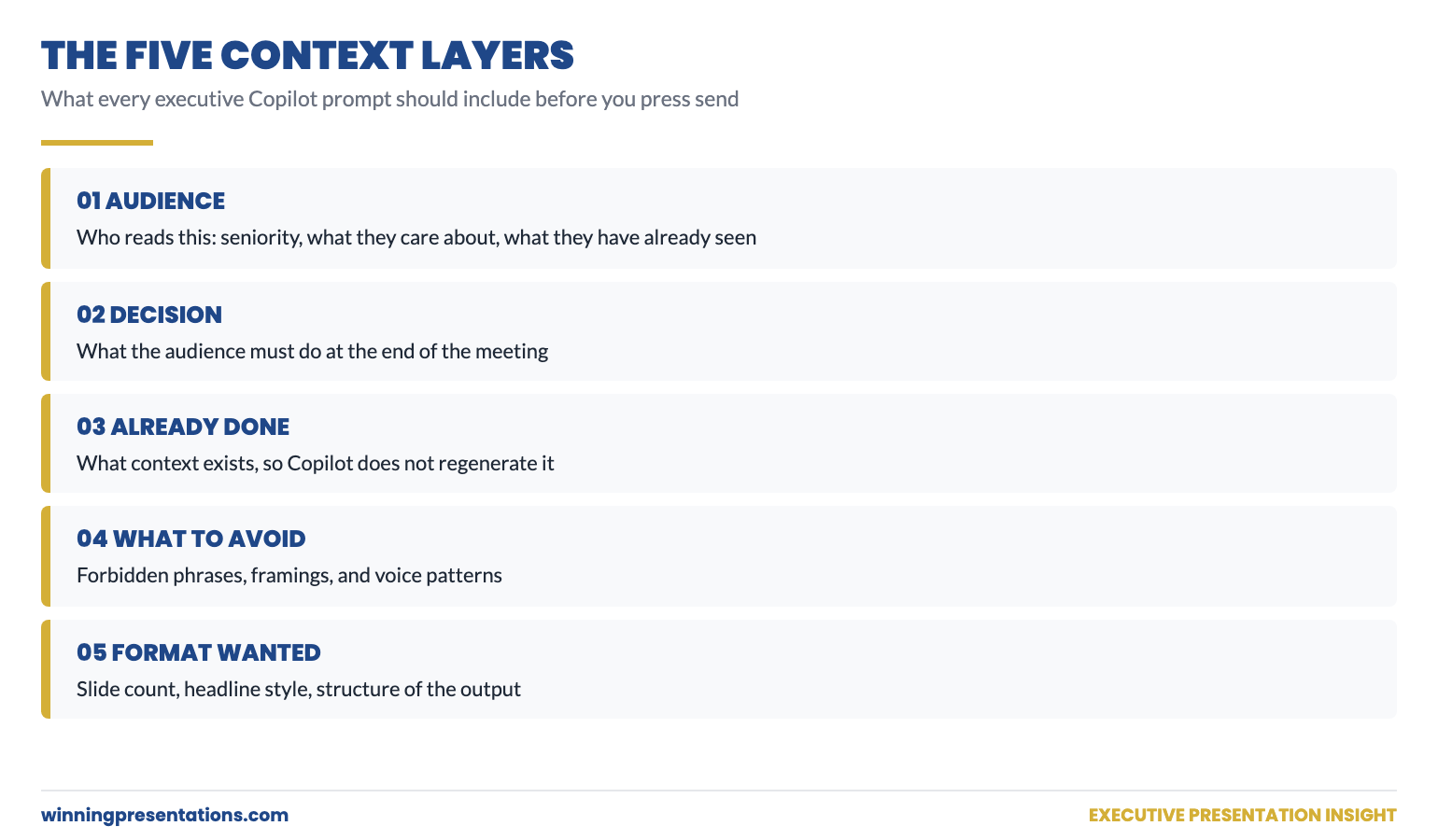
Context-stacking means writing your prompt so that five specific layers are present before you ask for any output. Each layer answers a question Copilot would otherwise have to guess.
Layer 1: Audience
Who specifically will read or hear this? Job titles, seniority, what they already know, what they care about, what they have heard a hundred times before. “I am presenting to the global executive committee — eight people, average 22 years in pharma, all of whom have seen at least three portfolio strategy decks already this year. They are sceptical of strategy frameworks and want financial impact in the first slide.”
Layer 2: Decision being made
What does the audience need to do at the end of the presentation? Approve a budget? Pick between options? Sign off on a timeline? Sponsor a programme? “They need to choose one of three portfolio scenarios for 2026–28 capital allocation, by the end of this 25-minute session.” When the decision is named, every slide can be assessed against whether it helps make that decision.
Layer 3: What has already been tried (or already exists)
This layer prevents Copilot from regenerating things you have already done. “We have already presented the high-level strategy in March; this is the deeper portfolio cut. Do not repeat the strategic context — assume the audience knows it.” Without this, Copilot reinvents the wheel and you waste slides on context the room already has.
Layer 4: What to avoid
Negative constraints. Voice you do not want, phrases you have heard too often, framings you know will fail in this room. “Avoid: any reference to ‘unlocking value’, ‘transformation’, or ‘agile portfolios’. The CFO has banned all three from the strategy vocabulary. Do not hedge conclusions — recommend one scenario and defend it.” Negative constraints work because they remove the safe-default language Copilot otherwise gravitates toward.
Layer 5: Format and output structure
Exactly what you want back. Slide count, headline style, where to put the recommendation, whether to include speaker notes, whether to give you alternatives. “Give me 9 slides. Slide 1: the recommendation. Slides 2–4: scenario A, B, C with three bullets each. Slides 5–7: financial impact comparison. Slide 8: risks. Slide 9: ask. Headlines must be statements, not categories. No speaker notes.” Format-as-a-constraint produces dramatically tighter output than asking for “a presentation.”
A worked example: the same request, with and without context-stacking
Take Mei’s original prompt: “Help me write a board presentation on three portfolio scenarios for our European business, and recommend the strongest one.”
Copilot produces a generic 11-slide deck. Headlines like “Strategic Portfolio Considerations” and “Path Forward”. Three scenarios written in identical voice. Recommendation hedged. The whole thing reads as written for “any board” rather than her board.
Now the context-stacked version of the same request:
“Audience: Global executive committee, 8 people, all 20+ years in pharma. They have seen our March strategy deck already. They are sceptical of frameworks and want financial impact early.
Decision: They need to pick one of three European portfolio scenarios for 2026–28 capital allocation, in this 25-minute session.
Already done: March strategy deck covered the rationale for refocusing on Europe. Do not repeat strategic context.
Avoid: Words like ‘leverage’, ‘transformation’, ‘unlock’, ‘journey’. Avoid hedging — recommend Scenario B and defend it. The CFO will reject any deck that does not include 2026 EBIT impact on slide 1.
Format: 9 slides. Slide 1 — recommendation and 2026 EBIT impact. Slides 2–4 — three scenarios in identical structure (definition, financial impact, risk). Slides 5–7 — comparison: EBIT impact, capital intensity, regulatory risk. Slide 8 — what we are betting on if Scenario B is chosen. Slide 9 — the ask. Headlines must be assertions, not categories. No speaker notes.”
The output from the second prompt is unrecognisable from the first. Statement headlines (“Scenario B delivers £180m EBIT in 2026 against £140m and £95m”). Specific framings. A recommendation that defends itself. The deck still needs editorial review — Copilot’s numbers should always be checked against a trusted source — but the voice and structure are 80% of the way to where they need to be.
The difference is not Copilot. The difference is the brief.
Skip the briefing step — start from prompts already structured for executive work
Building a context-stacked prompt from scratch every time takes 5–10 minutes per request. The Executive Prompt Pack gives you 71 prompts already structured around the five context layers — for board updates, capital cases, change proposals, Q&A prep, and pitch decks.
- 71 prompts spanning the most common senior-level presentation scenarios
- Every prompt structured around audience, decision, constraints, and output format
- Ready-to-paste — adapt the audience and decision lines, send
- Instant download, lifetime access, £19.99
Get the Executive Prompt Pack — £19.99 →
Designed for senior professionals across financial services, technology, and consulting.
The one-paragraph shortcut for time-pressed executives
If you do not have time to write five distinct layers, write a single paragraph that contains all five answers in any order. Copilot reads them. Example for a budget presentation:
“I need a 6-slide budget approval deck for our 9-person investment committee. They are time-poor, they have already seen the strategy, and they have rejected our last two CapEx requests for being too vague. They need to approve £4.2m for IT infrastructure modernisation. Avoid ‘transformation’, avoid ‘unlock value’, and do not hedge the ROI. Slide 1 — the ask and 36-month payback. Slides 2–3 — what the £4.2m buys. Slide 4 — the risk of not investing. Slide 5 — milestones. Slide 6 — decision needed today. Statement headlines, no bullet lists in slide titles.”
That paragraph contains all five context layers. It takes 90 seconds to write. The output it produces is 10× more useful than a one-line request — and the saved editing time more than repays the upfront briefing time.
How to refine the output without starting over
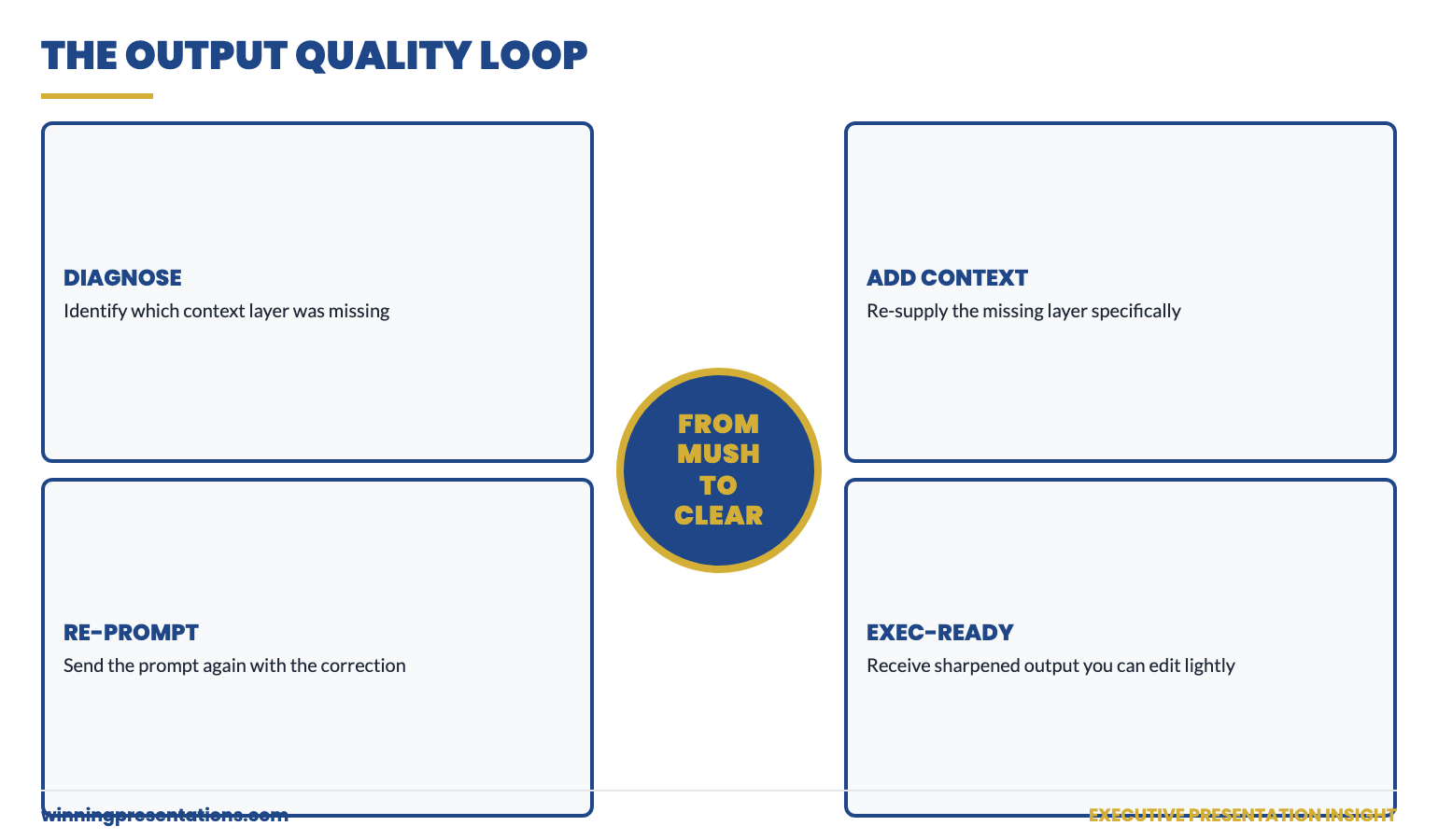
Even with full context-stacking, the first draft will not be perfect. The mistake most senior users make is to start a fresh prompt from scratch. This loses all the context Copilot has just built up. The better move is to refine the existing draft in the same conversation.
Three refinement patterns that work:
Pattern 1 — voice surgery. “Slide 4 reads as defensive. Rewrite it as a confident assertion of why the risk is acceptable. Same content, different posture.” This works because Copilot already has the slide content; you are only adjusting the voice.
Pattern 2 — structural adjustment. “Move the financial impact from slide 5 to slide 2. Shorten the strategy context on slides 2–3 to fit on a single slide.” Copilot will rebuild the deck around the structural change without reinventing the content.
Pattern 3 — comparative iteration. “Give me three alternative versions of slide 1 — one that leads with the 2026 EBIT number, one that leads with the recommendation, one that leads with the question the committee needs to answer. I will pick one.” Comparative options force Copilot out of its default phrasing and surface the version most likely to land.
The pairing that produces the strongest output is context-stacked initial prompt plus disciplined refinement. Both halves matter. The brief gets you to a usable first draft; the refinement gets you to the version you take into the room. For a deeper look at the settings-side fix that complements this prompt-side technique, see the partner article on Copilot custom instructions for executives.
For a complete prompt library already built around the five-layer structure described above, the Executive Prompt Pack (£19.99) is the lowest-friction starting point — 71 prompts, every one structured for senior presentation work.
The structural side of any executive deck — what goes where, what gets cut, how the recommendation lands — sits underneath every AI prompt. If your underlying structure is unclear, no amount of prompt craft will save the output. The structural conventions of a strong board presentation are worth a separate read.
Stop building each prompt from scratch
71 ready-to-paste prompts for senior-level presentation work, every one structured around the five context layers in this article. £19.99, instant download, lifetime access.
Get the Executive Prompt Pack →
Built for board updates, capital cases, change proposals, and pitch decks.
FAQ
Why does Copilot keep using words I have told it to avoid?
Two common reasons. Either the forbidden phrases are in your standing custom instructions but the conversation has overridden them through subsequent prompts, or you are using a Copilot surface where custom instructions are not active. Re-state the avoided phrases at the top of any prompt where it matters — the latest instruction wins.
Should I include numbers in my context layer, or save them for refinement?
Include the numbers in the context. If you tell Copilot the EBIT impact is £180m, the recommendation is for Scenario B, and the budget request is £4.2m up front, the draft will be built around your real figures. If you withhold them, Copilot inserts placeholder numbers that you then have to remember to overwrite — and the placeholders sometimes get missed in the final read-through.
How long should a context-stacked prompt be?
For a substantial executive deck, 200–400 words. Shorter than that and you are skipping layers; longer than that and you are writing the deck yourself. The right length is whatever it takes to specify audience, decision, constraints, and format clearly enough that someone else could produce the deck from your brief alone.
Does context-stacking work for shorter outputs like emails or one-page summaries?
Yes. The five layers compress proportionally. For a board pre-read email, you might write three sentences of context: “Audience is the chair, who has not seen the proposal. Decision is whether to take it to full board next month. Avoid jargon — the chair was an operations leader, not a strategist. Keep to under 200 words.” That is context-stacking applied to a short output.
Get The Winning Edge — weekly
One sharp, story-led idea every Thursday on executive presentation craft, AI workflows, and the small habits that change how senior audiences receive you.
Not ready for the full system? Start here instead: download the free Executive Presentation Checklist — a one-page reference covering the structural moves that hold any executive deck together.
The next prompt you send Copilot, before you press enter, ask yourself: have I named the audience, the decision, what already exists, what to avoid, and the exact format I want back? If any of the five is missing, that is where the mush will appear.
About the author. Mary Beth Hazeldine is Owner & Managing Director of Winning Presentations Ltd, founded 1990. With 24 years of corporate banking experience at JPMorgan Chase, PwC, Royal Bank of Scotland, and Commerzbank, she advises executives across financial services, healthcare, technology, and government on structuring presentations for high-stakes funding rounds and approvals.