

Quick answer: Useful crisis communication presentation training teaches the structural frame that holds a room when the situation has gone wrong — naming the situation cleanly without minimising or catastrophising, taking proportionate ownership without either over-apologising or deflecting, presenting the plan with the single decision the room needs to make, and closing on credibility rather than reassurance — together with the composure to hold that frame through hostile questioning. Most crisis communication training focuses instead on media-handling soundbites, holding statements, and the optics of a press conference, which are useful for an external spokesperson role and largely beside the point for the senior leader who has to stand in front of their own board, executive committee, or staff during a crisis and keep the room’s confidence. The internal crisis presentation is a buy-in problem under maximum pressure: you are asking a room that has just learned something has gone wrong to keep trusting your judgement about what happens next. The training to look for is the training that works through the structural frame and the live-pressure handling with a real scenario, a real deck, and real hostile-question rehearsal — not the training that teaches you to sound calm on camera. Self-paced programmes that build the underlying buy-in structure can substitute for much of what one-to-one crisis coaching provides, at a fraction of the cost.
JUMP TO:
- What crisis communication presentation training should actually teach
- The four-move crisis presentation frame
- Holding the frame through hostile questioning
- Why internal crisis presentations differ from media handling
- Self-study programmes versus one-to-one crisis coaching
- Choosing a programme: questions to ask before committing
- Frequently asked questions
During the market dislocation of 2008, I watched a senior leader at one of the institutions I had worked in present to a board that had just absorbed a sequence of genuinely bad news over the preceding fortnight. The room was tense in a way I had not seen before — directors who were normally measured were sharp, the chair was visibly under pressure himself, and the usual courtesies had thinned. The senior leader had been well prepared for an ordinary board presentation. He had not been prepared for this one. He opened by trying to contextualise the situation, which the room heard as minimising; a director cut across him within ninety seconds. He then over-corrected into a long acknowledgement of how serious things were, which the room heard as a senior leader losing his nerve. By the time he reached his actual plan — which was sound — the room had stopped extending him the benefit of the doubt, and the plan was received with a scepticism it did not deserve. The content was not the problem. The structural handling of a presentation under crisis conditions was the problem, and it was a different skill from the one he had spent his career developing. He had never been trained for the room that has just learned something has gone wrong, because almost no one is.
I have spent a meaningful part of the years since helping senior leaders prepare for exactly that room, and the demand for it tends to arrive in two ways. Sometimes a crisis is already unfolding and a senior leader needs to prepare for a specific high-stakes presentation in days. More often, an organisation has recognised after a near-miss that its senior people are not equipped for crisis-condition presenting and wants to build the capability before the next crisis arrives. Both are legitimate reasons to invest in crisis communication presentation training, and both are poorly served by most of what is sold under that name, because most crisis communication training was built for the external-spokesperson problem — the press conference, the holding statement, the broadcast interview — and the senior leader presenting to their own board or staff during a crisis has a different and harder job.
(This article was created with AI assistance; all stories and insights are based on 35 years of real client work.)
This piece walks through what useful crisis communication presentation training teaches, the structural frame that holds an internal room during a crisis, how to handle hostile questioning under pressure, why the internal crisis presentation differs from media handling, when self-study programmes can substitute for one-to-one coaching, and the questions worth asking any training provider before committing. The audience is senior leaders who present to boards, executive committees, staff, investors, or regulators during periods when something has gone wrong — a results miss, an operational incident, a restructuring, a regulatory finding, a sudden market shift — and who recognise that the room under those conditions cannot be handled with ordinary presentation skills.
Before paying for crisis presentation training, run the structural check on your own readiness:
The Executive Presentation Checklist covers the structural moves a high-pressure executive presentation depends on — the clean situation statement, the proportionate ownership, the decision-shaped plan, and the credibility close. Free download, no email gate. A useful first diagnostic on whether your crisis-condition presenting needs structural work or only rehearsal.
What crisis communication presentation training should actually teach
Useful crisis communication presentation training teaches two things that ordinary presentation training does not: a structural frame specifically built for the room that has just learned something is wrong, and the composure to hold that frame when the room pushes back hard. Both are different from their ordinary-presentation equivalents. The ordinary presentation frame — context, analysis, recommendation, ask — assumes a room that is broadly receptive and has time to be walked through a case. The crisis room is neither. It has already heard the bad news, it is anxious or angry or both, and it has no patience for a build-up. A frame designed for a receptive room actively backfires in a crisis room, because the contextualising opening that works in calm conditions reads as minimising in crisis conditions, exactly as it did for the senior leader I described. The training has to teach a different opening, a different ownership move, and a different relationship between the presenter and the room’s anxiety.
The composure component is equally distinct. Ordinary presentation training treats nerves as a performance issue to be smoothed away. Crisis presentation training has to treat composure as a structural signal, because in a crisis the room is reading the senior leader’s steadiness as data about whether the situation is under control. A senior leader who is visibly rattled tells the room, without saying a word, that the situation may be worse than the plan claims; a senior leader who is composed but not dismissive tells the room that someone competent has hold of it. The composure is not cosmetic in a crisis — it is part of the message, and it has to be genuine rather than performed, because crisis rooms are unusually good at detecting performed calm. Training that addresses composure only as delivery polish misses that the room is reading composure as evidence, and that the evidence has to be real.
The best crisis communication presentation training works through both components with a real scenario rather than in the abstract. A senior leader cannot learn crisis-condition presenting from a lecture on principles; they learn it by building the frame for an actual plausible crisis relevant to their own organisation, presenting it, and being put under realistic hostile questioning by someone who knows how a pressured board actually behaves. The scenario-based approach is what separates training that transfers to the real room from training that produces a senior leader who can describe the frame but falls apart when an actual director cuts across them in the first ninety seconds. Presenting to senior management under ordinary conditions is the foundation, but the crisis layer requires its own specific, rehearsed handling.
The four-move crisis presentation frame
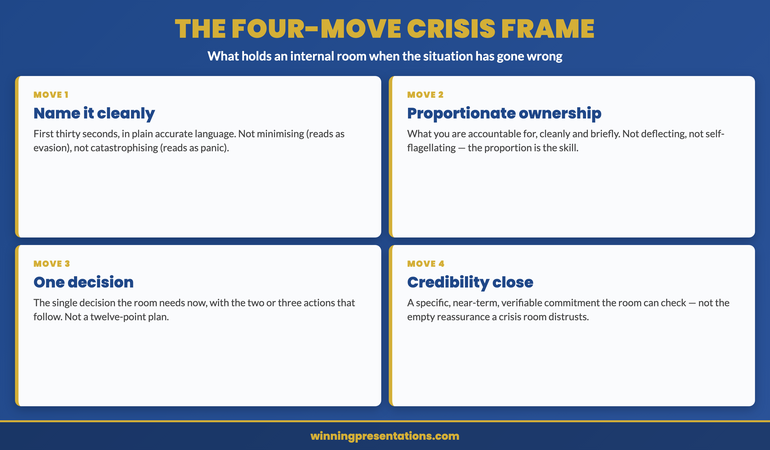
The first move is to name the situation cleanly, in the opening, without minimising and without catastrophising. The crisis room cannot be walked up to the bad news through context, because it already knows the bad news and any approach that delays naming it reads as evasion. The opening has to state the situation in plain, accurate language in the first thirty seconds: what has happened, at what scale, with what immediate consequence. The discipline is calibration — a situation statement that is too soft reads as minimising and forfeits the room’s trust, while a situation statement that is too stark reads as panic and forfeits the room’s confidence. The senior leader who can state a serious problem in accurate, unflinching, unpanicked language in the first thirty seconds has done the single most important thing a crisis presentation does, which is to demonstrate that they see the situation clearly. The room cannot trust a plan from someone who appears not to grasp the problem, and the clean situation statement is how the presenter establishes that they grasp it.
The second move is proportionate ownership. The crisis room is testing, early, whether the senior leader will take appropriate responsibility or will deflect, and both over-ownership and under-ownership fail. Under-ownership — blaming external factors, other teams, or circumstances — tells the room the senior leader is managing their own position rather than the problem, and the room withdraws trust accordingly. Over-ownership — an extended, abject acknowledgement of fault — tells the room the senior leader is overwhelmed, and the room withdraws confidence. Proportionate ownership names what the senior leader and their function are accountable for, cleanly and briefly, without either inflating it into self-flagellation or deflecting it onto others, and then moves on to the plan. The proportion is the skill, and it is highly situation-specific, which is why it is best learned against a real scenario with a coach who can calibrate it rather than from a general rule.
The third move is the plan with a single decision, and the fourth is the credibility close. The plan in a crisis presentation must be structured around the one decision the room actually needs to make now, not around a comprehensive account of everything being done. A crisis room cannot absorb a twelve-point plan; it can absorb one clear decision with the two or three actions that follow from it. The senior leader who presents the one decision cleanly gives the room something to do with its anxiety, which is what the room is actually looking for. The credibility close then ends not on reassurance — “everything will be fine” reads as exactly the empty comfort a crisis room distrusts — but on credibility: a specific, near-term, verifiable commitment that the room can check. “You will have the first remediation milestone confirmed by Friday” is a credibility close; “we are confident this is under control” is a reassurance close, and the crisis room believes the first and discounts the second. The board-level crisis communication structure applies this frame specifically to the boardroom, where the credibility close matters most.
A crisis presentation is a buy-in presentation under maximum pressure — the structure is learnable.
The Executive Buy-In Presentation System is the self-paced programme senior professionals use to build the structural method behind holding a room’s confidence when the case is hard — the clean situation statement, the proportionate ownership, the decision-shaped plan, and the credibility close that a crisis room actually believes. The same buy-in discipline that secures board approval is what keeps a board’s trust when something has gone wrong. Self-paced programme with monthly cohort enrolment, 7 modules, no deadlines, no mandatory session attendance, optional live Q&A sessions fully recorded so you can watch back anytime. Lifetime access to materials. Built on 24 years in corporate banking and 16 years coaching senior professionals through high-pressure boardrooms. £499.
- Self-paced programme with monthly cohort enrolment — start when you need it, not when a course timetable allows
- 7 modules, no deadlines, no mandatory session attendance — work through the buy-in structure around your own schedule
- Optional live Q&A sessions, fully recorded — watch back anytime, including the sessions on difficult-room scenarios
- The stakeholder-analysis and case-construction modules that underpin holding a room’s trust under pressure
- Lifetime access to materials — usable for every high-stakes presentation, crisis or routine — £499
Holding the frame through hostile questioning
The crisis presentation rarely survives intact to the end, because the crisis room interrupts. Directors cut across, peers challenge, anxious stakeholders press for guarantees the senior leader cannot honestly give. The frame is only as good as the senior leader’s ability to hold it through that pressure, which is why the question-handling component of crisis communication presentation training matters at least as much as the deck-building component. The core skill is to absorb a hostile question without either collapsing into the questioner’s framing or fighting it — to acknowledge the concern accurately, answer the part that can be answered honestly, and decline the part that cannot, all without losing composure. A senior leader who answers a hostile crisis question defensively confirms the room’s fear; one who answers it with steady, accurate, non-defensive directness reassures the room more than any rehearsed reassurance line could.
The hardest crisis questions are the ones that demand a guarantee the senior leader cannot give — “can you assure us this will not happen again?” — and the handling of these is a specific, trainable skill. The trap is to either give the guarantee, which is dishonest and will be remembered if it fails, or to refuse it flatly, which reads as evasive. The trained answer replaces the impossible guarantee with a credible commitment: not “this will never happen again” but “here is the specific control we are putting in place and the date by which you can verify it is operating”. This converts an unanswerable demand for certainty into an answerable commitment to action, which is what the room actually needs even though it asked for certainty. Learning to make that conversion in real time, under pressure, from a hostile questioner, is exactly the kind of skill that only develops through rehearsal against a realistic adversarial questioner, which is why scenario-based training with live hostile-question practice is the component to insist on.
Composure under this questioning is partly technique and partly something deeper that training has to address honestly: the senior leader’s own anxiety in a high-stakes hostile room is real, and pretending it away does not work. The most effective crisis question-handling rests on a genuine steadiness that comes from having rehearsed the hard questions in advance, so that the live hostile question is not the first time the senior leader has confronted it. A senior leader who has been put through twenty hostile crisis questions in rehearsal meets the real twenty-first with a composure grounded in preparation rather than in willpower. The composure that crisis rooms read as evidence of control is, underneath, the composure of someone who has already faced these questions in a safe setting and knows they can hold the frame. That is what good training builds, and it is why a single afternoon of media-soundbite coaching does not produce it.
For senior leaders building the crisis deck itself, the slide structure is worth having to hand:
The Executive Slide System ships the 26 templates, 93 AI prompts, and 16 scenario playbooks the high-pressure deck depends on — including the clean situation slide, the decision-shaped plan slide, and the verifiable-commitment close. Instant download, lifetime access. £39.
Why internal crisis presentations differ from media handling
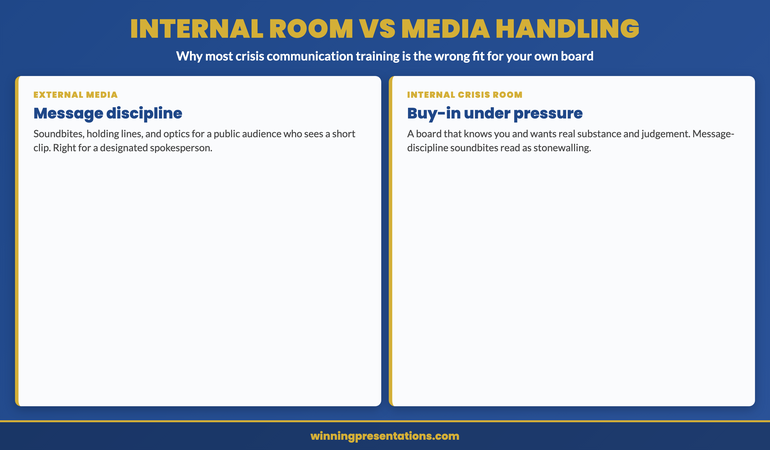
Most crisis communication training on the market was built for the external-spokesperson problem, and it is worth understanding why that training is the wrong fit for the internal crisis presentation, because buying the wrong category is the most common mistake organisations make here. External crisis communication — the press conference, the broadcast interview, the holding statement — is built around message discipline: staying on a small number of pre-agreed lines, not being drawn beyond them, managing the optics for a public audience who will see a short clip. It is a real skill and the right one for a designated external spokesperson. It is the wrong skill for the senior leader presenting to their own board, because the internal room does not want message discipline — it wants the actual substance, the real plan, and the senior leader’s genuine judgement, and it will read external-style message discipline as stonewalling.
The internal crisis room knows the senior leader and has an ongoing relationship with them, which changes everything about how the presentation has to work. A press audience meets the spokesperson once; the board meets the senior leader monthly and will hold them to what they say. The board can tell the difference between substance and message discipline because they know the subject as well as the presenter does. A senior leader who brings external-style soundbites to an internal crisis board presentation insults the room’s intelligence and forfeits exactly the trust the presentation needs to preserve. The internal crisis presentation is, at its core, a buy-in presentation — the senior leader is asking a room that has just learned something is wrong to keep backing their judgement about what happens next — and buy-in is earned through substance and credibility, not through optics. This is why training built on a buy-in foundation transfers to the internal crisis room and training built on a media-handling foundation does not. The executive buy-in presentation discipline is the right foundation for internal crisis presenting precisely because the crisis room is a buy-in room under pressure.
Self-study programmes versus one-to-one crisis coaching
One-to-one crisis presentation coaching has real advantages and a real cost. The advantage is the live adversarial rehearsal — a skilled coach playing a hostile board, calibrating the senior leader’s ownership move in real time, pushing on the unanswerable questions until the senior leader can hold the frame. The cost is that one-to-one crisis coaching runs in the four to five figures and is usually arranged under time pressure when a crisis is already unfolding, which is the worst time to be sourcing and vetting a provider. For an organisation that wants to build crisis-presentation capability ahead of need rather than during an emergency, a self-paced programme that teaches the underlying buy-in structure is a far more cost-effective foundation, and it has the advantage of being available immediately and repeatable across a leadership team rather than delivered to one person at a time.
The realistic pattern for most senior leaders is to build the structural foundation through a self-paced programme — learning the four-move frame, the proportionate-ownership calibration, the credibility close, and the question-handling principles — and then, if and when a specific high-stakes crisis presentation arrives, to add a small amount of targeted live rehearsal against that specific scenario. The self-paced foundation does most of the work; the targeted rehearsal pressure-tests it against the real situation. This combination costs a fraction of a full one-to-one crisis coaching engagement and produces, for a senior leader who is otherwise a capable presenter, comparable readiness for the crisis room. The senior leader who has internalised the buy-in structure in advance needs only to apply it to the specific crisis, rather than learning the structure for the first time under emergency conditions, which is the situation that produced the failed board presentation I described at the start.
Build the crisis-room capability before the crisis, not during it.
The Executive Buy-In Presentation System — self-paced, 7 modules, optional recorded Q&A sessions, new cohort every month, lifetime access — gives senior leaders the structural foundation that holds a room’s trust under pressure, available immediately and repeatable across a leadership team. £499. Built on 24 years in corporate banking and 16 years coaching senior professionals.
Choosing a programme: questions to ask before committing
The questions worth asking any crisis communication presentation training provider are structural and reveal quickly whether the provider is selling the internal-room skill or the external-media skill. Ask: is the training built around presenting to my own board, committee, and staff, or around handling press and external audiences? Does it teach a structural frame for the crisis presentation itself, or does it focus on message discipline and soundbites? Does it include live, adversarial hostile-question rehearsal against a realistic pressured room, or only principles and examples? Will the rehearsal use a real plausible scenario relevant to my organisation, or a generic case? A provider whose answers centre on boards, committees, structural frames, and live adversarial rehearsal is selling the skill the internal crisis room requires. A provider whose answers centre on media, optics, soundbites, and holding statements is selling a real but different skill, useful for a spokesperson and largely beside the point for the senior leader who has to hold their own board’s confidence.
The credential question worth asking is whether the provider has actually been in pressured senior rooms during real crises, on either side of the table, rather than whether they have a communications or media background. A provider who has sat on or presented to boards, investment committees, or executive teams during genuine crises brings calibration that a media-trained provider cannot, because the internal crisis room behaves differently from a press audience and only direct exposure teaches how. This does not mean a communications background is worthless — it is valuable for the external problem — but for the internal crisis presentation, the provider who has been in the pressured boardroom understands the room the senior leader will actually face. Board-level presentation training built on real boardroom experience is the closest adjacent capability, because the crisis board is the approval board under pressure.
Frequently asked questions
Is crisis communication presentation training worth it if we are not currently in a crisis?
It is most worth it when you are not in a crisis, because the worst time to build the capability is during an emergency when there is no time to learn and the stakes of getting it wrong are highest. An organisation that builds crisis-presentation capability across its senior team in calm conditions has the structural frame, the ownership calibration, and the question-handling already internalised when a crisis arrives, so the senior leader applies a known method to the specific situation rather than improvising under maximum pressure. The senior leaders who handle crisis rooms well are almost always the ones who prepared before they needed to. Buying the training during an unfolding crisis is still better than nothing, but it forces learning and emergency execution into the same compressed window, which is exactly the situation that produces the avoidable failures. Build it ahead of need.
We already had media training. Do we still need crisis presentation training for internal rooms?
Yes, because media training and internal crisis presentation training teach different and largely non-overlapping skills. Media training builds message discipline for external public audiences who see a short clip and with whom you have no ongoing relationship. The internal crisis presentation is the opposite situation: a room that knows you, holds you to what you say, has an ongoing relationship with you, and wants real substance rather than soundbites. A senior leader who brings media-trained message discipline to an internal crisis board presentation reads as stonewalling and forfeits the room’s trust. The two trainings are complementary rather than substitutable — the media training equips a designated external spokesperson, and the internal crisis presentation training equips the senior leaders who have to hold their own board, committee, and staff. Most organisations have invested in the first and overlooked the second, which is why the internal crisis room so often catches capable leaders unprepared.
How is presenting in a crisis different from a normal high-stakes presentation?
The crisis room has already heard bad news, has no patience for a build-up, is reading the presenter’s composure as evidence about whether the situation is controlled, and will interrupt. A normal high-stakes presentation can use a contextualising opening to walk a receptive room toward a recommendation; the crisis room hears that same opening as minimising and cuts across it. A normal presentation can present a comprehensive plan; the crisis room can only absorb one clear decision. A normal presentation can close on confidence; the crisis room distrusts reassurance and believes only verifiable near-term commitments. The structural moves that work in calm conditions actively backfire in crisis conditions, which is why crisis presenting is a distinct skill rather than just a more intense version of ordinary presenting. Training that does not teach the crisis-specific frame leaves capable normal presenters exposed in exactly the room where exposure costs the most.
Can a self-paced programme really prepare me for hostile live questioning?
A self-paced programme builds the structural foundation — the frame, the ownership calibration, the question-handling principles, the conversion of unanswerable guarantees into verifiable commitments — which is most of what holds up under hostile questioning, and it does so at a fraction of one-to-one coaching cost and on your own schedule. What a self-paced programme cannot fully replicate is live adversarial pressure from a real person playing a hostile board, and for a specific imminent high-stakes crisis presentation that live rehearsal is worth adding. The cost-effective pattern is to build the foundation through the self-paced programme and, when a particular crisis presentation is on the horizon, add a small amount of targeted live rehearsal against that specific scenario. For building general crisis-room capability across a leadership team ahead of need, the self-paced programme is the practical and repeatable route; the targeted live rehearsal is the focused top-up for the specific high-stakes moment.
The Winning Edge — weekly newsletter
The Winning Edge is a weekly (Thursday) newsletter for senior professionals who present at the executive level. One short email a week on the structural moves that hold a room’s confidence under pressure. Subscribe to The Winning Edge →
For the broader picture across slides, storytelling, confidence, and delivery, the seven-product Complete Presenter library is the bundle most senior professionals find useful as a single resource — £99 for everything, lifetime access.
About the author
Mary Beth Hazeldine is Owner & Managing Director of Winning Presentations Ltd. With 24 years of corporate banking experience at JPMorgan Chase, PwC, Royal Bank of Scotland, and Commerzbank, she advises senior professionals across financial services, healthcare, technology, and government on holding a room’s confidence in high-stakes and crisis-condition presentations — the clean situation statement, the proportionate ownership, the decision-shaped plan, and the credibility close that a pressured board actually believes.
Walk into your next high-pressure board presentation with the four-move frame built in advance — the clean situation statement in the first thirty seconds, the proportionate ownership, the one decision the room needs, and the credibility close on a commitment they can verify — and with the hostile questions already rehearsed in a safe setting rather than met for the first time in the room. The senior leader who builds the crisis-room capability before the crisis holds the room’s confidence when something goes wrong. The senior leader who waits until the crisis to learn it improvises under maximum pressure in front of the one audience that cannot be improvised in front of.