

Quick answer: When your sponsor is not in the room, the presentation has a different job. It must do the work the sponsor would have done — connect the proposal to the strategic context, defend the case under pressure, and give a proxy champion the language to carry your argument when the conversation continues without you. The deck you would have given to a sponsor-led room is the wrong deck. A proxy-champion deck is structurally different.
Jump to:
Imelda was three weeks from a steering-committee presentation when her sponsor — the COO — was pulled into a regulatory review that would not lift before the meeting. Her instinct was to move the meeting. The committee chair declined. The agenda was full and her item was not the most senior. She would present without her sponsor in the room.
The presentation she had prepared had been written for a sponsor-led conversation. Her sponsor would open with the strategic context. Her sponsor would close with the recommendation. She would present the substance in the middle. With the sponsor absent, the structure was wrong. She rewrote the deck in five days. The proposal was approved.
A senior presentation rarely happens in isolation. There is usually a sponsor — an executive committee member, a board chair, a partner, an investor — whose endorsement carries the room and whose presence shapes how the discussion unfolds. When that person is absent, the presenter cannot run the same deck and hope. A different protocol is required. The deck has different work to do, and the room has a different shape.
If you are presenting without your sponsor for the first time
The Executive Buy-In Presentation System covers the case-construction and stakeholder dynamics that make a presentation work when the room is harder to read. 7 self-paced modules, monthly cohort enrolment, optional recorded Q&A. Designed for senior professionals who need to secure approval from boards, executive sponsors, and reluctant stakeholders.
Why a sponsor-absent room changes the presentation
A sponsor in the room does three things, often invisibly. First, the sponsor frames the proposal — usually with one or two sentences before the deck opens that signal to the room why this proposal exists, why it is being heard now, and why it matters at this level. Second, the sponsor absorbs scrutiny — questions that would otherwise hit the presenter directly are caught and re-routed by the sponsor, often softened or re-framed in a way that protects the case. Third, the sponsor closes the loop — when the meeting is over and decisions are still being shaped in side conversations, the sponsor is the person who continues to advocate.
Remove the sponsor and all three jobs become unfilled. The framing has to come from the deck. The scrutiny has to be absorbed by the presenter directly, in real time, in front of an audience that is now reading the proposal without an internal endorsement. The post-meeting advocacy has to be transferred to someone else — usually a proxy champion identified in advance — or it disappears entirely.
The most common mistake is to assume that the absence is procedural and the deck is the same. It is not. Every senior presentation built on the assumption of sponsor presence becomes structurally weaker when that assumption fails. The presentation has to be rebuilt with the sponsor’s three jobs distributed across the deck and the proxy. Without that rebuild, the proposal usually loses momentum even when the substance is strong.
The five-step proxy-champion protocol
A proxy champion is a senior figure in the room who is willing to carry the proposal in the sponsor’s absence. The protocol is what makes the proxy effective. Without it, a willing proxy still cannot deliver because they do not know enough to defend the case.
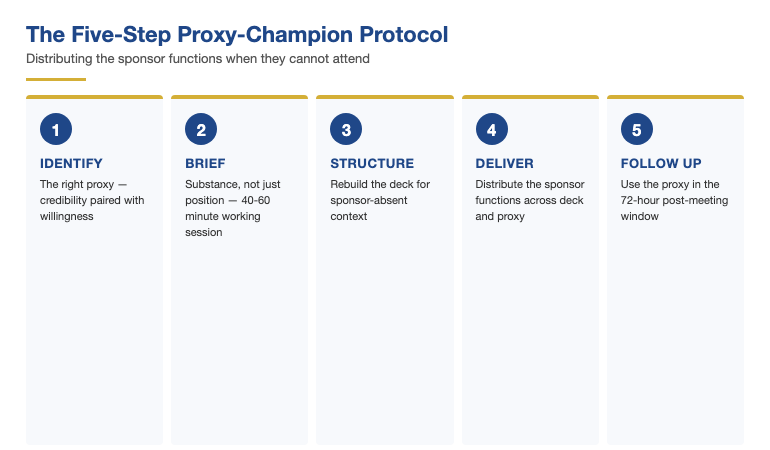
Step one — identify the right proxy. The proxy is not the most senior person available. The proxy is the person whose endorsement will be most credible to the room and who has both the willingness and the standing to carry the proposal. A respected committee member who has worked on similar issues is usually a stronger proxy than a more senior figure who has never engaged with the substance. The criterion is not seniority. It is credibility paired with willingness.
Step two — brief the proxy on substance, not just position. A proxy who knows only the headline cannot defend the proposal under pressure. A proxy who has read the substance, asked their own questions, and heard your answers can. The brief is not a courtesy email — it is a working session. Forty to sixty minutes, ideally in person, where the proxy is allowed to challenge the proposal and watch you respond.
Step three — structure the deck for the sponsor-absent context. The deck has to do the framing the sponsor would have done. The opening is different. The recommendation is named earlier. The strategic connection is made explicitly rather than left to the sponsor’s framing. Each section anticipates the questions a sponsor would have caught and addresses them in the body of the case.
Step four — deliver with the sponsor’s functions distributed. In the room, the presenter takes the framing job that the sponsor would have done. The proxy takes the closing-loop and post-meeting advocacy roles. Scrutiny is absorbed primarily by the presenter, with the proxy stepping in on the questions where credibility matters most — usually the strategic and political ones, less often the operational and technical ones.
Step five — follow up through the proxy. Decisions made in the meeting are often refined in the seventy-two hours afterwards. The sponsor would normally drive that refinement. In the sponsor’s absence, the proxy is the channel. Brief them on what to listen for, what to push back on, and where the proposal is most vulnerable to drift. Without active proxy follow-up, the meeting outcome can soften between approval and execution.
Briefing the proxy champion before the meeting
The brief is the highest-leverage hour in the sponsor-absent process. A poorly briefed proxy will do harm — they will speak with confidence on a topic they do not fully understand, get caught in a follow-up question, and the credibility of the proposal will erode along with theirs. A well-briefed proxy can carry the room.
Open the brief with the strategic context. Start where the sponsor would have started — why this proposal exists, why it is being heard now, what the executive committee has said about the broader strategy that this connects to. The proxy needs the same framing the sponsor would have provided so that they can offer it back to the room if asked.
Walk through the case with the proxy as challenger. Do not present to the proxy as if they are the audience. Invite them to challenge the case as a sceptical board member would. The questions they raise are the questions the room will raise. Their phrasing of the objection is often more useful than your own anticipation, because the proxy is closer to the room you are presenting to.
Identify the three sentences the proxy should be ready to say. The single most useful artefact from a brief is a short set of defensible sentences the proxy can offer in the meeting. Three is the right number. More than that is hard to remember; fewer is too thin to carry a discussion. The sentences should cover the strategic frame, the most likely objection, and the closing endorsement.
Agree on the post-meeting follow-up explicitly. Do not leave the post-meeting work to chance. Agree what the proxy will do — who they will speak to, what they will say, what they will report back to you. The sponsor would normally hold this work without explicit conversation. In the sponsor’s absence, it must be made explicit.
For senior professionals who present without consistent sponsor support
The Executive Buy-In Presentation System — build the case your stakeholders cannot dismiss
The Executive Buy-In Presentation System is a self-paced framework for senior professionals who need to secure approval when the room is unfamiliar, the sponsor is absent, or the stakeholders are reluctant. 7 modules walking you through stakeholder analysis, case construction, and the presentation structures that hold up under board scrutiny. Monthly cohort enrolment, optional recorded Q&A.
- 7 self-paced modules covering stakeholder analysis, case construction, and the structures that earn senior approval
- Optional live Q&A / coaching calls — fully recorded, watch back at your own pace
- No deadlines, no mandatory live attendance, lifetime access to materials
- Monthly cohort enrolment — enrol any time, start with the next cohort
£499 · Self-paced · Lifetime access to materials · Next cohort enrolment opens monthly
How the deck changes when no sponsor is present
The structural differences between a sponsor-led deck and a sponsor-absent deck are concrete. Five changes recur across most senior presentations.
Change one — the opening expands. A sponsor would typically take thirty to sixty seconds before the deck opens to frame why the proposal is in the room. Without a sponsor, that framing has to live in the first slide. The opening is no longer just a title and a question — it is a strategic context slide that anchors the proposal to the broader work the room is already engaged with.
Change two — the recommendation moves earlier. Sponsor-led decks can afford to build the case before stating the ask, because the sponsor’s introduction has already signalled the destination. A sponsor-absent deck cannot. State the recommendation earlier — typically by minute three of the deck — so the room knows what is being asked and can read the rest of the case as evidence for it rather than guessing.
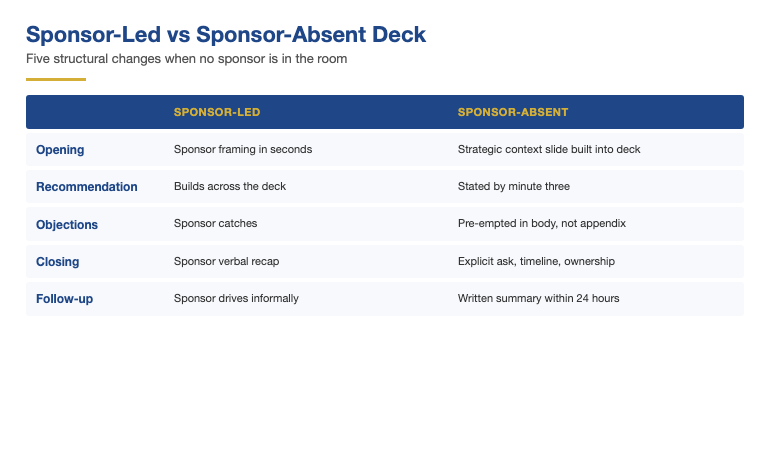
Change three — objections are pre-empted in the body. Sponsor-led decks can leave the most political objections to the sponsor to handle. Sponsor-absent decks cannot. Every significant objection has to appear and be addressed in the body of the deck — not in an appendix, not in a note, not in a back-pocket reply. The deck has to absorb the scrutiny the sponsor would have absorbed.
Change four — the closing slide is more concrete. A sponsor would typically close the discussion with a verbal recommendation. Without a sponsor, the closing slide has to do the same job — explicit ask, explicit timeline, explicit ownership. Vague closing slides work in sponsor-led rooms. They fail in sponsor-absent ones, where the room is more likely to leave the meeting without a clear decision.
Change five — the post-meeting artefact matters more. A sponsor would normally drive the post-meeting refinement informally. Without a sponsor, the deck and a structured follow-up note do that work. The note matters more than usual because there is no senior advocate continuing the conversation. Make it findable, make it concise, and make it land in the right inboxes within twenty-four hours of the meeting.
For broader context on how board approval is structured around senior advocacy, see the related discussion of the board approval presentation framework — which assumes sponsor presence and which the sponsor-absent protocol modifies.
What happens after the meeting
The work after a sponsor-absent meeting is more demanding than the work after a sponsor-led one. Decisions are softer, momentum is more vulnerable, and the proposal needs more active maintenance to convert provisional approval into confirmed action.
Confirm what was actually decided. Sponsor-absent meetings often produce decisions that are less precise than the room realises in the moment. Within twenty-four hours, send a written summary of what was decided, what was deferred, and what is dependent on other work. Send it to the chair, the proxy, and the original sponsor. Ambiguous decisions harden into the wrong outcome if no one writes them down.
Re-engage the sponsor with a precise debrief. The sponsor needs to know what happened in the room they were not in. Not a long write-up — a tight debrief covering what was decided, where the proposal nearly stalled, who carried it, and what is now needed to convert provisional approval to execution. The sponsor will then be able to drive the follow-up that they would normally have driven from inside the meeting.
Use the proxy in the seventy-two-hour window. The proxy who carried the room can also carry the post-meeting conversation, but only if briefed to do so. Identify two or three specific conversations the proxy should have in the days after the meeting — typically with the swing votes who were quiet in the room — and check back to confirm the conversations happened.
Frequently asked questions
Should I delay the meeting if my sponsor cannot attend?
Sometimes, but rarely. If the proposal is not time-sensitive and the sponsor’s absence is procedural rather than strategic, delay can make sense. More often, the agenda will not move and the meeting will go ahead. The realistic decision is not whether to delay but how to rebuild the deck for the actual room. Senior presenters who insist on rescheduling tend to look fragile. Senior presenters who adapt are read as confident.
Who is the right proxy champion if I do not have a strong relationship with anyone else in the room?
Use the relationship the sponsor has, not the relationship you have. Ask the sponsor who in the room they would brief if they could only brief one person. That person is the proxy. The sponsor’s relationship is doing the heavy lifting, with you taking responsibility for the substance. This is more effective than identifying a proxy through your own network, particularly if you are newer to the level the meeting sits at.
Can the deck do the proxy’s job if no proxy is available?
Partially. A well-built deck can absorb the framing and scrutiny work, but it cannot do the post-meeting advocacy. If no proxy is available, accept that the seventy-two hours after the meeting will be weaker than usual and plan to do that work yourself, more visibly than you would otherwise. The follow-up note carries more weight when no proxy is closing the loop. Make it precise, make it land, and follow up personally with the swing votes.
How is this different from co-presenting?
Co-presenting splits the delivery between two presenters. The proxy-champion protocol does not — the presenter still delivers the deck. The proxy is in the room as a senior advocate, not as a co-presenter. The work the proxy does is endorsement, scrutiny absorption on political questions, and post-meeting advocacy. The substance still belongs to the presenter. Mixing the two roles tends to weaken both — the proxy stops being credible as an independent senior voice, and the presenter loses authorship of the case.
Maven cohort enrolment — open this month
Stop losing buy-in at the last minute when the room shifts
The Executive Buy-In Presentation System gives you the complete framework for securing executive approval when the conditions are not ideal — sponsor absent, stakeholders sceptical, or the political weather has shifted. 7 self-paced modules, with bonus Q&A calls (optional, recorded). £499, lifetime access to materials.
- 7 self-paced modules — work through at your own pace, no deadlines
- Optional live Q&A calls — fully recorded, watch back any time
- Monthly cohort enrolment — enrol any time, start with the next cohort
- Lifetime access to all materials, no subscription, no expiry
£499 · Self-paced · Lifetime access · Next cohort enrolment opens monthly
The Winning Edge — weekly
One short note each Thursday on board-level presentation patterns, structural shortcuts, and the behaviours senior presenters use under scrutiny. Written for professionals who do not have time for newsletters that read like newsletters.
Want a starting point first? The free Executive Presentation Checklist covers the structural fundamentals senior presenters use before adapting for sponsor absence.
For a wider view of the senior approval dynamics that the proxy-champion protocol modifies, see the related piece on stakeholder buy-in psychology — the human dynamics that determine which proxies can credibly carry which rooms.
Next step: Look at the next senior presentation on your calendar. Identify your sponsor. Identify the most credible proxy in the room if your sponsor were unavailable. Brief that person now, not when you have to. The relationship will pay back over years of meetings.
Mary Beth Hazeldine is the Owner & Managing Director of Winning Presentations. With 25 years of corporate banking experience at JPMorgan Chase, PwC, Royal Bank of Scotland, and Commerzbank, she advises senior professionals across financial services, healthcare, technology, and government on structuring presentations for high-stakes board meetings, investment committees, and executive sessions. She speaks German and works extensively with the German-speaking financial markets.