

Quick answer: The boardroom pause is a deliberate four-second silence after a consequential statement. It signals composure, invites reflection, and lets the room absorb the point before the next sentence arrives. Senior presenters use it to hold authority without raising their voice. The skill is knowing where to place it and resisting the urge to fill the gap.
A regional managing director I worked with in 2024 — I’ll call her Ines — walked out of a difficult investment committee meeting with the approval she needed. She had presented a capital allocation shift that nobody on the committee had expected. Two members were openly skeptical for the first ten minutes.
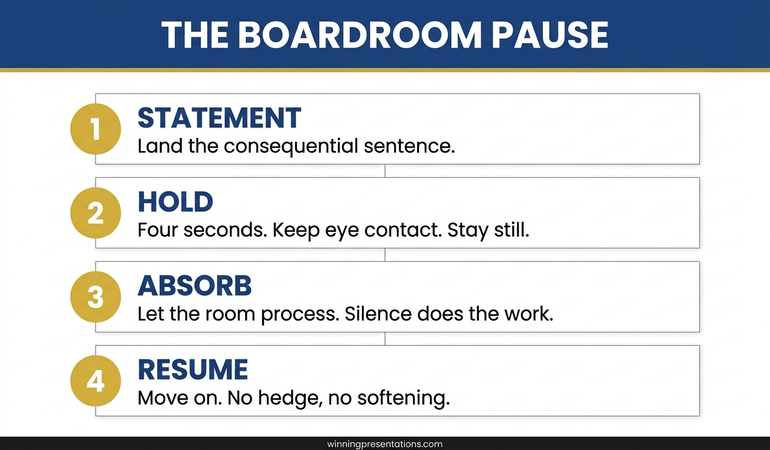
What she did differently that day was not a new framework. It was not a better slide. After her key line — “This reallocation protects the revenue we already have” — she stopped. She did not look away. She did not cough, shuffle notes, or say “so basically”. She held the silence for what she later timed as just over four seconds.
The skeptical committee chair leaned back in his chair. Another member nodded once, slowly. The room shifted. When Ines resumed, she was no longer defending; she was briefing a room that had already decided to listen.
That moment — four seconds of deliberate silence after a consequential sentence — is what senior presenters call the boardroom pause. It is one of the quietest tools in executive delivery, and one of the most misunderstood.
If you want a printable reference for delivery techniques like this
The Public Speaking Cheat Sheets cover pause placement, breath control, and the NLP anchoring techniques senior presenters use in the moments that matter.
What the boardroom pause actually is
The boardroom pause is a deliberate silence placed after a single load-bearing sentence. It is not a breath. It is not a transition. It is a choice to stop for long enough that the room is required to hold the statement rather than simply hear it.
Most mid-career presenters do not use silence at all. They move from sentence to sentence at a steady rhythm, partly because silence feels uncomfortable and partly because they have been taught that momentum is the same as confidence. Under pressure, this tendency doubles. The room starts to feel briefed at, not briefed.
Senior presenters behave differently. They speak less, but the pauses between what they say are longer. When they land a sentence that carries weight — a figure, a risk, a decision point — they stop and let the room catch up. The pause is where the sentence lands; without it, most executive-level statements simply wash past the audience.
This is a behaviour, not a trick. Once you see it, you see it everywhere. In a well-run board meeting, the chair often pauses for three to five seconds after raising a difficult point. In investor Q&A, a confident founder will pause before answering a hostile question. The pause does not feel like uncertainty; it feels like command of the material.
Why four seconds is the threshold
Audiences process consequential statements more slowly than most presenters think. A senior listener is not just hearing the words — they are running them against their own models, weighing implications for their budget, their risk exposure, their credibility. That internal work takes time. Under two seconds of silence, the processing is still happening when the next sentence arrives. The statement does not land.
Four seconds is the threshold at which two things happen. First, the audience has had enough time to finish the initial internal response to your statement. Second, the silence becomes deliberate rather than accidental — short enough to avoid awkwardness, long enough to communicate that you chose it.
Below three seconds, a pause reads as a breath. Between three and five seconds, it reads as composure. Above six seconds, it starts to read as a stall or a loss of thread, which undermines the effect. The narrow band of three-to-five seconds is where senior presenters operate.
You do not need to count exactly. But you do need to resist the instinct to keep talking. Most mid-career presenters pause for about one second and then fill the gap. The difference between one second and four seconds, repeated three or four times in a twenty-minute presentation, changes how the room reads your authority.
Related reading on this delivery habit: The pause technique for executive presentations covers the mechanical side of building pauses into a delivery script without sounding staged.
Where to place it in a senior presentation
The pause is only useful if it follows a sentence worth pausing on. Placed after filler or connective language, it feels self-important and strange. Placed after a consequential statement, it does the work.
The four placements that earn the pause in senior presentations:
- After your headline recommendation. The one sentence that summarises what you are asking the room to approve. “We recommend closing the Lyon facility in Q3.” Pause. The room needs time to register what you have just said before you explain why.
- After a material number. A cost, a loss, a return, a probability. Executive audiences calibrate against numbers; they need a moment to decide whether yours changes their view. “The contract exposure is eighteen million pounds.” Pause. Now explain.
- After a risk statement. When you name what could go wrong, the room assumes you are about to soften it. Silence disrupts that assumption and makes the risk feel serious. “If we do not act by September, we lose the window.” Pause.
- Before answering a hostile question. When someone on the committee pushes back, the instinct is to respond fast. Stopping for three or four seconds before answering signals that you are thinking, not defending. It also often produces a better answer.
What the pause does in each case is the same. It separates the statement from whatever follows so that the statement can be received on its own terms. Mid-career presenters connect everything; senior presenters let the important things stand alone.
The cheat sheet every senior presenter wants within reach before a high-stakes meeting
The Public Speaking Cheat Sheets (£14.99) are a set of nine printable guides covering pause placement, vocal control, NLP anchoring, breath protocols, and emergency techniques for the moments where delivery has to carry weight. Designed for senior professionals who deliver under pressure.
- Nine printable guides covering delivery techniques
- NLP anchoring and emergency protocols
- One-page format, designed to keep at arm’s reach
Designed for senior professionals in financial services, healthcare, technology, and government.
Get the Public Speaking Cheat Sheets →
£14.99, instant download. Nine guides, one PDF.
The three mistakes that kill the pause
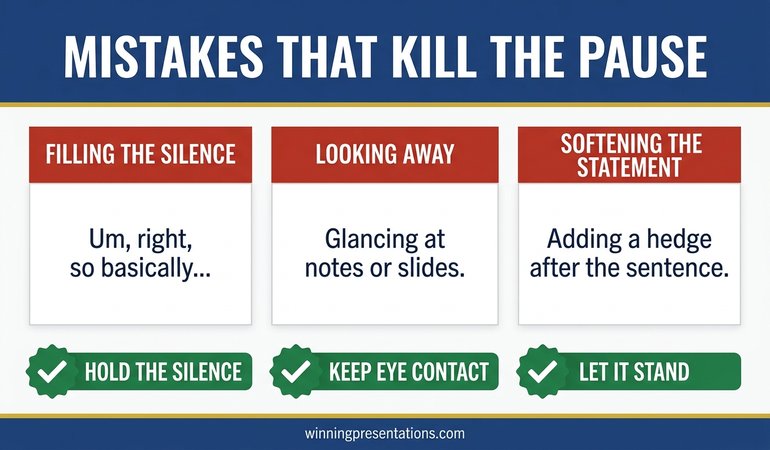
Knowing where to pause is only half the skill. The other half is what you do during the silence. Most mid-career presenters do one of three things that neutralise the effect.
The first mistake is filling the silence. A four-second pause does not feel like four seconds when you are the one presenting — it feels like twenty. The instinct to bridge the gap is overwhelming. “Um.” “Right.” “So basically.” “What that means is.” Every one of these fillers erases the work the pause was doing. The sentence before no longer stands alone; it becomes a setup for a longer explanation that nobody asked for.
The second mistake is looking away. Dropping your eyes to your notes, glancing at the slide, or scanning the room during the silence tells the audience that you are checking something. The pause has to be held with open posture, eyes on one or two decision-makers, hands still. Looking away turns a deliberate pause into an accidental one.
Dropping the gaze is one of the most common delivery tells. The related habit — filling silence with verbal fillers during presentations — has the same underlying cause: discomfort with the absence of action. Both are solvable with rehearsal.
The third mistake is softening the sentence that preceded the pause. Some presenters land the consequential line, notice the silence hanging, and get nervous about what they said. They then add a hedge. “Well, broadly.” “Obviously this is a first view.” “We could potentially revisit.” The hedge undoes the statement. The pause was supposed to give the sentence weight; the softening takes the weight back off.
The simplest rule: say the sentence, stop, hold your ground, then move to the next point without qualifying what you said. If the room has a question, they will ask. Silence invites engagement. Hedging invites dismissal.
Practising the pause without looking rehearsed
The boardroom pause has to feel natural in the moment, or it does not work. A pause that reads as theatrical is worse than no pause at all. The preparation work sits in three places.
Mark your script. When you prepare a senior presentation, read through your talk and circle the three or four sentences that carry the most weight — the recommendation, the material numbers, the risk statements. Next to each one, write the word “PAUSE”. This is the only rehearsal instruction you need. Do not try to choreograph the entire talk; just know where the four or five pause points are.
A simple structured approach to not rambling includes this marking practice: you plan where you will stop, and everything between those points is allowed to breathe.
Practise with a clock visible. Most people experience a four-second pause as an eternity. The only way to recalibrate is to hold a pause while a second hand ticks, so you can feel how short four seconds actually is. Doing this twice in rehearsal changes your sense of the duration and stops you truncating the pause under real pressure.
Decide your eye-contact anchor. Before you walk in, pick one decision-maker whose response matters most, and plan to hold your gaze on that person during each pause. You do not have to stare; you just need a default anchor so your eyes do not drift. This removes the instinct to look down during the silence.
Repeat the first two steps twice and the third step once, and the technique becomes reliable. You will not have to think about it in the room — the rehearsal does the work.
Partner post worth reading on a related delivery signal: the vocabulary signals C-suite listeners associate with promotability.
Need openings and closings that earn the pause?
The Presentation Openers & Closers Swipe File (£9.99) is a copy-paste collection of 50 opening lines and 30 closing techniques — the sentences most worth pausing after. Designed for senior presenters who need their first and last words to do heavier work.
Why this one technique matters more than you expect
There is nothing dramatic about four seconds of silence. But the compound effect of using it well across a twenty-minute senior presentation is substantial. The room reads you as more senior. Your statements carry weight. Your answers feel considered. You come across as someone who has the authority to allow the room to react, rather than someone who has to keep pushing to stay in control.
The inverse is also true. A presenter who fills every gap — with words, hedges, or glances — reads as junior regardless of title. The pause is one of the clearest delivery signals for executive presence, and it costs nothing to install.
Start with one pause. Pick the single most consequential sentence in your next senior presentation and commit to holding silence for four seconds after it. Mark it on your notes. Choose your eye-contact anchor. When you get to the sentence, stop. Do not fill. Do not look away. Do not soften.
Then watch what the room does.
The cheat sheet you want within reach before the meeting starts
Nine printable delivery guides, one PDF, at-a-glance format. Covers pauses, breath control, NLP anchoring, and in-the-moment recovery.
Instant download. One PDF, nine guides.
Frequently asked questions
Isn’t four seconds of silence awkward in a meeting?
It feels awkward to the presenter, not to the room. Audiences experience a four-second pause as about one to two seconds — because they are using the time to process what you said. The awkwardness is a sensation of the speaker, not the listener. Practising with a visible second hand calibrates this quickly.
Does the boardroom pause work in virtual presentations?
Yes, with one adjustment. Hold eye contact on the camera rather than on a specific participant, and keep your posture still. Lag and audio compression on video calls can stretch silences slightly, so a three-second pause often reads as four. The placement rules are the same.
How do I pause without it looking rehearsed?
Limit yourself to three or four pause points in a twenty-minute presentation, and place them after sentences that would earn a reaction anyway — the recommendation, the headline number, the risk statement. Natural pauses follow natural emphasis. Trying to pause everywhere is what makes it look rehearsed.
What if someone interrupts during the pause?
That is a good outcome. An interruption during the pause means the statement landed and the room wants to engage with it. Let them. The pause has already done its job by that point — it created room for the response. Answer the interruption, then resume.
Get The Winning Edge
One email each Thursday. Named techniques from real boardroom work — pauses, vocabulary, framing moves — that senior professionals can try in the next presentation.
Not ready for the full system? Start here instead: download the free Executive Presentation Checklist — the one-page reference senior presenters use to pressure-test a deck before a senior meeting.
Next step: pick one sentence in your next senior presentation that deserves to stand alone, mark it with a pause, and walk into the room knowing you will hold it.
About the author
Mary Beth Hazeldine is Owner & Managing Director of Winning Presentations Ltd. With 24 years of corporate banking experience at JPMorgan Chase, PwC, Royal Bank of Scotland, and Commerzbank, she advises executives across financial services, healthcare, technology, and government on structuring presentations for high-stakes funding rounds and approvals.


