

Quick answer: An opening story for an executive presentation works because it earns you the room’s attention before you spend it — an executive decides in the first ninety seconds whether to lean in or open their laptop, and an agenda slide loses that bet every time. The opening story that works is short and built to one shape: a specific character in a specific moment, a complication that creates tension, a pivot where something turns, and a bridge — one sentence connecting the story to the decision the room is about to make. Keep it under ninety seconds; past that you are spending attention you have not yet earned. Test it with the bridge test: if you cannot write the single sentence that links the story to your topic, the story is an anecdote, not an opening, and you should cut it. A good opening story does not entertain; it makes the room care about the thing you are there to discuss before you have made a single claim about it.
JUMP TO:
In 2015 I ran the speaker coaching for a leadership offsite and watched two divisional heads open back to back. The first stood, advanced to a slide headed “Today I’ll cover three things,” and read the three things aloud. Within forty seconds I counted four people reaching for their phones under the table; the chair started reading his own papers. The second head opened differently. She did not put up a slide at all. She said, “Last March, one of our longest-standing clients called me on a Friday afternoon to tell me they were leaving — and the reason they gave was something we’d been told was fixed eighteen months ago.” The phones stayed down. She had maybe forty people, and for ninety seconds you could hear the room not moving. By the time she said, “that call is why I want to talk about how we handle client risk,” she had something the first speaker never got: permission. Same audience, same hour, same stakes. One opened by announcing his agenda and lost the room; the other opened with ninety seconds of story and was handed the next twenty minutes.
(This article was created with AI assistance; all stories and insights are based on 35 years of real client work.)
That offsite crystallised something I now teach every senior presenter who asks how to start: the opening of an executive presentation is not where you tell the room what you will say — it is where you earn the right to say it. An agenda slide spends the room’s attention before you have given them any reason to grant it; a well-built opening story earns the attention first, so everything after it lands on a room that is leaning in rather than checking out. This piece sets out the four-beat shape of a ninety-second opening that does that work, the bridge test that tells you whether your story actually belongs in the talk or is just a story you like, and why the discipline of ninety seconds — not three minutes — is what separates an opening that earns attention from one that squanders it.
Most presenters have a stock of good stories and no structure for turning one into an opening that earns the room.
The free 7 Presentation Frameworks Quick Reference Card lays out the narrative shapes that hold a senior audience — including the character-complication-pivot arc behind a strong opening — on a single page you can build against. It is the quickest way to see whether your opening is built on a structure or just a nice anecdote. Free download, no email gate.
What the first ninety seconds actually decide
A senior audience makes a decision in the first ninety seconds of a presentation, and it is not the decision you are there to ask for. It is a smaller, faster, mostly unconscious one: is this worth my full attention, or can I run it in the background while I do something more pressing? Executives sit through a great many presentations, and they have learned to triage them quickly, because most are not worth the front of their mind. The opening is the audition for their attention, and it is decided before you reach any of your content. Win it and the room processes the rest of your talk actively, looking for your point. Lose it and the room processes your talk passively, waiting for it to be over — and a passive room does not get persuaded, it gets endured.
An agenda slide loses the audition almost every time, for a precise reason: it asks the room to care about the structure of your talk before it has been given any reason to care about the subject. “Today I’ll cover three things” is information about your presentation, not about anything the room finds important, and it signals that the next stretch will be a recitation. The room files it as low-stakes and reallocates attention accordingly. The opening lines that actually work on an executive board do the opposite — they make the subject feel consequential in the first breath, before the structure, before the credentials, before the agenda. A story does this faster than any other opening because the human attention system is built to track a person in trouble, and it cannot easily switch that tracking off.
This is why the opening story is not decoration. It is the most leveraged ninety seconds in the entire presentation, because it sets the mode in which everything else is received. The same recommendation, the same data, the same ask lands completely differently on a room that has decided to lean in than on a room that has decided to coast. You are not choosing between a serious opening and a story; the story, built correctly, is the serious opening, because it is the one that converts a triaging audience into an engaged one before you have spent a single one of your real arguments.
The 90-second opening: four beats
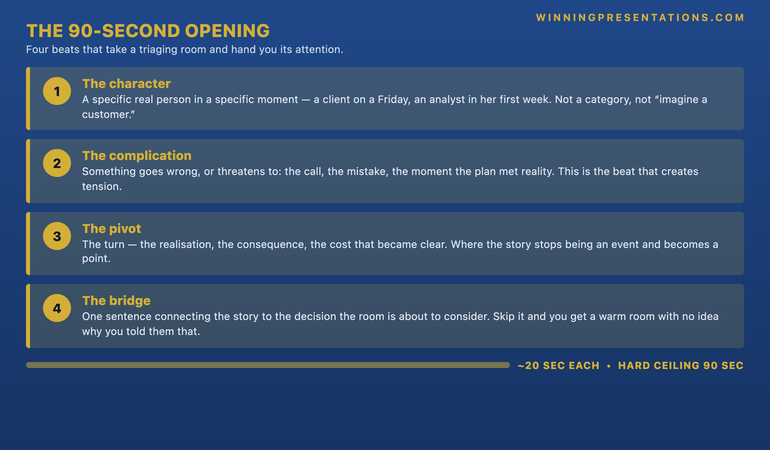
A ninety-second opening story is built from four beats, in order. The structure is not a creative-writing exercise; each beat does a specific job, and a story missing one of them stops doing its work. Built to the four beats, a story takes a triaging room and hands you its attention. Missing a beat — most often the last — it becomes the anecdote that makes people wonder when you are going to start.
The four beats are these. One, the character. Open on a specific person in a specific moment: a client on a Friday afternoon, a new analyst in her first week, a customer at the checkout. Not a category (“our clients”), not a hypothetical (“imagine a customer”) — one real person the room can picture. Two, the complication. Something goes wrong, or threatens to: the call, the mistake, the moment the plan met reality. This is the beat that creates tension, and tension is what holds attention. Three, the pivot. The turn — the realisation, the consequence, the cost that became clear. This is where the story stops being an event and starts being a point. Four, the bridge. One sentence, no more, that connects the story to the decision the room is about to consider: “that call is why I want to talk about how we handle client risk.” The bridge is the beat that turns a story into an opening rather than an interruption.
The reason the order matters is that each beat sets up the next and removes a way the opening can fail. The character gives the room someone to track, which is what buys the first few seconds of genuine attention. The complication converts that attention into tension, which is what sustains it — a story with a character but no complication is just a description, and a room disengages from a description. The pivot gives the tension meaning, so the room feels the story was about something. And the bridge collects all of that earned attention and points it at your actual subject, so the engagement you created does not evaporate the moment the story ends. Skip the bridge and you get a warm room that has no idea why you told them that — attention earned and then dropped on the floor.
Learn to build openings that earn the room — from the stories you already have.
The Business Storytelling Mini-Course teaches the narrative shapes that move executive decisions, including how to find the story inside your own material and structure it into an opening that holds a senior room. It is built for people who present real business content — numbers, recommendations, updates — and need the story to serve the decision rather than upstage it.
- How to locate the character-complication-pivot inside your own work, not borrow someone else’s anecdote
- Building the bridge so the story points at your ask instead of standing apart from it
- The shapes behind openings, turns, and closes that keep a serious audience with you
- Instant access, lifetime use, on demand — £29
The bridge test
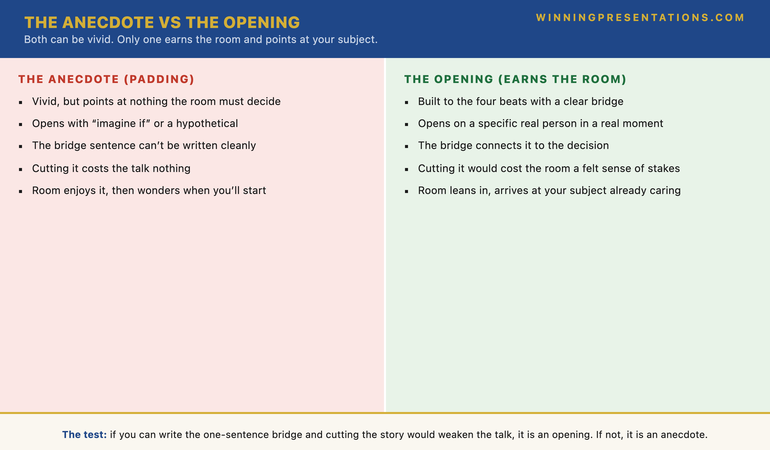
The single most useful check on an opening story is the bridge test, and it takes one sentence. Before you put the story anywhere near your talk, try to write the bridge: the one sentence that connects the story to the decision or subject the room is there for. If you can write it cleanly — “that call is why I want to talk about how we handle client risk” — the story earns its place, because it has somewhere to point its attention. If you cannot write the bridge, or the best you can manage is a vague “and that just goes to show how important communication is,” the story does not belong in this talk. It is a story you like, not an opening for this subject, and a senior room will feel the join between the anecdote and the agenda as a clumsy gear-change.
The test works because it isolates the one thing that distinguishes an opening from an anecdote: relevance that the room can feel. A story can be vivid, well-told, and genuinely interesting and still be the wrong opening, because it points at nothing the room needs to decide. The bridge is the proof of relevance, and writing it first forces you to choose stories that connect rather than stories that merely impress. It also stops the most common failure, which is the presenter who tells a great story, lets it land, and then has to manufacture a connection on the spot — the room watches them reverse-engineer a reason, and the cleverness of the story curdles into the suspicion that it was told for its own sake.
There is a second, sharper version of the test for stories you are unsure about: cut the story entirely and see whether your talk is worse. If removing the opening story costs the talk nothing — if the bridge sentence alone would have done the job — then the story was padding, however good. A real opening story does something a flat statement cannot: it makes the room feel the stakes of your subject before you argue them, so that your argument lands on prepared ground. The strongest executive opening lines all pass both versions of this test — they are relevant enough to bridge and consequential enough that cutting them would cost the room something it needed to feel.
When you need an opening fast and don’t have time to build one from scratch.
The Presentation Openers & Closers Swipe File gives you 50 proven opening lines and 30 closing techniques, copy-paste ready — the patterns you can adapt to your own material when the meeting is tomorrow and the blank first slide is staring back at you. It is the practical shortcut to a strong start when you have the content but not the time to craft the opening. £9.99, instant download.
Why a specific person beats “imagine if”
In 2018 I coached a chief operating officer who opened every town hall the same way: “Imagine you’re a customer trying to get hold of us on a Saturday.” It was a reasonable instinct — he was trying to build empathy — and it never quite worked, because “imagine” asks the room to do the work of conjuring a person, and a tired audience will not do it. We changed one thing. Instead of “imagine a customer,” he opened with a real one: “On Saturday the 11th, a woman named in our complaints log spent forty minutes trying three different numbers to reach us, and gave up.” Same point, same length. But the second version did the conjuring for the room — it handed them a specific person in a specific moment, and their attention locked onto her the way it never locked onto the hypothetical. He told me afterwards it was the first opening that ever made the room go quiet. The difference was not the quality of the writing. It was that one version asked the audience to build the character and the other built it for them.
This is a reliable rule: specificity does the audience’s imaginative work for them, and an executive audience will not do that work voluntarily. “Imagine if”, “picture a scenario where”, “think about a typical client” — all of these outsource the construction of the character to a room that is triaging your talk, and the room declines. A specific person, named or precisely described, in a specific time and place, removes that work: there is nothing to imagine, only someone to watch. The cost of the hypothetical is not just weaker engagement; it is that a hypothetical signals there may not be a real example, which quietly undermines the very point the story is trying to make. The real instance proves the stakes exist. The imagined one only asserts that they might.
The same principle governs the details you choose. “A Friday afternoon” beats “recently”; “forty minutes and three numbers” beats “a long time”; “turned the deck face-down on the table” beats “seemed frustrated.” Concrete, sensory, slightly specific detail is what makes a story feel witnessed rather than constructed, and a witnessed story carries an authority an abstract one cannot. You do not need many such details — two or three placed in the character and complication beats are enough to make the whole thing feel real. The discipline is to resist the instinct to generalise for safety. The generalised version feels more professional to write and lands as less true to hear, because the human ear treats specificity as evidence and abstraction as spin.
Why ninety seconds, and not three minutes
The ninety-second ceiling is not arbitrary, and it is the constraint presenters most often break. The logic is simple: the opening story is a loan against the room’s attention, not a gift, and you repay it with the value of what follows. For the first ninety seconds, a room will extend you credit on the strength of the story alone, because a person in trouble is inherently worth tracking. Past ninety seconds, the credit runs out, and the room begins to ask the dangerous question — “where is this going?” The moment a senior audience asks where a story is going, the story has stopped working, because they have shifted from being inside it to being outside it, judging it. A three-minute opening story almost always crosses that line, and the back half is spent losing the very attention the front half won.
Length also signals judgement, and a senior room reads it. A presenter who opens with a tight ninety-second story signals that they value the room’s time and know exactly why they are telling this; a presenter who runs four minutes signals self-indulgence, that the story is for them rather than for the room. The same content, over-told, reads as a worse presenter. This is why the discipline of cutting matters more than the skill of telling: most opening stories are improved by removing the second example, the bit of context that “helps it make sense,” and the extra beat of colour the presenter is fond of. The brutal version — character, complication, pivot, bridge, and almost nothing else — is nearly always the one that lands hardest.
There is a practical way to hold the line: time it out loud, standing up, the way you will actually deliver it. Stories run longer spoken than they read on the page, and the gap is where the over-run hides. If your opening runs to two minutes when you read it silently, it will run to nearly three when you deliver it with the pauses and emphasis a good telling needs — well past the ceiling. The openers that actually grab an executive audience are almost always shorter than their authors first wrote them, because the writing instinct is to add and the delivery reality is that the room rewards subtraction. Build the story, then cut it until it is ninety seconds, and then trust that the leanness is doing work the extra material would have undone.
The best opening story is almost always already inside your own work — you just need the structure to find it.
Borrowed and invented openings are what a senior room detects and discounts. The Business Storytelling Mini-Course teaches you to locate the real character, complication, and pivot inside your own material and shape them into a ninety-second opening that earns the room — so you stop reaching for someone else’s anecdote and start opening from the moment your subject became real.
- Find the story hiding in your own numbers, projects, and meetings — not a generic one
- Build the bridge so the opening points at your ask instead of standing apart from it
- Keep the narrative serving the decision, without the theatrics that switch a board off
- Instant access, lifetime use — £29
How to build your opening before your next talk
Before your next presentation, write your opening story as exactly four sentences — one for the character, one for the complication, one for the pivot, one for the bridge — and write the bridge first. If you cannot write the bridge sentence that connects the story to your subject, stop: you do not have an opening for this talk, and you should choose a different story or a different opening altogether. If you can write the bridge, build the other three sentences behind it, then stand up and read all four aloud while you time yourself. If it runs past ninety seconds, cut — the second example, the context, the extra colour — until it fits. Then ask one final question: if I deleted this story and kept only the bridge sentence, would the talk be worse? If yes, you have an opening. If no, you have an anecdote, and the room will know the difference within the first forty seconds, the way they always do.
Frequently asked questions
Isn’t a story too soft a way to open a serious executive presentation?
This is the fear that keeps the agenda slide alive, and it has the cause and effect backwards. What reads as “soft” is a story with no point — an anecdote that entertains and then leaves the room wondering why it was told. A story built to the four beats, with a bridge that connects it to a real decision, is the opposite of soft: it makes the room feel the stakes of a serious subject before you argue them, which is a hard-edged, deliberate move, not a warm-up. Senior audiences are not put off by stories; they are put off by stories that waste their time. Keep it under ninety seconds, make it specific, and point it at the decision, and a board will read it as command of the room, not as fluff.
What if I don’t have a good story for my topic?
Most presenters have more material than they think; the problem is usually that they are looking for a dramatic story when they need a specific one. The character can be a single customer, one colleague, a moment in a single meeting — it does not need to be a saga. Look in your own recent experience for the moment the subject became real to you: the call, the number that surprised you, the thing that went wrong. That moment, told in four beats, is almost always a stronger opening than a borrowed or invented one. If, after looking, there genuinely is no story, do not force one — a sharp, specific opening line about the stakes can do similar work. The failure mode to avoid is an invented or generic story, which a senior room detects and which costs you more credibility than a plain opening ever would.
How long does it take to get good at building openings like this?
The structure itself you can apply to your next talk — the four beats and the bridge test are usable the first time you try them. What takes longer is the judgement: learning which stories carry, how much detail is enough, and where to cut. That develops over a handful of presentations, fastest if you time yourself out loud each time and watch where the room’s attention holds or slips. Most people see a noticeable difference in how their openings land within their first few attempts, because the four-beat structure fixes the most common failure — a story with no bridge — immediately. The refinement continues after that, but you do not need to wait for mastery to get the benefit; the structure does most of the work from the start.
Does this work for virtual presentations, where I can’t read the room?
It matters more on video, not less, because the triage decision happens faster when the audience can mute you and multitask invisibly. On a call you cannot see the phones come out, but they come out sooner, and the opening is your only reliable lever against it. The four-beat story works the same way — a specific person in a specific moment captures attention through a screen as well as in a room — but the ninety-second ceiling becomes even more important, because patience is shorter on video and the cost of a slow start is a quietly disengaged call you cannot read. If anything, tighten the opening for virtual: lead with the character in the first sentence, before any housekeeping, so the engagement is won before the room’s attention has a chance to drift to the other windows on their screen.
The Winning Edge — weekly newsletter
The Winning Edge is a weekly (Thursday) newsletter for senior professionals who present to boards, committees, and large internal audiences. One short email a week on the structural moves — openings, turns, closes — that separate a presentation the room leans into from one it endures. Subscribe to The Winning Edge →
For the full set of skills behind a presentation that holds an executive room — slides, storytelling, confidence, and delivery — the Complete Presenter bundle of seven products brings them together as a single resource — £99 for everything, lifetime access.
About the author
Mary Beth Hazeldine is Owner & Managing Director of Winning Presentations Ltd. With 24 years of corporate banking experience at JPMorgan Chase, PwC, Royal Bank of Scotland, and Commerzbank, she advises senior professionals across financial services, insurance, consulting, and technology on the structural moves that turn a presentation into a decision a room can act on.