Tag: presentation nerves

19 Dec 2025
How to calm nerves before a presentation - 5 minute reset technique for presentation anxiety

How to Calm Nerves Before a Presentation: The 5-Minute Reset That Actually Works

A hypnotherapist’s structured technique for stopping presentation anxiety before you walk into the room

You’re about to present. Your heart is racing. Your hands are shaking. Your mind is going blank.

You need something that works in the next five minutes — not a week-long course on confidence.

I’m going to give you exactly that. As a clinical hypnotherapist who applies evidence-based clinical techniques to managing presentation anxiety.

It takes five minutes. It works every time. And by the end of this article, you’ll have a pre-presentation routine you can use for the rest of your career.

Why You Can’t “Think” Your Way Out of Presentation Anxiety

Here’s what most people get wrong when trying to calm nerves before a presentation: they try to think their way out of a physiological response.

“Relax.” “You’ve got this.” “Stop being nervous.”

It doesn’t work. In my hypnotherapy practice, I saw this pattern time and again with executive clients. Presentation anxiety isn’t a thinking problem — it’s a nervous system response. Your brain has detected a threat (the audience) and triggered fight-or-flight.

No amount of positive self-talk will override that biological reaction. You need to speak directly to your nervous system.

That’s exactly what the 5-Minute Reset does.

Related: Public Speaking Tips: 15 Techniques That Actually Work

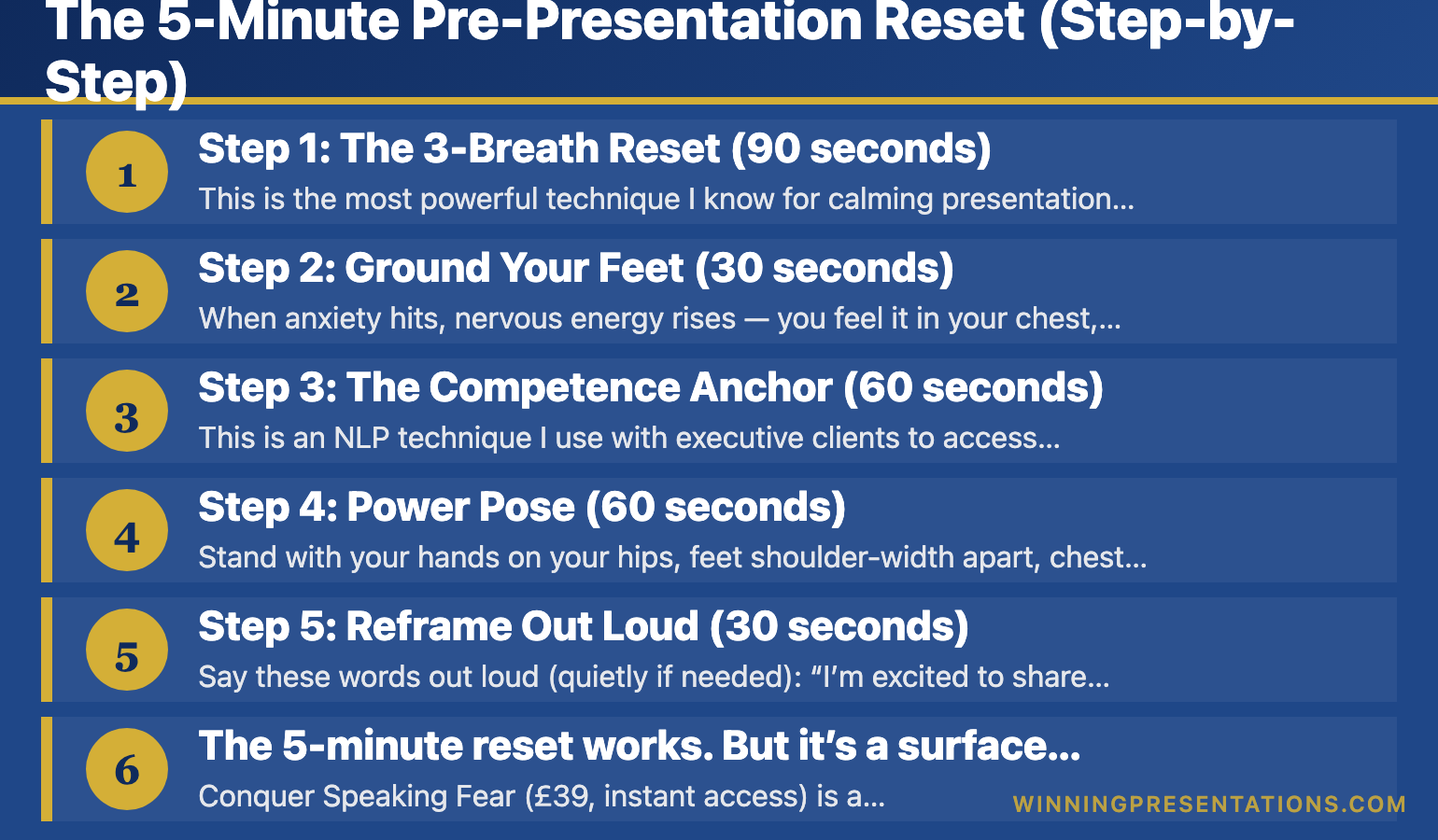
The 5-Minute Pre-Presentation Reset (Step-by-Step)

Do this sequence in order, ideally somewhere private — a bathroom, your car, an empty corridor. It takes five minutes and will change your physiological state completely.

Step 1: The 3-Breath Reset (90 seconds)

This is the most powerful technique I know for calming presentation nerves. I used it with panic attack clients for years before bringing it into executive training.

How to do it:

  1. Breathe in through your nose for 4 counts
  2. Hold for 4 counts
  3. Breathe out through your mouth for 6 counts
  4. Repeat 3 times

Why it works: The extended exhale activates your parasympathetic nervous system — literally telling your brain the threat is over. This isn’t relaxation advice; it’s how your nervous system is wired. I’ve used this exact technique to help clients stop panic attacks in their tracks.

Three breaths. Ninety seconds. Do it every single time.

Step 2: Ground Your Feet (30 seconds)

When anxiety hits, nervous energy rises — you feel it in your chest, throat, and head. Your feet want to pace or shift.

Counter this by pressing your feet firmly into the floor. Feel the ground beneath you. Imagine roots growing from your feet into the earth.

This “grounding” technique redirects nervous energy downward and creates physical stability that will translate to vocal stability when you speak. It’s a core technique in anxiety therapy that I used extensively in my clinical hypnotherapy practice before adapting it for presenters.

Related: How to Start a Presentation: 15 Powerful Opening Techniques

Step 3: The Competence Anchor (60 seconds)

This is an NLP technique I use with executive clients to access confident states on demand. It’s one of the most effective ways to calm nerves before a presentation because it gives you a physical trigger you can use anywhere.

How to create it:

  1. Remember a time you felt completely confident — any context
  2. Close your eyes and fully re-experience that moment
  3. When the feeling peaks, press your thumb and forefinger together firmly
  4. Hold for 5 seconds, then release

You’ve now created a physical trigger. Before you present, press your thumb and forefinger together to access that state. Your nervous system doesn’t distinguish between remembered confidence and current confidence.

This is the same anchoring technique I used to help anxiety clients access calm states on demand. It works for presentations too.

Step 4: Power Pose (60 seconds)

Stand with your hands on your hips, feet shoulder-width apart, chest open. Hold for 60 seconds.

Research on power posing is mixed, but I’ve seen it work consistently with the executives I train. At minimum, it interrupts the closed, protective posture that presentation anxiety creates — hunched shoulders, crossed arms, shallow breathing.

That posture change affects your mental state. Open body, open mind.

Step 5: Reframe Out Loud (30 seconds)

Say these words out loud (quietly if needed): “I’m excited to share this.”

Not “I’m calm” — your body knows that’s a lie. “I’m excited” works because the physiological response to excitement is identical to anxiety: racing heart, heightened alertness, energy surge. The only difference is the label you put on it.

Research shows that reframing anxiety as excitement actually improves performance. One sentence. Say it out loud. It matters.

🎯 Want This Entire Routine on a Printable Card?

The include the 5-Minute Reset, voice warm-ups, power poses, and 20+ techniques on printable cards you can keep in your bag. Review them before any high-stakes presentation.

Stop managing nerves. Eliminate them.

The 5-minute reset works. But it’s a surface technique — and you know it.

Conquer Speaking Fear (£39, instant access) is a hypnotherapist-designed system that targets the root cause of presentation anxiety — not just the symptoms. Use the reset in the short term; use the system to stop needing it.

  • Fear Type Assessment — identify exactly what drives your anxiety response
  • 10 evidence-based techniques with structured practice
  • 5 word-for-word scripts for worst-case scenarios
  • 30-day structured plan — build lasting confidence

Get Conquer Speaking Fear → £39

⚡ Presenting this week?

If you’re heading into a high-stakes presentation this week and need more than a 5-minute reset, Conquer Speaking Fear gives you the complete system — including the pre-presentation protocols that make the nerves manageable every time.

Explore Conquer Speaking Fear →

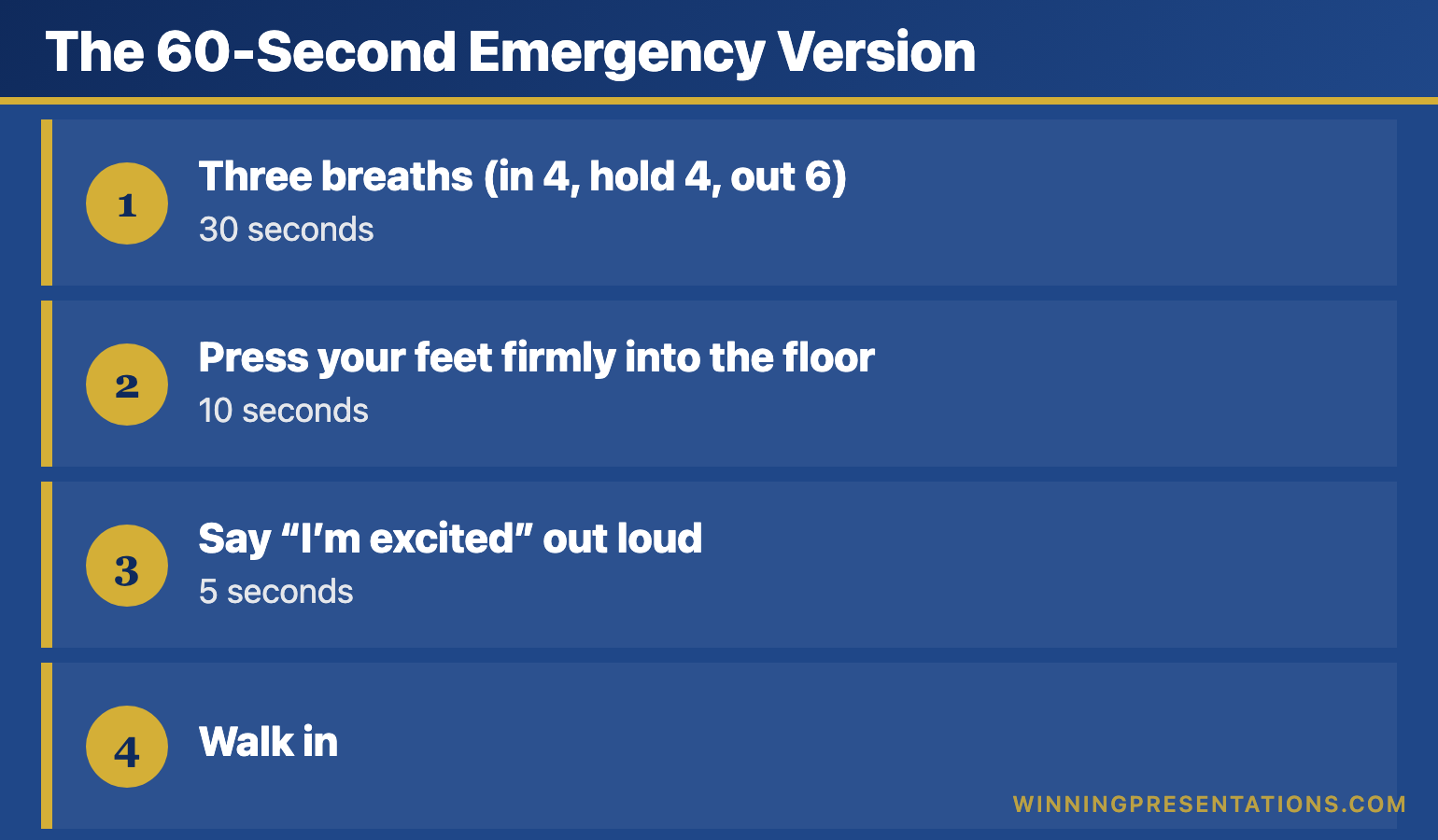
The 60-Second Emergency Version

No time for the full reset? Here’s how to calm presentation nerves in under a minute:

  1. Three breaths (in 4, hold 4, out 6) — 30 seconds
  2. Press your feet firmly into the floor — 10 seconds
  3. Say “I’m excited” out loud — 5 seconds
  4. Walk in

Forty-five seconds. It won’t eliminate your nerves completely, but it will take the edge off enough to get through your opening — and the first 60 seconds are when presentation anxiety is highest. After that, you’ll settle.

What to Do If Your Mind Goes Blank During the Presentation

Even with preparation, it happens. You’re mid-sentence and suddenly — nothing. Your mind is completely empty.

Here’s your recovery plan:

  1. Pause. It feels like an eternity to you. To the audience, it looks like confidence.
  2. Look at your slide or notes. No one judges you for this.
  3. Say: “Let me come back to that point…” and move to the next section.

The audience rarely notices these moments as much as you fear. And knowing you have a recovery plan removes the panic that makes blanking worse.

Related: How to End a Presentation: 7 Closing Techniques That Work

Why This Works When Other Techniques Don’t

Most advice for calming nerves before a presentation focuses on what to think. But as I learned in my clinical hypnotherapy practice, you can’t think your way out of a physiological state.

The 5-Minute Reset works because it targets your nervous system directly:

  • Breathing activates the parasympathetic response
  • Grounding redirects nervous energy
  • Anchoring accesses stored confident states
  • Posture interrupts anxiety body language
  • Reframing changes how your brain interprets the arousal

Each step builds on the last. Together, they create a reliable state change that works whether you’re presenting to five people or five hundred.

Related: How to Create Executive Presentations That Get Results

Building Long-Term Presentation Confidence

The 5-Minute Reset is a powerful tool for calming nerves before any presentation. But if presentation anxiety is a recurring challenge, you’ll want to build deeper confidence over time.

That means:

  • Knowing your opening cold — Memorise your first 30 seconds word-for-word so you don’t have to think when nerves are highest
  • Arriving early — Get to the room first and make the space yours
  • Creating a consistent ritual — Use the same pre-presentation routine every time so your brain learns to associate it with successful outcomes
  • Practising in stressful conditions — Rehearse standing up, in front of colleagues, in the actual room when possible

I cover all 15 of these techniques in my comprehensive guide: Public Speaking Tips: 15 Techniques That Actually Work

Ready to build confidence that works long-term?

Conquer Speaking Fear is a complete system for executives who understand their material but still feel the anxiety response before every presentation. 75-page workbook. Evidence-based. Immediate download.

Want to stop relying on the reset and start walking in composed? Conquer Speaking Fear builds the foundation underneath the techniques →

Learn more about Conquer Speaking Fear → £39

Frequently Asked Questions

How do I stop shaking before a presentation?

Shaking comes from adrenaline — you can’t stop the adrenaline, but you can process it. Do the 3-Breath Reset (breathe in 4, hold 4, out 6, repeat 3 times), then hold something in your hands — a clicker, pen, or notes — to occupy them. The shaking usually subsides within 60-90 seconds of starting your presentation if you don’t fight it.

What if I get nervous again during the presentation?

Use a micro-reset: take one slow breath (in 4, out 6), press your feet into the floor, and continue. You can do this while speaking or during a natural pause. The audience won’t notice.

Does the 5-Minute Reset work for virtual presentations?

Absolutely. Do the full routine before you go on camera. The only adaptation: during the presentation, you can ground your feet while seated, and focus your eye contact on the camera lens (not the screen) to create connection.

What if I only have 2 minutes before presenting?

Use the 60-Second Emergency Version: three breaths (30 seconds), ground your feet (10 seconds), say “I’m excited” out loud (5 seconds), then walk in. It’s enough to take the edge off your presentation anxiety.

Why do I get presentation anxiety when I know the material?

Because anxiety isn’t about knowledge — it’s about perceived threat. Your nervous system interprets being watched and judged as danger, regardless of how prepared you are. That’s why techniques that target the nervous system directly (like the 5-Minute Reset) work better than “just know your stuff” advice.


📬 The Winning Edge Newsletter

Weekly strategies for speaking confidence, executive presence, and career-critical presentation moments.

Subscribe free →

Your Next Step

You now have a structured technique to calm nerves before any presentation. Here’s what I want you to do:

  1. Save this article — bookmark it or print the steps
  2. Use the 5-Minute Reset before your next presentation — even a low-stakes meeting
  3. Notice the difference — in your body, your voice, your confidence

Once you’ve experienced how well this works, you’ll never present without it again.

Go deeper: Public Speaking Tips: 15 Techniques That Actually Work — the complete guide to confident presenting, from a hypnotherapist who specialises in executive presentation skills.


Mary Beth Hazeldine is a qualified clinical hypnotherapist and Managing Director of Winning Presentations. She spent 25 years in corporate banking at JPMorgan, PwC, Royal Bank of Scotland, and Commerzbank, and applies evidence-based clinical techniques to managing presentation anxiety. She advises executives across financial services, healthcare, technology, and government.

Not ready for the full system? Start here instead: subscribe to The Winning Edge — weekly strategies for executive confidence and presentation skills, free.

19 Dec 2025
15 public speaking tips that actually work - psychology-backed techniques for confident presentations

Public Speaking Tips: 15 Techniques From Someone Who’s Trained 5,000+ Executives

Quick Answer: Slow your first two sentences by 15%, exhale longer than you inhale, pause after key points, and land one clear closing line. That’s 80% of confident speaking.

Most public speaking tips are useless. “Picture the audience in their underwear.” “Just be yourself.” “Practice in front of a mirror.” You’ve heard them all. They don’t work.

The fear of public speaking — glossophobia — affects up to 75% of people. But it doesn’t have to control you.

I come at this from two directions. First, I spent 24 years presenting to boards, investors, and C-suite executives at JPMorgan, PwC, Royal Bank of Scotland, and Commerzbank. I was terrified for the first five years. The generic public speaking techniques made it worse.

Second — and this is what makes my approach different — I’m a qualified clinical hypnotherapist who has treated hundreds of clients with anxiety disorders. Panic attacks. Social anxiety. Performance anxiety. I’ve seen what actually rewires the fear response, and I’ve brought those techniques into my presentation training.

What changed everything wasn’t tips — it was understanding the psychology behind fear and confident speaking. These public speaking tips come from training over 5,000 executives, combined with my background in NLP (Neuro-Linguistic Programming) and clinical hypnotherapy. They’re not motivational fluff — they’re specific techniques you can use to overcome stage fright and speak confidently in your next presentation.

🎯 Ready to Conquer Your Fear of Public Speaking?

After 5 years of presentation terror and treating hundreds of anxiety clients as a clinical hypnotherapist, I created a system that actually works — not just “breathe and visualise” advice that fails under pressure.

Includes:

  • The neuroscience behind why your brain panics (and how to rewire it)
  • The 60-second reset that works even minutes before you speak
  • Scripts and exercises you can use immediately

Get the Complete System → £39

Based on clinical techniques I used with hundreds of anxiety clients, adapted for high-stakes presenting.

Why Most Public Speaking Tips Fail

Before we get to what works, let’s address why the standard advice doesn’t help with public speaking anxiety.

In my hypnotherapy practice, I saw the same pattern repeatedly: people trying to think their way out of a physiological response. It doesn’t work. Telling someone to “relax” when their nervous system is in fight-or-flight mode is like telling someone with a broken leg to “walk it off.”

Generic public speaking tips fail because they treat symptoms, not causes. The real issues behind fear of public speaking are:

  • Perceived threat response — Your brain interprets audience judgment as physical danger
  • Attention misdirection — You’re focused on yourself instead of your message
  • Lack of control anchors — Nothing feels predictable or manageable
  • Identity attachment — You’ve made the outcome mean something about your worth

These are the same patterns I treated in my anxiety clients. The techniques below address these root causes, not just the surface symptoms. Whether you’re looking to overcome presentation nerves or become a more confident speaker, these strategies will help.

Related: How CEOs Actually Present: Executive Presentation Skills for Leadership

Part 1: Before You Speak (Preparation)

1. The 3-Breath Reset

This is the single most effective technique I teach for calming nerves before a presentation. I used it with my hypnotherapy clients for years before bringing it into corporate training. It takes 30 seconds and changes your physiological state immediately.

How to do it:

  1. Breathe in for 4 counts through your nose
  2. Hold for 4 counts
  3. Breathe out for 6 counts through your mouth
  4. Repeat 3 times

Why it works: The extended exhale activates your parasympathetic nervous system — literally telling your brain the threat is over. This isn’t meditation woo-woo; it’s how your nervous system is wired. I’ve used this technique to help clients stop panic attacks in their tracks.

Do this in the bathroom, in your car, or standing backstage. Three breaths. Every time. It’s one of the most reliable presentation anxiety tips you’ll find.

3-breath reset technique for public speaking anxiety - breathe in 4 counts hold 4 out 6 to calm nerves

2. Arrive in the Room First

One of my most counterintuitive public speaking tips: get to the room early and own the space.

Walk the stage or the front of the room. Touch the podium. Adjust the chair. Stand where you’ll stand when presenting. Your brain needs to register this as YOUR territory, not hostile ground you’re entering.

I learned this presenting to the board at Commerzbank. The executives who commanded the room weren’t more talented — they arrived 15 minutes early and made the space theirs.

3. Know Your First 30 Seconds Cold

You don’t need to memorise your entire presentation. But you absolutely must have your opening locked in — word for word, no improvisation.

Why? Because the first 30 seconds are when your nerves are highest. If you have to think about what to say, you’ll stumble. If it’s automatic, you can focus on delivery while your brain calms down.

This single public speaking tip has helped more nervous presenters than any other technique I teach.

Related: How to Start a Presentation: 15 Powerful Opening Techniques

4. The “What If” Reframe

Nervous speakers ask: “What if I forget my words? What if they hate it? What if I fail?”

Confident speakers ask the same question differently: “What if this goes well? What if they’re genuinely interested? What if this is the presentation that changes everything?”

This isn’t positive thinking — it’s pattern interruption, a technique I used constantly in hypnotherapy. Your brain will answer whatever question you ask it. Ask better questions. It’s a powerful way to overcome stage fright before it takes hold.

These reframing techniques are just the beginning. Conquer Speaking Fear includes the complete set of NLP scripts I used with my hypnotherapy clients — adapted specifically for presentation anxiety.

5. Eliminate “Performance” From Your Mind

Here’s a mindset shift that transformed my speaking: you’re not performing, you’re having a conversation.

When you “perform,” you create distance between yourself and the audience. You become an actor trying to impress. The audience feels it — and so do you.

Instead, think of your presentation as a conversation where you happen to be doing most of the talking. You’re sharing something you know with people who want to hear it. That’s it.

This single reframe has helped more nervous executives develop speaking confidence than any technique I teach.

Part 2: During Your Presentation (Delivery)

6. Find Three Friendly Faces

Before you start speaking, identify three people in different parts of the room who look receptive. Maybe they’re nodding. Maybe they’re smiling. Maybe they just look interested.

During your presentation, rotate your eye contact between these three people. It feels like you’re speaking to individuals who want to hear from you — because you are.

Avoid: the person checking their phone, the one with arms crossed, the obvious sceptic. They exist in every audience. They’re not your target.

7. Pause Before Key Points

Nervous speakers rush. They fill every silence with words because silence feels dangerous.

Here’s the truth: pauses make you look confident, not uncertain.

Before your most important point, stop. Take a breath. Let the silence build. Then deliver your message.

Watch any TED Talk from a masterful speaker. Count the pauses. They’re not accidents — they’re strategic. This is one of the most powerful public speaking techniques for projecting confidence.

Related: How to End a Presentation: 7 Closing Techniques I Teach C-Suite Executives

8. Ground Your Feet

When anxiety hits, nervous energy rises. You feel it in your chest, your throat, your head. Your feet want to pace or shift.

Counter this by consciously pressing your feet into the floor. Feel the ground beneath you. This “grounding” technique redirects nervous energy downward and creates physical stability that translates to vocal stability.

Grounding is a core technique in anxiety therapy. I taught it to hundreds of hypnotherapy clients before adapting it for presenters. I have executives imagine roots growing from their feet into the floor. It sounds strange. It works.

⭐ These Tips Work — But There’s a Faster Way

I spent 5 years terrified of presenting before I cracked the code. Now I’ve packaged everything — the neuroscience, the NLP techniques, the exact scripts — into a system you can use before your next presentation.

What’s inside:

  • The 60-second nervous system reset (works even backstage)
  • Reframing scripts from my clinical hypnotherapy practice
  • The pre-presentation protocol I teach to executives

Conquer Your Speaking Fear → £39

“I went from avoiding all presentations to volunteering for them.” — Senior Manager, Financial Services

9. Speak to the Back Row (Voice Projection)

Project your voice as if the most important person is in the back of the room. This does three things:

  • Forces you to slow down (voice projection requires pace)
  • Deepens your voice (projecting engages your diaphragm)
  • Commands attention (volume signals authority)

You don’t need to shout. Just imagine your words need to reach someone 30 feet away. Your body language and vocal delivery will adjust automatically.

10. Use Purposeful Movement

Standing frozen looks nervous. Pacing looks nervous. The solution is purposeful movement.

Move when you transition between points. Walk to a different spot on stage, plant your feet, deliver the next section. Then move again for the next transition.

This gives your nervous energy somewhere to go while building stage presence that looks intentional rather than anxious.

Part 3: Managing Your Nerves (Psychology)

This section draws heavily on my hypnotherapy training. These aren’t generic mindset tips — they’re clinical techniques adapted for the boardroom.

11. Reframe Nerves as Excitement

This is one of the most research-backed public speaking tips available. Studies show that reframing speech anxiety as excitement improves performance.

The physiological response is identical — racing heart, heightened alertness, energy surge. The only difference is the label you put on it.

Before you present, say out loud: “I’m excited.” Not “I’m calm” (your body knows that’s a lie). “I’m excited” redirects the same energy toward a positive interpretation.

How to reframe public speaking nerves as excitement - same physical response different mindset

12. The Competence Anchor

This is an NLP technique I’ve used with hundreds of clients — both in my hypnotherapy practice and in executive training — to build speaking confidence.

How to create it:

  1. Remember a time you felt completely confident — any context
  2. Close your eyes and fully re-experience that moment
  3. When the feeling peaks, press your thumb and forefinger together
  4. Repeat 5-10 times with different confident memories

Now you have a physical trigger. Before presenting, press your thumb and forefinger together to access that state. Your nervous system doesn’t distinguish between remembered confidence and current confidence. This is the same anchoring technique I used to help anxiety clients access calm states on demand.

The Competence Anchor is one of dozens of NLP techniques in Conquer Speaking Fear. The full system includes audio exercises so you can build these anchors properly.

13. Prepare for Mistakes (So They Don’t Derail You)

Mistakes will happen. You’ll lose your train of thought. The slide won’t advance. You’ll say the wrong word.

The difference between amateur and professional speakers isn’t that professionals don’t make mistakes — it’s that mistakes don’t throw them off.

Pre-plan your recovery phrases:

  • “Let me come back to that point…”
  • “Actually, the more important thing is…”
  • “Where was I? Right — [key word from your notes]”

When you know you can recover, mistakes lose their power to create panic. This is essential for anyone learning how to speak in public with confidence.

For a deep dive on building lasting confidence, see my guide on how to speak confidently in public.

14. Detach From Outcome

This is advanced, but it’s the public speaking tip that creates lasting transformation.

Most presentation anxiety comes from attachment to outcome. You need them to approve. You need them to be impressed. You need to not embarrass yourself.

But here’s the truth: you don’t control how they respond. You only control what you deliver.

Shift your goal from “make them say yes” to “deliver my message as clearly as possible.” The first goal creates anxiety because it’s outside your control. The second creates focus because it’s entirely within your control.

I’ve seen executives transform overnight with this shift. The paradox is that when you stop needing a specific outcome, you usually get better outcomes.

15. Create a Pre-Presentation Ritual

Every confident speaker I’ve trained has a ritual. Not superstition — a deliberate sequence that signals to their brain: “It’s time to perform.”

My ritual before high-stakes presentations:

  1. Review my opening (2 minutes)
  2. 3-Breath Reset (30 seconds)
  3. Competence Anchor — press thumb and forefinger (10 seconds)
  4. Power pose in private — hands on hips, chest open (60 seconds)
  5. Say out loud: “I’m excited to share this” (5 seconds)

Total: under 5 minutes. The consistency is what matters. Your brain learns that this sequence leads to successful presenting, and it prepares accordingly.

5-minute pre-presentation ritual for public speaking confidence - review opening, breathing, power pose

Related: How to Create Executive Presentations That Get Results

Public Speaking Tips for Specific Situations

Different contexts require adapting these public speaking techniques. Here’s how to speak confidently in specific high-stakes situations:

Virtual Presentations

Virtual presenting has unique challenges. You can’t read the room. Energy feels flat. Distractions are everywhere.

Adapt these techniques:

  • Look at the camera, not the screen (this creates “eye contact”)
  • Exaggerate your facial expressions by 20% (the camera flattens them)
  • Stand if possible — it improves your energy and breathing
  • Use people’s names frequently to maintain audience engagement

Related: Why Most QBR Presentations Bore Leadership (And How to Fix Yours)

Board Presentations

Boards are time-poor and decision-focused. They don’t want a performance — they want clarity.

  • Lead with your recommendation (tip #3 applies here — know your opening cold)
  • Speak with authority, not apology
  • Anticipate the three questions they’ll ask and have answers ready

If you’re preparing slides for a board presentation, see our Executive Presentation Template for the structure that commands attention.

Related: The Board Presentation Structure Nobody Teaches You

Investor Pitches

High stakes, short time, sceptical audience. The speaking confidence techniques become even more critical.

  • Your conviction matters as much as your numbers
  • Pause after your ask — let them process
  • Treat questions as interest, not attacks

Related: Investor Pitch Deck Template: The Sequoia Format That Raised Billions

Speaking Confidently in Meetings

Not every speaking opportunity is a formal presentation. Here’s how to project confidence when speaking in meetings:

  • Speak early — the longer you wait, the harder it gets
  • Use the grounding technique (#8) while seated
  • Prepare one key point you want to make before the meeting starts
  • Lower your vocal pitch slightly (nerves raise pitch)

Common Public Speaking Mistakes to Avoid

Even with these tips, certain mistakes undermine your impact:

Mistake 1: Apologising at the Start

“Sorry, I’m a bit nervous” or “I’m not very good at this” — these phrases kill your credibility before you’ve said anything of substance.

Fix: Start with your content. Your audience doesn’t need to know you’re nervous. Most can’t even tell.

Mistake 2: Reading Slides

If you’re reading what’s on the screen, why are you there? Slides support your message — they don’t replace it.

Fix: Know your content well enough that slides are visual aids, not scripts.

Mistake 3: Ending Weakly

“So, yeah… that’s it. Any questions?” is not an ending. It’s an apology for taking their time.

Fix: Prepare your closing as carefully as your opening. End with a clear call to action or a memorable final statement.

Related: Presentation Structure: 7 Frameworks That Actually Work

How to Practice Public Speaking Skills

Knowing techniques is one thing. Embodying them is another. The fastest path to becoming a better public speaker isn’t more practice — it’s more deliberate practice with specific techniques.

Related: How to Get Better at Public Speaking: What Actually Works

Record Yourself

I know — watching yourself is painful. Do it anyway. You’ll notice filler words, pacing issues, and body language habits you’d never catch otherwise.

Practice Transitions, Not Scripts

Don’t memorise every word. Instead, practice how you move between sections. “After I cover X, I’ll transition to Y by saying Z.” This keeps you flexible while maintaining structure.

Rehearse the Anxiety

Practice in conditions that mimic the stress. Present to colleagues. Present standing up. Present in the actual room if possible. Your brain needs to experience success in challenging conditions to believe it’s possible.

Get Feedback That Matters

“That was great!” isn’t useful feedback. Ask specific questions: “Did I rush through the third section? Was my ask clear? Where did you lose focus?”

Related: How to Improve Public Speaking Skills: The 5 Things That Actually Matter

⭐ Your Next Presentation Doesn’t Have to Feel Like This

If reading these tips made you think “I need this” — the full system goes deeper. It’s everything I learned from treating hundreds of anxiety clients, adapted for high-stakes presenting.

You’ll get:

  • Why your brain panics (and how to interrupt the pattern)
  • The anchoring technique that gives you confidence on demand
  • Audio exercises you can use the morning of your presentation

Get the Complete System → £39

Join hundreds of professionals who’ve transformed their relationship with presenting.

Frequently Asked Questions

How do I calm nerves before a presentation?

Use the 3-Breath Reset: breathe in for 4 counts, hold for 4 counts, breathe out for 6 counts. Repeat 3 times. The extended exhale activates your parasympathetic nervous system and physically calms your body. Combine this with arriving early to own the space and knowing your first 30 seconds cold. For a step-by-step walkthrough, see How to Calm Nerves Before a Presentation.

How do I stop shaking when presenting?

Shaking comes from adrenaline. You can’t stop the adrenaline, but you can process it: (1) Do the 3-Breath Reset before presenting, (2) Hold something — a clicker, a pen, notes — to occupy your hands, (3) Ground your feet firmly on the floor. The shaking usually subsides within 60-90 seconds of starting if you don’t fight it.

What if I forget what to say?

Pause. Look at your notes or slide. Say “Let me come back to that point” and move on. Audiences rarely notice these moments as much as you fear. Preparation helps: know your key points rather than scripts, so you can always return to the core message.

What are the best public speaking tips for beginners?

Start with three fundamentals: (1) Know your opening cold — memorise your first 30 seconds word-for-word, (2) Use the 3-Breath Reset before speaking to calm your nervous system, and (3) Focus on one friendly face in the audience rather than trying to scan everyone. Master these before adding more advanced techniques.

How do I handle a hostile audience?

First, don’t assume hostility — scepticism often looks like hostility but isn’t. If someone is genuinely combative: acknowledge their point (“That’s a fair concern”), answer directly, and move on. Don’t get defensive or debate. Your composure is more persuasive than winning an argument.

How long does it take to become a confident speaker?

Most people see meaningful improvement within 3-5 presentations if they apply these public speaking techniques consistently. Mastery takes years, but competence and speaking confidence come much faster than most people expect. The key is deliberate practice, not just repetition.

Can introverts be good public speakers?

Absolutely. Some of the best speakers I’ve trained are introverts. Introverts often prepare more thoroughly and listen better to audience cues. The key is working with your natural style rather than trying to become an extrovert on stage. Many introverts find that the “conversation, not performance” reframe (tip #5) is particularly helpful.

How can I project confidence when speaking?

Confidence comes from three things: preparation (know your opening cold), physiology (ground your feet, breathe deeply, speak to the back row), and mindset (reframe nerves as excitement, detach from outcome). The Competence Anchor technique (#12) gives you instant access to confident states when you need them.

📧 Join 2,000+ Professionals

Get weekly presentation insights — techniques that actually work, not generic advice.

Subscribe to The Winning Edge →

📖 Free Download: 7 Presentation Frameworks

The structures I use for every presentation type — from team updates to investor pitches.

Download Free →

Your Next Step

These public speaking tips work. But reading about techniques and applying them are different things.

Here’s what I suggest:

  1. Pick three techniques from this article that resonate with you
  2. Apply them to your next presentation — don’t try to do everything at once
  3. Notice what changes — in your nerves, your delivery, your audience response

Once you’ve experienced the difference, you’ll want to go deeper. When you’re ready, Conquer Speaking Fear gives you the complete system — everything I learned from 5 years of presentation terror and treating hundreds of anxiety clients.

Mary Beth Hazeldine is the Managing Director of Winning Presentations. She spent 24 years in corporate banking at JPMorgan Chase, PwC, Royal Bank of Scotland, and Commerzbank before training thousands of executives to present with impact. As a qualified clinical hypnotherapist, she has treated hundreds of clients with anxiety disorders — experience she now applies to help professionals overcome fear of public speaking. Her clients have raised over £250M using her frameworks.