Tag: presentation failure recovery

01 May 2026
Rebuild confidence after a presentation that went badly, separate the story you are telling yourself from what actually

Rebuilding Confidence After a Presentation That Went Badly

Quick answer: Rebuilding confidence after a presentation that went badly starts with separating what actually happened from the story you are telling yourself about what happened. The body remembers threat before the mind remembers detail, so the first task is to settle the nervous system before attempting any analysis. What you do in the seventy-two hours after a difficult presentation determines whether it becomes a setback you recover from or a narrative that shapes the next twelve months of your speaking life.

Ines Moreira, regional head of supply chain for a European consumer group, walked out of her first executive committee presentation on a Tuesday afternoon in March and went straight to her car. She had not started it. She sat in the driver’s seat for twenty minutes and went through the whole thing in her head, sentence by sentence. She had lost the thread at minute fourteen. The CFO had asked a question she had not expected and she had said the words “I’ll come back to you on that” four times in two minutes. She was certain she had damaged her standing with the executive team.

That evening she sent a long, apologetic email to her line manager detailing everything she thought she had got wrong. He replied the next morning with three lines. She had not damaged her standing. She had lost the thread for roughly forty seconds, not fourteen minutes. The CFO’s question had been off-agenda and nobody in the room had expected her to have an answer. The reason she was now certain she had failed was not because she had failed. It was because her body had decided she had and her mind had spent the night building evidence to match.

Ines kept that email. Six months later, before her next executive committee presentation, she re-read it. Reading it did not remove the nerves. But it removed the story she had been carrying — that she was someone who lost the thread — which had been a far heavier thing to walk into the room with than the nerves themselves.

What Ines did in the seventy-two hours after that first presentation determined whether she came back to the committee six months later as herself or as a more cautious, more over-prepared, more apologetic version of herself. The difference is rarely made in the presentation. It is made in the recovery.

If you want a neuroscience-based approach to rebuilding confidence after a difficult presentation, Conquer Your Fear of Public Speaking covers nervous system regulation, cognitive reframing, and the specific protocols for recovering from a presentation setback without over-correcting into permanent caution.

Explore the Programme →

The First Hour: What Not to Do

The first hour after a presentation that went badly is the worst time to analyse what happened. The nervous system has just come down from a threat response. Cortisol is still circulating. The part of the brain that constructs narrative is wide awake and looking for patterns, and the patterns it finds are disproportionately negative because it is still interpreting the environment as dangerous.

If you replay the presentation in detail during this hour, you are not reviewing a performance. You are laying down memory in an elevated state. The memory that forms now is the memory you will carry forward, and it will be more catastrophic than the actual event. Every executive who has ever walked out of a difficult presentation and gone straight to their desk to write a brutal post-mortem knows this feeling. The post-mortem, written in that state, is almost always harsher than the reality warrants.

Three protective moves in the first hour. Walk — physically move for at least twenty minutes, outside if possible. This is not a wellness cliche. It is how the body metabolises the cortisol still in the bloodstream. Eat a proper meal — a real one, not a snack. Low blood sugar amplifies threat-interpretation. Do not email your manager tonight. The email you write in the first hour will not be the email you would write in the morning. Write it if you need to, but save it as a draft and open it at 8 a.m. the next day.

Recover Without Over-Correcting Into Permanent Caution

Conquer Your Fear of Public Speaking is a neuroscience-based programme covering nervous system regulation, cognitive reframing, physical symptom management, and pre-presentation protocols — including recovery strategies for after a presentation that did not go the way you wanted.

£39 — instant access. Designed for executives who need a structured way back after a difficult speaking experience.

Explore the Programme →

Separate What Actually Happened From the Story

Every difficult presentation generates two records. The first is what actually happened — the sequence of words, questions, responses, and reactions in the room. The second is the story you are telling yourself about what happened. The two are never the same, and in the aftermath of a presentation that felt bad, the gap between them becomes the central problem to solve.

A concrete exercise. Twenty-four hours after the presentation — not sooner — write two lists on the same page. On the left, write only the observable facts. “I was asked to present for twenty minutes. I spoke for twenty-three. There were four questions. I did not know the answer to one of them. Two people nodded during the executive summary. The chair closed with thank you and moved to the next item.” Observable. Describable to someone who was not there. No interpretation.

On the right, write the story you are telling yourself. “I was too slow. The question I could not answer made me look unprepared. The chair’s tone was dismissive. The exec team now thinks I am not ready for this level of exposure.” This is not the truth — it is the interpretation. Naming it as interpretation is the point of the exercise. Both lists on the same page make visible what the mind is adding on top of the facts.

The right column almost always contains future tense and mind-reading — “they now think,” “they will remember,” “they will not trust me.” None of these are observations. They are predictions about what other people are thinking, based on a mind that is still in threat response. Treat them as hypotheses, not facts. The principles in the broader guide to presentation anxiety recovery go deeper into how interpretation loops form and how to break them.
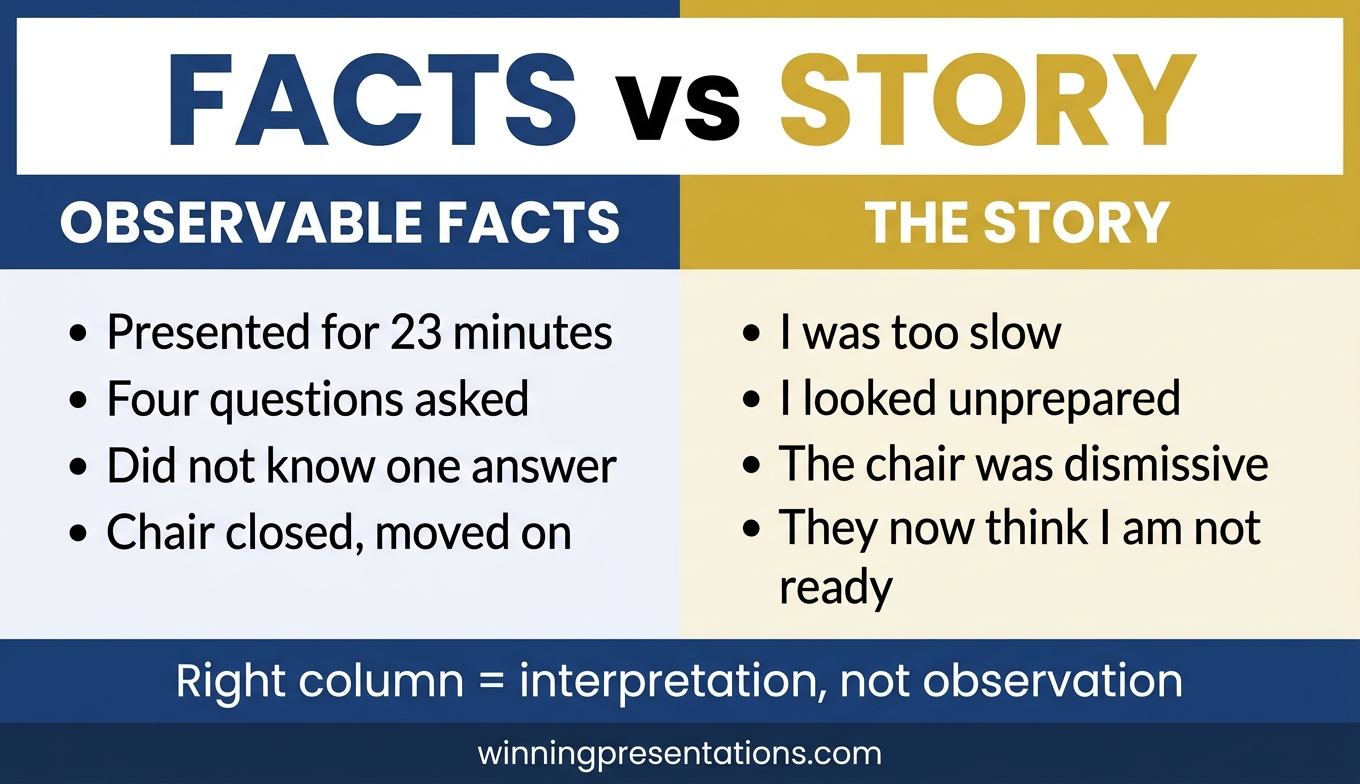

Two-column exercise showing observable facts from a presentation on the left versus the interpretation and story being told on the right, separating what actually happened from what the mind is adding on top

The Three-Day Rule for Post-Presentation Review

Most executives conduct their post-presentation review within twenty-four hours, often the same evening. This is the wrong timing. The review is too emotionally coloured to be accurate, and the conclusions drawn then tend to stick. Wait three days before writing anything approaching a considered analysis.

Day one. Nervous system recovery only. No analysis. No replay. If intrusive thoughts come — they will — write them down in one line and move on. The writing-down itself is protective; the mind is less likely to keep rehearsing a thought it knows has been captured.

Day two. Observable facts only. The two-column exercise above. Still no conclusions. Still no “what should I have done differently.” The task today is just to get the facts and the interpretations onto separate sides of the same page.

Day three. The structured review. Three questions, in this order. What were the two or three things that went well — specific, observable, not generous? What were the two or three things that did not land — specific, observable, not catastrophic? What is the one thing I would prepare differently for a comparable situation? Not everything. One thing. A review that produces a list of fifteen learning points produces no learning at all, because nothing gets implemented.

The reason for the three-day gap is not psychological indulgence. It is accuracy. A review written in an elevated state conflates the felt experience with the observable performance. By day three, the physiology has returned to baseline and the review reflects what actually happened rather than how it felt.

Why You Must Talk to Exactly One Person

Talking to nobody is a mistake. Talking to everyone is a bigger one. After a difficult presentation, the instinct is either to go silent — hoping the event fades — or to process it with half a dozen colleagues. Neither works. Silence lets the story solidify unchecked. Multiple conversations produce multiple reinforcements of whichever narrative you have already started telling.

The correct protocol is exactly one person. A trusted colleague who was in the room, or a line manager who has context but was not in the room. Their role is not to reassure you. Their role is to compare their version of what happened to yours, and to notice where the two diverge. The divergence is the diagnostic.

Frame the conversation carefully. “I am trying to work out what actually happened in that presentation, not whether it was good or bad. What did you see from your seat? What landed, what did not?” This framing disarms the reassurance reflex. Most colleagues, asked directly how a presentation went, will offer reassurance. Asked what they observed, they will describe. The description is useful. The reassurance is not.

Do this conversation on day two or three, not day one. Do it once. Do not keep returning to it. The conversation is a calibration check, not a source of ongoing validation.
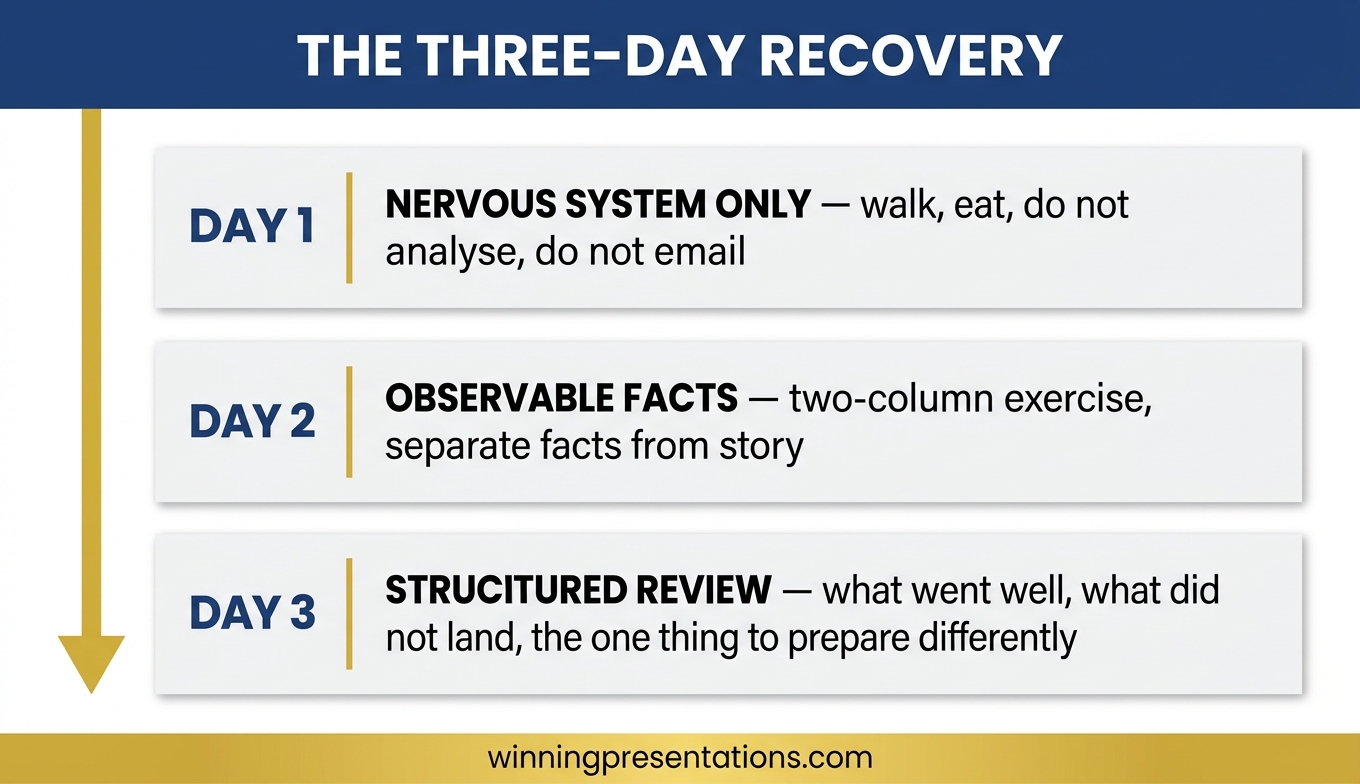

The three-day recovery timeline after a difficult presentation showing day one nervous system recovery, day two observable facts separation, and day three structured review with three questions

Recover the Confidence the Experience Is Trying to Take

Conquer Your Fear of Public Speaking covers the neuroscience of presentation recovery: how the nervous system stores a difficult speaking experience, how to keep a setback from becoming a narrative, and structured protocols for the days and weeks that follow.

£39 — instant access.

Explore the Programme →

Preparing for the Next One Without Over-Preparing

The biggest risk after a difficult presentation is over-correction. The presenter who stumbled on one question prepares twelve hours of Q&A answers for the next session. The presenter who lost the thread at minute fourteen scripts every word. The presenter who got a sceptical response from one board member rewrites the deck three times. Each of these is a caution response, and caution looks like preparation but behaves like constriction.

Over-prepared presentations land worse than well-prepared ones. They read as defensive, they sound rehearsed, and the presenter loses the responsiveness that makes live executive presentations feel alive. The audience feels the difference even when they cannot name it.

The discipline is to prepare the next presentation to the same standard you would have prepared it if the last one had gone well. Not more. Not less. If you would normally rehearse twice, rehearse twice. If you would normally prepare three anticipated questions, prepare three — including the one you could not answer last time. Preparing six because of last time is over-correction. Preparing two because you do not want to think about the topic is avoidance. Neither serves the next audience.

The one allowable change. Pick one specific thing from the day-three review and build it into the preparation for the next presentation. One. A single micro-change — “I will pause for three seconds before answering any question I do not immediately know the answer to” — produces the confidence gain that a global rewrite cannot. The brain registers that something has been improved. It does not need ten improvements to register that.

Related principles apply across any public speaking confidence setting — the fewer the deliberate changes, the more sustainable the rebuilding.

If you want a structured path through the recovery weeks, Conquer Your Fear of Public Speaking covers the nervous system regulation protocols and cognitive reframing techniques that underpin sustainable recovery.

The Long-Term Confidence Question

A single difficult presentation is a data point. A series of difficult presentations without recovery is a pattern. The long-term confidence question is whether the pattern is forming and, if it is, whether the cause is within the presentation itself or somewhere upstream.

Sometimes the upstream cause is physical — chronic sleep debt, under-recovery, caffeine stacked on cortisol. A presenter who is running on nothing will find any presentation destabilising, because the nervous system has no reserve. Addressing the physiology is upstream of addressing the presentation.

Sometimes the cause is structural — a role that requires presenting to an audience for which the presenter has not yet built the right mental model. Executive committee presentations are a different cognitive load from functional team updates, and the first few at a new level will feel harder even when preparation is identical. This is development, not failure, and treating it as failure compounds the problem.

And sometimes the cause is narrative — a story the presenter has been carrying for years, possibly from a single formative event early in their career, that now attaches itself to every difficult presentation. The solution is not another rehearsal. It is examining the story.

The practical move is to distinguish between these three causes before deciding what to change. Adding rehearsal to a physiology problem does not help. Adding rehearsal to a narrative problem makes it worse. Adding rehearsal to a developmental curve is appropriate but insufficient. Bouncing back from a setback depends on matching the intervention to the actual cause, not the apparent one.

Frequently Asked Questions

How long does it take to recover confidence after a bad presentation?

Most executives recover the felt confidence within two to four weeks if they follow a structured recovery process. The nervous system settles within seventy-two hours. The narrative takes longer, because the mind continues to rehearse the story in the weeks that follow. A deliberate, one-time structured review followed by the next presentation at comparable stakes usually closes the loop.

Should you apologise to the audience after a presentation you think went badly?

Rarely. Most apologies post-presentation are driven by the presenter’s discomfort rather than any need in the audience. They also amplify the signal that something went wrong — the audience often did not register the issue until the apology arrived. Only apologise if there is a specific, observable error that materially affected the audience’s understanding, and keep the apology factual and brief.

Is avoiding the next presentation ever the right move?

Almost never. Avoidance compounds the issue by making the next presentation bigger, not smaller. The shorter the gap between a difficult presentation and the next opportunity, the less the narrative has time to solidify. If you can present again within three to four weeks at comparable stakes, do.

Does it help to watch a recording of the presentation?

Only after day three, and only once. Before day three, the recording is experienced through the elevated state and tends to confirm the catastrophic story. After day three, one viewing, with a specific question in mind — “where did I lose the thread?” — can be diagnostic. Repeated viewings are rarely useful and often harmful.

Join The Winning Edge

Free weekly newsletter for executives working on speaking confidence, recovery from difficult presentations, and the neuroscience of presenting under pressure — delivered every Thursday.

Subscribe Free →

Not ready for the full programme? Start here instead: download the Public Speaking Cheat Sheets — nine printable guides covering pre-presentation protocols, nervous system regulation, and quick-reference recovery techniques.

Read next: If the thing that destabilised the presentation was a question you could not answer, see Handling a Question You Genuinely Cannot Answer in an Executive Setting for a complementary framework on responding in the moment.

The next step is tactical. If you are inside the first seventy-two hours, protect the physiology. If you are inside the first week, do the two-column exercise once, on paper, not in your head. If the next presentation is within a month, prepare it to your normal standard and build in exactly one micro-change. Recovery is not glamorous and is rarely dramatic — it is the accumulation of small, deliberate moves in a settled state.

Mary Beth Hazeldine is the Owner & Managing Director of Winning Presentations. With 24 years of corporate banking experience at JPMorgan Chase, PwC, Royal Bank of Scotland, and Commerzbank, she advises executives on structuring presentations and managing the psychology of high-stakes speaking — including the recovery period after a presentation that did not go as planned.

12 Feb 2026
Professional reflecting on past presentation experience with contemplative expression

Presentation PTSD Is Real: Signs You’re Still Carrying an Old Failure

It was seven years ago. I still remember exactly what I was wearing.

The room had 40 people. I was presenting quarterly results to the leadership team. Slide 12 — a chart I’d built myself — had an error. The CFO spotted it immediately. “These numbers don’t add up,” he said. Not quietly. Not kindly.

For the next three minutes, I stood there while he picked apart my work in front of everyone. My face burned. My voice disappeared. I wanted the floor to open and swallow me whole.

That presentation ended my confidence for years. Every time I stood up to speak after that, I wasn’t in the current room — I was back in that room, waiting for someone to find the error, waiting for the humiliation to start again.

If you’ve had a presentation experience that still affects how you feel about speaking — even years later — you’re not being dramatic. Your nervous system is doing exactly what it’s designed to do. It’s trying to protect you from a threat it still believes is real.

I’m writing about this now because presentation anxiety is increasingly recognised as a genuine psychological response, not a character flaw. Recent understanding of how trauma affects the nervous system explains why “just get over it” doesn’t work — and what actually does.

Quick answer: Presentation trauma occurs when a difficult speaking experience becomes encoded in your nervous system as a threat. Signs include physical reactions (racing heart, sweating, nausea) that seem disproportionate to the current situation, avoidance behaviours, intrusive memories of past failures, and anticipatory anxiety that starts days before a presentation. Recovery involves recognising the pattern, working with your nervous system rather than against it, and gradually rebuilding positive associations with speaking. Some people notice shifts relatively quickly; deeper patterns can take longer. The key is that recovery is possible — your nervous system learned this response, and it can learn something new.

⏰ Presenting in the next 48 hours?

Three things to do right now to calm your nervous system:

  1. Tonight: Use a guided nervous system reset before bed (18–20 min)
  2. Tomorrow morning: Avoid caffeine; do 5 minutes of slow breathing
  3. Minutes before: Use a 90-second physical reset in the corridor

If you’d rather work from a structured system, the Conquer Speaking Fear programme includes guided audio for each of those three moments.

Note: This article discusses presentation-related anxiety and trauma responses. While these experiences are common and the techniques here help many people, persistent or severe symptoms may benefit from support with a qualified mental health professional. The term “PTSD” is used colloquially here to describe trauma-like responses to presentation experiences — clinical PTSD is a specific diagnosis that requires professional assessment.

As a certified hypnotherapist who now works with executives on presentation anxiety, I’ve heard hundreds of these stories. The details differ — a forgotten line, a hostile question, a technology failure, a panic attack — but the pattern is remarkably consistent.

Something happened. It felt terrible. And now, years later, it still controls how you feel about presenting.

The good news: this isn’t permanent. Your nervous system learned this fear response, and it can unlearn it. But first, you need to understand what’s actually happening.

Signs You’re Carrying Presentation Trauma

Presentation trauma doesn’t always announce itself obviously. Sometimes it shows up as “I just don’t like presenting” or “I’m not a natural speaker.” But there are specific signs that suggest you’re carrying something from the past:

1. Your Body Reacts Before Your Mind Does

You get an email about an upcoming presentation. Before you’ve even processed what it says, your heart rate increases. Your stomach tightens. Your palms get clammy.

This instant physical response — before conscious thought — is a hallmark of trauma. Your nervous system has flagged “presentation” as a threat and is activating your fight-or-flight response automatically.

2. The Fear Seems Disproportionate

You’re presenting to three friendly colleagues about a topic you know well. Objectively, the stakes are low. But your body is reacting like you’re about to face a firing squad.

When the fear response doesn’t match the actual situation, it’s often because your nervous system is responding to a past threat, not the current one.

3. You Have Intrusive Memories

When you think about presenting, your mind automatically goes to that time it went wrong. You can see it clearly — the faces, the room, the moment everything fell apart. These memories arrive unbidden and feel uncomfortably vivid.

4. You Avoid at All Costs

You’ve turned down opportunities, delegated important moments to others, or restructured your career to minimise presenting. The avoidance has become a pattern that shapes your professional life.

5. Anticipatory Anxiety Starts Days (or Weeks) Early

A presentation is scheduled for next Thursday. By Sunday, you’re already feeling anxious. By Wednesday night, you can’t sleep. The dread builds exponentially as the date approaches.

6. You Experience Shame, Not Just Fear

There’s a difference between “I’m afraid of presenting” and “I’m ashamed of how I present.” Trauma often carries shame — a feeling that you are fundamentally flawed, not just that the situation is scary.

🎯 Release Presentation Trauma With Guided Nervous System Work

Conquer Speaking Fear — £39, instant access — uses hypnotherapy and NLP techniques specifically designed to work with your nervous system, not against it. The programme includes three audio tools for different moments:

  • Full Guided Session (18-20 min): Deep nervous system reprogramming — use the night before
  • 90-Second Reset Audio: Quick calm-down for the corridor or bathroom — minutes before
  • Printable Pocket Card: 4-step physical reset — in the moment when you need it

Get Conquer Speaking Fear → £39

Instant download. Created by a certified hypnotherapist who spent five years terrified of presenting — and found a way out.

Why Your Nervous System Won’t “Just Let It Go”

If you’ve ever been told to “just relax” or “it’s not a big deal,” you know how unhelpful that advice is. Here’s why your nervous system doesn’t respond to logic:

The Amygdala Doesn’t Have a Calendar

Your amygdala — the brain’s threat-detection centre — processes experiences without timestamps. A humiliating presentation from 2018 feels just as threatening as one happening right now, because to your amygdala, there’s no difference between “this happened” and “this is happening.”

Emotional Memories Are Stored Differently

Traumatic experiences aren’t filed away like regular memories. They’re stored in a fragmented, sensory way — which is why a particular room layout, a certain type of projector, or even a specific smell can trigger the whole response pattern.

Your Body Keeps the Score

The fear isn’t just in your mind — it’s encoded in your body. Your posture, your breathing pattern, your muscle tension all hold the memory. This is why cognitive approaches (“think positive thoughts”) often fail. The body remembers what the mind tries to forget.

Avoidance Reinforces the Fear

Every time you avoid presenting, your nervous system gets confirmation: “See? That was dangerous. Good thing we escaped.” The avoidance provides temporary relief but strengthens the fear response long-term.

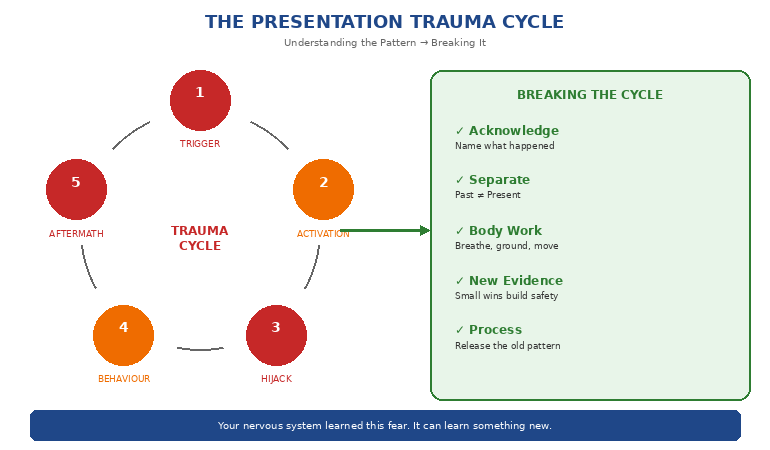
The Trauma Response Cycle

Understanding the cycle helps you interrupt it:

Stage 1: Trigger
Something reminds your nervous system of the original threat — a calendar invite, a request to present, even someone mentioning “presentation” in conversation.

Stage 2: Activation
Your fight-or-flight system activates. Heart rate increases, stress hormones release, blood flows away from your prefrontal cortex (thinking brain) toward your survival systems.

Stage 3: Hijack
Your rational mind goes offline. You can’t think clearly, can’t access your preparation, can’t remember that you’re actually safe. The past has hijacked the present.

Stage 4: Behaviour
You either fight (get defensive, speak too fast, overcompensate), flight (avoid, delegate, call in sick), or freeze (mind goes blank, voice disappears, body locks up).

Stage 5: Aftermath
Regardless of how the presentation actually went, you feel depleted, ashamed, and more convinced than ever that presenting is dangerous. The cycle reinforces itself.


Presentation trauma cycle showing trigger, response, and recovery pathway

Breaking the cycle means working with your body, not just your mind — the Conquer Speaking Fear programme (£39) is built around that principle, with guided audio that interrupts this exact pattern.

How to Release the Pattern

Recovery from presentation trauma isn’t about forcing yourself to present more (exposure therapy without proper support often makes things worse). It’s about working with your nervous system to create new associations.

Step 1: Acknowledge What Happened

Stop minimising. “It wasn’t that bad” or “I should be over it by now” keeps you stuck. Something happened that affected you. That’s real. Your response makes sense given what you experienced.

I spent years pretending my CFO moment didn’t bother me. Recovery only started when I admitted: that was humiliating, it hurt, and it changed how I felt about presenting.

Step 2: Separate Past from Present

When you notice the fear response activating, practice naming it: “This is my nervous system responding to 2018, not to today.” You’re not trying to make the feeling go away — you’re creating space between the trigger and your response.

Step 3: Work With Your Body

Because the trauma is stored in your body, body-based techniques are often more effective than cognitive ones:

  • Slow exhales: Longer exhales than inhales can help activate your parasympathetic nervous system
  • Grounding: Feel your feet on the floor, your weight in the chair — anchor yourself in the present moment
  • Movement: Shake out your hands, roll your shoulders — discharge the physical activation
  • Posture reset: Stand tall, open your chest — your body’s position affects your emotional state

Step 4: Create New Experiences

Your nervous system needs evidence that presenting can be safe. This doesn’t mean forcing yourself into high-stakes situations. It means starting small:

  • Speaking up in a meeting with one comment
  • Presenting to one trusted colleague
  • Recording yourself and watching without judgment
  • Gradually increasing the challenge as your nervous system adapts

Step 5: Process the Original Experience

Sometimes the old memory needs direct attention. Techniques like guided visualisation, timeline therapy, or working with a therapist can help you process what happened so it no longer controls your present.

This is where hypnotherapy-based approaches can be particularly effective — they work directly with the subconscious patterns that keep the trauma response active.

🧠 Nervous System Reprogramming for Presentation Trauma

Conquer Speaking Fear (£39, instant access) was created specifically for professionals carrying presentation trauma. The guided hypnotherapy session helps your nervous system release the old pattern and build new, calmer associations with speaking.

  • Work with your subconscious, not against it
  • Release the physical holding patterns
  • Build genuine confidence (not just “fake it”)
  • Three audio formats for different situations

Get Conquer Speaking Fear → £39

Instant download. Developed from hypnotherapy techniques that helped me release my own presentation trauma after five years of suffering.

Rebuilding Confidence After a Bad Experience

Once you’ve started releasing the trauma pattern, you can begin rebuilding genuine confidence:

Reframe the Original Story

The story you tell yourself about what happened matters. “I failed and everyone saw” is different from “I had a difficult experience and I survived it.”

My CFO story? I eventually reframed it: “I made an error, someone called it out publicly, and I handled a difficult moment without falling apart completely. I went back to work the next day. I kept presenting. I survived.”

Collect Counter-Evidence

Your brain has been selectively remembering the bad experience. Start noticing the neutral and positive ones. After each presentation — even a small one — note what went okay. Build a file of evidence that presenting doesn’t always mean disaster.

Prepare Differently

Trauma often creates over-preparation (spending 20 hours on a 10-minute presentation) or under-preparation (avoiding thinking about it until the last minute). Neither works.

Effective preparation for trauma recovery means: know your content well enough to feel secure, but accept that perfection isn’t the goal. Your safety doesn’t depend on getting everything right.

Build Physical Anchors

Create associations between specific physical actions and calm states. When you’re relaxed, practice a subtle gesture (touching your thumb to your finger, for example). Over time, this gesture can help trigger the calm state — giving you a tool you can use in the moment.

This anchoring technique is part of what makes nervous system-based approaches so effective for presentation anxiety.

What Recovery Actually Looks Like

Recovery from presentation trauma isn’t linear, and it doesn’t mean you’ll never feel nervous again. Here’s what realistic progress looks like:

Week 1-2: You start noticing the pattern — recognising when your nervous system is responding to the past rather than the present.

Week 3-4: The anticipatory anxiety begins to shorten. Instead of dreading a presentation for two weeks, you might dread it for a few days.

Month 2-3: You have a presentation that goes “okay” and notice it. The negative bias starts shifting.

Month 3-6: The physical symptoms become less intense. Your heart still races, but it doesn’t feel life-threatening. You can think while nervous.

Ongoing: Presenting becomes uncomfortable rather than terrifying. You can do it without it ruining your week. Eventually, some presentations feel almost… fine.

This timeline varies. Some people see significant shifts in weeks; others take longer. The key is that progress is possible — your nervous system can learn new patterns.

🎓 25 Years Coaching Senior Professionals Through Speaking Fear

Conquer Your Fear of Public Speaking is built from 16 years coaching senior professionals across financial services, consulting, healthcare, and technology — alongside 25 years of corporate banking experience. Every technique — the nervous system regulation work, the trauma-informed preparation rituals, the in-the-moment recovery scripts — comes from real client work with executives who came to speaking with histories that needed careful, not generic, approaches.

Designed for senior professionals whose speaking fear has roots in past experience, not just nerves — and who need approaches that respect that history.

Get Conquer Your Fear of Public Speaking → £39

Instant download — lifetime access to every framework and technique.

Frequently Asked Questions

Is “presentation PTSD” a real diagnosis?

The term is used colloquially to describe trauma-like responses to presentation experiences. Clinical PTSD is a specific diagnosis with defined criteria that requires professional assessment. However, the nervous system responses described in this article — hypervigilance, avoidance, intrusive memories, disproportionate fear responses — are real and well-documented, even if they don’t meet the clinical threshold for PTSD. Your experience is valid regardless of diagnostic labels.

How long does it take to recover from presentation trauma?

This varies significantly based on the severity of the original experience, how long ago it happened, and what support you have. Some people notice shifts within a few weeks; deeper patterns may take several months of consistent work. There’s no universal timeline — everyone’s nervous system responds differently. If you’re not seeing progress after sustained effort, consider working with a therapist who specialises in anxiety or trauma responses. The key is that recovery is possible — your nervous system learned this response, and it can learn a new one.

Should I force myself to present more to get over it?

Exposure without proper support can actually reinforce the trauma. Simply forcing yourself through more presentations while activated often strengthens the fear response. The goal is to present while regulated — which requires first developing tools to work with your nervous system. Gradual, supported exposure works; white-knuckling through high-stakes presentations usually doesn’t.

Can I fully recover, or will I always be anxious about presenting?

Most people don’t become completely anxiety-free — some presentation nerves are normal and even useful. What changes is the intensity and the control. Instead of anxiety hijacking your ability to think and speak, it becomes manageable background noise. Many people who’ve done this work eventually describe presenting as “uncomfortable but doable” rather than “terrifying and avoided at all costs.”

📬 PS: Weekly techniques for managing presentation anxiety and building genuine confidence. Subscribe to The Winning Edge — practical strategies from a hypnotherapist who’s been there.

Related: If presentation trauma is holding you back from career moments like requesting resources or budget, read The Headcount Request That Got Yes When Everyone Said No for a presentation structure that builds confidence through preparation.

That presentation from years ago — the one you still think about — doesn’t have to control your future.

Your nervous system is doing what it was designed to do: protect you from perceived threats. But the threat isn’t real anymore. The room is different. The audience is different. You are different.

Recovery is possible. Your nervous system learned to fear presenting, and it can learn something new.

It starts with acknowledging what happened, understanding why your body responds the way it does, and working with your nervous system rather than against it.

The past doesn’t have to own your present. You can let it go.

About the Author

Mary Beth Hazeldine is the Owner & Managing Director of Winning Presentations. With 25 years in corporate banking at JPMorgan Chase, PwC, Royal Bank of Scotland, and Commerzbank, she experienced presentation trauma firsthand — including five years of debilitating fear before finding techniques that actually worked.

Now a certified hypnotherapist and NLP practitioner, Mary Beth specialises in helping professionals release presentation anxiety at the nervous system level. She combines executive communication expertise with evidence-based approaches to fear and trauma recovery.

Book a discovery call | View services