

Quick answer: Half-year burnout is why June is the month presentation confidence often breaks for senior leaders, and it is not the same thing as a single bad presentation. It is an accumulation: six months of high-stakes presenting — board updates, pitches, all-hands, quarter reviews — each one drawing on a reserve that the standard advice assumes refills on its own and that, by June, has not. The presenter who was steady in February is now reading a normal flutter of nerves as evidence that something has changed, which adds a second layer of anxiety on top of the first. The fix is not to push through. It is to recognise the accumulation for what it is and run a deliberate reset: separating the physical symptoms you can manage in the room from the depleted reserve you can only refill out of it, lowering the stakes you have quietly inflated, and rebuilding the evidence base your confidence is actually supposed to rest on. June feels like the month your nerve failed. It is usually the month your reserve ran out, which is a different problem with a different solution.
JUMP TO:
In 2019 I coached a senior leader — a divisional director in a professional services firm, someone who had presented at a senior level for fifteen years without difficulty — who came to me in late June convinced he had developed a presentation problem he had never had before. He described it precisely: he had stood up to give a routine half-year update to his leadership team, a room of people he knew well, and felt his voice go unsteady in a way it had not done since he was a junior manager. He had a printed copy of his own deck in front of him, and he told me he had looked down at it mid-sentence and lost his place on a slide he had built himself. Nothing about the meeting was high-stakes. That was what frightened him. “If I’m shaking in front of my own team in June,” he said, “what happens in the autumn when the real ones start?” When we mapped his year, the answer was obvious in a way it had not been to him from the inside. Since January he had given thirty-one presentations, eleven of them genuinely high-stakes — a refinancing pitch, two board updates, a regulatory session. He had not had a clear week without a significant presentation since the second week of January. He did not have a new presentation problem. He had run out of reserve, and the unsteady voice in June was the first time his body had told him so.
I have now worked with a large number of senior presenters who arrive in June and early July with exactly this story, and the shape almost never varies. The presenter has had a heavy first half. They have been steady throughout it, which is itself part of the problem — being steady felt free, so they kept spending. Then somewhere around the half-year mark, in a meeting that should have been easy, the steadiness is suddenly not there, and they read its absence as a loss of nerve. It is not a loss of nerve. It is the predictable result of drawing on a finite reserve for six months without deliberately refilling it. The reason June is the month it shows up is arithmetic: the first half is when the reserve gets spent, and the half-year point is when the running total finally comes due.
(This article was created with AI assistance; all stories and insights are based on 35 years of real client work.)
I spent five years early in my own career genuinely afraid of presenting — credit committees, client meetings, even speaking up in internal discussions — so I am not describing this from the outside. What I learned, and what I now teach, is that the standard performance-anxiety toolkit is built for a single acute event and quietly assumes your baseline is intact. Half-year burnout breaks that assumption, because the baseline itself has dropped. The half-year reset protocol I want to describe is built for the depleted-baseline version of the problem. It has three components, each with its own test: separate the symptoms from the reserve, deflate the stakes you have inflated, and rebuild the evidence base. The presenter who runs the reset in late June walks into the autumn with the reserve restored. The presenter who pushes through carries the depletion into the high-stakes second half, which is exactly when they can least afford it.
If the in-the-moment symptoms are what frighten you most:
Calm Under Pressure is a focused set of rapid-response techniques for the physical symptoms of presentation anxiety — shaking hands, racing heart, trembling voice, the sudden blank — the methods you can use in the room, in the moment, without anyone noticing. Built for the version of burnout where the body reacts before the mind has caught up.
Why half-year burnout is an accumulation, not an event
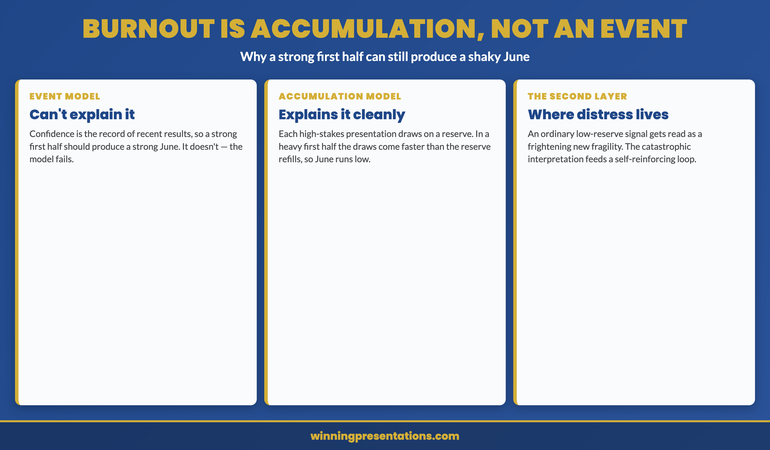
The mental model most senior presenters carry is event-based: a presentation goes well or it goes badly, and your confidence is the running record of recent results. On that model, a strong first half should produce a strong June, because the recent record is good. That is exactly why half-year burnout is so disorienting — the record is good, and the confidence has dropped anyway, which the event-based model cannot explain. The accumulation model explains it cleanly. Each high-stakes presentation draws on a reserve of focus, adrenaline regulation, and recovery capacity. A single presentation spends some of the reserve and, given recovery time, the reserve refills. The problem in a heavy first half is that the presentations come faster than the reserve refills, so the running balance drops even though each individual presentation went well. By June the balance is low, and a low balance shows up as the steadiness suddenly being unavailable in a moment that should have been easy.
This is why the timing is so consistent across very different people and roles. It is not about the difficulty of any one June meeting; it is about where June sits in the year. The first six months are when the reserve gets drawn down — new-year planning, Q1 reviews, the spring pitch and budget season, the half-year close — and the half-year mark is simply when the cumulative draw catches up with the supply. A presenter whose heavy season ran October to March would feel the same thing in April; the calendar varies, the pattern does not. Recognising burnout as accumulation rather than event is the first move of the reset, because it reframes the unsteady June meeting from “I have lost my nerve” to “my reserve is low,” and those two readings lead to completely different actions. The first leads to shame and pushing harder. The second leads to a refill. The wider pattern of high-stakes presentation burnout follows this same accumulation logic.
The second layer of anxiety that makes June feel worse
What turns a manageable dip into something that feels like a crisis is the second layer the presenter adds on top. The unsteadiness in the June meeting is the first layer — an ordinary physical signal of a low reserve. The second layer is the interpretation: “this has never happened before, something is wrong with me, what does this mean for the autumn.” The second layer is where the real distress lives, and it is entirely a product of misreading the first. A presenter who reads the unsteadiness as a low reserve feels a flutter and lets it pass. A presenter who reads it as the onset of a career-threatening problem feels the same flutter and pours fear into it, which raises the arousal further, which produces more symptoms, which confirms the catastrophic reading. The loop is self-feeding, and it is built entirely on the interpretation, not on the original signal.
This is why the most useful single intervention in half-year burnout is often nothing more than the correct diagnosis. The senior leader I described earlier improved markedly the moment we mapped his year and he saw thirty-one presentations and no clear week — not because anything about his reserve had changed in that conversation, but because the catastrophic second layer dissolved. The unsteadiness was no longer evidence of a mysterious new fragility; it was the obvious consequence of a workload, and obvious consequences are not frightening. Removing the second layer does not refill the reserve, but it stops the reserve problem from masquerading as an identity problem, and that alone brings the felt intensity down by a large margin. The mechanism here — separating the bodily signal from the catastrophic story laid over it — is the core of the cognitive work in presentation nerves training.
Rebuild the reserve before the high-stakes second half, not during it.
Conquer Your Fear of Public Speaking is the full programme behind this article — built by someone who spent five years afraid of presenting and worked out, method by method, how to get the reserve back and keep it. It covers the diagnostic that separates a low reserve from a real fear, the techniques that bring the in-the-moment symptoms down, and the practice structure that rebuilds the confidence the first half spent. £39, instant download, lifetime access.
- The diagnostic that tells a depleted reserve apart from an underlying fear — so you treat the right problem
- Rapid techniques for the physical symptoms that show up first when the reserve is low
- The cognitive work that removes the catastrophic second layer June burnout adds
- A practice structure for rebuilding confidence on evidence rather than on the last result
The half-year reset protocol
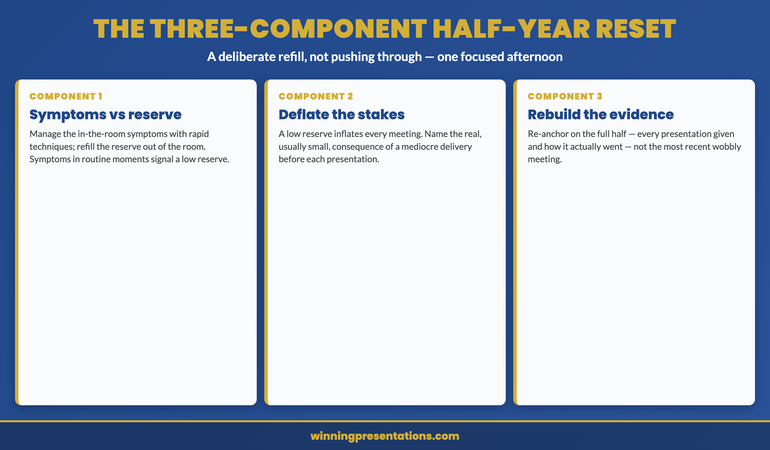
The first component of the reset is separating the symptoms from the reserve. These are two different problems that feel like one, and they need different treatment. The symptoms — the unsteady voice, the racing heart, the momentary blank — are real, immediate, and manageable in the room with rapid-response techniques. The reserve is the underlying capacity, and it cannot be managed in the room at all; it can only be refilled out of it, over days, through recovery. The presenter who confuses the two tries to fix a reserve problem with in-the-moment techniques, finds the techniques only partly work, and concludes the techniques have stopped working — when in fact they were never designed to refill a reserve. The test for this component is simple: ask whether the symptom appeared in a genuinely high-stakes moment or in a routine one. Symptoms in routine moments are a reserve signal, not a stakes signal, and they point to refill rather than technique.
The second component is deflating the stakes you have inflated. A depleted reserve quietly raises the perceived stakes of every presentation, because a tired system reads more situations as threatening. The June meeting that should have felt routine felt high-stakes precisely because the low reserve inflated it. The deflation move is to name, before each presentation in the burnout window, what the actual consequence of a mediocre delivery would be — not the catastrophic imagined consequence, the real one. For the internal half-year update, the real consequence of a shaky delivery is close to nothing; the team knows the presenter and judges them on a year of work, not one meeting. Naming the real, usually small, consequence deflates the inflated stakes and removes a layer of arousal. The third component is rebuilding the evidence base, which I will come to in the next section, because it is the component that actually restores the reserve rather than just managing its effects.
For the in-the-room half of the reset:
Calm Under Pressure gives you the rapid-response side — the techniques for shaking hands, racing heart, trembling voice and the sudden blank that you can use in the moment, discreetly, while the slower work of refilling the reserve happens out of the room. It pairs naturally with the deflation and evidence work above: the techniques hold the symptoms while the reset rebuilds the baseline. £19.99, instant download.
What you can manage in the room and what you can only refill out of it
The third component — rebuilding the evidence base — is the one that actually refills the reserve, and it is the one most senior presenters skip because it does not feel like a presentation skill. By June, a depleted presenter is running on the most recent result, which in a burnout state is often the wobbly June meeting. That makes the most accessible evidence the worst evidence. The rebuild move is to deliberately re-anchor the evidence base on the full half rather than the last meeting: the thirty-one presentations given, the eleven high-stakes ones survived, the refinancing pitch that landed, the board updates that held. The depleted presenter has all of this evidence and is simply not looking at it, because the low reserve narrows attention to the most recent and most negative data point. Writing the full half down — literally listing the presentations given and how they actually went — rebuilds the evidence base the confidence is supposed to rest on, and it is the closest thing to a direct refill the reset offers.
The practical version of all three components fits in a single afternoon. Block two hours in late June. Map the year — every significant presentation since January, and how each one actually went, not how it felt. The map does two things at once: it surfaces the accumulation (you will see the workload that drained the reserve) and it rebuilds the evidence base (you will see how much went well). Then, for the next month, name the real consequence of each presentation before you give it, and use rapid-response techniques for the symptoms in the room while the reserve refills out of it. The presenter who does this in late June arrives at the autumn’s high-stakes season with the reserve restored and the catastrophic second layer gone. The one who treats the June wobble as a character flaw and pushes through carries a depleted reserve into exactly the presentations that need a full one.
Treat the reserve now, while the stakes are low.
Conquer Your Fear of Public Speaking gives you the full method — diagnostic, in-the-moment techniques, and the practice structure that rebuilds confidence on evidence. Instant download, lifetime access, £39 once. Built for senior presenters who would rather refill the reserve in a quiet June than discover it is empty in a high-stakes October.
Frequently asked questions
How do I tell half-year burnout apart from a deeper, longer-standing presentation fear?
The clearest tell is the history. Half-year burnout shows up as a change — you were steady earlier in the year and the steadiness dropped — and it tracks a heavy workload. A longer-standing fear is present at a stable level regardless of workload and usually has a longer history behind it. The year-map is the diagnostic: if mapping your presentations since January shows a heavy first half and a confidence drop that follows it, you are most likely looking at burnout, which responds to a reset. If the map shows a fear that was there at the same level in a light period as in a heavy one, you are looking at something the reset alone will not fully resolve, and the deeper work in a full programme is the better route. The two can also coexist, in which case the reset still helps because it removes the burnout layer sitting on top.
I don’t have time for a reset — the second half is already filling up. What’s the minimum?
The two-hour year-map is the irreducible minimum, and it is the highest-value two hours you can spend, because it does the diagnosis and the evidence rebuild at once. If you do nothing else, block those two hours before the autumn season starts. The reason it matters more when you are busy, not less, is that a depleted reserve carried into a heavy second half compounds — each high-stakes presentation drains a reserve that is already low, and the symptoms get more frequent rather than less. Two hours of reset now is cheaper than a second half spent managing escalating symptoms in the room. The busiest presenters are precisely the ones who most need the deliberate refill, because their workload is what drained the reserve in the first place.
Does this only happen to people who are anxious presenters generally?
No — it happens most visibly to confident presenters, which is part of why it is so disorienting for them. A naturally anxious presenter expects nerves and is not shocked when they appear. A presenter who has been steady for years has no framework for a sudden drop, reads it as a frightening new development, and adds the catastrophic second layer that makes June burnout feel like a crisis. Confidence built on a long record of steadiness is actually more vulnerable to the accumulation pattern, because the presenter has never had to think about their reserve and so has never learned to refill it deliberately. The strong first half that drained the reserve is usually the work of a capable, in-demand presenter, not a struggling one.
What is the single most useful thing to do the morning of a presentation during a burnout patch?
Name the real consequence of a mediocre delivery out loud, before you build any adrenaline around the meeting. A depleted reserve inflates the stakes of everything, so the most useful single move is the deflation: say plainly what would actually happen if this particular presentation went only averagely — which, for most meetings in a normal week, is very little. Pair that with one rapid-response technique ready for the symptoms if they appear in the room. The deflation lowers the arousal going in; the technique handles the symptom if it shows up anyway. Together they get you through the individual meeting without spending reserve you do not have, while the slower reset work refills the baseline between meetings.
The Winning Edge — weekly newsletter
The Winning Edge is a weekly newsletter for senior professionals who present at the executive level. One short email a week on the structural and psychological moves that keep a strong presenter steady across a long, heavy year. Subscribe to The Winning Edge →
For more on the patterns behind a mid-year confidence drop, see high-stakes presentation burnout and the wider confidence resources on the services page.
About the author
Mary Beth Hazeldine is Owner & Managing Director of Winning Presentations Ltd. With 24 years of corporate banking experience at JPMorgan Chase, PwC, Royal Bank of Scotland, and Commerzbank, she advises executives across financial services, healthcare, technology, and government on presenting under pressure. Having spent five years early in her own career afraid of presenting, she now helps senior leaders build confidence that holds across a demanding year.
The next time June arrives and the steadiness is not there, do three things instead of pushing through: block two hours and map every presentation since January, so you can see the workload that drained the reserve and the record that should be rebuilding your evidence base; name the real, usually small, consequence of a mediocre delivery before each meeting, so the depleted reserve stops inflating ordinary stakes into threats; and keep a rapid-response technique ready for the symptoms in the room while the reserve refills out of it. The presenter who runs the reset in a quiet June walks into the autumn with a full reserve. The presenter who reads the June wobble as a lost nerve and pushes through carries an empty one into exactly the presentations that need it most.


