

Quick answer: If you find that a quieter summer makes the dread of presenting worse rather than better, you are not imagining it — a slowdown does three things to an anxious presenter, and all three raise the pressure. It detrains you: the familiarity that regular presenting builds fades, so the skill feels rusty even though it has not actually gone. It inflates the next event: with fewer presentations on the calendar, the one in September carries more weight, because it is no longer one of many but the only one. And it opens up rumination space: an empty calendar gives anticipatory anxiety somewhere to expand, so “rest” quietly becomes weeks of rehearsing the dread. The antidote is not to wait for September and hope; it is to keep the skill warm with small, low-stakes speaking reps through the quiet weeks, so the next big presentation is not a standing start. Test your exposure with one question: when is my next real presentation, and how many small speaking reps will I have had before it? If the honest answer is “September, and none,” you are set up for a spike — and the fix is to put the reps in now.
JUMP TO:
In 2018 I worked with a senior manager who had, by her own account, finally got her presentation nerves to a manageable place. Through a busy spring she had presented most weeks — team updates, a couple of client meetings, a board sub-committee — and somewhere in that run the fear had settled into something she could live with. Then the summer came. Her calendar emptied out: clients went quiet, the committee paused until September, her own diary opened into long unbroken weeks. She expected to feel relief. Instead, by early August she described a creeping dread she had not felt since the previous year — a tightness whenever she thought about the big strategy presentation waiting for her on the other side of the break. Nothing had gone wrong. She had not had a bad experience. She had simply stopped presenting for six weeks, and the fear, which the busy spring had kept in its box, had quietly climbed back out. She rang me in the third week of August to ask why resting had made it worse.
(This article was created with AI assistance; all stories and insights are based on 35 years of real client work.)
It is one of the most counterintuitive things about presentation anxiety, and one of the most common: for a lot of people, presenting often is what keeps the fear small, and a stretch with no presenting lets it grow. We assume the relationship runs the other way — more presenting, more stress; less presenting, more peace — and for the event itself that is true, a quiet week is genuinely calmer than a busy one. But the fear of presenting is not really about any single event; it is about the looming next one, and a slowdown does something specific and unhelpful to how that next one looms. This piece explains the three mechanisms behind it — why a quiet summer detrains you, inflates the next presentation, and hands your anxiety the empty space to grow in — and sets out the simple maintenance practice that keeps the skill warm so the first presentation back in September is not the hardest one of your year.
Why rest doesn’t calm the fear
The expectation that a break will calm presentation anxiety rests on a model of fear as a battery that depletes with use and recharges with rest. Present a lot and you run down; stop and you recover. For physical tiredness that model is roughly right, and a genuinely exhausted presenter does need rest. But the fear of presenting does not behave like a depleting battery, because it is not primarily driven by how recently you presented — it is driven by your relationship with the next time you will. And rest does nothing to improve that relationship. If anything, it removes the very thing that was keeping the relationship manageable: the steady, repeated experience of doing the feared thing and surviving it.
This is the part that surprises people. Regular presenting, for an anxious presenter, functions a little like regular exposure to anything feared — each time you do it and come out the other side, the threat signal turns down a notch, and the skill stays familiar in your hands and mouth. You are not necessarily enjoying it, but you are accumulating evidence, week after week, that you can do this and the catastrophe does not arrive. A busy season quietly runs that exposure for you. When the season stops, the exposure stops too, and the threat signal — which was being held down by repetition, not by resolution — begins to drift back up. The fear was never gone; it was being managed by the very activity you have now paused. Even confident, experienced presenters still feel nerves, and what keeps those nerves workable is usually contact with the activity, not distance from it.
So the quiet summer that should have been a relief becomes, for the anxious presenter, a slow withdrawal of the thing that was keeping the fear in proportion. The relief is real for a week or two — the immediate pressure of the next meeting lifts — and then a different and less obvious pressure takes its place: the growing weight of a return that gets larger the longer the gap runs. Understanding this does not make the summer less worth resting in; it makes clear that the rest has a cost for presenters specifically, and that the cost is payable in September unless you do something small to offset it across the weeks in between.
The three things a quiet stretch does
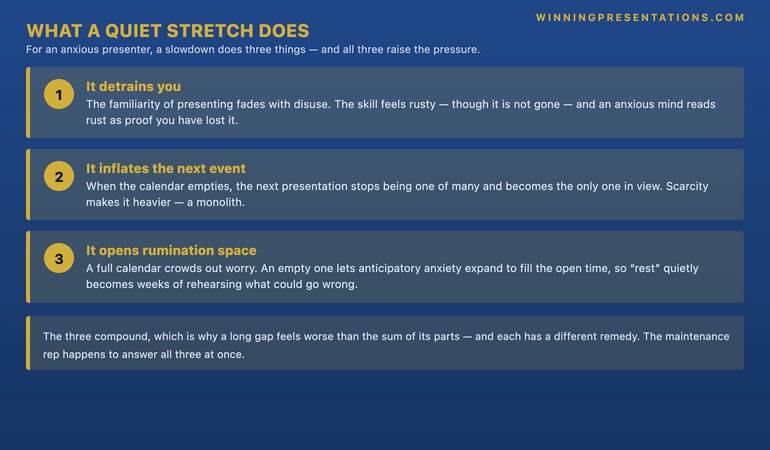
A quiet stretch raises an anxious presenter’s pressure through three distinct mechanisms. They compound, which is why a long gap can feel so much worse than the sum of its parts, and naming them separately is the first step to addressing each one rather than treating the whole thing as a vague mood.
One, it detrains you. Presenting is a skill, and like any skill it has a familiarity that fades with disuse. After six weeks away the words do not come as readily, the timing feels less sure, the physical ease of standing and speaking is slightly stiff. The skill is not gone — you have not forgotten how — but it feels rusty, and that rustiness reads to an anxious mind as evidence that you have lost it, which feeds the fear. Two, it inflates the next event. When you present most weeks, any single presentation is one of many, and a low-stakes one barely registers. When the calendar empties, the next presentation becomes singular — the only one in view, the one all your attention converges on — and scarcity makes it heavier. The September strategy talk that would have felt routine in a busy spring becomes, in an empty August, a monolith. Three, it opens up rumination space. A full calendar crowds out worry; there is no room to dwell because the next thing is always arriving. An empty calendar is the opposite — it is open time, and anticipatory anxiety expands to fill open time the way work expands to fill the hours available. The “rest” becomes, without your choosing it, weeks of low-grade rehearsal of everything that could go wrong. Anticipatory anxiety thrives on exactly this kind of unstructured anticipation.
What makes the three mechanisms important is that each has a different remedy, so naming which ones are operating tells you what to do. Detraining is answered by keeping the skill in use — small reps that maintain familiarity. Inflation is answered by keeping more than one presentation in view, so no single one becomes the monolith. Rumination space is answered by giving the anticipation structure — a plan, a practice, a schedule — rather than leaving it open for the fear to colonise. The single practice in the next section happens to address all three at once, which is why it works so well, but it helps to see that you are not fighting one big amorphous dread; you are fixing three specific, understandable effects of having stopped.
When the fear climbs back over a quiet stretch, the answer is the response underneath it — not gritting through the next talk.
Conquer Your Fear of Public Speaking is built from exactly this territory — five years of presenting while frightened, and the methods that brought the fear under control. It works on the underlying anxiety response that lets a quiet gap inflate the next presentation into a monolith, so you meet September from a steadier baseline instead of a spike that has been building all summer.
- How the fear response actually works — and why distance from presenting can make it grow, not shrink
- Practical techniques for keeping anticipatory dread from filling the open weeks
- The mindset shift that stops a quiet stretch reading as “I’ve lost it”
- Built for real high-stakes rooms — committees, clients, conferences. Instant access, lifetime use — £39
The first-rep test
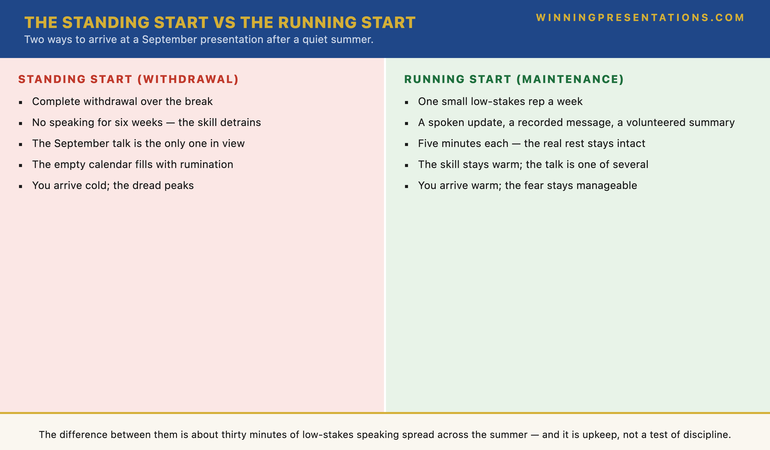
The simplest way to know whether you are walking into a September spike is a single question, asked honestly in June or July: when is my next real presentation, and how many small speaking reps will I have had before it? The test is diagnostic because it surfaces the exact condition that produces the worst returns — a long gap ending in a high-stakes event with nothing in between. If your honest answer is “a big presentation in September, and no speaking of any kind before then,” you have just described the standing start: weeks of detraining and rumination, terminating in a monolith. That is the setup for the spike my client felt in her third week of August, and the test catches it while there is still time to change the answer.
The value of the test is that it makes an invisible risk concrete. Most presenters do not see the summer spike coming, because nothing is going wrong — there is no bad experience to point at, just an empty calendar that looks like a good thing. The dread arrives in August feeling like it came from nowhere, when in fact it was entirely predictable from the shape of the calendar in June. Asking the first-rep question in advance converts “I feel oddly anxious and I don’t know why” into “I have a six-week gap before a high-stakes talk, so of course the pressure is building — and here is what I can do about it.” The relief of having a cause and a plan is itself part of the remedy.
The test also points straight at the fix, because the variable it measures — reps before the next big one — is the one you can change. You usually cannot move the September presentation, and you cannot manufacture a busy summer out of nothing. But you can almost always insert small speaking reps into the quiet weeks, and the test tells you how many you need: enough that the September talk is not the first time you have stood up and spoken in months. The goal is not to fill the summer with presentations — that would defeat the rest you genuinely need — but to keep the count above zero, so the skill stays warm and the next big event has company in your recent memory. One small rep a week, across six quiet weeks, is the difference between a standing start and a running one.
The maintenance-rep practice
The maintenance-rep practice is deliberately undemanding, because the point is consistency, not intensity. A maintenance rep is any small, low-stakes occasion to speak on your feet or out loud to others: a two-minute spoken update on a team call instead of a written one, a short recorded video message to your team rather than an email, volunteering to give the quick summary at a meeting you would normally sit quietly in, even a five-minute talk-through of your weekend plans to a partner who agrees to listen as if they were an audience. None of these is a presentation in the high-stakes sense, and that is exactly the point — they keep the skill in use and the threat signal turned down without demanding the energy or the exposure of a real event. The fitness analogy is precise: you are not training hard over the summer, you are doing enough to not detrain, so you are not starting from cold in September.
In 2019 I worked with a leader who had felt the summer spike the year before and decided to test the practice. Over a quiet July and August he did one deliberate maintenance rep a week — usually a spoken rather than written update on his weekly team call, occasionally a short recorded message — treating each one, privately, as a rep rather than a chore. They cost him five minutes each and felt almost trivial. When his September strategy presentation arrived, the thing he reported was not that he felt no nerves — he did — but that the talk did not feel like the first in months. The skill was in his hands, the act of standing and speaking was familiar, and the presentation was one of several recent speaking occasions rather than a monolith looming over an empty calendar. The maintenance reps had not removed the fear; they had kept it the manageable size it had been in the busy spring, which was all he needed. The contrast with the client who rested completely and spiralled into August was stark, and the difference between them was about thirty minutes of low-stakes speaking spread across the summer.
The practice works on all three mechanisms at once, which is why such a small input has such a disproportionate effect. It directly counters detraining by keeping the skill in regular use. It deflates the next event by ensuring the September talk is not the only presentation in view — it sits among a string of recent speaking occasions, even small ones, so it stops being singular. And it closes off rumination space by giving the quiet weeks a structure: a weekly rep is a small recurring commitment that the anxiety has to share the calendar with, rather than empty time it can expand into freely. The same principle — that confidence is maintained by contact, not by waiting — is why so many presenters find their fear worst after their longest gaps, and best when they keep a steady, low-stakes hand in.
This is not a discipline problem
It is worth saying plainly, because anxious presenters are quick to turn this into another stick to beat themselves with: the summer spike is not evidence that you are weak, lazy, or insufficiently resilient. It is a predictable consequence of how fear and skill respond to a gap, and it happens to capable, experienced people who have done nothing wrong — the client who rang me in August was good at her job and good on her feet, and she spiralled not because she lacked grit but because she rested completely, exactly as she had been told rest was the answer. The mechanisms are doing what mechanisms do. Knowing that they are mechanisms, rather than personal failings, matters because self-criticism is itself a multiplier of presentation anxiety: a presenter who reads their rising summer dread as proof of inadequacy adds a layer of shame on top of the fear, and the shame makes the September talk heavier still.
The healthier frame is the one any athlete or musician would recognise: skills detrain, and you maintain them with light, regular practice rather than berating yourself for the rust. No one tells a runner that needing to keep training over a quiet period is a character flaw; it is simply how bodies work, and presenting works the same way. Treating your maintenance reps as ordinary upkeep — the equivalent of a gentle weekly run, not a moral test — takes the charge out of the whole thing. You are not proving anything by doing them, and you have not failed by needing them. You are just a presenter keeping a presenter’s skill warm over a quiet stretch, which is exactly what a sensible presenter does.
This reframe also protects the rest itself. The point of maintenance reps is emphatically not to deny yourself a genuine break or to fill the summer with anxious over-preparation — that would replace one problem with another, swapping detraining for burnout. The reps are small precisely so that the rest around them stays real. You can take the holiday, switch off the email, and genuinely recover, while still doing the one small weekly thing that keeps you from arriving in September cold. The two are not in tension; the maintenance rep is what lets you rest properly without paying for it in dread, because it removes the hidden cost that makes complete withdrawal backfire for presenters in the first place.
Maintenance reps keep a manageable fear from growing — but if every quiet stretch turns into a battle, the fear underneath is the thing to work on.
Conquer Your Fear of Public Speaking goes underneath the calendar to the anxiety response itself, so that gaps and returns stop carrying so much charge. It is drawn from five years of presenting while frightened and the methods that brought the fear under control — not a promise that the nerves vanish, but a steadier baseline from which a quiet summer no longer reads as “I’ve lost it” and a September return no longer looms as a monolith.
- Lower the baseline fear, so quiet periods stop drifting it upward in the first place
- Stop the “I’ve lost the skill” story that rust over a gap triggers in an anxious mind
- Present from a steadier place whether you have presented every week or none
- Built for real high-stakes rooms — committees, clients, conferences. Instant access, lifetime use — £39
One thing to do this week
This week, before the quiet stretch properly arrives, do one concrete thing: open your calendar, find your next genuinely high-stakes presentation, and count the weeks of quiet between now and then. Then put a single small speaking rep into each of those weeks — a spoken update instead of a written one, a two-minute summary you volunteer to give, a recorded message in place of an email — and write it in as a recurring five-minute commitment, not an aspiration. Keep them deliberately small; the aim is to keep the count above zero, not to fill the summer. If you do only this, you will arrive at the September presentation having stood up and spoken every week of the gap, and it will be one of several recent occasions rather than the first in months. The dread that would otherwise build into August has nowhere to grow when the skill stays warm and the calendar is not empty.
Frequently asked questions
Doesn’t everyone deserve a real break — isn’t forcing speaking reps over the summer just denying yourself rest?
The maintenance reps are designed to protect your rest, not to deny it. They are small on purpose — five minutes of low-stakes speaking a week — precisely so the genuine break around them stays intact. You can still switch off, take the holiday, and recover; the weekly rep is not a presentation and does not require preparation or energy. What actually denies presenters a real rest is the hidden cost of complete withdrawal: the dread that builds across an empty calendar and turns the supposed break into weeks of low-grade anxiety about September. The reps remove that cost, so you can rest properly. Far from being the opposite of rest, they are what makes a real rest possible for someone whose fear grows in the gaps.
What if my anxiety is bad enough that even small reps feel too much during the summer?
Then start smaller than you think you need to, and treat the size of the rep as adjustable. A maintenance rep does not have to be a team call — it can be speaking your point of view aloud to one trusted person, or recording a two-minute message you never even send, just to keep the act of speaking on your feet familiar. The principle is contact, not difficulty, and any contact counts. If the anxiety is severe enough that all speaking feels overwhelming and is interfering with your work or life more broadly, that is worth treating as its own issue rather than a scheduling one — the underlying fear response is what needs attention, and working on that directly will do more than any number of reps. The reps maintain a manageable fear; they are not a substitute for addressing one that has become unmanageable.
How quickly does the dread come back if I stop presenting — is a two-week holiday enough to cause this?
A standard two-week holiday is rarely the problem; it is the longer, open-ended quiet stretches — six weeks or more with nothing on the calendar — that reliably produce the spike. A fortnight away usually sits within the range your recent presenting still covers, so the skill stays familiar and the next event is still close enough not to inflate. The risk rises with the length of the gap and the stakes of what waits on the other side: a long summer ending in a major presentation is the classic setup, while a short break between regular presentations is genuinely just rest. Use the first-rep test rather than a fixed number — if the gap is long and the return is high-stakes, add the reps; if it is short and the calendar resumes normally, you can simply enjoy the break.
Is it worth working on the underlying fear, or just managing the calendar around it?
Managing the calendar helps, but it manages a symptom; working on the underlying fear is what changes the size of the thing you are managing. The maintenance-rep practice keeps an existing fear from growing over a gap, which is genuinely useful — but if the fear is large enough that every quiet stretch becomes a battle and every return a spike, the higher-leverage move is to work on the anxiety response itself, so that gaps and returns stop carrying so much charge in the first place. The two approaches complement each other: address the underlying fear to lower the baseline, and use maintenance reps to keep it from drifting up over quiet periods. If you only ever manage the calendar, you stay at the mercy of every gap; if you also work on the fear underneath, the gaps stop having so much power over you.
The Winning Edge — weekly newsletter
The Winning Edge is a weekly (Thursday) newsletter for senior professionals who present under pressure. One short email a week on staying steady on your feet — including the quiet-period habits that keep the fear in proportion. Subscribe to The Winning Edge →
For the full set of skills behind presenting steadily under pressure — confidence, slides, storytelling, and delivery — the seven-product Complete Presenter bundle brings them together as a single resource — £99 for everything, lifetime access.
About the author
Mary Beth Hazeldine is Owner & Managing Director of Winning Presentations Ltd. After 24 years in corporate banking — including five years of presenting while genuinely frightened — she now helps senior professionals across financial services, insurance, consulting, and technology present with steadiness under pressure, drawing on both the experience of the fear and the methods that brought it under control.