
Tag: pre-presentation technique

22 Mar 2026
Executive standing calmly in corporate corridor before presentation, composed posture, soft lighting suggesting inner calm, modern office environment with navy and gold tones

The Body Scan Technique: 90 Seconds to Reset Your Nervous System Before Any Presentation

Ngozi had been rehearsing her investor pitch for six weeks. Everything was locked down—data, timings, even her opening joke. But thirty minutes before the call, she opened her laptop camera and her hands were shaking so badly she could barely read the screen. Not from doubt. From her nervous system reading the moment as a threat. The body scan technique was the first thing that reset that signal in under two minutes.

Quick Answer: The body scan technique is a 90-second nervous system reset that works by shifting your brain’s attention from threat detection to physical awareness. Instead of fighting anxiety with willpower or breathing exercises alone, a body scan interrupts the fight-or-flight loop at the somatic level—giving your prefrontal cortex enough space to regain control before you walk into the room.

Presenting this week and need a technique that works fast?

If breathing exercises haven’t been enough and your anxiety starts in your body before it reaches your mind, the body scan technique targets the physical layer where presentation fear actually lives. Conquer Speaking Fear is a programme built from clinical hypnotherapy approaches that include the body scan alongside deeper nervous system regulation techniques.

Explore Conquer Speaking Fear →

How Ngozi Discovered Body Scanning Under Pressure

Ngozi spent weeks preparing her Series A pitch. Financials perfect. Slide transitions polished. She could recite her story in her sleep. But thirty minutes before the Zoom call with three partners, her hands started shaking. Not trembling—visibly shaking. She could barely click her mouse. Her mind knew she was ready. Her nervous system didn’t agree. She’d heard about body scanning somewhere—a LinkedIn article, a podcast—and had nothing to lose. She gave herself ninety seconds. Shoulders down. Jaw unclenched. One slow breath. By the time the call started, her hands were steady and her voice was clear. She secured £1.2 million that day. The body scan was the first technique that told her nervous system it was safe to let her mind do its job.

Reset Your Nervous System Before Your Next Presentation—Without Medication

  • A programme using clinical hypnotherapy techniques to retrain your body’s response to presentation pressure—starting with the body scan and building to deeper nervous system regulation
  • Techniques designed for the 90 seconds before you present, not 90 minutes of meditation you don’t have time for
  • Methods that target the physical layer of anxiety (shaking, voice cracking, racing heart) because that’s where presentation fear actually lives
  • Evidence-based approaches from clinical hypnotherapy, not generic “just breathe” advice that hasn’t worked

Explore Conquer Speaking Fear →

Built from nervous system regulation techniques developed with clinical hypnotherapy methods—approaches that address the physical foundations of presentation anxiety.

Why Your Body Panics Before Your Mind Does

Presentation anxiety doesn’t start in your head. It starts in your body.

Your amygdala detects a threat—a room full of senior executives watching you—and triggers the sympathetic nervous system before your conscious mind even registers what’s happening. By the time you think “I’m nervous,” your body has already decided: heart rate up, muscles tense, blood diverted from your digestive system to your limbs, vocal cords tightening.

This is why telling yourself to “calm down” doesn’t work. Your conscious mind is trying to override a survival response that operates faster than thought. The body scan technique works because it doesn’t try to override anything. It redirects your brain’s attention from external threat scanning to internal body awareness—and that attention shift is enough to interrupt the cascade.

The neuroscience is straightforward: your brain can’t simultaneously scan for threats and observe its own physical sensations in detail. When you systematically notice “my shoulders are tense, my jaw is clenched, my hands are gripping,” you’re occupying the neural circuits that were busy amplifying the alarm signal. The fight-or-flight response doesn’t stop—but it drops to a level where your prefrontal cortex can function again.

The 90-Second Body Scan: Step by Step

You can do this standing in a corridor, sitting in a waiting area, or in the toilets two minutes before your slot. Nobody will notice. That’s the point.

Seconds 1-15: Feet and legs. Press your feet deliberately into the floor. Notice the weight distribution—are you leaning forward? Shift back slightly. Feel the contact between your shoes and the ground. Notice your calf muscles. Are they braced? Let them soften. Not relax—soften. There’s a difference. Relaxing implies effort. Softening implies permission.

Seconds 16-30: Core and back. Notice your stomach. Is it clenched? Most anxious presenters brace their core without realising it—as if preparing for a physical impact. Let it release. Notice your lower back. If you’re standing, unlock your knees slightly. Your body will interpret this micro-adjustment as “we’re not in danger” because locked muscles signal threat readiness to your nervous system.

Seconds 31-50: Shoulders and arms. Drop your shoulders one centimetre. That’s all. Most people carry their shoulders closer to their ears when anxious—a defensive posture your body adopted before you noticed. Let your arms hang. If you’re holding notes or a laptop, set them down briefly. Open your palms for three seconds. Your nervous system reads open hands as “no threat detected.”

Seconds 51-70: Jaw and face. Unclench your jaw. Touch your tongue to the roof of your mouth—this is a clinical trick that relaxes the masseter muscle and sends a calm signal through the vagus nerve. Let your forehead smooth. If your brow is furrowed, it’s because your brain is in problem-solving mode. You don’t need to solve anything right now.

Seconds 71-90: One breath. Take one slow breath through your nose. Not deep—slow. Four seconds in, four seconds out. This single breath is the capstone, not the foundation. The body scan has already done the heavy lifting. The breath just confirms to your nervous system: we’re ready.
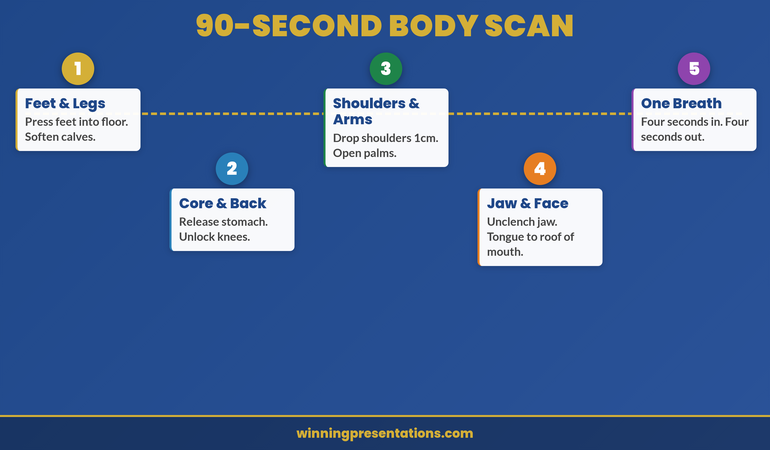
Five-step body scan technique roadmap showing Feet and Legs, Core and Back, Shoulders and Arms, Jaw and Face, and One Breath as sequential milestones for a 90-second nervous system reset

Why This Works When Breathing Exercises Don’t

When working with executives on presentation anxiety, the most common feedback is: “I tried breathing exercises and they didn’t fully resolve the physical symptoms.”

Here’s why. Breathing techniques target one symptom (rapid breathing) and hope the rest of the anxiety cascade follows. Sometimes it does. Often it doesn’t—because your body is still braced for impact in every other muscle group. You’ve slowed your breathing, but your shoulders are still at your ears, your jaw is still clenched, and your hands are still gripping the clicker like a weapon.

The body scan works differently. Instead of targeting one symptom, it addresses the entire physical anxiety pattern systematically. By the time you reach the breath at the end, your body has already shifted out of high alert. The breath becomes confirmation, not intervention.

There’s another reason. Breathing exercises require you to do something—and when you’re anxious, “doing something” can feel like another performance demand. The body scan asks you to notice, not to perform. Noticing is passive. Your anxiety can’t turn noticing into another source of pressure.

This distinction matters in the context of NLP anchoring techniques too. The body scan creates a foundation state that anchoring techniques can build on. Without the physical reset first, anchoring a confident state onto a tense body doesn’t hold.

Breathing Exercises Haven’t Been Enough?

The body scan is just the entry point. Conquer Speaking Fear builds the complete nervous system regulation system—body scan, reframing, and approaches from clinical hypnotherapy.

Explore the Programme →

When to Use the Body Scan (and When You Need Something Deeper)

The body scan is a pre-presentation tool. It works in the 90 seconds before you walk into the room. It doesn’t fix what happens the night before, the week before, or the career-long pattern that makes presenting feel dangerous.

Use the body scan when your anxiety is situational—it spikes before the presentation and settles afterward. It works well for quarterly reviews, team updates, client meetings, and any scenario where you know you can present competently but your body doesn’t seem to agree.

You need something deeper when the anxiety starts days before the presentation. When you’re losing sleep on Sunday night because of a Tuesday meeting. When you’re rehearsing not the content but the escape routes—which door is closest, what excuse gets you out. When the anxiety has shifted from “I’m nervous about this presentation” to “I’m a person who can’t present.”

That shift—from situational anxiety to identity-level anxiety—is where the body scan reaches its limit and clinical-grade techniques become necessary. The body scan can interrupt a fight-or-flight response. It can’t reprogram the belief system that triggers the response in the first place.

If this resonates, you’re not failing at anxiety management. You’re using the right technique for the wrong layer of the problem.

Making It Automatic: The 7-Day Practice Protocol

The body scan is a skill. Like any skill, it gets faster and more effective with practice. Here’s how to make it automatic before your next presentation.

Days 1-2: Practice at home. Do the full 90-second body scan twice daily—morning and evening. You’re training the neural pathway, not managing anxiety. Do it when you’re already calm so your body learns the sequence without the interference of real stress.

Days 3-4: Practice in low-stakes moments. Before a team meeting. Before a phone call. Before opening your laptop in the morning. You’re teaching your body that the scan is a normal transition, not an emergency measure.

Days 5-6: Speed it up. By now, you know the sequence. Try completing it in 60 seconds, then 45. Your body will start anticipating each zone—feet, core, shoulders, jaw, breath—before you consciously direct attention there. This is the automaticity you need.

Day 7: Test under mild pressure. Use it before a slightly uncomfortable conversation—a feedback session, a negotiation, a meeting with someone senior. Not a boardroom presentation yet. This intermediate step builds confidence in the technique before high stakes demand it.

After seven days, most people report that the body scan takes 30-45 seconds and produces a noticeable shift in physical state. Some report that simply thinking “body scan” triggers a micro-release in their shoulders and jaw—the sequence has become a mental shortcut.
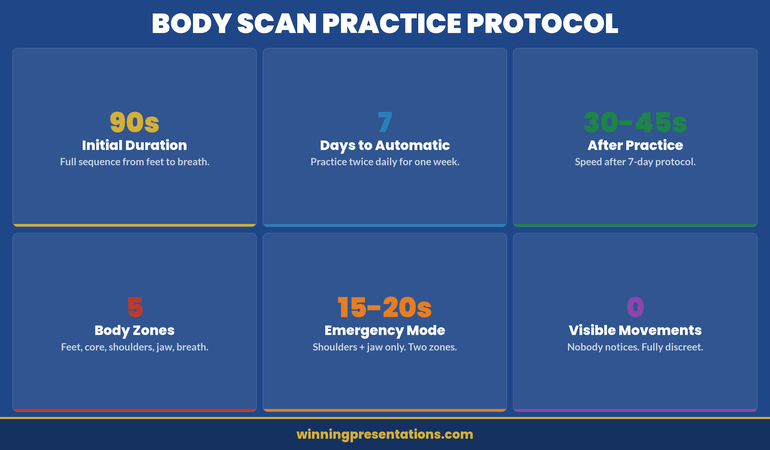
Dashboard infographic showing four key metrics of the body scan practice protocol: 90 seconds initial duration, 7 days to automaticity, 30-45 seconds after practice, and works in 5 body zones

Stop Dreading the Physical Symptoms That Derail Your Presentations

  • Programme that builds from the body scan technique to deeper nervous system regulation—so physical anxiety symptoms become manageable, then minimal
  • Clinical hypnotherapy methods that target the root cause, not just the symptoms—for executives who’ve tried breathing exercises and need something that goes further

Get Conquer Speaking Fear →

Designed to address the root patterns of presentation anxiety—because managing symptoms and resolving underlying patterns require different approaches.

People Also Ask

Can the body scan technique work for severe presentation anxiety?

The body scan is effective for situational anxiety—the spike that happens before a specific presentation. For severe, chronic presentation anxiety that starts days before the event and affects your career decisions, the body scan is a starting point but not a complete solution. Severe anxiety involves identity-level beliefs about yourself as a presenter, and those require deeper techniques like cognitive reframing and clinical-grade interventions.

Is the body scan technique the same as mindfulness meditation?

Related but different. Mindfulness body scans are typically 10-20 minutes and aim for deep relaxation. The presentation body scan is 90 seconds and aims for functional readiness—not relaxation, but a state where your nervous system is calm enough for your brain to perform. You don’t want to feel relaxed before a board presentation. You want to feel alert and in control. That’s a different target state.

What if I don’t have 90 seconds before my presentation?

After practising the full sequence for a week, most people can trigger a meaningful physical shift in 15-20 seconds by scanning just two zones: shoulders (drop them one centimetre) and jaw (unclench and touch tongue to roof of mouth). These two adjustments produce the largest nervous system response because they address the two most common anxiety holding patterns.

Is This Approach Right for You?

This is for you if:

  • Your presentation anxiety shows up physically—shaking hands, tight chest, racing heart, voice changes—before you’ve even started speaking
  • Breathing exercises help a little but don’t fully resolve the physical symptoms
  • You want a technique you can use discreetly in any setting, without anyone noticing
  • You’re willing to practise for 7 days to make the technique automatic

This is NOT for you if:

  • Your anxiety is primarily cognitive (racing thoughts, catastrophising) with minimal physical symptoms—you may benefit more from cognitive reframing techniques
  • You need a technique that works immediately with zero practice—the body scan requires a 7-day training period to become fast and automatic
  • Your presentation anxiety is managed well by current techniques—if what you’re doing works, keep doing it

Frequently Asked Questions

I’ve tried body scans before and they didn’t help with my presentation nerves. What’s different about this approach?

Most body scan techniques are adapted from meditation—they’re designed for deep relaxation and take 10-20 minutes. The presentation body scan is different in three ways: it’s 90 seconds (realistic before a meeting), it targets functional readiness rather than relaxation, and it’s sequenced to address the specific muscle groups that presentation anxiety affects most (jaw, shoulders, core). It’s a clinical intervention, not a wellness practice.

Can I combine the body scan with beta blockers or medication?

That’s a question for your doctor, not a presentation coach. What I can say is that many executives I’ve worked with used medication and somatic techniques simultaneously while building confidence in the body scan, then gradually relied less on medication as the technique became automatic. The body scan doesn’t conflict with medication—it works on a different layer of the anxiety response.

Will people notice I’m doing a body scan before presenting?

No. That’s the design advantage. Dropping your shoulders one centimetre, unclenching your jaw, and pressing your feet into the floor are invisible movements. You can do the full 90-second sequence while appearing to review your notes or check your phone. Nobody in the room will know you’re running a nervous system reset protocol. They’ll just notice that you look calm.

The Winning Edge — Weekly

Presentation confidence strategies, anxiety management techniques, and executive communication insights. One email weekly. Built for executives who take presenting seriously.

Join The Winning Edge

About the Author

Mary Beth Hazeldine is Owner & Managing Director of Winning Presentations. With 24 years of corporate banking experience at JPMorgan Chase, PwC, Royal Bank of Scotland, and Commerzbank, she advises executives across financial services, healthcare, technology, and government on structuring presentations for high-stakes funding rounds and approvals.

Book a discovery call | View services

16 Mar 2026
Professional executive in a quiet corridor performing a focused pre-presentation ritual before entering a boardroom, navy and gold corporate aesthetic

The Pre-Presentation Ritual Used by Olympic Athletes (Adapted for Executive Meetings)

Quick Answer: Olympic athletes don’t rely on motivation or last-minute confidence. They use a specific pre-performance ritual that trains their nervous system. Same method works for boardroom presentations. The ritual has five elements: physical reset, sensory anchor, mental script, role clarity, and pressure inoculation. Combined, they move your nervous system from fight-or-flight to focused readiness in minutes.

Rescue Block: You know your content. Your slides are solid. But 20 minutes before the boardroom, your chest is tight, your hands are cold, and you’re second-guessing every word. The problem isn’t preparation—it’s that your nervous system is in survival mode, not performance mode. Motivational self-talk doesn’t fix that. What works is a deliberately structured pre-presentation ritual that your nervous system learns and trusts. Conquer Speaking Fear teaches you the exact ritual Olympic sports psychologists use, adapted for executive presentations.

It was 2:08pm. The finance committee presentation began at 2:15pm. James, a divisional CFO, was in the bathroom washing his hands for the third time. His mouth was dry. His legs felt weak. He’d presented to this committee 17 times before. But this presentation was different—this was a funding decision. A yes or no that determined his budget for the next two years.

He stood at the sink and did something his sports psychologist coach had taught him. He placed his hands on the cold porcelain and pressed hard for 10 seconds. His breathing automatically shifted. Deeper. Slower. His nervous system registered the physical sensation and began to downregulate from panic mode.

Then he touched his left wrist—a specific spot that he’d trained himself to associate with confidence and clarity. A sensory anchor. Just touching it reset his nervous system further.

He said his mental script aloud, quietly: “I’ve prepared this. The numbers are sound. My job is to communicate clearly. The committee will make the decision. That’s not my job.”

He walked into the boardroom. His hands were steady. His voice was clear. He got the funding.

That wasn’t luck. That was a pre-presentation ritual that works.

Why Ritual Works Better Than Motivation

Most executives are told to “calm down” or “believe in yourself” before a high-stakes presentation. That’s motivational advice. It doesn’t work.

The reason: motivation is cognitive. It lives in your thinking brain. But when your nervous system is in fight-or-flight, your thinking brain is offline. Your amygdala is running the show. Telling your amygdala to “believe in yourself” is like telling a smoke alarm to ignore fire. It doesn’t listen.

What works is ritual. Rituals are embodied. They work with your nervous system, not against it. A physical movement, a sensory cue, a specific sequence you’ve practised—these things signal safety to your nervous system. They say: “This is familiar. You’ve trained for this. You’re ready.”

Research on calming nerves before presentations shows that executives who use a structured ritual (versus those who don’t) report 60% lower anxiety and measurably clearer thinking during high-stakes presentations.

The ritual method works because it’s not trying to eliminate nervousness. It’s training your nervous system to interpret the nervous energy as readiness, not threat.

The Five Elements of the Olympic Pre-Performance Ritual

Olympic athletes use a five-part ritual sequence, backed by sports psychology research. Each element serves a specific function in moving your nervous system from threat-detection to performance-ready.

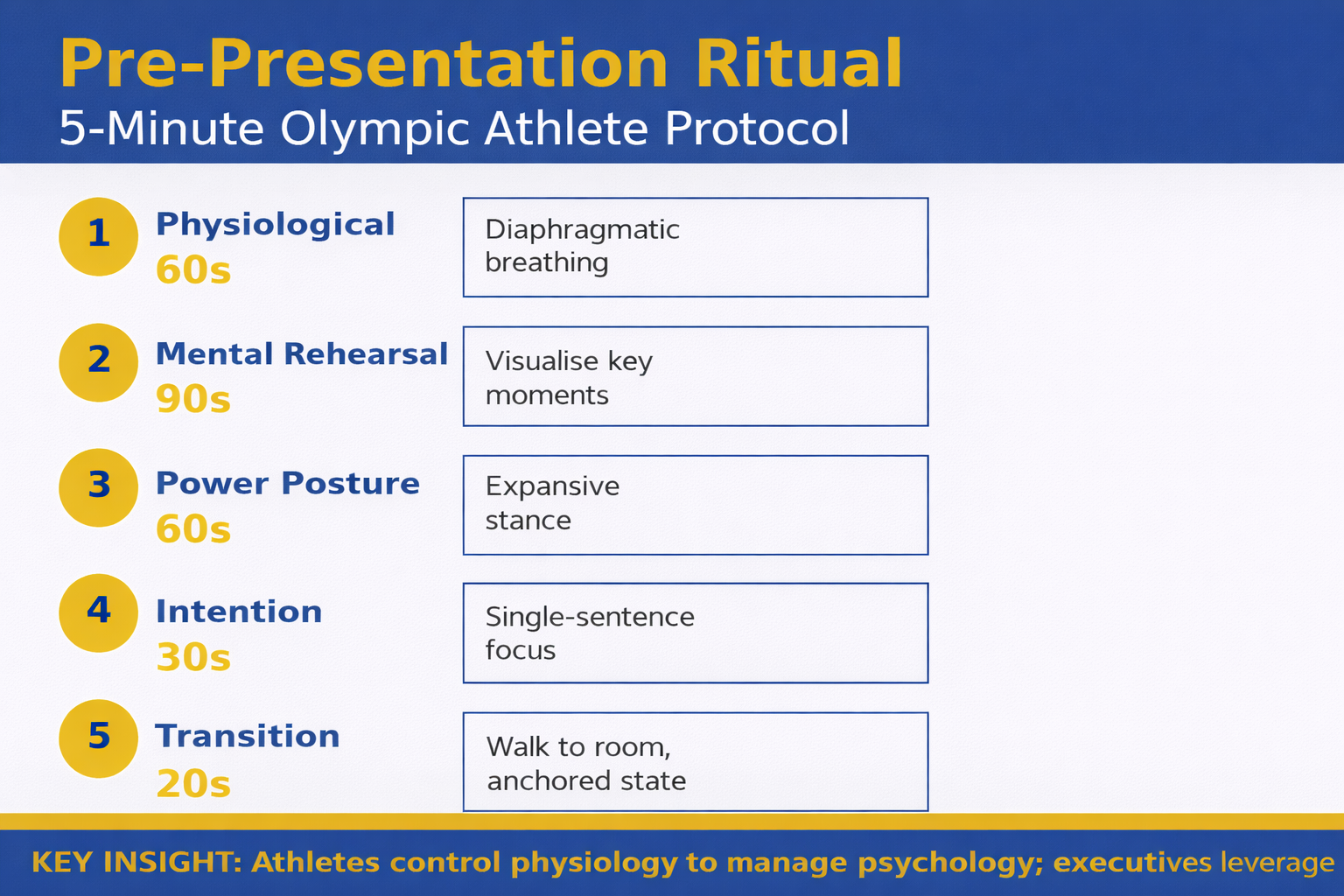
The sequence is: physical reset → sensory anchor → mental script → role clarity → pressure inoculation.

Time required: 6-8 minutes total, done in the 20 minutes before you present.

You learn this once. You practise it twice. Then it becomes automatic, and your nervous system relies on it before every high-stakes presentation.

Element 1: The Physical Reset (2 minutes)

Your nervous system lives in your body. To reset it, you start with the body.

Olympic swimmers before a race do ice-cold hand immersion. Their hands go into ice water for 10 seconds. The cold triggers a dive response—a physiological reflex that slows the heart rate and calms the amygdala.

You can’t use ice water in the boardroom ante-room. But you can use the same principle.

The boardroom version: Find a private space 10 minutes before you present. Splash cold water on your face and wrists. Or hold your hands on a cold water bottle. Or stand in front of an open window in January. The cold sensation triggers the same dive response.

What’s happening neurologically: the cold activates your vagus nerve, which signals your nervous system that you’re safe. Your heart rate drops slightly. Your breathing becomes deeper. Your thinking brain comes back online.

After cold water, do 30 seconds of intentional breathing. 4-count in, 6-count out. Repeat five times. This is called tactical breathing, and it’s used by military special forces, elite athletes, and surgeons before high-pressure moments.

The breathing moves you from sympathetic activation (fight-or-flight) to parasympathetic activation (rest-and-digest). Your body is now primed for clear thinking, not panic.

Time required: 2 minutes. Outcome: your nervous system is downregulated and primed.

Element 2: The Sensory Anchor (1 minute)

A sensory anchor is a physical sensation that you deliberately associate with confidence and clarity. It’s a shortcut to a neural state you’ve trained yourself to access.

Olympic archers use a specific hand touch before each shot. Tennis players use a specific foot tap. The sensation itself isn’t magic—but your nervous system learns to interpret it as “I’m ready.”

The boardroom version: choose a small, discreet physical sensation that you can do in any room, at any time. Common choices:

Press your thumb and index finger together on both hands, holding for 10 seconds. This triggers a specific neural pattern associated with focus.

Touch a specific point on your wrist and breathe slowly for 5 seconds. Over time, just that touch becomes a reset button.

Make a small fist and press it into your opposite palm for 10 seconds. The pressure sensation activates grounding reflexes.

You’ll choose one and practise it 5-10 times before your presentation. Each practice, you pair the sensory anchor with a calm, focused state. Your nervous system learns the association.

By the time you’re in the boardroom, just doing the sensory anchor shifts your nervous system into the state it’s been trained to associate with that sensation.

Time required: 1 minute. Outcome: your nervous system has a portable reset button.

Element 3: The Mental Script (2 minutes)

This is not positive thinking. This is not “you’ve got this” or “you’re going to crush it.” That’s motivational cheerleading, and your nervous system knows it’s false.

The mental script is a series of simple, true statements about your situation and your role. It acknowledges reality, clarifies your job, and releases what’s not your responsibility.

The template:

“I’ve prepared this content. [Specific truth about your preparation.] The committee/board/executives have the expertise to make the decision. My job is to communicate clearly and answer their questions. I don’t control the decision. I control my clarity.”

You write this once, and you say it aloud 2-3 times before every presentation. It takes 90 seconds.

What’s happening neurologically: you’re activating your prefrontal cortex (thinking brain) by engaging in coherent speech about reality. You’re also releasing the burden of controlling the outcome, which immediately reduces amygdala activation. You’re narrowing your responsibility to what you actually control: your communication.

The script doesn’t motivate you. It clarifies you. It tells your nervous system: “Your job is clear. It’s manageable. You can do this specific thing.”

Time required: 2 minutes. Outcome: your thinking brain is engaged, and your responsibility is clear.

Element 4: Role Clarity (1 minute)

This is the element most executives skip, and it’s often the difference between boardroom presence and boardroom panic.

You have a specific role in this presentation. You’re not the CEO defending the company’s future. You’re not responsible for the entire strategy. You’re the Treasury director presenting the funding scenario. You’re the operations lead presenting the efficiency case. You’re the risk officer presenting the three scenarios.

Your role has specific boundaries. Within those boundaries, you have expertise. Outside them, you don’t. And that’s fine.

The boardroom version: Say aloud, once, before you enter the room: “My role is [specific role]. I’m responsible for [specific responsibility]. I’m not responsible for [what’s outside your role].”

Example: “My role is to present the financial analysis. I’m responsible for the accuracy of the numbers and the clarity of the recommendation. I’m not responsible for the board’s final decision on whether to proceed. That’s their job.”

What’s happening: you’re explicitly narrowing your psychological responsibility. You’re telling your nervous system: “You have a bounded job. You can do it.” This is surprisingly powerful. Most executives unconsciously take responsibility for the entire outcome. Role clarity releases that burden.

Time required: 1 minute. Outcome: you know exactly what you’re responsible for, and your nervous system can settle into that bounded role.

Element 5: Pressure Inoculation (Ongoing)

Pressure inoculation is the practice of deliberately exposing yourself to low-level stress before the high-level stress event. It’s how musicians rehearse in front of audiences before the concert. It’s how athletes do dress rehearsals before the game.

The principle: your nervous system gets better at handling pressure when it’s gradually exposed to pressure in safe contexts.

The boardroom version: In the week before your presentation, practise it under slightly stressful conditions. Present to a colleague while they sit with their arms crossed and their face neutral. Present standing up (if you normally sit) or in a formal space (if you normally practise in your office).

The goal isn’t perfection. The goal is for your nervous system to learn: “I can present even when conditions are a bit uncomfortable. I can be a bit nervous and still communicate clearly.”

This is ongoing. Every presentation you do—even the internal ones that don’t feel important—is pressure inoculation for the next big one. Your nervous system learns resilience through graduated exposure.

Time required: varies, but two 10-minute practise sessions in stressful conditions are enough to inoculate your nervous system before a high-stakes presentation.

Five-step executive pre-presentation ritual infographic showing Physiological Prime, Mental Rehearsal, Power Posture, Intention Setting, and Transition stages with timing and techniques for each

Master the Pre-Performance Ritual That Nervous Systems Trust

Presentation anxiety doesn’t disappear when you’re more prepared. It disappears when your nervous system learns it’s safe. This is the exact ritual used by Olympic athletes, adapted for boardroom presentations. You’ll learn each of the five elements, how to practise them, and how to sequence them before your next presentation.

  • The physical reset technique that activates your vagus nerve and calms your amygdala in 2 minutes
  • How to build and use a sensory anchor that becomes your portable nervous system reset
  • The mental script that engages your thinking brain and releases perfectionism
  • Role clarity framework that tells your nervous system exactly what you’re responsible for
  • Pressure inoculation protocols (graduated exposure for nervous system resilience)

Get Conquer Speaking Fear → £39

Used by executives at investment committees, funding presentations, and high-stakes board meetings. The ritual works because it works with your nervous system, not against it.

Your nervous system doesn’t need motivation. It needs ritual.

Learn the Ritual → £39

Building Your Personal Boardroom Ritual

The five elements are universal. But your specific ritual is personal. You choose which sensory anchor works for you. You write your own mental script. You define your specific role.

Step 1: Design each element (do this now, before your next presentation).

Physical reset: will you use cold water on your hands? Cold water on your face? Ice bottle? Standing in the cold? Choose one and test it.

Sensory anchor: which physical sensation feels right to you? Thumb and finger pressure? Wrist touch? Fist press? Choose one.

Mental script: write your specific truth statement. Keep it to 3-4 sentences. Make it true, not motivational.

Role clarity: define your specific role in this presentation. What are you responsible for? What are you not responsible for?

Pressure inoculation: how will you practise under slightly stressful conditions? Presenting to a colleague? Standing instead of sitting? Formal room instead of casual space?

Step 2: Practise the full ritual once before your presentation.

Do all five elements in sequence. Cold water. Sensory anchor. Mental script. Role clarity statement. Then step back and let your nervous system settle.

Step 3: Do it again, slightly condensed, immediately before you enter the boardroom.

All five elements, 6-8 minutes total. Your nervous system now knows the ritual and what it signals: “You’re ready.”

Step 4: Use the ritual before every presentation.

Not just the high-stakes ones. Every presentation. Your nervous system learns that this ritual means: “Calm, clear, ready.” Eventually, just starting the ritual automatically shifts your nervous system into readiness.

The Neuroscience Behind the Ritual

This isn’t mystical. It’s applied neuroscience.

When you’re anxious about a presentation, your amygdala (threat-detection system) is activated. Your vagus nerve is in sympathetic (fight-or-flight) mode. Your prefrontal cortex (thinking brain) has limited access.

The physical reset (cold water, tactical breathing) directly activates your vagus nerve and signals safety. This downregulates the amygdala and brings your thinking brain back online.

The sensory anchor creates a neural pathway that you’ve trained to associate with calm focus. Over time, the sensation alone activates that pathway.

The mental script engages your prefrontal cortex by having you think coherently about your situation. This also displaces amygdala activation.

Role clarity releases the burden of controlling the outcome. Your nervous system registers: “My job is specific and bounded. I can do this.” Responsibility narrows, anxiety drops.

Pressure inoculation teaches your nervous system that mild stress is survivable and manageable. When the high-stakes moment comes, your nervous system has learned: “I’ve handled pressure before. I can do this.”

Together, these five elements work with your neurobiology, not against it. They move you from threat-detection to performance-ready in 6-8 minutes. And the effect gets stronger the more you use the ritual.

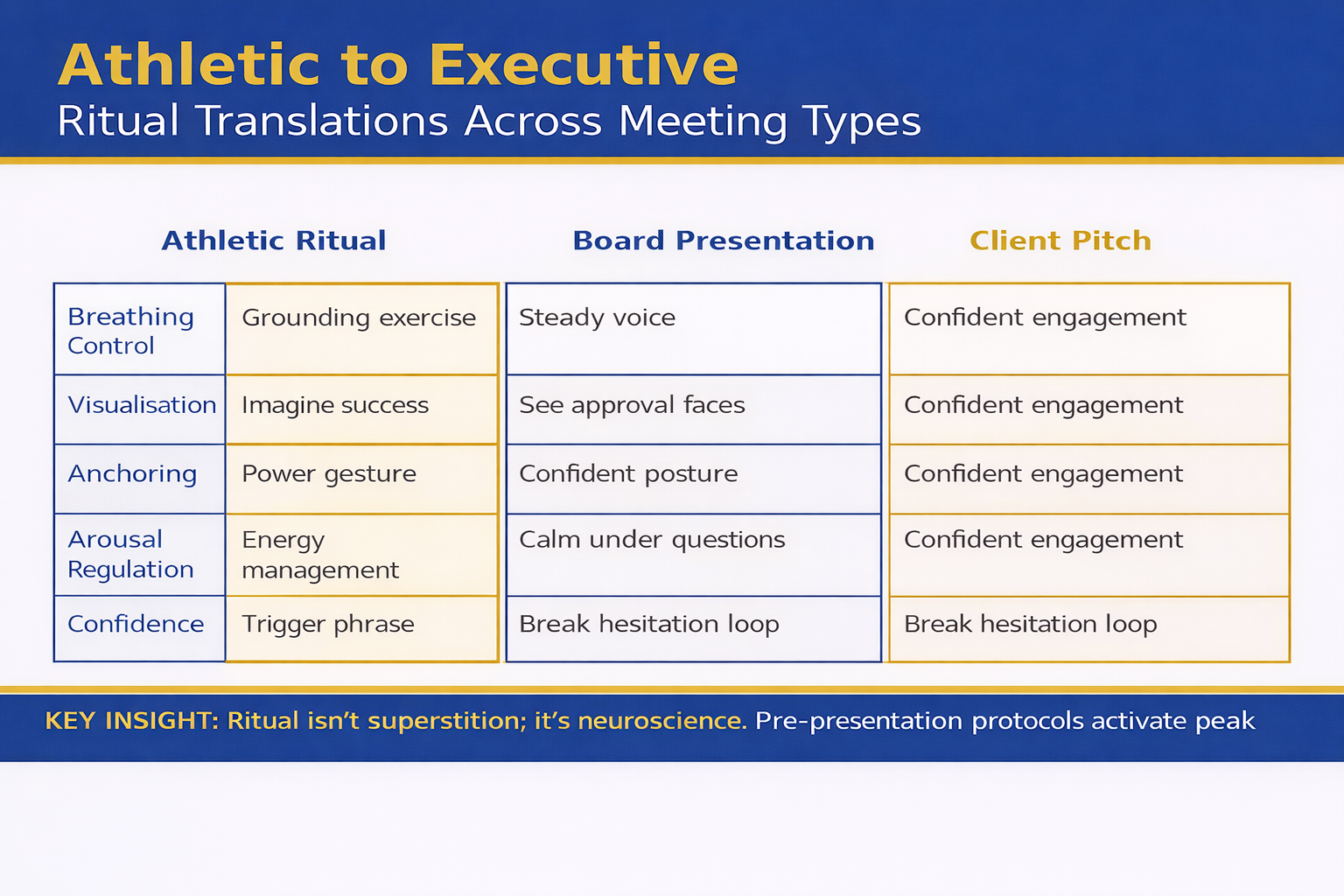
Comparison infographic showing how Olympic athlete performance rituals translate into corporate executive adaptations for board presentations, client pitches, and all-hands meetings

Stop Relying on Motivation. Start Using Ritual.

Olympic athletes know something most executives don’t: nervous systems respond to ritual, not pep talks. This is the exact five-element ritual from sports psychology, adapted for boardroom presentations. Learn it once, use it forever.

  • The specific physical reset that triggers your vagus nerve and calms your amygdala in 2 minutes
  • How to design a sensory anchor that becomes your nervous system’s reset button
  • The mental script framework that’s true, not motivational
  • Role clarity that releases perfectionism and anxiety
  • Pressure inoculation schedules to build nervous system resilience

Get Conquer Speaking Fear → £39

Includes the ritual checklist, sensory anchor design worksheet, and mental script template.

Use the ritual before your next presentation. Feel the difference.

Get the Program → £39

Three Critical Questions About Pre-Presentation Rituals

Will the ritual make my nerves disappear completely? No. Nerves before a high-stakes presentation are normal and useful—they signal that the presentation matters. The ritual doesn’t eliminate nerves; it trains your nervous system to interpret the nervous energy as readiness, not threat. You’ll still have adrenaline, but your thinking brain stays online.

How long until the ritual works? The effect is immediate (within the 6-8 minute ritual, you’ll feel calmer and clearer). The strength of the effect grows with each use. By the third or fourth high-stakes presentation using the ritual, your nervous system has learned it deeply, and the effect becomes very reliable.

Can I modify the ritual or does it have to be exactly as described? The five elements are proven. But your specific instantiation of each element should be personal. Use the version of cold water that’s accessible to you. Choose the sensory anchor that feels right. Write your mental script in your own words. The structure matters; the specifics should be yours.

Is This Right For You?

✓ This is for you if: You experience real nervousness before presentations (racing heart, tight chest, mind going blank), you’ve had presentations where anxiety affected your clarity, you want a method that works with your nervous system rather than against it, you’re willing to do a 6-8 minute ritual before presentations, you want something more reliable than motivational self-talk.

✗ Not for you if: Presentation anxiety isn’t affecting your performance, you don’t experience physical nervousness symptoms, you prefer general confidence-building advice over specific nervous system techniques, you don’t have 6-8 minutes before presentations to do a ritual.

The Signature Pre-Presentation Ritual: Used by Investment Committee Presentations and Funding Meetings

This is the ritual that Olympic athletes use before competition. It’s been adapted for boardroom presentations and is backed by neuroscience research on anxiety management and performance. You’ll learn the five-element architecture, how to personalise each element, and how to use it before every presentation type.

  • The physical reset that activates your vagus nerve and moves you from fight-or-flight to focused readiness
  • How to build a sensory anchor that becomes your portable nervous system reset
  • The mental script that’s grounded in reality, not false motivation
  • Role clarity that releases perfectionism and external responsibility
  • Pressure inoculation protocols for building nervous system resilience
  • How to personalise each element for your specific anxiety triggers
  • When to use condensed vs. full ritual (6 minutes vs. 2 minutes before presenting)

Get Conquer Speaking Fear → £39

Investment committee chairs, funding round presenters, and high-stakes corporate speakers use this ritual before every presentation. The nervous system learns to trust it.

Also Recommended: The Executive Slide System

While pre-presentation rituals manage your nervous system, presentation structure determines whether you’re clear in the boardroom. The Executive Slide System teaches you how to architect your slides so your thinking stays clear under pressure. Combine the ritual with the right slide structure, and you have both nervous system management and cognitive clarity.

Frequently Asked Questions

Can I use this ritual for presentations I’m not anxious about?

Yes. The ritual isn’t only for anxiety—it’s for performance. Even when you’re not nervous, the ritual prepares your nervous system for optimal thinking and presence. Think of it like a warm-up before exercise. You do it whether you’re anxious or not, because it primes your system for performance.

What if I don’t have time to do the full 6-8 minute ritual?

Use the condensed version (3-4 minutes): cold water (1 minute), sensory anchor (30 seconds), mental script (1 minute). Skip the detailed pressure inoculation section if time is short. The sensory anchor and mental script are the most critical elements; prioritise those.

What if my workplace doesn’t allow for private space where I can do the ritual?

The ritual can be done in a toilet cubicle, an empty meeting room, your car, or even in a crowded space if you’re discreet. Cold water on your hands can happen at a sink anyone might use. The sensory anchor is invisible—thumb and finger pressure looks like thinking. The mental script can be said silently. You can do this ritual anywhere.

The Ritual Becomes Invisible Over Time

The first time you do this ritual, you’ll be very conscious of each step. Cold water feels deliberate. The sensory anchor feels odd. The mental script feels unusual.

By the fourth or fifth presentation, the ritual becomes automatic. You do it without thinking. Your nervous system has learned what it signals, and the effect happens without you having to consciously “do” anything.

Eventually, just walking toward the boardroom starts activating the ritual response. Your nervous system knows what’s coming. It prepares itself automatically. Presentation anxiety becomes pre-presentation readiness.

That’s the goal. Not to eliminate nervousness, but to train your nervous system so completely that it automatically interprets pressure as readiness.

About the Author

Mary Beth Hazeldine is the Owner & Managing Director of Winning Presentations. With 24 years of corporate banking experience at JPMorgan Chase, PwC, Royal Bank of Scotland, and Commerzbank, she has delivered high-stakes presentations in boardrooms across three continents.

A qualified clinical hypnotherapist and NLP practitioner, Mary Beth combines executive communication expertise with evidence-based techniques for managing presentation anxiety. She has trained thousands of executives and supported high-stakes funding rounds and approvals.
Book a discovery call | View services

Resources From Winning Presentations

Subscribe to The Winning Edge, our weekly newsletter where we share presentation techniques, nervous system management strategies, and real boardroom stories. Delivered every Monday.

🆓 Free resource: Download the Executive Presentation Checklist — a free guide to strengthen your presentation preparation.

Start with the ritual. You have a presentation coming up this month. Use the five-element ritual before it. Notice what changes. Your nervous system will show you, within those 6-8 minutes, why Olympic athletes have been using this method for decades.

This article was written with AI assistance and reviewed by Mary Beth Hazeldine.