Quick answer: When the stakes of a presentation are high enough to disrupt clear thinking, more preparation makes things worse, not better. What works is a structured 30-minute pre-presentation ritual: physical movement to discharge cortisol, slow exhale-led breathing to lower heart rate, a fixed verbal anchor for the opening line, and ten minutes of complete quiet before walking into the room. Rituals work because they shift the nervous system out of threat mode without requiring you to “calm down” through willpower — a strategy that consistently fails when stakes are highest.
JUMP TO:
Tomás was an excellent presenter on quarterly business reviews. He had presented forty of them. Then he was asked to present a £6m restructuring proposal to the parent group’s executive committee in Madrid. New room. New audience. Higher stakes. He spent the morning re-reading his deck, drinking coffee, and trying to “get his head right”. By the time he stood up to present, his hands were shaking visibly, his voice was thinner than he had ever heard it, and he could not remember the order of his own opening three slides. The presentation he had given competently forty times before suddenly felt impossible.
This is not a competence problem. It is not even a confidence problem in the usual sense. What Tomás experienced is what happens when the stakes of a presentation are high enough to push the nervous system into threat response — and the response interferes with the very cognitive resources he needed to deliver. Working memory narrows. Recall slows. The body floods with cortisol and adrenaline. The presenter becomes aware of their own heartbeat. None of that can be reasoned away in the moment.
What works is not more preparation. By T-30 minutes, the deck is the deck. What works is a structured pre-presentation ritual designed to shift the nervous system back into a state where clear thinking is possible. The protocol below is built from techniques that have worked across financial services, biotech, and government settings — for senior people who could deliver in lower-stakes rooms but were collapsing in the high-stakes ones.
If you want a complete framework for high-stakes presentation nerves:
Conquer Your Fear of Public Speaking is a structured programme covering the psychology, physiology, and practical techniques senior professionals use to walk into high-stakes rooms calm.
Why thinking fails when stakes are highest
The body does not distinguish between physical and social threat. A boardroom where your reputation, role, or career-trajectory might be on the line registers in the nervous system the same way a confrontation with a predator would. The autonomic stress response activates: heart rate rises, breathing shortens, blood is redirected away from the digestive system and toward muscles, attention narrows, and — crucially for presenters — the prefrontal cortex (the part of the brain responsible for working memory, complex reasoning, and verbal fluency) becomes less efficient.
This is why telling yourself to “calm down” or “think clearly” before a high-stakes presentation almost never works. The system that would calm down is the same system being suppressed by the threat response. You cannot use the prefrontal cortex to override what the limbic system is doing — at least, not without first interrupting the physiological signal that is keeping the limbic system activated.
What works is the opposite direction: change the body first, and the brain follows. Physical movement, slow breathing, and reducing stimulation lower the threat signal. Once the threat signal drops, the prefrontal cortex comes back online. Working memory returns. Recall improves. The presenter who could not remember their opening three slides at T-30 minutes can deliver them cleanly at T-0 — but only if the intervening time is used for nervous-system recovery, not more cognitive grinding.
Why a ritual works when willpower does not
A ritual is a fixed sequence of actions performed in the same order every time. It is the opposite of a decision. When stakes are highest and cognitive capacity is lowest, decisions become harder — even small ones like “should I have one more coffee?” or “should I read through the deck again?” Each of those decisions costs energy that is already in short supply. By the time you walk into the room, you have spent your reserves on micro-choices that did not need to be made.
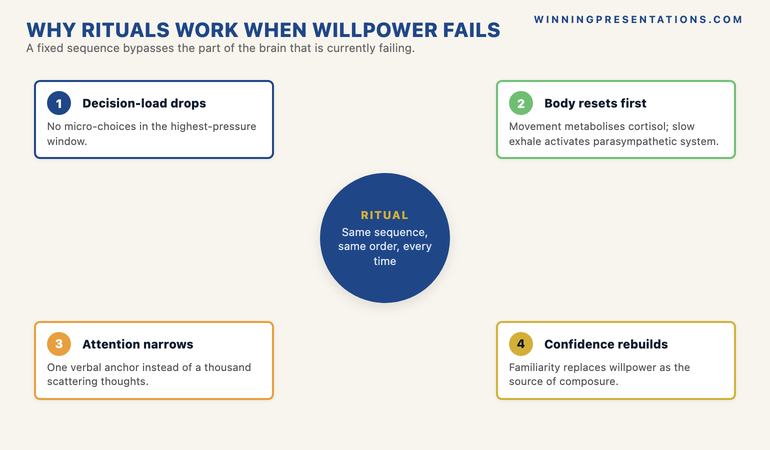
A pre-presentation ritual eliminates those decisions. The same sequence, every time. After three or four high-stakes presentations using the same ritual, the nervous system starts to associate the ritual itself with calm — the way a familiar warm-up routine settles an athlete before competition. The ritual does not depend on you feeling calm. It works because it bypasses the part of the brain that is currently failing.
This is not woo. It is how the autonomic nervous system actually responds to predictable, repeated input. Slow exhales lengthen the activation of the parasympathetic nervous system. Movement metabolises stress hormones. Reducing visual and auditory stimulation lowers the threat signal further. None of these depend on belief. They are physiological mechanisms.
The 30-minute pre-presentation ritual
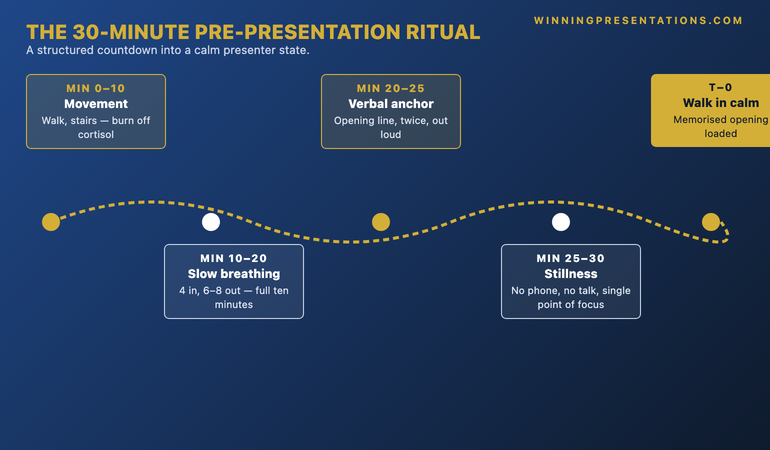
The protocol below is structured to fit into the 30 minutes before you walk into the room. If you have only 15 minutes, compress proportionally — keep the sequence and shrink the durations. If you have 45 minutes, do not extend it. More time spent in the ritual past 30 minutes does not produce more calm; it produces room for re-entering the deck mentally, which is what you are trying to avoid.
Stop trying to “think your way calm”. The body has to lead.
Conquer Your Fear of Public Speaking is the structured programme for senior professionals who present competently in low-stakes rooms but collapse in high-stakes ones. Five years of being terrified of presenting taught Mary Beth what actually works — the techniques that go beyond breathing exercises and address the underlying nervous-system response. £39, instant access.
- The physiology of high-stakes presentation fear (and why “just relax” fails)
- Body-led techniques that lower heart rate when willpower cannot
- The pre-presentation ritual structure for senior settings
- What to do when nerves hit mid-presentation, not before
- Long-term reconditioning for presenters who have collapsed once and now dread the next one
Get Conquer Your Fear of Public Speaking — £39 →
Designed for senior professionals across financial services, biotech, technology, and consulting.
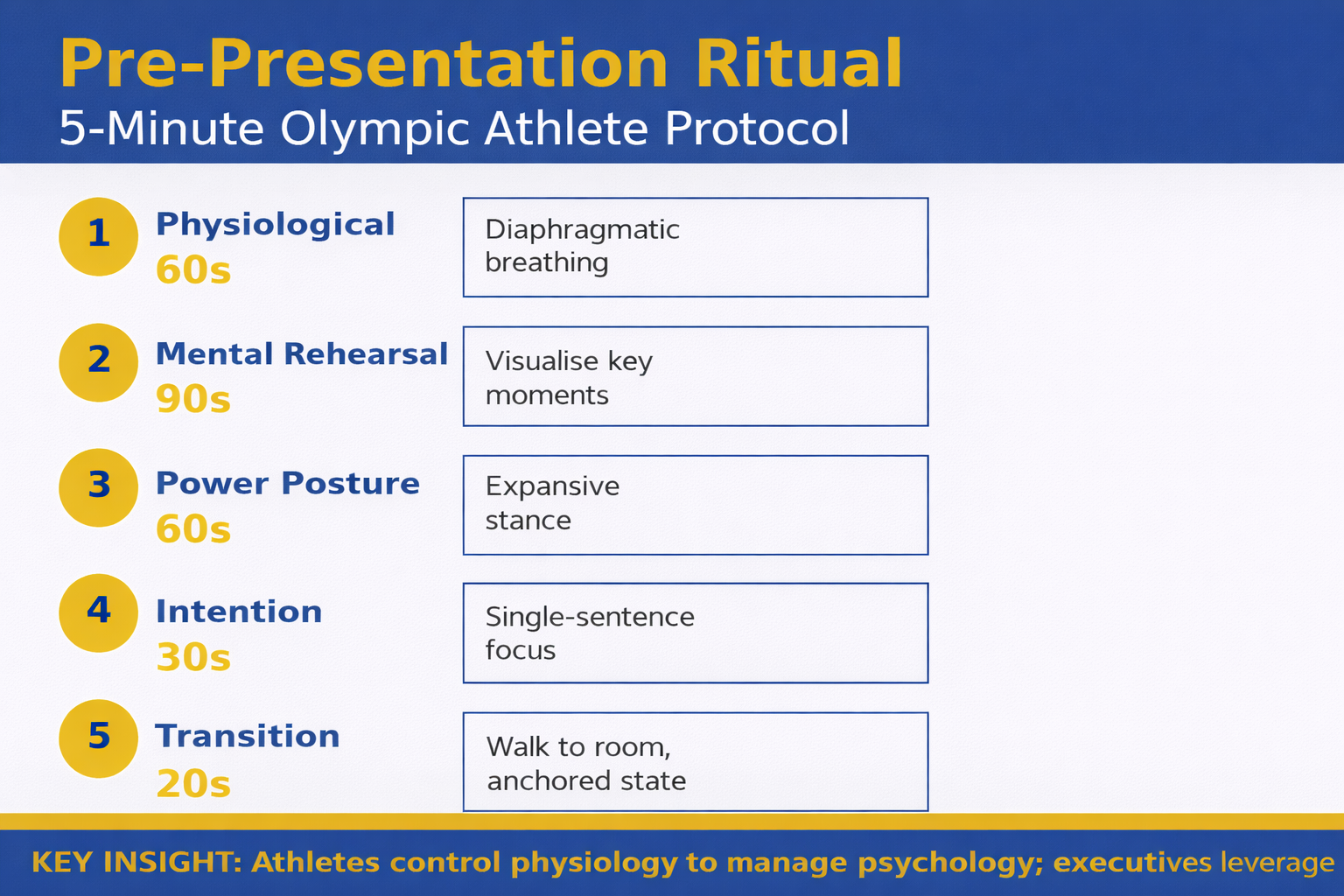
Minutes 0-10: Movement. Walk. Take stairs if you have them. Walk briskly outside if the building permits. The goal is to elevate the heart rate slightly through voluntary physical effort — which paradoxically reduces the involuntary stress-driven heart rate that nerves produce. Cortisol and adrenaline are designed to fuel physical action. If you are sitting still in a meeting room while your body floods with stress hormones, those hormones have nowhere to go and the symptoms get worse. Movement metabolises them. Even a ten-minute walk in the corridor measurably reduces shaking, racing heart, and the cluster of physical symptoms that destabilise the opening of a presentation.
Minutes 10-20: Slow exhale-led breathing. Find a quiet space. Sit or stand still. Breathe in through the nose for 4 counts, exhale through the mouth for 6-8 counts. The exhale is the active part — longer than the inhale by at least 50%. This activates the parasympathetic nervous system in a way that fast or shallow breathing does not. Five minutes barely moves the needle. Ten full minutes resets the autonomic baseline. Most presenters skip this step because it feels too long. That is precisely why it works — the duration is the mechanism. See 4-7-8 breathing for board presentations for the technical detail and an alternative count pattern if 4-6-8 does not suit you.
Minutes 20-25: Verbal anchor (see next section). Speak your opening line out loud, twice. Not the whole opening — just the first sentence or two. The voice, the cadence, the breath. This rehearses the single most important moment of the presentation while you are now in a calmer physiological state.
Minutes 25-30: Stillness. Stop everything. No phone. No notes. No conversations. No “quick check” of anything. Stand or sit completely still, looking at a single point in the distance, breathing slowly. Five minutes feels much longer than it sounds when you are anxious. Hold the stillness anyway. This is where the nervous system fully resets before you walk in.
The verbal anchor: your opening line
The first 30 seconds of a high-stakes presentation are the highest-risk window. If your opening goes well, the nervous system reads it as a successful start — threat signal drops, working memory expands, recall improves. If the opening goes badly, the threat signal escalates and the next two minutes of the presentation are spent trying to recover.
The intervention is to memorise your opening line — the literal words — verbatim. Not the rest of the presentation. Just the opening. Once memorised, repeat it during the ritual until your voice feels steady saying it.
The opening line itself should be short, declarative, and not require improvisation. “Thank you. The recommendation is straightforward. We are asking the committee to approve £6m of restructuring across the next 18 months — and I will walk through the rationale, the alternatives we considered, and the risks.” That is one sentence. It is composed and committed before you enter the room. You will not have to construct it under pressure.
Memorising the opening removes the most common point of nervous-system collapse. Once the opening is delivered, the rest of the presentation flows from material you already know well. The opening is the moment that needs to be automatic.
For more on what to do when the body still betrays you mid-presentation — voice shaking, hands trembling — see the 10-second reset for when your voice shakes mid-presentation and grounding techniques for boardroom anxiety.
What to stop doing in the final 30 minutes
Equally important is what to remove from the final 30 minutes. Three habits consistently make high-stakes presentation nerves worse, not better.
Re-reading the deck. By T-30 minutes, the deck is the deck. Re-reading it does not strengthen recall — it actually overwrites the consolidated memory you built during yesterday’s rehearsal. More damaging, scrolling through slides at this point invites you to spot something you wish you had changed, which spikes anxiety and gives you no time to act on it. Close the laptop.
Conversations. Last-minute “quick check-ins” with colleagues, sponsors, or anyone connected to the presentation transfer their nervous energy into yours. Even a well-meant “you’ll be great!” from a peer can register as evidence that you might not be. The 30 minutes before a high-stakes presentation are not a social window. Be alone.
Caffeine and sugar. Both elevate heart rate, increase tremor, and intensify the physical symptoms of nerves. The double espresso “for energy” 20 minutes before a high-stakes presentation is the single most common mistake senior presenters make. Water is the only thing you should be drinking in the final 30 minutes. The energy you need is already there — you do not need to add to a system that is already over-activated.
For more on how the 72 hours leading up to T-30 should be structured, see the partner article on the 72-hour protocol senior leaders use.
Frequently asked questions
Does this ritual work the first time, or does it take practice?
It works partially the first time and more completely each subsequent use. The physical mechanisms — slow breathing activating the parasympathetic system, movement metabolising stress hormones — work immediately. The associative effect, where the ritual itself starts to trigger calm, builds over three or four uses. Senior professionals who use the same ritual before every high-stakes presentation report that by the fifth use, the ritual has become a reliable settling sequence regardless of room or audience.
What if I am presenting back-to-back and cannot do a full 30 minutes?
Compress to 10-15 minutes. Five minutes of movement, five minutes of slow breathing, three minutes verbal anchor, two minutes of stillness. The shortened version is less effective than the full protocol, but materially more effective than no ritual at all. The minimum effective dose is roughly 8-10 minutes. Anything shorter does not allow the nervous system enough time to shift state.
What about beta-blockers or anti-anxiety medication?
That is a conversation for a doctor, not for an article. Some senior professionals use them under medical supervision for specific high-stakes events. The ritual described here works alongside or independently of medication, and addresses the underlying nervous-system response rather than masking the symptoms. Most presenters find that with consistent ritual practice, they need less pharmacological intervention over time.
My voice still shakes when I start. What do I do in the moment?
Slow your opening pace deliberately. The first 30 seconds should feel almost too slow to you — that pace will sound composed to the audience. A shaking voice is amplified by speed. If you walk in and immediately start speaking quickly, the tremor is audible. If you walk in, pause for two seconds, and begin slowly, the tremor often does not register. Combined with the memorised opening line, this is usually enough to get through the opening cleanly.
When nerves hit physically — shaking hands, racing heart — in the moment:
Calm Under Pressure covers rapid-response techniques for the physical symptoms of presentation anxiety: shaking hands, racing heart, trembling voice, nausea — methods you can use in the room, in the moment, without anyone noticing. £19.99, instant access.
A structured framework, not a list of breathing tips.
Conquer Your Fear of Public Speaking — the system designed for senior professionals who can present competently most of the time but collapse when stakes are highest. £39, instant access. Built from 5 years of being a terrified presenter and the techniques that actually moved the needle.
Get The Winning Edge newsletter
A weekly note from Mary Beth on the structure, psychology, and preparation that earns senior approval. One idea, one application, one specific scenario — every Thursday morning.
Not ready for the full programme? Start here instead: download the free Virtual Presentation Quick-Start Checklist — covers the setup, delivery, and rescue elements every high-stakes presentation needs.
Next step: Block 30 minutes in your calendar before your next high-stakes presentation — not “prep time”, labelled clearly as “ritual”. The structure does the work.
About the author
Mary Beth Hazeldine is Owner & Managing Director of Winning Presentations Ltd, founded in London in 1990. With 24 years of corporate banking experience at JPMorgan Chase, PwC, Royal Bank of Scotland, and Commerzbank, she advises executives across financial services, healthcare, technology, and government on the psychology and preparation that sustains performance under pressure.