Tag: post-presentation anxiety

31 May 2026
Post-Board-Presentation Limbo: Why Waiting for the Decision Triggers More Anxiety Than Presenting

Post-Board-Presentation Limbo: Why Waiting for the Decision Triggers More Anxiety Than Presenting

Quick answer: Post-board-presentation limbo — the days after a major presentation when the decision is unresolved — can be more anxious than the meeting itself. The reasons are structural. The moment of presenting has anchors: a slot, a slide deck, a defined audience, and a clear end. The wait has none of those. The mind fills the absent structure with rumination. The fix is to introduce structure deliberately — a written follow-up, a deadline you set yourself, and contained windows of attention rather than diffuse low-grade worry.

Adaeze, a senior director at a UK-listed retailer, presented a major restructure to the board on a Wednesday afternoon. The presentation went well — the questions were engaged, the discussion ran longer than the slot allowed, and the chair closed by saying the board would consult and come back with their view. By Wednesday evening, Adaeze felt the post-presentation high. By Thursday morning, she felt fine. By Sunday night, she could not sleep. By Monday afternoon, she had drafted three different follow-up emails to the chair and sent none of them. By Wednesday — a full week of unresolved limbo — she was performing worse in her day job than she had during the presentation itself.

This pattern is not rare. Most senior leaders who present at board level have experienced some version of it. The presentation itself is intense but bounded. The wait afterward is unbounded, and the absence of bounds is precisely what produces the anxiety. People who would describe themselves as “not generally anxious presenters” are often acutely thrown by post-presentation limbo. The body is calm in the moment of high stakes; it does not stay calm in the diffuse low-grade hours afterward, when there is no slide deck to focus on and no audience to read.

This article is about that limbo. It does not promise to remove the experience — limbo is a structural feature of senior decision-making, not a bug — but it sets out why the wait is so disproportionately heavy on the body and the mind, and what structural moves contain it. The work is partly cognitive and partly procedural. Done well, the next post-presentation week feels less like an open wound and more like a project window with a clear shape.

If presentation anxiety extends well beyond the room itself:

Conquer Your Fear of Public Speaking is a structured course covering the anxiety patterns that hit before, during, and after high-stakes presentations — including the specific limbo pattern most senior presenters experience after major board meetings. Designed for the experienced presenter whose anxiety has shifted from the room to the days that follow.

Explore the Course →

Why limbo can hit harder than the room

Most senior leaders expect the presentation itself to be the hardest moment. They prepare for it accordingly — rehearsing the opening, anticipating the questions, sleeping deliberately the night before. The structure of the meeting works in their favour. The room has a start and an end. The slides have a sequence. The audience is identifiable, and their reactions, even when guarded, are at least observable. The body knows what to do with all of that. It releases adrenaline at the start, settles into a working rhythm by slide three or four, and registers a clear close when the chair thanks the presenter and moves to the next item.

The limbo that follows has none of those anchors. There is no defined endpoint — the decision will land when it lands, which might be tomorrow, might be three weeks. There is no slide deck to focus attention on. There is no audience to read. There is, in most cases, simply silence, punctuated by occasional ambiguous signals — a committee member’s friendly hello in a corridor, a chair’s brief reply to a routine email, a comment from a colleague who heard it went well. None of these signals carry the weight of an actual decision. But the mind treats each one as data to be analysed, and the analysis runs on a loop.

The presenter who handled the moment cleanly is now spending Sunday evening parsing whether the COO’s response in the meeting was supportive or merely polite. Whether the chair’s “we will come back with a view” meant a backed view or a deferred one. Whether the silence on Monday is normal silence or pre-rejection silence. The work is exhausting, and it produces no information the presenter does not already have. But the mind keeps doing it, because the structure of limbo invites exactly that kind of low-grade analytical churn.

The structural reason: anchors stripped

The deeper reason limbo is harder than the moment is that the moment had anchors and the wait does not. Anxiety is not really about stakes — most senior leaders have presented in genuinely high-stakes situations and felt fine. Anxiety, especially the diffuse kind that surfaces in limbo, is about the absence of the structure the body uses to regulate response. The room provides that structure. The week afterward strips it.

An anchor is anything the body and mind can orient against. In the room, anchors are physical (the podium, the slide screen, the chair’s body language), procedural (the agenda item, the time allocated, the questions asked), and social (the named audience, their visible reactions). Together they give the nervous system something to track. The body knows it is performing a defined task, and it can dial up engagement and dial it down on cue.

In limbo, all three layers of anchor are absent. There is no physical task — the work is internal. There is no procedure — the timeline is unknown. There is no social signal — the committee has gone quiet, and silence is unreadable. The nervous system, deprived of the structures it normally uses, fills the gap with vigilance. The body stays in low-grade activation. The mind stays in low-grade analytical loop. Both feel exhausting precisely because there is no defined task to discharge them against.

The two anxieties: body and cognitive

It helps to separate the two layers. The body anxiety is the residual physical activation — disturbed sleep, tightness in the chest, a stomach that registers every email arrival, an inability to settle into deep work even on subjects unrelated to the presentation. The cognitive anxiety is the analytical churn — replaying moments of the meeting, parsing post-meeting signals, drafting follow-up emails in the head, imagining outcome scenarios.
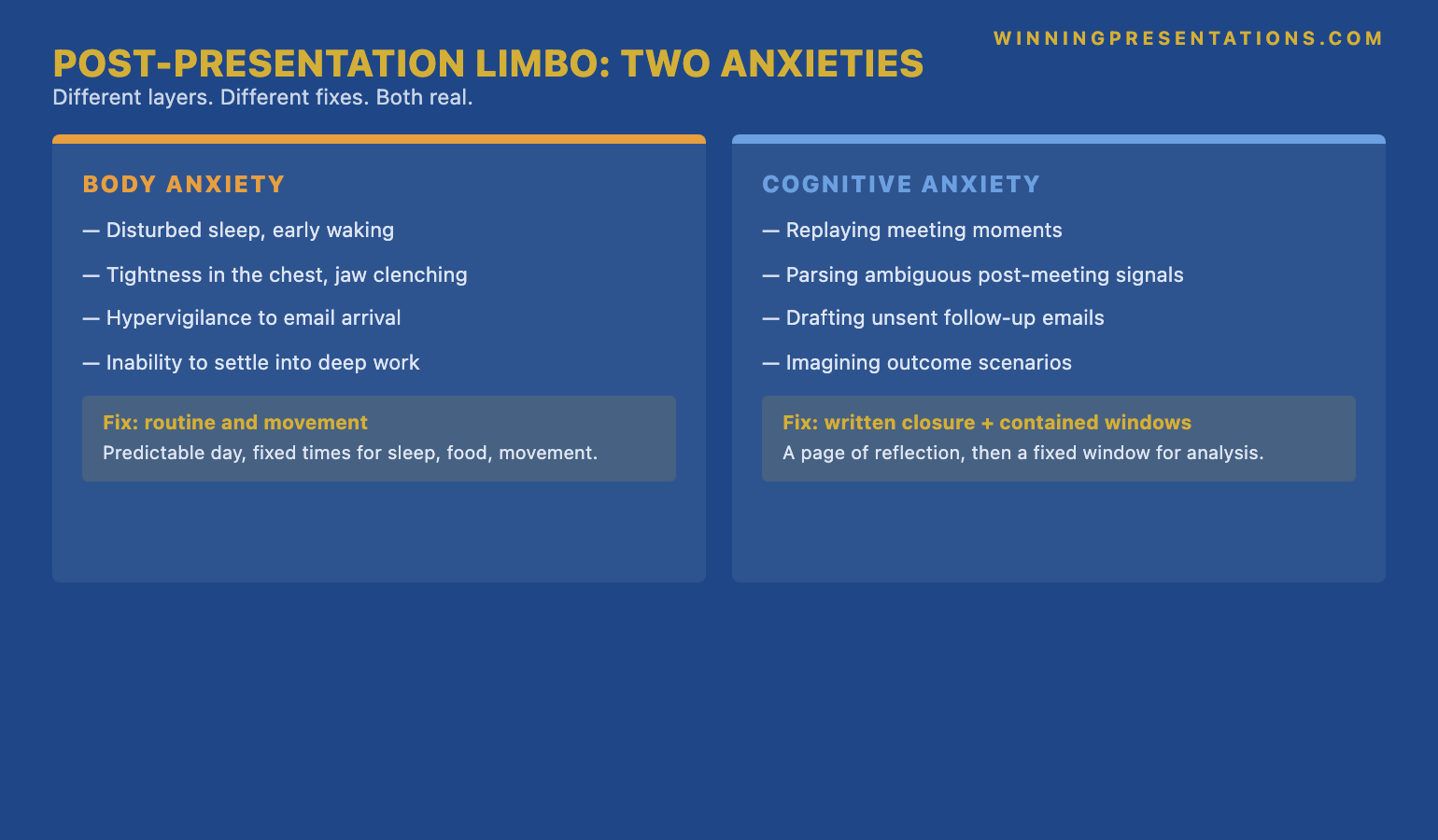
The post-board-presentation limbo two-anxieties infographic showing the body anxiety pattern (disturbed sleep, chest tightness, hypervigilance to email arrival, inability to settle into deep work) versus the cognitive anxiety pattern (replaying meeting moments, parsing ambiguous signals, drafting unsent follow-up emails in the head, imagining outcome scenarios) — and the principle that the two layers respond to different structural fixes: the body to ritual and movement, the cognition to written closure and contained windows.

The two layers respond to different structural fixes. The body responds to physical re-anchoring — a deliberate ritual that provides the missing structure in the days after the meeting. Movement at a fixed time. A short walk after lunch. Sleep hygiene that does not depend on the resolution of the wait. The body does not need certainty about the outcome; it needs predictability in the day. Once the day has predictable anchors again, the residual activation begins to settle, even if the decision is still unresolved.

Limbo is not a failure of preparation — but it is something the body can be trained for.

Conquer Your Fear of Public Speaking covers the anxiety patterns that surface before, during, and after high-stakes presentations — including the specific limbo pattern that hits experienced presenters in the days after major board meetings. Body-focused techniques and cognitive frameworks for the senior leader whose anxiety has shifted from the room to the wait. £39, instant access, no subscription.

  • Modules covering the physical and cognitive anxiety layers separately
  • Practical techniques for managing residual activation in the days after a major presentation
  • Frameworks for distinguishing useful post-meeting reflection from rumination
  • Designed for experienced presenters, not beginners — the limbo pattern is specifically a senior-presenter experience

Get Conquer Your Fear of Public Speaking — £39 →

The cognitive layer responds to a different fix: written closure and contained windows. The mind is looping because there is no defined place for the analysis to land. A short written reflection — even a single page in a notebook, even a paragraph in an email draft — gives the analytical churn a destination. Once the destination is reached, the looping reduces. The mind does not need to keep producing the same content if the content has somewhere to go. The contained windows complement the writing: a fixed time of day where reflection on the presentation is allowed, and the rest of the day where it is gently set aside if it surfaces. The two together do not eliminate the limbo. They contain it. For more on the broader pattern of mind-looping after high-stakes work, see post-presentation rumination.

What to do in the first 24 hours

The first 24 hours after a deferred-decision meeting set the shape of the wait that follows. Three structural moves, in order.

First, send the follow-up email. The four-paragraph format covered in the partner article on the follow-up email after a board presentation is the structural instrument that converts ambiguous limbo into a defined waiting window. The email proposes a specific next step with a specific date. Once it is sent, the wait has a shape — the date in paragraph four — and the body and mind can orient against it. Limbo without the email lasts indefinitely. Limbo with the email lasts until the date you proposed.

Second, write a short reflection — twenty to thirty minutes, one page in a notebook — covering what you noticed in the meeting that you would adjust next time, and what you are leaving behind because it is outside your control. The reflection is not a critique. It is a structured handoff from the analytical mind to the page. The point is to give the looping a destination. Many senior leaders find that a single, deliberate page does more for limbo than three days of background ruminating that feels productive but produces nothing.

Third, schedule something that is not work for the evening of the day after the meeting. A dinner. A class. A long walk. The point is not to celebrate or to escape, but to provide the body with a structural anchor that is not the email inbox. The body learns from the planned non-work evening that life has not paused while the committee deliberates. That learning matters more than its content. The decision is in the committee’s hands. The hours of life you control are still yours.

How to plan the next two weeks

Most board decisions land within ten days of presentation. Some take longer. The two-week plan is what carries the senior leader through that window. The structural pattern is straightforward: the days are anchored by routine, the windows for reflection are contained, and the inputs that drive rumination are deliberately reduced.

Routine first. Wake at the same time. Eat at the same times. Move the body at a defined time of day. Sleep in the same window each night. The point is not optimisation. The point is to give the nervous system a stable scaffold to operate against. Limbo is harder when sleep, food, and movement times drift. It is contained when they do not. This is a structural intervention, not a wellness one. The body uses the predictability of the day as the anchor that the meeting outcome cannot provide.

If the limbo is a recurring pattern around buy-in decisions specifically:

The Executive Buy-In Presentation System is a separate Maven programme covering the structure, stakeholder analysis, and post-presentation moves that turn deferred decisions into backed ones. Self-paced, 7 modules, monthly cohort enrolment, £499, lifetime access. Often the upstream structural work that reduces the frequency of unresolved post-meeting waits.

Explore the Buy-In Programme →

Contained reflection second. Pick a fifteen-minute window, ideally in the morning, where reflection on the presentation is allowed. Outside that window, when the looping starts, name it gently to yourself — “this is the post-presentation analytical loop, it can wait until tomorrow morning’s window” — and move attention back to whatever you were doing. The first two days of this discipline often feel impossible. By day four it gets easier. By day seven the contained window does most of the analytical work the diffuse looping was previously doing, and the rest of the day clears.

Reduced inputs third. The mind does not need more information during the wait. Avoid triple-checking the email inbox. Avoid asking colleagues for their read of how the meeting went. Avoid drafting alternative scenarios for what to do if the decision goes against. None of these activities produce information that changes the outcome. All of them feed the looping. A senior leader who is normally connected and responsive can deliberately reduce email frequency for the post-presentation week without consequence. The committee does not expect a hyperactive presence. They expect dignity in the wait.

What not to do

Three patterns that consistently make limbo worse and that experienced presenters fall into anyway. Each is worth naming so the body can recognise it as a pattern rather than as new information.
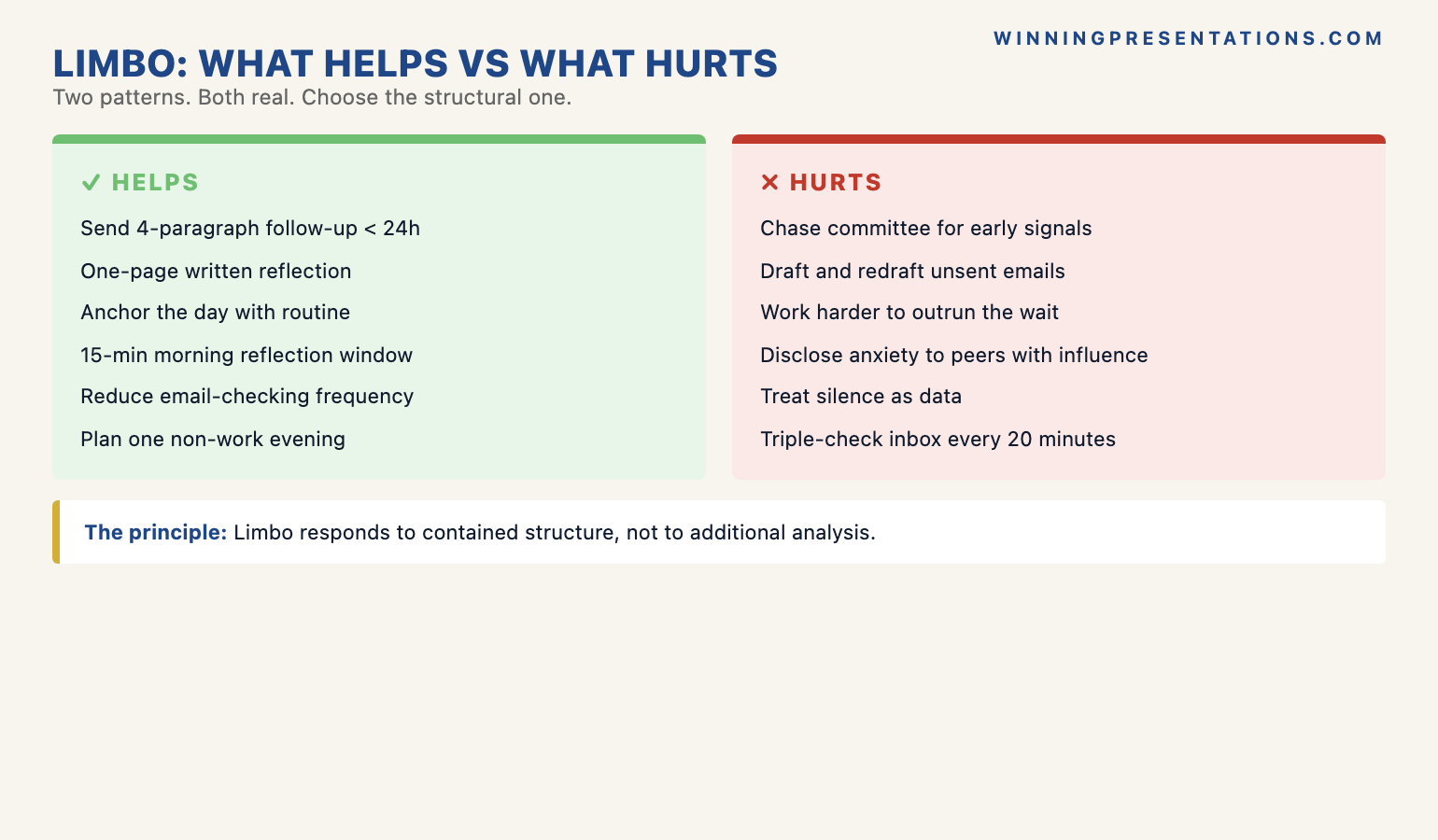
The post-board-presentation limbo what-helps-and-what-hurts split-comparison infographic showing helpful structural moves (send the four-paragraph follow-up within 24 hours, write a one-page reflection, anchor day with routine, contain reflection to a 15-minute morning window, reduce inputs and email-checking) versus what makes limbo worse (chase committee members for early signals, draft and redraft unsent follow-up emails, work harder to compensate for the wait, escalate disclosure to peers about the anxiety, treat the silence as data) — with the principle that limbo responds to contained structure, not to additional analysis.

First: chasing committee members for early signals. The polite-question approach — bumping into the COO and asking “any sense of where things are heading?” — almost always produces ambiguous responses that feed the loop. The committee member, even if friendly, is not authorised to telegraph the outcome and will hedge. The hedge will be parsed for fifty hours and produce no useful information. Better to wait for the formal decision, even if the wait is uncomfortable.

Second: drafting and redrafting unsent follow-up emails. After the four-paragraph follow-up has been sent, the work is done on the leader’s side. Drafting additional emails — apologising for missed nuances, offering more detail, proposing alternative framings — is the cognitive loop searching for a way to discharge itself. The drafts are almost never sent, but the act of drafting amplifies the anxiety they are meant to relieve. Notice the urge to draft, name it, and close the document.

Third: working harder during the wait to compensate for the perceived risk. Some senior leaders respond to limbo by piling on additional projects, working longer hours, or pushing their team harder. The behaviour reads externally as resilient, but internally it is the body trying to outrun the activation rather than letting it settle. The wait is shorter and less painful when the working week is structured normally rather than intensified. The anxiety is real, but the response that contains it is rest and routine, not additional output.

Contain the limbo before it costs you the next presentation.

Conquer Your Fear of Public Speaking (£39, instant access) is the practical course for senior presenters whose anxiety extends well beyond the room itself. Body-focused techniques and cognitive frameworks for managing the post-presentation wait without losing the working week.

Get Conquer Your Fear — £39 →

Frequently asked questions

Why does this anxiety hit harder than the presentation itself?

Because the presentation has structural anchors and the wait does not. The room provides physical, procedural, and social anchors that the body uses to regulate activation. The week after the meeting strips all three. The nervous system, deprived of structure, fills the gap with low-grade vigilance. The mind, deprived of a defined task, fills the gap with analytical looping. Both can feel worse than the bounded intensity of presenting itself, even though the actual stakes have not increased.

I am not a generally anxious presenter. Why is this happening to me now?

Because in-room anxiety and limbo anxiety are different patterns. Many experienced presenters who handle the room cleanly are surprised by how heavy limbo feels. The skill that contained the in-room anxiety — preparation, slide structure, audience reading — does not transfer to the wait, where there is no slide deck to focus on and no audience to read. The post-presentation experience often surfaces the anxiety pattern most strongly precisely in the senior leaders who handle the room well, because they have less practice managing diffuse activation.

Should I tell anyone how anxious I am during the wait?

Be selective. A trusted senior peer who has been through similar waits is helpful — the conversation normalises the pattern and adds structure to the days. A direct report or a colleague who reports up to the same committee is usually unhelpful, because their interpretation of the limbo will have its own bias and may amplify your own. Avoid raising the anxiety with the chair or with committee members. The conversation will land as a pressure move, even if it is meant honestly. Containment is the right discipline; disclosure to anyone with influence over the decision is rarely useful.

What if the decision goes against me — does the limbo end immediately?

The acute version of the limbo ends. The diffuse version often does not. Senior leaders who receive a deferred or rejected decision frequently report a different kind of cognitive churn — replaying the meeting for what they could have done differently, parsing the rejection for hidden signals about future career or trust. The patterns are similar to limbo but resolve in a different timeline. The structural moves are the same: written reflection within 24 hours, routine-based days, contained windows for analysis. The recovery from a no is faster than the wait for an unresolved decision, in part because the no provides the anchor the wait was missing.

How long is too long for limbo before I should follow up again?

The date in paragraph four of the follow-up email is the right anchor. If the date passes without a response, a single short email — “checking in on the proposed approval at the meeting on the 14th, happy to provide any additional input that would help” — is appropriate. Beyond that, escalating frequency rarely helps. If three weeks have passed with no response, the structural reality is that the proposal has been quietly deferred, and the right move is a different conversation — typically a 1:1 with the chair or the senior independent director — not another email. For more on the underlying pattern of decisions that disappear into ambiguity, see executive decision stalling.

The Winning Edge — weekly newsletter

The Winning Edge is a weekly newsletter for senior professionals who present at the executive level. One short email a week, focused on the structural moves that separate decks committees back from decks they defer. Subscribe to The Winning Edge →

Not ready for the full course? Start here instead: download Calm Under Pressure — practical techniques for the physical symptoms of presentation anxiety, designed to be used in the moment.

About the author

Mary Beth Hazeldine is Owner & Managing Director of Winning Presentations Ltd. With 24 years of corporate banking experience at JPMorgan Chase, PwC, Royal Bank of Scotland, and Commerzbank, she advises executives across financial services, healthcare, technology, and government on structuring presentations for high-stakes funding rounds, board approvals, and strategic decisions.

18 Mar 2026

Why Your Heart Races 10 Minutes AFTER the Presentation (The Post-Presentation Crash Nobody Discusses)

Quick Answer: Your heart races after the presentation because your nervous system has just spent 30 minutes in fight-or-flight activation, and when the threat (presenting) ends, adrenaline floods your bloodstream without an outlet. Your body expected physical action; instead you got applause. This causes a physiological crash that manifests as trembling, racing heart, numbness, and emotional volatility—all completely normal, but entirely manageable with the right technique.

You’re Experiencing Post-Presentation Anxiety If: You delivered a solid presentation, the audience responded well, and then 10 minutes later you felt shaky, your heart was racing, or you went numb. Most executive training addresses presentation nerves. Nothing teaches you how to regulate your nervous system after it’s been flooded with adrenaline and the presenting is done. That gap is where post-presentation crashes happen—and where you can intervene.

See the somatic techniques that stop the crash →

The Moment You Realise Something’s Wrong

James, a Director at a major investment bank, walked off stage after a 40-minute investor presentation. The room had been engaged. Questions were sharp, positive. He’d answered well. His team caught him afterward, saying the content landed perfectly.

Then he sat down in his office. His heart was hammering. Not nervously—but forcefully, irregularly. His hands were trembling. He felt cold despite the warm room. He tried to make a call and heard his voice shaking. The internal voice started: What’s happening? Did I have a panic attack? Am I having a heart attack?

He wasn’t. His nervous system was.

For 40 minutes, his body had been in fight-or-flight. Adrenaline, cortisol, heightened blood pressure, accelerated heart rate—all of it was doing what it’s designed to do. It was preparing him to survive a threat. The threat (delivering under pressure) ended. His mind knew he was safe. His nervous system hadn’t caught up yet.

This is the post-presentation crash. And it’s the one thing nobody teaches executives to manage.

The Physiology Behind the Crash

Your nervous system doesn’t distinguish between “real” threats and “perceived” threats. When you stand in front of an audience, your amygdala registers threat. Your sympathetic nervous system activates. Adrenaline floods your bloodstream. Your heart rate increases. Blood is diverted from your digestive system to your muscles, preparing for action.

This state is designed for physical response. Fight. Flight. Physical action that discharges the adrenaline.

Presenting doesn’t offer that outlet. You stand still. You speak. Your body is chemically primed for action it doesn’t take. The presentation ends. The cognitive threat is gone. But neurochemically, you’re not done.

Adrenaline has a half-life of 2–3 minutes. But it doesn’t evaporate—it rebounds. Your body needs physical action to metabolise it. If you don’t move, if you don’t discharge that activation, you get the crash: racing heart, trembling, sudden fatigue, numbness, or emotional intensity.

This isn’t weakness. This isn’t anxiety disorder. This is physiology.

Why Nobody Warns You About This

Every presentation skills course teaches you how to manage nervousness before and during the presentation. Breathing techniques. Posture work. Vocal delivery. All of it is designed to keep you regulated while you’re in the room.

What they don’t teach: how to help your nervous system transition back to baseline after you’re done.

Most executives experience post-presentation anxiety at least once. They interpret it as proof that they’re “anxious people” or that presenting is “too stressful for them.” They don’t realise it’s a normal neurophysiological response to adrenaline discharge without physical outlet.

The gap in training exists because post-presentation crashes happen after the presentation—when the coaching is done. But that’s precisely when you need a protocol.

What Happens in Your Body After You Leave the Stage

The moment you finish presenting and step off the stage, your brain registers the threat as resolved. Your amygdala should tell your sympathetic nervous system to stand down. The parasympathetic nervous system (your rest-and-digest system) should activate to bring you back to baseline.

That transition is supposed to happen automatically. Often it does. But if you’ve been in a heightened state for a sustained period, the rebound can be messy.

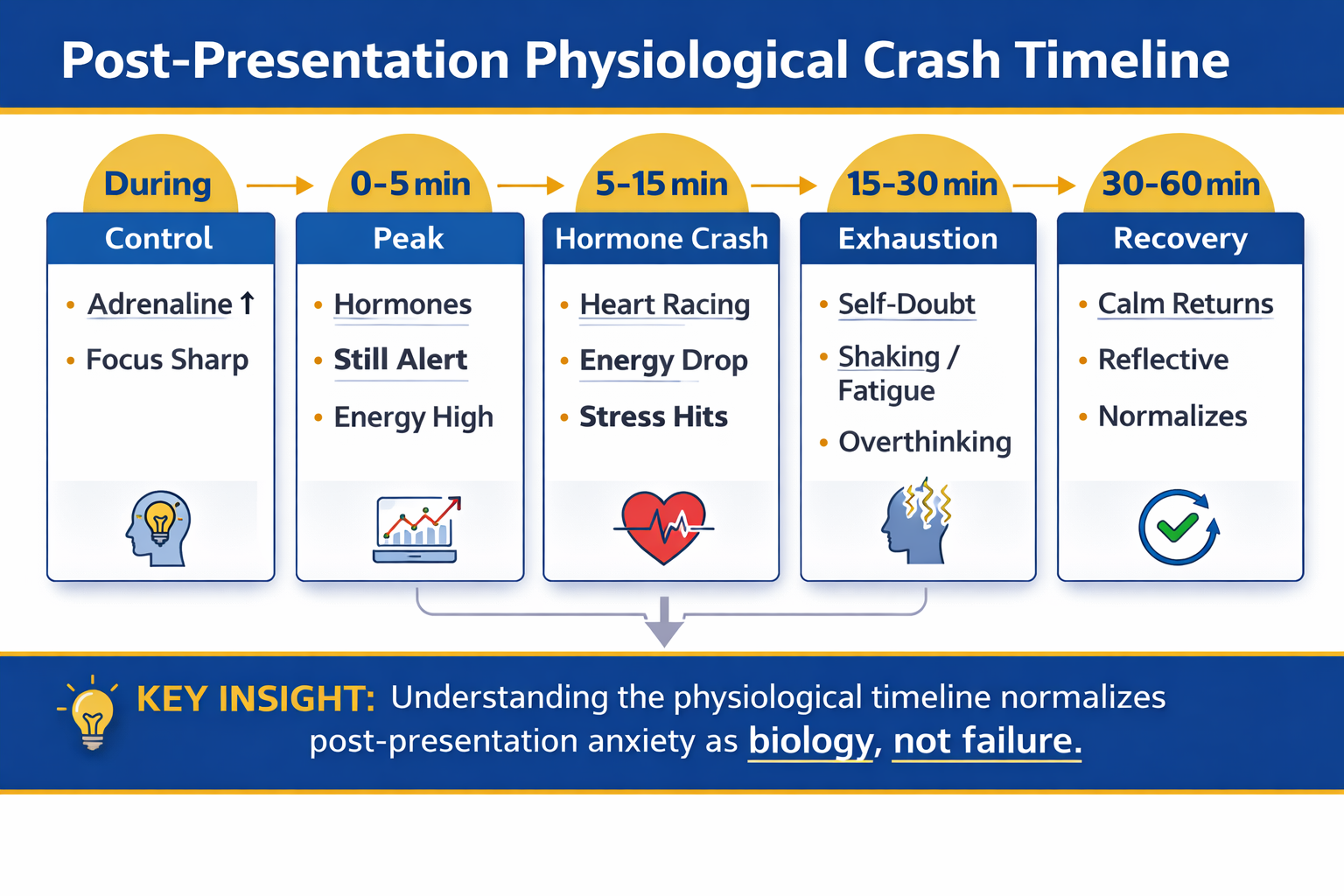
0–5 minutes after presentation: You feel relief, maybe a rush of positive energy. Adrenaline is still high but you’re no longer under threat. Your body is still in sympathetic activation.

5–15 minutes after: This is where the crash often happens. Your cognitive threat is resolved, but your neurochemical state hasn’t caught up. Adrenaline is rebounding. Your heart rate is still elevated. Some people experience sudden drops in blood sugar. Others feel numbness or dissociation. Some feel emotionally intense or tearful.

15–30 minutes after: Your parasympathetic system is working to bring you back to baseline, but if you’ve had no physical outlet, the process is slower and more uncomfortable. You might feel exhausted suddenly. Or you might experience the “second wind”—a final surge of adrenaline.

The key: you need to help this transition happen faster and more smoothly. That’s where somatic intervention comes in.

The Shutdown Response (And Why It’s Different From the Crash)

Some executives don’t experience post-presentation crashes. They experience post-presentation shutdown. This is your nervous system moving too far in the opposite direction—from sympathetic activation straight into parasympathetic collapse.

You finish the presentation feeling numb, disconnected, or emotionally flatlined. You can’t access your usual emotions. You might feel foggy or depersonalised. Some people describe it as feeling like they’re watching themselves from outside their body.

This is your nervous system overcorrecting. After sustained threat activation, it swings too far into rest mode. Your body has essentially frozen.

The intervention is different from the crash protocol. You need to gently activate your nervous system back up from the shutdown state, rather than bringing it down from hyperactivation. But the principle is the same: help your body transition back to baseline on your timeline, not on automatic.

The Post-Presentation Recovery Protocol

Calm Under Pressure gives you a somatic toolkit specifically for the post-presentation window. This is the exact 7-minute sequence that helps your nervous system transition from threat activation to baseline without the crash.

  • The four somatic techniques that stop the racing heart (no breathing—these are body-based)
  • How to discharge adrenaline safely even when you can’t physically exercise
  • The shutdown recovery sequence (if you freeze rather than spike)
  • Integration techniques for the 12 hours after (so the crash doesn’t come back)

Get Calm Under Pressure → £19.99

Used by executives who present weekly and need a protocol that works regardless of presentation length, audience size, or how the room responded.

Your heart is racing right now?

Get the Recovery Toolkit → £19.99

Immediate Interventions That Work

If you’re experiencing a post-presentation crash right now, here are four immediate interventions you can use without special equipment or privacy:

Intervention 1: The Cold Water Reflex. Splash cold water on your face or hold your wrists under cold water for 20–30 seconds. This triggers your mammalian dive reflex—an ancient response that immediately lowers your heart rate and activates your parasympathetic nervous system. It’s not pleasant, but it works within seconds.

Intervention 2: Grounding Through Sensation. Place your feet firmly on the floor. Feel the full contact. Press your feet down hard for 10 seconds. Release. Repeat three times. This activates your proprioceptive sense, which signals to your nervous system that you’re safe and stationary. It’s more subtle than cold water, but it interrupts the racing cycle.

Intervention 3: Deliberate Physical Action. Your body expected to discharge adrenaline through physical action during the presentation. Give it that outlet now. Walk briskly. Do 20 jumping jacks. Shake your arms and legs vigorously. Your nervous system will metabolise the adrenaline faster when you give it the action it was primed for.

Intervention 4: Bilateral Stimulation. Tap your knees alternately—left, right, left, right—in a steady rhythm for two minutes. This engages both hemispheres of your brain and interrupts the racing cycle. It’s discreet enough to do under a table during a client dinner.

The key: pick one that feels authentic to you and use it immediately. Don’t wait for the crash to settle on its own. Your nervous system is primed for action—give it what it needs.

Preventing This From Becoming a Pattern

A single post-presentation crash isn’t a problem. It’s a signal that your nervous system needs support transitioning after high-stakes delivery. The problem is when it becomes a pattern. You start anticipating the crash. Your nervous system learns to expect it. What started as a physiological response becomes an anxiety pattern.

To prevent this:

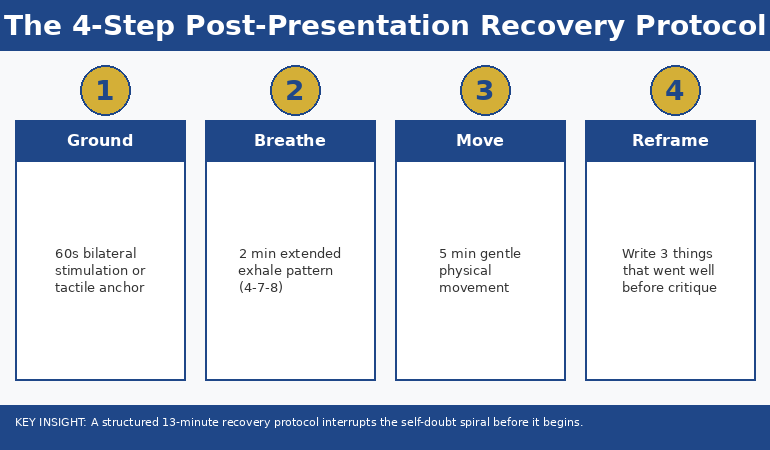
Build a post-presentation protocol into your routine. Don’t wait until the crash happens. After every significant presentation, spend 10 minutes doing deliberate nervous system work. It might be a walk, stretching, cold water, or grounding exercises. Whatever it is, make it consistent. Your nervous system learns through pattern. A consistent post-presentation protocol teaches your body that after presenting comes a specific regulated transition—not a crash.

Address the deeper pattern. If post-presentation anxiety is happening regularly, it’s worth exploring what your nervous system is learning about presentations. Are you interpreting every presentation as genuinely threatening? Are you not fully believing you’re safe once it’s over? These are patterns that shift with the right approach, but they require more than just physical interventions.

Deeper Than Somatic Tools

Immediate interventions work. But if post-presentation anxiety is a regular pattern, something deeper needs to shift. Calm Under Pressure includes the somatic toolkit, plus the framework for understanding what your nervous system is learning about presentations—and how to change that pattern at the root.

  • The nervous system patterns that fuel post-presentation crashes (and how they formed)
  • Reframing work that changes your nervous system’s relationship to threat
  • Seven-day integration protocol (somatic work + cognitive shifts + lifestyle anchors)
  • How to know when you’re genuinely “fixed” vs. just managing symptoms

Get Calm Under Pressure → £19.99

Used by senior executives at FTSE firms, investment banks, and multinationals who present weekly but didn’t realise the crashes were addressable.

The Bigger Picture

Post-presentation crashes are a symptom. They tell you your nervous system is treating presentations as threats. That’s not always wrong—some presentations are genuinely high-stakes. But if your body is responding to routine client updates or team presentations with full fight-or-flight activation, something in your threat detection system needs recalibration.

This connects to larger patterns. If you’re experiencing post-presentation anxiety, you might also notice presentation anxiety before client meetings, or you might have a history where a past presentation experience left a mark on your nervous system. These are all connected to the same system. Fixing one piece shifts the whole pattern.

You might also benefit from understanding the neurobiology of fight-or-flight and how to interrupt it—not just in the post-presentation window, but as a foundational shift.

Is This Right For You?

✓ This is for you if:

  • You experience a racing heart, trembling, or numbness 10–20 minutes after presenting
  • You deliver presentations confidently but then feel crashed or numb afterward
  • You’re not sure if what you’re experiencing is “normal” or a sign of a deeper anxiety issue
  • You present regularly (weekly or more) and the post-presentation crash is becoming a pattern
  • You want practical tools you can use immediately, not just cognitive reframing

✗ Not for you if:

  • You experience anxiety during the presentation itself (that requires a different intervention)
  • You’re looking for general stress management rather than post-presentation-specific support
  • Your post-presentation symptoms are severe (chest pain, severe shortness of breath) and you haven’t consulted a medical professional
  • You present very rarely (once or twice a year) and the crash doesn’t significantly impact your performance or wellbeing

The Real Cost of Not Addressing This

A single post-presentation crash is uncomfortable. But when it becomes a pattern, it shapes your behaviour. You start avoiding presentations. You over-prepare as a way to manage anxiety. You rehearse obsessively. You negotiate to get out of presenting. Or you deliver presentations but spend the next hours in a state of dysregulation.

The psychological cost: you begin to believe presentations are too stressful for you. The physiological cost: your nervous system learns that presenting = threat, so each subsequent presentation triggers a stronger response. The professional cost: you might miss opportunities to lead, present findings, or influence decision-making because you’re working around the anxiety pattern.

The intervention is straightforward. But it requires intention. You need to understand what’s happening in your nervous system and give it what it needs to transition back to baseline.

Want the exact somatic protocol?

Get Calm Under Pressure → £19.99

Three Quick Answers

Is a racing heart after presenting a sign I have anxiety disorder? Not necessarily. Adrenaline is a physical substance. When your body releases it during a presentation and then doesn’t have a physical outlet to metabolise it, your heart will race. This is physiology, not pathology. If the racing heart is happening regularly and you’re concerned, consult a medical professional. But in most cases, this is a signal that your nervous system needs a transition protocol, not that something is wrong with you.

Should I be taking medication for this? That’s a question for your doctor. What I can tell you: somatic interventions often work faster and more effectively than medication for post-presentation crashes because they address the physiological process directly. But everyone’s situation is different. If you’re on medication, work with your prescriber. If you’re not and you’re considering it, try somatic interventions first.

How long does it take to stop having post-presentation crashes? With consistent use of a post-presentation protocol, most people notice a shift within 2–3 weeks. The crash intensity decreases. The recovery time shortens. Your nervous system learns that there’s a regulation protocol after presenting, so it anticipates the intervention and activates it. Within 6–8 weeks, the pattern usually shifts significantly.

The Slide System Works for This Too

If post-presentation anxiety is a pattern for you, it’s often because you’re spending mental energy managing the presentation content when what you actually need is a slide structure that works effortlessly. The Executive Slide System includes frameworks that reduce cognitive load during delivery—which means less adrenaline activation during the presentation and less crash afterward. Fewer mental resources spent on managing the deck means your nervous system doesn’t need to work as hard.

Explore the Executive Slide System → £39

FAQ

Is it normal to feel emotionally intense or tearful after a presentation?

Yes. Adrenaline and cortisol can create emotional volatility as they metabolise. You might feel tearful, angry, or intensely joyful after a presentation even if you didn’t feel that way during it. This is your nervous system processing the activation. Use your post-presentation protocol and let the emotions move through. They usually pass within 10–30 minutes.

What if the crash happens hours after the presentation, not immediately?

Sometimes your nervous system is still in activation mode hours later and doesn’t “crash” until you’re in a safer environment (home, car, after the meeting ends). The protocol is the same—immediate intervention using somatic techniques. The delayed crash can actually indicate that you were working very hard to stay regulated during the presentation and the effort caught up with you once you could relax.

Can I prevent the crash by not thinking about it?

No. The crash is a physiological response, not a cognitive one. Ignoring it or trying to think your way out of it usually extends it. Your nervous system responds to physical interventions—movement, cold, grounding, bilateral stimulation. Use those rather than trying to manage the crash mentally.

Should I tell my team if I’m experiencing this?

You don’t have to. It’s your nervous system’s process. But some executives find it helpful to have a brief exit plan (“I’m going for a walk to decompress”) so they’re not caught off-guard by the need to step away. You don’t need to explain the crash—just the need for a few minutes of space.

The Path Forward

Your heart is racing after presentations because your body is doing exactly what it’s designed to do. You needed activation to manage the threat of presenting. Now you need help transitioning that activation back to baseline. The somatic tools in this article work. Use one immediately the next time you feel the crash. Then build a protocol you use consistently after every presentation—before the pattern solidifies into an anxiety disorder.

This is addressable. But it requires intention in the 10 minutes after you leave the stage—not weeks of therapy afterward.

Stay Updated

New frameworks for managing presentation stress land in The Winning Edge newsletter every Friday. Subscribe for approaches you can use immediately.

🆓 Free resource: Free PDF — a free guide to strengthen your presentation preparation.

About the Author

Mary Beth Hazeldine is the Owner & Managing Director of Winning Presentations. With 24 years of corporate banking experience at JPMorgan Chase, PwC, Royal Bank of Scotland, and Commerzbank, she has delivered high-stakes presentations in boardrooms across three continents.

A qualified clinical hypnotherapist and NLP practitioner, Mary Beth combines executive communication expertise with evidence-based techniques for managing presentation anxiety. She has trained thousands of executives and supported high-stakes funding rounds and approvals.

Book a discovery call | View services

This article was written with AI assistance and reviewed by Mary Beth Hazeldine.