

Quick answer: When a zoom freezes critical point hits a senior presentation, the first ten seconds after the reconnect decide whether the rest of the session lands or gets deferred. The three-phrase recovery script senior leaders rehearse covers a reconnect line that names what just happened from both sides, a pickup line that anchors back to the last completed thought, and a micro-recap that restates the substantive thread the room needs to re-engage with. Most senior presenters skip the reconnect line, dive straight into the pickup, and find the committee asking remedial questions for the next ten minutes that erode whatever momentum the H2 ask was about to land with. The freeze itself costs nothing; the unrehearsed reconnect costs the rest of the meeting.
JUMP TO:
- Why the freeze itself is not the problem
- The reconnect line that opens the recovery
- The pickup line that anchors back to the last completed thought
- The micro-recap that re-engages the committee
- The freeze-recovery rehearsal the day before
- One thing to do before the next high-stakes virtual session
- Frequently asked questions
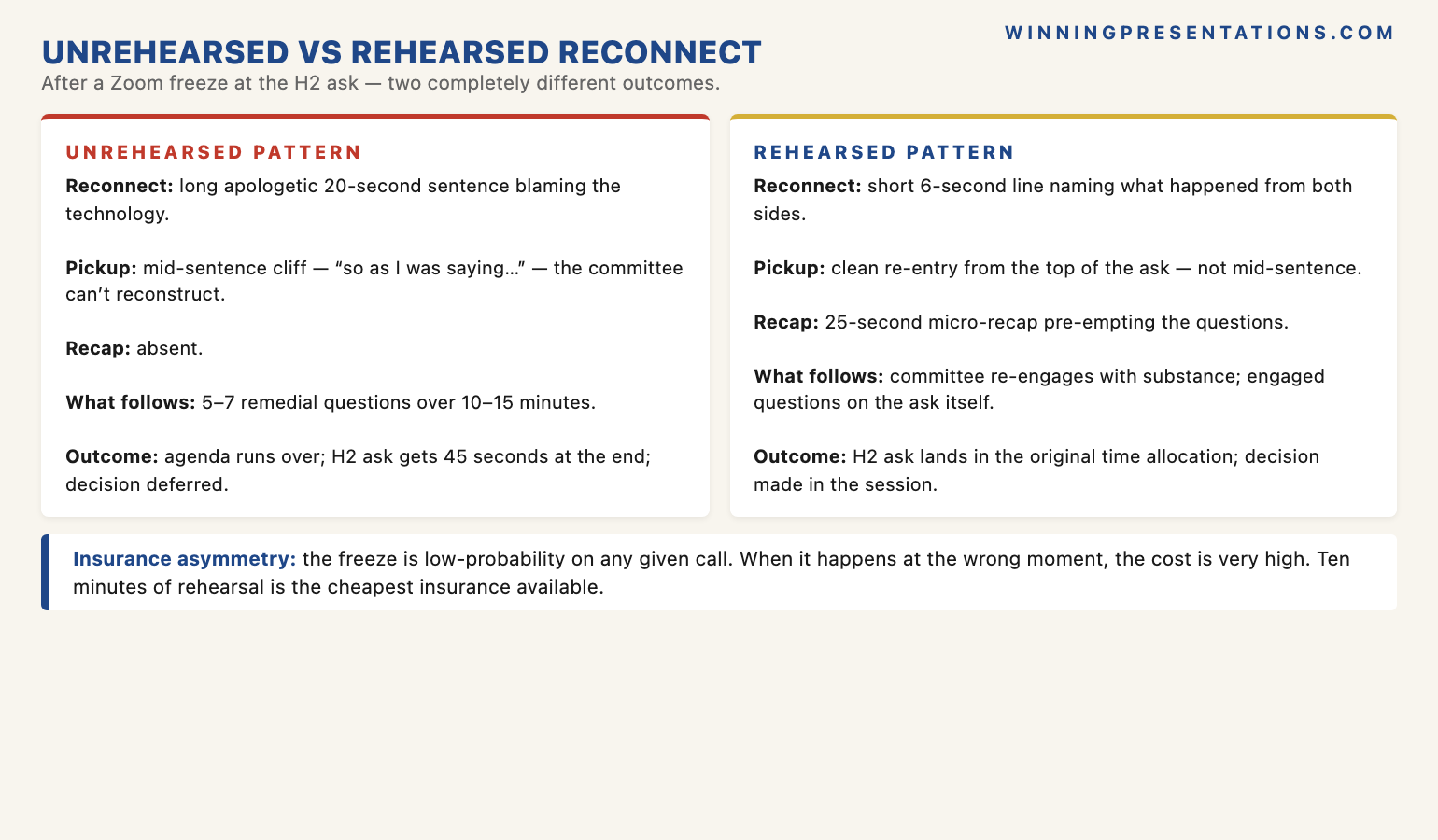
In May 2022 I was retained to observe a virtual H1 board update at a UK-listed financial services group. The presenter was the regional managing director for the UK and Ireland business, presenting to the group executive committee on Zoom. The committee was distributed: the group CEO and CFO at headquarters in Manchester, the CRO at the London office, the chief of staff and two non-executive directors on the same Manchester laptop, the head of strategy joining alone from Edinburgh. The presenter had thirty minutes and was about twenty-four minutes in — just past the H1 verdict, through the bridge analysis, and three sentences into the H2 ask — when his Zoom connection froze. His tile became a still image with his hand half-raised mid-gesture and his mouth open on a vowel. The committee waited fifteen seconds, then the chief of staff politely said into the microphone “I think we’ve lost him.” The presenter reconnected thirty-eight seconds after the freeze had started. He came back in, his face slightly flushed, and said “Sorry about that — where was I? Yes, the H2 ask — so as I was saying, the budget reallocation is what we’re proposing.” He continued for another four minutes. The committee asked seven questions over the next ten minutes. Five of those questions were re-asking points from the section before the freeze; two were genuinely new. The H2 ask was deferred to a follow-up session the following week. The MD’s subsequent debrief with me focused on what he could have said about the budget; the actual cost was the ten seconds after the reconnect, which he had not rehearsed.
(This article was created with AI assistance; all stories and insights are based on 35 years of real client work.)
This piece walks through the three-phrase recovery script senior leaders use in the first ten seconds after a Zoom freeze at a critical point in a virtual presentation. The freeze itself is not the costly event; the unrehearsed reconnect is. The freeze costs the committee about thirty seconds of waiting and produces no permanent damage. The unrehearsed reconnect costs ten or fifteen minutes of remedial questions, a lost H2 ask, and sometimes the entire substantive decision the meeting was supposed to land. The three-phrase script — reconnect line, pickup line, micro-recap — takes about twelve seconds to deliver and removes almost all of the reconnect cost. The script is mechanical, easy to rehearse, and almost never used by senior leaders who otherwise have rehearsed responses for every other component of the high-stakes virtual meeting. The freeze is the gap in most presenters’ preparation. This piece is what closes it.
Before the next high-stakes virtual session, the freeze-recovery rehearsal is worth ten minutes.
The Virtual Presentation Quick-Start Checklist includes the freeze-recovery script template and the pre-call connection check that senior leaders run in the ninety seconds before a critical session. Free download, no email gate.
Why the freeze itself is not the problem
The freeze costs almost nothing structurally. The committee’s experience of a thirty-second Zoom freeze is roughly equivalent to the experience of a long natural pause in an in-person meeting: a bit of fidgeting, a couple of glances at watches, a polite assumption that the presenter will resume shortly. The committee’s engagement with the substance of the presentation is not erased by the pause. The pages already covered are still in the committee’s memory; the points already made are still landed; the engagement posture the presenter has built over the first twenty-four minutes is still intact. A thirty-second freeze is a recoverable event in the same category as a slight cough, a moment to take a sip of water, or the chair stepping out briefly to take a call. None of these structurally damages the meeting.
What does damage the meeting is what happens in the ten seconds after the reconnect, because those ten seconds re-set the engagement frame for the rest of the session. The committee has been waiting in a slightly unsettled posture (the chief of staff has commented, the CRO has reached for their phone, the two non-exec directors have started a sotto-voce side conversation). The reconnect is the moment when the presenter has to re-establish chairmanship of the meeting and re-recruit the committee’s attention onto the substance of the H2 ask. If the presenter skips that re-establishment and dives straight back in, the committee’s attention is still in the post-freeze unsettled posture and the substantive content of the next four minutes lands inside that posture. The remedial questions that follow are not really about the content; they are about the committee re-running the substance themselves because the presenter never re-recruited their attention onto it.
The cost of the unrehearsed reconnect compounds because each remedial question takes the meeting further from the H2 ask. By the time the committee has asked their fifth re-cover question, the agenda is over time, the chair is signalling the close, and the H2 ask — the actual decision the meeting was supposed to land — gets the last forty-five seconds in a session that originally had four minutes allocated to it. The committee defers the decision because they have not had the time to engage with it properly. The presenter walks out of the meeting believing the freeze cost them the decision; what actually cost them the decision was the ten seconds after the reconnect that they did not rehearse. The recovery patterns senior leaders use mid-meeting covers the broader version of this dynamic across the other moments where seniority creates the assumption that improvisation will be enough.
The reconnect line that opens the recovery
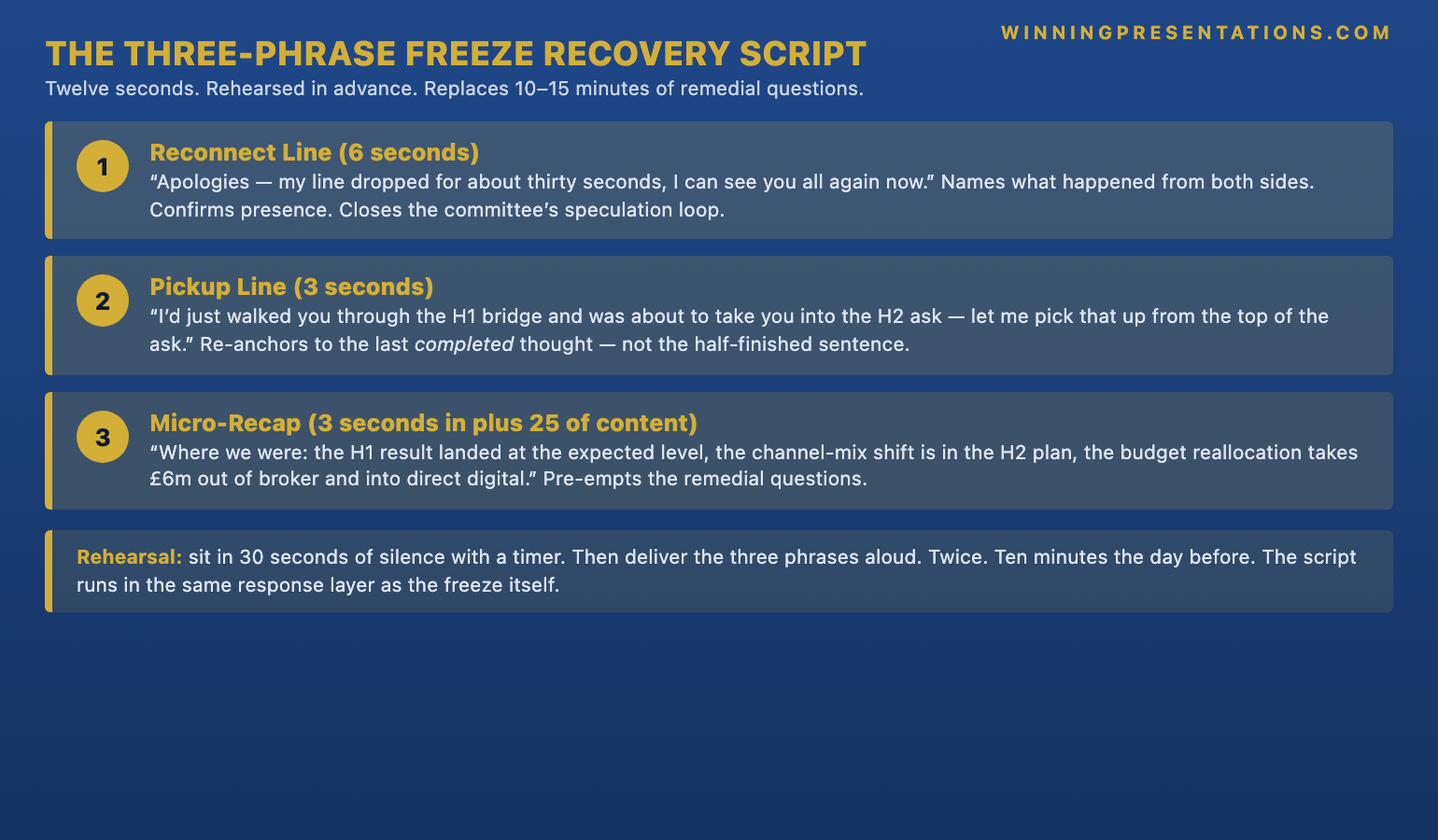
The first phrase of the recovery script is the reconnect line. The reconnect line is a single sentence, about ten to fifteen words, that does three things at once: it names what just happened from the presenter’s side, names what the committee likely experienced from theirs, and confirms the presenter is now back in the room. “Apologies — my line dropped for about thirty seconds, I can see you all again now.” That sentence takes about six seconds to deliver. It costs almost nothing in agenda time. It accomplishes three structural functions that the alternative (“Sorry about that — where was I?”) does not.
Naming what happened from the presenter’s side closes the speculation loop the committee has been running during the freeze. The committee has been wondering whether the presenter has noticed the failure, whether the presenter is trying to fix it, or whether the entire call is about to fall apart. The brief, calm naming of the event ends that loop. Naming what the committee experienced acknowledges the asymmetry — the committee was waiting, the presenter was absent, and this is a normal feature of virtual meetings rather than a hidden source of friction. Confirming presence with “I can see you all again now” re-establishes the visual contract: the presenter is back, the committee can re-engage, and the meeting can resume. The three functions together cost six seconds and recover the entire engagement frame.
The reconnect line that fails is the one that apologises at length, blames the technology, or descends into a confessional about how disrupted the presenter feels. “I’m so sorry — my Wi-Fi has been terrible all morning, I’ve already had this happen on two other calls, I really hope it doesn’t happen again, this is so frustrating” takes about twenty seconds, signals to the committee that the presenter is rattled, invites a sympathetic response that costs another fifteen seconds, and pushes the substantive recovery a full minute past where it needed to be. The committee’s engagement posture during that minute drifts further from the substance, not closer to it. The long apologetic version of the reconnect line is what most unrehearsed presenters produce because it matches the internal emotional state of having just been frozen out of the meeting. The short calm version is the rehearsed alternative.
The pickup line that anchors back to the last completed thought
The second phrase is the pickup line. The pickup line is a single sentence, also short, that re-anchors the substantive thread to the last completed thought before the freeze — not to the half-finished sentence the presenter was mid-way through when the line dropped. “I’d just walked you through the H1 bridge against plan and was about to take you into the H2 ask — let me pick that up from the top of the ask.” The pickup line names where the meeting was substantively, signals the segment that is about to resume, and explicitly resets the presentation to a clean transition rather than the mid-sentence cliff the freeze created.
The structural function of the pickup line is to give the committee a clean re-entry point. The committee’s memory of the meeting before the freeze is not granular; they remember the major sections (verdict, bridge, ask) rather than the specific sentence the presenter was mid-way through. The presenter who tries to pick up exactly where they left off (“So as I was saying, the second of the three components of the H2 ask is…”) is asking the committee to re-construct a half-finished thought the committee does not actually have a strong memory of. The committee’s response is to ask remedial questions to fill in what they did not catch, which is what produces the cascade of re-cover questions that erodes the rest of the meeting. The presenter who picks up from the top of the ask (“let me take you through the H2 ask cleanly”) is restarting a coherent segment that the committee can engage with as a fresh unit, rather than asking them to mentally re-construct a fragmented sentence.
The pickup line is also a chairing signal. The presenter who picks up cleanly is demonstrating that they are still in control of the meeting’s structure, that the freeze did not derail their plan, and that the session will resume to land the substantive decision. The presenter who picks up mid-sentence is signalling that the freeze has thrown them off and the meeting is now running on improvisation. Senior committees read these signals within the first ten seconds of the reconnect and calibrate their engagement accordingly. A chaired-recovery signal earns engaged engagement for the rest of the session; an improvised-recovery signal earns the polite, surface engagement that produces deferred decisions. The pickup line is the cheapest chairing signal available in the freeze-recovery moment. The Q&A discipline for virtual presentations where the format changes everything covers the same chairing dynamic in the post-presentation question segment, which is structurally identical to the post-freeze recovery.
The post-freeze remedial questions are Q&A under the worst possible conditions. The Q&A discipline is what compresses them back.
The Executive Q&A Handling System is the structured framework senior professionals use to handle the high-pressure question moments in executive presentations — including the post-freeze recovery, the hostile question mid-pitch, the curveball from a non-executive director, and the questions that are really objections in disguise. The system includes the pattern library of the eleven question types senior committees actually ask, the response frameworks for each, and the chairing moves that hold the room while the answer is being constructed.
- Eleven question-type patterns with worked examples from financial services, insurance, consulting, and technology
- Response frameworks for each pattern — covering the structural move, the chairing move, and the recovery move when the answer is incomplete
- The post-disruption chairing protocol (post-freeze, post-tech-failure, post-objection) for re-establishing engagement
- Pre-rehearsal drills that install the chairing moves in advance of the high-stakes session
- Instant download, lifetime access — usable across every executive Q&A cycle, not just the one in front of you now — £39
The micro-recap that re-engages the committee
The third phrase is the micro-recap. The micro-recap is three or four sentences that restate the substantive thread the meeting was on before the freeze, in a form the committee can re-engage with without having to ask remedial questions. “Where we were: the H1 result landed at the expected level, the channel-mix shift is real and is now in the H2 plan, and the budget reallocation I’m about to ask the committee to approve takes £6m of marketing spend out of the broker channel and redirects it to direct digital acquisition for H2. Let me walk you through the rationale.” That micro-recap takes about twenty-five seconds and replaces the five or six remedial questions that would otherwise eat ten minutes of the meeting.
The structural function of the micro-recap is that it pre-empts the questions the committee was going to ask anyway. The committee was going to ask “remind me what the H1 number landed at” and “how does the channel-mix shift relate to the broker reallocation” and “is the budget reallocation gross or net of the existing spend”. Each of those questions, asked separately, would have taken about a minute to ask and answer, and would have fragmented the substantive thread further. The micro-recap delivers the answers in the structured order the committee needed them, in twenty-five seconds, without the committee having to do the work of asking. The committee is then free to engage with the H2 ask itself, which is what the meeting was supposed to land on. The remedial questions are converted into engaged questions about the substantive recommendation, which is the productive use of the committee’s remaining time.
The micro-recap also re-establishes the presenter’s authority over the meeting’s structure. After a freeze, the committee’s implicit calibration is that the meeting may have lost its rhythm and they may need to take more chairing initiative themselves to keep it on track. The micro-recap signals that the presenter has the rhythm intact, knows where the meeting is, and will continue to chair it through the substantive content. The committee’s implicit calibration reverts to the pre-freeze state, the chairing remains with the presenter, and the H2 ask lands as the agenda item it was originally allocated to be rather than as a rushed final two minutes of an over-running meeting. The underlying discipline of presenting online without losing the room covers the structural moves that prevent many of the disruptions in the first place.
The freeze-recovery rehearsal the day before
The freeze-recovery rehearsal takes about ten minutes the day before a high-stakes virtual session. Open the deck. Identify the slide that contains the H2 ask or the substantive decision the meeting is supposed to land. Identify the slide three positions before that one — the slide where the freeze would do maximum damage if it hit there. On a sticky note attached to that slide, write the three-phrase recovery script in full: the reconnect line, the pickup line, and the micro-recap. Read the three phrases aloud, in sequence, twice. Rehearse the transition from the pickup line into the micro-recap; this is the join that is hardest to do under panic.
Then rehearse the actual freeze scenario. Set a timer for thirty seconds. Sit in silence for the thirty seconds, pretending the call has frozen. When the timer ends, deliver the three-phrase script aloud, picking up from the rehearsed slide. The thirty seconds of silence is the rehearsal of the most uncomfortable part of the scenario — sitting in the disconnect, knowing the committee is waiting, knowing the recovery has to come quickly when the reconnect happens. Presenters who have never rehearsed the silence find the silence itself contributes to the panic when it happens in real time. Presenters who have sat through the silence in rehearsal once or twice find it manageable in the live session. The silence is what most freeze-recovery rehearsals miss because it feels artificial in practice; it is the variable that does the most work in the actual moment.
The second rehearsal is the question-anticipation pass. After delivering the micro-recap, list aloud the three most likely remedial questions the committee would have asked if you had not done the micro-recap. For each one, formulate a one-sentence response. This is not so the response is needed in the actual session; it is so the presenter has a backup that the committee will probably ask anyway, and the response is therefore available in the same rehearsed-muscle layer as the recap. The five-minute question-anticipation rehearsal converts the post-freeze Q&A from improvised remedial work into a rehearsed continuation of the substantive thread. The total rehearsal takes ten minutes and is the single highest-leverage preparation in the whole pre-meeting routine.
Why senior presenters rarely rehearse the reconnect
The freeze-recovery script is rarely rehearsed by senior presenters for a structural reason: it is preparation for an event that may not happen. Most virtual presentations do not have a freeze at a critical moment; most freezes happen at uneventful moments where they have little cost; most senior presenters have completed dozens of sessions without ever needing the script. The base-rate frequency of the high-cost freeze scenario is low enough that rehearsal feels disproportionate to the risk. The asymmetry is that when the high-cost freeze does happen, the cost is very high — a lost H2 decision, a deferred budget approval, a board ask that has to be re-presented in a follow-up session two weeks later. The cost-weighted expected value of the ten-minute rehearsal is high even though the unweighted probability of needing it on any given call is low.
The same structural pattern applies to other rare-but-high-cost virtual events: the platform crash, the audio cutout, the deck refusing to advance, the late attendee joining and asking for a complete recap. Each is low-probability on any given session and very high-cost when it happens at the wrong moment. The senior presenters who handle these events well are not the ones who happened to improvise well in the moment; they are the ones who had a rehearsed script for each pattern, available in the same response layer as the substantive content. The improvised response under maximum cognitive load is reliably worse than the rehearsed one, even for very experienced presenters, because the cognitive bandwidth available in the moment is the constraint, not the presenter’s underlying capability. The freeze-recovery script is the cheapest insurance available against the highest-cost virtual scenarios. Most senior presenters do not buy the insurance until after they have paid the cost of not having it.
Built on 24 years in corporate banking and 16 years coaching senior professionals on the question moments that derail high-stakes presentations.
The Executive Q&A Handling System is designed for senior professionals across financial services, insurance, consulting, and technology who present at the board, executive committee, and investment committee level. The system includes the eleven question-type patterns senior committees actually ask, the structured response frameworks for each, the chairing moves that hold the room while the answer is being constructed, and the post-disruption recovery protocols (post-freeze, post-tech-failure, post-objection) that re-establish engagement after the meeting has been thrown off rhythm. Instant download, lifetime access. £39.
One thing to do before the next high-stakes virtual session
The day before the next virtual session where a decision genuinely matters, take ten minutes and write the three-phrase recovery script in full, on a sticky note, attached to the deck slide three positions before the H2 ask. Read the three phrases aloud twice. Sit in silence for thirty seconds with the timer running. When the timer ends, deliver the three phrases in sequence, pick up the ask, and continue. Then list the three remedial questions the committee would have asked without the micro-recap, and formulate a one-sentence response for each. The whole rehearsal takes ten minutes and installs the recovery script in the response layer that runs in real time under cognitive load. If the freeze happens in the live session, the next ten seconds become a twelve-second pause the committee absorbs. If the freeze does not happen, the rehearsal time has been a low-cost insurance premium and the rest of the meeting benefits from the cleaner chairing the rehearsal indirectly produces.
Frequently asked questions
What if the freeze is short — only five or ten seconds — do I still need the full three-phrase script?
For freezes under about ten seconds, the reconnect line is usually sufficient on its own. The committee’s memory of the substantive thread is intact and the disruption to engagement is minimal. The short version is something like “Apologies — brief lag — let me continue.” The pickup and micro-recap are not needed because the committee did not lose the thread to begin with. The full three-phrase script becomes necessary at about fifteen seconds of disconnect and above. The judgement is mechanical: short freeze, reconnect line only; medium freeze, reconnect plus pickup; long freeze with substantive content lost, full three-phrase script. The presenter does not need to make the judgement in the moment; the rehearsed three-phrase script can simply be truncated to fit. Delivering the full script after a five-second freeze is over-engineered and reads as fussy. Delivering only the reconnect after a thirty-second freeze leaves the committee without the substantive re-engagement they need.
Does the recovery script work the same way when the freeze is on the audience side rather than mine?
The reverse-freeze scenario — where the presenter is talking but the audience has frozen — is structurally different and harder to detect than the presenter-side freeze. The first signal is usually no signal at all: the audience tiles continue to display, but the chat does not move, no questions arrive when expected, and the natural micro-reactions on the audience faces stop. The recovery in this case is to pause the presentation, ask explicitly “Can I check that everyone’s still with me — can anyone confirm in the chat or unmute to say yes?”, and wait for the response. If the response indicates that the audience missed the last segment, the micro-recap from the three-phrase script applies in the same form. The reverse-freeze case usually requires the chairing of a host or the chief of staff to confirm what the audience experienced, which is a different chairing burden the presenter does not always carry alone.
What if the freeze happens during the Q&A segment rather than during the presentation itself?
The freeze during Q&A is structurally easier to handle than the freeze during the presentation. The pickup line resets to the question that was being asked rather than to a substantive content point: “Apologies — line dropped for a moment — I think the question on the table was the one about the H2 expense envelope. Let me address that.” The micro-recap is not usually needed in the Q&A scenario because the substantive ground has already been covered; the committee just needs to know which question is being answered. The Q&A freeze recovery is shorter (just the reconnect line plus the pickup line) and is also easier to rehearse because the question being addressed is a known anchor point. Many of the moves are also covered in the Executive Q&A Handling System’s broader chairing-the-room discipline.
I’m a confident presenter who has never frozen mid-meeting — do I really need to rehearse this?
Yes, because the question is not whether you can present confidently under normal conditions but whether you can deliver a rehearsed twelve-second script under maximum cognitive load. Confident presenters reliably underestimate the cognitive bandwidth cost of the freeze itself. The freeze is not a small interruption you can ride through; it is an acute spike in cognitive load that compresses the available bandwidth for absolutely everything else, including the substantive content you were about to deliver. The rehearsed script is what runs under that compression because it is already installed in the rehearsed-response layer. Confident presenters who have never rehearsed it still freeze under the compression, just like every other presenter; the difference is that they tend to be more surprised by it, which makes the recovery slower rather than faster. The rehearsal is the insurance, and the cost is ten minutes the day before a session that already requires hours of substantive preparation. The asymmetry favours doing the rehearsal.
The Winning Edge — weekly newsletter
The Winning Edge is a weekly (Thursday) newsletter for senior professionals who present at the executive level. One short email a week, focused on the rehearsed recovery scripts that senior leaders use when the high-stakes virtual session does not go to plan — freezes, hostile questions, late attendees, last-minute deck changes — and the structural moves that compress the recovery to seconds rather than minutes. Subscribe to The Winning Edge →
For the broader picture across slides, storytelling, confidence, and delivery, the Complete Presenter library — seven products in one bundle is what most senior professionals find useful as a single resource — £99 for everything, lifetime access.
About the author
Mary Beth Hazeldine is Owner & Managing Director of Winning Presentations Ltd. With 24 years of corporate banking experience at JPMorgan Chase, PwC, Royal Bank of Scotland, and Commerzbank, she works with senior professionals across financial services, insurance, consulting, and technology on the rehearsed recovery scripts that protect high-stakes virtual sessions from the unforced cost of unrehearsed reconnects — freezes, tech failures, late attendees, and the question moments that compound the disruption.