

- Action-Value-Proof (AVP) is the framework we teach at Winning Presentations for the single most important part of any presentation: the opening blueprint that tells your audience where you’re taking them and why they should come.
- Action = the decision you want them to make. Value = the reason it’s worth their attention (what’s in it for them). Proof = the three strongest arguments that earn the action.
- Most presentations fail before slide three — not because the content is weak, but because the opening never says what it wants, never gives the audience a reason to care, and then marches through the material chronologically instead of leading with the arguments that move this audience.
- Get the opening blueprint right and everything downstream — your structure, your slides, your Q&A — falls into place.
Reading time: about 9 minutes • Updated June 2026
- What is the Action-Value-Proof framework?
- Why most presentations fail in the first ninety seconds
- A — Action: the decision you actually want
- V — Value: why should they listen?
- P — Proof: your three strongest arguments
- AVP in practice: a worked opening
- Where AVP fits in the bigger picture
- Frequently asked questions
What is the Action-Value-Proof framework?
The Action-Value-Proof framework is the method we teach at Winning Presentations for building the opening of any high-stakes presentation. It has three parts that have to work together: Action — the decision you want your audience to make; Value — the reason it’s worth their time, the “what’s in it for me”; and Proof — the three strongest arguments, in deliberate order, that build the case for that action. Done well, those three elements form a blueprint your audience can follow from the very first minute. They know what you want, why it matters to them, and where you’re going — before you’ve shown a single chart.
I’ve taught this framework to teams at investment banks, asset managers and corporates for more than fifteen years. It’s at the heart of how we think about presentations at Winning Presentations — and it reflects something I learned the hard way across twenty-four years in corporate banking: brilliant people lose deals not because their thinking is wrong, but because nobody in the room can tell what they’re being asked to decide.
Join The Winning Edge — a short weekly email on presentation skills, communication, leadership, executive presence and the habits that help senior professionals get heard and get results.
Why most presentations fail in the first ninety seconds
Here’s the uncomfortable thing I’ve learned from sitting through hundreds of pitches and rehearsals: the audience decides whether to really listen to you almost immediately — and most presenters give them every reason not to.
The three failures I see again and again:
No clear Action. The presenter never states the decision they want. They “walk the audience through” the numbers and hope the conclusion lands. It rarely does. An audience that doesn’t know what you want can’t give it to you.
No Value for the audience. The opening is about the presenter — their firm, their process, their product — and never answers the only question the audience is actually asking: why should I care? If you don’t give them a reason to listen in the first minute, they’ll spend the rest of the meeting on their phone.
Chronological instead of persuasive. This is the big one. Most presenters organise their material the way they produced it — background, then methodology, then findings, then, finally, a recommendation buried on slide nineteen. But your audience doesn’t want the order you discovered things in. They want your three strongest arguments, ordered for them, leading to the action you want.
Let me give you a composite — the kind of pitch I saw play out again and again.
Picture a team pitching a major acquisition: a deal worth several hundred million, months of work behind it, genuinely strong analysis. They open the way most teams do — by walking the board through their process. First the market background. Then the strategic rationale. Then the diligence: the models, the scenarios, the sensitivities. Then, finally — well past the twenty-minute mark — the recommendation.
It was logical. It was thorough. It was the exact order in which they’d done the thinking. And it was killing them.
Because the board didn’t want the journey. From the first slide they were silently asking the only question that mattered to them — what are you asking us to approve, and why should we? — and the deck made them wait twenty-five minutes to find out. By the time the recommendation landed, the energy in the room had already gone. Not because the deal was bad — because nobody could tell, early enough, what they were being asked to back or why it was good for them.
The analysis was never the problem. The blueprint was. They had everything they needed to win that boardroom — they’d just sequenced it for themselves instead of for the people who had to say yes.
None of these are content problems. They’re blueprint problems. And the blueprint is what Action-Value-Proof gives you.
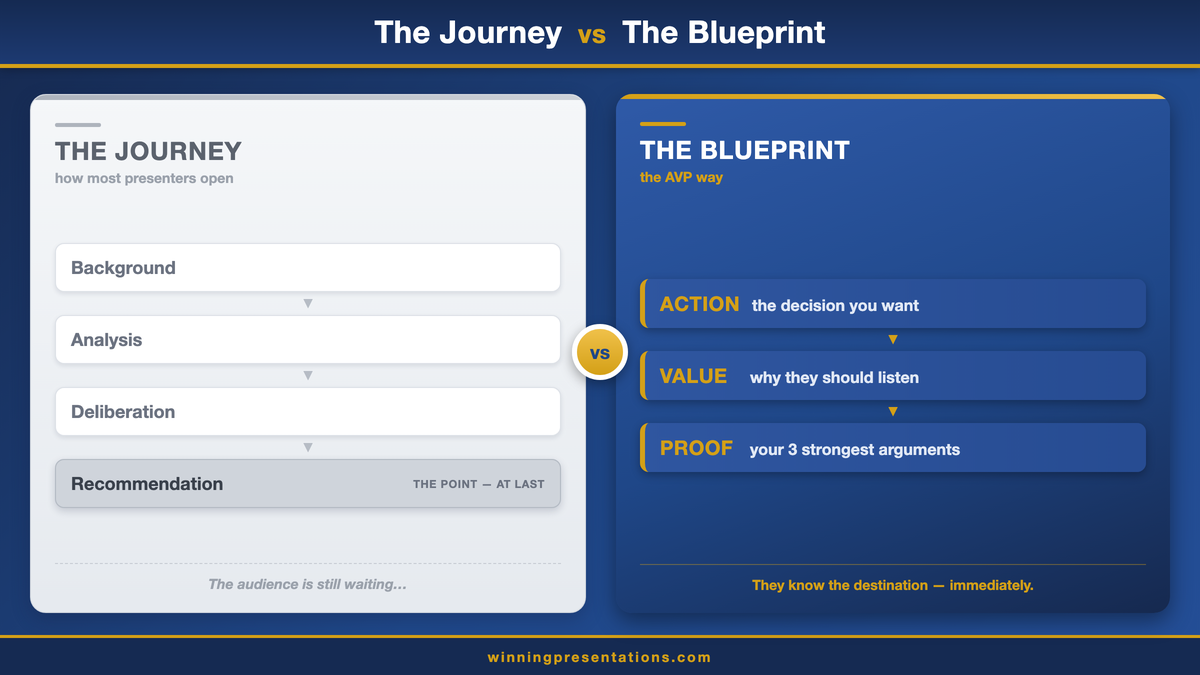
A — Action: the decision you actually want
Action is the purpose of your presentation, stated as a decision. Not “to update you on the project.” Not “to walk through Q3.” A decision: approve this investment, sign this mandate, back this plan.
The discipline here is brutal and simple: if you can’t say in one sentence what you want the audience to do, you’re not ready to present. I make clients write the Action first — before a single slide — because everything else is in service of it. Your Value has to make that action worth taking. Your three Proof points have to build the case for that action. If you can’t name it, you can’t structure for it.
Sometimes the take-away isn’t a decision but knowledge — a genuinely informational brief. That’s fine. But be honest about which you’re doing, because the moment you’re trying to persuade, a vague purpose is fatal.
V — Value: why should they listen?
Value is the hook. It answers the audience’s silent, universal question: what’s in it for me — and what’s the cost of ignoring this?
This is where most openings collapse into self-interest. The presenter leads with what they want, and the audience feels it. The fix is to frame the action entirely in terms of the audience’s world: their returns, their risk, their reputation, their problem. The strongest hooks I’ve seen make the audience slightly uncomfortable about not acting — they surface a threat, an opportunity, a number that doesn’t sit right, a question the audience can’t answer.
A good Value statement is short, and it’s about them. If your opening sentence has your company’s name in it before it has the audience’s interest in it, you’ve already lost the hook.
P — Proof: your three strongest arguments
Proof is your map: the three sub-topics — and only three — that make the case for the action. Not everything you know. Not everything in the data room. The three strongest arguments for this audience.
Two things make this hard, and both are about discipline. First, the number: three. The moment you add a fourth and fifth argument, you don’t strengthen your case — you dilute it. Every extra point lowers the average weight of evidence and gives the audience more surfaces to object to. I’d rather you make three arguments brilliantly than seven adequately.
Second, the selection. Your three arguments aren’t the three you find most interesting — they’re the three that move this audience toward this action. A board cares about different things than a credit committee; a founder cares about different things than a procurement team. Same underlying truth, different three arguments.
And the order matters too — which is a discipline in its own right (it’s why we teach a specific sequencing rule for those three messages). But that’s a deeper layer than this article. For now, the move that changes everything is simply this: pick three, and pick them for your audience.
My Executive Slide System gives you the templates, prompts and playbooks to build presentations on this exact structure — Action-Value-Proof is one of the built-in frameworks. If you’d rather not start from a blank page, this is the fastest way to put it to work.
Action-Value-Proof is the blueprint — but a winning presentation needs the full method behind it: how to sequence your three arguments, how to deliver them so they land, and how to handle the room when the questions come. That’s what I teach in The Executive Buy-In Presentation System — my Maven course for senior professionals who present to boards, investors and leadership. Live coaching, real deck reviews, and the complete framework applied to your own high-stakes presentation.
AVP in practice: a worked opening
Let me show you the difference. Here’s a real-world style example — a recommendation to a company’s leadership to sell and lease back their head office building. (This is the kind of case I use in training.)
The chronological version (how most teams would open): “Thank you for your time. Today I’ll walk you through the history of our property holdings, our current portfolio, some market context, and then a few options we’ve been considering…” — and the room switches off.
The Action-Value-Proof version:
Action (the decision I want): I’m going to make the case for selling and leasing back this building.
Value (why you should listen): Because doing so will significantly improve our operating returns — right now a large share of our capital is locked in an asset earning a fraction of what it should.
Proof (my three arguments): First, the true value of what this building costs us. Second, how releasing that capital improves returns for employees and shareholders. Third, the specific benefits of the plan as we grow.
Ninety seconds in, the audience knows exactly what they’re being asked to decide, why it matters to them, and the three pillars of the argument. Now they’ll listen to the detail — because they have a frame to put it in.
That’s the whole point of AVP: it’s not decoration on the front of your deck. It’s the blueprint that makes everything after it make sense.
Where AVP fits in the bigger picture
Action-Value-Proof is one piece of a complete method I teach for high-stakes presentations. It governs the opening — the blueprint. But a winning presentation also needs the right sequencing of those three arguments, the right delivery behaviours to make them land, and a deliberate summary that closes the loop. Each of those is its own discipline, and each builds on the blueprint AVP gives you.
If you take one thing from this article, take this: before you build another slide, write your Action, your Value, and your three Proof points on a single page. If you can’t, the presentation isn’t ready — and no amount of polish downstream will save it. If you can, you’ve already done the hardest and most important work.
Your next step
Try it on your next presentation. Open a blank page and write three things: the decision you want, the reason your audience should care, and your three strongest arguments for them. That single page will tell you more about whether your presentation will work than any slide deck will.
And if you want the full method — the sequencing, the delivery, the room-handling that turns a good blueprint into a won decision — come and work through it with me. The Executive Buy-In Presentation System is where I teach senior professionals to do exactly that, on their own real, high-stakes presentations. Or join The Winning Edge for a weekly idea you can use straight away.
Frequently asked questions
Who created the Action-Value-Proof framework?
Action-Value-Proof is one of the frameworks we teach at Winning Presentations as part of our method for high-stakes executive presentations. I teach it drawing on my twenty-four years in corporate banking and more than fifteen years coaching senior professionals to present to boards, investors and leadership.
What do Action, Value and Proof actually stand for?
Action is the decision you want your audience to make. Value is the reason it’s worth their attention — what’s in it for them, or the cost of ignoring it. Proof is your three strongest arguments, ordered for that specific audience, that build the case for the action.
Why only three Proof points?
Because more arguments dilute your case rather than strengthen it. Each additional point lowers the average weight of your evidence and gives the audience more to object to. Three strong, well-chosen arguments beat seven adequate ones every time.
Where in the presentation does Action-Value-Proof go?
It’s your opening — the overview or blueprint that comes right at the start, before the body of your presentation. It tells the audience what you want, why they should listen, and where you’re taking them, so the detail that follows has a frame to sit in.
How is this different from “tell them what you’ll tell them”?
The old “tell them what you’ll tell them” advice gets the structure right but misses the persuasion. Action-Value-Proof isn’t just a preview — it’s a deliberately persuasive blueprint: it names a decision, sells the audience on why it matters to them, and orders your strongest arguments for impact, not for chronology.
Related resources
- The Pyramid Principle for presentations — how to structure your thinking top-down (pairs naturally with AVP’s blueprint).
- The 3Ps Framework — the wider Winning Presentations method that Action-Value-Proof sits within.