

Quick answer: A presentation log is a private record a senior leader keeps after every presentation they give, written in about ninety seconds while the room is still fresh, capturing five fields: the ask (the decision the presentation was trying to win, in one line), the result on a calibrated scale rather than a binary win-or-lose, the one slide that went soft, the one move that landed harder than expected, and the one reader who pushed and where. The log exists because memory keeps the emotional residue of a presentation — it went well, it went badly — and loses the detail that would make the next one better, and the detail is where all the value is. A senior leader who relies on memory rediscovers the same structural weakness every year because the feeling persists while the specifics fade. A senior leader who keeps the log builds, over a year of presentations, a private dataset of their own patterns: the slide category they are consistently weak on, the move they consistently underuse, the reader they consistently under-serve. The discipline is ninety seconds per presentation and a quarterly re-read; the return is the only feedback source that is fully under the senior leader’s own control and is calibrated to their actual rooms rather than to generic advice.
JUMP TO:
In 2011 I was working alongside a senior leader in a professional-services firm, and I noticed something he did at the end of every client presentation that I had not seen anyone do before. While the rest of us were packing up and exchanging the usual post-meeting pleasantries, he would step to the side, open a small black notebook, and write for about a minute, then close it and rejoin the room. I assumed at first he was noting action points. After the third or fourth time, I asked him what he was writing. He turned the notebook toward me. It was not action points. It was four or five short lines about the presentation itself: what he had been trying to land, how it had actually gone, which part had drawn the difficult question, and one thing he wanted to do differently. He had a notebook going back years. He told me that when he was promoted into senior client work he had realised he was making the same presentation mistakes repeatedly without noticing, because each presentation felt like a fresh event and he had no record connecting one to the next. The notebook was how he connected them. He was, by a distance, the most consistently improving senior presenter in that firm, and the notebook was the reason. He was not more talented than his peers. He was the only one keeping a record.
I have since recommended some version of this to many senior leaders, and the ones who adopt it improve in a way the ones who do not cannot match, for a reason that has nothing to do with talent. Improvement at presenting requires noticing your own patterns, and patterns are invisible at the level of a single presentation. The slide that went soft this quarter looks like bad luck. The same slide going soft three quarters running is a pattern — but only a senior leader with a record can see it, because by the third quarter the first two are gone from memory, blurred into a general impression that those meetings went broadly fine. The log is not a productivity habit. It is the instrument that makes your own patterns visible to you, and without it the patterns stay invisible no matter how reflective you are in the moment.
(This article was created with AI assistance; all stories and insights are based on 35 years of real client work.)
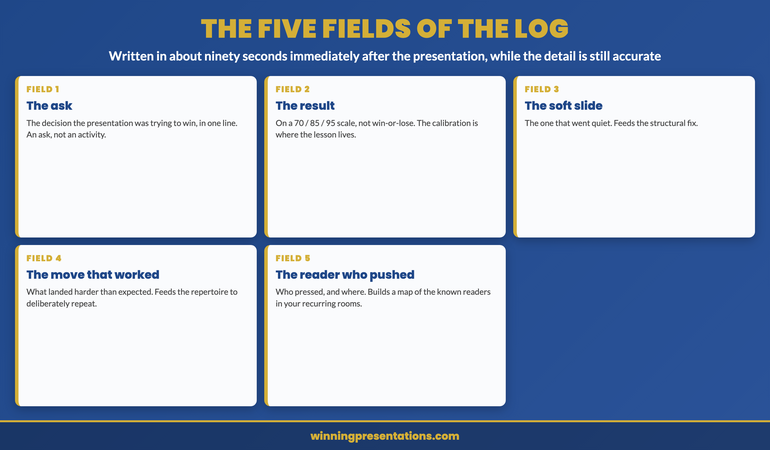
The log I want to describe is deliberately minimal, because a heavy log does not get kept. It is five short fields, written in about ninety seconds immediately after the presentation, and re-read once a quarter. The ninety-second constraint is the whole design: a log that takes ten minutes competes with the rest of the senior leader’s day and loses within a fortnight, while a log that takes ninety seconds survives because it costs almost nothing per entry and the cost of skipping it — losing the only record of that presentation forever — is visibly higher than the cost of keeping it. The value is not in any single entry. It is in the accumulation, which is why the discipline of keeping every entry, even the boring ones, matters more than the quality of any individual entry.
When the log surfaces the slide you are consistently weak on:
A pattern in the log — the same slide category going soft quarter after quarter — calls for a structural fix, not another resolution to do better. The Executive Slide System ships 26 executive templates covering the slide categories that most often recur as weak points, with 93 AI prompts to rebuild them from your live numbers and 16 scenario playbooks. Built for senior presenters who would rather fix a recurring weakness permanently than re-discover it every quarter.
Why memory is the wrong instrument for improving at presentations
Memory is built to retain the emotional summary of an event and discard the detail, which is exactly backwards from what improvement requires. A senior leader remembers, months later, that a particular board presentation went well or went badly — the feeling survives with high fidelity. What does not survive is the detail that would actually help: which specific slide drew the hard question, what the precise wording of the chair’s concern was, which move in the delivery landed and which fell flat. Those details are gone within days, replaced by a smoothed-over narrative. The senior leader is left with a feeling and no data, and a feeling cannot be acted on. You cannot rebuild the slide that went soft if you can no longer remember which slide it was.
The smoothing is also biased, which compounds the problem. Memory does not just lose detail; it rewrites the narrative toward the emotionally dominant outcome. A presentation that ended on a strong note gets remembered as stronger throughout than it was; a presentation that drew one painful question gets remembered as worse throughout than it was. The senior leader relying on memory is therefore not just working with less data but with systematically distorted data, weighted toward whatever they felt most strongly at the end. The log defeats the distortion because it is written before the smoothing happens — in the ninety seconds after the presentation, the detail is still accurate and the narrative has not yet consolidated. What you write in that window is closer to what actually happened than anything you will be able to reconstruct later.
There is a third reason memory fails specifically for senior leaders: the presentations are too far apart. A senior leader might give a major board or committee presentation once a quarter. Three months is more than long enough for the specifics of the last one to vanish, so each presentation arrives feeling like a fresh problem with no usable history attached. The infrequency that makes each senior presentation high-stakes is the same infrequency that makes memory useless across them. The log bridges the gap. A ninety-second entry from three months ago, re-read the week before the next presentation, restores the specific lessons that memory would have lost — which is why the quarterly re-read is timed to the preparation window for the next major presentation rather than to an arbitrary calendar date. A genuine method for improving at presentations has to solve the across-presentation memory problem, and the log is the simplest solution to it.
The five fields the log records
The first field is the ask: the decision the presentation was trying to win, in one line. Recording the ask matters because it anchors everything else — a presentation can only be judged against what it was trying to achieve, and senior leaders frequently misremember their own intent after the fact, recalling a presentation as a success because it was well-received when its actual ask was not met. Writing the ask in advance, or immediately after, keeps the evaluation honest. “Secure approval for the fourteen-percent budget reallocation” is an ask. “Present the Q3 plan” is not an ask, it is an activity, and a log full of activities rather than asks cannot tell you whether your presentations are actually winning the decisions they exist to win.
The second field is the result, recorded on a calibrated scale rather than as a binary. The most useful scale is the one introduced earlier in this series — roughly, did this land at 70% (approved but soft), 85% (clearly carried, some friction), or 95% (championed, no friction) — because the binary win-or-lose hides almost all the useful variance. Most senior presentations are not won or lost; they are won at some level of conviction, and the level is what predicts whether the decision sticks and whether the next ask from the same person is easier or harder. Recording the calibrated result trains the senior leader’s own judgement of the difference between a 70% meeting and an 85% meeting, which is the single most useful distinction in senior presenting and one that the log builds through repetition.
The third, fourth, and fifth fields are the specifics: the one slide that went soft, the one move that landed harder than expected, and the one reader who pushed and where. Each is deliberately singular. The log does not ask for a full account of everything that happened; it asks for the single most salient item in each category, because the singular constraint forces the senior leader to identify what actually mattered rather than transcribe the whole meeting. The soft slide feeds the structural fix. The move that worked feeds the repertoire — the things that land harder than expected are worth deliberately repeating, and most senior leaders underuse their own best moves because they never noticed which ones worked. The reader who pushed builds, over time, a map of the known readers in the senior leader’s recurring rooms and where each one consistently applies pressure.
Turn a logged weakness into a fixed slide structure.
When the log shows the same slide category failing repeatedly, the Executive Slide System gives you the structure to fix it for good — 26 executive templates, 93 AI prompts to populate from live numbers, 16 scenario playbooks, and 7 checklists. Built for senior presenters tracking their own patterns who want a permanent structural fix rather than another quarter of the same soft slide. £39, instant download, lifetime access.
- 26 executive slide templates — covering the slide categories that most often recur as logged weak points
- 93 AI prompts — rebuild a recurring weak slide from your live numbers in minutes
- 16 scenario playbooks — board approval, quarterly review, capital allocation, and strategic reset
- 7 checklists — including a pre-meeting check you can run against your own logged patterns
The quarterly re-read that surfaces the pattern
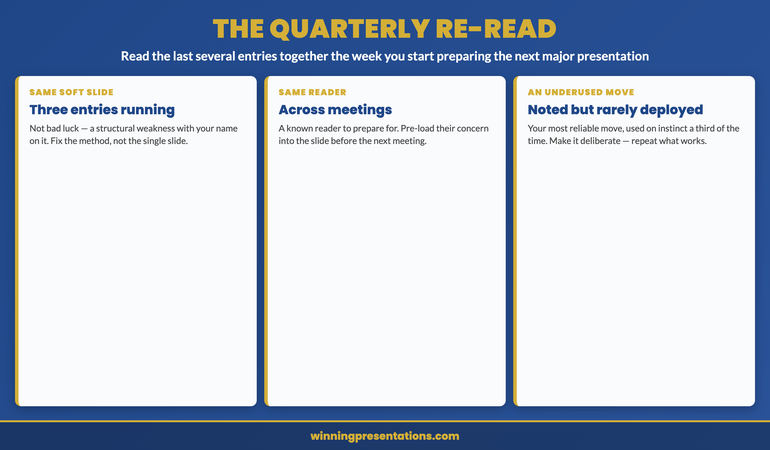
The log’s value is unlocked not by writing it but by re-reading it, and the re-read is where the patterns that are invisible at the single-presentation level become visible across the accumulated entries. Once a quarter — ideally in the week a senior leader begins preparing their next major presentation — read the last several entries together and look for repetition. Is the same slide category in the soft-slide field more than once? Is the same reader in the pushed field across multiple meetings, applying the same kind of pressure? Is there a move in the worked field that you keep noting as effective but rarely actually deploy? The repetition across entries is the signal. A single soft slide is noise; the same soft slide three entries running is a structural weakness with your name on it, and the re-read is the only thing that makes it visible.
I worked with a senior commercial leader who kept a log for a year and found, on her first annual re-read, two patterns she had been completely unaware of. The first was that her competitive-positioning slide was in the soft field in four of her six logged presentations — a clear structural weakness she had never noticed because each individual instance had felt like a different room being difficult. The second was more useful: the move she had recorded as landing well, more often than any other, was a single slide where she named the strongest counter-argument to her own proposal before anyone in the room could raise it. She had been doing it intermittently, on instinct, in about a third of her presentations. The log showed her it was her most reliable move, and once she saw that she started doing it deliberately in every presentation. Her hit rate on difficult approvals rose noticeably over the following year, from one change: deliberately deploying a move the log had revealed she was underusing. Neither pattern was visible without the log, and both were obvious once she re-read it.
The re-read also recalibrates the senior leader’s self-assessment, which tends to drift. Senior leaders carry a self-image as a presenter — “I’m strong on strategy, weaker on detail” — that is often years out of date and based on a handful of memorable events rather than the actual run of their presentations. The log’s accumulated results field is a more accurate self-assessment than the self-image, because it is the average of every presentation rather than the memory of the most vivid ones. A senior leader who believes they are strong in board settings but whose log shows their board presentations averaging lower than their committee presentations has learned something genuinely useful about where to direct their development effort — something no amount of unstructured reflection would have surfaced, because the reflection was working from the distorted self-image rather than the data. The discipline of a structured quarterly review at the level of the business has its individual analogue in the quarterly re-read of the presentation log.
Turning the log into preparation for the next presentation
The log’s most direct payoff is in preparation. The week before a major presentation, a senior leader with a log has a personalised preparation brief that no generic advice can match: re-read the entries from the last few presentations to the same room or the same type of room, and the log tells you which slide you tend to under-build, which reader will probably push and where, and which of your own moves to make sure you deploy. This is preparation calibrated to your actual rooms and your actual patterns rather than to general best practice. The senior leader preparing for a board presentation can read their previous board entries and walk in already knowing that the chair tends to push on optionality, that their own risk slide has gone soft before, and that the pre-empting move they recorded as effective is worth building in deliberately this time.
As the log accumulates across many presentations, the volume of entries itself becomes useful in a way a handful never could, and this is where modern AI tools earn their place in the workflow. A senior leader with two or three years of logged entries has a substantial personal dataset, and AI-assisted analysis can surface cross-cutting patterns that even a careful quarterly re-read might miss — the correlation between meeting length and result, the readers whose pushback most often precedes a soft outcome, the slide types that perform differently in board versus committee settings. The log written in plain language is exactly the kind of unstructured personal record that AI is now genuinely good at finding patterns in, provided the senior leader is comfortable with the privacy and tooling involved. The discipline of keeping the log comes first; the analysis is a multiplier on a record that already exists, not a substitute for keeping it.
For senior leaders using AI to build and refine executive presentations:
AI-Enhanced Presentation Mastery is a self-paced programme for senior professionals using AI — including Copilot — to structure, draft, and refine executive-grade decks. 8 modules, 83 lessons, no deadlines, no mandatory session attendance, plus 2 optional live coaching sessions, fully recorded so you can watch back anytime. New cohort opens every month. Lifetime access to materials. £499. Built for the senior leader moving beyond basic AI usage to executive-grade output.
The senior leader from the professional-services firm with the black notebook eventually told me the single most valuable thing the log had done for him over the years was not catching his weaknesses, though it did that. It was protecting his strengths. Early in his senior career he had a tendency, after a difficult question, to over-correct in the next presentation — to add caveats, hedge his recommendations, and dilute the clarity that had made him effective in the first place. The log let him see that the difficult questions he was over-correcting for were usually one-off reactions from a single reader rather than evidence of a real flaw in his approach, and that his clearest, least-hedged presentations were consistently his highest-scoring ones. Without the record, each difficult question had felt like a verdict requiring a change. With the record, he could see which questions were verdicts and which were noise, and he stopped diluting his strengths in response to noise. That, he said, was worth more than any individual weakness the log had helped him fix.
Fix the recurring weak slide once. Keep the template for every cycle after.
Instant download. Lifetime access to the Executive Slide System — 26 templates, 93 AI prompts, 16 scenario playbooks, 7 checklists. No subscription, no renewal. £39 once, for the senior presenter who tracks their own patterns and wants to act on them structurally.
Frequently asked questions
Is keeping a log worth it if I only give a few major presentations a year?
It is especially worth it if your presentations are infrequent, because infrequency is exactly what makes memory useless across them. If you presented daily, you would build pattern-recognition through sheer volume and might not need a written record. Giving a major presentation once a quarter, you have no chance of carrying the specifics from one to the next in memory — three months erases them — so the few high-stakes presentations you give are precisely the ones where a record pays off most. Five logged entries a year is enough to surface a recurring weakness on the annual re-read, and because each of your presentations is high-stakes, fixing even one recurring weakness has outsized value. The lower your presentation frequency, the more each one matters and the more you lose by not recording it.
What is the most common reason senior leaders abandon a presentation log?
They make it too heavy. A log designed as a full reflective journal — paragraphs on what went well and what to improve — competes with everything else in a senior leader’s day and loses within a fortnight, and then the half-built log feels like a failure and gets abandoned entirely. The five-field, ninety-second design exists precisely to survive a real senior leader’s schedule. The constraint is the feature: by capping each entry at five short fields written in the ninety seconds after the meeting, the log stays cheap enough to actually keep. If you find yourself writing paragraphs, you are building the version that gets abandoned. Keep it to the five singular fields. The accumulation does the work, not the depth of any single entry, so consistency matters far more than completeness.
Should the log be on paper or digital?
Whichever you will actually keep, with one consideration: if you intend to do AI-assisted pattern analysis on the accumulated entries later, a digital log in plain text is far easier to work with than a paper notebook you would have to transcribe. The senior leader with the black notebook kept his on paper for years and it served him well, so paper is not wrong. But a simple digital note — one entry per presentation, five short lines each — gives you the option of analysing the whole record at scale once it accumulates, which a paper log does not. The format matters less than the discipline; choose the one you are most likely to keep filling in for years, because a beautifully structured log you abandon after a month is worth nothing next to a scruffy one you keep for three years.
Does this work the same way for client-facing pitches as for internal presentations?
It works the same way and the reader field becomes even more valuable, because client rooms tend to have more stable recurring readers than internal ones. If you pitch repeatedly to the same client’s procurement lead or the same buying committee, the pushed field accumulates a precise map of who in that client raises what, which is directly usable in the next pitch to them. For client pitches the result field also benefits from being calibrated rather than binary, because a pitch that wins the deal at a soft 70% of conviction often signals a renewal or expansion that will be harder than the numbers suggest, while a pitch that wins at 95% signals an advocate inside the client. The log captures that distinction, which the won-or-lost record on the deal alone does not, and the distinction is what tells you which client relationships are actually secure.
The Winning Edge — weekly newsletter
The Winning Edge is a weekly newsletter for senior professionals who present at the executive level. One short email a week on the structural habits that compound over a year of presentations rather than the tips that fade by the next one. Subscribe to The Winning Edge →
For the wider library of senior-presenter assets — slide system, storytelling primer, Q&A taxonomy, delivery references — the seven-product Complete Presenter library (£99) collects them in one place. See the AI workflow in depth at the AI-enhanced presentation masterclass.
About the author
Mary Beth Hazeldine is Owner & Managing Director of Winning Presentations Ltd. With 24 years of corporate banking experience at JPMorgan Chase, PwC, Royal Bank of Scotland, and Commerzbank, she advises executives across financial services, healthcare, technology, and government on structuring presentations for high-stakes funding rounds, board approvals, and strategic decisions.
After your next presentation, before you close the laptop or leave the room, write five short lines: the ask you were trying to win, the result on a 70/85/95 scale, the one slide that went soft, the one move that landed, and the one reader who pushed and where. Ninety seconds. Then re-read the last several entries the week you start preparing your next major presentation. The senior leader who logs every presentation builds a private dataset of their own patterns and improves on the things that actually recur. The senior leader who relies on memory rediscovers the same weakness every year, because memory keeps the feeling and loses the detail, and the detail was where all the value was.