Tag: performance review presentation

13 May 2026

Quarterly Review Slide Structure: The 4-Section Framework Senior Leaders Trust

Quick Answer

A quarterly review slide structure works when it follows a four-section frame: position, performance, pivot, provision. Each section maps to one or two slides. The frame turns a quarterly review from a status report into a decision conversation — what changed, what worked, what needs to change next, and what the executive committee needs to provision for the next quarter.

Mei runs a 14-person product engineering function inside a B2B SaaS company. Her quarterly reviews used to take three days to prepare and ninety minutes to deliver. Last December she finished her QBR feeling she had presented well. Two days later her boss sent a message: “Good update. What did you actually need from us?”

She had not asked for anything. The deck was 22 slides of accomplishments, metrics, and forward plans. The executive committee had no decision to make. The meeting was a transmission, not a conversation. Three months later she rebuilt the QBR around four sections — position, performance, pivot, provision — and went back into the room with eight slides instead of 22. Her boss asked three questions and committed to two resourcing decisions. The QBR became useful for the first time in two years.

If your QBR ends with no decision asked for and none made

A four-section structure forces every quarterly review into decision-shape. The exec committee leaves the room knowing what changed, what they need to provision, and what they decided.

Explore the Executive Slide System →

Why most QBRs fail to drive decisions

Standard QBR templates inherit a structural flaw: they are organised around what we did, not what changed. The result is a quarterly ritual that consumes calendar time without producing decisions. Three patterns recur across companies of every size:

The “Q1 Highlights” syndrome. Slide 2 lists six bullets summarising the quarter’s achievements. Slide 3 lists six more. By slide 5 the executive committee has skim-read the highlights, formed an impression, and lost interest. Highlights are not a position; they are a narrative the team writes about itself. Senior audiences need the position — what changed in the operating reality the team owns — not a curated set of wins.

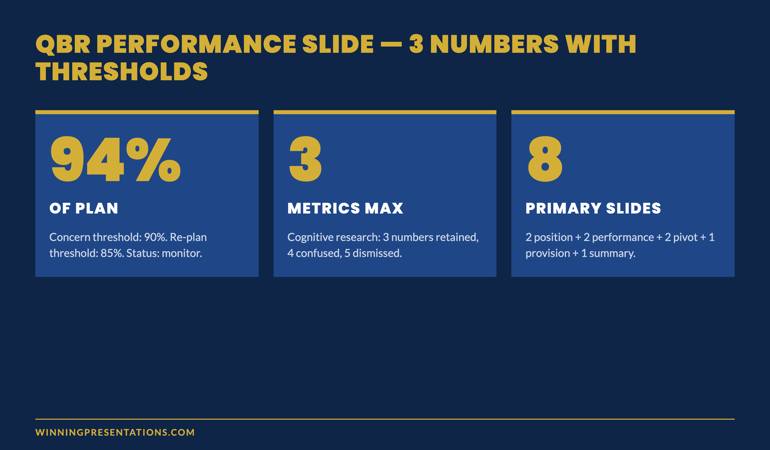
Performance metrics presented without thresholds. A slide showing revenue at 94% of plan reads differently when the room knows the threshold for concern is 90% and the threshold for re-planning is 85%. Without the thresholds, the metric becomes a Rorschach test — every committee member projects their own anxiety onto it. The conversation that follows is about the metric, not the implication of the metric.

No provision request. The most common failure mode of a QBR is to end without asking the executive committee for anything. No headcount decision. No budget reallocation. No prioritisation choice. Senior committees exist to make those calls; a QBR that does not ask for any is using their time inefficiently. The exec committee will not initiate the request on your behalf — they expect the team to know what it needs and ask.

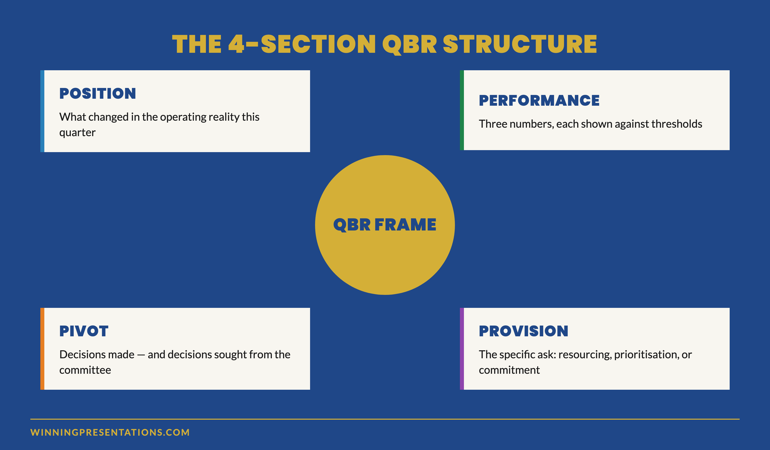
The 4-Section QBR Structure infographic showing Position, Performance, Pivot and Provision sections with the central question each section answers

The 4-section structure: position, performance, pivot, provision

The four-section frame works because each section answers a question the executive committee needs settled before they can usefully engage with the next.

Position. Where the function is now, relative to the position they held three months ago. The change in the operating reality. Two slides maximum.

Performance. The three or four metrics that matter, each shown against its threshold for concern and threshold for re-planning. Two slides.

Pivot. The decisions the team has already made for next quarter, and — separately — the decisions the team is bringing to the committee for input or approval. One or two slides.

Provision. The specific resourcing, prioritisation, or commitment the team needs from the committee in the next quarter. One slide.

Eight primary slides. An indexed appendix with everything else. The discipline is in the front eight; the appendix can run to whatever depth the function requires.

Build slides that earn time on the agenda

Stop running QBRs that end with no decision

  • 26 templates covering QBR, board, performance review, and strategic decision slides
  • 93 AI prompts for drafting position statements, performance commentary, and provision asks
  • 16 scenario playbooks including QBR with mixed performance, QBR after missed targets, and QBR before resourcing decisions
  • Master checklist for stress-testing every slide before the meeting

Executive Slide System — £39, instant access, 30-day refund if it does not fit your next quarterly review.

Get the Executive Slide System →

Designed for senior professionals running quarterly reviews with executive committees.

Section by section: what each one carries

Position — what changed in the operating reality

The position section answers one question for the committee: where is this function now, that it was not three months ago? Not “we delivered X.” Not “we launched Y.” The position is the change in the underlying reality — pipeline shape, customer mix, technical debt level, regulatory exposure, organisational health. The committee needs the position because every other section is interpreted in light of it.

Two slides is enough. The first describes the position in three lines. The second visualises the change — a chart, a quadrant shift, a heat-map comparison between this quarter and last. Avoid the temptation to add a third slide; the position is meant to be read fast and held in the room as backdrop for everything that follows.

Performance — three numbers, each with thresholds

Performance is where most QBRs lose discipline. The instinct is to show every metric the team tracks. Resist it. The committee can absorb three or four metrics during a QBR; anything beyond that gets skimmed and forgotten. Choose the three metrics that matter most for the committee’s decisions, and show each one against two thresholds:

  • The threshold for concern — at this level we re-plan internally without committee input.
  • The threshold for re-planning — at this level we bring the re-plan to the committee.

This treatment turns a metric into a decision instrument. The committee can see at a glance whether the number requires their attention or can be left with the function. It also reduces the time spent debating the metric — once thresholds are visible, the conversation is about whether the threshold is right, not whether the number is good.

Pivot — decisions made and decisions sought

The pivot section separates two kinds of decision. Decisions the team has already made for the coming quarter — informational, no committee input required. Decisions the team is bringing to the committee — actively seeking input or approval before the team acts.

This separation matters. Without it, the committee tends to weigh in on every forward-looking statement, which slows the meeting and dilutes the team’s authority. With it, the committee knows when to listen and when to engage. One slide for each side of the pivot is usually enough.

For senior leaders running these reviews regularly, structured QBR slide frames make the pivot section faster to build and easier to navigate. The Executive Slide System includes a QBR pivot template that visually distinguishes decisions made from decisions sought.

Provision — the specific ask

The provision slide is where the QBR earns its place on the calendar. It states the resourcing, prioritisation, or commitment the function needs from the committee for the next quarter. Three components:

  • The ask, in one sentence — what specifically you need from the committee.
  • The cost or trade-off the committee is being asked to accept.
  • The decision required from the committee in this meeting (or, if appropriate, by a stated date).

If a QBR has no provision ask, the meeting can be replaced by a written update. That is a useful test: could this QBR have been an email? If yes, restructure the deck to include a provision section that earns the meeting. If no provision ask is genuinely needed for the quarter, propose to the committee that the next QBR be replaced by a written brief and a 20-minute Q&A.

QBR Performance Slide With Thresholds infographic showing a metric chart with concern threshold (yellow) and re-planning threshold (red) overlaid against the actual quarterly performance line

Data discipline: three numbers per section

Each of the four sections should carry no more than three numerical claims on its primary slide. This is a hard discipline that improves QBRs more than any other single change. Three reasons:

The committee remembers three. Cognitive research on senior decision-makers consistently shows that three numbers per topic are retained, four are confused, five are dismissed. The QBR that presents twelve numbers on a single slide is teaching the committee to skim.

Three numbers force prioritisation. The team has to choose which three numbers carry the meaning. That choice is itself an act of senior judgement. The committee will read the choice as well as the numbers; the slide that confidently elevates three metrics signals a function that knows what matters.

Three numbers leave room for the question. A slide with three numbers leaves cognitive space for the committee to ask “what about X?” That question is the moment the QBR becomes a conversation. A slide with twelve numbers crowds the question out; the committee disengages instead of probing.

The slide system senior professionals use in banking, biotech, SaaS

Quarterly reviews. Board papers. Investment proposals. Strategic pivots. The same five-section logic underneath, scenario-specific templates on top. Executive Slide System — £39, instant access.

Get the Executive Slide System →

Designed for senior professionals running QBRs, board updates, and strategic reviews.

Frequently asked questions

How long should a QBR deck be in total?

Eight primary slides — two for position, two for performance, two for pivot, one for provision, and one summary. Plus an indexed appendix that can run to whatever depth the function needs. The appendix is for committee navigation during Q&A; it is not a place for slides that did not earn a position in the front eight.

What if the committee asks for “all the numbers” rather than three?

That request usually means the committee does not trust the team’s prioritisation. The fix is to have the prioritisation conversation explicitly: which three numbers would the committee want to see if they could only see three? Once that is settled, the committee tends to relax into the discipline. The “all the numbers” request rarely means they want to see twelve metrics every quarter.

Can this structure work for a quarterly business review with a customer?

Partially. The four sections still apply — position, performance, pivot, provision — but the audience is different. Customers want to see how their relationship with you has changed, not how your function has changed. The position section becomes the relationship position; the provision section becomes the joint commitment for the next quarter. The structure holds; the semantics shift.

What if there is no pivot to discuss this quarter?

That is rare in any function genuinely operating. If the team has made no decisions for the next quarter and is bringing nothing to the committee, the committee will conclude either that the function is on autopilot or that the team is concealing the pivot. Either reading damages credibility. If the quarter genuinely contains no pivot, name it explicitly: “This quarter contains no material change in direction. Here is why we believe the current plan continues to be right.” That framing converts a non-pivot into a deliberate act of judgement.

The Winning Edge — weekly newsletter for senior presenters

One framework, one micro-story, one slide pattern — every Thursday morning, ten minutes’ read. The senior leaders who subscribe present to executive committees, boards, and investors weekly.

Subscribe to The Winning Edge →

Not ready for the full system? Start here instead: download the free Executive Presentation Checklist — covers the four-section QBR test you can apply to your next deck before it leaves your desk.

For the partner article on board-pack structure, see board-ready executive slide templates.

Mary Beth Hazeldine — Owner & Managing Director, Winning Presentations Ltd. With 24 years of corporate banking experience at JPMorgan Chase, PwC, Royal Bank of Scotland, and Commerzbank, she advises senior professionals across financial services, healthcare, technology, and government on quarterly review structure, board paper format, and high-stakes executive communication.

12 Apr 2026
Executive team gathered around a boardroom table presenting cross-department quarterly review data on a large screen

Cross-Department Quarterly Review: How to Stop the Blame Game

Quick Answer

A cross-department quarterly review stops becoming a blame session when you structure it around shared data, forward-facing language, and a single executive narrative — rather than individual departmental reports. The key shift is framing every slide around decisions and progress, not performance scores.

Marcus had been preparing for three weeks. As Head of Operations at a mid-size logistics company, he was responsible for presenting the cross-department quarterly review to the executive committee — a room that included the CFO, two divisional MDs, and the Group CEO.

The first twenty minutes went according to plan. Then the IT Director put up a slide showing system uptime metrics. Operations pushed back. Sales said the delays were causing client churn. Finance said the numbers didn’t reconcile with what they’d seen the previous month. Within thirty minutes, the review had become a tribunal — with every department defending its own data and attacking everyone else’s.

Marcus told me afterwards: “The executive sponsor sat there in silence for most of it. At the end he said, ‘I don’t need to know what happened. I need to know what we’re doing about it.’ Nobody had an answer.”

The problem wasn’t the data. It was the structure. Each department had prepared slides designed to demonstrate their own performance — which meant every difficult interdependency was someone else’s problem. The meeting had no shared narrative, no forward focus, and no mechanism for building agreement. What it produced instead was defensiveness, frustration, and a room full of executives who left with less confidence in the leadership team than when they’d arrived.

Cross-department quarterly reviews are among the most politically complex presentations in business. Done well, they demonstrate executive cohesion and strategic momentum. Done poorly, they become the stage on which leadership teams publicly undermine each other — often without realising they’re doing it.

Preparing for a cross-department review?

If you’re building the deck and wondering how to present shared data without triggering defensiveness, the Executive Slide System gives you a structured framework designed for exactly these scenarios. Explore the System →

Why cross-department quarterly reviews descend into blame

The blame game in quarterly reviews is almost always structural, not personal. It emerges when the meeting is designed around individual departmental accountability rather than shared organisational progress.

When each department prepares its own slides in isolation, a predictable dynamic emerges. Each presenter selects data that reflects well on their function. When there’s a performance shortfall, the natural response is to show how it connects to a dependency in another department. The other department does the same in reverse. The executive audience watches the cycle repeat and loses confidence in the entire leadership tier.

There’s also a presentation format problem. Most cross-department quarterly reviews use a round-robin structure — each department presents in sequence, each for ten to fifteen minutes. This format guarantees fragmentation. There is no shared narrative, no agreed baseline, and no common language for interpreting the data. The executive sponsor receives five separate stories with five separate recommendations that often contradict each other.

The cross-department quarterly review that works is built differently. It starts from a single agreed executive narrative, uses shared data presented once, and keeps every slide oriented towards future decisions rather than past performance. The departments aren’t gone — their data is there — but it’s been integrated into a unified story rather than a collection of individual defences.

For related structure thinking, see how to structure a monthly business review presentation — many of the same principles apply at the quarterly level.

Executive Slide System

Stop Building Slides. Start Building Agreement.

The cross-department quarterly review tests whether your executive communication can rise above departmental politics. The Executive Slide System — £39, instant access — gives you the templates and frameworks to structure a presentation that drives decisions rather than debate.

  • Slide templates for executive scenario presentations including reviews and approvals
  • AI prompt cards to build your quarterly narrative fast
  • Framework guides for structuring complex multi-stakeholder data
  • Scenario playbooks for high-stakes business reviews

Get the Executive Slide System →

Designed for executives who need clarity in complex, multi-stakeholder environments.

The four-part structure that prevents blame before it starts

The most effective cross-department quarterly reviews use a four-part structure that begins with agreement rather than individual data. This structure does something counterintuitive: it removes the incentive to defend departmental performance by framing the entire review as a shared challenge rather than a collection of individual report cards.

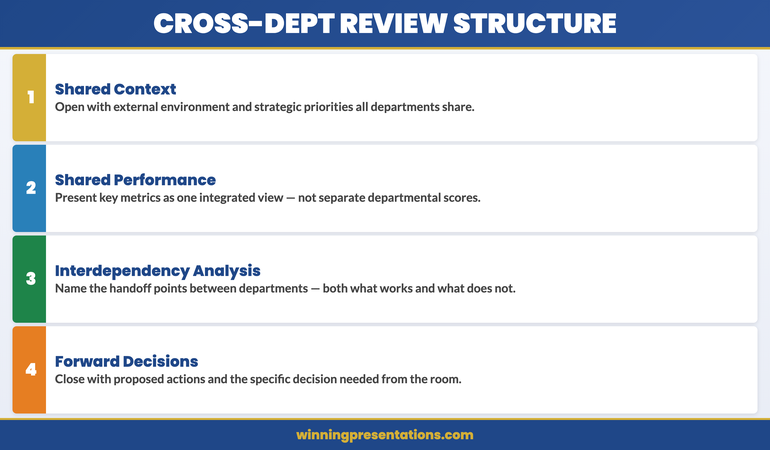
The four-part cross-department quarterly review structure: shared context, performance against shared goals, interdependency analysis, and forward decisions — infographic showing each stage

Part 1 — Shared context (2–3 slides). Open with the external environment and the strategic priorities that all departments are working towards. This reframes the review from “how did each department do?” to “how are we tracking as a business?” Senior executives respond well to this framing because it mirrors how they think about the quarter.

Part 2 — Performance against shared goals (4–6 slides). Present the key metrics that cut across all departments — revenue, customer satisfaction, operational efficiency, and any programme milestones — as a single integrated view. Show interdependencies explicitly. When performance is below target, name the shared nature of the gap before attributing it to any specific function.

Part 3 — Interdependency analysis (2–3 slides). This is the section most reviews skip — and it’s the section that prevents blame. Name the handoff points between departments explicitly. Where a handoff is working, show it. Where it’s not, frame the analysis as a systems question: what is the process that needs to change? Avoid framing any individual department as the cause of a failure.

Part 4 — Forward decisions (2–3 slides). End with a clear set of proposed actions and the decision you need from the executive sponsor. This is what senior audiences are waiting for. If the meeting ends without decisions, it will feel like a waste of time regardless of how good the data was.

The total deck for this structure is typically twelve to fourteen slides — well within the tolerance of most executive committees for a quarterly review.

How to present departmental data without triggering defensiveness

Data triggers defensiveness when it’s presented as a verdict. The moment a slide reads “Operations: underperforming against target,” the Operations Director is no longer listening to the rest of the review — they’re constructing a rebuttal.

The reframe is straightforward: present every metric as a question, not a conclusion. “We’re at 78% against our target of 85% — here’s what the data tells us about where the gap is sitting” is a fundamentally different proposition to “the Operations function missed its target by 7 percentage points.” Same data, different implication. One invites collaboration. The other triggers a territorial response.

A few specific techniques worth using:

Aggregate first, disaggregate second. Start with the combined business-level number, then break it down by function. This trains the audience to see the data as a shared issue before they see their own piece of it.

Use trend lines, not snapshot comparisons. A snapshot comparison (“Q3 vs Q4”) invites argument about what changed. A trend line invites conversation about direction. If the trend is improving, the story is encouraging even if the number is below target. If the trend is worsening, the question becomes what intervention is needed — not who is responsible.

Attribute causality to processes, not people or departments. “The delay in the customer onboarding cycle is sitting in the handoff between CRM and provisioning” is process language. It avoids naming a department as the cause, focuses attention on the system rather than the individual, and creates space for a collaborative solution.

If you’re presenting alongside colleagues from other departments, the cross-functional presentation translation framework covers how to communicate technical or functional data to mixed executive audiences without losing clarity.

The Executive Slide System includes prompt cards specifically designed to help you frame complex performance data in language that builds rather than disrupts executive confidence — see what’s included.

The language of shared accountability

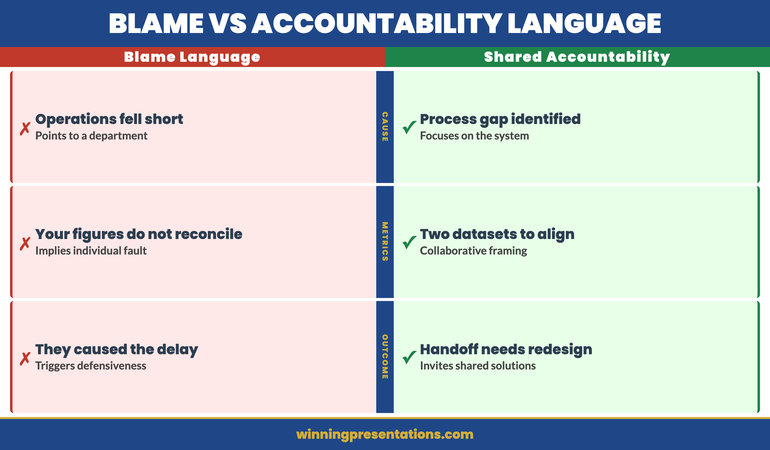
Language is the mechanism through which a cross-department review either builds or destroys alignment. There are specific word choices that consistently escalate defensiveness — and specific alternatives that consistently reduce it.

The highest-risk phrase in any cross-department review is the indirect attribution: “The delays in X were due to late sign-off from Y department.” Even if accurate, this kind of statement — particularly on a slide — puts Y on the defensive for the remainder of the meeting. They will spend the rest of their time accumulating evidence of their own competence rather than contributing to the forward conversation.

The replacement is accountability framing: “The sign-off process between X and Y has created delays in the pipeline. We’ve identified three points where the cycle time can be reduced, and we’re proposing to test a new protocol in Q1.” This acknowledges the same underlying reality but frames it as a shared process improvement rather than an individual failing.

Pronouns matter as well. “We” is always more constructive than “they” in this context. “Our performance in the quarter” is a better frame than “the performance of each function” — even when the reality is that some functions performed better than others. The executives in the room know that nuance exists. They don’t need the slides to dramatise it.

Comparison of blame language versus shared accountability language in cross-department quarterly reviews — infographic showing four before and after examples

What your executive audience actually wants from this meeting

Most presenters preparing for a cross-department quarterly review spend ninety per cent of their preparation time on what the data shows, and almost none on what the executive audience is actually trying to learn from the meeting.

Senior executives attending a cross-department quarterly review are typically trying to answer three questions. First: are we on track to achieve what we committed to, and if not, how far off are we? Second: do the people running this business understand the interdependencies well enough to manage them? Third: what decisions need to be made at this level, and are they being proposed clearly?

They are not trying to audit each department’s performance in granular detail. That level of operational review happens elsewhere. The quarterly review in front of the executive committee is a strategic conversation — and if it descends into operational detail, the room will disengage quickly.

This has a practical implication for your deck. The slides that matter most to a senior executive audience are the context slide (where are we against strategic goals?), the interdependency slide (what’s working, what’s not, what needs a decision?), and the forward-looking recommendation slide (what are we proposing to do, and what do we need from you?). Everything else supports those three moments.

For the board-level version of these principles, how to structure a department update presentation for senior leadership covers the specific adaptations needed when the audience includes non-executive directors.

Executive Slide System — £39

The Quarterly Review Deck That Works

The Executive Slide System — £39, instant access — gives you a structured approach to quarterly business reviews that keeps the focus on decisions, not departmental politics.

Explore the System →

Designed for cross-department reviews, board presentations, and multi-stakeholder updates.

Preparing for the difficult conversation ahead

Even with a well-structured deck and careful language choices, cross-department quarterly reviews sometimes surface genuine conflict that a presentation structure alone cannot contain. A department has significantly underperformed. A key project has stalled. Relationships between senior leaders are strained. In these circumstances, the presentation is only part of the solution — and in some cases, an important conversation needs to happen before the formal meeting.

The pre-meeting executive alignment conversation is one of the most underused tools in this situation. Before a quarterly review that you know will contain difficult news, a short conversation with the executive sponsor — not to rehearse the content, but to align on the narrative and the tone — is almost always worth the time. Sponsors who feel blindsided by difficult data in the room become a destabilising presence. Sponsors who have been briefed become a stabilising one.

When preparing your pre-meeting brief, keep it to three elements: what the challenging data shows, what you believe the underlying cause is (in systems language, not blame language), and what you’re proposing to do about it. That framing gives the executive sponsor everything they need to contribute constructively to the discussion.

Also worth considering: who else in the room needs a pre-meeting conversation? If you know that two department heads are in conflict over a shared metric, a brief alignment call between the three of you before the formal review can prevent thirty minutes of circular argument in front of the executive committee. It’s not about rehearsing a script — it’s about ensuring the room is focused on decisions rather than relitigating the past.

For parallel thinking on this approach when presenting strategic change, the article on structuring a digital transformation board presentation covers similar stakeholder alignment principles in a programme-led context.

Frequently Asked Questions

How long should a cross-department quarterly review presentation be?

For an executive committee audience, aim for twelve to fourteen slides and a sixty-minute meeting: twenty minutes for the presentation, twenty minutes for discussion, and twenty minutes for decisions. If the review is running longer than ninety minutes, the structure usually needs tightening — either there’s too much operational detail in the deck, or the forward-looking decision section is absent and the discussion is filling that gap.

What should I do if another department’s data contradicts mine during the review?

Address data discrepancies before the meeting, not during it. If you identify a conflict between datasets in the preparation phase, align with the relevant department head to agree a shared number and a brief explanation of the variance. Walking into a quarterly review with unresolved data conflicts creates exactly the kind of credibility problem that undermines the entire session. If a discrepancy surfaces unexpectedly in the room, name it calmly: “We’ll need to reconcile these two numbers — can we action that today and send an update to the committee?” This keeps the meeting moving and demonstrates competence rather than concealing the problem.

Who should present which sections of a cross-department quarterly review?

The most effective format is a single lead presenter who owns the shared narrative — usually the most senior executive responsible for cross-functional outcomes — with subject matter contributors speaking to specific technical or operational sections when genuine expertise is required. Avoid the round-robin format where each department presents its own section: it fragments the narrative, makes the meeting feel like a series of individual reports rather than a shared review, and creates the conditions for blame dynamics to emerge.

The Winning Edge — Weekly Insights for Executive Presenters

Every Thursday: one practical insight to sharpen your executive communication. No generic tips — only what works in real high-stakes rooms.

Join The Winning Edge →

Free resource: The Executive Presentation Checklist — a pre-meeting quality check for high-stakes presentations.

About the Author

Mary Beth Hazeldine — Owner & Managing Director, Winning Presentations

With 25 years of corporate banking experience at JPMorgan Chase, PwC, Royal Bank of Scotland, and Commerzbank, Mary Beth advises executives across financial services, healthcare, technology, and government on structuring presentations for high-stakes funding rounds and approvals. She is the creator of the Executive Slide System and the Conquer Speaking Fear programme.

10 Apr 2026
Finance director presenting mid-year business review results on a large screen to a board of directors, confident stance, data charts visible, navy and gold tones, editorial photography style

Mid-Year Business Review Presentation: How to Structure the Second Half

Quick Answer: A mid-year business review presentation must do more than report what happened in the first half. It needs to explain why performance landed where it did, what that means for the second half, and what decisions the board or leadership team needs to make now. The structure that works puts honest assessment first, resets the forward view second, and closes with a clear ask — not a summary of slides already shown.

Henrik had been Finance Director at a professional services group for four years when he presented his first mid-year business review to the full board. He had prepared what he considered a thorough deck — twenty-two slides covering every line of H1 performance against budget, with detailed commentary on each variance. He had spent three evenings getting the numbers right.

Forty minutes into the meeting, the Chair stopped him at slide sixteen. “Henrik, I appreciate the detail. But I need to ask: are we on track, are we off track, and if we’re off track, what are you asking us to do about it?” Henrik realised he had prepared a report when the board needed a presentation. The data was all there. The judgement — and the ask — was entirely absent.

He asked for a brief recess, came back, and spent ten minutes giving the board the two-slide version of what he had just presented: H1 summary in plain language, three decisions required for H2. The Chair thanked him. The remaining board members engaged immediately. The revised deck he prepared for the next mid-year review was eight slides total. It covered everything that mattered.

Preparing for a board or leadership review?

The Executive Slide System includes slide templates designed for financial review, performance reporting, and strategic update contexts — structured for senior leadership audiences.

Explore the System →

What Most Mid-Year Reviews Get Wrong

The most common structural failure in a mid-year business review presentation is the same one Henrik made: conflating a management report with a board presentation. These are fundamentally different artefacts. A management report is a record of what happened. A board presentation is a judgement on what it means and a request for a decision. Presenting the former when the audience expects the latter creates the most common type of mid-year meeting failure — a technically thorough session that leaves leadership without the clarity they came for.

The second most common mistake is the false balance between backward-looking and forward-looking content. Mid-year reviews typically spend sixty to seventy per cent of their time on H1 performance and the remainder on H2 direction. This distribution is usually the wrong way around. Board members and senior leadership have already seen monthly management information during the first half. They are not coming to the mid-year review to hear the same numbers aggregated over a longer period. They are coming to understand the forward implications of what happened and to make decisions about the second half.

A third failure pattern is variance explanation without variance significance. Presenters often explain why revenue was down 12 per cent in March — the sales cycle lengthened, a key deal slipped — without addressing what that means for the full year, what the response is, and whether the structural assumption behind the original target is still valid. The explanation answers the question “what happened?” The board’s question is “what does it mean?” These require different slide structures.

The Structure That Works: Four Sections

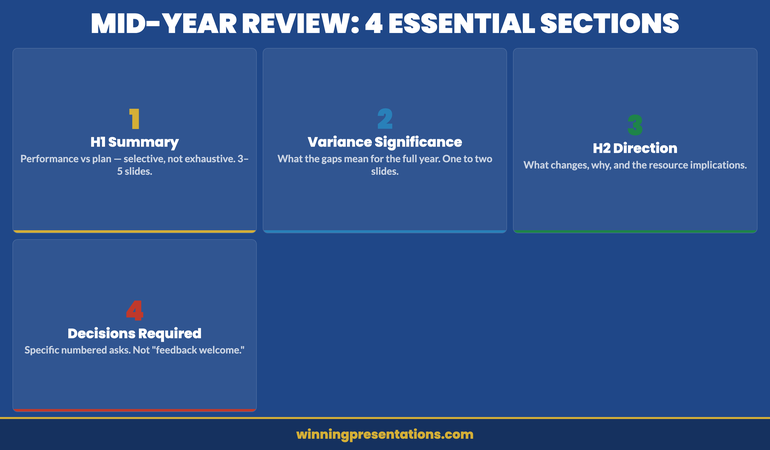
The mid-year business review presentation that serves a board or senior leadership team effectively typically contains four sections, not twenty-two slides. The discipline of the structure comes from being ruthless about what each section must do — and removing anything that doesn’t serve that function.

Mid-Year Business Review presentation structure infographic showing four dimensions: H1 Performance Summary (honest assessment of results vs plan), Variance Significance (what the gaps mean for full year), H2 Direction Reset (revised targets and priorities), and Decisions Required (specific asks from leadership)

Section 1 — H1 Performance Summary. Three to five slides covering the most important performance dimensions: revenue versus plan, margin versus plan, key operating metrics, and any strategic milestones that were or were not achieved. The principle here is selectivity, not completeness. If you present twelve revenue lines when the board needs to understand two, you are making comprehension harder, not easier. Choose the metrics that tell the most important story.

Section 2 — What the H1 Results Mean. This section is the one most consistently missing from mid-year review decks. It takes the performance data from Section 1 and applies judgement: are the gaps structural or transient? Is the full-year target still achievable? Have any of the original strategic assumptions been invalidated by H1 performance? One to two slides. Direct language. This is the section where the presenter’s credibility is established or lost.

Section 3 — H2 Direction. What changes, and why. Revised targets if applicable, reprioritised initiatives, resource allocation decisions, any strategic pivots that H1 performance makes necessary. This section is also where the Q2 planning presentation framework overlaps — if the mid-year review triggers a formal Q3 planning cycle, the structure of that conversation follows naturally from this section.

Section 4 — Decisions Required. The most underused section in mid-year review presentations. A clear, numbered list of the specific decisions you are asking the board or leadership team to make. Not “feedback is welcome” — that is a non-ask. Specific decisions: approve revised budget, authorise additional headcount, endorse strategic pivot, confirm risk appetite. One decision per slide if they’re complex; a single decisions list if they’re straightforward. This section transforms the review from a briefing into a governance meeting.

Structure Your Review Deck for Decision-Quality Clarity

The Executive Slide System gives you slide templates and framework guides designed for the financial review and strategic update presentations that senior leadership teams require — structured for board-level comprehension, not management reporting.

  • Slide templates for board review and performance reporting contexts
  • Framework guides for structuring H1/H2 comparative narratives
  • AI prompt cards to build strategic review decks faster
  • Scenario playbooks for presenting difficult performance results

Get the Executive Slide System — £39

Designed for Finance Directors, Strategy leads, and business unit heads preparing senior leadership review presentations.

How to Report H1 Performance Without Losing the Room

The mechanics of how you present H1 performance data matter as much as the data itself. Two principles govern this section more than any others: narrative before numbers, and significance before detail.

Narrative before numbers means that every set of financial figures needs a one-sentence interpretive statement before the data appears. “Revenue for H1 came in at 94 per cent of plan. The shortfall is concentrated in one business line and reflects a single deal that slipped into H2.” That one sentence tells the board what they’re looking at before they look at it. Without it, every person in the room constructs their own interpretation of the same data simultaneously — and you spend the next eight minutes responding to four different reads of the same chart.

Significance before detail means leading with the implications rather than the components. For a variance that matters, present the significance first (“this puts the full-year target at risk if the trend continues”) and the detailed breakdown second. Audiences who understand why a number matters are far better equipped to process the detail than audiences who are still constructing their own significance judgements while you’re explaining line-item variances.

This approach aligns with the principles behind effective quarterly forecast presentations — the same narrative-first logic applies whether you’re presenting one quarter or six months of data. See also the team performance review presentation framework for how to apply the same structure to operational rather than financial metrics.

Resetting Strategic Direction for H2

The H2 direction section of a mid-year business review presentation is where most presenters underestimate the audience’s tolerance for directness. Boards and senior leadership teams do not need protecting from difficult strategic realities. What they cannot tolerate is ambiguity about what the presenter actually thinks.

If H1 performance has invalidated one of the strategic assumptions behind the annual plan, the H2 direction section is the place to say so clearly. “Our original assumption was that the enterprise segment would accelerate in H2 following the product launch. The H1 data suggests that assumption was optimistic. We are recommending a revised focus on the mid-market segment where conversion times are shorter and our H1 win rate was stronger.” That is a strategic pivot. Name it as such. Don’t bury it in hedging language.

The H2 direction section should also address resource implications directly. A strategic reset without resource implications is a strategic statement, not a plan. If the H2 pivot requires reallocating budget, deferring a project, or hiring in a specific area, those decisions need to appear in the deck — not be left as questions for a follow-up conversation. Leaving resource implications unresolved is the most common reason mid-year reviews generate a second meeting rather than decisions.

If you’re building the deck for a board or C-suite review, the Executive Slide System includes templates specifically structured for performance reporting and strategic review contexts.

The Ask: What Decisions Does the Board Need to Make?

The decisions-required section is the most structurally important part of a mid-year business review presentation, and the most commonly omitted. Its absence turns a governance meeting into a briefing session — the board receives information but doesn’t exercise judgement, which defeats the purpose of convening them.

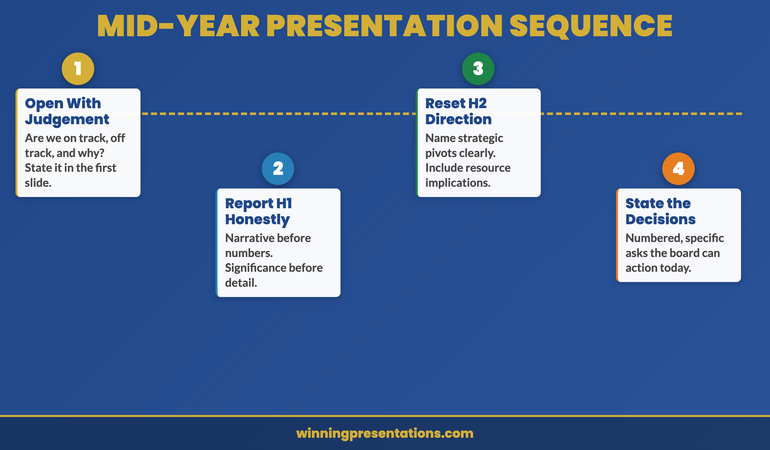
Mid-Year Presentation Sequence roadmap infographic showing four milestones: Open With Judgement (state on-track or off-track in the first slide), Report H1 Honestly (narrative before numbers, significance before detail), Reset H2 Direction (name strategic pivots clearly with resource implications), and State the Decisions (numbered specific asks the board can action today)

A well-constructed decisions list is specific, bounded, and actionable within the meeting. It does not contain questions that require further investigation before a decision can be made — those belong in a pre-read or a follow-up. It contains decisions that the board has enough information to make based on what they’ve just seen in the preceding sections of the review.

The format that works most consistently is a numbered list, one decision per item, with a brief rationale attached to each. “Decision 1: Approve a revised full-year revenue target of £X, reflecting the H1 shortfall and revised H2 conversion assumptions. Rationale: the original target is no longer achievable without material upside on the deal that slipped; the revised target reflects the most credible H2 outlook.” The board can approve, reject, or request modification. That is a governance action. A vague “discussion of performance challenges” is not.

The competitive win-back presentation uses a similar bounded-ask principle — in both contexts, the precision of the ask determines whether the meeting produces a decision or a deferral.

From Performance Data to Board-Ready Presentation

The Executive Slide System gives you framework guides and scenario playbooks for translating complex performance data into the structured, decision-focused format senior leadership teams require.

Explore the Executive Slide System

Designed for senior professionals presenting to boards, executive committees, and investment committees.

Common Structural Mistakes and How to Avoid Them

Several structural patterns in mid-year business review presentations consistently undermine otherwise solid content. Recognising them in advance is more effective than diagnosing them after a difficult meeting.

Too many slides on context that the board already has. A mid-year review is not an onboarding session. Slides covering business model, market overview, and strategic objectives that the board approved in January are filler in a mid-year review. They signal that the presenter is either filling time or lacks the confidence to start directly with performance. Cut context to a single orientation slide if the board composition has changed, or omit it entirely if the audience is consistent.

Variance explanation without variance judgement. “Revenue was down 8 per cent because of a softer market environment in Q2” is an explanation. “Revenue was down 8 per cent, and based on our current pipeline we expect H2 to recover approximately half that gap, which means the full-year target is at risk by approximately 4 per cent” is a judgement with a forward implication. Boards need both; most mid-year decks only provide the former.

Ending on a summary rather than an ask. The final slide should not be “Key Takeaways from H1.” It should be “Decisions Required.” A summary restates what the audience just heard. A decisions slide asks them to act on it. If the meeting ends on a summary, the board leaves feeling informed but not empowered. If it ends on a decisions slide, they leave with clarity about what they did and what happens next.

Frequently Asked Questions

How many slides should a mid-year business review presentation contain?

For a board or senior leadership audience, eight to twelve slides is typically the right range. More than fifteen slides suggests the presenter hasn’t done the work of deciding what matters most. The discipline of reducing a full H1 performance record to twelve focused slides is itself a demonstration of strategic judgement. If supporting detail is essential, it belongs in an appendix that the board can reference rather than in the main deck.

What should go in the appendix of a mid-year review deck?

The appendix of a mid-year business review presentation is for detailed breakdowns that board members may want to reference during discussion — divisional P&Ls, segment-level variance tables, pipeline analysis — but that would slow the main narrative if included in the body of the deck. The rule is: if you need it to make the decision, it belongs in the main deck. If you might need it to answer a question, it belongs in the appendix.

How do you handle a mid-year review when performance is significantly below plan?

Present it directly. The most damaging presentation approach when performance is below plan is to soften, contextualise, or defer the difficult news. Boards have seen every version of that approach and it erodes credibility faster than the performance gap itself. Lead with the honest assessment, explain the root cause analysis, and come prepared with a specific H2 recovery plan and the decisions needed to execute it. Credibility in difficult performance conversations comes from candour and preparedness, not from minimising.

The Winning Edge Newsletter

Weekly presentation strategies, frameworks, and analysis for senior executives and finance professionals. Practical — not theoretical.

Subscribe Free →

Free resource: Download the Executive Presentation Checklist — a pre-presentation reference for board and leadership review contexts.

About Mary Beth Hazeldine

With 25 years of corporate banking experience at JPMorgan Chase, PwC, Royal Bank of Scotland, and Commerzbank, Mary Beth Hazeldine is Owner and Managing Director of Winning Presentations. She advises executives across financial services, healthcare, technology, and government on structuring presentations for high-stakes funding rounds, board approvals, and strategic review cycles. View services | Book a discovery call