

Quick answer: Senior presenters who plateau on 1:1 coaching after six months are not running out of coachable material — they are running out of the friction that drives change. 1:1 coaching becomes therapeutic. The coach knows the leader, the leader knows the coach’s feedback before it arrives, and both unconsciously settle into a comfortable rhythm where new improvement requires new ground. Cohort coaching for executives reintroduces friction by replacing the single trusted reflector with a room of peers whose decks, scars, and blind spots are different from the leader’s own. The peers are not better presenters — they are differently broken, and the structural value of seeing six other senior leaders work through the same framework on six different decks is what 1:1 cannot supply. The plateau is a room problem, not a coach problem.
JUMP TO:
In 2018 I worked with a managing director at a mid-sized investment bank who had hired me for 1:1 presentation coaching at the recommendation of her boss. She was preparing for a major board pitch and wanted a structured pair of eyes on the deck. The first three sessions did serious work — we re-cut her opening, we rebuilt the recommendation slide, we changed how she handled the financial summary. By session six the deck was meaningfully sharper than where it started and the board pitch landed cleanly. We kept meeting monthly because we both enjoyed the conversation and because, on her side, the coaching had begun to feel like a useful ritual. Nothing dramatic happened in any individual session. The decks were marginally better each time. The work was good. It was also, after about six months, structurally finished and neither of us had noticed.
I noticed about a year in, when she sent me a deck for a different audience — an industry conference rather than a board — and my notes came back almost identical to my notes on a board deck from eight months earlier. I had developed a stable lens for her work and she had absorbed it. The notes she found useful were the ones that confirmed what she already half-knew. The notes that would have moved her further were the ones I no longer thought to give, because I had stopped seeing her fresh. A 1:1 coaching relationship that goes on long enough optimises toward comfort. The leader feels well-supported. The coach feels useful. The slides keep getting marginally better. Real change has quietly stopped.
(This article was created with AI assistance; all stories and insights are based on 35 years of real client work.)
The conversation that ended the plateau happened almost by accident. She had asked whether I knew anyone else doing the kind of work she was doing — not for hiring, just for benchmarking. I introduced her to two other senior leaders from different sectors who were also clients. The three of them met for coffee, brought decks, and spent ninety minutes critiquing each other. She emailed me afterward and said it was the most useful single session she had had on her own presentation work in years. That is the structural insight that produces cohort coaching for executives: at a certain point in a senior leader’s development, the most valuable feedback comes from peers facing different problems, not from the same coach giving the same lens to the same person.
If you have plateaued on 1:1 and want a different room:
The Executive Buy-In Presentation System is a self-paced programme with monthly cohort enrolment — 7 modules, no deadlines, no mandatory live attendance, optional Q&A calls fully recorded. The framework you work through privately; the cohort enrolment puts you alongside other senior leaders working the same material on different decks.
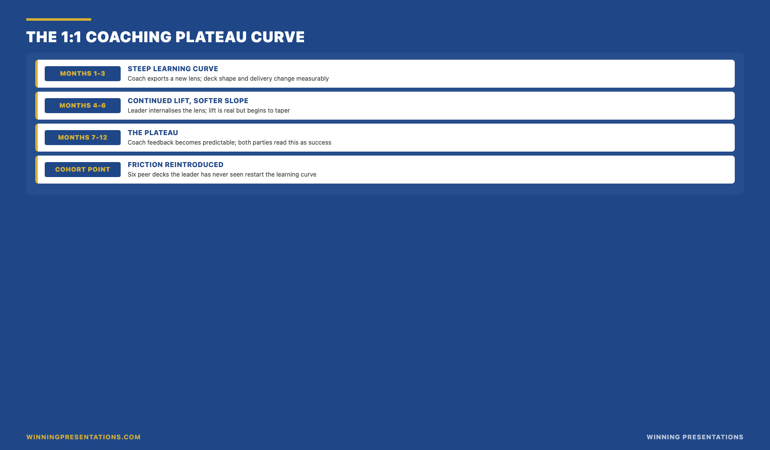
The plateau most 1:1 coaching produces around month six
The first six months of a 1:1 coaching engagement with a senior leader who already presents reasonably well are usually the most productive six months of work either party has done together. The coach can see things the leader cannot. The leader can hear them, because the source is calibrated to their context. The decks improve. The deliveries tighten. The first board meeting after the engagement begins lands measurably better than the last one before. None of this is in dispute. The dispute — or rather, the unstated structural problem — arrives later, when the relationship continues past the point at which the coach has fully exported what they can see to the leader, and the leader has fully internalised it.
After that point, the marginal return on each session falls quickly. The coach’s feedback becomes predictable to the leader, which is partly because the leader has learned the lens and partly because the coach has stopped looking fresh. Both parties read this as “the coaching is working” because the leader can now produce the feedback herself before the coach gives it. In a real sense the coaching is working — the skill transfer has happened. But the engagement frequently continues for another six, twelve, or twenty-four months on a kind of ritual basis, with the leader believing each session adds something material when in fact each session is producing the satisfying feeling of having a trusted reflector available, without the underlying improvement curve that justified the engagement in the first place. This is not a bad thing to spend money on. It is just not coaching anymore. It is professional companionship.
The leaders who avoid this fate are the ones who, around month six or seven, do something that changes the structure of the room. Some hire a second coach with a different background to introduce a different lens. Some bring in a peer reviewer for specific high-stakes decks. The most structurally efficient move — the one that introduces the most new friction with the least transactional cost — is to move from 1:1 into a cohort room where six or seven other senior leaders are working through the same framework on completely different decks. The friction is not from being challenged personally, although that happens. It is from watching someone else handle a structural problem the leader has not yet encountered, and from realising mid-watching that they have been getting their own version of that problem wrong for years without anyone in their 1:1 sessions ever flagging it.
Why friction is the missing ingredient, not technique
The naive view of why coaching plateaus is that the leader has run out of techniques to learn. This is almost never true. Most senior leaders have unused range across the techniques they already know about — the openings they have heard described and never tried, the framework they bought a book on and never used, the question-handling approach they nodded at and then went back to their default. The unused range is enormous. The plateau is not a knowledge problem. It is a deployment problem — the leader knows what they could do differently, and they do not, because the conditions in their working life do not produce enough friction to make the alternative feel necessary.
1:1 coaching, after the first six months, becomes part of those low-friction conditions. The coach is a known quantity. The lens is familiar. The session is, in a structural sense, safe. The leader is not at any risk of being publicly wrong. The feedback they receive is delivered privately by someone they trust, calibrated to what they can absorb, and offered with care. This is exactly what makes 1:1 coaching good early in the engagement and increasingly limited later. The same conditions that enable a leader to hear hard feedback early on insulate them from the deeper hard feedback later. The reflector cannot be both the source of the comfort and the source of the discomfort that produces the next layer of change.
A cohort room reintroduces structural friction without being personally hostile. The friction does not come from the facilitator giving sharper notes than the 1:1 coach would. It comes from the leader watching another senior peer present a deck, recognising in real time that they have been making a structurally similar mistake on their own deck for years, and absorbing the lesson in a way that no second-hand description could deliver. The peer in that moment is not a coach. The peer is a mirror with a different angle, and the angle is what produces the change. For more on the structural decisions the system teaches, see the Executive Buy-In Masterclass overview; the comparison with the limits of 1:1 executive presentation coaching is the companion piece.
What a cohort room actually does that 1:1 cannot
The structural advantage of a cohort room is not that the group somehow knows more than the coach. The facilitator’s expertise is identical to what a 1:1 coach would bring. The advantage is in what the room produces that no single coach-leader pair can produce: parallel-track exposure to the same framework being applied to seven different real decks at once. The leader who has only ever worked their framework against their own decks has, in effect, seen the framework in one colour. The leader who watches six peers work the same framework against six different decks has seen the framework in seven colours, and the depth of understanding that produces is structurally unavailable in a 1:1 setting no matter how long the engagement runs.
The Executive Buy-In Presentation System is built on this premise. The self-paced course content gives the leader the framework to internalise privately — 7 modules covering stakeholder analysis, case construction, and the presentation structures that hold up to senior scrutiny. The monthly cohort enrolment puts that leader alongside other senior people who are working through the same modules on their own real decks, with optional live Q&A calls that are fully recorded so attendance is never mandatory. The leader gets the framework in private and the multi-deck exposure in cohort, which is the combination that breaks the 1:1 plateau without losing the depth of work the 1:1 produced. A leader can enrol with the next cohort at any time; there are no deadlines and the materials are lifetime access.
Stop guessing what your stakeholders need to say yes.
The Executive Buy-In Presentation System is the self-paced framework for decoding stakeholder resistance and building the case that addresses it — 7 modules, monthly cohort enrolment, optional recorded Q&A calls. You work the modules at your own pace; the cohort enrolment puts you alongside other senior leaders working the same material on different decks. £499, lifetime access to materials.
- 7 modules of self-paced course content covering stakeholder analysis, case construction, and presentation structure
- Optional live Q&A / coaching calls, fully recorded — watch back anytime
- Monthly cohort enrolment — join the next cohort whenever suits you
- Lifetime access to all course materials, no deadlines
When 1:1 is the right call, not the wrong one
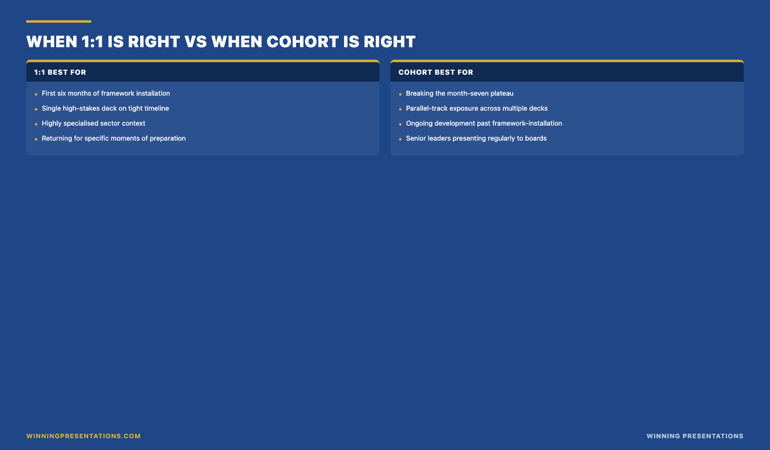
None of this is an argument against 1:1 coaching in general. 1:1 is the right format for several specific situations and remains the most efficient delivery for them. The first is the early engagement — the first six months of work with a senior leader who has not yet been through a structured presentation framework. There is no substitute for individual attention while the framework is being installed. The second is preparation for a single high-stakes deck on a tight timeline. A board pitch in three weeks does not benefit from a six-month cohort cycle. The third is when the leader’s work is so sector-specific that the cohort would add limited parallel-track value — some highly specialised regulatory or scientific contexts fall in this category, although fewer than people assume.
What 1:1 is structurally worse at, after the first six months and outside those three specific situations, is producing the next layer of change. The cohort room is what produces the second layer. Many senior leaders run both at different points in their development — six to nine months of 1:1 to install the framework, a cohort cycle to break the plateau, and occasional 1:1 returns for specific high-stakes situations. The formats are complementary, not competitive. The mistake is treating 1:1 as the only format and then wondering why the improvement curve flattened a year in. The improvement curve flattened because the room did not change. The fix is to change the room. The Executive Buy-In Presentation System is the format that change usually takes, because the framework and the multi-deck exposure travel together in the same enrolment.
A lower-cost path for leaders who want to deepen the structural side of the work without enrolling in a full cohort — or to supplement the cohort framework with the slide structure that lets the buy-in case land cleanly — is to pair the cohort with the Executive Slide System (£39). The slide system gives you the 26 templates, 93 AI prompts, and 16 scenario playbooks that the buy-in framework references in module five. Most cohort attendees who already own the slide system find the module five work goes about half the time it otherwise would, because the templates are already there.
Designed for senior professionals who present decisions to boards, investment committees, and executive sponsors.
The Executive Buy-In Presentation System — 7 self-paced modules covering the psychology and structure that earn serious approval. Monthly cohort enrolment, optional recorded Q&A sessions. £499, lifetime access to materials.
Frequently asked questions
Is cohort coaching worth it for someone who already has a long-standing 1:1 coach?
Usually yes, and the leaders who already have a strong 1:1 relationship tend to get the most from it because they have already done the framework-installation work the cohort builds on top of. The cohort is not a replacement for the 1:1 — it is the room that adds the parallel-track exposure the 1:1 cannot produce. Most leaders who run both find their 1:1 conversations become sharper after the cohort, because they bring back specific structural questions surfaced by watching peers handle problems the leader had not yet encountered. Treat them as complementary formats, not competing ones.
What is the most common mistake senior presenters make about choosing a coaching format?
Assuming the format that worked at the start of their development is the format that will work indefinitely. 1:1 is usually the right starting format and the wrong long-term-only format. The leaders who plateau on 1:1 have generally not failed to find the right coach — they have failed to recognise that the room itself stopped producing the friction that drove the early gains. The fix is structural, not relational. A different coach often produces a temporary lift that runs out for the same reason. A different room is the longer-lasting move.
How long does it take to see meaningful change from cohort coaching?
The framework-side change is usually visible inside the first month, as the leader works through the early modules privately and starts applying the structural moves to live decks. The cohort-side change — the parallel-track learning from watching peers work the same framework on different decks — usually shows up by the third or fourth real-world meeting after the cohort begins, because the new structural moves only earn their keep once they have been pressure-tested in the room. Most senior leaders who complete a cohort cycle report the most meaningful change in the six to nine months following the cohort, not during it.
Does this work for senior leaders presenting in highly specialised sectors?
Mostly yes, although the calibration varies. The framework is content-agnostic — the structural moves that get a board to approve a credit-policy change are the same moves that get a board to approve a clinical-trial design or a software-platform investment. Where specialised sectors need a small adjustment is in the case-construction module, where the proof types differ between regulatory, scientific, and commercial domains. The cohort handles this naturally, because the peer mix usually spans multiple sectors and the comparative work is one of the strongest learning surfaces in the room. The leaders who get least from the cohort are the ones whose work is so narrow that the parallel-track exposure adds limited value — this is rarer than people assume, but it does happen.
The Winning Edge — weekly newsletter
The Winning Edge is a weekly newsletter for senior professionals who present at the executive level. One short email a week on the structural moves that separate decks committees back from decks they defer. Subscribe to The Winning Edge →
For the wider library of presentation assets that pair with the buy-in framework — the slide system, the storytelling primer, the Q&A taxonomy, and the delivery references — the Complete Presenter bundle (£99) collects them in one place.
About the author
Mary Beth Hazeldine is Owner & Managing Director of Winning Presentations Ltd. With 24 years of corporate banking experience at JPMorgan Chase, PwC, Royal Bank of Scotland, and Commerzbank, she advises executives across financial services, healthcare, technology, and government on structuring presentations for high-stakes funding rounds, board approvals, and strategic decisions.
The next time your 1:1 coaching feels useful but not productive, do three things instead: ask yourself when the last piece of feedback genuinely surprised you; count how many other senior leaders’ decks you have seen worked through the same framework in the last twelve months; and reserve a seat in the next cohort if either answer is “not recently”. The friction your work needs is not in your coach’s notes any more — it is in the room you are not yet in.