Tag: online presentation course

30 May 2026
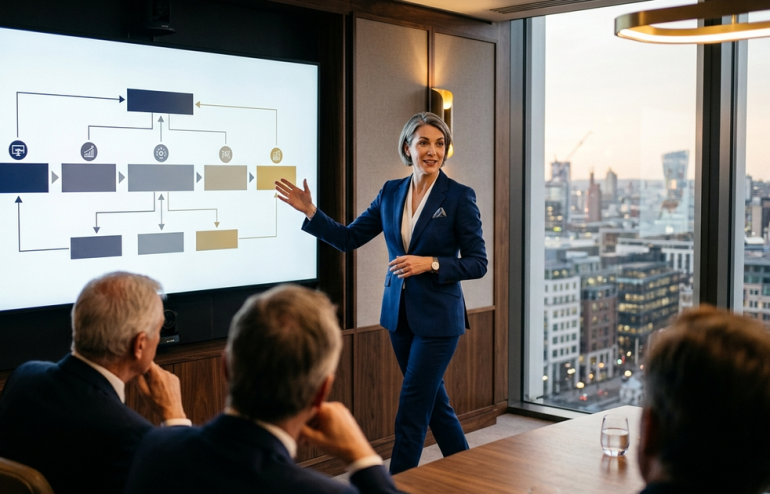
Senior executive presenting a strategic proposal to a boardroom, confident stance, navy and gold editorial palette.

Strategic Presentation Skills Training Online: An Executive Programme

If you are looking for strategic presentation skills training online — specifically for senior professionals who present decisions that shape direction, not just deliver updates — AI-Enhanced Presentation Mastery is a self-paced programme covering 8 modules and 83 lessons, with AI-assisted frameworks for building board-level arguments and executive-grade decks.

This page explains exactly what the programme includes, who it is designed for, and how it differs from generic communication training. If you are evaluating options, the detail below is written to help you decide.


Senior executive presenting a strategic proposal to a boardroom, confident stance, navy and gold editorial photography

Short on time? If you would rather skip the analysis and see the programme directly, view AI-Enhanced Presentation Mastery on Maven — 8 modules, self-paced, monthly cohort enrolment. The remainder of this page is for readers who want the context first.

Why Strategic Presentations Need Different Training

There is a real difference between delivering an update and presenting a strategy. The update explains what happened. The strategy asks a room of senior people to commit capital, headcount, or reputation to a particular direction — and to defend that choice against competing priorities they have been told about all week.

Most presentation training does not acknowledge the difference. Two-day workshops teach you to open with a hook, structure three key messages, and close with a call to action. That template works fine for a town hall and falls apart when the audience is an investment committee or an executive sponsor with three competing proposals on the table.

Strategic presentations live or die on structure and anticipation. How you frame the problem. How you sequence the evidence. How you pre-empt the objection the CFO will raise in minute eight. These are editorial and analytical skills, not delivery skills — and generic training does not teach them.

What an Executive-Level Programme Covers

AI-Enhanced Presentation Mastery is built for professionals who already present at work and now need to present strategically. It is not an introductory course. It is a structured programme of 8 modules and 83 lessons that takes you from slide architecture through to stakeholder preparation, with AI-assisted workflows at every stage.

The programme is designed by Mary Beth Hazeldine, who spent 24 years in corporate banking at JPMorgan Chase, PwC, Royal Bank of Scotland, and Commerzbank before taking over Winning Presentations in 2023. The content draws directly on the kinds of strategic presentations she delivered and advised on — capital requests, restructuring proposals, investor updates, and cross-border regulatory submissions.

Delivery is entirely online and self-paced. You access all 8 modules and 83 lessons from enrolment, with no deadlines. Two optional coaching sessions with Mary Beth are included, both fully recorded so you can watch back. New cohorts open every month — here, a cohort is an enrolment group, not a fixed live timetable. For broader context, the executive presentation masterclass overview is a useful reference.

What the Programme Includes

  • 8 modules, 83 lessons — covering strategic slide architecture, narrative sequencing, evidence structuring, stakeholder analysis, Q&A preparation, and AI-assisted drafting
  • Self-paced access — no deadlines, no mandatory attendance. Work through the material on your own schedule
  • AI workflows throughout — practical prompts for ChatGPT and Microsoft Copilot, integrated into every module so you apply them immediately to your real presentations
  • 2 optional live coaching sessions — with Mary Beth Hazeldine, fully recorded. Bring a real presentation and receive direct feedback
  • Monthly cohort enrolment — join any month. The cohort is an enrolment batch, not a fixed timetable
  • Lifetime access to materials — revisit modules before future presentations for as long as you need

Price: £499 per seat — one payment, lifetime access to materials.

Build Strategic Presentations That Hold Up Under Senior Scrutiny

AI-Enhanced Presentation Mastery gives you the structural frameworks and AI-assisted workflows that senior professionals use to prepare strategic decks — from the first outline to the final objection-handling brief.

  • 8 self-paced modules, 83 lessons — structural and editorial focus, not delivery drills
  • AI prompts and workflows for ChatGPT and Microsoft Copilot, built into every module
  • 2 optional coaching sessions with Mary Beth (fully recorded — watch back anytime)
  • Monthly cohort enrolment, lifetime access to all materials

Explore AI-Enhanced Presentation Mastery → £499

Designed for senior professionals who present strategic decisions to boards, investment committees, and executive sponsors

How AI Changes Strategic Preparation

Strategic presentations are editorial work before they are delivery work. The hours disappear into outlining, pulling data, rewriting after feedback, preparing answers to questions you expect, and rehearsing. AI does not replace any of the thinking. What it compresses is the drafting cycle — early structuring, first-pass slide content, stress-testing arguments, and generating objection banks for Q&A preparation. Used properly, it turns a twelve-hour prep cycle into something closer to four.

Used poorly, AI produces generic output that a senior audience recognises immediately. The programme covers both sides — what AI is genuinely good at, and what still requires human judgement: reading a specific audience, weighting political considerations, and anticipating the question that will actually get asked in your room. Participants leave using AI as a drafting partner, not a drafting replacement. For the broader frameworks, the executive presentation training overview covers the underlying approach.

Stop burning twelve-hour prep cycles on strategic decks.

AI-Enhanced Presentation Mastery gives you the prompt libraries and workflow patterns that compress drafting without producing generic output. 8 modules, 83 lessons, self-paced. £499, lifetime access.

See the Programme → £499

Is This the Right Programme for You?

This programme is designed for you if:

  • You present strategic decisions — capital requests, restructuring, market entry, major partnerships — to senior decision-makers
  • You want AI workflows that genuinely cut preparation time without producing generic slide output
  • You want structural frameworks, not delivery drills
  • You prefer self-paced learning that fits around a senior role
  • You work across multiple industries or geographies and need frameworks that travel

This programme is probably not the right fit if:

  • You are looking for an introductory public speaking course (this is senior-level, not beginner)
  • You need in-person workshop training with group exercises
  • Your primary challenge is presentation anxiety rather than structural and analytical
  • You want live, instructor-led weekly sessions — this is self-paced with two optional recorded coaching sessions

If the fit looks right but you want to test the approach first, the executive presentation coaching overview explains how Mary Beth frames strategic preparation in shorter articles. The programme is where the full implementation, AI workflows, and coaching sessions live.

No deadlines, no mandatory attendance, lifetime access.

You keep the materials forever. Work at your pace, revisit modules before future presentations. AI-Enhanced Presentation Mastery — 8 modules, 83 lessons, 2 optional recorded coaching sessions. £499, one payment.

Enrol in the Next Cohort → £499

Frequently Asked Questions

Is this strategic presentation training fully online?

Yes. AI-Enhanced Presentation Mastery is entirely online and self-paced. All 8 modules and 83 lessons are accessible from any device at any time. The two optional coaching sessions with Mary Beth are run online and fully recorded, so you can watch back whenever suits you.

How long does the programme take to complete?

That is entirely up to you. Some participants work through the material across two to three weeks alongside a senior role. Others take two to three months. There are no deadlines, and your access to the materials does not expire. Most people dip back into specific modules when preparing for particular presentations after finishing.

Do I need AI experience before starting?

No. The programme assumes no prior AI knowledge. You are taught how to use ChatGPT and Microsoft Copilot specifically for strategic presentation preparation — from drafting slide content and structuring arguments to generating Q&A banks. The prompts and workflows are provided ready to use.

Is this only for UK-based professionals?

No. The programme is designed by a UK-based instructor and draws on British and European corporate scenarios, but participants come from financial services, technology, healthcare, government, and professional services across multiple countries. The principles of structuring strategic presentations travel well across markets.

What if I have a specific strategic presentation coming up?

This is exactly what the two optional coaching sessions are for. Bring a real presentation — draft slides, outline, or just the brief — and Mary Beth will work through the structure and approach with you. Both sessions are recorded, so you can revisit the feedback when you build the next version.

How is this different from a generic communication course?

Generic communication training focuses on delivery — body language, voice, managing nerves. This programme focuses on the editorial and analytical work that sits behind a strategic presentation: how to structure evidence, sequence an argument, pre-empt objections, and use AI to accelerate the drafting cycle. Delivery matters, but it is not the reason strategic presentations get rejected.

The Winning Edge — weekly newsletter for senior professionals

Short, practical essays on strategic presentations, boardroom communication, and AI-assisted preparation. One email a week.

Subscribe to The Winning Edge →

About the Author

Mary Beth Hazeldine is the Owner & Managing Director of Winning Presentations. With 24 years of corporate banking experience at JPMorgan Chase, PwC, Royal Bank of Scotland, and Commerzbank, she advises senior professionals across financial services, healthcare, technology, and government on structuring strategic presentations for board approvals, investor updates, and capital requests.


28 May 2026
High Stakes Presentation Course Online: What Senior Presenters Need

High Stakes Presentation Course Online: What Senior Presenters Need

Quick answer: A high-stakes presentation course online needs to do four things most courses do not: address structure (how to build the deck a senior audience will actually approve), psychology (the nervous-system response that destabilises competent presenters in big rooms), Q&A handling (the questions that decide approvals), and stakeholder pre-work (the alignment that happens before the meeting starts). Courses that focus only on delivery skills — voice, posture, slides — leave senior presenters under-prepared for the moments that decide outcomes.

A senior commercial director at a UK-headquartered insurance group emailed Mary Beth in February. She had completed three online presentation courses in the previous 18 months. The first was a Coursera-style university programme. The second was a series on pitch decks via a major learning platform. The third was a self-paced video course bought from a US-based business influencer. None of them, she wrote, prepared her for the specific situation she now faced: presenting a £40m investment recommendation to her group’s investment committee in eight weeks. The courses had taught her to “engage the audience” and “tell a story”. The investment committee was not interested in being engaged. They were interested in deciding.

This is the fundamental gap in most online presentation training. The dominant courses are built for general business audiences — middle managers, sales professionals, public-speaking enthusiasts. They are useful for those audiences. They are not built for senior people facing high-stakes decision presentations where the room is silent, the audience is more senior than the presenter, and the outcome materially affects strategy, capital, or career trajectory.

What follows is what to look for in a course that does address that scenario, what questions to ask before enrolling, and how to evaluate format honestly. We will also describe the programme Mary Beth runs, but the framework below applies regardless of which course you choose.

Already know what you need? Start here:

The Executive Buy-In Presentation System is a self-paced programme covering the structure, psychology, and preparation that senior professionals use to secure approval at board level.

Explore The Executive Buy-In Presentation System →

What senior presenters actually need from a course

The presentation skills taught in a typical online course are useful at the wrong level for high-stakes work. Storytelling, audience engagement, slide aesthetics — all of these matter, but none of them are the load-bearing element when the audience is a board, an investment committee, or a senior executive sponsor with the authority to approve or reject the recommendation.

Four areas matter at this level. A high-stakes presentation course online should address all four substantively, not just one.

Structure. What is on the deck and what is off. How decisions get framed. The recommendation slide. The option set. The risk profile. Where evidence lives. How the deck flows when read in 90 seconds during a pre-read in the back of a car. Most courses skip this and go straight to delivery technique. For senior settings, structure is the first half of the work.

Psychology. The nervous-system response that destabilises competent presenters when stakes are highest. Why “just relax” is not a strategy. The protocol that actually settles a presenter in the 30 minutes before walking into the room. The specific techniques for shaking voice, racing heart, and dry mouth in the moment. Courses that ignore this leave the most experienced presenters vulnerable to the one room they cannot afford to lose.

Q&A handling. Senior audiences make decisions in Q&A, not during the prepared content. The hostile question patterns. The career-risk question. The pile-on dynamic when three or four committee members challenge in succession. The 45-second decision-safe answer structure. Bridging and blocking. This is usually treated as an afterthought in general courses. It is the most consequential element of a high-stakes presentation.

Stakeholder pre-work. The alignment that happens before the meeting starts. Pre-read distribution. One-to-one conversations with sceptics. Decision-readiness mapping. The work that determines whether the approval has effectively been won before the presentation even begins. General courses rarely address this. For high-stakes work, it is often the difference between a meeting that approves and one that defers.

For more on the structural side specifically — what an executive deck needs to contain at board level — see the 15-minute board presentation template and the 8-slide CFO presentation template.

Format questions to ask before enrolling

Before paying for any online presentation course aimed at senior-level presenting, four format questions matter more than the marketing copy.

Who teaches it? Has the instructor delivered high-stakes presentations themselves at senior level, or have they only taught presentation skills as a generalist? The signal you are looking for is named experience — companies, sectors, the actual scenarios they have presented in. A course taught by someone who has never sat across from an investment committee will struggle to address what happens in that specific room.

Walk into your next high-stakes presentation prepared.

The Executive Buy-In Presentation System is a self-paced programme — 7 modules covering the structure, psychology, and preparation that senior professionals use to secure approval at board level. Monthly cohort enrolment, optional recorded Q&A calls, lifetime access. £499.

  • Structure: the deck framework that earns senior approval
  • Stakeholder analysis and pre-meeting alignment protocols
  • The psychology of high-stakes presentation pressure
  • Q&A handling for the questions that decide approvals
  • Optional bonus Q&A calls with Mary Beth (recorded — watch back anytime)

Explore The Executive Buy-In Presentation System →

Designed for senior professionals across financial services, healthcare, technology, and government.

Who is it designed for? If the course’s target audience is “professionals who want to improve their presentation skills”, it is built for a generalist audience. Senior-level presenting is a narrower problem. Look for courses that specify the audience: senior leaders, executives presenting to boards, investment committees, regulators, or executive sponsors. The framing tells you whether the content was built for your scenario.

What is the format actually? Self-paced video, live cohort, hybrid, 1:1 coaching? Each has trade-offs. Live cohorts impose a schedule that may not match your meeting timeline. Self-paced gives you flexibility but requires you to drive your own pacing. 1:1 coaching is high-cost but tailored. The format question matters more than most enrolees realise.

What does “live” actually mean? Many programmes marketed as “live cohorts” or “live coaching” are in fact self-paced courses with optional live calls. There is nothing wrong with that format — it is often the right one for senior professionals with unpredictable calendars. But you need to know which it is before you enrol. Ask whether attendance is mandatory, whether calls are recorded, and whether the core content is delivered live or pre-recorded.

Self-paced versus live: which suits high-stakes presenting

The dominant assumption in adult learning is that “live is better than self-paced” — that real-time interaction improves outcomes, that synchronous beats asynchronous. For senior professionals working on high-stakes presentations, this is not always true.

Self-paced courses suit senior presenters for three reasons. First, the meeting that drives the learning need is not on a fixed schedule. A board presentation in eight weeks needs different work than a presentation in two weeks. Self-paced learning lets you compress or expand the timeline to fit the actual meeting. Second, the content needs to be revisited. The structure module you watched in week one becomes much more useful when you are actively building a deck in week six. Self-paced courses make that re-visit straightforward. Third, senior calendars do not respect synchronous schedules. A live cohort meeting at 6pm on a Tuesday is likely to be missed three times in any twelve-week programme.

Live cohorts suit some learners — those who need the social accountability of a fixed schedule, those who learn best from real-time discussion, those whose work calendars are predictable enough to commit to weekly sessions. For most senior professionals juggling unpredictable demands, the self-paced format with optional live touchpoints is the more honest fit.

The risk with self-paced is starting and not finishing. The mitigation is twofold: pick a course where the modules are short enough to complete in a single sitting (under 45 minutes each), and pick a course with a structure that maps to a real upcoming meeting rather than to an abstract “skills development” goal. Learning anchored to a real deadline gets completed. Learning anchored to “someday I’ll get better at this” does not.

What to avoid in a high-stakes course

Three patterns appear in courses that under-deliver for senior presenters. Recognise them before you pay.

Heavy emphasis on stage technique. Voice projection, gesture training, stage choreography — these belong in courses for keynote speakers and TED-style stage presentations. They are largely irrelevant in a board room where you are seated, the audience is six metres away, and the entire presentation is delivered from a chair with a remote in your hand. Courses that lead with stage technique are signalling their target audience, and it is not yours.

Outcome guarantees. “You will close every deal.” “Your board will say yes.” “You will eliminate presentation anxiety.” Outcomes depend on factors well outside any course’s control — the strength of your underlying case, the politics of the room, the timing relative to other organisational priorities, the audience’s existing biases. Courses that make outcome guarantees are signalling that they prioritise marketing over honest framing. Look for courses that promise process — “build a stronger case”, “structure the conversation”, “prepare for the questions that decide” — not outcomes.

Generic “engagement” content. Courses heavy on “how to capture attention”, “how to make slides memorable”, “how to use storytelling to engage your audience” — these are aimed at presenters whose challenge is keeping a passive audience interested. The challenge in a high-stakes presentation is the opposite: a hyper-attentive audience that is forming sharp judgements every minute. The skills required are different. Look for courses that name the specific skills required for your scenario, not the generalist skills shared across all presentation contexts.

For more on the structural side of preparation specifically, see the 31-point first board presentation review and the partner article on the 72-hour protocol senior leaders use.

The Executive Buy-In Presentation System

Since you are reading this on the Winning Presentations site, it is fair to be transparent about the programme Mary Beth runs and where it fits.

The Executive Buy-In Presentation System is a self-paced programme on Maven covering 7 modules. It is designed for senior professionals who present decisions to boards, executive sponsors, investment committees, and regulators. The modules cover stakeholder analysis, case construction, the slide structures that hold up under board scrutiny, the psychology of high-stakes presenting, Q&A handling for the questions that decide approvals, and the rehearsal protocols senior presenters use in the final 72 hours before the meeting.

Format: self-paced. New cohort enrolment opens monthly — you join the next cohort whenever timing suits, then work through at your own pace. Optional bonus Q&A calls with Mary Beth are fully recorded so you can watch back anytime. No deadlines. No mandatory attendance. Lifetime access to all course materials. Price: £499.

It is not the right course for every audience. If your work is primarily client-facing sales presentations or external pitches to general audiences, other formats may suit better. If your work is presenting decisions internally to senior stakeholders — board approvals, capital requests, strategic recommendations, structural change proposals — the programme is built specifically for that scenario.

Want the slide structure that goes with the framework?

The Executive Slide System gives you 26 templates including the recommendation, options, and risk slides used in real C-suite decks. £39, instant access — pairs naturally with the Buy-In programme when you want both strategic framework and tactical templates.

Get the Executive Slide System — £39 →

Frequently asked questions

How long does a high-stakes presentation course take to complete?

Self-paced programmes vary. Most senior professionals complete the core content of a focused course in 6-10 hours of work, spread over two to six weeks depending on calendar pressure. Anchoring the work to a real upcoming meeting compresses the timeline naturally — most learners drive harder when the pre-meeting deadline is real than when learning is abstract. Live cohort programmes typically run 4-8 weeks on a fixed schedule.

Is an online course as effective as in-person coaching for high-stakes work?

For different things. In-person 1:1 coaching is the highest-touch format and remains the standard when the budget supports it — typically £3,000-£15,000 for a focused engagement around a specific high-stakes presentation. Online courses give you the structural and psychological framework at a lower price point and on your timeline. For most senior professionals, the right answer is online course as the foundation, with selective 1:1 coaching for the specific high-stakes meetings where the stakes justify the investment.

Should I take a course before my next high-stakes presentation, or after?

Before, if there is time. The structural and psychological work is most useful when you are actively building a real deck and rehearsing for a real audience. Taking a course “after” — to learn from the meeting that just happened — is also valuable but slower-burning. The compression effect of an upcoming meeting drives most of the learning.

What is the price range for high-stakes presentation courses online?

£20-£100 for self-paced courses on general platforms (Coursera, Udemy, LinkedIn Learning) — useful as foundational content but rarely deep on senior-level scenarios. £200-£800 for specialist self-paced programmes built for executive audiences. £1,000-£3,000 for live cohort programmes with named instructors. £3,000-£15,000 for 1:1 executive coaching engagements. The Executive Buy-In Presentation System sits in the £499 specialist self-paced category.

The structured framework for senior approval — at your pace.

The Executive Buy-In Presentation System — 7 self-paced modules, monthly cohort enrolment, optional recorded Q&A calls. Designed for senior professionals presenting decisions at board level. £499, lifetime access to materials.

Explore the programme — £499 →

Get The Winning Edge newsletter

A weekly note from Mary Beth on the structure, psychology, and preparation that earns senior approval. One idea, one application, one specific scenario — every Thursday morning.

Subscribe to The Winning Edge →

Not ready for the full programme? Start here instead: download the free Executive Presentation Checklist — a single-page reference for what every high-stakes presentation needs before it leaves your desk.

Next step: Identify your next high-stakes presentation date. Work backwards. Pick a course that fits the timeline and addresses the four areas — structure, psychology, Q&A, stakeholder pre-work. Enrol in time to use the work, not just to complete it.

About the author

Mary Beth Hazeldine is Owner & Managing Director of Winning Presentations Ltd, founded in London in 1990. With 24 years of corporate banking experience at JPMorgan Chase, PwC, Royal Bank of Scotland, and Commerzbank, she advises executives across financial services, healthcare, technology, and government on high-stakes presentation structure, psychology, and Q&A composure.

24 May 2026
Featured image for Presentation Cohort Programmes vs Self-Study: Why Peer Pressure Matters

Presentation Cohort Programmes vs Self-Study: Why Peer Pressure Matters

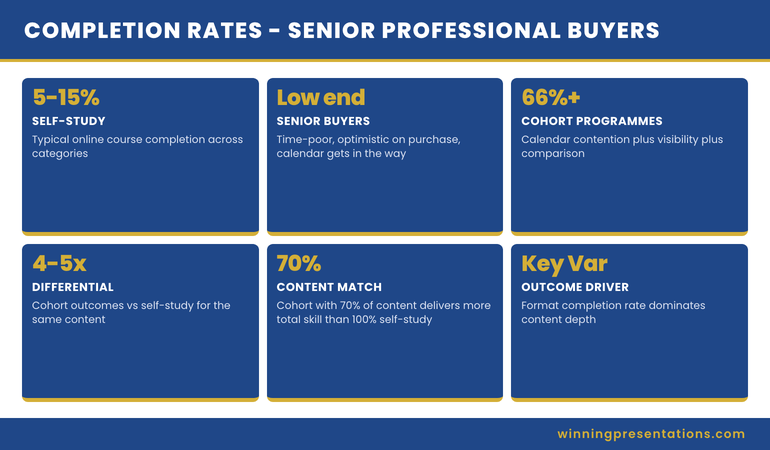
Quick answer: Cohort and self-study presentation programmes look similar on paper. They differ on one variable that most buyers under-weight: completion. Senior professionals enrolled in self-study courses complete roughly one in four. Senior professionals enrolled in cohort programmes complete most. The peer pressure is structural, not motivational. The decision is not about content — it is about which format the buyer will actually finish.

Geraldine had bought three presentation courses in the previous five years. She was a senior partner at a professional services firm with thirty-plus years’ experience. She was also, by her own admission, a serial non-completer. Each course had felt like the right purchase at the time. Each had been opened, sampled across the first two modules, and then quietly abandoned three weeks later when something more urgent arrived. The fourth time, she enrolled in a cohort programme. She finished it.

The reason was not that the cohort programme was better. The reason was that the cohort programme had other people in it. On the second week she watched another participant present a draft to the group. On the fourth week she presented her own. By week six, the prospect of arriving at the next group session without having done the work was social, not just self-imposed. The accountability that her self-study courses had been unable to manufacture was simply present in the cohort by structural default.

This is the decision most senior buyers misframe. They compare cohort and self-study programmes on content. The content is usually similar. They compare on price. The price is usually similar. They compare on time commitment. The time commitment is usually similar. They almost never compare on the variable that determines outcome — which format produces completion.

If you have started a presentation course before and not finished it

The Executive Buy-In Presentation System uses a monthly cohort enrolment model — the structure that drives completion. 7 self-paced modules, optional live Q&A calls (fully recorded). Lifetime access to materials. £499.

Explore the system →

The completion gap

Self-study completion rates for paid online courses, across categories, sit roughly between five and fifteen per cent depending on the course design. For senior professional buyers — who are time-poor, have unusually high competing demands, and tend to buy courses optimistically — the completion rate sits at the low end of that range. The buyer is sincere on purchase. The calendar is not.

Cohort completion rates, by comparison, sit much higher. The exact figure varies by programme, but well-designed cohorts routinely show completion rates of two-thirds or more. The differential is large enough that it dominates almost every other variable in the buying decision. A cohort that delivers seventy per cent of the content of a self-study course but is finished by seventy per cent of buyers will produce more aggregate skill development than a self-study course with one hundred per cent of the content and twelve per cent completion.

Bar chart comparing typical completion rates of self-study versus cohort presentation programmes for senior professional buyers, showing a large gap that drives outcome differential

The completion gap is not a function of intelligence, motivation, or commitment. Senior professionals who do not complete self-study courses are not failing — they are running into a calendar problem. The work that competes with the course is genuinely urgent. Self-study has no mechanism to put the course back on the calendar when it gets pushed off. Cohort programmes do.

How cohort peer pressure actually works

Cohort accountability is often described as social pressure. That is the surface mechanism. The deeper mechanism is calendar contention. A cohort puts dates on the calendar. The dates are external commitments. External commitments are dramatically harder to skip than internal intentions. The cohort, in effect, borrows the buyer’s professional discipline — the same discipline that makes them reliably attend a board meeting they would never skip — and applies it to the course.

A second mechanism is visibility. Self-study courses are private. If the buyer falls behind, no one knows. Cohort courses are partially public. Other participants notice if work is not done. The visibility creates a small but persistent pull on attention. It is not sufficient on its own to drive completion. Combined with calendar contention, it usually is.

A third, less obvious mechanism is comparison. Cohort participants see other participants’ progress. If three other senior professionals at similar levels are working through module four, the buyer who is still on module two notices. The comparison is not punitive — it is informational. It updates the buyer’s sense of what is normal, and most buyers adjust upward.

A fourth mechanism is question seeding. In self-study, the buyer asks the questions they think to ask. In a cohort, the buyer hears the questions other participants are asking. Many of those questions are ones the buyer would not have asked themselves but benefits from hearing answered. The breadth of question coverage is materially higher in cohort formats than in self-study.

For senior professionals who have started courses and not finished them

The cohort programme designed for senior buyers who need completion structure

The Executive Buy-In Presentation System is a self-paced programme delivered through a monthly cohort enrolment model. 7 modules covering stakeholder analysis, case construction, and the structural patterns that secure board-level approval. Optional live Q&A calls are fully recorded — watch back any time you cannot attend. The cohort structure provides the completion-rate uplift; the self-paced format means there are no missed-session penalties.

  • 7 self-paced modules — work through at your own pace, no deadlines
  • Optional live Q&A / coaching calls — fully recorded, watch back any time
  • No mandatory live attendance, no fixed-week schedule, no missed-session penalty
  • Monthly cohort enrolment — enrol any time, start with the next cohort
  • Lifetime access to all course materials

£499 · Self-paced · Lifetime access · Next cohort enrolment opens monthly

Join the next cohort →

Where self-study still wins

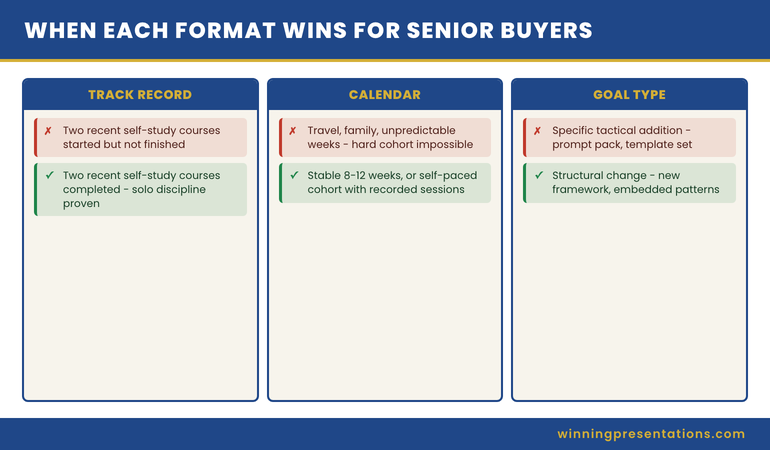
Self-study is the right format for three specific buyer profiles. The first is the senior professional who has demonstrated, over multiple completed courses, that they finish self-paced material. The pattern is observable. If the buyer’s bookshelf or course library shows three to four completed certificates from solo work, the structural completion problem does not apply. Self-study is faster, cheaper, and unrestricted by cohort calendars. Buy it.

The second profile is the senior professional with an unusual schedule — frequent international travel, irregular weeks, dependent care responsibilities — that makes any cohort calendar difficult to honour. A cohort with mandatory live sessions would be unfair to the buyer’s situation. A purely asynchronous self-study course is more honest. The trade-off is the lower completion rate, but the calendar fit makes the course possible at all.

The third profile is the senior professional who already has the structural framework — they have completed coaching, an MBA, a previous high-quality course — and is now looking for a specific tactical addition. A short self-study course on, say, AI prompts for presentations or one-page slide design is the right tool. The buyer does not need accountability for a small tactical addition. They need fast access to specific content.

Outside these three profiles, the case for self-study weakens. For the senior professional who is buying their first or second presentation programme and has not yet demonstrated a completion pattern, the cohort format produces dramatically better outcomes — even when the cohort and self-study courses are nominally similar in content.

The hybrid that solves both problems

There is a format that has emerged in the last two years which solves the structural trade-off. It is the self-paced cohort — a programme that uses cohort enrolment for the accountability structure but self-paced delivery for the calendar flexibility. The buyer enrols with a cohort, has access to optional live sessions that are fully recorded, but has no mandatory live attendance and no fixed-week deadlines.

Diagram showing how the self-paced cohort format combines the accountability of cohort enrolment with the calendar flexibility of self-study, removing the trade-off between completion and schedule control

The format works because the cohort delivers the visibility, comparison, and question-seeding benefits, while the self-paced delivery removes the calendar contention that makes hard-cohort formats feel exclusive to senior buyers with controllable schedules. The completion rate sits between the two extremes — lower than a hard cohort, dramatically higher than pure self-study. For most senior buyers, this is the highest-yield format available.

The format also resolves the secondary issue with hard cohorts: the missed-session penalty. In a four-week live cohort, missing one of the four sessions removes a quarter of the live experience. In a self-paced cohort with recorded sessions, missing the live moment costs nothing — the buyer watches the recording at the next available window. Senior professionals, who routinely have to miss meetings for unavoidable reasons, find this configuration much more compatible with their actual calendars. See the related discussion of presentation coaching due diligence for the questions buyers should ask before committing to either format.

A decision framework for senior buyers

Three questions resolve the cohort vs self-study decision for most senior buyers. First, what is the buyer’s completion track record on previous courses? If at least two recent self-study courses were finished, self-study is fine. If two or more were started and not finished, cohort or self-paced cohort.

Second, what is the buyer’s calendar profile in the next eight to twelve weeks? If the calendar is broadly stable, a hard cohort is feasible. If travel, family events, or unpredictable demands are likely, a self-paced cohort with recorded sessions is the right choice. A pure self-study course is the option of last resort, used only when the buyer can demonstrate the completion track record above.

Third, what is the buyer’s actual goal? If the goal is a specific tactical addition — a prompt library, a slide template pack, a one-day delivery refresh — self-study is fast and right. If the goal is structural change in how the buyer presents, the cohort element matters because structural change requires sustained attention across weeks rather than a one-evening reading.

A fourth, less common question is worth adding for buyers who have already engaged 1:1 coaching. If a coach is already working with the buyer on a specific high-stakes meeting, a self-study course often complements well — the coach handles delivery, the course handles the structural framework, and the two work in parallel without scheduling conflict. This is one of the few cases where pure self-study sits comfortably alongside other senior development work.

Frequently asked questions

Are cohort programmes always more expensive than self-study?

Not consistently. Some cohort programmes are priced similarly to high-quality self-study courses. The price differential, where it exists, is usually offset by the completion-rate uplift — paying twice for a course you will finish is better than paying once for a course you will not. The buyer should compare cost per completed module, not cost per enrolment.

Can I switch from a self-study course to a cohort if I am not finishing?

Often yes. Many cohort programmes accept buyers who have started self-study material elsewhere. The pattern is common enough that it is sometimes called a “rescue enrolment” — the buyer admits the self-study has stalled and joins a cohort to recover the investment. The cohort completion structure usually does the work the self-study could not.

Do cohorts work for senior people who do not want to be visible to other learners?

Self-paced cohort formats work well for buyers who prefer not to participate in live group discussion. The accountability structure is provided by enrolment, calendar markers, and optional sessions; the buyer can engage as much or as little as they wish in the visible elements. For buyers who actively dislike public participation, this format delivers most of the cohort benefit without the social discomfort.

Is the completion gap really as large as the article suggests?

The published research on online course completion rates is broadly consistent — single-digit to low-teens for self-study, well above fifty per cent for cohort or peer-supported formats. Senior professional buyers tend to skew towards the lower end on self-study because of competing time demands, and towards the higher end on cohorts because the same competing time demands respond to external scheduling cues. The gap is large and persistent.

Maven cohort enrolment — closing this week

The self-paced cohort format senior professionals use to actually finish

The Executive Buy-In Presentation System combines monthly cohort enrolment with a fully self-paced delivery model — the format that resolves the cohort vs self-study trade-off. 7 modules, optional live Q&A calls (fully recorded). The current cohort closes this week — enrolment then re-opens with the next monthly cohort.

  • 7 self-paced modules covering stakeholder analysis and case construction
  • Optional live Q&A calls — fully recorded, watch back any time
  • No deadlines, no mandatory attendance, lifetime access
  • Monthly cohort enrolment — enrol any time, start with the next cohort

£499 · Self-paced · Lifetime access · Next cohort enrolment opens monthly

Join the next cohort →

The Winning Edge — weekly

One short note each Thursday on board-level presentation patterns, structural shortcuts, and the behaviours senior presenters use under scrutiny. Written for professionals who do not have time for newsletters that read like newsletters.

Subscribe to The Winning Edge →

Want a starting point first? The free Executive Presentation Checklist covers the structural fundamentals you would internalise in either format.

For a wider view of how this fits into senior development decisions, see the related piece on board presentation templates — the artefact most cohort programmes converge on.

Next step: Look at the last two presentation or skill courses you bought. Did you finish them? If yes, you are likely a self-study buyer. If no, the cohort or self-paced cohort format is the more honest match for your calendar and completion pattern. Buy accordingly.

Mary Beth Hazeldine is the Owner & Managing Director of Winning Presentations. With 25 years of corporate banking experience at JPMorgan Chase, PwC, Royal Bank of Scotland, and Commerzbank, she advises senior professionals across financial services, healthcare, technology, and government on structuring presentations for high-stakes board meetings, investment committees, and executive sessions. She speaks German and works extensively with the German-speaking financial markets.

22 May 2026
Featured image for Coaching vs Online Course Presentation: Honest Comparison

Coaching vs Online Course Presentation: Honest Comparison

QUICK ANSWER

Coaching vs online course presentation work is rarely an either/or decision. One-to-one executive coaching solves bespoke, time-bound problems — a specific high-stakes presentation in four weeks — at a price that reflects the personal attention. A structured online course builds durable disciplines that transfer across every future presentation, at a fraction of the cost. The senior professionals who get this right tend to use coaching for the immediate fire and a course to install the habits that prevent the next one.

Cosmin paid £8,400 for six hours of one-to-one executive presentation coaching three weeks before a Series C steering meeting. The coach was excellent — a former corporate communications director with twenty years in the room. The sessions were sharp, the feedback was specific, and the deck Cosmin walked into the meeting with was, on the day, the strongest version of itself he could have produced.

The meeting went well. He got the approval. And then, three months later, he walked into a different room, with a different audience, on a different topic, and felt every old habit reassert itself within the first four slides. The coaching had solved the presentation. It had not, in any durable way, changed how he prepared the next one.

His head of finance, who had watched the whole arc, said something Cosmin remembered for a long time afterwards: “You bought a fix. You did not buy a discipline.” It was not a criticism of the coach. It was a description of what coaching is for — and what it is not for. Cosmin spent the next quarter working through a structured online programme on the same material at less than a tenth of the cost, and the difference between the two purchases became the clearest lesson he had taken from the year.

Stuck choosing between coaching and a course?

If the decision feels stuck because both options sound right for different reasons, that is usually a signal that the underlying problem has two parts — an immediate presentation and a longer-term discipline gap. The honest comparison below walks through where each path actually fits.

Read the comparison →

Two paths, two problems

The first thing worth saying clearly is that one-to-one executive coaching and structured online courses are not competing for the same job. They look like substitutes from the outside — both promise to make a senior professional better at presenting — but the senior professionals who buy both, in sequence or together, tend to describe them as solving genuinely different problems.

Coaching solves a bespoke problem. There is a specific presentation, a specific room, a specific set of stakeholders, a specific deadline. The coach studies the deck, watches a rehearsal, gives feedback that is unique to that situation, and refines the delivery until the speaker walks in with the strongest version of that presentation they can produce. The output is a single high-stakes event handled well.

A structured online course solves a different problem. It is not built around a single event. It is built around the discipline that produces a strong presentation in any future event — how to analyse stakeholders, how to construct a load-bearing case, how to anticipate objections, how to lay out a deck that survives a senior reader landing on any single slide. The output is a permanent shift in how the speaker prepares the next ten presentations rather than the perfection of one.

This is the lens that resolves most of the genuine confusion in the market. People who say coaching is better than courses are usually thinking of a specific high-stakes event. People who say courses are better are usually thinking of long-term capability. Both are correct, for the problem they are describing. Neither is correct for the problem the other is describing. This pattern shows up in the wider presentation skills gap at VP level — where senior professionals often need both bespoke help on the immediate fire and durable capability for what comes next.

Cost and what it actually buys

The price difference between the two paths is the most visible thing about them. Top-tier executive presentation coaching in London or New York runs from £500 to £2,000 per hour. A typical engagement — four to six sessions, plus deck reviews and rehearsals — lands somewhere between £4,000 and £15,000 depending on the coach, the seniority of the speaker, and the complexity of the situation. Structured online courses in the same category run from £39 for a focused module to £499 for a full programme covering the senior buy-in curriculum end-to-end.

The honest reading of this is not that one is cheaper than the other. It is that the two prices are buying different things. The £2,000-an-hour coach is buying you the personal attention of a senior practitioner who is prepared to study your specific situation, watch you present, and give feedback that is unique to you. The £499 programme is buying you the curriculum, distilled, in a form you can absorb at your own pace and apply to every future presentation rather than just the one in front of you.

Where the cost calculation actually breaks is when senior professionals choose the wrong tool for the problem. Paying £8,000 for coaching because you do not yet have a durable presentation discipline is buying the most expensive possible version of a one-time fix. Paying £499 for a course three weeks before a Series C steering meeting is buying time you do not have to absorb material that will not land before the deadline. The cost is wrong in both cases not because of the number, but because of the mismatch between the tool and the job.

Comparison infographic showing executive coaching versus structured online course across cost, scope, depth, schedule, accountability, and retention dimensions

THE EXECUTIVE BUY-IN PRESENTATION SYSTEM

The structured curriculum behind senior buy-in work

Drawn from twenty-four years of corporate banking experience at JPMorgan Chase, PwC, Royal Bank of Scotland, and Commerzbank, The Executive Buy-In Presentation System is the structured online path for senior professionals building a durable approach to securing buy-in from senior stakeholders — rather than a one-off fix on a single deck.

  • Self-paced programme with monthly cohort enrolment
  • 7 modules, no deadlines, no mandatory session attendance
  • Optional live Q&A sessions, fully recorded — watch back anytime
  • Lifetime access to materials
  • Framework for securing buy-in from senior stakeholders

The Executive Buy-In Presentation System — £499, lifetime access. Self-paced, with monthly cohort enrolment for those who want the structure of starting alongside other senior professionals.

Explore the programme →

Built for senior professionals presenting to boards, steering committees, investment committees, and senior approvers.

Scope and depth, in opposite directions

Coaching and courses go deep in different directions. A coach goes deep on you. They study your particular tics, your default patterns under pressure, the way you handle a specific kind of question, the parts of your delivery that read most credibly and the parts that do not. The depth is personal, and it is unrepeatable — the next coach you hire will not start from the same place, because the starting place was the relationship.

A structured course goes deep on the discipline. It does not study you. It hands you the curriculum — stakeholder analysis, recommendation-first structure, objection pre-handling, the mechanics of a deck that holds up under senior scrutiny — and trusts you to apply it. The depth is in the material rather than in the personal feedback. For senior professionals who are good at extracting principles from frameworks, this depth often outlasts the coaching depth, because it is portable across rooms.

The senior professionals who frame coaching as “deeper” than a course are usually comparing personal attention to material attention and concluding that personal attention wins. That is not wrong, on the dimension they are measuring. It is just incomplete. The course goes deeper in a different direction, and that direction is the one that compounds over a career rather than over a single quarter.

This is also where buyers often run into training fatigue — the sense that they have absorbed too many one-off interventions and not enough that stuck. Coaching, taken without a structured backbone behind it, can feed this fatigue. The hours feel intense in the moment and dissolve quickly afterwards.

Schedule fit and the four-week problem

The most honest single test for choosing between the two paths is the schedule. If the high-stakes presentation is in four weeks or less, coaching is the right tool. There is not enough runway to absorb a structured course, install the discipline, and apply it to a live deck before the date. A good coach will compress what they need into the time you have, and the personal attention is the mechanism that makes that compression possible.

If the high-stakes presentation is six months out, or if there is no specific event but a recognised need to present better at senior level over the next year, the structured course is almost always the right tool. The runway is long enough to absorb the material, apply it across two or three real presentations, and have the discipline genuinely installed by the time the next major event arrives. Coaching at that horizon tends to produce a polished one-off rather than a permanent change.

The cases where the schedule resists this rule are the ones where buyers tend to spend money badly. Hiring a coach for a presentation that is six months out is using a hammer to install a habit. Buying a course three weeks before a board meeting is reading the manual when the building is already on fire. The schedule fit is not a soft consideration. It is the load-bearing one.

Need the slide structure underneath either path?

Whether you choose coaching, a course, or both, the slide structure is the artefact you will be judged on. The Executive Slide System gives you 26 templates, 93 AI prompts, 16 scenario playbooks, a master checklist, and a framework reference — the structural backbone that earns the most from whichever path you take. £39, instant access.

Get the system →

Accountability and retention

Accountability is the dimension where coaching is often described, accurately, as superior. There is a coach in the room. They have seen you rehearse. They will tell you when a habit is reasserting itself. The accountability is human, immediate, and difficult to ignore. For senior professionals who have absorbed many self-paced materials over a career and applied few of them, that human accountability can be the entire difference between buying material and using it.

Retention works in the opposite direction. Material absorbed inside a coaching engagement tends to be tied to that engagement. When the engagement ends, the recall begins to fade within weeks. Material absorbed inside a structured course, particularly one with written materials and reference sections that can be re-read, tends to retain better — not because the course is more memorable in the moment, but because the artefact is still there to return to. Lifetime access to a curriculum is a different shape of retention than a six-week coaching arc.

The senior professionals who get the most from either path treat accountability and retention as the two ends of a single discipline. They use coaching, when they use it, for the accountability. They use structured material, when they use it, for the retention. And they put a small amount of work into translating the coaching insights into written notes that survive after the coach is gone — otherwise the personal attention purchased at £2,000 an hour leaves a smaller permanent footprint than a £39 reference document does.

Before paying for coaching, it is also worth running the due-diligence questions before paying for coaching — the checks that separate genuinely senior practitioners from generally polished generalists. The retention argument only holds if the underlying material was worth retaining.

Decision matrix infographic showing when to choose executive coaching, when to choose an online course, and when to combine both based on schedule, scope, and depth needs

How to choose (or, more often, how to combine)

The cleanest decision rule is built from two questions. First: is there a specific high-stakes presentation in the next four to six weeks? Second: is there a recognised gap in your underlying presentation discipline that is showing up across multiple events rather than just the next one?

If the answer to the first question is yes and to the second is no, coaching alone is the right tool. The job is bespoke, the schedule is tight, and the underlying discipline is good enough that a one-off intervention will land. Buy the coach, do the work, walk into the meeting in the strongest version of yourself, and move on.

If the answer to the first is no and to the second is yes, a structured course is the right tool. The job is durable, the schedule is generous, and the underlying discipline is the thing that needs to change. Buy the course, work through it at the pace it expects, and apply it across the next three or four real presentations rather than waiting for a single big event to test it on.

If the answer to both is yes — and for senior professionals it often is — the right answer is to use both. Coaching for the immediate fire, in the four weeks before the date. A structured course in parallel, or in the quarter that follows, to install the discipline that prevents the next fire. The two paths are not in competition for the same budget; they are doing different jobs in sequence. The combination tends to produce a far better return than either path used alone, because each one covers the ground the other cannot.

If you are early in this decision and want a more detailed walk-through of the structured online side specifically — how it works, what is in it, who it is for — a presentation skills course for executives goes into that depth. For the broader picture across formats, executive presentation training online covers the landscape.

Frequently asked questions

Is one-to-one executive coaching always better than an online course?

No. Coaching is better for bespoke, time-bound problems — a specific high-stakes presentation in four weeks. A structured online course is better for building durable disciplines that transfer across every future presentation. The senior professionals who frame this as “coaching is better” are usually thinking about a single event. The ones who frame it as “courses are better” are usually thinking about long-term capability. Both are right for the problem they are describing.

How much does executive presentation coaching typically cost?

One-to-one executive presentation coaching in major financial centres typically runs from £500 to £2,000 per hour, with full engagements landing between £4,000 and £15,000 depending on the seniority of the coach, the complexity of the situation, and how many sessions, deck reviews, and rehearsals are included. Structured online courses in the same category typically run from £39 for a focused module to around £499 for a full programme covering the senior buy-in curriculum end-to-end.

Can a structured online course really substitute for personal coaching?

For the bespoke, personal-feedback dimension, no — a course cannot watch you rehearse and tell you which habit is reasserting itself in the third minute. For the discipline dimension, often yes — a well-built course goes deeper into the curriculum than a coaching engagement typically does, and the material is portable across every future presentation rather than tied to a single relationship. The honest answer is that the two paths cover different ground, and the decision is usually about which dimension you most need help with right now.

Should I do coaching and an online course together?

For senior professionals who have a specific high-stakes presentation in the next four to six weeks AND a recognised longer-term gap in their underlying presentation discipline, the answer is usually yes. Coaching handles the immediate fire. The course installs the discipline that prevents the next one. They are not competing for the same budget; they are doing different jobs in sequence. The combination tends to produce a far stronger result than either path used alone.

THE EXECUTIVE BUY-IN PRESENTATION SYSTEM

Lifetime access. No deadlines. Watch the cohort sessions back any time.

If the longer-term piece of this decision is the real one — if you have walked out of enough good presentations and into enough rooms where the same patterns keep reasserting themselves — the structured online path is built for exactly that situation. Self-paced programme. 7 modules. Monthly cohort enrolment for the structure of starting alongside others. Optional live Q&A sessions, fully recorded so you can watch back any time. No mandatory session attendance. No deadlines. Lifetime access to materials. £499.

Explore the programme →

Self-paced. Monthly cohort enrolment. Lifetime access to materials. Framework for securing buy-in from senior stakeholders.

The Winning Edge

A weekly newsletter for senior professionals who present at board level. One specific structural idea per issue, drawn from real boardroom and committee work. No filler.

Subscribe to The Winning Edge →

Not ready for the full programme? Start here instead: download the free Executive Presentation Checklist — the pre-flight checks that catch the structural mistakes most senior professionals make in the last 24 hours before a high-stakes meeting.

If this article landed for you, Executive presentation coaching online is the natural next read. It walks through how the online side of executive coaching has matured, what to look for, and how to evaluate whether a coaching offer is genuinely senior-grade or just generally polished.

Next step: sit with the two questions in the choosing section — is there a specific high-stakes presentation in the next four to six weeks, and is there a recognised gap in your underlying discipline? Write the two answers down. The right path falls out of the answers far more cleanly than from any general comparison of coaching and courses.

Mary Beth Hazeldine is the Owner & Managing Director of Winning Presentations. With 24 years of corporate banking experience at JPMorgan Chase, PwC, Royal Bank of Scotland, and Commerzbank, she advises senior professionals across financial services, healthcare, technology, and government on structuring presentations for high-stakes funding rounds and approvals. She speaks German and works extensively with the German-speaking financial markets.

19 Apr 2026
Female executive attending live online training cohort on laptop in professional home office, focused and engaged, navy and gold tones

Business Presentation Course Online UK

Quick Answer

Most business presentation courses available online in the UK teach general communication skills that do not address what senior professionals actually face: structuring a board update under time pressure, using AI tools to build a credible deck, or making a case to a sceptical executive committee. The most effective online presentation training for UK professionals combines live instruction, small-group feedback, and direct application to real presentations — not hypothetical exercises.

Valentina had been in asset management for seventeen years. She had presented to investment committees, chaired client briefings, and sat on boards. When her firm moved her into a regional director role, she found herself presenting to the executive committee monthly — and for the first time in her career, she could feel her credibility slipping. The committee was polite. The decisions that emerged from her presentations were often inconclusive. She searched for business presentation training online and found dozens of courses: confidence building, slide design, public speaking for beginners. Nothing that addressed what she was actually struggling with — the logic of a board argument, the structure of a high-stakes recommendation, the difference between informing a committee and moving one. She eventually found the right training. When she presented her Q3 regional strategy two months later, the committee approved her full budget recommendation without amendment. The gap had not been her confidence. It had been her structure.

Looking for a business presentation course online in the UK? The Executive Buy-In Presentation System is a self-paced online programme for senior professionals — covering strategic structure, board-level case-building, and the presentation architecture that moves committees to a decision. New cohorts open monthly. Explore the programme →

What Most Online Courses Miss for Senior Professionals

Type “business presentation course online UK” into any search engine and you will find a large number of options. Udemy, Coursera, LinkedIn Learning, and various coaching platforms all offer presentation skills training at a range of price points. Some of it is competent. Much of it addresses the wrong level.

The majority of online presentation courses are designed for people who are new to presenting in professional settings. They focus on managing nerves, structuring a basic argument, and making slides look cleaner. For someone who has been presenting to senior audiences for a decade or more, none of this is the gap. The gap is usually strategic: how to build an argument that moves a sceptical committee; how to structure a multi-stakeholder recommendation where different parts of the room want different things; how to use AI tools to build credible decks without losing the strategic logic that makes them work.

There is also a format problem. Most online courses are pre-recorded and self-paced. That format works for skills acquisition — learning software, building knowledge. It does not work well for presentation development, which requires feedback on your specific content, your specific audiences, and your specific presentation habits. Watching videos about how to structure a board presentation is not the same as having an expert review the board presentation you are actually about to give.

A third issue is the American frame of reference. A significant proportion of online presentation courses are produced for US corporate audiences. The presentation culture, the stakeholder dynamics, and the risk appetite around directness differ between US and UK boardrooms in ways that matter. Advice to “lead with confidence and project authority” lands differently in a UK financial services context, where the culture rewards precision and understatement over self-projection.

Understanding the structural framework for executive presentations is the starting point — before design, before delivery, before AI tools. Structure is what a committee evaluates, even when they could not articulate exactly why they approved one recommendation and deferred another.

When the Room Has to Say Yes — Build That Presentation.

The Executive Buy-In Presentation System is built for senior professionals who present recommendations, strategies, and investment cases to boards and committees. Self-paced. £499. New cohorts open monthly.

Explore the Programme →

Build Board-Ready Presentations in 30 Minutes

The Executive Slide System gives you 22 templates, 51 AI prompt cards, and 15 scenario playbooks — designed for senior professionals who present to boards, committees, and executive leadership. £39, instant access, no subscription.

Get the Executive Slide System →

Designed for executives presenting at board level and senior leadership meetings

What Business Presentation Training Actually Needs to Cover

Effective business presentation training for senior professionals needs to address three distinct areas. The first is structure — not a generic three-part structure, but the specific architecture of a high-stakes recommendation: how to frame the ask, how to sequence the evidence, how to anticipate and pre-empt the objections that will arise during Q&A rather than waiting to be surprised by them.

The second area is audience intelligence. Senior stakeholders in UK organisations — executive committees, boards, investment committees, audit committees — have specific decision-making patterns, risk tolerances, and information preferences. Training that treats all audiences as equivalent misses the specific dynamics of the contexts where the stakes are highest. A skills training course online UK should prepare you for the room you are actually walking into, not a generic corporate audience.

The third area is AI integration. The use of AI tools in building presentations has shifted from novelty to standard practice in most large organisations. What has not kept pace is the skill of using AI to strengthen structure rather than simply to generate content. AI-generated slide drafts are frequently fluent and visually coherent but strategically weak — they produce arguments that sound plausible rather than arguments that are decision-ready. Training that addresses AI as a structural tool, rather than a drafting shortcut, is a genuine differentiator.

These three areas — structure, audience intelligence, and AI integration — are what distinguish advanced presentation training for senior professionals from the general-purpose courses that make up most of the online training market. When searching for a business presentation skills course UK, the question to ask of any programme is: does it address these three areas explicitly, with examples drawn from the actual senior contexts you work in?

For the structural side specifically, the stakeholder alignment process that precedes major presentations is often the overlooked element — the preparation that happens before the first slide is opened. Effective training addresses the full process, not just the delivery moment.

Why UK Context Matters in Presentation Training

My own background is twenty-five years in corporate banking — spanning JPMorgan Chase, PwC, Royal Bank of Scotland, and Commerzbank — followed by sixteen years working with executives across financial services, healthcare, technology, and government. That experience spans London, Edinburgh, Frankfurt, and Zurich. What I have observed consistently is that presentation culture is genuinely different between UK and US corporate environments, and between UK financial services and UK technology or healthcare.

UK boardrooms, and particularly those in regulated industries, value epistemic humility. A presenter who projects certainty without acknowledging constraint will often lose credibility faster than one who acknowledges the limits of the data while articulating why the recommendation is still sound. The phrase “I am confident in the direction, though I want to flag two risks to the timeline” carries more weight in many UK executive committee rooms than “This will deliver £X million in returns.” Confidence is read through precision, not projection.

UK-specific contexts also matter: presentations to regulators, to audit committees under FCA scrutiny, to investment committees governed by FRC standards. These have specific structural expectations and specific risk tolerances around how claims are made and evidence is presented. Training designed for a US sales presentation context will not prepare you for a UK regulatory context — and the gap between them is consequential.

An online presentation skills course UK that does not account for this context will produce advice that technically correct but practically counterproductive. The best training is specific: specific to your seniority level, specific to the types of decisions you are asking audiences to take, and specific to the UK and European corporate environments in which those decisions are being made.

If you are preparing a board presentation as part of a live programme and want to review the structural elements in advance, the board presentation follow-up protocol covers the full post-presentation sequence — including how to maintain the momentum of a positive board meeting through to a confirmed decision.

For an overview of what makes the Executive Buy-In Presentation System different from generic online presentation courses, the Maven programme page sets out the curriculum structure, the learning outcomes, and the participant profile.

AI Tools and Presentation Structure: The New Competency Gap

The introduction of AI tools into the presentation-building workflow has created a new competency gap that most online business presentation training has not yet addressed. The gap is not technical — most senior professionals can open Copilot, ChatGPT, or Gemini and ask it to draft slides. The gap is strategic: knowing how to direct an AI tool to produce the argument you need, rather than accepting the argument the AI generates.

AI-generated presentations tend to be structured around the information the presenter has, rather than the decision the audience needs to take. This is a fundamental structural error, but it is invisible to the AI. A prompt asking for “a presentation on our Q3 performance and plans for Q4” will produce a document that covers Q3 performance and Q4 plans — but will not, without more specific direction, produce a document structured to move the committee to the specific decision the presenter is seeking. The logic of information sharing and the logic of decision facilitation are different, and AI does not distinguish between them automatically.

Training that integrates AI tools into the structural and strategic framework of executive presentations — rather than treating AI as a drafting tool and structure as a separate concern — is the format that produces measurable improvement in the shortest time. Senior professionals who learn to direct AI with structural precision produce better decks faster, and those decks are more likely to result in the decisions their organisations need.

This is the specific competency gap that the Executive Buy-In Presentation System addresses: not AI as a productivity shortcut, but the strategic and structural skills required to build presentations that move decision-makers to a clear yes.

The Executive Buy-In Presentation System

For executives who need their next high-stakes presentation to land a decision, not just inform one. Self-paced programme, £499, new cohorts open monthly.

Join the Next Cohort →

Is This Right for You?

The Executive Buy-In Presentation System is built for senior professionals who are already competent presenters and who are working at the level where presentations have direct commercial, strategic, or organisational consequences. It is not a beginner’s course. It is not a confidence-building programme for people new to public speaking.

The typical participant is a director, head of function, or senior manager who presents regularly to executive committees, boards, or major client or regulatory audiences. They have the experience to know what they want to achieve in a presentation — and the frustration of watching well-prepared presentations produce inconclusive outcomes. They want the structural and strategic tools to close that gap.

The programme is particularly suited to professionals preparing significant presentations in the near term — budget reallocations, strategic reviews, board approvals, or major client pitches. Being self-paced, the work you do in the modules applies directly to presentations you are building right now.

If you are looking for a business presentation skills course UK that covers both the foundations and the advanced strategic structure for senior-level contexts, the Executive Buy-In Presentation System delivers both — sequenced for people who already have the foundations and need to develop the senior-level application. New cohorts open monthly.

Frequently Asked Questions

What is the difference between business presentation training online UK and a public speaking course?

Public speaking courses focus primarily on delivery: voice, body language, managing nerves, and engaging an audience. Business presentation training for UK professionals addresses a broader and more strategic set of skills — how to structure a recommendation, how to build a case for a specific decision, how to read a senior audience and adapt in real time, and how to use tools including AI to build decks that hold up to scrutiny. For senior professionals, delivery is rarely the limiting factor. Strategy and structure are.

Are online presentation courses effective for senior professionals in the UK?

They can be — but the format matters significantly. Pre-recorded self-paced courses produce limited results for senior professionals because they do not include feedback on the specific presentations those professionals are building. Live cohort programmes, where participants work on real presentations and receive expert and peer feedback, are substantially more effective. The key differentiator is whether the training is applied to your actual work or to generic hypothetical scenarios.

How does the executive presentation course on Maven differ from standard LinkedIn Learning content?

LinkedIn Learning and similar platforms offer video-based instruction that teaches general frameworks and principles. The Executive Buy-In Presentation System is a structured self-paced programme where participants work through the specific architecture of decision-focused presentations — built for senior professionals at director level and above, presenting to boards and committees in UK and European corporate contexts.

What does a business presentation skills course UK typically cost?

Online self-paced courses typically range from £20 to £200. Live coaching programmes for senior professionals typically range from £500 to £3,000+ per participant, depending on the level of personalisation and the seniority of the facilitator. The Executive Buy-In Presentation System is priced at £499 — a self-paced programme covering the complete architecture of board and committee presentations, with new cohorts opening monthly. It sits at the accessible end of the live-training market for senior professionals.

The Winning Edge

Weekly insights on executive presentations, strategic structure, and boardroom communication — for UK professionals who present at senior level.

Subscribe Free

Building a high-stakes presentation now? Download the Executive Presentation Checklist — a structured framework for senior professionals preparing board-level and executive committee presentations.

If you are preparing for an upcoming board meeting and want to think through the structural elements of your follow-up process, the follow-up deck for approval meetings covers exactly how to maintain decision momentum after a strong executive presentation.

About the author

Mary Beth Hazeldine, Owner & Managing Director, Winning Presentations. With 25 years of corporate banking experience at JPMorgan Chase, PwC, Royal Bank of Scotland, and Commerzbank, she works with executives across financial services, healthcare, technology, and government on structuring presentations for high-stakes approvals, board reviews, and senior stakeholder communication.