
Tag: NLP

14 Mar 2026
Executive pressing thumb and finger together as an NLP anchor before stepping onto a presentation stage

NLP Anchoring for Presenters: The Technique That Changed My Career (Step-by-Step)

Quick Answer: NLP anchoring is a psychological technique that associates a specific sensory cue (touch, sound, or gesture) with a desired mental state. By repeatedly pairing the cue with confidence, you train your nervous system to trigger that state on command—allowing you to access calm assurance moments before presenting, regardless of anxiety levels.

My Five Years of Terror—and the Discovery That Changed Everything

For five years, I was terrified. Not of the content I knew I’d present—I was confident in that. I was terrified of the presentation itself. My hands would shake. My throat would tighten. My mind would go blank the moment I stood up. I’d spend nights before presentations feeling sick, and I’d wake at 3 am in cold panic.

I was a corporate banker with 24 years of technical expertise. I could advise clients on complex financial structures, but I couldn’t stand in front of a room without my nervous system hijacking me.

Then I trained in neuro-linguistic programming and clinical hypnotherapy. I discovered anchoring—a technique that quite literally rewired my nervous system’s response to presenting. Not through willpower. Not through breathing exercises alone (though they help). But through direct neurological conditioning.

Within three months of using the anchor I’ll teach you in this article, I went from being the person who dreaded presenting to being the person people asked for advice on how to present with such calm confidence. That shift changed my career, my income, and my entire relationship with public speaking.

Quick Diagnostic: Is Anchoring Right for Your Anxiety?

Before we go further, let’s make sure we’re addressing the right problem. Anchoring is exceptionally effective for acute presentation anxiety—the kind where you know exactly what to say, but your nervous system misfires when you’re about to deliver it. Your chest tightens. Your hands shake. Your breathing becomes shallow. You might even feel nauseous.

Anchoring works because it gives your nervous system a physiological pathway to access calm confidence on demand. It’s not about thinking positively or reframing thoughts. It’s about conditioning a sensory-motor response that your body can reproduce instantly.

However, if you’re experiencing burnout, chronic exhaustion, or a deeper nervous system depletion from overwork, anchoring alone won’t be sufficient. You’d benefit from a more comprehensive programme that addresses both acute anxiety and system recovery.

The good news: most presenters dealing with stage fear fall into the acute anxiety category, and that’s exactly what anchoring solves. If that’s you—if you’re confident in your content but your nervous system sabotages you in the moment—this technique will be transformative.

Ready to learn how to create your first anchor? Let’s go. Or if you want the full system including other hypnotherapy techniques for presentation anxiety, Conquer Speaking Fear £39 walks you through the complete process.

What Is NLP Anchoring, Exactly?

NLP anchoring is a technique from neuro-linguistic programming that uses a deliberate sensory trigger—a gesture, sound, or physical touch—to evoke a specific mental or emotional state on command.

Here’s the mechanism: Your brain is fundamentally associative. Pavlov’s dogs learned to salivate at the sound of a bell because the bell became paired with food. You learned to feel hunger when you smell coffee in the morning because that smell has been paired with breakfast time. This is classical conditioning, and it’s one of the most reliable processes in neuroscience.

Anchoring harnesses that same principle deliberately. You choose a mental state you want to access (confidence, calm, focus). You experience that state intensely. Then you pair it with a specific, unique sensory trigger—perhaps pressing your thumb and forefinger together, or touching a specific point on your wrist. After multiple repetitions, that trigger becomes hardwired to that state. Eventually, you can activate the state simply by firing the trigger.

The anchor itself is neutral. A thumb-and-finger press is meaningless. But through repetition and intensity, your nervous system learns: This gesture means access confidence now.

Unlike positive self-talk or visualisation, anchoring doesn’t rely on conscious thought. Your nervous system doesn’t care what your logical brain believes. Once an anchor is properly installed, it works even if you’re anxious, doubtful, or disoriented—because the anchor operates at a neurological level, not an intellectual one.
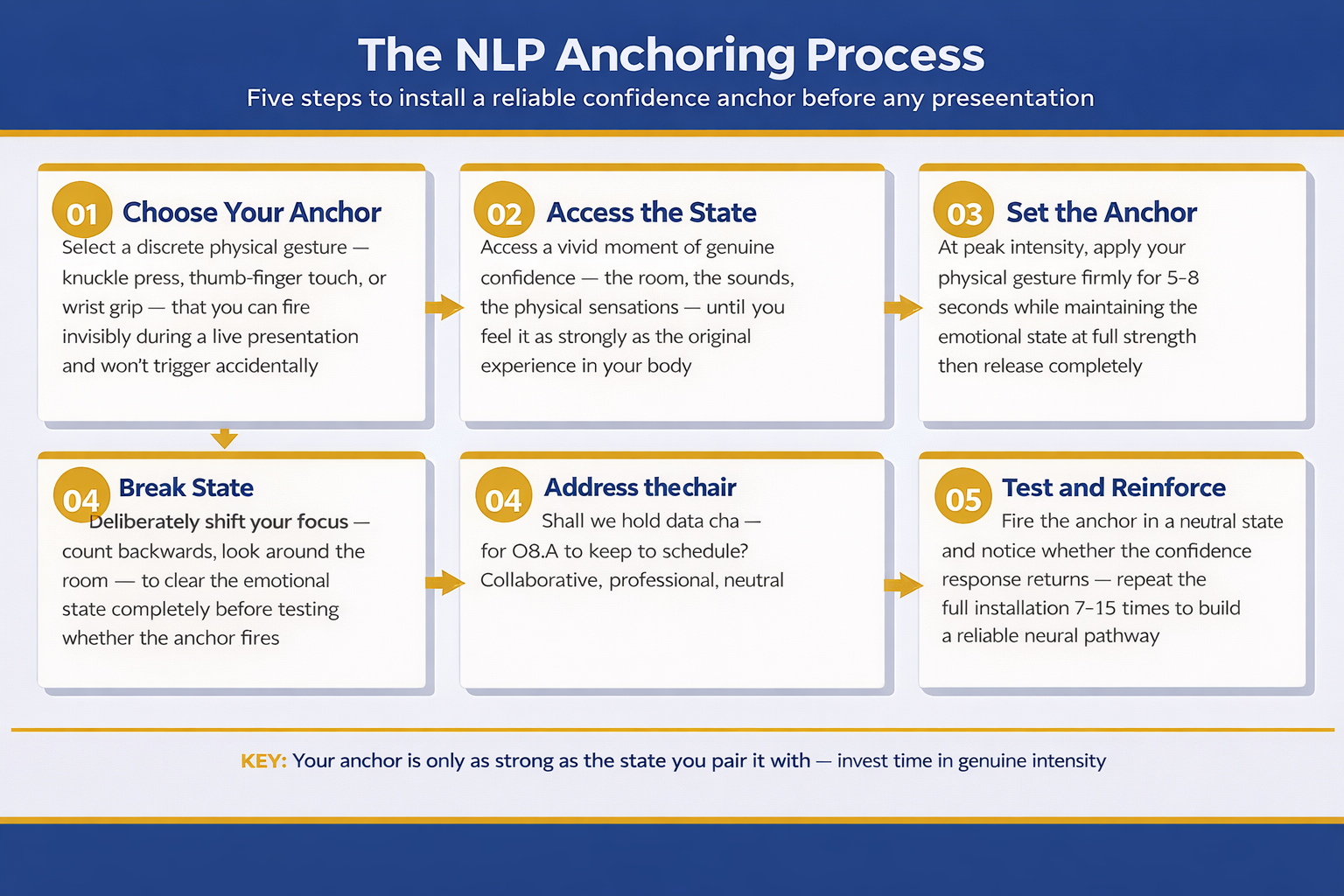
The NLP Anchoring Process for Presenters infographic showing five sequential steps: Choose Your Anchor (select a discrete physical gesture), Access the State (recall a vivid moment of genuine confidence), Set the Anchor (apply the gesture at peak intensity for 5-8 seconds), Break State (clear the emotional state completely before testing), and Test and Reinforce (fire the anchor and repeat 7-15 times to build a reliable neural pathway)

The Science: Why Anchoring Actually Works

When you experience a powerful emotion or mental state, your brain activates specific neural pathways. If you’re feeling confident, particular networks in your prefrontal cortex, amygdala, and anterior cingulate cortex light up. These aren’t abstract concepts—they’re actual electrical and chemical activity in your brain.

When you pair that brain state with a sensory cue repeatedly, something remarkable happens: the neural pathway becomes bidirectional. Normally, confidence leads to calm physiology. But through anchoring, the sensory cue activates the confidence pathway directly, bypassing the need for logical thought or conscious effort.

This is why anchoring is so effective for presentation anxiety. Anxiety lives in the amygdala and limbic system—the ancient, automatic parts of your brain. You can’t logic your way out of amygdala activation. But you can create a more powerful competing activation through anchoring. When you fire your anchor, you’re not fighting anxiety with your conscious mind. You’re recruiting the same ancient brain systems to create a stronger, competing state of calm.

The research supports this. Studies on neuro-linguistic programming show that anchoring produces measurable changes in cortisol levels (stress hormone), heart rate variability, and subjective anxiety ratings. It’s not placebo. It’s not wishful thinking. It’s applied neuroscience.

This is particularly important if you’ve read about how presentation anxiety lives in your nervous system—because anchoring is one of the most direct ways to communicate with that nervous system and shift its default response.

How quickly does an NLP anchor start to work?

Most people report feeling a shift within 2–3 uses of a properly installed anchor. You’ll notice the anchor firing (triggering the state) immediately, though the intensity builds over the first week or two of consistent use. For presentation anxiety specifically, you should feel measurably calmer within 3–5 presentations where you’ve used the anchor. That said, the stronger and more emotionally vivid your anchor installation, the faster it works.

How to Create Your Own Anchor (Step-by-Step)

Now for the practical bit. This is where anchoring stops being theory and becomes something you can actually use. Creating an anchor involves four key steps.

Step 1: Choose Your Trigger

Your trigger needs to be specific, unique, and easy to reproduce. Most people choose a physical gesture because it’s portable and invisible during a presentation. Common triggers include:

  • Pressing your thumb and forefinger together (the most popular choice)
  • Touching a specific point on your wrist or arm
  • Pressing your tongue against the roof of your mouth in a particular way
  • Squeezing a specific muscle in your leg

The trigger should be something you can do discreetly, even while presenting or on a video call. You also want it to be distinct enough that you don’t trigger it accidentally throughout your day. Choose something now and stick with it—consistency is crucial for anchoring.

Step 2: Activate a Powerful State of Confidence

This is the critical step that most people skip or rush through, which is why their anchors don’t work. You cannot create a strong anchor while feeling mildly confident. You need to activate a genuinely powerful state of confidence and calm.

The best way to do this is to recall a specific memory where you felt absolutely confident and assured. Not arrogant—genuinely calm and certain of your capabilities. It could be from presenting, from a moment in your career, or from any domain of life. Close your eyes. Step into that memory. Remember what you saw, what you felt in your body, your posture, your breathing. Make it vivid and visceral. Spend at least 2–3 minutes fully inhabiting that state.

If you don’t have a powerful confidence memory, you can create one through visualisation. Imagine yourself presenting brilliantly—calm, articulate, commanding the room. Watch yourself as if you’re watching a film. Then step into the image and feel it from the inside. Again, spend 2–3 minutes really living it, not just thinking about it.

Step 3: Pair the Trigger with the State (The Anchoring Moment)

At the peak moment of your confidence state—when you’re feeling it most strongly—perform your trigger gesture. If you’ve chosen the thumb-and-forefinger press, press them together firmly while taking a breath. Hold the trigger for 2–3 seconds whilst the state is at its strongest. Then release.

This is the moment of anchoring. You’re creating an association between the gesture and the state.

Step 4: Repeat the Installation (Minimum 7 Times)

A single pairing is not enough. Your nervous system learns through repetition. Repeat the full process—activate the state, pause, reach peak confidence, fire the trigger—a minimum of 7 times in one session. Ideally 10–15 times. Each time, make sure you’re reaching genuine confidence, not just half-heartedly going through the motions.

After your first installation session, repeat the anchor at least once daily for five days. This cements the neural pathway. After that, you can maintain it with occasional use (firing the anchor a few times per week).

If you want additional anchoring variations and how to layer multiple anchors together, Conquer Speaking Fear £39 includes a complete guided video walkthrough of this exact process.

Stop Anxiety Before It Hijacks Your Presentation

  • Create a neurological anchor that accesses calm on demand—no willpower required
  • Learn the exact 7-step installation process used by executives who present to boards and investors
  • Discover how to use your anchor in real presentations (even when presenting on video)
  • Understand why traditional anxiety management often fails—and what actually works
  • Install your anchor correctly the first time (mistakes will cost you weeks of progress)

Get Conquer Speaking Fear → £39

Trusted by 1000+ professionals in finance, tech, and consulting

How to Fire Your Anchor Before Presenting (The Deployment Strategy)

Installing an anchor is one thing. Using it effectively in the high-stress environment of a real presentation is another. Here’s how to actually deploy your anchor when it matters most.

The Pre-Presentation Window (15 Minutes Before)

Find a private space—the bathroom, a quiet hallway, your car, even a locked conference room. You need 2–3 minutes of solitude. Fire your anchor 3–5 times in succession. Each time, pause for a few seconds and let yourself feel the calm it generates. Don’t just mechanically perform the gesture; actually inhabit the confident state it triggers.

This is different from the installation process. You’re not trying to deepen the anchor further. You’re activating it to bring that confident state into your present moment, ready for your presentation.

The Waiting Moment

After you fire the anchor, you have roughly 10–15 minutes before the anchor naturally “decays”—meaning the neurological activation fades. Time your anchor-firing strategically so that you’re presenting within that window. If you’re waiting longer than 15 minutes, fire the anchor again closer to your presentation start.

During the Presentation Itself

Once you’re presenting, you can fire the anchor discreetly during the talk if you feel anxiety spiking. A thumb-and-finger press hidden at your side, or a tongue-press that no one will notice, can reset your nervous system mid-presentation. Some presenters do this during pauses, whilst taking a sip of water, or when moving between sections of their talk.

Most people find they don’t need to fire it during the presentation if they’ve installed it strongly and fired it beforehand. The initial activation is usually sufficient.

What if I forget to fire my anchor before presenting?

If you’ve already begun presenting, you can still fire it discreetly at any point. The anchor will activate a calm state within seconds. However, the better strategy is to build firing the anchor into your pre-presentation routine, so it becomes automatic. Some presenters fire their anchor whilst walking to the stage, or immediately before they’re introduced. Make it part of your ritual.

Advanced Techniques for Powerful Anchors

Once you’ve installed a basic anchor, you can enhance it with additional techniques that make it stronger and more reliable. Here are the most effective variations.

Stacking Anchors (Multiple States)

Instead of anchoring only to confidence, you can create separate anchors for different states: calm, focus, articulation, charisma. Then fire them all in sequence before presenting, creating a compounded effect. For instance, you might press your thumb-and-forefinger for calm, then touch your wrist for focus, then press a leg muscle for charisma. The neurological intensity multiplies.

Anchor Chaining

This involves firing one anchor to access a state, then immediately performing a second action (perhaps a power pose or a specific breathing pattern) whilst the first anchor is active. This creates an association between the anchor and the secondary behaviour, making both more powerful together.

Collapsing Anchors

If you have a lingering anxiety state that you want to eliminate, you can create an anchor for confidence, then deliberately activate the anxiety state, and fire the confidence anchor immediately whilst the anxiety is present. The confidence state “collapses” the anxiety state, and over repetitions, this weakens the anxiety response. This is advanced work and works best when paired with understanding your fight-or-flight response.

Resource Anchoring

Some people create an anchor not just for a mental state, but for accessing a specific resource or memory of a person they trust. For example, you might anchor to a memory of a mentor you admire, or a moment when a colleague praised your presentation skills. The anchor gives you neurological access to that resource precisely when you need it.

Never Walk Into a Presentation Unprepared Again

  • Master anchoring plus five additional NLP techniques specifically for presentation anxiety

Get Conquer Speaking Fear → £39

Includes video guides, workbook, and quick-reference deployment checklists

Can anchors fade or stop working?

An anchor can weaken if you don’t use it regularly. Think of it like a muscle—if you stop exercising, it atrophies. However, it’s remarkably easy to reactivate. Even if you haven’t used an anchor in months, firing it a few times usually restores its full power. Additionally, if you repeatedly fail at your anchor (for instance, trying to fire it whilst in a state of panic without having installed it properly first), you can inadvertently weaken it. This is why proper installation is non-negotiable.
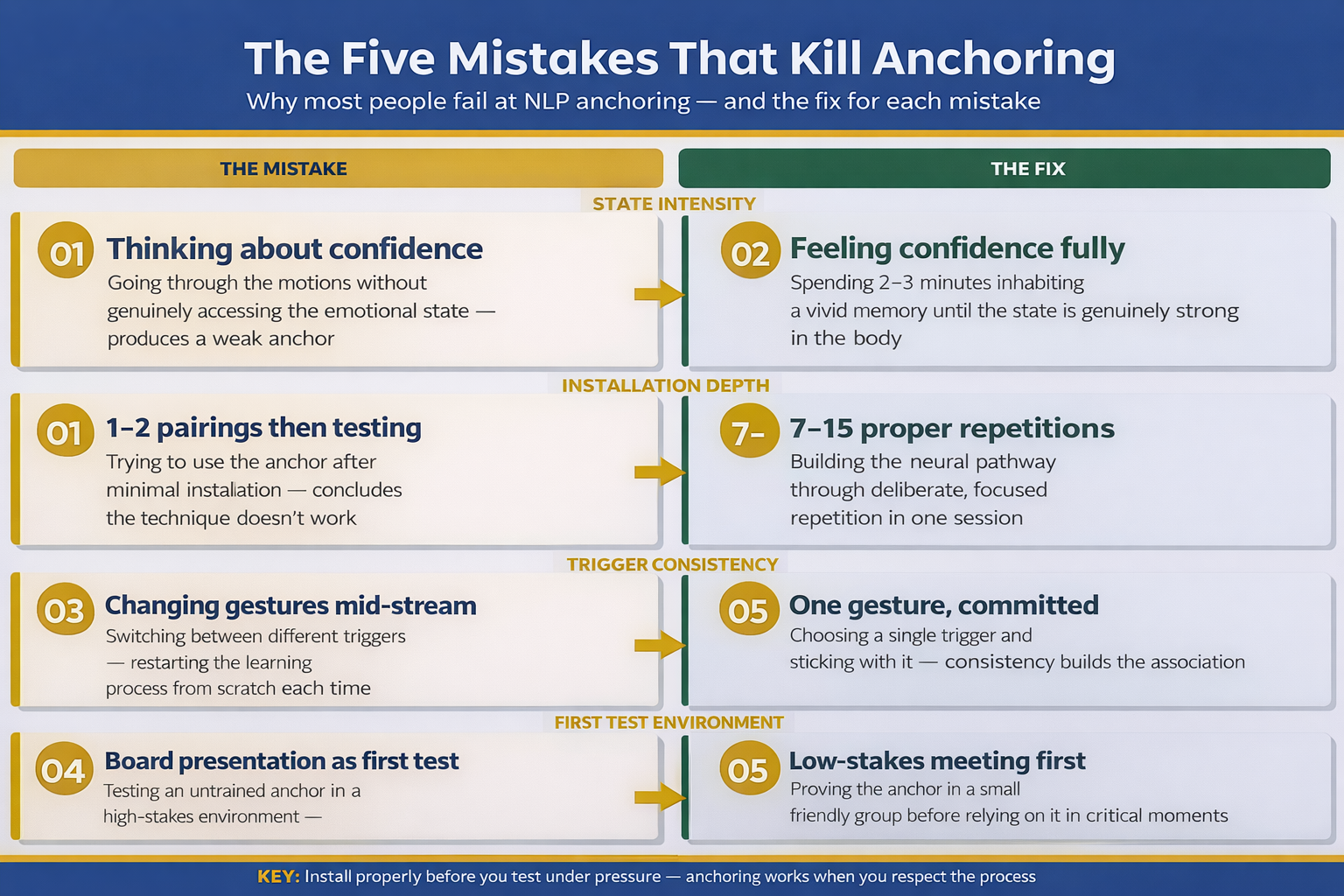
Side-by-side comparison of five common NLP anchoring mistakes and the correct approach for each, covering state intensity, installation depth, trigger consistency, and first test environment

The Mistakes That Kill Anchoring (And How to Avoid Them)

I’ve seen hundreds of people attempt anchoring and fail. Not because anchoring doesn’t work, but because they made preventable mistakes during installation or deployment. Here are the most common ones.

Mistake 1: Installing Without Reaching a Genuinely Powerful State

This is the number one reason anchors fail. People think about confidence rather than feeling it. They go through the motions without really accessing the state. Your anchor will be only as strong as the state you pair it with. If you’re 60% confident during installation, your anchor will trigger 60% confidence when you fire it. Invest the time to genuinely access a powerful, vivid state of confidence. Make it real. Make it felt.

Mistake 2: Firing the Anchor Without Installing It Properly First

Some people try to use an anchor after just one or two pairings, then conclude it doesn’t work. Anchors need a minimum of 7 proper installations to be neurologically reliable. You’re building a neural pathway, and pathways need repetition to become strong. If you try to use an untrained anchor under stress, it won’t work—and then you’ll question the whole technique.

Mistake 3: Changing Your Trigger Mid-Stream

Once you choose a trigger, commit to it. If you keep switching between different gestures, you never build a consistent pairing. Your brain is learning: This gesture means this state. If you’re constantly introducing new gestures, you’re starting the learning process from scratch each time.

Mistake 4: Relying on the Anchor Alone Without Context

Anchoring is extraordinarily powerful, but it’s not magic. If you’re presenting on zero sleep, or you’re in a genuinely dangerous situation (not presentation anxiety, but actual danger), no anchor will override your nervous system’s appropriate response. Anchoring works best when paired with proper preparation, adequate sleep, and other practical tools like breathing techniques.

Mistake 5: Firing the Anchor Under Extreme Distress Without Prior Installation

Your first test of an anchor should not be a high-stakes presentation in front of your board of directors. Install the anchor in low-stress situations first (perhaps presenting to a small friendly group, or in a low-pressure meeting). Let it prove itself in manageable contexts before you rely on it in the most critical moments.

Beyond these installation mistakes, there are also mistakes in how people think about what anchoring can do. Anchoring is brilliant for acute presentation anxiety. It’s less effective if you’re dealing with chronic burnout or deeper nervous system dysregulation. Know what problem you’re solving.

If you want to understand not just how to install an anchor, but also how to diagnose what type of presentation anxiety you’re dealing with and which techniques work for each type, Conquer Speaking Fear £39 walks through the complete diagnostic and treatment process.

Learn From Someone Who’s Used Anchoring With Thousands of Presenters

  • 24 years in corporate banking at JPMorgan Chase, PwC, Royal Bank of Scotland, and Commerzbank
  • Qualified clinical hypnotherapist and certified NLP practitioner with live case studies from clients
  • Video walkthroughs of the exact anchor installation process, plus six additional NLP techniques
  • Troubleshooting guide: what to do when your anchor isn’t working (and why)
  • Real-world deployment strategies for presentations, investor pitches, board meetings, and speaking engagements

Get Conquer Speaking Fear → £39

Trusted by professionals at FTSE 100 companies and Silicon Valley tech firms

Want the slides too?

If you’re installing anchors but struggling to deliver them with visual confidence, your slides might be working against you instead of amplifying your message. The Executive Slide System £39 teaches the slide design and delivery approach used by executives at FTSE 100 firms—so your visuals reinforce your nervous system work, not undermine it.

Is NLP Anchoring Right For You?

✅ Anchoring is right for you if:

  • You’re confident in your presentation content but anxious in the delivery
  • Your anxiety spikes only in presentation moments, not throughout your day
  • You want a practical tool you can use immediately, before your next presentation
  • You’re open to learning applied neuroscience rather than relying on willpower alone
  • You’ve tried breathing exercises and positive self-talk but need something stronger
  • You’re willing to spend 20 minutes installing an anchor properly before expecting results

❌ Anchoring might not be sufficient if:

  • You’re experiencing severe chronic anxiety unrelated to presentations
  • You’re burnt out or experiencing nervous system exhaustion from overwork
  • You lack confidence in your presentation content itself
  • You’re unwilling to spend time practising the anchor installation process
  • You’re expecting a magic solution without any personal effort or commitment
  • You’re in acute crisis and need immediate professional mental health support

Frequently Asked Questions

How long does it take to install an anchor properly?

The initial installation takes 20–30 minutes. This includes 10–15 repetitions of activating the state, reaching peak confidence, and firing the trigger. After installation, you’ll want to reinforce it daily for 5 days (5–10 minutes per day). Most people report measurable results within a week, though the anchor becomes more powerful over the first month of use.

Can anchoring work if I’m naturally anxious or introverted?

Yes, absolutely. Anchoring doesn’t depend on your personality type or baseline anxiety level. It depends on your nervous system’s ability to learn associations, and that’s universal. Whether you’re naturally anxious or calm, whether you’re introverted or extroverted, your nervous system can be trained to access confidence on command. Introversion and anxiety are different things—introversion is personality, anxiety is a nervous system state.

What if I’ve tried anchoring before and it didn’t work?

Most commonly, anchoring “failed” because the initial installation wasn’t done properly. Perhaps the state wasn’t genuinely powerful, or the anchor was fired only once or twice before being tested under stress, or the trigger was changed mid-stream. The technique itself is neurologically sound. If you’re willing to redo the installation with proper attention to each step, it will work. The second time around, most people see dramatic results.

Can I use anchoring alongside other anxiety-management techniques?

Yes, and in fact this is the ideal approach. Anchoring works brilliantly with breathing techniques, preparation, adequate sleep, and other NLP methods. Anchoring addresses the neurological pathway to confidence. Other techniques address preparation, physical state, and cognitive framing. Together, they’re more powerful than any single tool alone.

🆓 Free resource: Executive Presentation Checklist — a free guide to strengthen your presentation preparation.

Your Next Step

You now understand how anchoring works, why it’s neurologically powerful, and exactly how to install an anchor that will be reliable in your presentations. The technique is straightforward. The challenge most people face isn’t understanding—it’s execution. Most people read about anchoring and then don’t actually do it.

So here’s my challenge to you: within the next three days, choose your trigger gesture, find a quiet space for 20 minutes, activate a memory of genuine confidence, and install your anchor using the step-by-step process outlined above. Don’t overthink it. Don’t wait for the “perfect” moment. Just do it. By next week, you’ll have a neurological tool that will fundamentally change how your body responds to presentations. Your next presentation is your first real test. Use the anchor beforehand, and notice the difference.

If you want the full video walkthrough, additional NLP techniques, and troubleshooting support, Conquer Speaking Fear £39 is designed exactly for that.

About the Author

Mary Beth Hazeldine is the Owner & Managing Director of Winning Presentations. With 24 years of corporate banking experience at JPMorgan Chase, PwC, Royal Bank of Scotland, and Commerzbank, she has delivered high-stakes presentations in boardrooms across three continents.

A qualified clinical hypnotherapist and NLP practitioner, Mary Beth combines executive communication expertise with evidence-based techniques for managing presentation anxiety. She has trained thousands of executives and supported presentations that have secured high-stakes funding rounds and approvals.

Book a discovery call | View services

04 Mar 2026
Clinical hypnotherapy approach to treatment-resistant presentation anxiety in corporate setting

When Therapy, Coaching, AND Practice Haven’t Fixed Your Presentation Fear

You’ve done everything right. You’ve sat in therapy, talking through your childhood fears and perfectionism. You’ve invested in coaching programmes that promised to rewire your confidence. You’ve rehearsed your presentations until you could deliver them in your sleep. Yet when you stand up to speak, your body hijacks you anyway. Your heart races. Your voice trembles. The fear is still there—just as visceral as it was five years ago.

This isn’t a reflection on your intelligence, your preparation, or your commitment to change. It means you’re experiencing treatment-resistant presentation anxiety, and you need a different approach.

When traditional therapy, coaching, and practice haven’t resolved your presentation fear, the issue isn’t your willpower—it’s your nervous system’s regulation. Clinical hypnotherapy and nervous system-focused techniques work differently than talk therapy because they address the body’s threat response directly, not just the thoughts about the threat. If you’ve exhausted conventional approaches, a clinical framework designed specifically for treatment-resistant speaking anxiety may be the missing piece.

Tried therapy, coaching, and practice—still dreading your next presentation?

The pattern repeats: preparation feels thorough, yet your nervous system floods with adrenaline the moment you step on stage. This is treatment-resistant presentation anxiety, and it requires a nervous system approach—not more talking.

  • Recognise why traditional anxiety treatment sometimes fails for public speaking
  • Understand the specific mechanism your nervous system is stuck in
  • Access a clinical protocol designed for people who’ve tried everything

Ready for the clinical approach?

Get Conquer Speaking Fear → £39

The Story That Changed How I Understand Presentation Fear

I spent five years terrified of presenting. Not anxious. Terrified. When I was asked to present, my body responded as though I were facing physical danger: nausea, shaking, voice that cracked mid-sentence, hands that wouldn’t stay still. I tried talking therapy, which helped me understand my perfectionism but didn’t stop the physical response. I tried techniques: breathing exercises, positive affirmations, exposure practice. They helped slightly, but not enough.

The breakthrough came when I began my clinical hypnotherapy training and learned that my nervous system didn’t believe I was safe, no matter what my conscious mind knew. Cognitive work alone wasn’t addressing the subcortical threat response. Once I applied nervous system regulation techniques—the ones I now teach in Conquer Speaking Fear—the physical symptoms resolved within weeks, not years. That experience shaped everything I now teach about treatment-resistant presentation anxiety.

Why Traditional Approaches Fall Short for Treatment-Resistant Presentation Anxiety

When your presentation fear persists despite years of therapy, coaching, and practice, it’s not because these approaches are ineffective in general. They work brilliantly for many people. But for a subset of individuals—those with treatment-resistant presentation anxiety—the conventional toolbox hits a ceiling.

Therapy, particularly talk-based approaches, excels at helping you understand the origins of your fear: the critical parent, the early experience of public failure, the perfectionism that became armour. This understanding is valuable. But understanding doesn’t always change the nervous system’s threat response. Your amygdala—the brain’s threat detector—doesn’t operate primarily through language. It operates through subcortical pathways that bypass conscious reasoning. You can intellectually know you’re safe, and your body still floods with adrenaline.

Coaching and presentation skills training work on competence: more preparation, more rehearsal, more exposure. The assumption is sound—confidence builds through mastery. But when your nervous system interprets the presentation context as a threat, more exposure can actually reinforce the association. You practise, you feel afraid, your nervous system learns: “This environment is dangerous.” The loop tightens.

This is where treatment-resistant presentation anxiety differs from garden-variety nervousness. It’s not that you lack confidence in your content or your ability to deliver. It’s that your threat-detection system has become miscalibrated. It fires even when the evidence for danger is absent.

What Your Nervous System Is Actually Doing

To understand why traditional approaches sometimes fail, you need a precise picture of what’s happening in your body when you present.

Your nervous system has three core states: sympathetic (fight-or-flight), parasympathetic (rest-and-digest), and social-engagement (calm-but-alert). Most people move fluidly between these states depending on context. In low-threat situations, you’re parasympathetic. When you step up to present, your sympathetic system activates appropriately—your heart rate increases, blood flows to your muscles, your awareness sharpens. This is useful. It’s supposed to happen.

But in treatment-resistant presentation anxiety, your sympathetic system doesn’t calibrate. It floods. Your nervous system assigns the same threat level to a boardroom presentation as it would to a physical attack. This is what produces the nausea, shaking, voice disruption, and mental fog you experience. Your body is preparing you to flee or fight—and neither option is available in the presentation context, so you freeze instead.

The critical insight: this isn’t a thinking problem. It’s a nervous system regulation problem. Your conscious mind may be telling you, “This is safe, you’re prepared, you know this content,” but your nervous system isn’t listening because it operates according to patterns encoded much deeper than conscious thought. These patterns live in procedural memory, emotional conditioning, and somatic (body-based) imprints. Talk therapy reaches the cortex. Treatment-resistant presentation anxiety needs subcortical intervention.

Why CBT, Coaching, and Exposure Sometimes Aren’t Enough

Cognitive-behavioural therapy is genuinely effective for many anxiety conditions. It works by challenging distorted thoughts and gradually exposing yourself to the feared situation until your nervous system learns it’s safe. The theory is sound. The mechanism is this: repeated exposure without catastrophe should extinguish the fear response.

But exposure therapy has a known limitation for treatment-resistant cases: it can flatten the fear response temporarily without changing the underlying nervous system calibration. You give a presentation, nothing terrible happens, yet three weeks later, the anxiety is back at full intensity. Why? Because your nervous system never actually re-encoded safety. The fear was merely suppressed or you white-knuckled through it using willpower. The subcortical threat pattern remains intact.

Rehearsal and practice, taken to extremes, can even worsen treatment-resistant presentation anxiety. More hours at the podium sometimes means more opportunities for your nervous system to practice the threat response. You condition yourself deeper into the pattern.

Coaching works well when the barrier is skill or confidence. But when the barrier is nervous system dysregulation, coaching is asking the wrong system to change. You can have a coach point out every strength you possess, and your amygdala still won’t care. It’s operating from a different information set: procedural memory and somatic patterns, not rational evaluation.

The pattern is this: traditional approaches assume the nervous system will self-correct once the thinking changes or the experience repeats. For treatment-resistant anxiety, this assumption breaks. The nervous system needs direct intervention—techniques that speak its language.

How Hypnotherapy and Nervous System Approaches Work Differently

Clinical hypnotherapy isn’t stage hypnosis or entertainment. In a clinical context, hypnotherapy is a method for achieving focused attention and accessing the parts of the nervous system that aren’t reachable through conscious discussion.

When you’re in hypnotic trance (which feels like a relaxed, concentrated state—not sleep, not loss of control), your critical conscious mind becomes less dominant, and your nervous system becomes more accessible. This is where the reframing happens, not in your thoughts, but in how your body interprets threat and safety.

A clinical hypnotherapist working with treatment-resistant presentation anxiety isn’t trying to convince you that presentations are safe. You already know that intellectually. Instead, the work is subcortical: recalibrating your nervous system’s threat-detection threshold. Through techniques like nervous system anchoring and somatic resourcing, your body learns a new physiological response to the presentation context.

Neuro-Linguistic Programming (NLP) operates from a similar principle: it works with the structure of your experience—how you’re internally representing the threat—rather than trying to think your way out of it. An NLP practitioner helps you interrupt the automatic pattern and install a resourced response in its place.

Both approaches share a critical difference from talk therapy and coaching: they work with the nervous system directly. They don’t ask your thinking to change your physiology; they change your physiology and allow your thinking to follow.

The Clinical Mechanism: From Theory to Regulation

Here’s the specific mechanism that makes clinical approaches effective for treatment-resistant presentation anxiety:

Pattern interruption. Your presentation anxiety has become automatic. You think of presenting, and your body responds with threat activation before you’ve consciously processed what you’re afraid of. A clinical approach interrupts this automatic sequence. It breaks the conditioned link between “presentation context” and “threat activation.”

Subcortical re-encoding. Once the automatic pattern is interrupted, your nervous system can be guided into a new encoding. Not through logic, but through direct nervous system work. You’re literally teaching your amygdala that presentations are safe—not by telling it, but by activating a genuinely resourced physiological state while simultaneously encountering the presentation context. This is how nervous system learning occurs.

Resource anchoring. Clinical protocols typically establish what’s called a “resourced state”—a physiological condition of genuine safety, calm alertness, and confidence. This state is anchored (associated) with specific triggers or contexts. When you subsequently encounter a presentation opportunity, those anchors activate the resourced state rather than the threat response. Your body remembers a different pattern.

Somatic integration. The goal isn’t intellectual acceptance. It’s bodily integration. You should be able to stand in front of an audience and feel genuinely calm—not managing anxiety, not white-knuckling through it, but physiologically present and regulated. This is what becomes possible when you work at the nervous system level.

What a Clinical Approach Actually Looks Like

If you’ve decided that treatment-resistant presentation anxiety requires a clinical intervention, here’s what that process actually involves:

Assessment of your nervous system patterns. A clinical approach begins by understanding precisely how your nervous system is triggering. Is it a full sympathetic flood from the moment you think about presenting? Does it spike only when you’re in front of people? Does it manifest as a freeze response rather than fight-or-flight? The specifics matter because they determine the intervention.

Guided nervous system regulation. You’ll learn techniques to access and activate your parasympathetic (calm) system and your social-engagement system (the nervous system state of safe connection). These aren’t breathing exercises in the traditional sense. They’re precise physiological interventions that shift your nervous system state measurably.

Reprocessing in context. Once you can reliably access a resourced nervous system state, the clinical work involves reprocessing the presentation context while you’re in that state. The goal is to decouple “presenting” from “threat.” Your nervous system learns: “This is a context where I’m calm, capable, and connected.”

Rehearsal with regulation. Unlike traditional practice, which can reinforce anxiety patterns, clinical rehearsal is done while maintaining nervous system regulation. You’re practising presentations from a resourced state, which teaches your nervous system a completely different pattern.

Maintenance and integration. The final phase ensures the changes are durable. You learn to maintain nervous system regulation under increasing pressure, and you develop ways to access resourced states independently, without relying on a practitioner.

Present Without the Adrenaline Hijack

When traditional methods haven’t worked, the clinical nervous system approach delivers what they couldn’t: genuine physiological calm during presentations.

  • Learn the specific nervous system techniques used by clinical hypnotherapists to decouple threat responses from presentation contexts
  • Regain access to your resourced nervous system state on demand, even under pressure
  • Move beyond anxiety management to actual resolution—no more white-knuckling, no more suppression
  • Integrate new nervous system patterns through guided practice that rewires, rather than reinforces, old fear responses
  • Develop lasting capacity to present with genuine calm and executive presence

Get Conquer Speaking Fear → £39

Created by a clinical hypnotherapist who spent 5 years terrified of presenting and developed these techniques to resolve her own treatment-resistant anxiety.

Not sure if this is for you? If you’ve exhausted therapy, coaching, and practice and your presentation fear persists, a nervous system approach is specifically designed for your situation. You can explore Conquer Speaking Fear risk-free and see if it resolves what traditional methods couldn’t.

Comparison of traditional anxiety treatment approaches versus nervous system-focused clinical approach for presentation fear

Stop Dreading Every Presentation on Your Calendar

You shouldn’t have to spend weeks in advance worrying about a 30-minute talk. You shouldn’t wake up the morning of a presentation with your stomach in knots.

  • Replace the dread-preparation-adrenaline cycle with genuine nervous system calm
  • Show up to presentations feeling resourced, not just competent

Get Conquer Speaking Fear → £39

A 30-day programme using nervous system regulation techniques from clinical hypnotherapy—designed specifically for people who’ve tried everything.

The turning point: When you realise your presentation fear isn’t a personal failing or a thinking problem, but a nervous system that needs re-education, everything shifts. That turning point is available to you.

Timeline showing nervous system regulation progression through clinical hypnotherapy treatment for presentation anxiety

Questions People Ask About Treatment-Resistant Presentation Anxiety

What if I’ve already tried hypnotherapy and it didn’t work?

Clinical hypnotherapy for presentation anxiety is highly specific. If you’ve had a session with a general hypnotherapist, that’s quite different from working with someone trained specifically in nervous system regulation for presentation fear. The depth, duration, and focus matter enormously. A single session is unlikely to resolve treatment-resistant anxiety; a structured programme with nervous system-specific techniques is what creates lasting change.

How is this different from just learning to manage anxiety?

Management and resolution are fundamentally different. Anxiety management is about learning to tolerate or suppress the fear while you present—breathing techniques, grounding strategies, cognitive reframes. Resolution is about actually changing your nervous system so that the fear doesn’t activate in the first place. You’re not managing a response; you’re creating a different physiological response.

How long does it take to see results?

With a properly designed clinical protocol and consistent practice, most people report significant shifts within 2-4 weeks and substantial resolution within 30 days. This is faster than traditional therapy because you’re working directly with the nervous system rather than waiting for cognitive shifts to produce physiological changes. However, durability requires integration—continuing the practices that maintain your nervous system regulation.

Is This Right For You?

A clinical nervous system approach is specifically for people in this situation:

  • You’ve invested in talk therapy or coaching and made progress intellectually, but your body still responds to presentations with fear
  • Your presentation anxiety is treatment-resistant—it hasn’t resolved despite your best efforts
  • You experience physical symptoms (nausea, shaking, voice disruption, mental fog) that appear automatic and beyond your control
  • You’re willing to work directly with nervous system techniques, not just more thinking or more practice
  • You want resolution, not just management

If this describes you, then exploring why therapy alone didn’t resolve your presentation fear is the next logical step toward finding what will.

From 5 Years of Terror to Teaching Thousands

My own treatment-resistant presentation anxiety shaped everything I teach about nervous system regulation for public speaking.

  • Learn the exact nervous system techniques I developed to move from terror to teaching
  • Access a 30-day structured programme that combines clinical hypnotherapy, nervous system regulation, and presentation rehearsal
  • Get guided audio sessions for nervous system anchoring and resourced practice
  • Work through a framework designed by someone who has lived treatment-resistant presentation anxiety and resolved it
  • Join hundreds of professionals who’ve moved from dread to genuine executive presence using these techniques

Get Conquer Speaking Fear → £39

30-day clinical programme using nervous system regulation from hypnotherapy. Designed for people who’ve tried everything else.

Want the slides too?

Preparation reduces anxiety. The Executive Slide System (£39) includes confident-presenter templates designed to minimise preparation stress.

Frequently Asked Questions About Treatment-Resistant Presentation Anxiety

Is this a self-help course or a clinical intervention?

Conquer Speaking Fear is a structured self-guided programme built on clinical nervous system principles. It’s not a substitute for working with a licensed therapist if you have diagnosed mental health conditions, but it’s specifically designed for people who want to apply clinical techniques independently to resolve treatment-resistant presentation anxiety. You’ll have access to guided sessions, frameworks, and integration practices—everything needed to work at the nervous system level yourself.

Will this work if my anxiety is rooted in trauma?

If your presentation anxiety is connected to past trauma, a clinical programme is a useful tool, but you may benefit from working with a trauma-trained therapist in parallel. The nervous system regulation techniques in Conquer Speaking Fear are safe and supportive, but trauma resolution typically requires additional guidance. The programme is designed to work alongside professional support if you’re currently engaged with a therapist.

What if I’m taking medication for anxiety?

Medication and nervous system regulation work beautifully together. If you’re on medication prescribed by your doctor, continue taking it as directed. The nervous system techniques in Conquer Speaking Fear complement pharmaceutical support—they’re not in conflict. You’re still addressing the root nervous system regulation, and medication helps stabilise your baseline while you do that work.

Ready for deeper insights?

Join our weekly newsletter for practitioner-level articles on nervous system regulation, presentation psychology, and the clinical approaches that actually work for treatment-resistant anxiety.

Subscribe to The Winning Edge

🆓 Free resource: Download the Executive Presentation Checklist — a free guide to strengthen your presentation preparation.

The Path Forward

Treatment-resistant presentation anxiety tells you something important: the approaches that work for others aren’t working for you, which means you need a different system. That system exists. It’s clinical, it’s evidence-based, and it works at the level where your anxiety actually lives—your nervous system.

You’ve already proven you’re capable of change. You’ve done the work. The question now is whether you’re willing to try a method that speaks directly to the part of your nervous system that has been stuck. If you are, everything that follows is possible.

Mary Beth Hazeldine, clinical hypnotherapist and presentation coach

Mary Beth Hazeldine is a clinical hypnotherapist and presentation coach who specialises in treatment-resistant presentation anxiety. She spent 5 years terrified of presenting before developing the nervous system regulation techniques now taught in Conquer Speaking Fear. Her work combines clinical hypnotherapy, NLP, and executive coaching for professionals who’ve exhausted conventional approaches.

Explore Conquer Speaking Fear →

24 Dec 2025
Persuasive presentations - how to change minds without manipulation using ethical influence

Persuasive Presentations: How to Change Minds Without Manipulation

NLP-based influence techniques that get decisions — without tricks or pressure tactics

Early in my banking career, I watched a senior director get a £12 million budget approved in under 15 minutes. No hard sell. No pressure. No clever tricks. The room simply… agreed.

I’d spent weeks on a similar request and been rejected twice. What was he doing differently?

It took me years to understand: persuasive presentations aren’t about convincing people you’re right. They’re about helping people convince themselves. The difference is everything.

As a qualified NLP practitioner and clinical hypnotherapist, I’ve spent decades studying ethical influence — how to change minds without manipulation. Here’s what actually works in business contexts.

🎁 Free Download: Executive Presentation Checklist — includes the persuasion framework from this article. Print-ready PDF.

What Makes a Presentation Persuasive (It’s Not What You Think)

Most people think persuasion means stronger arguments. Better data. More compelling logic.

It doesn’t.

Neuroscientist Antonio Damasio studied patients with damage to emotional brain centres. They could analyse options perfectly — but couldn’t make decisions. His conclusion: emotion isn’t the enemy of reason. It’s the engine.

A persuasive presentation doesn’t overwhelm with logic. It creates the emotional conditions for agreement. The logic provides justification after the decision is already made.

This is why:

  • A CFO approves a budget wrapped in a client story but rejects the same numbers in a spreadsheet
  • A board says yes to a recommendation framed as risk mitigation but no to the same recommendation framed as opportunity
  • An investor funds a founder who tells a compelling origin story over one with better metrics

The information is identical. The emotional frame is different.

Related: Storytelling in Presentations: The NLP Techniques That Captivate Any Audience

Persuasive Presentation Techniques: The Ethical Approach

There’s a line between influence and manipulation. Manipulation exploits. Influence aligns.

Ethical persuasion helps people see how your recommendation serves their interests. It removes friction, addresses concerns, and makes the right decision feel obvious. It never tricks, pressures, or exploits cognitive biases against someone’s own interests.

Here are the techniques that work:

1. Lead With Their Problem, Not Your Solution

Most presenters start with what they want: “I’m recommending we invest £2 million in…”

Persuasive presenters start with what the audience wants to solve: “We’re losing 15% of deals in the final stage. Here’s why — and how to fix it.”

When you articulate someone’s problem better than they can, you earn the right to propose solutions. They lean in because you understand them.

2. Use the “Yes Ladder”

Before your main ask, get a series of small agreements. Each “yes” makes the next one more likely — this is called “commitment consistency” in psychology.

Example:

  • “Would you agree that customer retention is our biggest growth lever right now?” (Yes)
  • “And that our current churn rate is higher than the industry benchmark?” (Yes)
  • “So addressing this should be a priority for Q1?” (Yes)
  • “Here’s the investment that would make that happen…”

By the time you reach your recommendation, they’ve already agreed with the logic that leads there.

3. Name the Objection Before They Do

If you know people will worry about cost, timeline, or risk — say it first.

“You’re probably thinking this sounds expensive. Let me show you the numbers…”

This does two things: it builds trust (you’re not hiding concerns) and it lets you frame the objection on your terms. An objection you raise is half-answered. An objection they raise feels like a discovery.

4. Give Them the “Out”

Counterintuitively, acknowledging alternatives strengthens your position.

“We could do nothing and accept the current results. We could try a smaller pilot first. Or we could commit fully and capture the market window. Here’s why I’m recommending option three…”

When you present options fairly, people trust your judgment more. You’re not selling — you’re advising.

5. End With the Decision, Not the Data

Weak closings: “So that’s the analysis. Any questions?”

Strong closings: “Based on what we’ve seen, I’m recommending we proceed with Option A, starting in Q1. Can I get your approval to move forward?”

A persuasive presentation always ends with a clear ask. If you don’t ask, you don’t get.

Related: How to Create Executive Presentations That Get Results

Persuasive presentation techniques - 5 ethical influence methods: lead with problem, yes ladder, name objections, give the out, end with decision

The NLP Framework for Persuasive Presentations

In NLP, we talk about “pacing and leading.” Pacing means matching someone’s current state — their concerns, their language, their worldview. Leading means guiding them toward a new perspective.

You can’t lead someone you haven’t paced first. This is why jumping straight to your recommendation fails.

The sequence:

1. Pace their current reality. Show that you understand where they are. Use their language. Acknowledge their constraints. Reference their priorities.

“I know Q4 budget is already stretched. I know we’ve had implementation challenges before. And I know the board is focused on profitability over growth right now.”

2. Bridge with shared goals. Connect their current concerns to the outcome you’re proposing.

“Which is exactly why this matters. This isn’t about spending more — it’s about spending smarter. It directly addresses the profitability mandate.”

3. Lead to your recommendation. Now that you’re aligned, introduce your solution as the logical next step.

“Here’s what I’m proposing, and how it gets us to the outcome we both want…”

This isn’t manipulation. It’s communication that works with human psychology instead of against it.

Related: How to Present to Your CFO: The Financial Language That Gets Buy-In

Structure Your Persuasive Presentations

The Executive Slide System (£39) gives you the frameworks to structure presentations that get decisions.

What’s included:

  • The 3-slide decision framework
  • Before/after examples from real client work
  • Templates for budget requests, strategic recommendations, and board presentations
  • The “yes ladder” structure built into slide flow

Get the Executive Slide System →

What Persuasive Presentations Avoid

Knowing what not to do matters as much as knowing what works.

Don’t overwhelm with options. Three choices maximum. More than that creates decision paralysis, not persuasion.

Don’t hide weaknesses. If your recommendation has risks or limitations, acknowledge them. Audiences aren’t stupid — they’ll find the holes anyway. Better to address them on your terms.

Don’t mistake length for thoroughness. A 60-slide deck isn’t more persuasive than 15 slides. It’s less persuasive. Every slide that doesn’t advance your argument dilutes it.

Don’t end with Q&A. Q&A should happen, but it shouldn’t be your closing. After Q&A, return to your recommendation and ask for the decision. The last thing they hear should be your ask, not their own objections.

Don’t confuse agreement with action. “That makes sense” isn’t a yes. “Let me think about it” isn’t a yes. Push gently for a concrete next step: “Can I schedule the kickoff meeting for next week?”

Related: The Board Presentation Structure Nobody Teaches You

Frequently Asked Questions About Persuasive Presentations

How do I make a presentation persuasive without being pushy?

Focus on their interests, not yours. A persuasive presentation shows how your recommendation solves their problem. If you’ve done that clearly, you don’t need to push — the logic carries itself. The “pushy” feeling comes from asking for something without establishing why it matters to them.

What’s the most important element of a persuasive presentation?

Starting with their problem, not your solution. When you articulate someone’s challenge better than they can, you earn credibility. Everything else builds on that foundation. If you skip this step, no technique will save you.

How do I handle a hostile or sceptical audience?

Name it directly: “I know there’s scepticism about this approach — and I understand why. Let me address that head-on.” Then acknowledge the valid concerns before making your case. Fighting resistance amplifies it. Acknowledging resistance dissolves it.

Can I be persuasive with data-heavy content?

Absolutely — but lead with the insight, not the data. “We’re leaving £2 million on the table annually. Here’s the analysis that shows why.” The number creates interest. The analysis provides proof. Most presenters reverse this and lose the audience before they reach the point.

What’s the difference between persuasion and manipulation?

Intent and alignment. Persuasion helps people make decisions that serve their interests. Manipulation exploits cognitive biases against their interests. If your recommendation genuinely helps them, advocating for it strongly isn’t manipulation — it’s service.


Master Persuasive Presentations + AI + Structure

AI-Enhanced Presentation Mastery teaches the complete persuasion system — from frameworks to delivery to handling resistance.

8 self-paced modules (January–April 2026):

  • The S.E.E. Formula: Story-Evidence-Emotion for persuasive messaging
  • The AVP Framework: Action-Value-Proof structure for recommendations
  • The 132 Rule: Structure that executives prefer
  • Handling tough Q&A and hostile audiences
  • NLP delivery techniques for influence
  • AI prompts that build persuasive narratives

Plus: 2 live coaching sessions (April 2026) with personalised feedback.

Presale price: £249 (increases to £299, then £499)

60 seats total. Lifetime access.

See the full curriculum →

Your Next Step: Build Your Persuasion Toolkit

Persuasive presentations aren’t about being slick or clever. They’re about understanding how decisions actually get made — and structuring your communication to work with that process.

The techniques here are ethical, effective, and learnable. Start with one: lead with their problem, not your solution. Master that, and the rest follows.

🎁 START FREE: Download the Executive Presentation Checklist — includes the persuasion framework from this article.

📘 GET THE STRUCTURE (£39): The Executive Slide System gives you templates and frameworks for presentations that get decisions.

🎓 MASTER IT ALL (£249): AI-Enhanced Presentation Mastery — 8 modules covering persuasion, structure, AI tools, and delivery. January–April 2026, 60 seats.


Mary Beth Hazeldine is a qualified NLP practitioner and clinical hypnotherapist who spent 24 years in corporate banking at JPMorgan, PwC, Royal Bank of Scotland, and Commerzbank. She now trains executives in the ethical influence techniques that drive decisions — combining boardroom experience with the psychology of persuasion.

23 Dec 2025
Storytelling in presentations - NLP techniques that captivate any audience

Storytelling in Presentations: The NLP Techniques That Captivate Any Audience

Why some presenters hold attention effortlessly — and how to use the same neurological triggers

I’ve watched hundreds of presentations where the data was solid, the slides were clean, and the recommendation made sense. And still, the audience checked out within three minutes.

Then I’ve watched presenters with weaker data and simpler slides hold a room captive for 45 minutes. The difference wasn’t charisma. It was storytelling in presentations — specifically, story structures that work at a neurological level.

As a qualified NLP practitioner and clinical hypnotherapist, I’ve spent years studying why certain narratives bypass resistance and embed in memory. This isn’t presentation theory. It’s applied neuroscience — and it’s the reason my clients have raised over £250 million using these techniques.

Here’s what actually works.

🎁 Free Download: 7 Presentation Frameworks — including the story structures in this article. Print-ready PDF.

Why Storytelling in Presentations Works (The Neuroscience)

When you present facts, you activate two areas of the brain: Broca’s area (language processing) and Wernicke’s area (language comprehension). That’s it.

When you tell a story, you activate those areas plus the motor cortex, sensory cortex, and frontal cortex. The listener’s brain literally synchronises with yours — a phenomenon called “neural coupling.”

This matters because:

  • Stories are 22x more memorable than facts alone (Stanford research)
  • Narrative transport reduces counter-arguing — when someone is absorbed in a story, they’re less likely to mentally object
  • Emotional engagement drives action — decisions are made emotionally and justified rationally, not the other way around

In NLP terms, stories access the unconscious mind directly. Facts hit the conscious filter first — where objections live. Stories slip past.

This is why a CFO who would reject a data-heavy slide deck will approve the same budget request when it’s wrapped in narrative. The information hasn’t changed. The delivery has.

Related: How to Create Executive Presentations That Get Results

The 5 Storytelling Structures That Work in Business Presentations

Not all stories work in professional settings. The hero’s journey is great for Hollywood, but it’ll get you laughed out of a board meeting.

These five structures are specifically designed for business storytelling in presentations:

1. The S.E.E. Formula (Story-Evidence-Emotion)

This is my go-to structure for persuasive presentations. It works because it hits all three levels of processing:

  • Story: A specific, concrete example that illustrates your point
  • Evidence: Data that validates the story isn’t an outlier
  • Emotion: The implication — what this means for the listener

Example:

“Last quarter, a biotech client came to us with a 60-slide investor deck. Three months of work, zero meetings booked. [STORY] When we analysed 50 successful biotech raises, we found that decks over 20 slides had a 40% lower response rate. [EVIDENCE] If your deck is sitting in inboxes unopened, the problem might not be your science — it might be your slide count. [EMOTION]”

2. The Before-After-Bridge

Paint the current painful state, show the future desired state, then bridge the gap with your solution.

Example:

“Right now, your team spends 6-8 hours building each presentation. [BEFORE] Imagine cutting that to 90 minutes — same quality, less burnout. [AFTER] The bridge is a systematic AI workflow that handles the 80% that doesn’t require human judgment. [BRIDGE]”

This works because the brain is wired to resolve tension. You create the gap, then fill it.

3. The Contrast Story

Two characters, two approaches, two outcomes. Let the audience draw their own conclusion.

Example:

“Two analysts at RBS, similar experience, similar technical skills. One led with data every time — comprehensive, thorough, exhausting. The other wrapped her data in client stories. Same information, different frame. Guess who made Director first.”

The power of contrast stories is that you never explicitly state the lesson. The audience internalises it themselves, which makes it stickier.

4. The “What I Learned” Frame

Personal vulnerability + insight = credibility + connection.

Example:

“Early in my banking career, I presented quarterly results to a credit committee. I had 47 slides of analysis. I was thorough. I was comprehensive. I was also completely ignored. The senior partner stopped me on slide 12 and asked, ‘What’s the recommendation?’ I learned that day: executives don’t want your journey. They want your conclusion.”

This structure works because it positions you as someone who’s made mistakes and grown — not an untouchable expert.

5. The Nested Loop

Start a story, pause it, tell another story that illuminates the first, then close both. This is an advanced NLP technique that creates cognitive tension — the audience stays engaged because they need closure.

Example:

“I was about to present to the biggest client of my career… [PAUSE — don’t resolve] Let me tell you about something my mentor told me years earlier. She said, ‘Mary Beth, the room decides in the first 30 seconds whether they’ll listen to you.’ [SECOND STORY] So there I was, about to walk into that meeting, and I remembered her words. I threw out my opening slide and started with a question instead. [CLOSE BOTH]”

Nested loops are what make TED talks feel magnetic. The audience is holding multiple open threads, which keeps attention locked.

Related: Presentation Structure: 7 Frameworks That Actually Work

5 storytelling structures for business presentations: S.E.E. Formula, Before-After-Bridge, Contrast Story, What I Learned, Nested Loop

How to Find Stories for Your Presentations (The NLP Approach)

The biggest objection I hear: “I don’t have any good stories.”

Yes, you do. You just haven’t learned to recognise them.

In NLP, we use a technique called “anchoring” — attaching emotional states to specific memories. You can reverse-engineer this to find stories:

Step 1: Identify the emotion you want your audience to feel.

Do you want them to feel urgency? Relief? Curiosity? Confidence? Name it specifically.

Step 2: Recall a moment when YOU felt that emotion.

Not a concept. A moment. Where were you? Who was there? What happened immediately before?

Step 3: Extract the universal principle.

Your story is specific, but the lesson applies broadly. That bridge is what makes the story relevant to your audience.

Example:

I want my audience to feel confident that they can handle tough Q&A. So I recall a moment when I felt that confidence — specifically, a board meeting where I answered a hostile question calmly and the room’s energy shifted. The universal principle: preparation plus a framework equals composure under pressure.

Now I have a story that creates the emotion I want my audience to feel.

Related: Business Presentation Skills: What Actually Matters in Corporate Environments

Master Business Storytelling in 2 Hours

The Business Storytelling Mini-Course gives you the complete system for finding, structuring, and delivering stories that persuade.

What’s included:

  • All 5 story structures with fill-in templates
  • The “Story Mining” exercise to uncover your best material
  • NLP techniques for emotional delivery
  • Before/after examples from real client presentations
  • The S.E.E. Formula worksheet

£29Get the Storytelling Mini-Course →

Storytelling Mistakes That Kill Business Presentations

Stories can backfire. Here’s what to avoid:

1. Stories that make you the hero.

If every story ends with you saving the day, you’ll come across as arrogant. Better: stories where you learned something, or where your client/colleague succeeded.

2. Stories without a point.

“And then we had lunch” endings kill momentum. Every story needs a clear “so what” — the reason you’re telling it.

3. Stories that are too long.

Business stories should be 60-90 seconds maximum. If you’re going longer, you’re including unnecessary detail. Cut the scene-setting and get to the tension faster.

4. Stories that feel rehearsed.

A story told the same way every time loses its energy. Know your beats, not your script. Let the words vary while the structure stays consistent.

5. Stories without specificity.

“A client once came to us with a problem” is weak. “Last March, a biotech CEO called me at 7am, panicking because their Series B pitch was in 48 hours and nothing was working” is strong. Specific details create believability.

Related: How to Present Like a CEO: Executive Presentation Skills for Leadership

How to Deliver Stories in Presentations (NLP Techniques)

The structure is only half the equation. Delivery determines whether your story lands or falls flat.

Pace changes: Slow down at emotional moments. Speed up during action. The contrast signals importance to the brain.

Sensory language: “I walked into the boardroom” is weak. “I walked into a boardroom that smelled like stale coffee and anxiety” engages more brain regions.

Present tense for climax: Shift from past to present tense at the critical moment. “And then he says to me…” This pulls the audience into the scene.

The pause: Before your key insight, pause. Two full seconds. The silence creates anticipation and signals that what comes next matters.

Eye contact during the lesson: Tell the story to the room generally, but deliver the insight to specific individuals. This creates personal connection with your conclusion.

These techniques come from hypnotherapy — they’re designed to create trance states, which is essentially deep engagement. You don’t need to hypnotise your audience, but you can use the same tools to hold attention.

Go Deeper: Master Storytelling + AI + Persuasion

AI-Enhanced Presentation Mastery includes a complete module on the S.E.E. Formula and business storytelling — plus AI prompts that help you find and structure stories faster.

8 self-paced modules (January–April 2026):

  • The S.E.E. Formula: Story-Evidence-Emotion for persuasive messaging
  • The AVP Framework: Action-Value-Proof structure for any presentation
  • AI prompts that help you mine stories from your experience
  • Data storytelling: turn numbers into narratives
  • 2 live coaching sessions with personalised feedback

Presale price: £249 (increases to £299, then £499)

60 seats total.

See the full curriculum →

Frequently Asked Questions About Storytelling in Presentations

How long should a story be in a business presentation?

60-90 seconds for most business contexts. You can go longer (2-3 minutes) if the story is central to your argument, but never longer than that. If your story takes 5 minutes, it’s a monologue, not a story.

Can I use the same story in multiple presentations?

Absolutely. Your best stories should become part of your repertoire. Adjust the framing to match the audience and context, but the core narrative can stay the same. Great speakers have 5-10 signature stories they deploy strategically.

What if my work isn’t “interesting” enough for stories?

Every field has stories — you just need to recognise them. The moment a project almost failed. The client who taught you something unexpected. The mistake that changed how you work. Interest comes from tension and transformation, not from the subject matter itself.

How do I transition from a story back to my slides?

End your story with the lesson explicitly stated, then link it to your next point: “That’s why [lesson from story]. And it’s the reason I’m recommending [next slide content].” The story should feel like setup for what comes next, not a detour.

Is storytelling appropriate for technical presentations?

More appropriate than you think. Technical audiences are still human — they respond to narrative just like everyone else. The difference is that your stories should feature technical challenges, elegant solutions, and lessons learned. The structure stays the same.


Your Next Step: Build Your Story Repertoire

Storytelling in presentations isn’t a talent. It’s a skill — and like any skill, it improves with structure and practice.

🎁 START FREE: Download 7 Presentation Frameworks — including story structures you can use immediately.

📘 GET THE SYSTEM (£29): The Business Storytelling Mini-Course gives you templates, exercises, and NLP techniques for finding and delivering stories that persuade.

🎓 MASTER IT ALL (£249): AI-Enhanced Presentation Mastery — 8 modules covering storytelling, structure, AI tools, and delivery. January–April 2026, 60 seats.

The presenters who captivate aren’t born. They’ve learned to structure their experiences into narratives that stick. You can learn it too.


Mary Beth Hazeldine is a qualified NLP practitioner and clinical hypnotherapist who spent 24 years in corporate banking at JPMorgan, PwC, Royal Bank of Scotland, and Commerzbank. She now trains executives in the storytelling and persuasion techniques that drive decisions — combining boardroom experience with the psychology of influence.