
Tag: nervous system reset

22 Mar 2026
Executive standing calmly in corporate corridor before presentation, composed posture, soft lighting suggesting inner calm, modern office environment with navy and gold tones

The Body Scan Technique: 90 Seconds to Reset Your Nervous System Before Any Presentation

Ngozi had been rehearsing her investor pitch for six weeks. Everything was locked down—data, timings, even her opening joke. But thirty minutes before the call, she opened her laptop camera and her hands were shaking so badly she could barely read the screen. Not from doubt. From her nervous system reading the moment as a threat. The body scan technique was the first thing that reset that signal in under two minutes.

Quick Answer: The body scan technique is a 90-second nervous system reset that works by shifting your brain’s attention from threat detection to physical awareness. Instead of fighting anxiety with willpower or breathing exercises alone, a body scan interrupts the fight-or-flight loop at the somatic level—giving your prefrontal cortex enough space to regain control before you walk into the room.

Presenting this week and need a technique that works fast?

If breathing exercises haven’t been enough and your anxiety starts in your body before it reaches your mind, the body scan technique targets the physical layer where presentation fear actually lives. Conquer Speaking Fear is a programme built from clinical hypnotherapy approaches that include the body scan alongside deeper nervous system regulation techniques.

Explore Conquer Speaking Fear →

How Ngozi Discovered Body Scanning Under Pressure

Ngozi spent weeks preparing her Series A pitch. Financials perfect. Slide transitions polished. She could recite her story in her sleep. But thirty minutes before the Zoom call with three partners, her hands started shaking. Not trembling—visibly shaking. She could barely click her mouse. Her mind knew she was ready. Her nervous system didn’t agree. She’d heard about body scanning somewhere—a LinkedIn article, a podcast—and had nothing to lose. She gave herself ninety seconds. Shoulders down. Jaw unclenched. One slow breath. By the time the call started, her hands were steady and her voice was clear. She secured £1.2 million that day. The body scan was the first technique that told her nervous system it was safe to let her mind do its job.

Reset Your Nervous System Before Your Next Presentation—Without Medication

  • A programme using clinical hypnotherapy techniques to retrain your body’s response to presentation pressure—starting with the body scan and building to deeper nervous system regulation
  • Techniques designed for the 90 seconds before you present, not 90 minutes of meditation you don’t have time for
  • Methods that target the physical layer of anxiety (shaking, voice cracking, racing heart) because that’s where presentation fear actually lives
  • Evidence-based approaches from clinical hypnotherapy, not generic “just breathe” advice that hasn’t worked

Explore Conquer Speaking Fear →

Built from nervous system regulation techniques developed with clinical hypnotherapy methods—approaches that address the physical foundations of presentation anxiety.

Why Your Body Panics Before Your Mind Does

Presentation anxiety doesn’t start in your head. It starts in your body.

Your amygdala detects a threat—a room full of senior executives watching you—and triggers the sympathetic nervous system before your conscious mind even registers what’s happening. By the time you think “I’m nervous,” your body has already decided: heart rate up, muscles tense, blood diverted from your digestive system to your limbs, vocal cords tightening.

This is why telling yourself to “calm down” doesn’t work. Your conscious mind is trying to override a survival response that operates faster than thought. The body scan technique works because it doesn’t try to override anything. It redirects your brain’s attention from external threat scanning to internal body awareness—and that attention shift is enough to interrupt the cascade.

The neuroscience is straightforward: your brain can’t simultaneously scan for threats and observe its own physical sensations in detail. When you systematically notice “my shoulders are tense, my jaw is clenched, my hands are gripping,” you’re occupying the neural circuits that were busy amplifying the alarm signal. The fight-or-flight response doesn’t stop—but it drops to a level where your prefrontal cortex can function again.

The 90-Second Body Scan: Step by Step

You can do this standing in a corridor, sitting in a waiting area, or in the toilets two minutes before your slot. Nobody will notice. That’s the point.

Seconds 1-15: Feet and legs. Press your feet deliberately into the floor. Notice the weight distribution—are you leaning forward? Shift back slightly. Feel the contact between your shoes and the ground. Notice your calf muscles. Are they braced? Let them soften. Not relax—soften. There’s a difference. Relaxing implies effort. Softening implies permission.

Seconds 16-30: Core and back. Notice your stomach. Is it clenched? Most anxious presenters brace their core without realising it—as if preparing for a physical impact. Let it release. Notice your lower back. If you’re standing, unlock your knees slightly. Your body will interpret this micro-adjustment as “we’re not in danger” because locked muscles signal threat readiness to your nervous system.

Seconds 31-50: Shoulders and arms. Drop your shoulders one centimetre. That’s all. Most people carry their shoulders closer to their ears when anxious—a defensive posture your body adopted before you noticed. Let your arms hang. If you’re holding notes or a laptop, set them down briefly. Open your palms for three seconds. Your nervous system reads open hands as “no threat detected.”

Seconds 51-70: Jaw and face. Unclench your jaw. Touch your tongue to the roof of your mouth—this is a clinical trick that relaxes the masseter muscle and sends a calm signal through the vagus nerve. Let your forehead smooth. If your brow is furrowed, it’s because your brain is in problem-solving mode. You don’t need to solve anything right now.

Seconds 71-90: One breath. Take one slow breath through your nose. Not deep—slow. Four seconds in, four seconds out. This single breath is the capstone, not the foundation. The body scan has already done the heavy lifting. The breath just confirms to your nervous system: we’re ready.
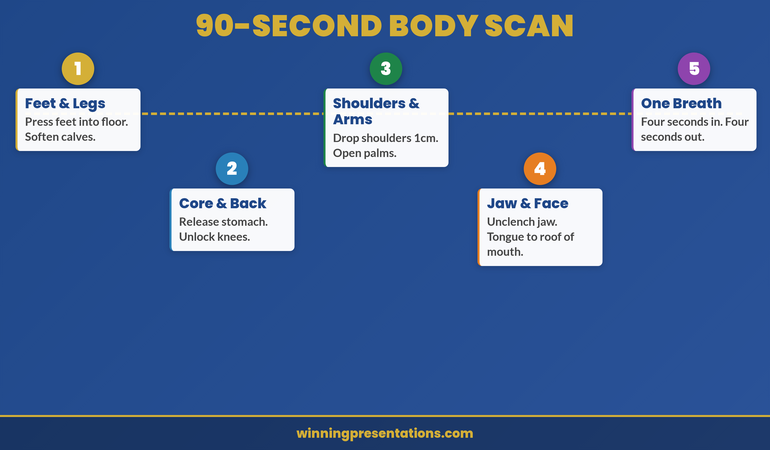
Five-step body scan technique roadmap showing Feet and Legs, Core and Back, Shoulders and Arms, Jaw and Face, and One Breath as sequential milestones for a 90-second nervous system reset

Why This Works When Breathing Exercises Don’t

When working with executives on presentation anxiety, the most common feedback is: “I tried breathing exercises and they didn’t fully resolve the physical symptoms.”

Here’s why. Breathing techniques target one symptom (rapid breathing) and hope the rest of the anxiety cascade follows. Sometimes it does. Often it doesn’t—because your body is still braced for impact in every other muscle group. You’ve slowed your breathing, but your shoulders are still at your ears, your jaw is still clenched, and your hands are still gripping the clicker like a weapon.

The body scan works differently. Instead of targeting one symptom, it addresses the entire physical anxiety pattern systematically. By the time you reach the breath at the end, your body has already shifted out of high alert. The breath becomes confirmation, not intervention.

There’s another reason. Breathing exercises require you to do something—and when you’re anxious, “doing something” can feel like another performance demand. The body scan asks you to notice, not to perform. Noticing is passive. Your anxiety can’t turn noticing into another source of pressure.

This distinction matters in the context of NLP anchoring techniques too. The body scan creates a foundation state that anchoring techniques can build on. Without the physical reset first, anchoring a confident state onto a tense body doesn’t hold.

Breathing Exercises Haven’t Been Enough?

The body scan is just the entry point. Conquer Speaking Fear builds the complete nervous system regulation system—body scan, reframing, and approaches from clinical hypnotherapy.

Explore the Programme →

When to Use the Body Scan (and When You Need Something Deeper)

The body scan is a pre-presentation tool. It works in the 90 seconds before you walk into the room. It doesn’t fix what happens the night before, the week before, or the career-long pattern that makes presenting feel dangerous.

Use the body scan when your anxiety is situational—it spikes before the presentation and settles afterward. It works well for quarterly reviews, team updates, client meetings, and any scenario where you know you can present competently but your body doesn’t seem to agree.

You need something deeper when the anxiety starts days before the presentation. When you’re losing sleep on Sunday night because of a Tuesday meeting. When you’re rehearsing not the content but the escape routes—which door is closest, what excuse gets you out. When the anxiety has shifted from “I’m nervous about this presentation” to “I’m a person who can’t present.”

That shift—from situational anxiety to identity-level anxiety—is where the body scan reaches its limit and clinical-grade techniques become necessary. The body scan can interrupt a fight-or-flight response. It can’t reprogram the belief system that triggers the response in the first place.

If this resonates, you’re not failing at anxiety management. You’re using the right technique for the wrong layer of the problem.

Making It Automatic: The 7-Day Practice Protocol

The body scan is a skill. Like any skill, it gets faster and more effective with practice. Here’s how to make it automatic before your next presentation.

Days 1-2: Practice at home. Do the full 90-second body scan twice daily—morning and evening. You’re training the neural pathway, not managing anxiety. Do it when you’re already calm so your body learns the sequence without the interference of real stress.

Days 3-4: Practice in low-stakes moments. Before a team meeting. Before a phone call. Before opening your laptop in the morning. You’re teaching your body that the scan is a normal transition, not an emergency measure.

Days 5-6: Speed it up. By now, you know the sequence. Try completing it in 60 seconds, then 45. Your body will start anticipating each zone—feet, core, shoulders, jaw, breath—before you consciously direct attention there. This is the automaticity you need.

Day 7: Test under mild pressure. Use it before a slightly uncomfortable conversation—a feedback session, a negotiation, a meeting with someone senior. Not a boardroom presentation yet. This intermediate step builds confidence in the technique before high stakes demand it.

After seven days, most people report that the body scan takes 30-45 seconds and produces a noticeable shift in physical state. Some report that simply thinking “body scan” triggers a micro-release in their shoulders and jaw—the sequence has become a mental shortcut.
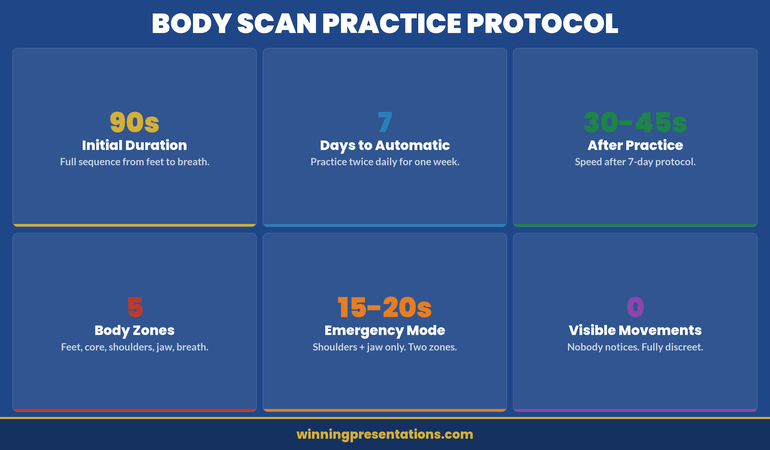
Dashboard infographic showing four key metrics of the body scan practice protocol: 90 seconds initial duration, 7 days to automaticity, 30-45 seconds after practice, and works in 5 body zones

Stop Dreading the Physical Symptoms That Derail Your Presentations

  • Programme that builds from the body scan technique to deeper nervous system regulation—so physical anxiety symptoms become manageable, then minimal
  • Clinical hypnotherapy methods that target the root cause, not just the symptoms—for executives who’ve tried breathing exercises and need something that goes further

Get Conquer Speaking Fear →

Designed to address the root patterns of presentation anxiety—because managing symptoms and resolving underlying patterns require different approaches.

People Also Ask

Can the body scan technique work for severe presentation anxiety?

The body scan is effective for situational anxiety—the spike that happens before a specific presentation. For severe, chronic presentation anxiety that starts days before the event and affects your career decisions, the body scan is a starting point but not a complete solution. Severe anxiety involves identity-level beliefs about yourself as a presenter, and those require deeper techniques like cognitive reframing and clinical-grade interventions.

Is the body scan technique the same as mindfulness meditation?

Related but different. Mindfulness body scans are typically 10-20 minutes and aim for deep relaxation. The presentation body scan is 90 seconds and aims for functional readiness—not relaxation, but a state where your nervous system is calm enough for your brain to perform. You don’t want to feel relaxed before a board presentation. You want to feel alert and in control. That’s a different target state.

What if I don’t have 90 seconds before my presentation?

After practising the full sequence for a week, most people can trigger a meaningful physical shift in 15-20 seconds by scanning just two zones: shoulders (drop them one centimetre) and jaw (unclench and touch tongue to roof of mouth). These two adjustments produce the largest nervous system response because they address the two most common anxiety holding patterns.

Is This Approach Right for You?

This is for you if:

  • Your presentation anxiety shows up physically—shaking hands, tight chest, racing heart, voice changes—before you’ve even started speaking
  • Breathing exercises help a little but don’t fully resolve the physical symptoms
  • You want a technique you can use discreetly in any setting, without anyone noticing
  • You’re willing to practise for 7 days to make the technique automatic

This is NOT for you if:

  • Your anxiety is primarily cognitive (racing thoughts, catastrophising) with minimal physical symptoms—you may benefit more from cognitive reframing techniques
  • You need a technique that works immediately with zero practice—the body scan requires a 7-day training period to become fast and automatic
  • Your presentation anxiety is managed well by current techniques—if what you’re doing works, keep doing it

Frequently Asked Questions

I’ve tried body scans before and they didn’t help with my presentation nerves. What’s different about this approach?

Most body scan techniques are adapted from meditation—they’re designed for deep relaxation and take 10-20 minutes. The presentation body scan is different in three ways: it’s 90 seconds (realistic before a meeting), it targets functional readiness rather than relaxation, and it’s sequenced to address the specific muscle groups that presentation anxiety affects most (jaw, shoulders, core). It’s a clinical intervention, not a wellness practice.

Can I combine the body scan with beta blockers or medication?

That’s a question for your doctor, not a presentation coach. What I can say is that many executives I’ve worked with used medication and somatic techniques simultaneously while building confidence in the body scan, then gradually relied less on medication as the technique became automatic. The body scan doesn’t conflict with medication—it works on a different layer of the anxiety response.

Will people notice I’m doing a body scan before presenting?

No. That’s the design advantage. Dropping your shoulders one centimetre, unclenching your jaw, and pressing your feet into the floor are invisible movements. You can do the full 90-second sequence while appearing to review your notes or check your phone. Nobody in the room will know you’re running a nervous system reset protocol. They’ll just notice that you look calm.

The Winning Edge — Weekly

Presentation confidence strategies, anxiety management techniques, and executive communication insights. One email weekly. Built for executives who take presenting seriously.

Join The Winning Edge

About the Author

Mary Beth Hazeldine is Owner & Managing Director of Winning Presentations. With 24 years of corporate banking experience at JPMorgan Chase, PwC, Royal Bank of Scotland, and Commerzbank, she advises executives across financial services, healthcare, technology, and government on structuring presentations for high-stakes funding rounds and approvals.

Book a discovery call | View services

10 Feb 2026
Professional taking a calming breath before high-stakes presentation, moment of composure

The Fight or Flight Hack I Learned From Hypnotherapy (It Works in 90 Seconds)

My heart was pounding so hard I could hear it in my ears.

I was standing outside a boardroom at JPMorgan, about to present a restructuring proposal to twelve senior executives. I’d done this a hundred times. I knew the content cold. But my body didn’t care about my experience. It had decided I was about to be eaten by a predator.

My hands were shaking. My mouth was dry. My brain was screaming at me to run — literally run — out of the building and never come back.

That was the day I realised something had to change. Not my preparation. Not my slides. Not my “mindset.” Something deeper. Something neurological.

I spent the next three years training as a clinical hypnotherapist, specifically to understand why intelligent, experienced professionals lose control of their bodies before presentations — and what actually works to stop it.

Here’s what I learned.

Quick answer: Presentation panic is an amygdala hijack — your brain’s threat detection system firing when there’s no actual threat. You can’t think your way out of it because the amygdala bypasses your rational brain. But you can interrupt it with a 90-second nervous system reset: ground your feet, slow your exhale, activate a physical anchor, and engage your peripheral vision. This shifts you from sympathetic (fight/flight) to parasympathetic (calm/focused) dominance before you enter the room.

For five years, I had a secret. I was a senior banking executive who delivered high-stakes presentations regularly — and I was terrified every single time.

Not nervous. Not “a bit anxious.” Terrified. The kind of fear where your vision narrows, your thoughts scatter, and your body feels like it belongs to someone else.

I tried everything the corporate world suggests: more preparation, more practice, more positive thinking. I visualised success. I told myself I was “excited, not nervous.” I did power poses in the bathroom.

None of it worked. Because none of it addressed the actual problem.

The problem wasn’t psychological. It was physiological. My nervous system was hijacking my body, and no amount of positive thinking could override 200,000 years of human evolution.

When I trained as a hypnotherapist, I finally understood why — and more importantly, what to do about it. (If you want the full story of how I overcame my fear of public speaking, I’ve written about that separately.)

Why Your Body Betrays You (The Neuroscience)

Here’s what’s actually happening when you feel presentation panic:

Your amygdala — the brain’s threat detection centre — has identified a potential danger: you’re about to be evaluated by a group of people. For our ancestors, group rejection meant death. Being cast out of the tribe was a survival threat.

Your amygdala doesn’t know the difference between a boardroom and a savannah. It just knows: evaluation by group = potential rejection = danger.

So it does what it’s designed to do: trigger the sympathetic nervous system. Flood your body with adrenaline and cortisol. Prepare you to fight or run.

This is the amygdala hijack. And here’s the crucial part: it happens before your rational brain gets involved.

The threat signal reaches your amygdala faster than it reaches your prefrontal cortex — the thinking brain. By the time you’re consciously aware of the fear, your body is already in full fight-or-flight mode. (This “low road” threat response was first described by neuroscientist Joseph LeDoux in his research on fear processing.)

This is why you can’t think your way out of it. By the time you’re thinking, the hijack has already happened.

You need to interrupt the nervous system directly.

The 90-Second Nervous System Reset

This technique works because it targets the vagus nerve — the main communication line between your body and your parasympathetic nervous system (the “rest and digest” system that calms you down).

Do this 2-3 minutes before you need to present:

Step 1: Ground (15 seconds)

Stand with both feet flat on the floor, hip-width apart. Press your feet down firmly — feel the floor pushing back up against you.

This isn’t metaphorical “grounding.” It’s neurological. Pressure receptors in your feet send signals to your brain that say “stable, safe, solid ground.” This interrupts the “run away” signal.

Mentally scan from the soles of your feet up through your ankles. Notice the connection to the earth. Your body is supported.

Step 2: Breathe (30 seconds)

Here’s the key most people get wrong: it’s not about breathing deeply. It’s about breathing out slowly.

Your exhale activates the parasympathetic nervous system. Your inhale activates the sympathetic (stress) system. Most anxious breathing is short inhale, short exhale — which keeps you stuck in stress mode.

The 4-7-8 pattern:

  • Inhale through your nose for 4 counts
  • Hold for 7 counts
  • Exhale slowly through your mouth for 8 counts

The extended exhale is what shifts your nervous system. Do this 3-4 times.

⚡ Presenting in the next 24 hours? Do this now (2 minutes):

  • Run the 90-second reset once (Ground → Breathe → Anchor → Peripheral)
  • Write the first sentence you’ll say when you start — just 9 words
  • Fire your anchor the moment you stand up tomorrow

If you want the guided audio version + the full calm protocol for tonight and tomorrow morning:

🎧 Emergency Relief: Guided Audio You Can Use Tonight

Conquer Speaking Fear includes a guided audio walkthrough of the 90-second reset — so you can practise with my voice in your ears instead of trying to remember each step. Use it tonight, use it tomorrow morning, use it 5 minutes before you present.

Get Conquer Speaking Fear → £39

Instant download. 30-day money-back guarantee. Printable protocol card included.

Step 3: Anchor (30 seconds)

This is the technique that changed everything for me. It’s called “anchoring” in NLP, and it gives you a physical switch to access calm on demand.

While you’re in that calm state from the breathing:

  • Press your thumb and middle finger together firmly
  • Hold for 10 seconds
  • Associate this pressure with the feeling of calm

The more you practise this (outside of stressful situations), the stronger the anchor becomes. Eventually, pressing those fingers together triggers the calm state automatically.

I’ve used this anchor in boardrooms, on stages, in TV interviews. It works because you’re not trying to create calm in the moment — you’re accessing calm you’ve already stored.

Step 4: Engage Peripheral Vision (15 seconds)

When we’re anxious, our vision narrows — literally. This is called “tunnel vision” and it’s part of the fight-or-flight response. Your brain focuses on the threat and ignores everything else.

You can reverse this deliberately:

  • Pick a spot on the wall in front of you
  • While keeping your eyes on that spot, expand your awareness to include what’s in your peripheral vision
  • Notice objects on the far left and far right without moving your eyes

This simple technique shifts your brain from “focused threat detection” to “relaxed awareness.” It’s impossible to maintain full fight-or-flight while in peripheral vision mode.

The Conquer Speaking Fear programme includes guided audio for each step of this protocol, plus advanced techniques for building permanent calm anchors.

90-second nervous system reset technique showing 4 steps: Ground, Breathe, Anchor, Engage

Why “Just Breathe” Doesn’t Work Alone

You’ve probably been told to “just breathe” before presentations. And you’ve probably found it doesn’t help much.

Here’s why: breathing alone, without the other elements, often makes anxiety worse.

When you focus intensely on your breathing while anxious, you’re focusing on a body that feels out of control. You notice how fast your heart is beating. You notice how shallow your breath is. You notice how uncomfortable you feel.

This increases anxiety, not decreases it.

The 90-second reset works because it combines multiple interventions:

  • Grounding interrupts the “run” signal
  • Extended exhale activates the parasympathetic system
  • Anchoring accesses pre-stored calm
  • Peripheral vision shifts brain state

Each element alone has some effect. Together, they’re transformative.

Physical Anchors: The Technique Nobody Teaches

Anchoring is the most powerful technique I learned in hypnotherapy training, and it’s almost never taught in corporate presentation skills courses.

The concept is simple: your brain naturally associates physical sensations with emotional states. Think of a song that instantly transports you to a specific memory and feeling. That’s an anchor — the song triggers the emotional state.

You can create these deliberately.

How to Install a Calm Anchor

Step 1: Create a genuine calm state

Do this when you’re actually relaxed — after a bath, during meditation, while listening to calming music. Don’t try to do it when you’re already anxious.

Step 2: Intensify the calm

Once you feel relaxed, focus on the feeling. Notice where you feel it in your body. Make it stronger in your imagination. Give it a colour if that helps.

Step 3: Set the anchor

At the peak of the calm feeling, press your thumb and middle finger together (or any unique physical gesture you can do discreetly). Hold for 10-15 seconds while maintaining the calm feeling.

Step 4: Release and repeat

Release the fingers, break the state (stand up, shake it off), then repeat 3-5 times in the same session.

Step 5: Test and strengthen

Later, in a neutral state, fire the anchor (press the fingers). Notice if you feel a shift toward calm. The more you repeat steps 1-4 over days and weeks, the stronger the anchor becomes.

This isn’t magic. It’s classical conditioning — the same mechanism Pavlov discovered with his dogs. You’re conditioning your nervous system to produce calm on demand.

🎯 Build a Permanent Calm Switch

The anchor installation protocol in Conquer Speaking Fear goes deeper than what I can cover here — including how to “stack” multiple calm memories into one anchor, how to test anchor strength, and how to rebuild an anchor if it weakens over time. This is the skill that transforms occasional relief into permanent confidence.

Get Conquer Speaking Fear → £39

Includes guided audio for anchor installation + stacking technique.

Before, During, and After: A Complete Protocol

The 90-second reset is for immediate pre-presentation use. But if you’re dealing with significant presentation anxiety, you need a complete protocol.

The Night Before

Do NOT review your slides obsessively. This increases anxiety by keeping the presentation front-of-mind.

Instead:

  • Do one final review in the early evening, then stop
  • Spend 10 minutes with your calm anchor (install or strengthen it)
  • Avoid alcohol (it disrupts sleep and increases next-day anxiety)
  • Go to bed at your normal time

The Morning Of

Your nervous system is most suggestible in the first 20 minutes after waking.

  • Don’t check email or news immediately — this triggers stress hormones
  • Do 5 minutes of the breathing protocol while still in bed
  • Visualise yourself calm and in control (not the presentation content — just the feeling of confidence)
  • Move your body — even a 10-minute walk shifts your nervous system state

The full morning protocol in Conquer Speaking Fear includes a specific sequence designed to set your nervous system baseline before high-stakes days.

2-3 Minutes Before

This is when you use the 90-second reset: Ground → Breathe → Anchor → Peripheral Vision.

Do this in a private space if possible — a bathroom, an empty corridor, even a stairwell. You need 90 seconds where no one will interrupt you. (For more techniques to calm your nerves before a presentation, see my dedicated guide.)

During the Presentation

If you feel anxiety rising mid-presentation:

  • Fire your anchor discreetly (press thumb and finger under the table or behind your back)
  • Slow your speaking pace deliberately — anxiety makes us rush
  • Engage peripheral vision while speaking — it’s easier than you think
  • Ground through your feet if you’re standing

Nobody will notice you doing these things. They’re invisible interventions.

After

Your nervous system doesn’t know the “threat” is over just because the presentation ended. You may feel residual anxiety for hours.

  • Don’t immediately debrief or replay what happened
  • Take 5 minutes for physical movement — walk around, stretch
  • Do 3-4 extended exhales to signal safety to your nervous system
  • Later that day, acknowledge what went well (your brain needs positive data to update its threat assessment)

What Changed for Me

That day at JPMorgan, standing outside the boardroom with my heart pounding, I didn’t have these techniques. I went in anxious, stayed anxious throughout, and delivered a presentation that was technically acceptable but emotionally flat.

Now, fifteen years and hundreds of presentations later, I still get the initial spike of adrenaline. That’s normal — it’s your body preparing for a performance. The difference is I know exactly how to channel it.

The 90-second reset isn’t about eliminating all nervousness. It’s about moving from panic (sympathetic dominance) to focused energy (balanced nervous system). The goal isn’t to feel nothing. It’s to feel ready.

You can learn to do this too. Your nervous system isn’t broken — it’s just running outdated threat detection software. You can update it.

🧠 The Complete Nervous System Control System

Everything in Conquer Speaking Fear:

  • The 90-second reset (guided audio + printable card)
  • Anchor installation protocol with memory stacking
  • Night-before and morning-of routines
  • Mid-presentation recovery techniques
  • Post-presentation nervous system reset

Get Conquer Speaking Fear → £39

Instant download. 30-day money-back guarantee. Used by hundreds of executives.

For physical symptoms specifically (shaking hands, racing heart, sweating): Calm Under Pressure (£19.99) provides targeted techniques for the body-level symptoms of presentation anxiety.

Frequently Asked Questions

How long does it take for anchoring to work?

Most people notice some effect after 3-5 installation sessions spread over a week or two. The anchor strengthens with repetition — the more you install it during genuinely calm states, the more reliable it becomes. Some of my clients have anchors they’ve been using for years that fire instantly.

What if I don’t have 90 seconds before the presentation?

If you only have 30 seconds, prioritise the extended exhale (3-4 breaths with long exhale) and fire your anchor. These two elements give you the most nervous system shift in the least time. Even one proper exhale helps.

Can this work for people with severe presentation anxiety?

Yes, but severe anxiety may need additional support. These techniques are the foundation I use with all my clients, including those with diagnosed anxiety disorders. For severe cases, I recommend combining these techniques with professional support from a therapist who understands performance anxiety specifically.

Note: These techniques are performance tools, not medical treatment. If you experience panic attacks, severe anxiety symptoms, or symptoms that significantly impact your daily life, please consult a qualified healthcare professional alongside using performance techniques.

Why does peripheral vision help with anxiety?

Tunnel vision is part of the fight-or-flight response — your brain narrows focus to the perceived threat. By deliberately engaging peripheral vision, you signal to your brain that you’re not in immediate danger (you wouldn’t be scanning the horizon if a predator were attacking). This shifts you out of the high-alert stress state.

📬 The Winning Edge Newsletter

Weekly techniques for presentation confidence and executive communication. Evidence-based strategies from a clinical hypnotherapist who’s been in the boardroom.

Subscribe free →

Related: Once your nervous system is under control, you need a presentation that’s worth delivering. Read The M&A Integration Update That Stops Panic for a framework that keeps 500 people calm when the stakes are high.

Your body’s fear response isn’t your enemy. It’s an ancient protection system that kept your ancestors alive. The problem is it can’t distinguish between a sabre-toothed tiger and a quarterly business review.

You don’t need to eliminate fear. You need to regulate it. Ground your feet. Extend your exhale. Fire your anchor. Engage your peripheral vision.

Ninety seconds. That’s all it takes to shift from panic to ready.

About the Author

Mary Beth Hazeldine is the Owner & Managing Director of Winning Presentations. A qualified clinical hypnotherapist and NLP practitioner, she spent 24 years in corporate banking at JPMorgan Chase, PwC, Royal Bank of Scotland, and Commerzbank before specialising in presentation anxiety.

Mary Beth combines evidence-based nervous system techniques with real-world executive experience. She has trained thousands of professionals in managing presentation fear and high-stakes communication pressure.

26 Jan 2026
Professional woman at podium with microphone looking nervous but determined before presentation

Hands Shaking During Presentations: The 30-Second Nervous System Reset

I dropped the clicker in front of 200 people.

My hands were shaking so badly I couldn’t grip it properly. It clattered onto the floor, rolled under the front row of chairs, and I had to ask someone to retrieve it while the entire room watched. The presentation hadn’t even started yet.

That was fifteen years ago. I was a senior banker at JPMorgan Chase, supposedly confident, supposedly competent. But my hands told a different story. They shook before every important presentation—sometimes visibly, sometimes so badly I couldn’t hold my notes steady.

What changed everything wasn’t “just relax” advice. It was understanding why hands shake in the first place—and learning specific techniques to interrupt the nervous system response that causes tremors.

Quick answer: Hands shake during presentations because your nervous system releases adrenaline, which causes involuntary muscle contractions. You can’t think your way out of shaking—it’s a physiological response. The fix is also physiological: specific techniques that activate your parasympathetic nervous system and interrupt the adrenaline cascade. The 30-second reset in this article works because it addresses the cause, not the symptom.

Written by Mary Beth Hazeldine, Owner & Managing Director of Winning Presentations. Qualified clinical hypnotherapist and NLP practitioner. I spent 5 years with debilitating presentation anxiety before learning to regulate my nervous system. These techniques come from both clinical training and personal experience. Last updated: January 2026.

🚨 Presenting in the NEXT 30 MINUTES? Do this now:

  1. Press your feet firmly into the floor (activates grounding response)
  2. Squeeze your thigh muscles hard for 5 seconds, then release (redirects adrenaline)
  3. Exhale longer than you inhale (4 counts in, 6 counts out) for 5 breaths

This combination interrupts the adrenaline cascade that causes tremors. It works in under 60 seconds.

Why Your Hands Shake (The Real Reason)

Here’s what nobody tells you about shaking hands: you can’t think your way out of them.

When your brain perceives a threat (and yes, presenting to senior leaders registers as a threat), it triggers the sympathetic nervous system. Adrenaline floods your bloodstream. Your muscles tense. Blood flow redirects to major muscle groups.

The shaking? That’s excess adrenaline with nowhere to go. Your muscles are primed for fight-or-flight, but you’re standing still at a podium. The energy has to release somehow—and it releases as tremors.

Why “Just Relax” Doesn’t Work

Telling yourself to relax when adrenaline is coursing through your system is like telling yourself not to blink. The response is involuntary. It’s happening below conscious control.

That’s why willpower fails. That’s why positive thinking fails. That’s why “just breathe” often makes it worse—because shallow, panicked breathing actually signals MORE danger to your nervous system.

📚 Research note: The physiological tremor response is well-documented in stress research. Studies on the autonomic nervous system (Porges’ Polyvagal Theory) show that physical interventions—not cognitive ones—are required to shift from sympathetic (fight/flight) to parasympathetic (calm) activation. This is why the techniques in this article focus on physical actions, not mental reframes.

The Good News

If the cause is physiological, the solution is also physiological. You don’t need to overcome fear. You need to interrupt the adrenaline response. That’s exactly what the techniques below do.

For more on the nervous system response before presentations, see how to calm nerves before a presentation.

The 30-Second Nervous System Reset

This is the technique that changed everything for me. It works because it activates your parasympathetic nervous system—the “rest and digest” system that counteracts adrenaline.

The Reset (Do This Exactly)

Step 1: Ground (5 seconds)

Press both feet firmly into the floor. Feel the pressure. Notice the contact points—heels, balls of feet, toes. This activates your body’s grounding response and pulls attention away from your hands.

Step 2: Squeeze and Release (10 seconds)

Squeeze your thigh muscles as hard as you can for 5 seconds. Then release completely. This gives the excess adrenaline somewhere to go—large muscle groups can absorb what your hands cannot.

Step 3: Extended Exhale (15 seconds)

Breathe in for 4 counts. Breathe out for 6 counts. Repeat three times. The extended exhale is critical—it directly activates the vagus nerve and signals safety to your nervous system.

Total time: 30 seconds.

You can do this while sitting, while standing at the side of the room, even while someone else is introducing you. Nobody will notice. Your nervous system will.

⭐ Stop the Shaking Before It Starts

Calm Under Pressure contains the complete nervous system regulation toolkit—including the advanced techniques I use with executive coaching clients who experience severe physical symptoms.

What’s included:

  • The full 5-minute pre-presentation protocol
  • Emergency techniques for when symptoms hit mid-presentation
  • Body positioning that naturally reduces tremors
  • The “invisible reset” you can do while presenting

Get Calm Under Pressure → £19.99

Developed from clinical hypnotherapy training and 5 years of personal experience with presentation anxiety.

What to Do BEFORE the Presentation

The best way to stop hands shaking during a presentation is to reduce the adrenaline surge before it happens.

The Night Before

Avoid caffeine after 2pm. Caffeine amplifies the adrenaline response. If you’re already prone to shaking, coffee on presentation day is fuel on fire.

Prepare your body, not just your slides. Lay out what you’ll wear. Know exactly where you need to be and when. Reduce every source of morning stress.

The Morning Of

Physical movement. A 20-minute walk, some stretching, or light exercise burns off baseline adrenaline. Your nervous system starts calmer.

Cold water on wrists. This sounds strange, but cold water on your inner wrists activates the vagus nerve and triggers a calming response. Do it in the bathroom 10 minutes before you present.

30 Minutes Before

Arrive early. Stand in the room. Touch the podium. Handle the clicker. Familiarity reduces threat perception.

Do the 30-second reset (from above) at least twice before you begin.

For a complete breathing protocol, see presentation breathing techniques.

Timeline showing what to do before a presentation to prevent hands from shaking: night before, morning of, and 30 minutes before

What to Do DURING the Presentation

Sometimes the shaking starts mid-presentation. Here’s how to manage it in real time.

The Invisible Reset

You can activate the parasympathetic response without anyone noticing:

  • Press your feet into the floor (grounding)
  • Press your tongue against the roof of your mouth (vagus nerve activation)
  • Slow your exhale (even slightly longer exhales help)

These micro-adjustments work while you’re speaking. Nobody will see them.

Use Your Body Strategically

Rest your hands on the podium. The contact point absorbs tremors and gives you stability.

Hold a pen (but don’t click it). The grip gives tremors somewhere to go. Just don’t fidget with it—hold it still.

Use open gestures. Counter-intuitively, moving your hands purposefully makes tremors less visible than trying to hold them still. Gesture broadly when making key points.

If Tremors Are Visible

Don’t apologise. Drawing attention to shaking makes it worse—both for you and your audience’s perception. Most people don’t notice unless you point it out.

Set things down. If you’re holding papers that shake, set them on the podium. If you’re holding a clicker, rest your hand against your thigh between clicks.

→ Want the complete toolkit? Calm Under Pressure (£19.99) includes emergency techniques, body positioning guides, and the “invisible reset” protocol for managing symptoms in real time.

5 Practical Hacks to Hide Tremors

While you work on the underlying nervous system regulation, these practical strategies reduce visible shaking:

1. Don’t Hold Papers

Shaking hands + paper = amplified tremor. The paper acts like a flag, making small tremors look dramatic. Use note cards (stiffer) or put notes on the podium/table.

2. Use a Slide Advancer, Not a Laptop

Reaching for a laptop keyboard makes tremors visible. A wireless clicker keeps your hands by your side or behind the podium between advances.

3. Interlock Your Fingers

When not gesturing, loosely interlace your fingers in front of you. This provides stability and makes tremors virtually invisible.

4. Rest One Hand

Keep one hand in your pocket or resting on a table while gesturing with the other. Fewer visible hands = fewer visible tremors.

5. Arrive Warm

Cold hands shake more. If the room is cold, warm your hands beforehand—rub them together, hold a warm drink, run them under warm water.

5 practical techniques to hide trembling hands during presentations: no papers, use clicker, interlock fingers, rest one hand, stay warm

⭐ I Spent 5 Years With Shaking Hands. You Don’t Have To.

The techniques in this article are a starting point. Calm Under Pressure is the complete system—everything I learned from clinical hypnotherapy training, nervous system research, and 5 years of personal trial and error.

Inside:

  • The full pre-presentation regulation protocol
  • Emergency resets for acute anxiety
  • Long-term techniques to reduce baseline anxiety
  • Audio guides for nervous system regulation

Get Calm Under Pressure → £19.99

Stop managing symptoms. Start regulating your nervous system.

When Shaking Signals Something Deeper

For most people, hands shaking during presentations is a normal stress response that these techniques can manage effectively.

But if you experience:

  • Shaking that happens outside of stressful situations
  • Tremors that interfere with daily activities
  • Symptoms that have suddenly worsened without clear cause

Consider consulting a healthcare professional. Persistent tremors can occasionally indicate other conditions worth ruling out.

For severe anxiety that goes beyond physical symptoms, see what to do about panic attacks before presentations.

→ Ready to stop the shaking for good? Calm Under Pressure (£19.99) gives you the complete nervous system regulation toolkit so you can present without visible anxiety.

Is This Right For You?

✓ This is for you if:

  • Your hands visibly shake before or during presentations
  • You’ve tried “just relax” and it doesn’t work
  • You want techniques that address the cause, not just hide symptoms
  • You’re willing to practise the techniques before your next presentation

✗ This is NOT for you if:

  • Your tremors happen outside of stressful situations (see a doctor)
  • You’re looking for medication recommendations
  • You expect instant results without practising the techniques
  • Your main issue is content/slides, not physical anxiety

⭐ That Dropped Clicker Changed Everything I Knew

After I dropped that clicker in front of 200 people, I spent years learning why shaking happens and how to stop it. The clinical hypnotherapy training, the nervous system research, the personal experimentation—it’s all in Calm Under Pressure. So you don’t have to figure it out yourself.

What you’ll get:

  • The complete 5-minute pre-presentation protocol
  • Emergency techniques for acute symptoms
  • Body positioning that naturally reduces tremors
  • The “invisible reset” for mid-presentation relief
  • Long-term techniques to reduce baseline anxiety

Get Calm Under Pressure → £19.99

From someone who solved her own shaking hands—and now helps executives do the same.

Frequently Asked Questions

What if my hands shake so badly I can’t hold notes or a clicker?

Don’t hold them. Put notes on the podium. Use a wireless clicker that you can grip against your thigh between slides. Or memorise your key points so you don’t need notes at all. The techniques in this article will reduce severity over time, but in the meantime, set yourself up so tremors don’t interfere with your delivery.

Does this work for severe anxiety, not just mild nerves?

Yes—these techniques are based on nervous system regulation, which works regardless of severity. In fact, they’re most effective for severe symptoms because they address the physiological cause rather than trying to override it mentally. That said, if you experience panic attacks or anxiety that significantly impacts daily life, consider working with a mental health professional alongside these self-help techniques.

Should I tell my audience I’m nervous?

Generally, no. Most people don’t notice nervousness unless you point it out. Announcing “sorry, I’m really nervous” makes the audience look for signs of anxiety and reduces their confidence in your content. Better to use the techniques in this article and let your preparation speak for itself.

What if the techniques don’t work?

They need practice. The nervous system doesn’t change overnight. Try the 30-second reset at least 10 times in low-stakes situations (at your desk, before phone calls) before expecting it to work in high-stakes moments. Most people see noticeable improvement within 2-3 weeks of consistent practice.

📧 Optional: Get weekly techniques for confident presenting in The Winning Edge newsletter (free).

Your Next Step

Shaking hands during presentations isn’t a character flaw. It’s a nervous system response—and nervous systems can be trained.

Start with the 30-second reset. Practice it today, at your desk, when no one’s watching. Practice it tomorrow before a low-stakes meeting. Build the muscle memory so it’s automatic when you need it.

For the complete toolkit—including the 5-minute pre-presentation protocol, emergency techniques, and body positioning guides—get Calm Under Pressure (£19.99).

P.S. If your nerves are under control but your slides aren’t landing, see why data presentations often backfire with executives—and what to do instead.

About the Author

Mary Beth Hazeldine is the Owner & Managing Director of Winning Presentations. That dropped clicker that opens this article? That was her—and it started a journey into clinical hypnotherapy, nervous system regulation, and presentation psychology.

Now a qualified clinical hypnotherapist and NLP practitioner, she combines 24 years of corporate banking experience with evidence-based techniques for managing presentation anxiety. The shaking stopped years ago. Now she helps others do the same.

Book a discovery call | View services