

Quick Answer
Stomach churning before presentations is your autonomic nervous system diverting blood away from digestion toward your muscles and heart. It is not a sign that something is wrong — it is your body’s preparation response. Vagus nerve activation, diaphragmatic breathing, and targeted pre-presentation protocols can reduce the gut response within minutes.
In this article
Nalini had given presentations to investor groups before. She was a portfolio director at a mid-cap asset management firm — pitching was part of the job. She knew her numbers. She trusted her analysis.
But her stomach had its own opinion about presenting.
It started the morning of her quarterly review to the investment committee. She woke at five thirty with a low wave of nausea that did not go away. By the time she arrived at the office, the churning had settled into a dull, grinding discomfort just below her ribs. She skipped breakfast. She drank water and immediately regretted it. Sitting outside the boardroom, she could feel the muscles in her abdomen tightening and releasing in slow, involuntary contractions, as if her body was bracing itself against something she could not see.
She presented well. The committee approved her recommendations. Afterwards, a colleague asked how she stayed so composed. Nalini smiled and said nothing. She did not mention the twenty minutes she had spent in the bathroom beforehand, or the tin of ginger pastilles she kept in her handbag for exactly these mornings, or that the churning did not stop until forty minutes after the meeting ended. Her preparation was thorough. Her body did not care.
Does your stomach react before every important presentation?
If you are looking for a structured approach to managing the physical side of presentation anxiety — not just the mental preparation — this may help:
- Does the nausea start hours before you present?
- Have you stopped eating breakfast on presentation days?
- Does the churning persist even after presentations that go well?
Why Your Stomach Reacts Before Your Mind Does
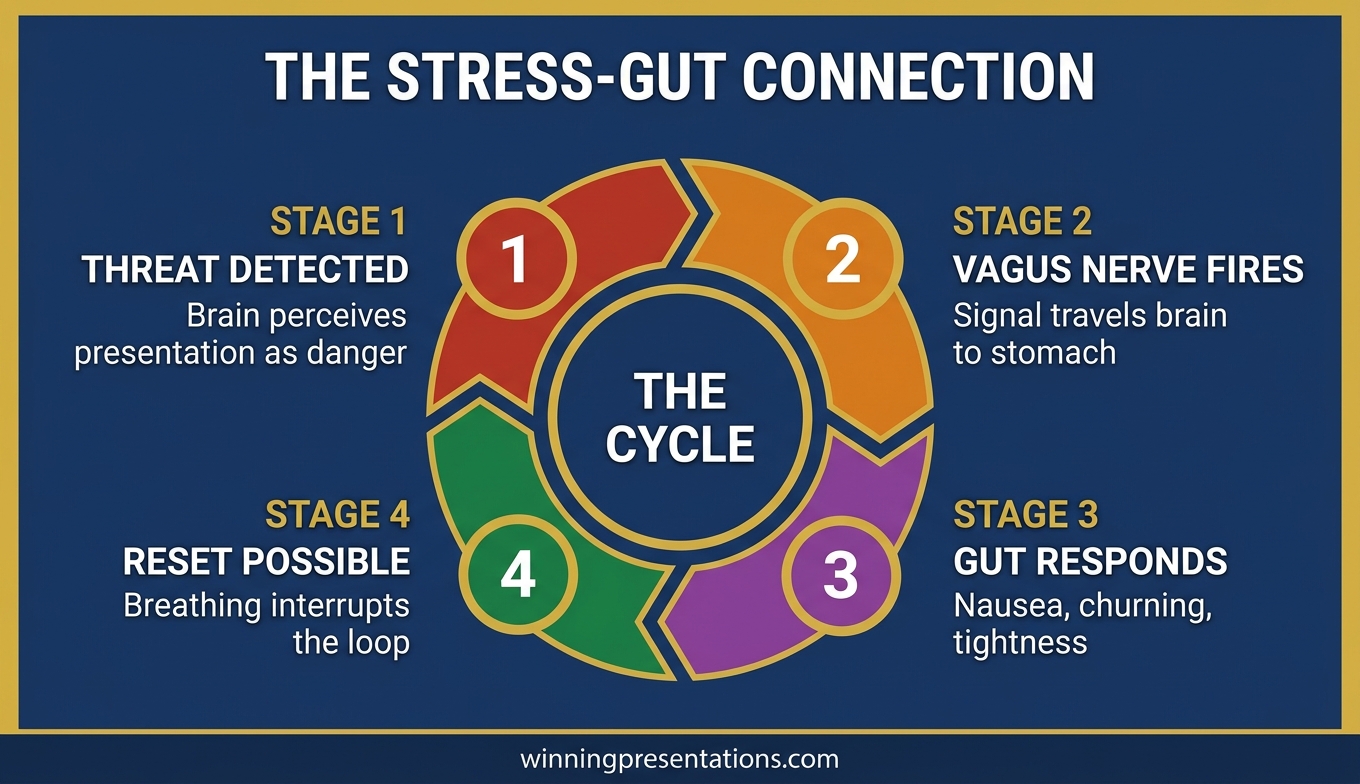
The stomach churning you feel before a presentation is caused by your autonomic nervous system detecting the situation as a threat and preparing your body to respond. This fight-or-flight response does not distinguish between a genuine physical danger and a boardroom full of senior leaders waiting for your update. The physiological cascade is the same: adrenaline surges, heart rate increases, and blood flow is redirected away from digestion toward the muscles needed for action.
Your gastrointestinal system is one of the first casualties. The stomach slows its normal contractions, the gut lining produces less protective mucus, and the smooth muscles of the intestinal wall begin to spasm. The result is the churning, nausea, and cramping that so many professionals experience before presenting.
The reason your stomach reacts before your mind catches up is that the gut contains over 100 million neurons and communicates with the brain via the vagus nerve. This gut-brain axis operates faster than conscious thought. Your stomach knows you are nervous before you have finished forming the thought. This is why intellectual confidence (“I know this material”) does not prevent the physical response. The two systems operate on different channels. For executives dealing with the anticipatory build-up that starts hours before, see our guide to anticipatory anxiety before presentations.
Why does my stomach churn before public speaking?
Your stomach churns because your autonomic nervous system activates the fight-or-flight response, redirecting blood away from digestion. The gut-brain axis — connected via the vagus nerve — registers the presentation as a threat faster than your conscious mind does, triggering nausea and abdominal discomfort even when you feel mentally prepared.
Your Stomach Is Telling You Something. Here Is How to Respond.
The physical symptoms of presentation anxiety are not character flaws — they are nervous system patterns that can be managed with the right approach. Conquer Speaking Fear — £39, instant access — is a neuroscience-based programme designed for professionals whose bodies react to presenting even when their preparation is thorough:
- Nervous system regulation techniques to reduce the gut-level stress response before you present
- Cognitive reframing protocols that change how your brain categorises the presentation situation
- Physical symptom management strategies for nausea, stomach discomfort, and visible tension
Designed for executives whose knowledge is never the issue — but whose body has its own agenda on presentation day.
The Vagus Nerve Connection: Your Gut-Brain Shortcut
The vagus nerve runs from the brainstem through the neck, chest, and abdomen. It is the primary communication channel between your brain and your gut. When your sympathetic nervous system activates the stress response, the vagus nerve’s calming influence is suppressed — a state called reduced vagal tone. The stomach loses its steady rhythm and begins to churn, cramp, or simply refuse to function.
The useful insight is that the vagus nerve carries signals in both directions. Stimulating it from the body side sends calming signals back to the brain, even when your conscious mind is still anxious. This is why cold water on the wrists, slow breathing, and gentle humming can reduce stomach symptoms within minutes. They activate the vagus nerve directly, bypassing conscious thought.
Vagal tone is also trainable. Executives who regularly practise diaphragmatic breathing or cold exposure tend to experience reduced baseline activation over time. The stomach still reacts, but the intensity diminishes and recovery time shortens. For professionals whose physical symptoms persist after presenting, see our guide to post-presentation anxiety and heart racing.
A Pre-Presentation Protocol for Stomach Calm
A structured protocol targeting gut symptoms works on three levels: reducing sympathetic activation, stimulating the vagus nerve, and managing the practical realities of an unsettled stomach.
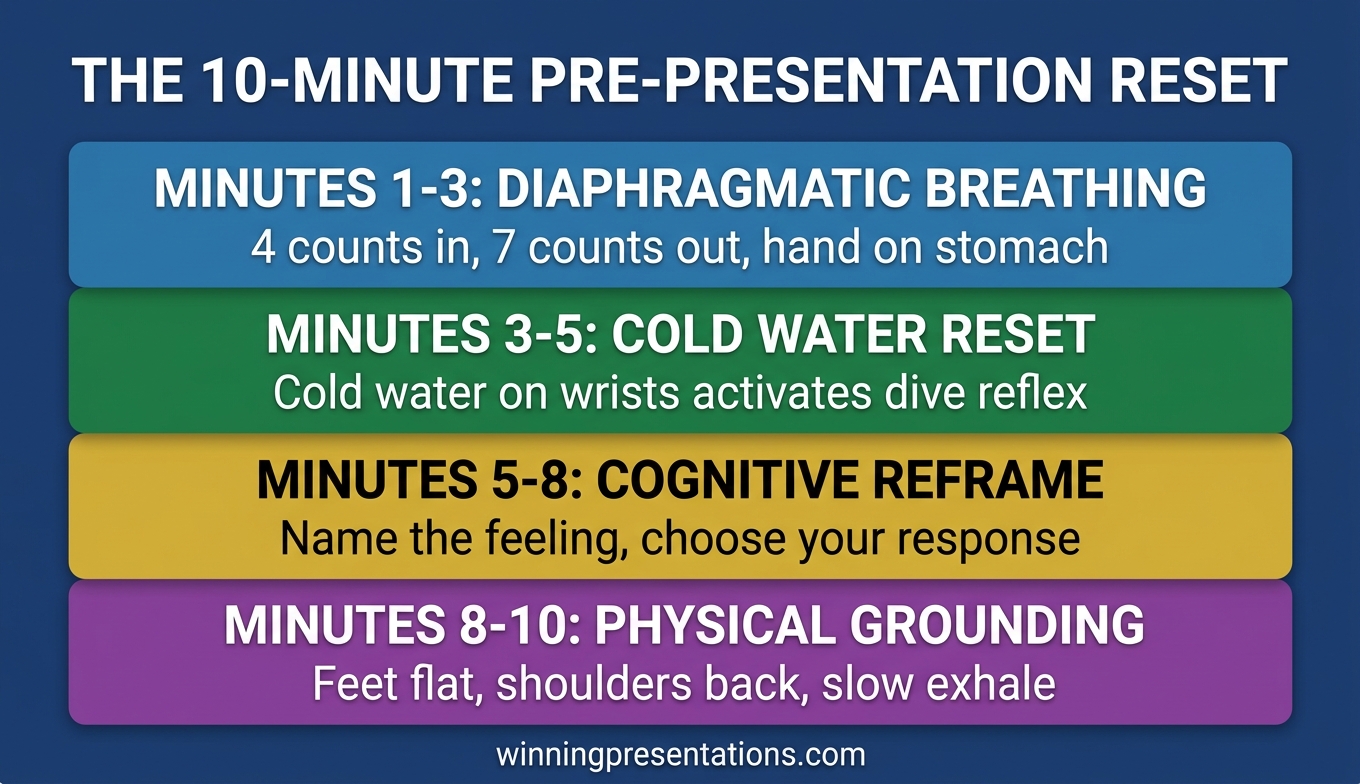
Two hours before: eat strategically. An empty stomach amplifies nausea — acid with nothing to work on creates its own discomfort. Eat something bland: plain toast, a banana, a handful of oats. Avoid caffeine, dairy, and anything acidic. If you cannot face food, ginger tea can settle the stomach without requiring you to eat.
Thirty minutes before: cold water vagus nerve activation. Run cold water over the insides of your wrists for sixty seconds. The temperature change stimulates the vagus nerve through the skin, sending a calming signal to the brainstem. If possible, splash cold water on your face — the dive reflex this triggers is one of the fastest routes to parasympathetic activation.
Fifteen minutes before: the 4-7-8 breathing sequence. Inhale for four counts, hold for seven, exhale slowly for eight. Repeat four times. The extended exhale directly stimulates vagal tone and signals your autonomic nervous system that the threat has passed.
Five minutes before: abdominal self-massage. Place your hand flat on your abdomen and make slow, gentle clockwise circles. This mimics the natural direction of digestive movement and can ease cramping. It also provides a grounding physical sensation that redirects attention from catastrophic thinking to the present moment.
How do I stop feeling sick before a presentation?
Eat something bland two hours before (an empty stomach worsens nausea), use cold water on your wrists to stimulate the vagus nerve, practise extended-exhale breathing (4-7-8 pattern), and apply gentle clockwise abdominal massage. These techniques activate the parasympathetic nervous system, counteracting the stress response causing your nausea.
Breathing Techniques That Settle the Gut
Breathing sits on the boundary between voluntary and involuntary control. When you consciously override its automatic pattern, the rest of your nervous system follows. The key principle: a longer exhale activates the parasympathetic nervous system, sending a direct signal through the vagus nerve that the body is safe and can resume normal digestion.
Box breathing (4-4-4-4). Inhale for four counts, hold for four, exhale for four, hold for four. Repeat for two minutes. This establishes a rhythm that overrides rapid, shallow stress breathing. Use it as a baseline technique when you need to stabilise quickly.
Extended exhale breathing (4-2-8). Inhale for four counts, hold for two, exhale for eight. This pattern maximises vagal stimulation by doubling the exhale. It is more effective at settling stomach symptoms specifically. Practise sitting down, as deep parasympathetic activation can occasionally cause light-headedness.
Physiological sigh (double inhale + long exhale). Take a quick inhale through the nose, immediately followed by a second shorter inhale on top, then a slow exhale through the mouth. This pattern is particularly effective at calming the diaphragm — the muscle sitting directly above the stomach. When the diaphragm relaxes, mechanical pressure on the stomach decreases, reducing the sensation of churning.
For executives whose physical responses extend beyond the stomach to authority-related tension, see our article on fear of authority when presenting.
If you want a structured programme combining these breathing techniques with cognitive reframing and pre-presentation protocols designed for executive environments, the Conquer Speaking Fear programme (£39) provides the complete framework.
Cognitive Reframing for Physical Symptoms
What makes stomach churning worse is the story you tell yourself about it. “If I am this nervous, I must not be ready.” “Other people do not feel this way.” These interpretations amplify the physical symptoms by registering as additional threat, which triggers more sympathetic activation, which worsens the gut response.
From “I am nervous” to “My body is preparing.” The physiological responses to excitement and anxiety are nearly identical. When you label the stomach sensation as preparation rather than fear, the brain does not escalate the threat response. This is not positive thinking — it is accurate reinterpretation.
From “Something is wrong with me” to “This is universal.” Most professionals experience stomach symptoms before high-stakes presentations. They simply do not discuss it. Normalising the response removes the additional anxiety of believing you are uniquely flawed.
From “I cannot present like this” to “I have done this before.” Most executives with stomach churning before presentations have a track record of presenting successfully despite the symptoms. Directing attention to that evidence counters the catastrophic prediction that the physical sensation will derail performance.
A Preparation Protocol Beyond Deep Breathing
This article gives you techniques for the moment. Conquer Speaking Fear — £39, instant access — gives you the complete preparation system: nervous system regulation, cognitive reframing, physical symptom management, and pre-presentation protocols designed for executives who present in high-stakes environments.
For professionals who want to change the pattern, not just manage the moment.
Building Your Personal Preparation Routine
These techniques work best when practised regularly, not improvised on the day. A consistent preparation routine trains your nervous system to respond differently to the anticipation of presenting.
Start with one technique and build. Choose the one that resonates — extended exhale breathing, cold water vagal activation, or the cognitive reframe — and use it before your next three presentations. Once it becomes automatic, add a second element.
Practise on low-stakes days. Use your chosen technique before team meetings or phone calls. The more your nervous system practises shifting from sympathetic to parasympathetic activation, the faster it will make that shift on presentation day.
Accept that the sensation may not fully disappear. Some activation before a high-stakes presentation is both normal and useful — it sharpens focus and improves recall. The goal is to bring it to a level where it serves your performance rather than dominating your attention.
Can presentation anxiety cause actual stomach problems?
Yes. Repeated stress activation can cause genuine gastrointestinal discomfort including nausea, cramping, acid reflux, and appetite changes. The gut-brain axis means chronic stress affects digestive function over time. These symptoms are physically real but driven by nervous system activation rather than digestive illness. Managing the stress response through breathing, vagal stimulation, and cognitive reframing reduces their frequency and intensity.
Frequently Asked Questions
Should I eat before a presentation if my stomach is churning?
Yes, but eat strategically. An empty stomach amplifies nausea because acid has nothing to work on. Eat something bland two hours before — plain toast, a banana, or porridge. Avoid caffeine, dairy, and citrus. If you cannot eat, sip ginger tea or warm water with honey. The goal is to give your digestive system a manageable task that reduces churning without overwhelming a stomach already under stress.
Why does my stomach only churn before important presentations but not regular meetings?
Your brain assigns different threat levels to different situations. A routine team meeting registers as low-stakes, so digestion continues normally. A presentation to the board or an investor committee registers as high-stakes, triggering a stronger fight-or-flight response and greater blood diversion from digestion. The churning correlates with perceived stakes, not actual danger — which is why cognitive reframing can reduce the gut response even when the audience stays the same.
How long before a presentation should I start my calming routine?
Begin two hours before with strategic eating, then use active techniques — cold water, breathing exercises, abdominal massage — in the final thirty minutes. Starting earlier is counterproductive because the anxiety has not yet peaked. Starting later than fifteen minutes before does not allow the parasympathetic nervous system to fully engage. The sweet spot is a graduated approach: gentle preparation two hours out, active regulation in the final half hour.
The Winning Edge — Weekly Presentation Intelligence
Every Thursday, I share one framework, one real-world example, and one practical technique drawn from 24 years of presenting in boardrooms across three continents. Join The Winning Edge newsletter →
Once your pre-presentation routine is in place, make sure your content preparation matches your physical preparation. See our guide to structuring a risk committee presentation for a framework that reduces preparation anxiety by giving you a clear structure to follow.
Also published today: how to structure an annual budget presentation that builds stakeholder confidence from the opening slide.
About the Author
Mary Beth Hazeldine is the Owner & Managing Director of Winning Presentations. With 24 years of corporate banking experience at JPMorgan Chase, PwC, Royal Bank of Scotland, and Commerzbank, she advises executives across financial services, healthcare, technology, and government on structuring presentations for high-stakes scenarios.