

Quick answer: Nervous presenters don’t simplify—they add slides. When anxiety spikes, your brain tells you that more content equals more safety, more credibility, more control. This backfires catastrophically. The presentation becomes bloated, the message blurs, and you look unprepared.
Catching yourself adding “just one more slide” before a presentation? That’s anxiety talking, and it will sabotage you. Conquer Speaking Fear teaches you to recognise anxiety-driven over-preparation and replace it with a simple, confidence-building presentation structure that stays intact under pressure.
A director walked into a boardroom with forty-seven slides. Her presentation was supposed to be thirty minutes. She’d prepared for six weeks, revising and expanding. The night before, anxiety hit: “What if they ask something I haven’t covered?” So she added seven more slides.
Twenty minutes in, the CFO interrupted. “What’s the actual decision you want from us?” She froze. In forty-seven slides, the core point had become invisible. She’d buried the recommendation under layers of supporting data that no one had asked for.
The content wasn’t bad. But the volume was a tell-tale sign of anxiety, and the audience knew it. Anxious presenters add slides. Confident presenters know what to cut.
The Anxiety-Content Loop
Here’s what happens in an anxious presenter’s mind, usually starting about a week before the presentation:
Monday: You finish your slides. Twelve slides, tight narrative. It feels clean.
Tuesday: Anxiety whispers: “But what if they ask about the quarterly impact on EBITDA? You should add a slide on that.” You add it.
Wednesday: Anxiety escalates: “The VP of Finance definitely wants to see a three-year projection. Add another one.” You do.
Thursday: Now you’re in full spiral mode: “What about competitive comparison? Market share implications? Risk factors by region?” You keep adding.
Friday night before the presentation: You have twenty-three slides instead of twelve. You stay up late “practising” but really you’re reading every slide, trying to memorise content you never meant to present in the first place.
Saturday morning: You feel unprepared (because you are—you’ve just memorised someone else’s presentation), and anxiety peaks at 6 AM: “I should add one more thing.” But now there’s no time to practise the new version.
This is the anxiety-content loop. And most presenters run it without even noticing they’re trapped in it.
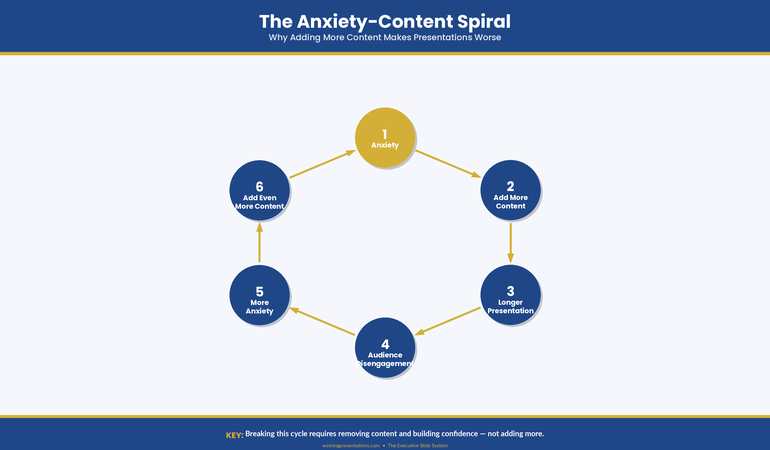
Why Anxiety Drives You to Add Instead of Cut
When your nervous system detects threat, it shifts into protective mode. For presenters, that protective instinct manifests as content hoarding. Your brain calculates: more information = fewer gaps I can be caught in = safer position.
This logic is backwards, but it feels true when you’re anxious. Here’s why:
Anxiety assumes the audience is looking for gaps. If you have forty-seven slides, there are forty-seven chances to prove your expertise and fill in potential questions. Your nervous system sees this as risk reduction. In reality, it’s noise creation.
Adding feels like control. When you can’t control whether the presentation will go well, you can at least control the volume of material. Expanding the deck feels like you’re doing something constructive. It’s false productivity born from helplessness.
Cutting feels like leaving yourself exposed. Every slide you remove feels like you’re leaving a weapon behind. “What if they ask about this and I don’t have a slide?” Your nervous system treats this as dangerous. So you keep the slide, just in case.
Anxiety distorts your sense of what’s necessary. When calm, you know that two slides on budget suffice. When anxious, one slide feels insufficient. You add a third “just to be thorough.” Then a fourth “for context.” Soon you have six slides on budget and the audience has stopped listening.
The cruel irony: the more slides you add from anxiety, the less prepared you actually feel, because now there’s more material to master. Anxiety creates the very problem it’s trying to prevent.
The Consequences of Slide Bloat
Audiences can sense when a presentation is bloated. They don’t consciously analyse slide count—they feel it. The signs:
Time pressure becomes obvious. You planned for thirty minutes but have forty slides. You start rushing, skipping slides, apologising: “I’ll skip this one—not critical.” Now you’re signalling that your own preparation was wasteful.
Your message becomes invisible. In client meetings and boardrooms, the core decision or ask gets buried under supporting details. Stakeholders leave confused about what you actually wanted from them.
You lose credibility. Bloated presentations signal insecurity, not expertise. Confident subject-matter experts trim ruthlessly. They know that clarity beats completeness.
The Q&A becomes chaotic. With forty-seven slides, questioners don’t know which one to challenge or build on. Instead of a focused conversation, you get scattered questions that force you to jump around the deck.
You appear unprepared. This is the cruel twist: over-preparation from anxiety makes you look under-prepared. The rushed pacing, the apologetic skipping, the obvious padding—it all screams “I didn’t think through what actually matters.”
Your delivery becomes stiff. More slides mean more memorisation, less mental space for presence and authenticity. You’re too focused on hitting your content marks to connect with the room.
None of this is because the slides are bad. It’s because the volume contradicts the presentation’s purpose.
How to Recognise the Pattern in Your Own Work
You might be in the anxiety-addition loop right now without realising it. Here’s the diagnostic checklist:
- Your slide count keeps growing, even though the time limit isn’t changing. You started with a plan for fifteen slides in thirty minutes. Now you have twenty-two and still find reasons to add more.
- You’re adding slides to answer questions you’ve imagined, not questions you’ve actually been asked. “They might ask about…” drives new slides.
- You can’t articulate why each slide is there. When someone asks “Why this slide?”, your answer is vague: “It provides context” or “Good to have.” Not “It directly supports the main recommendation.”
- Your practice sessions feel rushed because there’s too much material. You wanted to practise for an hour, but now there’s ninety minutes of content.
- You’re adding slides in the final days before presenting. Not because new information has emerged, but because you’re nervous and adding feels like productivity.
- You’ve already decided what to cut, but you haven’t actually deleted those slides. They linger in the deck as “backup” or “optional.” They’re adding cognitive load even if you don’t present them.
If three or more of these apply, you’re in the loop. The good news: once you see the pattern, you can interrupt it.
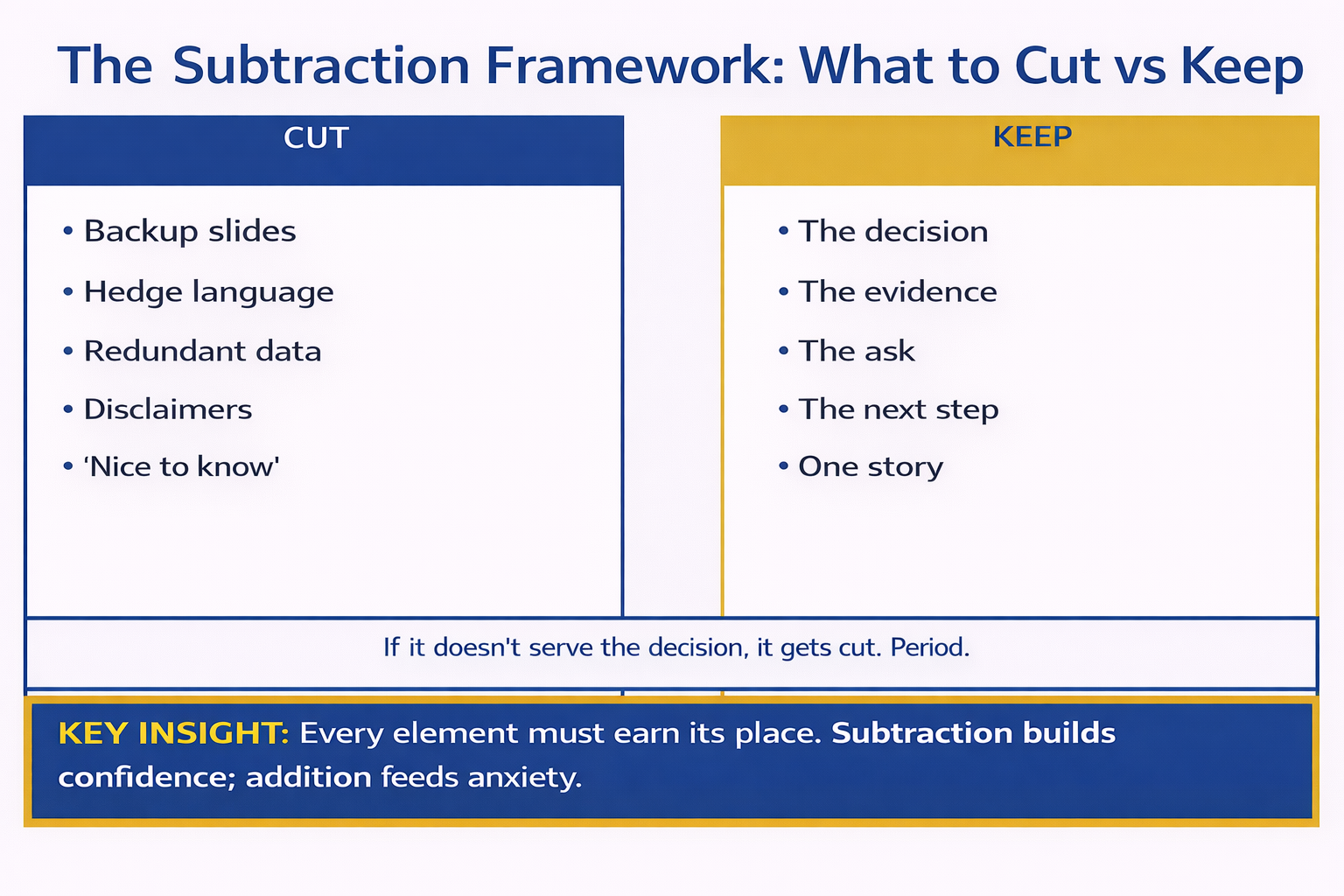
Rebuilding Your Preparation Approach
Breaking the anxiety-addition loop requires a different preparation strategy entirely. Instead of expanding until the night before, you build once and protect that structure.
Strategy 1: Build your presentation in one focused session, then stop. Choose one day—ideally two weeks before presenting. Build the slides based on your audience’s actual question: “What decision do I need from you?” or “What action do I want?” Build slides that answer that question and nothing else. Then close the file.
Strategy 2: If you want to add something, you must delete something. A rule: no additions without deletions. This forces genuine prioritisation. Is the new idea more important than one of the existing slides? If yes, which one gets cut? This forces you to defend your structure instead of just expanding it.
Strategy 3: Practise with the full slide count early, then lock the deck. Three weeks out, do a full run-through. If you finish with time left, that’s fine—you have space. But that means the slide count is set. No additions after the first full practice.
Strategy 4: Record yourself and watch for the signals. Film yourself presenting the deck. Watch for where you’re apologising, skipping slides, or rushing. Those are the problem areas. The solution isn’t more slides—it’s simplifying the existing ones or cutting them entirely.
Strategy 5: Use a trusted colleague as a veto. Before finalising, show your slides to someone you trust and ask: “Be honest—do we need this slide?” An external voice often catches padding that you can’t see because anxiety has normalised it.
Master the Confidence Structure That Stops Anxiety-Driven Additions
Conquer Speaking Fear teaches you a presentation framework designed to stop the anxiety-addition loop before it starts. You build once, you lock the structure, and you practise from confidence instead of from fear.
- The “Purpose Statement” framework: Build your deck around one clear decision or outcome, not scattered content
- The deletion protocol: How to know what to cut so anxiety can’t convince you to add it back
- The confidence checkpoint: Three practice milestones that prove you’re ready (no more adding after milestone 2)
- The anticipation exercise: Answer likely questions in your prep, not by adding slides
- The pre-presentation routine: Neurological techniques that calm anxiety in the final hours
Get Conquer Speaking Fear → £39
Includes the “Purpose Statement” template—used by executives at Goldman Sachs and major law firms to lock presentations and stop anxious editing.
Need a framework to stop adding slides from anxiety before your next presentation?
The Real Conversation Beneath the Anxiety
Adding slides from anxiety isn’t really about content. It’s about a belief: “I am not enough. My ideas alone won’t convince them. I need more stuff to be credible.”
This is the imposter syndrome that runs beneath presentation anxiety. When you doubt your credibility, you instinctively add armour—more data, more detail, more slides. It feels protective. It feels professional.
But audiences don’t evaluate you based on volume. They evaluate you based on clarity and confidence. The presenter who says “I know what you need to decide, and here it is” carries more authority than the presenter drowning in material.
Interrupting the anxiety-addition loop means interrupting the belief underneath it. You are enough. Your core message is enough. The slides exist to support your message, not to carry it.
Once you shift that belief, the preparation process changes. You’re no longer asking “What else should I include?” You’re asking “What does the audience actually need?” And those questions produce completely different decks.
The Relationship Between Anxiety and Preparation
Here’s a counterintuitive truth: The more you truly calm your nerves, the less you over-prepare. And the less you over-prepare, the calmer you actually feel during the presentation.
This is the opposite of what anxiety tells you. Anxiety says: “You’ll feel calmer when you’ve covered every possible angle.” That’s a lie. You feel calmer when you’ve mastered a focused, tight, defensible structure.
Executives who deliver killer presentations often have fewer slides than the average presenter. Not because they know less. Because they know more—they know what matters and what doesn’t. That confidence comes from a tight preparation process, not from an exhaustive one.
The Presentation Confidence System: From Anxiety to Clarity
Conquer Speaking Fear isn’t just about managing nerves—it’s about building a presentation structure and preparation process that make anxiety irrelevant. You lock your slides early, practise with purpose, and walk in feeling ready because you actually are.
- The core framework that stops “one more slide” syndrome before it starts
- The purpose statement that keeps you on track when anxiety tries to derail you
- The three-stage practice protocol that builds real confidence, not false reassurance
- The pre-presentation calm technique (clinical hypnotherapy anchoring for executive presenters)
- The Q&A anticipation process: Answer tough questions in prep, not by adding slides
Get Conquer Speaking Fear → £39
Includes a worksheet to map your own anxiety triggers during presentation prep.
Ready to stop over-preparing from anxiety and start building from clarity?
People Also Ask
What if my audience really does need that extra information? They don’t. What they need is to understand your core point. If they want more detail, they’ll ask. In fact, brevity often prompts better questions because there’s actually space for the audience to think.
Isn’t over-preparing better than under-preparing? No. Under-prepared presenters are scattered. Over-prepared presenters (from anxiety) appear insecure and rushed. There’s a preparation sweet spot: you know your material, you’ve cut ruthlessly, you have mental space to respond to the room. That’s not about total hours invested—it’s about where you focus.
How do I know if I’m adding from anxiety or from genuine new information? Ask yourself: “Has my audience’s actual need changed, or have I just had more time to worry?” Genuine new information changes the actual requirement. Anxiety just keeps you busy.
Is This Right For You?
✓ This is for you if:
✗ Not for you if:
Want to master the complete slide architecture that prevents this problem?
The Executive Slide System teaches you a seven-slide framework that works for any executive presentation. It’s tight enough that anxiety can’t derail it, and flexible enough that it adapts to your audience. Learn the ESS framework → £39
FAQ
Is there ever a good reason to add slides close to presentation day?
Almost never. If new information emerges that fundamentally changes your recommendation, then yes—rebuild from scratch. But “I just thought of something I should mention” at the three-day mark is anxiety, not strategy.
What if my boss asks me to add more detail before presenting?
That’s different from anxiety—that’s a genuine audience need. In that case, rebuild the structure instead of just tacking on extra slides. Ask your boss: “Which existing slides should I cut to make room for this new detail?” That forces prioritisation and usually gets you back to a reasonable slide count.
How many practice runs do I actually need before I stop adding?
Ideally one full run-through, at least ten days before presenting. That’s your confirmation moment: “The structure works. It covers what needs covering. No more additions.” Everything after that should be refinement, not expansion.
What if I finish practising and there are still fifteen minutes of blank time in my scheduled presentation?
That’s perfect. You can pause for questions, build in discussion time, or simply speak at a more natural pace (instead of rushing). Blank time during a presentation is a gift. Don’t fill it with slides.
Related: Your Presentation Didn’t Fail — The Decision Was Already Made Before You Walked In — How pre-decision dynamics compound anxiety and why you need to diagnose the situation early.
Related: Technical Questions From Non-Technical Executives: How to Translate Under Pressure — How to handle unexpected questions without relying on slides you added from anxiety.
Break the Anxiety-Addition Cycle Before Your Next Presentation
The best presentations you’ve ever given probably weren’t the ones with the most slides. They were the ones where you felt focused, confident, and clear about what you wanted the audience to do.
That feeling comes from a tight preparation process, not an exhaustive one. From a structure you can defend, not a mountain of material you’re hoping covers every contingency.
You’re presenting next week? This is the week to build your deck, practise it fully, and then lock it. Don’t open it again except for delivery adjustments. The additions your anxiety will suggest are noise, not value. Recognise the pattern and stop it.
Join executives learning to break anxiety patterns and build confidence through better preparation. Subscribe to The Winning Edge newsletter for weekly frameworks on managing presentation nerves.
🆓 Free resource: Download now — a free guide to strengthen your presentation preparation.
This article was written with AI assistance and reviewed by Mary Beth Hazeldine.