

Quick Answer
An effective mentorship presentation shares hard-won knowledge through structured experience rather than instruction. The key is framing your insight as something you discovered — not something you’re delivering. This shifts the dynamic from teacher-to-student to peer-to-peer, which is the only dynamic that actually changes how people think.
Henrik had 28 years of experience in supply chain finance. His mentee, Chiara, was sharp, ambitious, and had been promoted twice in four years. He wanted to share what he knew before he retired.
He built a presentation. Twenty-two slides covering everything he’d learned about vendor relationships, payment terms, and working capital dynamics. He delivered it over 90 minutes.
Chiara said it was helpful. Afterwards, she couldn’t recall a single specific insight.
The information was excellent. The format made it forgettable. Henrik had built a lecture when he needed to build a conversation. The difference between the two is not tone — it’s structure. And the structure problem is fixable.
Want your knowledge to land rather than wash over people?
The Executive Slide System includes frameworks for structuring complex knowledge into clear, actionable slide decks — the kind that get read, remembered, and acted on.
The patronising trap in mentorship presentations
The patronising trap is not about tone. Most people who patronise their audience aren’t trying to condescend — they’re trying to be thorough. The trap is structural: it’s built into how you organise the content.
When you present as though you know something your audience doesn’t, and your job is to transfer that knowledge to them, you’ve created a hierarchy. Even if the content is valuable and the delivery is warm, the structure says: I have expertise; you lack it. This creates a subtle defensiveness in the listener — particularly in high-performers who are used to being the person in the room who knows things.
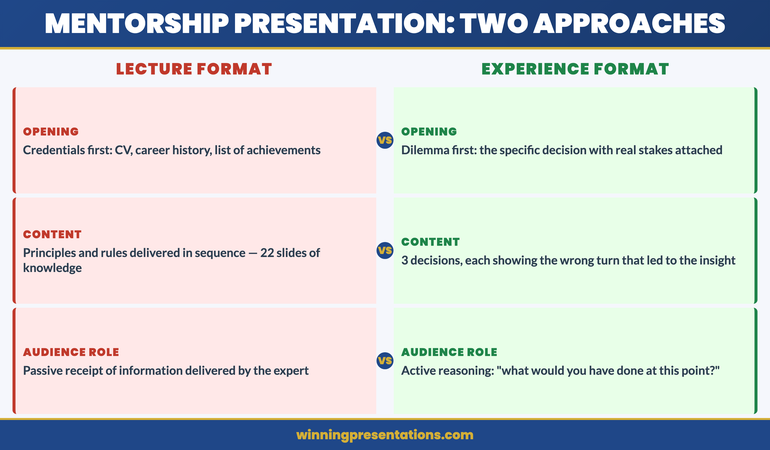
The alternative is to present as though you’re inviting them to examine a problem alongside you. You’ve already done the examination. You’ve already reached conclusions. But you’re presenting the examination, not just the conclusions — and you’re doing it in a way that allows them to follow the thinking rather than simply receive the result.
This matters because retained knowledge comes from active engagement. When a person follows a chain of reasoning and arrives at the insight themselves — even if you led them there — they own it. When you give them the conclusion directly, they receive it but don’t necessarily internalise it.
The structural shift is surprisingly simple: lead with a question or a dilemma rather than a statement. “Here’s what I learned” becomes “Here’s the problem I hadn’t anticipated.” The content that follows is identical. The relationship between presenter and audience is fundamentally different.
The structure that teaches without lecturing
There is a specific structure that works for mentorship presentations at executive level. I’ve used it across group mentorship sessions, one-to-one strategy conversations, and formal knowledge-transfer presentations. It adapts to any length and any subject matter.
It has four parts:
Part 1 — The decision you faced. Not the answer. The decision — the moment where multiple options existed and something was at stake. Be specific about the stakes. Vague stakes produce vague learning. “A significant contract was at risk” produces less engagement than “We had 48 hours to respond and a £3.8M renewal on the line.”
Part 2 — What you tried first (and why it was wrong). This is the part most mentors skip. They’re uncomfortable presenting failure or initial misjudgement. But the wrong turn is where the learning lives. If you jumped straight to the right answer, your mentee learns the answer without the reasoning that makes it applicable elsewhere. The wrong turn teaches them to recognise the situation next time — not just copy the response.
Part 3 — The insight that changed your approach. Not a principle. A specific realisation, triggered by a specific event or piece of information. “We realised the procurement lead wasn’t the real decision-maker — the CFO was reviewing every contract above £500K” is teaching. “You need to understand stakeholder dynamics” is not.
Part 4 — The pattern you now apply. This is where you make the specific applicable to the general. Once you’ve taken them through the specific decision, you can generalise to the pattern — and it will land because they’ve followed the reasoning. “Since then, I map decision authority before I map content” is a principle that makes sense because they understand where it came from.
This structure takes longer to build than a traditional knowledge-transfer presentation. But it transfers knowledge that stays.
Build Decks That Teach as Clearly as They Inform
The Executive Slide System — £39, instant access — includes frameworks for structuring knowledge presentations that audiences actually engage with. Stop building lecture decks. Build thinking frameworks instead.
- Slide structure templates for knowledge transfer and strategic alignment
- AI prompt cards to build complex content into clear narrative flows
- Executive presentation frameworks for different audience types
- Opening and closing structures that maintain engagement throughout
Get the Executive Slide System →
Designed for executive-level presentations across all formats and audiences.
How to design knowledge-transfer slides
Most knowledge-transfer presentations look like this: a title slide, a table of contents, seven section headers with three to five bullet points each, and a summary slide. This is the standard corporate training format. It’s also the format most likely to produce an audience who nods, takes notes, and remembers nothing specific three days later.
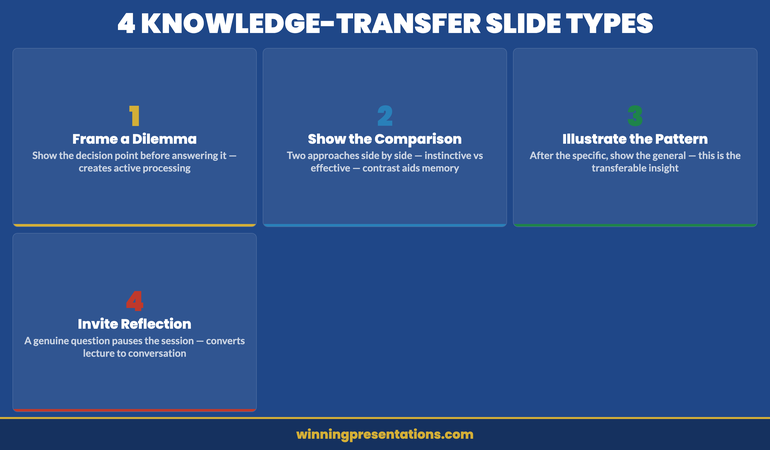
Slide design for knowledge transfer requires a different logic. Each slide should do one of four things:
Frame a dilemma. A slide that shows a decision point — “Which approach did we choose and why?” — orients the audience toward a specific question before you answer it. This creates active processing rather than passive receipt of information.
Show the comparison. Rather than a slide full of principles, a comparison slide shows two approaches side by side — the instinctive approach and the effective one, or the approach that works in one context and fails in another. Comparisons are memorable because they contain contrast, and the brain encodes contrast more reliably than lists.
Illustrate the pattern. Once you’ve taken the audience through a specific decision, a single slide showing the general pattern (with your specific example as one application) ties the learning together. This is the “applicable elsewhere” moment — the point at which specific experience becomes transferable knowledge.
Invite reflection. A slide that asks a question — “What would you have done at this point?” or “What’s the risk in each option?” — creates a pause for active engagement. In a one-to-one setting, you can ask these questions verbally without putting them on a slide. In a group, the slide creates a visible anchor for the conversation.
For the foundational principles of executive presentation structure that underpin this approach, the article on executive presentation structure covers the core frameworks.
Using questions to deepen retention
One of the most consistent patterns I’ve observed in effective mentorship presentations is the deliberate use of questions — not rhetorical questions, but genuine questions that pause the presentation and invite a response.
Most presenters avoid this. They’re worried about silence, or about the conversation going off track, or about losing the thread of their prepared content. The avoidance is understandable. But it costs them the engagement that makes knowledge transfer work.
The question method works like this: at a natural turning point in your narrative — usually just after you’ve described the wrong turn or the dilemma — you pause and ask a direct question. “Before I tell you what we did, what would you have considered here?” or “What’s the risk you’d want to understand before moving forward?”
The mentee’s answer reveals their current mental model. If they identify the same concern you had, you can confirm it and move forward — they’re tracking with you. If they identify a different concern, you have an opportunity to address that concern directly, which is far more valuable than following your prepared script.
You don’t need to ask questions on every slide. Two or three across a 60-minute session is enough to shift the dynamic from presentation to conversation. That shift changes retention significantly.
Four mistakes that undermine mentorship presentations
These patterns appear consistently in mentorship presentations that don’t transfer knowledge effectively. Each one has a specific fix.
1. Starting with credentials rather than content. Opening with your CV, your career history, or your list of achievements signals that you feel your authority needs establishing before your content will be accepted. Most mentees already respect you — that’s why they’re there. Starting with credentials delays the content and, ironically, can feel defensive. Start with the first dilemma. Your credentials will be demonstrated through the quality of the reasoning, not the length of your biography.
2. Covering too much. A mentorship presentation that tries to share 28 years of knowledge in 90 minutes will transfer almost none of it. Three specific, well-developed experiences with clear patterns will transfer far more than twenty principles illustrated with brief examples. Depth beats breadth in knowledge transfer every time.
3. Using “always” and “never.” Absolute rules are memorable but unreliable. The experienced person knows that every rule has a context in which it doesn’t apply. When you present principles as absolutes, you’re simplifying in a way that will mislead your mentee the first time they encounter the exception. Better: “My default is [approach] — and there are two situations where it doesn’t work.”
4. Skipping the failure. I’ve already mentioned this, but it deserves its own entry. The moments of your career that changed how you operated were almost always preceded by something going wrong. Sharing those moments is not a sign of weakness. It’s the most valuable thing you can give a mentee: the pattern of error that leads to the pattern of insight. Without the failure, the insight sounds like advice. With the failure, it sounds like truth.
If you’re also thinking about how to present your experience when moving between roles or seeking a new position, the article on internal transfer pitch presentations covers how to frame accumulated experience as a strategic asset.
For a complete framework for building structured executive presentations — including the slide templates that support knowledge transfer and persuasion across complex topics — the Executive Slide System gives you the structures used in high-stakes executive presentations.
Turn Your Experience Into a Presentation That Actually Changes How People Think
The Executive Slide System — £39, instant access — gives you the slide frameworks, AI prompt cards, and structure templates to turn complex knowledge and experience into presentations that land. Stop delivering information. Start transferring understanding.
Get the Executive Slide System →
Designed for executives structuring knowledge, strategy, and approval presentations.
Frequently Asked Questions
How long should a mentorship presentation be?
Sixty minutes is the ceiling for knowledge retention in a mentorship setting. Most people attempt 90 minutes to two hours and end up with an audience who remembers very little. If your content genuinely requires more time, divide it across multiple sessions rather than extending a single presentation. The break between sessions allows reflection and consolidation — which is where retention actually happens.
Should I use slides for a mentorship presentation?
Yes, when slides serve as anchors for specific frameworks, comparisons, or decision points — not when they’re a running commentary on what you’re saying. A mentorship presentation with eight well-designed slides will produce better knowledge transfer than one with thirty slides that duplicate your spoken content. The slides should create reference points, not document everything.
How do I handle it when a mentee already knows something I’m covering?
Acknowledge it directly and adjust. “You may already know this part — tell me if you want to skip ahead” treats the mentee as the intelligent professional they are. Continuing to present content they’ve already mastered wastes their time and suggests you haven’t thought about their current level. Good mentorship presentation means knowing when to skip, deepen, or redirect based on their responses.
The Winning Edge
Weekly insights for executives on presenting, persuading, and communicating with precision. Every Thursday.
Not ready for the full system? Start here instead: download the free Executive Presentation Checklist — a practical reference for structuring any executive presentation clearly and quickly.
For the related challenge of delivering difficult feedback through a formal presentation — where clarity and respect need to coexist — see the guide on team performance review presentations.
The best mentors don’t teach. They show their thinking, invite engagement, and create the conditions in which insight becomes visible. Your presentation is that invitation. Build it accordingly.
About the Author
Mary Beth Hazeldine is Owner & Managing Director of Winning Presentations. With 24 years of corporate banking experience at JPMorgan Chase, PwC, Royal Bank of Scotland, and Commerzbank, she advises executives across financial services, healthcare, technology, and government on structuring presentations for high-stakes funding rounds and approvals. She is a qualified clinical hypnotherapist and NLP practitioner.