

Quick answer: “Just be yourself” is comforting advice and bad advice for senior presentations. It conflates authenticity with naturalism, and it leaves senior professionals under-prepared for rooms that are reading structure rather than personality. The structural alternative is rehearsed authenticity — a prepared, deliberate version of the speaker’s own register that retains the cadence and vocabulary of the speaker’s normal voice but is built on a structured opening, a specific recommendation, and a planned response set for the three or four hardest questions. The aim is presence that is identifiably the speaker’s own and audibly prepared. The senior audience can distinguish prepared authenticity from improvised authenticity within ninety seconds; one reads as competent, the other reads as casual.
JUMP TO:
Yuki, a regional managing director at a Tokyo-headquartered industrial group, had been told for fifteen years that her presentations would land better if she “stopped over-preparing and just spoke from the heart”. The advice came from well-meaning peers, from leadership coaches in two separate development programmes, and once from a chief executive at her annual review. She tried it three times. The first time she walked into a board meeting with a rough mental outline rather than the structured deck she normally prepared and lost the room by slide three. The second time she replaced her usual rehearsal with a “just trust yourself” mantra and found herself in a question-and-answer round she had not pre-empted, watching the meeting drift. The third time she stripped a half-prepared opening and improvised instead, and the chair asked her afterwards whether everything was alright at home.
The advice was not malicious; it was misapplied. “Just be yourself” is excellent advice for someone who is over-rehearsed to the point of stiffness, who is performing a borrowed style, or who is trying to imitate a leader they admire. It is poor advice for a senior professional who is already authentic and whose problem is not authenticity but structure. Yuki was already herself in her presentations; what she needed was a clearer architecture for the next meeting, not a removal of the preparation that made her authentic delivery possible.
This piece walks through why “just be yourself” fails senior presenters, the distinction between authenticity and naturalism that the advice routinely misses, what rehearsed authenticity actually looks like in practice, the anxiety cost of trying to be natural under pressure, and the in-the-room work for moments where even prepared authentic delivery still feels exposed. The aim is to give senior professionals permission to prepare deliberately without thinking they are sacrificing authenticity — and to free them from a piece of advice that has cost real meetings.
If the structural rebuilding pattern below resonates, the deeper framework is worth a look.
Conquer Your Fear of Public Speaking is a structured framework for the kind of presentation anxiety that does not respond to “just calm down” or “just be yourself” advice — designed for senior professionals whose nerves predate the role and have outlasted seniority. Built on the techniques that worked for me after five years of acute presentation anxiety in my own banking career.
Why “just be yourself” fails senior presenters
“Just be yourself” works as advice when the speaker’s problem is over-performance — the leader who has adopted a borrowed style, the candidate trying to project an MBA-school version of themselves, the manager imitating a senior colleague. For those speakers, removing the performance reveals the authentic register underneath, and the audience reads the shift positively. The advice fails when the speaker’s problem is something else entirely — structure, preparation, content, or anxiety — and the implicit suggestion to remove preparation alongside the performance produces a presentation that is more authentic but also more structurally weak.
The other failure mode is the assumption that authenticity is a default state the speaker can return to by relaxing. For senior professionals presenting under pressure, the default state under stress is not authenticity; it is one of several stress responses — over-explanation, qualifier flooding, faster pace, smile-while-delivering-bad-news, or the reverse, terse defensiveness. None of these is the speaker’s authentic register; they are stress reactions. The “just be yourself” instruction, applied in the moment of high stakes, often results in the stress response rather than the authentic register, and the audience reads the stress response as the authentic speaker, which is unhelpful for both of them.
The third issue is that authenticity at senior level is partly a function of the room. The same speaker, presenting the same content, will be read as authentic in front of a familiar team and as performative in front of an unfamiliar board, even if the delivery is identical. The reason is that the audience reads the speaker against their prior knowledge of the speaker. A new audience has no prior; they read the speaker against generic senior-leader patterns. The “just be yourself” advice does not address this — it implicitly assumes that the audience is reading the speaker as the speaker reads themselves, which in front of unfamiliar senior audiences is rarely true. For the related discipline behind preparing for these audiences, see our executive presence for senior leaders piece.
Authenticity vs naturalism: the distinction the advice misses
The distinction worth holding is between authenticity and naturalism. Authenticity is the alignment between the speaker’s substance, their delivery, and the audience’s read of who the speaker is. Naturalism is the absence of preparation — the unrehearsed, improvised, spontaneous version. They are not the same thing. A speaker can be highly prepared and entirely authentic; a speaker can be entirely natural and noticeably inauthentic. The “just be yourself” advice conflates them, and the conflation produces the trap.
The most authentic senior presenters I have worked with are usually the most rehearsed. They have thought about their opening sentence in advance and tested it out loud; they have prepared structured responses to the three or four hardest questions the audience is likely to ask; they have rehearsed the recovery move for the moment when the meeting takes an unexpected turn. None of this preparation makes their delivery feel rehearsed to the audience. The audience reads them as composed, considered, and themselves. The preparation is invisible because it has been worked into the speaker’s own register rather than overlaid on it.
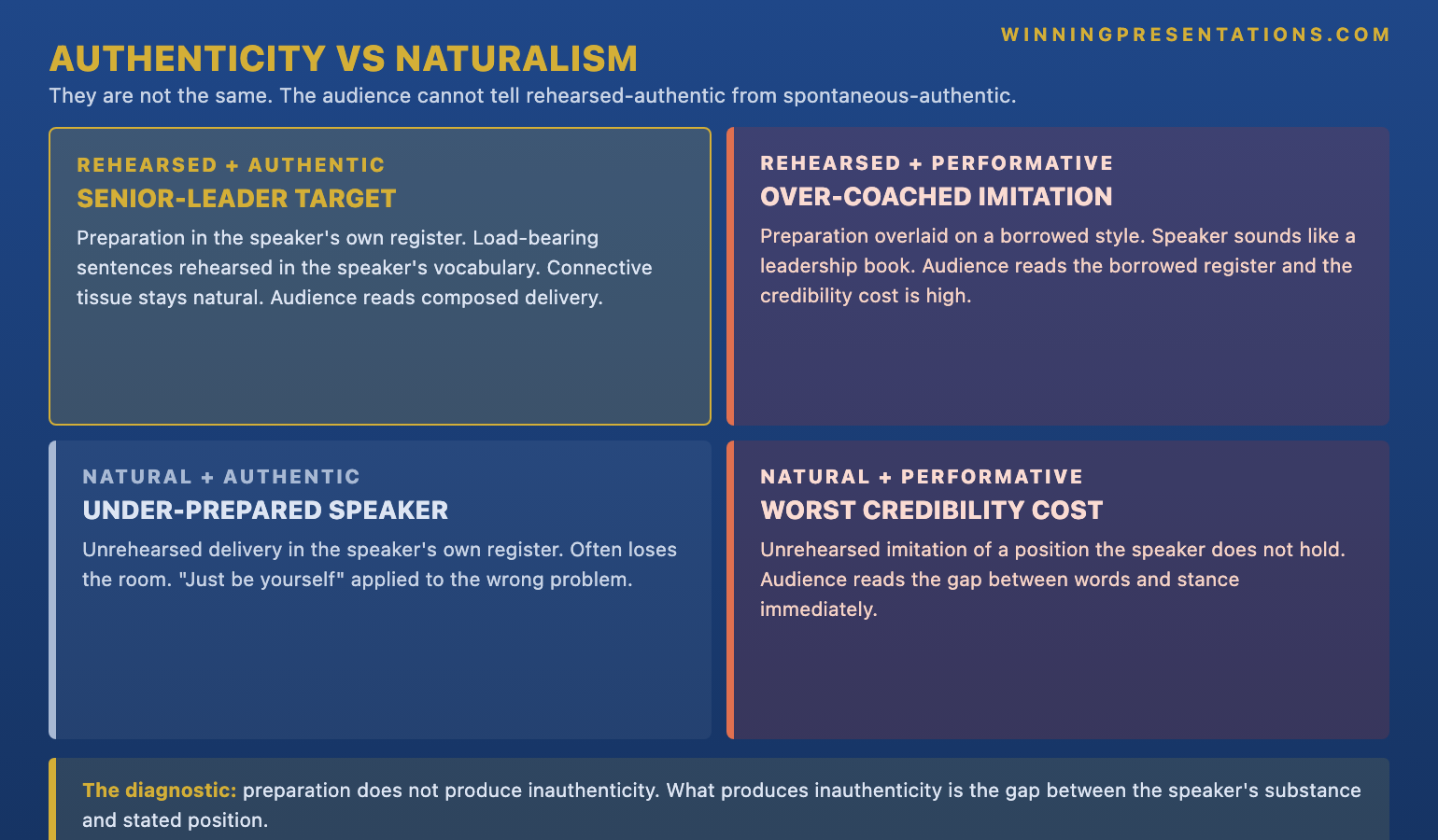
The reverse pattern is also worth naming. A speaker can be entirely natural — unrehearsed, off-the-cuff, improvised — and audibly inauthentic. This happens most often when a speaker is improvising a position they do not actually hold, walking through a recommendation they have not believed in, or responding to a question on a topic they do not fully understand. The naturalism does not save them; the audience reads the gap between the words and the speaker’s actual position, and the gap registers as the inauthenticity. Preparation does not produce inauthenticity in itself; what produces inauthenticity is the gap between the speaker’s substance and their stated position. Preparation, done well, narrows the gap rather than widens it.
What rehearsed authenticity looks like in practice
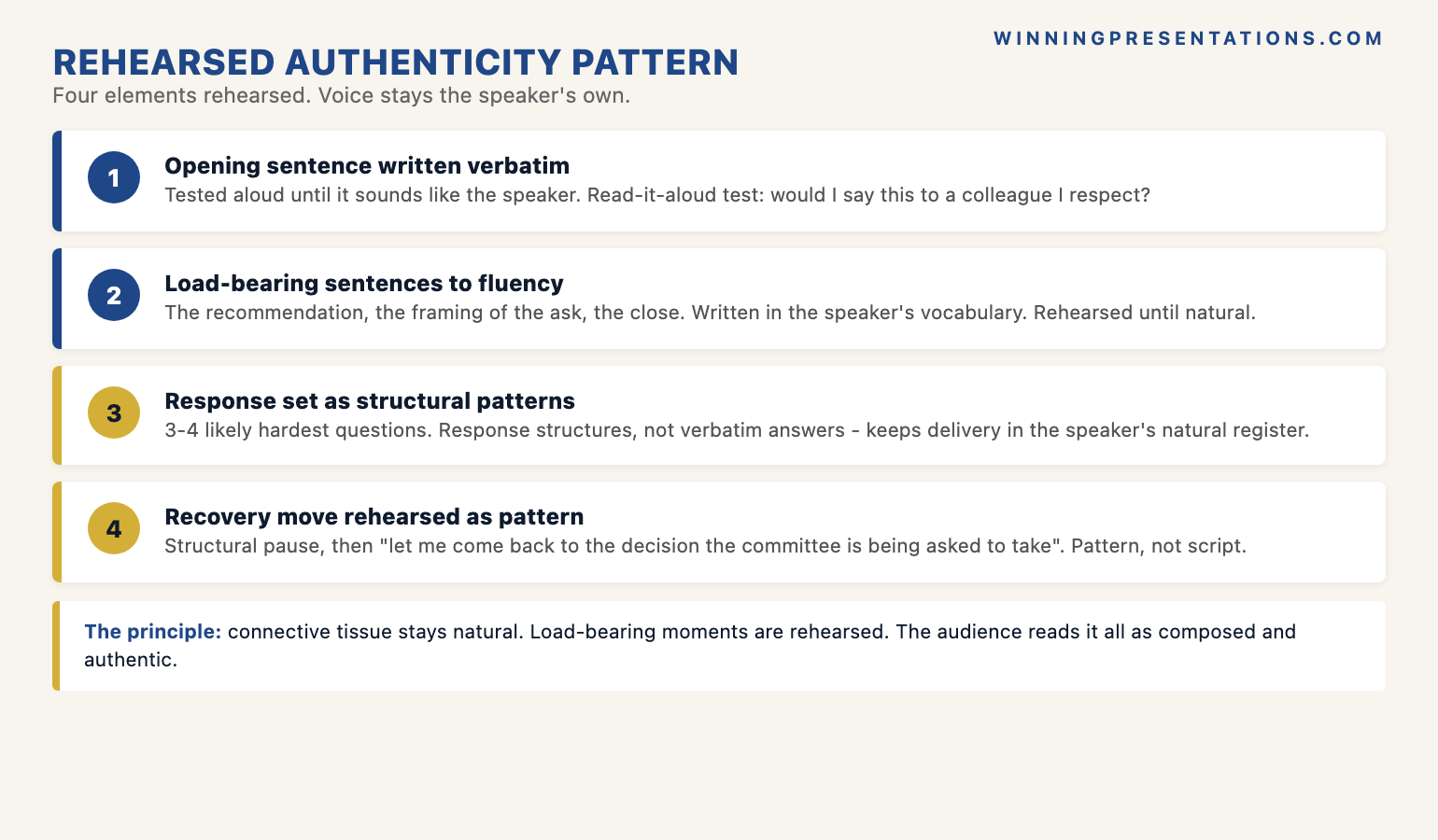
Rehearsed authenticity has a specific shape. The speaker’s natural cadence, vocabulary, and register stay; what gets rehearsed is the structure that holds the meeting together. The opening sentence is written out word for word and tested aloud until it sounds like the speaker rather than like a script. The three or four load-bearing sentences — the recommendation, the framing of the ask, the close — are similarly rehearsed to the point of fluency. The transitions between sections are rehearsed in outline rather than verbatim, because the verbatim transition is what reads as scripted. The recovery move after an unexpected question is rehearsed as a structural pattern, not as specific words.
The discipline of writing the load-bearing sentences in the speaker’s own voice is what separates rehearsed authenticity from rehearsed performance. The test is to read each sentence aloud and ask whether it sounds like something the speaker would say in a conversation with a colleague they respect. If the sentence sounds like it was lifted from a leadership book, an MBA case study, or a competitor’s pitch deck, it is rehearsed performance, not rehearsed authenticity. The rewrite is in the speaker’s own vocabulary, with the speaker’s own rhythm, even when the structural function of the sentence is the same.
Rafael, a chief financial officer at a São Paulo-headquartered manufacturing group, rebuilt his quarterly board opening sentence five times over six weeks. The first version — drafted by his communications team — used phrases like “I am pleased to report” and “moving forward strategically”. The second was Rafael’s first attempt at his own version and still sounded like a press release. The third sounded too casual for the audience. The fourth had the right register but lost the structural anchor. The fifth — “We are entering Q3 with two structural shifts in mind; the first you will see on slide one, the second on slide three” — read in his own voice and held the structure. The fifth version is the one he now uses, with one or two words changed each quarter. The structure is constant; the voice is his.
A structured framework for the kind of presentation anxiety that “just be yourself” does not solve.
Conquer Your Fear of Public Speaking is a structured framework built on the techniques I used to recover from five years of acute presentation anxiety in my own banking career. Designed for senior professionals whose anxiety predates the role and has outlasted seniority — and whose nerves have been made worse, not better, by years of “just relax” and “just be yourself” advice that addressed the wrong problem.
- The structural reframe that separates pre-meeting anxiety from in-meeting performance
- The cognitive rebuild for the night before, the morning of, and the 90 seconds before
- Techniques designed for senior professionals where standard advice has failed
- Built on lived experience, not theoretical models
- £39, instant download, lifetime updates
The anxiety cost of trying to be natural under pressure
The hidden cost of “just be yourself” advice for senior professionals is the anxiety it produces in the run-up to high-stakes meetings. A senior professional who has been told their problem is over-preparation, and who has accordingly tried to under-prepare, walks into a high-stakes room with two anxieties layered on top of each other — the standard anxiety of the meeting itself, and the additional anxiety of having stripped the preparation they would normally rely on. The result is worse, not better, than full preparation would have produced. The advice produced the opposite of its stated intent.
The structural reset is to give the speaker permission to prepare in a way that supports authentic delivery rather than undercuts it. The work is to identify which parts of the preparation are load-bearing — the opening, the load-bearing sentences, the response set, the recovery move — and to rehearse those to fluency, while leaving the connective tissue between them looser. The result is a meeting where the speaker is structurally secure on the moments that matter and improvising in the moments that do not. The audience reads the load-bearing moments as composed and the rest as natural. The anxiety is lower because the speaker knows their structural ground.
The other anxiety reduction is at the level of objective preparation rather than at the level of internal state. A speaker who knows what they will say in the first sixty seconds, knows their three load-bearing sentences, and has a planned response to the four hardest likely questions has materially reduced the actual surface area of the unknown. The dread feeds on the unknown; reducing the unknown reduces the dread. “Just be yourself” leaves the unknown intact and asks the speaker to be untroubled by it, which is sometimes possible and often not. For the closely related work on building in-the-room recovery techniques when the anxiety still spikes mid-meeting, see our calm under pressure guide.
In the room: when authentic delivery still feels exposed
Rehearsed authenticity does not eliminate exposure. Even with the structural moves prepared and the load-bearing sentences rehearsed, the speaker can still feel exposed at the moment of delivery — particularly during the recommendation sentence, the ask, and any question that touches a piece of analysis the speaker is less confident about. The exposure is normal; it is the sign that the meeting matters and that the speaker is engaged with the substance. The work is not to eliminate the exposure but to give it somewhere to go.
The in-the-room move is to use the structural pause to absorb the exposure rather than to fight it. A two-second pause before the recommendation sentence allows the speaker to ground themselves in the prepared form of the sentence rather than to launch into it from a state of acute alertness. The audience reads the pause as deliberate; the speaker uses the pause as a settle. The pause is short enough that the audience reads it as composed delivery and long enough that the speaker can return to their prepared register rather than to their stress-response register. Two seconds, used deliberately, is one of the most efficient interventions in the senior presenter’s repertoire.
If the structural buy-in work is what the next meeting calls for:
The Executive Buy-In Presentation System is a self-paced programme covering the stakeholder analysis, case construction, and presentation structure that earn approval from senior committees — built on rehearsed-authentic moves rather than borrowed performance. 7 modules, monthly cohort enrolment, optional Q&A calls (fully recorded). £499, lifetime access to materials.
The other in-the-room discipline is naming the exposure to yourself, briefly, in the moment. Senior professionals who train themselves to notice the moment of exposure — “this is the recommendation sentence; this is where it feels exposed” — and to acknowledge it internally rather than fight it, tend to recover the speaker’s authentic register faster than those who try to suppress the feeling. The acknowledgement does not need words; it is more like a brief internal nod. The exposure is a feature of caring about the outcome, not a defect to be eliminated. The structural work above lets the speaker deliver well in spite of the exposure rather than only when it is absent.
Frequently asked questions
Does this mean “just be yourself” is always bad advice?
No. It is good advice for someone who is performing a borrowed style — the leader who is imitating a senior colleague, the candidate using MBA-school vocabulary that is not their own, the manager trying to sound like someone they have admired. For those speakers, the advice removes the performance and reveals the authentic register underneath. The advice fails when the speaker is already authentic and their problem is structure, preparation, or anxiety rather than performance. The diagnostic is to ask whether the speaker’s problem is over-performance or under-preparation. The same advice helps one and hurts the other.
How do I know if I am over-rehearsed?
Over-rehearsal usually shows up as stiffness in the load-bearing sentences — the speaker arriving at the recommendation sounding like they are reading a script rather than naming their own conclusion. The remedy is not less preparation; it is rewriting the load-bearing sentences in the speaker’s own vocabulary, then rehearsing the rewritten versions to fluency. Most “over-rehearsed” speakers are not over-rehearsed at all; they have rehearsed sentences that are not in their natural voice. The fix is voice, not volume of preparation.
Should I tell the audience I have prepared carefully?
Generally no. Most senior audiences read preparation as a baseline expectation and naming it draws attention to the preparation rather than to the substance. The exception is a moment where the audience has asked a question the speaker has clearly anticipated; a brief “I had expected that question; here is the prepared response” can land well, because it signals analytical rigour rather than scripted delivery. Even there, the framing is on the analytical anticipation, not on the rehearsal of the response. The rule of thumb is that you can mention the analytical preparation; you should not mention the delivery preparation.
What about when the meeting goes off-script entirely?
This is the most common failure mode for the “just be yourself” approach and the strongest case for rehearsed authenticity. A meeting that goes off-script — major change in the audience’s framing, unexpected challenge to a foundational assumption, news in the room that changes the stakes — is exactly the meeting where preparation matters most. The rehearsed recovery move provides a structural reset that returns the speaker to their authentic register: a deliberate pause, a structural sentence (“let me come back to the decision the committee is being asked to make”), and a return to the rehearsed framing. Speakers who have rehearsed the recovery move recover faster and more authentically than those who try to improvise the reset under pressure.
The Winning Edge — weekly newsletter
The Winning Edge is a weekly newsletter for senior professionals who present at the executive level. One short email a week, focused on the structural moves that separate decks committees back from decks they defer. Subscribe to The Winning Edge →
Not ready for the full framework? Start here instead: download the free 10 Questions Every CFO Asks (+ Scripts) — the one-page reference of the questions finance leaders use to test senior recommendations and the response structure that holds up.
About the author
Mary Beth Hazeldine is Owner & Managing Director of Winning Presentations Ltd. With 25 years of corporate banking experience at JPMorgan Chase, PwC, Royal Bank of Scotland, and Commerzbank, she advises executives across financial services, healthcare, technology, and government on structuring presentations for high-stakes funding rounds, board approvals, and strategic decisions.