Tag: improve presentation skills

23 Apr 2026
Professional preparing a polished board presentation on a laptop in a modern office, focused and confident, editorial photography style

How to Improve Presentation Skills for Work: The Structured Approach That Actually Works

Quick Answer

To improve presentation skills for work you need three things working in parallel: a reliable structure so you stop rebuilding every deck from scratch, a system for managing delivery under pressure, and deliberate practice in conditions that match the real stakes of the presentations you need to give. Courses that only address one of these three typically produce temporary improvement. This guide covers all three.

Kwame had been told to “work on his presentation skills” three times in four years.

Once by a line manager after a client pitch that didn’t land. Once in a 360-degree feedback report after a town hall that received mixed responses. And once — most directly — by the head of his division, who told him in a performance review that he was “technically exceptional but needed to develop his executive presence in front of senior stakeholders.”

Each time, Kwame tried to act on the feedback. He watched YouTube videos. He read books. He took a one-day communication course his company funded. He rehearsed more. None of it moved the dial in the ways that mattered. He still rebuilt every presentation from scratch. He still felt exposed in Q&A. His delivery still tightened when the room was senior enough to matter.

The problem wasn’t effort. It was that the advice he was following addressed surface symptoms — delivery tips, confidence mantras, filler-word elimination — without addressing the underlying structural deficits that were producing them. When your presentations don’t have a reliable skeleton, you will always be improvising. And improvisation under pressure produces exactly the symptoms he was trying to fix.

Told to improve your presentation skills but not sure where to start?

The Executive Slide System gives you the structural foundation that removes the rebuilding problem — so you walk into every presentation with a proven framework rather than starting from a blank slide.

Explore the Executive Slide System →

Why Most Presentation Tips Don’t Stick

The internet contains thousands of presentation tips. Most of them are accurate. Almost none of them produce lasting change when applied in isolation, because they address individual behaviours without building the system those behaviours need to operate within.

“Make eye contact” is a useful tip. But if you’re using working memory to track your place in a poorly structured deck, your attention is on the slides — not your audience. The eye contact tip won’t help until the structural problem is resolved.

“Speak more slowly” is a useful tip. But if you’re anxious because you don’t know how to handle the Q&A that’s coming, you’ll speed up again as soon as a challenging question arrives. The delivery tip won’t help until the Q&A preparation problem is resolved.

“Use pauses instead of filler words” is a useful tip. But if your nervous system hasn’t been recalibrated to tolerate the silence, the pause will feel unbearable and you’ll default to “um” within seconds. The filler word tip won’t help until the nervous system regulation problem is resolved.

This is why presentation improvement initiatives that focus on tips — however accurate — tend to produce temporary results. You leave the workshop feeling equipped. You apply the tips in the next few presentations. Then the high-stakes presentation arrives, and you revert to baseline. Because tips are not a system. Presentation skills training that actually sticks has to address the underlying components, not just the surface behaviours.

The Three Components of Lasting Improvement

To improve presentation skills for work in a way that holds under pressure, you need to work on three components simultaneously. Each one reinforces the others. Fixing only one or two will produce partial improvement at best.

Component 1: Structure — a repeatable framework for building presentations that you don’t have to reinvent for every new context. Most professionals spend the majority of their preparation time trying to figure out what to put on each slide and in what order. A reliable structure eliminates this problem. You know the architecture; the work becomes filling it with the specific content for this presentation.

Component 2: Delivery under pressure — the ability to maintain composure, clarity, and authority when the stakes are high, the room is difficult, or the Q&A goes somewhere unexpected. This is a nervous system and rehearsal challenge, not a knowledge challenge. You can know your material completely and still feel exposed when a senior executive asks a question you hadn’t anticipated.

Component 3: Deliberate practice — a method of building skill that goes beyond simply giving more presentations and hoping improvement happens. Most people’s presentation skills plateau because they keep practising the same behaviours in the same conditions. Deliberate practice targets the specific gaps that matter and creates conditions that are challenging enough to produce genuine improvement.

The Structural Foundation Every Executive Presenter Needs

If you are rebuilding every presentation from scratch, you are solving the wrong problem before every meeting. The Executive Slide System — £39, instant access — gives you the structural framework that removes that problem permanently:

  • 22 PowerPoint templates covering the executive scenarios you actually encounter
  • 51 AI prompt cards to build content into any template fast
  • Scenario playbooks for board presentations, budget cases, client pitches, and more
  • Checklists that catch the structural errors that lose rooms before Q&A begins

Get the Executive Slide System →

Designed for professionals who need to present with confidence at executive and board level.

Structure: The Fastest Lever to Pull

Of the three components, structure produces the fastest visible improvement because it addresses the most common root cause of weak presentations: the absence of a clear decision logic.

Most professionals build presentations by gathering all the relevant information and then arranging it in a logical sequence. The problem with this approach is that “logical sequence” usually means chronological — how the situation developed, how the analysis was done, what was found, and then what is recommended. This is the right order for a research paper. It is the wrong order for an executive presentation.

Executive audiences want to know the recommendation first, the supporting evidence second, and the analysis third — if at all. This is the pyramid principle applied to presentations, and it runs counter to how most professionals were trained to present information at school and university. The result is that competent, well-prepared professionals produce presentations that bury the point, overwhelm the audience with context before the recommendation, and leave senior stakeholders frustrated even when the underlying thinking is excellent.

The executive presentation structure that works consistently follows this pattern: start with the conclusion, support it with three to four reasons or evidence points, and provide the detail as supporting material rather than the main event. This structure is learnable and replicable. Once you have internalised it, every presentation becomes easier to build — because you always know what goes where.

The templates in the Executive Slide System are built around this structure — so you don’t have to reinvent the architecture for each new presentation, you just load your content into a proven framework.

Delivery: What Changes When the Stakes Are Real

Good delivery in a low-stakes environment does not automatically transfer to good delivery in a high-stakes one. This surprises many professionals who feel confident in informal presentations but notice their delivery deteriorating when the room is more senior or the decision more significant.

What changes under pressure is the availability of cognitive resources. When the stakes feel high, part of your working memory is occupied by threat-monitoring — tracking how the room is responding, anticipating questions, managing any anxiety symptoms. This leaves less resource available for fluency, word retrieval, and the deliberate choices that constitute good delivery: eye contact, pacing, pausing.

Improving delivery under pressure therefore requires two parallel approaches. First, reduce the cognitive load of the presentation itself — a reliable structure and well-rehearsed content means less working memory is needed for the material, leaving more available for delivery choices. Second, reduce the baseline activation level of the threat response — through preparation, rehearsal in conditions that mimic the real stakes, and where necessary, nervous system regulation techniques that bring down arousal before you begin.

The specific presentation skills development work that addresses delivery under pressure includes: practising in front of people whose opinion you care about (not just in front of a mirror), recording yourself in full-dress rehearsals and watching it back, and simulating the most challenging Q&A scenarios you are likely to face. Each of these creates the conditions for genuine improvement rather than improvement in controlled practice environments that don’t translate.

Deliberate Practice: How to Improve Without More Presentations

Most professionals improve their presentation skills by giving presentations and hoping the experience produces improvement. This works to a point — you do get more comfortable with the mechanics of presenting — but it stops working once your skills plateau, because you are practising the same strengths in the same conditions.

Deliberate practice is different. It targets the specific gap, creates challenge that is slightly beyond your current capability, and builds in feedback so you can see whether you improved. Here is what deliberate practice looks like for the three most common development areas.

For structure: Take a presentation you have already given and rebuild it using a different structural logic — starting with the conclusion rather than the context, or organising by stakeholder concern rather than analytical sequence. Compare the two versions and assess which one a senior audience would find easier to act on. Repeat with three to five different past presentations until the new structure becomes your default approach.

For delivery under pressure: Ask a trusted colleague or manager to play the role of a challenging committee member during a rehearsal — specifically tasked with asking questions you won’t have prepared for, expressing scepticism, or cutting across your slides mid-sentence. This is uncomfortable. It is also the only way to build the skills you need for those conditions. Rehearsal against a supportive audience does not prepare you for a difficult one.

For verbal habits and fluency: Record two minutes of yourself explaining your current project — without notes — and watch it back with the sound off, then again with sound only. The visual and audio separation often reveals habits that are invisible when you’re watching both together. Identify the single most distracting habit and target it explicitly in the following week’s practice sessions, rather than trying to fix everything at once.

See today’s related articles: the specific verbal habits that damage executive credibility, how to present a pilot as a commercial case, and how to take a technology roadmap to the board.

Stop Rebuilding Presentations From Scratch

The Executive Slide System — £39, instant access — gives you the structural foundation, templates, and AI prompt cards that remove the biggest time drain in presentation preparation. Build better presentations faster, and walk in with a structure you trust.

Get the Executive Slide System →

Designed for professionals who need to present with confidence at executive and board level.

Frequently Asked Questions

What is the fastest way to improve presentation skills for work?

Fix your structure first. Most presentation problems — unclear delivery, loss of confidence in Q&A, audiences that seem disengaged — trace back to a structural problem: the presentation doesn’t make the recommendation early enough, or doesn’t organise information in the way a senior audience expects to receive it. Once the structure is reliable, delivery and confidence tend to follow because you’re spending less cognitive resource on figuring out where you are in the deck and more on connecting with the room.

Is it worth taking a presentation skills course for work?

It depends entirely on what the course addresses. A one-day communication workshop that covers tips and techniques without addressing structure, Q&A handling, or delivery under pressure will produce limited lasting improvement. Look for resources that provide a replicable structural framework — one you can use in your actual work presentations rather than a course-specific exercise — and that address the specific challenges you face: whether that is senior audience management, anxiety, Q&A, or deck construction. The most effective development work is targeted, not generic.

How do I improve presentation skills when I don’t present very often?

Treat every meeting where you speak as a presentation opportunity. The informal explanation you give in a team meeting, the project update you provide on a call, the recommendation you make in a one-to-one — these are all opportunities to practise structuring your thinking, leading with the conclusion, and managing the question that follows. Frequency of formal presentations is less important than the quality of practice. Deliberate work on structure and delivery in everyday professional communication builds the same capabilities you need in formal presentations.

Why do my presentation skills seem to get worse when I’m presenting to senior people?

Because senior audiences activate a stronger threat response, which takes cognitive resource away from fluency and delivery. This is a normal neurological pattern, not a sign of inadequate preparation. The mitigation is twofold: reduce the cognitive load of the presentation itself through structure and rehearsal, and reduce your baseline arousal level before you present through preparation rituals and, where needed, nervous system regulation techniques. Most professionals find that the combination of better structure and targeted rehearsal in high-stakes conditions produces measurable improvement within four to six presentations.

The Winning Edge — Weekly Presentation Intelligence

Every Thursday, one framework or technique for high-stakes presenting at work — drawn from 25 years of boardroom experience and 16 years training executives. Join The Winning Edge →

Not ready for the full system? Start here: download the free Executive Presentation Checklist — a one-page reference covering the structure and slides every work presentation needs before it goes to a senior audience.

About the Author

Mary Beth Hazeldine is the Owner & Managing Director of Winning Presentations. With 25 years of corporate banking experience at JPMorgan Chase, PwC, Royal Bank of Scotland, and Commerzbank, she advises executives across financial services, healthcare, technology, and government on structuring presentations for high-stakes funding rounds and approvals.

Book a discovery call | View services

29 Jan 2026
Confident business leader reviewing presentation on laptop with focused expression and minimal workspace

I Had 4 Hours a Week to Improve My Presentations. Here’s What Actually Moved the Needle

My calendar was a disaster. Back-to-back meetings. Endless email. Two direct reports who needed constant coaching.

And somewhere in that chaos, I was supposed to “work on my presentation skills.”

Every article I found assumed I had hours to practice. Record yourself! Watch it back! Do it again! Join Toastmasters! Find a speaking buddy!

I had maybe four hours a week—total—that weren’t already claimed. And most of those were fragmented: 30 minutes here, 45 minutes there.

So I stopped trying to follow the standard advice. Instead, I reverse-engineered what actually moves the needle for busy leaders. The answer wasn’t more practice time. It was smarter practice—focused on the three levers that create 80% of the impact.

Quick Answer: Presentation skills development for busy leaders requires ruthless prioritisation. Focus on three levers: structure (how you organise information), delivery (how you use voice and pacing), and presence (how you command attention). Most leaders only need 2-4 hours per week of focused practice—but it must target the right skills in the right order. Framework first, then refinement.

⏱️ Presenting This Week? Your 25-Minute Head Start

Before diving into the full roadmap, here are three things you can do right now:

  1. Rewrite your opening (10 min) — Start with your recommendation or key message, not background. What do you want them to do?
  2. Cut 30% of your slides (10 min) — Move anything that’s “nice to have” to an appendix. Keep only what directly supports your ask.
  3. Script your close (5 min) — Write the exact words you’ll use to ask for the decision. “I’d like your approval to [specific action] by [date].”

These three changes will improve your next presentation more than hours of slide polishing. Now read on for the complete system.

🎯 Is This Your Situation?

  • You’re senior enough that presentations matter—but too busy to spend hours practicing
  • You’ve plateaued at “good enough” and can’t seem to break through
  • Generic advice (“just practice more!”) doesn’t fit your reality
  • You want a roadmap, not a random collection of tips
  • You need results in weeks, not years

If this sounds familiar, keep reading. This roadmap was built for exactly your constraints.

The Realisation That Changed Everything

I spent years believing I needed more time to improve. More practice sessions. More feedback. More reps.

Then I noticed something odd: the best presenters in my organisation weren’t the ones with the most free time. They were often the busiest—running divisions, managing crises, juggling impossible demands.

What they had wasn’t more time. It was a system. A framework they could apply to any presentation, regardless of how little prep time they had.

When I finally asked one of them directly—a CFO who could command any room despite preparing most presentations on the train—she said something I’ve never forgotten:

“I don’t practice presentations. I practice principles. The presentation just follows.”

That’s when I understood: improving your presentations isn’t about finding more hours. It’s about knowing exactly which skills to develop, in which order, with which exercises. Everything else is noise.

Why Generic Presentation Advice Fails Busy Leaders

Most presentation advice is written for people with unlimited time and no constraints. It assumes you can:

— Record every presentation and review it
— Attend weekly practice groups
— Rehearse the same deck five times before delivery
— Hire a coach for ongoing feedback

If you’re a senior leader, none of that is realistic. You’re preparing presentations in the gaps between other work. Sometimes you get the deck 30 minutes before you present it. Sometimes you’re presenting someone else’s material entirely.

The real question isn’t “how do I practice more?”

It’s “what’s the minimum effective dose that actually improves my presentations?”

After 24 years of presenting in banking environments—and training executives who face the same constraints—I’ve identified three levers that create the vast majority of impact. Everything else is optimisation at the margins.

For more on how frameworks beat generic tips, see my guide on the executive presentation framework that AI can’t replace.

The Three Levers That Create 80% of Impact

Presentation skills development isn’t one skill—it’s a cluster of skills that interact. But not all skills are equal. Three levers drive most of the results:

Lever 1: Structure

How you organise information determines whether audiences follow you or lose you. Structure is invisible when done well—the presentation just “flows.” But when structure is weak, no amount of charisma saves you.

Structure is also the highest-leverage skill because it transfers. Learn to structure once, and every presentation improves automatically.

Lever 2: Delivery

Voice, pacing, pauses, emphasis. Delivery is how you bring structure to life. The same content delivered with poor pacing feels boring; delivered with good pacing, it feels compelling.

Delivery is trainable but requires deliberate practice. Most people never improve because they never isolate the specific delivery skills that need work.

Lever 3: Presence

How you occupy space. How you handle silence. How you respond when challenged. Presence is what separates good presenters from people who command rooms.

Presence is partly psychological (confidence, calm under pressure) and partly physical (posture, eye contact, movement). Both can be developed.

Presentation skills development roadmap showing three phases structure delivery and presence with timeline

The order matters. Structure first, because it’s foundational. Delivery second, because it activates structure. Presence third, because it multiplies everything else.

Trying to develop presence before you have solid structure is like polishing a car with a broken engine. It might look good, but it won’t get you anywhere.

⭐ The Complete Development System for Busy Leaders

AI-Enhanced Presentation Mastery is a structured cohort programme that develops all three levers—in the right order, with the right exercises, in a time-efficient format designed for senior professionals.

What you’ll develop:

  • The executive structure framework (70% of the programme)
  • AI-enhanced preparation workflows that often cut creation time significantly
  • Delivery and presence techniques for high-stakes environments

Learn More About the Programme →

Live cohort programme on Maven. Limited to 20 participants for hands-on feedback.

Phase 1: Structure (Weeks 1-4)

Structure is where most presentation improvement should begin—and where most busy leaders skip ahead too quickly.

Week 1-2: The Core Framework

Learn one structural framework deeply. Not five frameworks superficially. One framework you can apply to any presentation type: board updates, client pitches, team meetings, all-hands presentations.

The framework I teach has three components: Context (why this matters now), Content (what you need to know), and Call-to-action (what happens next). Every presentation maps to this structure.

Week 3-4: Application Practice

Take three real presentations from your calendar. Restructure each using the framework. You don’t need to deliver them differently—just reorganise the information.

This is where the skill becomes automatic. By the end of Week 4, you should be able to look at any presentation and immediately see where the structure is weak.

Time investment: 2-3 hours per week. Can be done in fragments.

For more on why structure is foundational, see my guide on presentation skills training that actually works.

Phase 2: Delivery (Weeks 5-8)

With structure solid, delivery becomes the multiplier. The same well-structured content can land with impact or fall flat—delivery makes the difference.

Week 5-6: Voice and Pacing

Most leaders speak too fast when presenting. Not because they’re nervous (though that’s part of it) but because they’ve never practised deliberate pacing.

Exercise: Take one section of an upcoming presentation. Deliver it three times: first at normal speed, then deliberately 30% slower, then finding the pace that feels right. Record the third version.

Week 7-8: Strategic Pauses

Pauses are the most underused tool in presentation delivery. A pause before a key point creates anticipation. A pause after creates absorption time. Most presenters fill every silence with “um” or “so.”

Exercise: Identify three moments in your next presentation where a 2-second pause would add impact. Mark them in your notes. Deliver them deliberately.

Time investment: 2-3 hours per week. Requires some uninterrupted practice time.

Want Delivery Exercises Designed for Senior Professionals?

AI-Enhanced Presentation Mastery includes specific delivery drills calibrated for busy leaders, plus live feedback on your actual presentations.

Learn More About the Programme →

Phase 3: Presence (Weeks 9-12)

Presence is what remains when structure and delivery are handled. It’s the quality that makes some presenters magnetic—and it’s more trainable than most people believe.

Week 9-10: Physical Presence

Posture, eye contact, use of space. These aren’t soft skills—they’re signals that audiences read unconsciously.

Exercise: Before your next presentation, stand for 2 minutes in an expansive posture (feet shoulder-width, arms uncrossed, chest open). Many leaders find this helps shift their physiological state before high-stakes moments. Then carry that posture into the room.

Week 11-12: Psychological Presence

The ability to stay calm when challenged. To handle silence without rushing to fill it. To respond to hostile questions without becoming defensive.

This is partly technique (specific frameworks for handling Q&A) and partly mindset (understanding that presence comes from internal state, not external validation).

Time investment: 2-4 hours per week. Includes real presentation opportunities.

How long does it take to improve presentation skills?

With focused practice on the right skills, most leaders notice meaningful improvement within 4-6 weeks. Significant transformation typically takes 90 days of consistent work. The key is deliberate practice on specific skills—not generic “presenting more often.”

Can you improve presentation skills without a coach?

Yes, but progress is typically slower without feedback. Self-study works for structure and some delivery skills. Presence and advanced delivery usually benefit from external perspective—whether a coach, peer group, or structured programme with feedback built in.

What’s the fastest way to get better at presentations?

Focus on structure first. It’s the highest-leverage skill and transfers to every presentation. Most leaders who feel stuck are actually stuck on structure—they’ve been trying to improve delivery and presence without the foundation. Fix structure, and everything else becomes easier.

⭐ Accelerate Your Development With Expert Guidance

The roadmap above works. But working through it with expert feedback and a cohort of peers accelerates results dramatically.

AI-Enhanced Presentation Mastery includes:

  • Live sessions covering structure, delivery, and presence
  • AI workflows that often cut preparation time significantly
  • Direct feedback on your actual presentations

Learn More About the Programme →

Next cohort starts soon. 70% framework, 30% AI enhancement.

The 4-Hour Weekly Rhythm

Here’s how to structure your limited time for maximum impact:

Hour 1: Learning (can be fragmented)

Read, watch, or listen to material on your current focus area. This can happen in 15-minute blocks: commute time, lunch, waiting for meetings to start.

Hour 2: Application (needs focus)

Take what you learned and apply it to a real upcoming presentation. Restructure. Rewrite. Mark delivery points. This works best in a single focused block.

Hour 3: Practice (needs privacy)

Actually deliver a section out loud. Not in your head—out loud. Record if possible. This requires uninterrupted time, but even 30 minutes twice per week compounds.

Hour 4: Reflection (can be fragmented)

After each real presentation, spend 15 minutes noting what worked and what didn’t. This is where learning consolidates. Most people skip this—and lose 80% of the development value.

Four hours. Sixteen weeks. The three levers. That’s the roadmap.

Want to Compress This Timeline?

AI-Enhanced Presentation Mastery covers the complete framework in a structured cohort format—with expert guidance and peer feedback built in.

Learn More About the Programme →

For more on how AI can enhance (not replace) your presentation workflow, see my guide on AI presentation workflows that actually work.

⭐ Ready to Accelerate Your Presentation Development?

AI-Enhanced Presentation Mastery is a live cohort programme for senior professionals who want to develop executive-level presentation skills in a time-efficient format.

What makes it different:

  • 70% framework development, 30% AI enhancement (not an AI gimmick)
  • Limited to 20 participants for meaningful feedback
  • Designed for busy leaders with real time constraints

Learn More About the Programme →

Live on Maven. Built from 24 years of executive presentation experience.

Frequently Asked Questions

How much time per week do I really need to improve my presentations?

Four hours per week is the minimum effective dose for meaningful improvement. Less than that and progress is too slow to maintain momentum. More than that isn’t necessary for most leaders—it’s about quality of practice, not quantity. The key is consistency over 12-16 weeks rather than intensity over a few weeks.

Should I focus on one skill at a time or work on everything?

Focus on one skill at a time, in sequence. Structure first (weeks 1-4), then delivery (weeks 5-8), then presence (weeks 9-12). Trying to improve everything simultaneously dilutes focus and slows progress. Each skill builds on the previous one.

What if I don’t have time to practice before presentations?

That’s actually the point of framework-based development. Once you’ve internalised the structure framework, you don’t need hours of prep—you can apply it quickly to any content. The 90-day development period is an investment that pays dividends in every future presentation.

Is presentation development different for senior leaders?

Yes. Senior leaders face unique constraints (less prep time, higher stakes, more diverse audiences) and unique opportunities (more real presentation reps, more authority in the room). Generic presentation advice doesn’t account for these differences. Development programmes designed for executives focus on high-leverage skills that work under real-world constraints.

Get Weekly Presentation Insights

Actionable advice for busy leaders—no fluff, just what works.

Subscribe to The Winning Edge →

Related: Structure starts with understanding what your audience actually needs. Read What Executives Actually Want From Your Presentation to see how decision-first structure works in practice.

The Bottom Line

Presentation skills development doesn’t require endless hours. It requires focus on the right skills, in the right order, with deliberate practice.

Structure first. Delivery second. Presence third. Four hours per week. Twelve to sixteen weeks.

That’s the roadmap. The question is whether you’ll actually follow it—or keep waiting for more time that never comes.

Your next step: Identify your next presentation. Before you build any slides, write out the structure: Context (why this matters now), Content (what they need to know), Call-to-action (what happens next). That single exercise will improve your presentation more than hours of slide polishing.

Mary Beth Hazeldine is the Owner of Winning Presentations, with 24 years of experience presenting in high-stakes banking environments at JPMorgan Chase, PwC, Royal Bank of Scotland, and Commerzbank. She has trained thousands of executives on presentation capability that works within real-world time constraints.

31 Dec 2025
Presentation skills goals for 2026 - what senior professionals need to improve

Presentation Skills Goals for 2026: What Senior Professionals Actually Need to Improve

Last updated: December 31, 2025 · 9 minute read

Most presentation skills goals fail before February.

Not because professionals lack discipline. Not because they’re too busy. But because they’re setting the wrong goals entirely.

“Present more confidently” isn’t a goal — it’s a wish. “Get better at slides” isn’t measurable. “Stop being nervous” isn’t achievable through willpower alone.

After 24 years in corporate banking and training over 5,000 executives at Winning Presentations, I’ve watched hundreds of professionals set presentation skills goals every January. The ones who actually improve share something specific: they treat presentation skills like a system, not an event.

Senior professionals who improve fastest invest in a working executive presentation toolkit rather than hoping a single course or book will fix the structural issues.

Here’s what actually works for setting presentation skills goals in 2026 — and why most advice gets it completely wrong.

⚡ Key Takeaways

  • Most presentation skills goals fail because they lack feedback loops, structure, and measurement
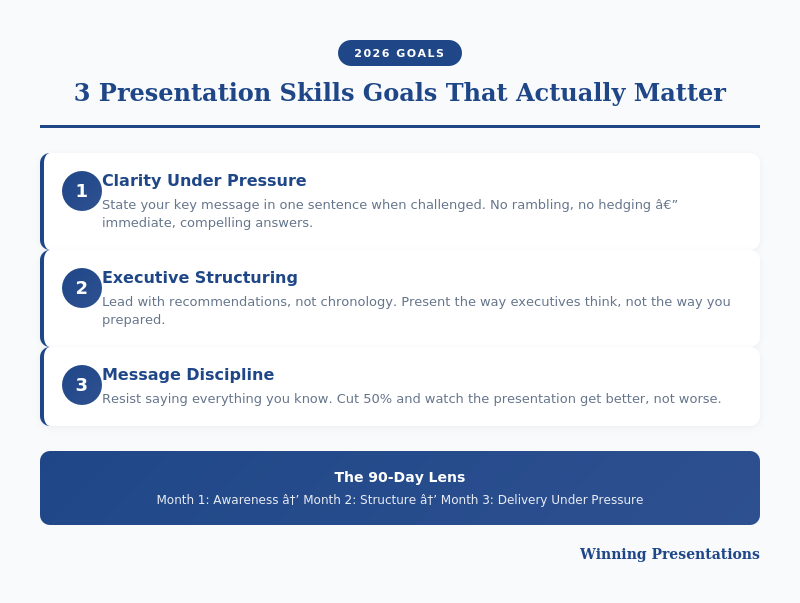
  • The 3 goals that matter: Clarity under pressure, executive structuring, and message discipline
  • 90-day improvement lens — Month 1: Awareness, Month 2: Structure, Month 3: Delivery under pressure
  • Systems beat motivation — deliberate practice compounds; random repetition doesn’t
  • Senior professionals think differently — they focus on skill systems, not presentation events

📥 FREE DOWNLOAD: Executive Presentation Checklist

The pre-presentation routine I use before every high-stakes talk.

Download Free →

Why Most Presentation Skills Goals Fail

Every January, millions of professionals make some version of the same resolution: “This year, I’ll get better at presenting.”

By March, nothing has changed.

The problem isn’t motivation. Research on professional development consistently shows that intention alone doesn’t drive skill improvement. What does? Systems.

Here’s why most presentation skills goals fail:

No Feedback Loop

You present. It goes “okay.” You present again. It goes “okay.” Without specific, structured feedback, you’re just reinforcing existing habits — good and bad.

Most professionals never get real feedback on their presentations. Colleagues say “that was great” because they’re being polite. Your manager focuses on content, not delivery. You have no idea what’s actually working or failing.

No Structure

“Get better at presenting” isn’t a goal — it’s a direction. Better how? Better at what specifically? Better measured by whom?

Vague presentation skills goals produce vague results. Without structure, you’ll drift toward whatever feels comfortable rather than what actually needs improvement.

No Measurement

How do you know if you’ve improved? Most professionals can’t answer this question. They rely on feelings: “I think I’m better.” “That one went well.”

Feelings aren’t measurement. Without clear metrics — even simple ones — you can’t track progress or identify what’s working.

No Pressure Simulation

Practising presentations alone in your office isn’t the same as presenting to a sceptical board. The skills that matter most — composure under pressure, handling tough questions, reading the room — only develop under realistic conditions.

This is why many professionals “know” what to do but can’t execute when it matters. They’ve practised the easy part and avoided the hard part.

For more on building genuine confidence, see my guide on how to speak confidently in public.

The 3 Presentation Skills Goals That Actually Matter

3 presentation skills goals that actually matter for professionals

After training thousands of executives, I’ve identified the three presentation skills goals that actually differentiate senior professionals from everyone else.

These aren’t “soft skills.” They’re specific, measurable capabilities that directly impact whether you get the outcome you want from a presentation.

Goal 1: Clarity Under Pressure

Can you articulate your key message in one sentence when someone interrupts you mid-presentation and asks “what’s the bottom line?”

Most professionals can’t. They’ve prepared 20 slides but haven’t distilled their core message. When pressure hits — an unexpected question, a time cut, a sceptical executive — they ramble, hedge, or lose the thread entirely.

What this looks like in practice:

  • You can state your recommendation in under 15 seconds
  • You can explain your “why” without slides
  • You stay coherent when challenged or interrupted
  • Your answer to “so what?” is immediate and compelling

How to develop it: Practise the “elevator pitch” for every presentation. Before you open PowerPoint, write your one-sentence message. Then test yourself: can you deliver it under pressure?

Goal 2: Executive Structuring

Do you structure presentations the way senior leaders think — or the way you think?

Most professionals present chronologically: “Here’s what I did, here’s what I found, here’s what I recommend.” Executives want the opposite: “Here’s my recommendation, here’s why, here’s what I need from you.”

What this looks like in practice:

  • You lead with the decision or recommendation
  • You provide supporting evidence, not comprehensive data
  • You anticipate the three questions they’ll ask
  • You can present the same content in 5 minutes or 30 minutes

How to develop it: Study how your most effective executives present. Notice the structure. Then apply it to your own content — starting with the “so what” instead of building toward it.

For detailed frameworks, see my guide on executive presentations.

Goal 3: Message Discipline

Can you resist the urge to say everything you know?

The curse of expertise is wanting to share all of it. But senior leaders don’t want comprehensive — they want relevant. They don’t want thorough — they want clear.

What this looks like in practice:

  • You cut 50% of your slides and the presentation gets better
  • You answer questions directly without over-explaining
  • You let silence exist instead of filling it with caveats
  • Your backup slides contain more content than your main deck

How to develop it: After preparing any presentation, force yourself to cut it by half. Not by rushing — by prioritising. What’s essential? What’s “nice to have”? Kill the nice-to-haves.

💡 Ready to Structure Like a Senior Leader?

The Executive Slide System includes 7 frameworks for structuring presentations the way executives think — recommendation-first, evidence-based, action-oriented.

Stop building toward your point. Start with it.

Get the Executive Slide System — £39 →

The 90-Day Improvement Lens for Presentation Skills Goals

Annual presentation skills goals are too distant. They let you procrastinate. “I have all year” becomes “I’ll start next month” becomes “maybe next year.”

Think in 90-day cycles instead. Three months is long enough to create real change, short enough to maintain urgency.

Month 1: Awareness

Before you can improve, you need to know what needs improving. Most professionals have blind spots — habits they don’t notice, weaknesses they’ve never identified.

Actions for Month 1:

  • Record yourself presenting (video, not just audio)
  • Ask 3 colleagues for specific, honest feedback
  • Identify your top 3 weaknesses — the specific things hurting your impact
  • Watch executives you admire — what do they do differently?

This month isn’t about changing anything. It’s about seeing clearly.

Month 2: Structure

Now that you know what to work on, build the systems that will drive improvement.

Actions for Month 2:

  • Create a pre-presentation routine you use every time
  • Develop 2-3 frameworks you apply to every presentation
  • Build a feedback system — how will you get input after each presentation?
  • Schedule deliberate practice, not just presentations

Structure turns intentions into habits. Without it, you’ll default to old patterns under pressure.

Month 3: Delivery Under Pressure

This is where most professionals skip. They practice alone, in comfortable settings, without stakes.

Actions for Month 3:

  • Present to colleagues who will challenge you — not support you
  • Practice with time constraints (you have 5 minutes, not 20)
  • Rehearse handling interruptions and tough questions
  • If possible, get coaching or join a structured programme

Skills that collapse under pressure weren’t really skills — they were comfort-zone performances.

For advanced techniques on handling pressure, see my guide on advanced presentation skills.

🎓 Want Structured Development?

If 2026 is the year you want to master presentation skills properly, structured development matters more than random practice.

Framework-based programmes with psychology techniques and expert feedback create lasting change — not just temporary motivation. If you’d like to discuss what structured development might look like for you, get in touch →

How Senior Professionals Think About Presentation Skills Goals

There’s a mental shift that separates professionals who continuously improve from those who plateau.

Skills vs Events

Plateau thinking: “I have a big presentation next month. I need to prepare for it.”

Growth thinking: “Presenting is a skill I’m developing. Each presentation is a data point.”

When you treat presentations as isolated events, you prepare, perform, and forget. When you treat presenting as an ongoing skill development, each presentation becomes an opportunity to test, learn, and refine.

Systems vs Motivation

Plateau thinking: “I need to feel confident before I can present well.”

Growth thinking: “I need systems that work even when I don’t feel confident.”

Motivation is unreliable. Systems are consistent. The executives who present brilliantly under pressure don’t rely on feeling good — they rely on preparation routines, structural frameworks, and recovery techniques that work regardless of how they feel.

Deliberate Practice vs Repetition

Plateau thinking: “The more I present, the better I’ll get.”

Growth thinking: “Purposeful practice on specific weaknesses improves skill. Random repetition just reinforces habits.”

Twenty years of presenting doesn’t automatically make you good. It makes you experienced. If you’ve been reinforcing bad habits for twenty years, you’re just an experienced bad presenter.

Deliberate practice means identifying specific weaknesses, designing exercises to address them, getting feedback, and adjusting. It’s uncomfortable. That’s why it works.

Making 2026 the Year You Actually Improve Your Presentation Skills Goals

Here’s the honest truth: most people reading this won’t do anything different in 2026.

Not because they lack ability or desire. But because they’ll set vague goals, rely on motivation, and treat presentation skills as an afterthought when they’re not actively presenting.

The professionals who actually improve will:

  • Set specific, measurable presentation skills goals (not wishes)
  • Build systems that don’t depend on motivation
  • Create accountability through feedback loops or structured programmes
  • Practice under realistic pressure, not comfortable conditions
  • Treat presenting as a skill to develop, not an event to survive

If that sounds like work, it is. Skill development always is. But the compound returns are substantial — in promotions, influence, credibility, and career opportunities.

The question isn’t whether presentation skills matter for your career in 2026. They obviously do.

The question is whether you’ll treat them like the strategic asset they are — or continue hoping that “more practice” will somehow produce different results.

Your Next Step

📖 FREE: Executive Presentation Checklist
The pre-presentation routine I use before every high-stakes talk.
Download Free →

💡 QUICK WIN: Executive Slide System — £39
7 frameworks for structuring presentations the way senior leaders think.
Get Instant Access →

🎓 COMPLETE SYSTEM: Structured Development
If you’re ready for comprehensive training with expert guidance, let’s discuss what that looks like for you →

FAQs: Presentation Skills Goals

What are the most important presentation skills goals to set for 2026?

The three presentation skills goals that matter most are: clarity under pressure (being able to state your key message when challenged), executive structuring (leading with recommendations instead of building toward them), and message discipline (resisting the urge to say everything you know). These directly impact whether you achieve your presentation outcomes.

How long does it take to improve presentation skills?

With deliberate practice and structured feedback, most professionals see meaningful improvement within 90 days. The key is focusing on specific weaknesses rather than general “practice.” Random repetition reinforces habits; deliberate practice changes them. Think in 90-day improvement cycles rather than annual goals.

Why do most presentation skills goals fail?

Most presentation skills goals fail because they lack four things: feedback loops (you don’t know what’s working or failing), structure (vague goals produce vague results), measurement (feelings aren’t data), and pressure simulation (practicing alone doesn’t prepare you for real stakes). Systems address all four.

How can I measure improvement in my presentation skills?

Measure presentation skills improvement through specific outcomes: Did you get the decision you wanted? Did stakeholders engage or disengage? How many clarifying questions did you get (fewer often means clearer communication)? Did you stay within your time limit? Recording yourself and comparing over time also provides objective measurement.

What’s the difference between deliberate practice and just presenting more?

Presenting more reinforces existing habits — good and bad. Deliberate practice involves identifying specific weaknesses, designing exercises to address them, getting feedback, and adjusting your approach. Twenty years of presentations doesn’t automatically make you skilled; it makes you experienced. The distinction determines whether you improve or plateau.


Mary Beth Hazeldine is the Owner & Managing Director of Winning Presentations. She spent 24 years in corporate banking at JPMorgan Chase, PwC, Royal Bank of Scotland, and Commerzbank, and has trained over 5,000 executives to present with impact. Her clients have raised over £250 million using her frameworks.

Get Weekly Presentation Insights

Join 2,000+ professionals getting practical presentation tips every Tuesday.

Subscribe to The Winning Edge →