
Quick answer: A hybrid meeting presentation is structurally two presentations running at the same time on two different signal channels. The senior presenters who land both audiences open with a deliberate double acknowledgement of the room and the camera tiles, rotate named attention between the two audiences across the first ten minutes, and run a two-screen check at the midpoint that exposes when the remote tiles have stopped engaging. Junior presenters address the in-room audience by default, treat the remote tiles as a peripheral feed, and discover at the end of the call that the remote half have been silently disengaged for thirty minutes. The two-audience discipline is what separates a hybrid meeting that holds both audiences from one that has effectively become an in-room meeting with passive observers on Zoom.
JUMP TO:
- Why a hybrid meeting is structurally two presentations at once
- The double acknowledgement that opens both audiences at the same time
- The named-attention rotation across the first ten minutes
- The two-screen check at the midpoint
- The hybrid-attention diagnostic the day before the meeting
- One thing to do before the next hybrid presentation
- Frequently asked questions
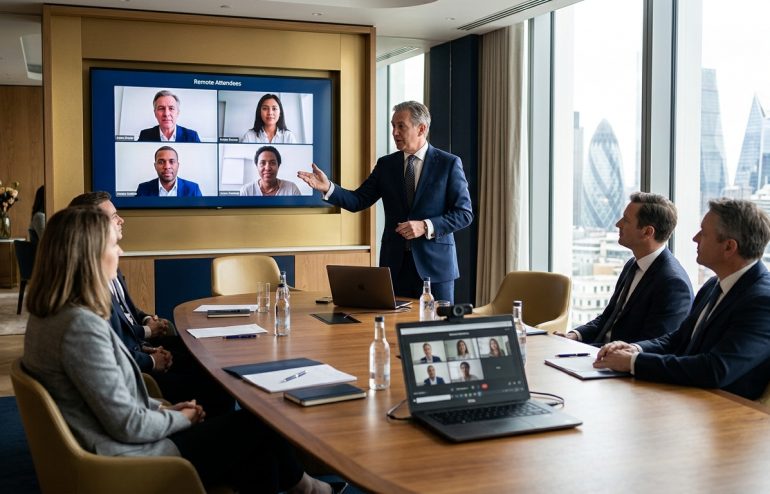
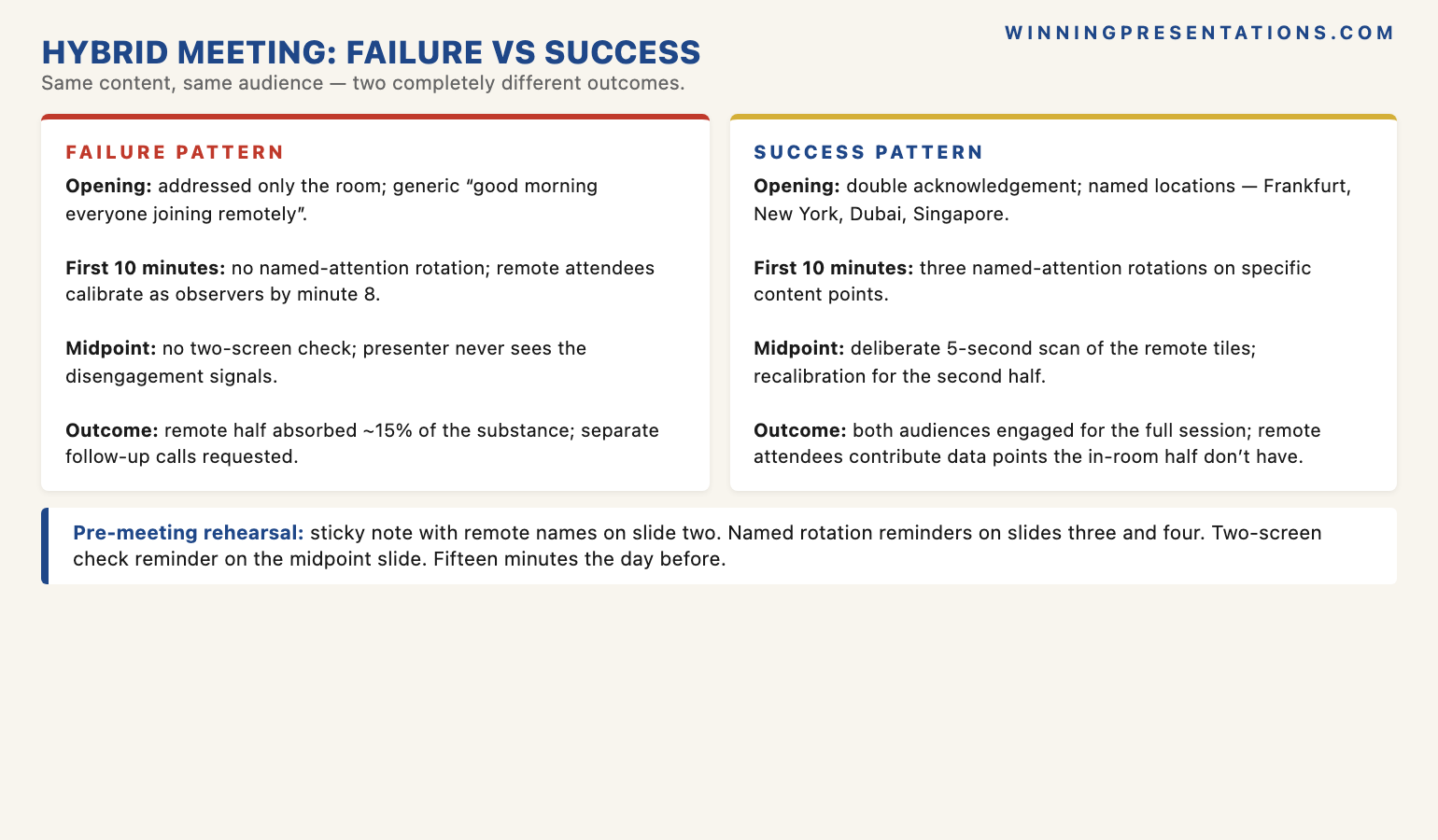
In October 2019 I observed a hybrid partner meeting at a consulting firm in central London. The room was the largest meeting space on the partner floor — a long oval table with seating for twelve, a wall-mounted screen at one end, and a single laptop in the centre of the table acting as both the Zoom host and the camera-and-microphone feed for the four partners joining remotely from Frankfurt, New York, Dubai, and Singapore. The presenter was a regional sales director presenting the Q3 pipeline to the partner group: six partners in the London room, four partners on Zoom on the wall-mounted screen as a 2×2 tile grid. He opened the meeting facing the room, said “Right, let’s get started”, looked around the table at the six in-room partners, and went straight into slide one. Forty-three minutes later, at the end of the meeting, the New York partner unmuted and asked a question that had been clearly addressed on slide four. The London partners exchanged glances. The presenter had been speaking to the room the entire session. The four remote partners had been visually present but had not been brought into the conversation once. Three of them had been on email for the last twenty minutes. Two of them later asked for a separate follow-up call to walk through the same pipeline. The meeting had been structurally two meetings, and only one of them had happened.
(This article was created with AI assistance; all stories and insights are based on 35 years of real client work.)
This piece walks through the three structural moves senior presenters make in a hybrid meeting presentation to hold both audiences at once — the double acknowledgement that opens both channels in the first thirty seconds, the named-attention rotation that holds the remote tiles inside the first ten minutes, and the two-screen check at the midpoint that exposes when the remote half has drifted. The moves are not about hybrid technology or fancier camera setups. They are about the discipline of chairing two parallel audiences whose attention costs and engagement signals are structurally different, and treating them as two audiences rather than as one room with some additional tiles attached. Senior presenters who treat the hybrid format as one extended audience lose the remote half within ten minutes. Senior presenters who treat it as two audiences chaired in parallel hold both for the full session.
Before the next hybrid meeting, the structural pre-check is worth ten minutes.
The Virtual Presentation Quick-Start Checklist covers the camera setup, the opening seconds, and the engagement signals that work in the hybrid format. Free download, no email gate.
Why a hybrid meeting is structurally two presentations at once
The structural problem of the hybrid format is that the two audiences receive the presentation through different signal channels and have different engagement costs. The in-room audience receives the presentation through the presenter’s physical presence: posture, eye contact, the way the presenter moves around the front of the room, the side conversations they can join during the natural pauses, the body language of the other partners around the table. The in-room audience’s engagement cost is essentially zero; they are physically committed to the room for the duration of the meeting and the social signals around the table will keep them engaged whether or not the presenter does anything special. The remote audience receives the presentation through a 2×2 or 3×3 tile grid on the wall-mounted screen at the front of the room, mediated by a single ceiling microphone, with the presenter visible only at the moments they happen to face the laptop camera in the centre of the table. The remote audience’s engagement cost is very high; they can mute, turn off their camera, and switch to email at any moment with no social cost to themselves and no visible signal to the room.
The asymmetry is the entire structural problem. The presenter who chairs the meeting by default ends up chairing the in-room audience because that audience is in front of them, gives them the engagement signals they are trained to read, and rewards the presenter’s effort with visible nods and follow-up questions. The remote audience receives whatever bandwidth the presenter has left over after running the in-room conversation, which in practice is close to none. The remote audience disengages silently inside the first ten minutes; the presenter does not notice because the remote tiles continue to show faces looking at screens; the in-room conversation continues to feel productive; and the meeting ends with the in-room half believing the session has gone well and the remote half having absorbed perhaps fifteen percent of the substance. The London consulting meeting in 2019 was a textbook version of this dynamic. The regional sales director was a good presenter by every conventional measure; he was just running an in-room meeting in a format that required him to run two meetings at once. The signals remote attendees give before they check out covers the pattern from the remote-tile side, where the disengagement is much more visible than the presenter realises.
The double acknowledgement that opens both audiences at the same time
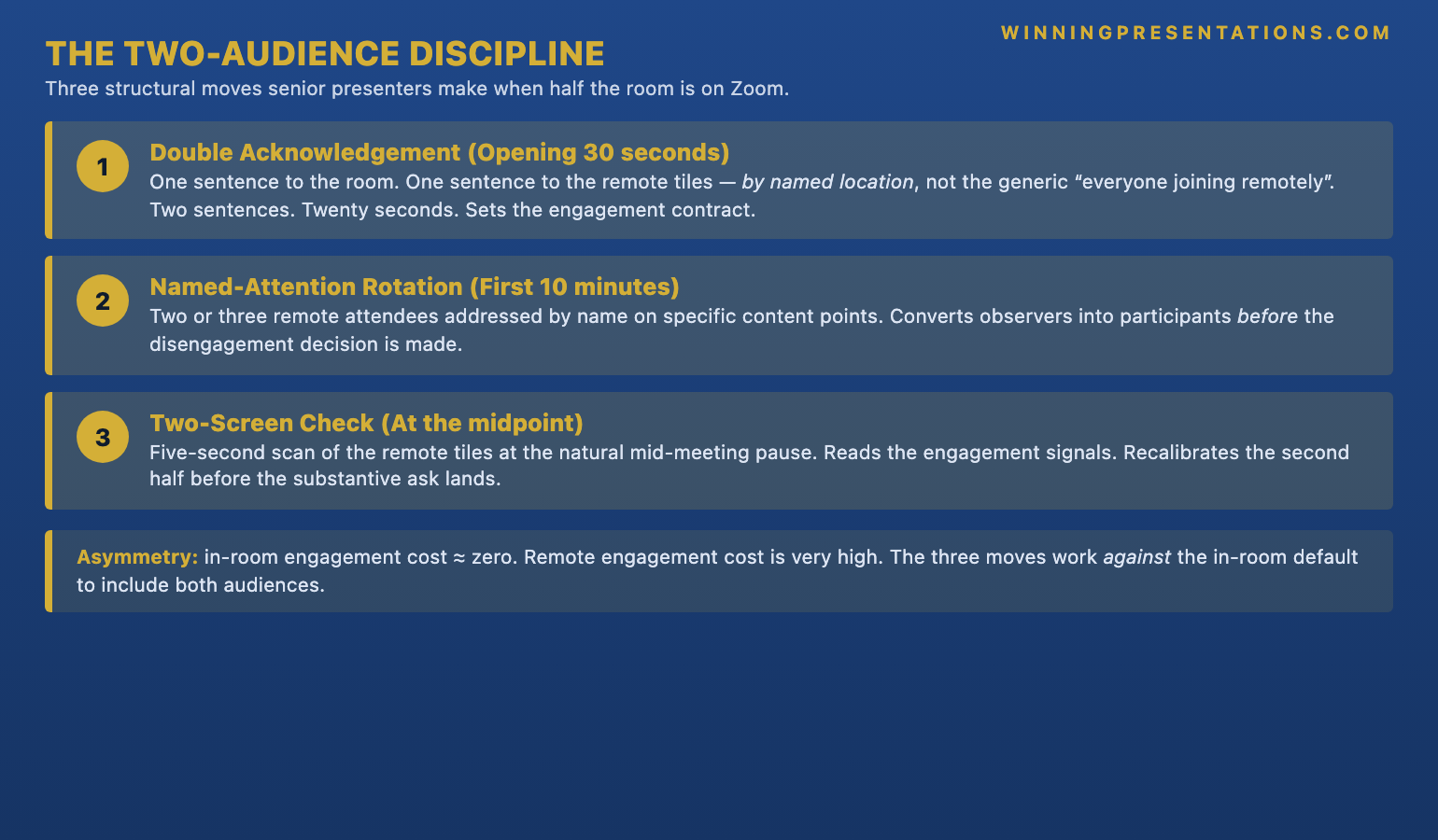
The first structural move senior presenters make in a hybrid meeting is the deliberate double acknowledgement of both audiences in the first thirty seconds of the meeting. The double acknowledgement is two short sentences: one addressed to the room, one addressed to the camera. The sentence to the room recognises the in-room partners by reference to the physical setting — “Good morning, thank you for coming over from the West Wing for this one”, or “I know we’re tight on time after the executive session, so I’ll keep this to the half-hour we said.” The sentence to the camera recognises the remote partners by reference to their specific locations — “And good morning to Frankfurt, New York, Dubai, and Singapore — thank you for the early start in three of those.” The two sentences together cost about twenty seconds. They establish, in the perceptual record of every attendee, that this is a meeting with two audiences and the presenter is chairing both of them.
The double acknowledgement matters out of all proportion to the time it takes. For the in-room audience, it costs almost nothing — they were going to engage anyway, and the brief acknowledgement of the remote attendees registers as professional courtesy. For the remote audience, it is the difference between feeling like attendees of a meeting and feeling like observers of one. Being named by location, in the first thirty seconds, is the signal that the presenter knows they are on the call and considers their engagement part of the meeting’s success. Without that signal, the remote attendees calibrate themselves as observers within the first minute, and the calibration is very hard to reverse later in the session. The opening thirty seconds set the engagement contract for the next thirty or forty minutes; the double acknowledgement is the contract that includes both audiences.
The named-location reference is the part that does the work. “And good morning to everyone joining remotely” is the generic version, and the remote attendees read it as the box-tick acknowledgement that allows the presenter to forget about them for the rest of the call. “Good morning to Frankfurt, New York, Dubai, and Singapore” is the named version, and the remote attendees read it as evidence that the presenter has prepared the meeting with their attendance in mind. The discipline of writing down the remote attendees’ locations on a sticky note next to the laptop, and reading the names aloud as part of the opening, takes about ninety seconds of preparation. The engagement difference for the next thirty minutes is the difference between a hybrid meeting and an in-room meeting with passive observers attached.
The named-attention rotation across the first ten minutes
The second structural move is the named-attention rotation across the first ten minutes of the meeting. After the double acknowledgement, the presenter deliberately addresses two or three remote attendees by name in the first ten minutes — not by asking them a hostile question, but by naming them as the reason for a point or by inviting a short reaction. “On the European pipeline, Frankfurt — this is the channel mix you flagged on the March call, and the figure has now moved in the direction you predicted”, or “Singapore, I’d be interested in your read of whether the APAC numbers look right against what you’re seeing in your region.” Each named-rotation takes about ten or fifteen seconds and converts the remote attendee from observer to participant for the rest of the session.
The rotation has to happen inside the first ten minutes because that is the window in which the remote attendees decide whether to keep their cognitive load on the meeting or to switch it to email. After ten minutes, the engagement decision has been made and is hard to reverse. The remote attendee who has been silently watching tiles for eight minutes without being addressed has calibrated this as a meeting where their input is not expected; the cognitive load required to re-engage when they are addressed at minute twenty is much higher than the cost of staying engaged in the first place, and most remote attendees simply do not pay it. The presenter who rotates named attention through the remote tiles in the first ten minutes prevents the disengagement decision from being made.
The reverse of this pattern is what I watched in March 2023 at a different consulting firm in Frankfurt, where a senior managing partner ran the same Q3 pipeline review with a similarly hybrid composition — seven partners in Frankfurt, four partners on Zoom in London, Milan, Boston, and Hong Kong. She opened with the named double acknowledgement. At minute four she addressed the Milan partner by name on a specific channel point. At minute seven she invited the London partner’s read on the European bookings number. At minute nine she made eye contact with the Hong Kong tile and said “APAC, I’ll come to you specifically on the trade-finance pipeline in about fifteen minutes — have a think on the conversion question.” The four remote partners were visibly leaning into the meeting for the rest of the session. The substance landed in both audiences at the same engagement depth. The Hong Kong partner contributed two specific data points in the second half of the meeting that none of the Frankfurt partners had. The named-attention rotation in the first ten minutes was the difference. The discipline of presenting when half the room is remote covers the broader dynamic across longer hybrid sessions.
Stop losing the remote half of the meeting in the first ten minutes.
The Executive Slide System is the slide library senior professionals use to build hybrid decks that explicitly anchor the named-rotation moments, surface the remote-attendee callouts inside the deck’s own structure, and build in the two-screen check at the midpoint — without having to remember every move in real time. Built on 24 years in corporate banking and 16 years coaching senior professionals across financial services, insurance, consulting, and technology.
- 26 Executive Templates — including the hybrid-meeting opener, the named-attention rotation marker, and the midpoint two-screen check slide
- 93 AI Prompts — rewrite the first ten minutes of the deck so the remote-attendee callouts are built in rather than improvised
- 16 Scenario Playbooks — including the hybrid quarterly review, the hybrid partner meeting, and the hybrid board update
- 7 Checklists — the hybrid pre-meeting setup, the in-meeting attention rotation, and the post-meeting follow-up to remote attendees
- Instant download, lifetime access — usable across every hybrid meeting cycle, not just the one in front of you now — £39
The two-screen check at the midpoint
The third structural move is the two-screen check at the midpoint of the meeting. About halfway through the scheduled time — minute fifteen of a thirty-minute meeting, minute twenty of a forty-minute one — the presenter explicitly looks at the wall-mounted screen showing the remote tiles for about five seconds, scans for the engagement signals, and recalibrates the second half of the meeting based on what the scan shows. The two-screen check is not an interruption of the substantive content; it is a thirty-second segment where the presenter consolidates the previous point and naturally turns toward the remote tiles before introducing the next section.
The engagement signals on the remote tiles are not subtle. The remote attendee who has switched to email shows a particular posture: eyes angled down and slightly to one side, head tilted at the angle of someone reading rather than listening, hand movements at the bottom of the tile that suggest typing or scrolling. The remote attendee who has muted and is participating in a side conversation in their own physical space shows a different signal: eyes off the camera at a side angle, occasional small head-shakes or nods that do not correspond to the meeting’s content, sometimes a hand visible at the side of the face holding a phone. The remote attendee who is fully engaged shows the engaged signal: eyes on the camera, occasional small nods on the presenter’s emphasis points, hands either out of frame or visible holding a notebook and pen. The presenter who scans the remote tiles at the midpoint can read these signals in five seconds.
The two-screen check matters because the second half of the meeting is the half where the substantive asks usually land — the budget request, the strategic recommendation, the H2 plan, the question the presenter is asking the room to engage with. If the remote half have disengaged during the first half, the substantive ask in the second half lands into a half-attentive audience and the meeting ends with the in-room half engaged and the remote half effectively absent for the most important content. The presenter who reads the two-screen check at the midpoint and finds the remote tiles disengaged has the option to deliberately pull them back — by naming a specific remote attendee at the start of the second half, by changing the framing to address the remote screen directly, or by acknowledging the format-cost of the hybrid setup and inviting any remote questions before continuing. Each of these moves takes about forty-five seconds and can recover the remote engagement for the second half. The presenter who skips the check has the same options but does not know they are needed.
When the hybrid meeting is the warm-up to a buy-in decision, the structural framework matters even more.
The Executive Buy-In Presentation System is the structured framework senior professionals use when the hybrid quarterly or partner meeting is the prelude to a committee approval — budget asks, channel reallocations, regional pivots, partnership decisions. 7 modules covering stakeholder analysis, case construction, and the presentation structures that hold up across hybrid audiences. Self-paced with monthly cohort enrolment, optional recorded Q&A. £499, lifetime access to materials.
The hybrid-attention diagnostic the day before the meeting
The hybrid-attention diagnostic takes about fifteen minutes and is run the day before the meeting. The procedure is mechanical. Print or open the deck. Identify the first ten minutes of content — usually slides one through four. On a sticky note attached to slide two, write the names and locations of the remote attendees who will be on the call. On slide three, write the name of the first remote attendee the presenter will address by name, and the specific point on which they will be addressed. On slide four, write the name of the second remote attendee and the second point. On the slide that sits at the meeting’s midpoint — usually around slide seven or eight on a fifteen-slide deck — write the two-screen check reminder: “scan tiles for thirty seconds, recalibrate second half”. The sticky notes are not for the meeting itself; they are for the rehearsal pass.
Then rehearse the first ten minutes aloud, with the sticky notes visible. The rehearsal is not about the content of the substantive pages; it is about the named-rotation moments and whether they feel natural in the flow. If the first named-attention moment feels forced, the named attendee is wrong or the framing is wrong; pick a different attendee or rephrase. If the double acknowledgement feels stilted, rewrite the two sentences. If the two-screen check sticky note does not have a natural pause around it in the deck’s rhythm, move the check to a different slide where the substantive content has a natural break. The fifteen minutes of rehearsal compresses the in-meeting cognitive load enormously. The presenter who has done the rehearsal walks into the meeting able to chair both audiences in parallel because the structural moves are already pre-positioned in the deck rather than improvised in real time. The presenter who has not walks in trying to remember three structural moves on top of forty minutes of substantive content, and the structural moves are the first thing to be sacrificed under cognitive load. The facilitation discipline that includes remote participants without losing the room covers the same dynamic from the meeting-chair side, where the structural moves also need to be pre-positioned rather than improvised.
Why the in-room defaults are so hard to override
The in-room defaults are hard to override because they are reinforced second-by-second throughout the meeting. The presenter is physically standing in front of an audience whose engagement signals are large, visible, and rewarding — the nod from the partner across the table, the small lean-in from the colleague at the corner, the half-smile from the person opposite. The remote tiles, by comparison, are flat, small, and slow to update — the nod takes a second to arrive on the wall-mounted screen, the lean-in is visible only when the attendee moves their entire body, the half-smile is lost in the resolution of the tile at the back of the room. Every neural reward the presenter receives during the meeting is from the in-room audience; the remote audience offers almost no real-time reward at all.
The structural fix is to treat the remote audience as a deliberate professional commitment rather than a reward-seeking interaction. The presenter is chairing the remote audience because the meeting is hybrid, not because the remote tiles will give them engagement signals to lean on. The named-attention rotation, the two-screen check, the deliberate facing of the laptop camera at the natural pauses — these are professional moves made for the format, not for the in-meeting reward. The presenter who waits for the remote audience to be as rewarding as the in-room one will wait forever; the presenter who runs the moves anyway gets the engagement back at the end of the meeting in the substance landed in both halves, even though the moves themselves felt unrewarding while they were being made. Hybrid discipline is, in this respect, like the discipline of writing the verdict slide first: structurally correct, neurally uncomfortable, and worth the cost in the engagement that follows.
Designed for senior professionals who chair both audiences in every hybrid meeting they run.
The Executive Slide System is the slide library used by senior professionals across financial services, insurance, consulting, and technology to build hybrid decks that pre-position the structural moves into the deck itself — named-rotation markers, midpoint check reminders, and remote-attendee callouts built into the slide structure rather than improvised in real time. Built on 24 years in corporate banking and 16 years coaching senior professionals. 26 templates, 93 AI prompts, 16 scenario playbooks, 7 checklists. £39, instant download, lifetime access to materials.
One thing to do before the next hybrid presentation
Fifteen minutes before the next hybrid meeting, write the names and locations of the remote attendees on a sticky note. Write a one-sentence double-acknowledgement that names the room and names the remote locations specifically. Write the names of two remote attendees you will address by name on a specific content point inside the first ten minutes. Write the two-screen check reminder on the slide that sits at the meeting’s midpoint. Walk into the meeting, open with the double acknowledgement, run the named-attention rotation in the first ten minutes, and pause at the midpoint to scan the remote tiles. The meeting will end with both audiences engaged in the substantive content at the same depth. The remote attendees will not need a separate follow-up call to re-cover the material the in-room half got the first time. The hybrid format will start to work for you instead of against you.
Frequently asked questions
What if the hybrid setup is just one laptop on the meeting-room table and the remote attendees can barely hear — doesn’t the technology limit what the presenter can do?
The technology limits the audio and visual fidelity, not the structural discipline. A single-laptop setup with poor ceiling microphone pickup will still transmit a named acknowledgement, a deliberate facing of the camera at the named-rotation moments, and a pause at the midpoint. The remote attendees will hear “Frankfurt, this is the point you flagged in March” even if the audio is imperfect; the named attention is the signal that does the work, not the audio quality. Technology upgrades help — a directional microphone, a wide-angle camera, a separate speaker array — but the structural moves are independent of the technology and worth running on whatever setup is available. Many of the worst hybrid meetings happen on the best technology because the presenter assumed the kit would compensate for the structural discipline. It does not.
How do I handle a hybrid meeting where the remote attendees outnumber the in-room ones, or where the most senior person is on Zoom?
The structural moves reverse polarity. When the remote audience is the majority or contains the most senior decision-maker, the presenter should default to addressing the camera, with the named acknowledgement of the in-room attendees as the secondary move. The double-acknowledgement is still two sentences but the first sentence goes to the camera tiles by named location and the second sentence goes to the room. The named-attention rotation still rotates through remote tiles primarily, with the in-room attendees included as the secondary rotation. The two-screen check at the midpoint becomes a check of the in-room engagement signals rather than the remote ones. The pattern is symmetric; the asymmetry is in which side is the default and which side requires deliberate effort to include. The discipline is to know which side is the structural default in the specific meeting and to deliberately work against the default to include the other.
Is the two-screen check just a one-off — or should I do it more than once during a longer meeting?
For meetings up to about forty minutes, one midpoint check is usually enough. For meetings beyond forty minutes — longer partner sessions, half-day strategic offsites that include remote attendees, multi-session committee meetings — the check should be repeated roughly every twenty to twenty-five minutes. Each check is short — thirty seconds at the natural pause between substantive sections — and serves the same function: reading the engagement signals on the remote tiles and recalibrating before the next section starts. Longer meetings have more disengagement windows; the periodic check is the cheapest way to prevent any single window from extending into full-session absence. The check is also a useful chairing signal: regular checks visibly demonstrate to both audiences that the presenter is actively monitoring engagement, which reinforces the engagement contract for everyone in the meeting.
What if the remote attendees keep their cameras off — can I still read their engagement signals?
Cameras-off changes the signals available but does not eliminate them. The remote attendee with the camera off who unmutes to comment within the first ten minutes is engaged. The remote attendee who has the camera off, has not unmuted, and has not posted in the chat by minute ten has either dropped off the call entirely or has disengaged behind the camera-off shield. The presenter who notices the silence can prompt directly — “Singapore, I know you’re on the call without the camera, just wanted to check this point lands the way you’d expect it to” — and the response reveals whether the attendee is engaged-but-quiet or absent. Cameras-off should not be treated as a passive choice. It is an engagement signal in its own right, and the presenter who reads it as one and responds to it directly will recover more of the cameras-off audience than the presenter who treats it as background noise.
The Winning Edge — weekly newsletter
The Winning Edge is a weekly (Thursday) newsletter for senior professionals who present at the executive level. One short email a week, focused on the structural moves that separate the hybrid meetings senior committees engage with from the ones they tolerate. Subscribe to The Winning Edge →
For the broader picture across slides, storytelling, confidence, and delivery, the Complete Presenter library of seven products is the bundle most senior professionals find useful as a single resource — £99 for everything, lifetime access.
About the author
Mary Beth Hazeldine is Owner & Managing Director of Winning Presentations Ltd. With 24 years of corporate banking experience at JPMorgan Chase, PwC, Royal Bank of Scotland, and Commerzbank, she advises senior professionals across financial services, insurance, consulting, and technology on the structural discipline of chairing both audiences in hybrid meetings — from quarterly partner sessions to half-year strategy reviews.