

Quick answer: The senior people who survive hard rooms do not have an answer for everything — they have a clean way of saying when they do not. The move is three steps: acknowledge the question without flannel or defensiveness; mark the boundary by stating exactly what you do know and precisely where your knowledge stops; and commit to a specific follow-up with a named owner and a date, not a vague “I’ll look into it.” Counter-intuitively, the boundary step is what reads as authority, because it shows you know the edge of your own knowledge rather than pretending you have none. The thing that actually damages credibility is not the gap — it is the bluff. Use the bluff test to catch yourself: if one more follow-up question would expose that you are guessing, you are past your boundary, and you should commit instead of inventing.
JUMP TO:
In 2008, during my time in corporate banking, I sat in a credit committee where a relationship director was asked a single, specific question: what was the counterparty’s exposure on a particular line. He did not have the figure to hand. He had a thick file, a sound proposition, and years of relationship history with the client — everything except that one number, in that one moment. What he did next took about four seconds and cost him far longer to repair. Rather than say he would confirm it, he offered a figure, said with the easy confidence of a man who knew his book. It sounded right. The committee moved on. But one member, the kind who checks, went back to the file afterwards and found the number was wrong — not catastrophically, but wrong. Nothing was said in the room, then or later. There was no confrontation, no correction, no awkward email. There was only a quiet, permanent adjustment: his next three proposals were met with a degree of scrutiny his earlier ones had not attracted. The committee had stopped giving him the benefit of the doubt, and they never told him why.
That is how credibility actually erodes at senior level — not in a dramatic exposure, but in a silent downgrade nobody announces. The relationship director was not punished for the gap in his knowledge; everyone in that room had gaps. He was punished for covering one. And the cruelty of it is that he never got to defend himself, because the charge was never filed. He simply noticed, over the following quarter, that the room had become harder to win, and assumed he was having a run of difficult propositions. He was not. He had taught a roomful of decision-makers that his confidence was not a reliable signal of his certainty, and once a committee learns that about you, every confident statement you make afterwards is privately re-rated.
(This article was created with AI assistance; all stories and insights are based on 35 years of real client work.)
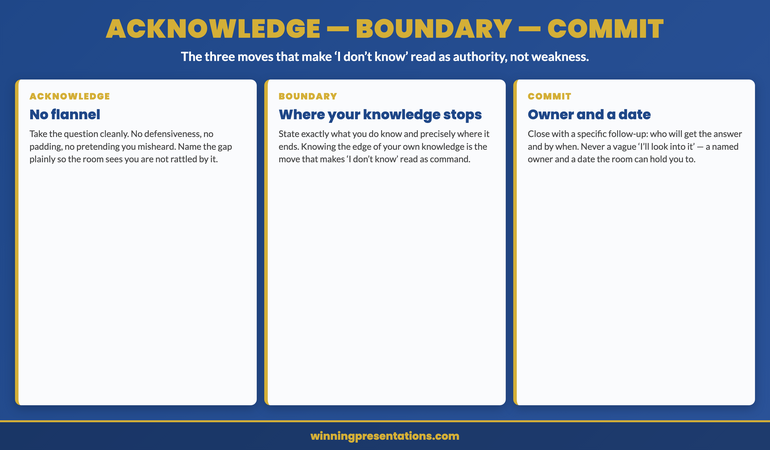
The skill that protects against this is not knowing more. It is knowing how to say you do not know in a way that the room reads as command rather than weakness. There is a structure to it, and the senior people who do it well are running the same three moves whether they have named them or not. I teach it as acknowledge — boundary — commit: the ABC of the honest non-answer. Acknowledge the question cleanly. Mark the boundary of what you know. Commit to closing the gap with a named owner and a date. Done in that order, “I don’t know” stops being an admission of weakness and becomes a demonstration that you can be trusted with the next, harder question.
If the questions are the part of the presentation you quietly dread:
The Executive Q&A Handling System is built for exactly the moment that caught the relationship director out — the tough or hostile question you cannot fully answer. It gives you structured, decision-safe responses you can deliver in around 45 seconds, so you stay in control when you are challenged rather than reaching for a number you do not have. It takes the panic out of the gap. £39, instant download, lifetime access.
Why the bluff is the real risk — not the not-knowing
Most people preparing for a high-stakes Q&A are afraid of the wrong thing. They are afraid of being asked something they cannot answer, and they pour their preparation into trying to eliminate that possibility — memorising more numbers, anticipating more questions, building a deeper file. But you cannot close every gap, and at senior level the questions are designed to find the edge of your knowledge precisely because that is where the interesting risk lives. A board, a credit committee, an investment committee — their job is partly to test whether you know where your own certainty ends. The gap is not the danger. The gap is expected. What the room is actually watching for is what you do when you reach it.
There are two things you can do at the edge of your knowledge, and they send opposite signals. You can mark the edge — say what you know, name what you do not, and commit to closing it — which tells the room you have a precise grip on your own file and can be trusted to know the difference between fact and guess. Or you can paper over the edge with a confident-sounding answer, which works exactly until someone checks, and at senior level someone always eventually checks. The bluff does not fail in the room. That is what makes it so tempting: it buys you a smooth moment and the bill arrives later, privately, in the form of a credibility downgrade you cannot see happening. The relationship director got his smooth moment. He paid for it across a whole quarter. The discipline of separating what you know from what you are guessing runs through all of how senior leaders are coached for high-stakes rooms, because it is the single behaviour that decides whether a room keeps extending you trust.
It helps to be precise about why the bluff is so costly relative to the honest gap. When you say “I don’t have that to hand,” you spend a small, recoverable amount of credibility — the room notes a gap and moves on, and you close it later. When you bluff and are caught, you do not spend credibility; you devalue the currency. Every confident statement you have ever made and ever will make is now suspect, because the room has learned that your confidence does not track your certainty. That is why the maths never favours the bluff. A known gap costs you one answer. A discovered bluff costs you the reliability of all your answers. No single question is worth that trade, and the senior people who last have internalised it so deeply that bluffing is simply not an option they consider.
Credibility is built in the moments you cannot fully answer — if you have a structure for them.
The Executive Q&A Handling System is a system for handling tough and hostile questions with calm authority. It gives you structured, decision-safe answers you can deliver in around 45 seconds — so when you are challenged, or asked something you cannot fully answer, you stay in control instead of improvising under pressure. It is built for senior people who are judged as much on how they field the questions as on how they make the case. £39, instant download, lifetime access.
The boundary move: where your knowledge stops
The first move, acknowledge, is the easy one to describe and the easy one to get wrong. Acknowledging the question cleanly means taking it head-on, without the tells that signal you have been knocked off balance: no defensive preamble, no “well, that’s a complicated one,” no buying time with a restatement of the question you clearly heard. You simply receive it. The room reads a great deal from these few seconds. A presenter who flinches at a hard question has already conceded something before they say a word; a presenter who takes it cleanly has signalled that the question, however pointed, is one they are willing to stand in front of. But acknowledgement only opens the door. The move that does the real work is the second one.
The boundary is the move almost nobody is taught, and it is the one that converts “I don’t know” from a confession into a credential. Marking your boundary means saying, in one breath, exactly what you do know and exactly where that knowledge stops. “What I can tell you is the direction of travel and the order of magnitude; what I don’t have to hand is the precise figure.” This is the opposite of a vague hedge. It is a precise map of your own certainty, and that precision is what the room hears as authority. Think about what it actually demonstrates: to say exactly where your knowledge ends, you have to know exactly where it ends, which means you have a far firmer grip on your file than the person who claims to know everything and is therefore presumed to know nothing precisely. The boundary turns the absence of one fact into evidence of command over all the others.
I watched this land in 2016, with an executive I was coaching before a board Q&A that everyone expected to be hostile. We drilled the boundary-commit move until it was automatic, because under pressure people revert to instinct and the instinct is to bluff. In the session, a director asked him for a figure he did not have. He did not flinch and he did not invent. He said: “I don’t have that exact number to hand — what I can tell you is the direction of travel, and I’ll have the precise figure to you by end of day.” The chair nodded and moved on. Here is the part that surprised him: his credibility went up, not down. The board did not file his answer as a gap. They filed it as a man who knew the difference between what he knew and what he was guessing — which, on a board, is one of the most reassuring things a presenter can demonstrate, because it tells them every other number he gives them is one he actually stands behind. The same principle of being scrupulous about the line between fact and inference runs through the work on presenting ambiguous data to executives.
The bluff test, and the commit that follows it
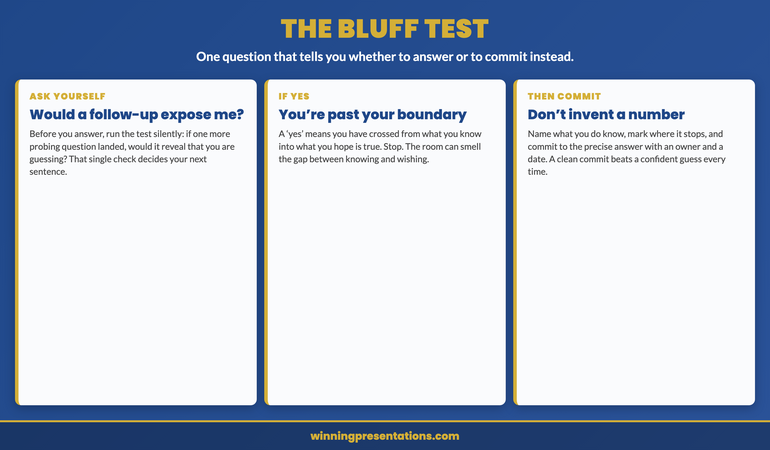
In the moment, under the heat of a real question, how do you know whether you are still inside your boundary or have drifted past it into a guess? The pressure to answer is enormous, and it is easy to talk yourself into believing that what is really an educated hope is solid enough to state as fact. The diagnostic I give people is the bluff test, and it is a single silent question you run before you commit to an answer: if one more follow-up question landed on this, would it expose that I am guessing? If the honest answer is yes, you are past your boundary. Stop. Whatever you were about to say is a bluff dressed as an answer, and the bluff test has caught it before the room does.
The test works because it reframes the decision. In the heat of the moment you are not really asking “do I know this?” — you are asking “can I get away with sounding like I know this?”, and the answer to that is often yes, which is exactly the trap. The bluff test changes the question to “what happens on the next question?”, and the next question is always coming in a serious room. Once you picture the follow-up, the guess loses its appeal, because you can see the cliff edge it is walking you towards. The relationship director in 2008 would have been saved by the bluff test in four seconds: a follow-up of “and how does that compare to the limit?” would have exposed him instantly, and had he pictured it he would have committed instead of guessed. The same forward-looking discipline is why senior presenters who use a structured board pre-read strategy get fewer surprise questions in the first place.
When the bluff test stops you, the commit is what you do instead — and a real commit is specific. “I’ll look into it” is not a commit; it is a polite way of hoping the question goes away, and the room knows it. A commit names an owner and a date: “I’ll have the precise figure to you by end of day,” or “my finance lead will confirm the breakdown and circulate it by Thursday.” The specificity does two things. It gives the room something concrete to hold you to, which paradoxically builds trust rather than risk, because a person who invites accountability is signalling they intend to deliver. And it closes the moment cleanly, so the conversation moves on instead of circling the gap. A clean commit lets you concede one fact without conceding control of the room — and control of the room, not omniscience, is what the senior people are actually protecting.
One structure for the hardest questions. No subscription, no renewal.
The Executive Q&A Handling System is a one-off £39 — instant download, lifetime access, no subscription to maintain. It gives you a repeatable way to handle tough and hostile questions with calm authority and to deliver structured, decision-safe answers in around 45 seconds, so the next time you are asked something you cannot fully answer you reach for a method instead of a bluff. Buy it once; use it for every Q&A you ever walk into.
Frequently asked questions
Won’t saying “I don’t know” make me look unprepared in front of the board?
Not when it is the boundary version rather than the bare phrase. A flat “I don’t know” with nothing around it can read as a gap, but that is rarely what senior people actually say. What they say is what they do know, where it stops, and when they will close it: “what I can tell you is X; what I don’t yet have is Y; I’ll have it to you by Thursday.” A board hears that as precision, not unpreparedness, because it shows you know the exact edge of your own knowledge. What genuinely looks unprepared is a confident answer that unravels on the next question. The boundary protects you from that far more reliably than a bluff ever could.
What’s the most common mistake people make when they don’t know the answer?
Filling the silence with a confident-sounding guess because the pause feels unbearable. The instinct is to treat any gap as a threat to be talked over, so people reach for a number or a claim that is really a hope, and it holds right up until someone checks. The fix is the bluff test: before you answer, ask whether one more follow-up would expose that you are guessing. If it would, you are past your boundary, and the right move is to commit rather than invent. The second most common mistake is the vague commit — “I’ll look into it” — which the room correctly reads as hoping the question disappears.
How do I make a commit specific enough to be credible?
Attach an owner and a date, every time. “I’ll have the precise figure to you by end of day” or “my finance lead will circulate the breakdown by Thursday” gives the room something concrete to hold you to, and inviting accountability is itself a trust signal — people who intend to deliver are comfortable being pinned to a date. Avoid the open-ended forms: “soon,” “shortly,” “I’ll come back to you.” They sound like a soft refusal. A good preparation habit is to draft your commit sentences before the meeting for the questions you most expect, so that under pressure you are recalling a sentence rather than constructing one.
Can I use this if I genuinely should have known the answer?
Yes, and the structure matters even more then. If the gap is one the room expected you to close, the boundary-commit move still beats the bluff, because compounding a preparation gap with a credibility gap is the worst available outcome. Acknowledge cleanly without over-apologising, mark what you do have, and commit tightly with an owner and a date. Resist the urge to manufacture an excuse, which only draws attention to the gap and reads as defensiveness. One missed figure handled with composure is recoverable; the same figure bluffed and later corrected is the version that follows you into the next meeting and the one after that.
The Winning Edge — weekly newsletter
The Winning Edge is a weekly newsletter for senior professionals who present and field questions at the executive level. One short email a week on the moves that separate the presenters a room keeps trusting from the ones it quietly downgrades. Subscribe to The Winning Edge →
About the author
Mary Beth Hazeldine is Owner & Managing Director of Winning Presentations Ltd. With 24 years of corporate banking experience at JPMorgan Chase, PwC, Royal Bank of Scotland, and Commerzbank, she advises executives across financial services, healthcare, technology, and government on structuring presentations for high-stakes funding rounds, board approvals, and strategic decisions.
The next time you are asked something you cannot answer, do three things instead of bluffing: acknowledge the question cleanly, with none of the tells that signal you have been knocked off balance; mark your boundary by saying exactly what you do know and precisely where your knowledge stops, because that is the move the room reads as authority; and commit to closing the gap with a named owner and a date the room can hold you to, never a vague “I’ll look into it.” Run the bluff test before every answer — if one more follow-up would expose that you are guessing, you are past your boundary, so commit rather than invent. The room does not need you to know everything. It needs to know that when you sound certain, you are.