

Quick answer: A board meeting is won or lost in the six weeks before it, not in the room. The senior people who walk into the last board meeting before summer calm and unsurprised are not more talented presenters — they ran a runway. The Six-Week Runway works backward from the date: at six weeks out, map the decision and every objection it will draw; at four weeks out, build the case down to a single page and socialise the headline with your sponsor; at two weeks out, pre-wire the key voters one by one so the meeting holds no surprises; in the final week, rehearse against the hardest question, not the friendliest. The point is not polish — it is that by the meeting, every real objection has already been raised and handled offline, so the room is a formality, not a gauntlet. Test whether your runway is finished with the no-surprises test: in the week before, can you predict every objection that will be raised in the room? If you cannot, the preparation is not done, however good the deck looks.
JUMP TO:
In 2014 I worked with a finance director preparing the most important request of his year — a capital approval that would shape his division for eighteen months. He was diligent, and he started his preparation about ten days before the board met, which felt to him like plenty. He built a clean deck, rehearsed it twice, tightened the numbers, and walked in genuinely well-prepared by the standard he had always used. Eleven minutes into the meeting a non-executive director slid a printed appendix across the table — a comparison with a peer transaction the finance director had not anticipated — and asked a single question he could not answer in the room. The deck was fine. The rehearsal was fine. What sank him was that the objection arrived for the first time in front of the whole board, and a board that watches a presenter meet a real objection cold does not approve; it defers “pending further analysis.” He left with the same request unapproved and six more weeks of work to do, all of which could have surfaced in a single conversation beforehand.
(This article was created with AI assistance; all stories and insights are based on 35 years of real client work.)
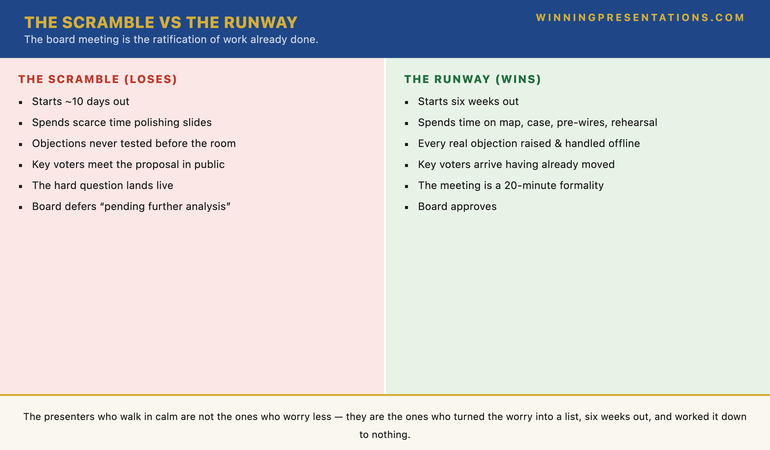
The deferral taught him — and reminded me — the rule that separates senior people who get sign-off from senior people who get “come back to us”: a board meeting is the visible end of a process that mostly happens before the room, and the presenters who treat the meeting as the event have already lost most of their leverage. The ten-day scramble produces a polished version of an unprepared case: the slides look right, but the objections have never been tested, the key voters meet the proposal for the first time in public, and any genuine resistance lands live, where it does maximum damage. This piece sets out the Six-Week Runway — the backward-planned schedule that moves every real objection out of the room and into the weeks before it — the no-surprises test that tells you whether the runway is actually finished, and why the quiet conversations two weeks out do more for the outcome than anything you do on the day.
Six weeks is enough time to prepare properly — if you know what to check and when.
The free Executive Presentation Checklist puts the pre-board checks — the decision, the objections, the pre-read, the rehearsal — in one place you can work through as the date approaches, so nothing important waits until the last week to be noticed. It is the simplest way to turn “I think I’m ready” into a list you have actually cleared. Free download, no email gate.
Why the week-before scramble keeps losing
The week-before scramble feels like preparation and is mostly production. In the final days the energy goes into the artefact — the slides, the wording, the chart that finally looks right — because those are the visible, controllable things, and polishing them produces the comforting sensation of progress. But the artefact was never the constraint. A board does not defer a well-built deck because it is not pretty enough; it defers because someone in the room has a concern the presenter has not answered, and that concern almost always existed weeks earlier, fully knowable, waiting only for someone to go looking for it. The scramble spends its scarce days on the part that was already fine and skips the part that decides the outcome.
There is a structural reason the timing matters so much. The objections that sink a board request are rarely about the numbers on the slide; they are about the things around the proposal — the peer comparison, the second-order risk, the question of why now rather than next year, the concern one director raised about a different project that this one resembles. Surfacing those takes conversations, and conversations take lead time: people are busy, calendars are full, and the director whose concern matters most may be travelling. Start ten days out and you have time to build the deck but not to have the conversations; the proposal therefore meets its real test for the first time in the room, which is the worst possible place for it to happen. Good board presentation practice is less about performance in the room than about the work that means the room holds no surprises.
The reframe is uncomfortable for people who pride themselves on delivery: the meeting is not your moment to shine, it is the ratification of work already done. The presenters who consistently get approval have usually made the actual decision happen in the preceding weeks, through individual conversations in which each key voter encountered the proposal, raised their objection privately, and had it addressed before they ever sat down at the board table. By the time the meeting happens, those voters are not deciding — they are confirming a position they already hold. That is what a calm board meeting actually is: not a presenter performing brilliantly under pressure, but a room with nothing left to be surprised by. The runway is how you get there.
The Six-Week Runway: four phases
The Six-Week Runway is a backward-planned schedule with four phases, each anchored to how far you are from the board date. The number six is not sacred — a smaller request needs less, a transformational one needs more — but six weeks is the realistic floor for a meaningful approval that depends on people who are hard to get time with. The phases run in order, and each one is a prerequisite for the next.
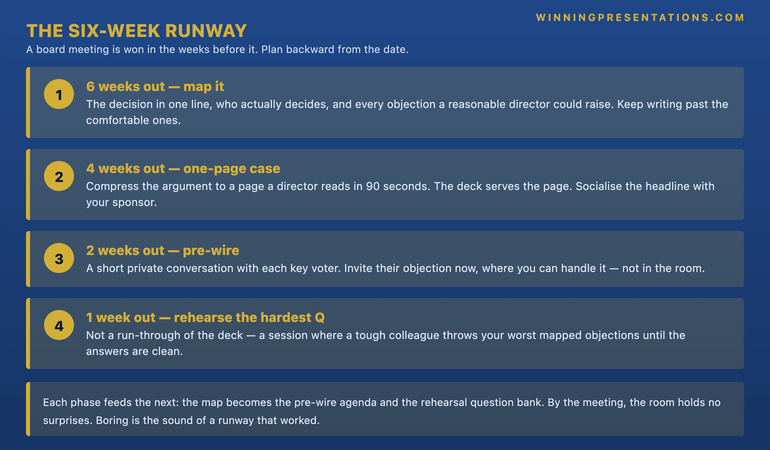
Six weeks out — map the decision and its objections. Write down, in one line each, exactly what you are asking the board to decide, who actually decides it, and every objection a reasonable director could raise. Be ruthless and a little paranoid: the objections you do not want to write down are usually the ones that will sink you. Four weeks out — build the case to one page and socialise the headline. Compress the argument to a single page that a director could read in ninety seconds and know what you want and why; the deck comes later and serves the page, not the reverse. Then take the headline to your sponsor — the executive who will back you in the room — and check it lands. Two weeks out — pre-wire the key voters. Have a short individual conversation with each director whose support you need, walk them through the ask, and — this is the point — invite their objection so you hear it now, in private, where you can handle it. One week out — rehearse against the hardest question. Not the polished run-through of the deck, but a session where a tough colleague throws the worst objections from your six-week map at you until your answers are clean. Rehearsing the questions rather than the script is what separates a runway from a dress rehearsal.
What makes the four phases work together is that each one feeds the next: the objection map at week six becomes the agenda for the pre-wires at week two and the question bank for the rehearsal at week one. Skip the map and the pre-wires have no structure; skip the pre-wires and the rehearsal is guessing at what the room will ask; skip the rehearsal and you meet your own best-known objections cold. Run all four in sequence and, by the week of the meeting, the proposal has been seen, challenged, and adjusted by everyone who matters — which is why the meeting itself can be almost boring. Boring, in a board meeting, is the sound of a runway that worked.
Build the one-page case and the board deck behind it — without losing a weekend to the slides.
The Executive Slide System gives senior presenters the templates and structures for board-grade decks, so the four weeks of your runway go into the case and the conversations, not into fighting layout. It is built to turn a clear one-page argument into the supporting deck fast, which is exactly what you want when the real work of a board approval lives in the preparation, not the production.
- 26 executive templates and 16 scenario playbooks, including board and approval formats
- 93 AI prompts to compress a long case into a one-page spine and an appendix that answers objections
- 7 checklists to pressure-test the deck against the questions on your six-week map
- Instant access, lifetime use — £39
The no-surprises test
The Six-Week Runway needs a test that tells you whether you have actually finished it or merely worked hard, and the test is a single question you ask yourself in the week before the meeting: can I predict every objection that will be raised in the room? Not the topics — the specific objections, in the specific words a particular director is likely to use, with my answer to each already prepared. If you can list them and you have a clean response to every one, the runway is finished and the meeting is a formality. If there is a director whose reaction you genuinely cannot predict, or a line of attack you are quietly hoping will not come up, the runway is not done — you have found the exact gap, and you have a week to close it with a conversation rather than discover it live.
The test works because it converts a vague feeling of readiness into a concrete, checkable claim. “I think I’m prepared” is unfalsifiable and therefore useless; “I can predict every objection and answer each one” is either true or it is not, and the moment you try to write the list you discover which. Most presenters who feel ready cannot actually complete the list — there is always one director or one risk they have been avoiding — and the avoidance is information. The objection you do not want to write down is almost always the one that will be raised, precisely because your reluctance to face it has kept you from preparing an answer. The test surfaces that reluctance while there is still time to act on it.
The no-surprises test also tells you where the gap is, not just that one exists. If you can predict the objections but not who will raise them, your pre-wires are incomplete — you have understood the proposal but not the room. If you know who is sceptical but cannot articulate their specific concern, you have not yet had the conversation that would tell you. And if your list is complete and your answers are clean but you still feel uneasy, the unease is often pointing at the sponsor relationship — you may be carrying the room alone when you should have a senior voice committed to backing you. A structured pre-board review is useful precisely because it forces the list onto paper, where the gaps cannot hide behind a general sense of being prepared.
When the approval is genuinely contested — when the room will resist and the pre-wire is the real battle — the persuasion deserves more than a checklist.
The Executive Buy-In Presentation System is the self-paced programme behind securing agreement from a senior, sceptical audience — seven modules covering stakeholder analysis, case construction, and the structure of an ask that holds up to scrutiny. It enrols in monthly cohorts with optional, fully recorded Q&A sessions you can watch back at your own pace, and lifetime access to the materials. £499.
Why the pre-wire does most of the work
Of the four phases, the pre-wire at two weeks out is the one that decides the most outcomes and the one inexperienced presenters most often skip, because it feels faintly like cheating — as though the decision should be made cleanly in the room, on the merits, in front of everyone. It should not, and it is not. In 2018 I worked with a divisional head making a case to consolidate two functions, a proposal certain to draw resistance from the director whose area would lose headcount. Her instinct was to make the argument so strong that it would overwhelm objection in the room. Instead we spent the two weeks before on three quiet conversations: she sat with the affected director, walked him through the logic, heard his real concern — which turned out to be about his people’s redeployment, not the consolidation itself — and adjusted the proposal to address it. By the board meeting he was not an opponent to be overwhelmed; he was a qualified supporter who raised his now-handled concern himself and answered it for her. The meeting took twenty minutes and approved. The work that produced that result had all happened in private a fortnight earlier.
The pre-wire works because of how senior people actually behave in rooms. A director who first encounters a proposal at the board table, in front of peers, with a concern unaddressed, is in the worst possible position to be persuaded: they must either voice the objection publicly — which commits them to it and turns the meeting adversarial — or swallow it and resent the railroading. Neither produces a clean yes. The same director, met privately two weeks earlier, can raise the same concern with no audience and no loss of face, hear your response, and arrive at the meeting having already moved. You have not manipulated anyone; you have given each decision-maker the chance to do their thinking in a setting where thinking is possible, rather than performing a reaction in a setting where only positioning is. The room then ratifies a set of positions already settled.
The discipline that keeps the pre-wire honest is to genuinely invite the objection rather than merely preview the pitch. A weak pre-wire is a presenter walking a director through the deck and asking “any questions?” — which gets a polite nothing and surfaces no real concern. A strong pre-wire asks the harder question directly: “where do you think this is weakest?” or “what would make you say no to this?” — and then listens, because the answer is the most valuable thing you will hear before the meeting. The objection you draw out in a pre-wire is a gift: it is the thing that would otherwise have sunk you, handed to you with two weeks to respond. The presenters who lose are not the ones who hear hard objections early; they are the ones who arrange their preparation so they never hear them until the room.
Stop walking into the last board meeting before summer hoping the hard question doesn’t come up.
The Executive Slide System works on the production half of the runway, so the preparation half — the map, the pre-wires, the rehearsal — gets the time it actually needs. A board deck that assembles fast from proven structures is the difference between a calm six weeks and a frantic ten days, and it is the part of board prep you can fix today.
- Board and approval templates that hold up to executive scrutiny, ready to fill with your case
- An appendix pattern for the peer comparisons and second-order risks that ambush unprepared presenters
- Checklists that turn “I think the deck is right” into a list you have cleared
- Instant access, lifetime use — £39
What makes the pre-summer meeting different
The last board meeting before summer carries a particular pressure that the runway has to account for: it is often the final chance to get a decision made before the calendar empties out for weeks. Directors travel, sponsors go on leave, and a proposal deferred in this meeting may not be heard again until the autumn — which can mean a lost quarter on whatever the decision was meant to unlock. That raises the stakes on getting it right the first time, and it also compresses the runway in a way you have to plan around. The people you need to pre-wire are exactly the people whose summer plans are filling their calendars, so the two-weeks-out conversations may need to happen at three or four weeks out, before the diaries close.
There is a second, subtler effect. A board approaching its summer break is often working through a heavier-than-usual agenda — everything that “needs to be done before the break” converges on the last meeting — which means less airtime per item and less patience for a proposal that generates surprises. In a lighter meeting a board might tolerate a live objection and work through it; in the pre-summer crush it is far more likely to defer anything that is not clean, simply to clear the agenda and get to the break. The runway matters more here precisely because the room’s tolerance for friction is lower. A proposal that arrives fully pre-wired, with every voter already moved, slides through the crowded agenda; one that arrives with open questions gets pushed to the autumn almost reflexively.
The practical adjustment is to run the same four phases but pull each one earlier, and to be honest with yourself about whether the decision can realistically be made before the break at all. If the runway cannot be completed in time — if the key director is already away, if the case is not ready — the disciplined move is sometimes to take the item to the autumn meeting deliberately, with a finished runway, rather than to a crowded pre-summer meeting half-prepared and watch it defer anyway. A deliberate delay with a complete runway beats a rushed attempt with an incomplete one, because the rushed attempt usually produces the deferral you were trying to avoid, plus the cost of having burned the room’s attention on an unready case. Knowing which meeting to aim for is itself part of the preparation.
One thing to do six weeks out
Six weeks before your next board meeting, do one thing before you open a single slide: take a blank page and write the decision you are asking for in one sentence, then list every objection a reasonable director could raise — and force yourself to keep writing past the comfortable ones until you reach the objection you have been quietly hoping will not come up. That last one, the one you resisted writing, is the centre of your runway: it tells you which director to pre-wire first, which answer to rehearse hardest, and whether the case is actually ready or only feels ready. Put a date against each phase — map now, one-page case at four weeks, pre-wires at two, rehearsal at one — and the abstract pressure of “I must prepare for the board” becomes a schedule you can actually clear. The presenters who walk in calm are not the ones who worry less; they are the ones who turned the worry into a list, six weeks out, and worked it down to nothing.
Frequently asked questions
Isn’t pre-wiring the board behind the scenes a bit manipulative — shouldn’t the decision be made openly in the meeting?
The decision is made openly in the meeting — the pre-wire changes when each director does their thinking, not whether the decision is theirs. A director met privately can raise a concern, hear your response, and weigh the proposal without the pressure of performing a position in front of peers; that is better thinking, not subverted thinking. Nothing about the pre-wire hides information or pressures anyone; it simply gives decision-makers the proposal early enough to consider it properly. What actually subverts a clean decision is the opposite: ambushing a room with a proposal it has never seen and hoping a strong deck overwhelms objection on the spot. That produces positioning, not judgement. Pre-wiring is how serious organisations make sure the meeting confirms a considered decision rather than manufacturing a rushed one.
What if I genuinely don’t have six weeks — the meeting is in two?
Run the same four phases compressed, and prioritise ruthlessly in favour of the pre-wires. With two weeks, spend the first two days mapping the decision and its objections, build a one-page case immediately rather than a full deck, and use the remaining time for the conversations that matter most — even one pre-wire with the most sceptical key voter is worth more than another day on the slides. The phase you can shorten is production; the phase you cannot skip is the pre-wire, because that is where the live objection gets moved out of the room. A compressed runway is weaker than a full one, but a compressed runway that protects the pre-wire still beats a polished deck with no conversations behind it. If even two weeks is impossible, that is a strong signal to consider whether this is the right meeting to aim for.
How long does it take before this preparation approach actually changes my outcomes?
The first time you run a full runway you will usually feel the difference in the meeting itself, because the experience of a board ratifying a pre-wired proposal is markedly different from defending an unwired one — the room is calmer and so are you. The deeper change takes two or three cycles, as you learn to read which objections matter, who to pre-wire, and how early to start given your particular board. The skill that compounds is the objection map: the more meetings you run this way, the faster and more accurately you can predict what a room will challenge, until anticipating objections becomes something you do almost automatically as you build a case. Most people who adopt the runway describe the second or third board meeting as the one where it stopped feeling like extra work and started feeling like the only sensible way to prepare.
Does the runway still apply if I’m presenting to a committee or a leadership team rather than a formal board?
Yes, and often more cleanly, because smaller decision bodies are even more influenced by what happens before the meeting. A committee or leadership team is usually a handful of people whose individual positions you can genuinely pre-wire, which makes the two-weeks-out conversations both easier to arrange and more decisive in effect. The four phases are identical — map the decision and objections, build the case, pre-wire the voters, rehearse the hardest question — and the no-surprises test is the same: can you predict what each person will challenge? The only adjustment is scale: a three-person committee may need a three-week runway rather than six, but the sequence and the discipline of moving objections out of the room hold regardless of how formal the body is.
The Winning Edge — weekly newsletter
The Winning Edge is a weekly (Thursday) newsletter for senior professionals who present to boards, committees, and investors. One short email a week on the structural moves that separate the proposals that get approved from the ones that get a polite “come back to us.” Subscribe to The Winning Edge →
For the full set of skills behind a board approval that goes through cleanly — slides, storytelling, confidence, and delivery — the seven-product Complete Presenter bundle brings them together as a single resource — £99 for everything, lifetime access.
About the author
Mary Beth Hazeldine is Owner & Managing Director of Winning Presentations Ltd. With 24 years of corporate banking experience at JPMorgan Chase, PwC, Royal Bank of Scotland, and Commerzbank, she advises senior professionals across financial services, insurance, consulting, and technology on the structural moves that turn a strong proposal into a decision a board can act on.