Tag: hostile question response

23 Jun 2026
Hostile question handling course online — executive boardroom editorial photograph, navy and gold tones

Hostile Question Handling Course Online: A Self-Paced System

If you are looking for a hostile question handling course online — one you can work through at your own pace and apply directly to board challenges, investor scrutiny, and procurement panels — The Executive Q&A Handling System is the structured self-paced course built for that specific problem. It covers the bridge statements, composure protocols, deflection techniques, and scenario playbooks senior professionals use to keep control of the room when the questions turn adversarial. Instant download, single payment, £39.

This page explains what the course teaches, how it differs from a generic presentation programme, and who it is built for. If you are weighing options before committing, the detail below is written to help you decide.


Senior executive holding composure during a hostile boardroom Q&A, navy and gold editorial photography, sceptical directors leaning in

Already decided? If you would prefer to skip the analysis and see the course directly, view The Executive Q&A Handling System on Gumroad — instant download, single payment, designed for senior professionals. The remainder of this page is for readers who want context first.

Why a Generic Q&A Course Will Not Cover Hostile Questions

Most online presentation training treats Q&A as a polite extension of the talk — a friendly room, curious questions, helpful clarifications. The advice is generic: “stay calm”, “don’t get defensive”, “repeat the question to buy time”. That guidance falls apart the moment a question is built to expose you — a loaded framing that assumes a flaw you have not conceded, a sceptical board member returning to the same objection from a different angle, a procurement reviewer pressing on the line of cost you cannot publicly discuss.

Hostile questions are a different category of skill. They demand specific phrasings, a method for separating the substance from the tone, and a composure routine that holds when the room is not on your side. Senior executives who handle friendly Q&A well often lose ground here, because they have never built the muscle for adversarial questioning. A course aimed at that specific problem looks very different from a generic presentation skills programme.

An Online Course Built for the Adversarial Q&A

The Executive Q&A Handling System is the opposite of an add-on chapter. The whole system is built around the questions presenters most often lose ground on — sceptical, loaded, and aggressive ones. It teaches you how to anticipate them before the meeting, how to bridge them back to substantive answers without appearing evasive, how to hold composure when a question is designed to provoke a reaction, and how to deflect questions you cannot or should not answer directly while preserving credibility.

It was built by Mary Beth Hazeldine, who spent 24 years in corporate banking at JPMorgan Chase, PwC, Royal Bank of Scotland, and Commerzbank before taking over Winning Presentations in 2023. The frameworks come from credit committees, investment committees, and senior client meetings where hostile questioning was the norm. The course delivers them as a self-paced system you can re-use whenever a high-pressure meeting lands on the calendar. The tough questions training overview walks through how the same principles apply in a specific board scenario.

What the Course Includes

  • Hostile question anticipation framework — a structured method for mapping the sceptical, loaded, and aggressive questions most likely to appear, by stakeholder and by issue
  • Bridge statement library — phrasings for redirecting hostile or loaded questions back to your key message without sounding defensive or evasive
  • Objection-handling methodology — a step-by-step approach for processing adversarial challenges in real time, so hostile questions do not derail the room
  • Composure protocols — practical techniques for managing the physiological stress response when a question is designed to provoke one
  • Deflection techniques — methods for handling questions you cannot or should not answer directly, without damaging credibility
  • Scenario-specific playbooks — tailored preparation routines for hostile board questioning, investor scrutiny, procurement panels, and internal stakeholder challenges
  • Instant download, single payment — yours to keep and re-use, no subscription, no expiry

Price: £39 — instant download, single payment.

Walk Into Hostile Q&A Prepared, Not Hoping

The Executive Q&A Handling System gives you the anticipation framework, the bridge statement library, and the scenario playbooks senior professionals use to handle adversarial Q&A as a structured discipline rather than an unrehearsed performance.

  • Hostile question anticipation framework for mapping sceptical and loaded challenges
  • Bridge statement library for redirecting adversarial questions without appearing evasive
  • Composure protocols and deflection techniques for the questions that land hardest
  • Scenario-specific playbooks for hostile board, investor, and procurement Q&A
  • £39, instant download, single payment, no subscription

Get The Executive Q&A Handling System → £39

Designed for senior professionals presenting to boards, investor panels, and executive committees

How the Course Differs from a Workshop or Coaching Hour

A senior Q&A coaching session typically runs at £400 to £1,500 per hour and depends on the coach’s availability — useful when you have it, impractical when the hostile meeting lands on Tuesday. A group workshop trades that immediacy for a fixed date weeks out and a syllabus built for the average attendee, not for the specific committee or procurement review you are facing this month.

A self-paced online course works differently. You buy it once, work through the frameworks when you have time, and pull the relevant playbook off the shelf the night before each new meeting. The capability builds over the first two or three rehearsals and then compounds across every adversarial Q&A you face. The Q&A training overview covers the broader system; this page is for readers whose biggest gap is the hostile end of the spectrum.

Stop relying on quick wits and adrenaline when the questioning turns hostile.

The Executive Q&A Handling System replaces improvisation with a preparation method you can repeat for every high-stakes meeting. Anticipation, bridging, composure, and scenario playbooks — the frameworks senior professionals use when the Q&A is the part that decides outcomes. £39, instant download.

See The Executive Q&A Handling System → £39

Is This the Right Course for You?

The Executive Q&A Handling System is designed for you if:

  • You face hostile questioning from boards, investment committees, investor panels, or procurement reviews where the questions are designed to test, not just to clarify
  • You want a structured online course you can work through at your own pace, not a group workshop on a fixed date
  • You already present competently but feel the adversarial Q&A is where you lose ground
  • You prefer a single-payment download to a subscription tool or recurring coaching arrangement
  • You want frameworks you can re-use across multiple meeting types — board challenge one month, investor scrutiny the next, internal steering group after that

It is probably not the right fit if:

  • Your main gap is slide structure or narrative flow rather than the Q&A specifically (the Q&A preparation overview is a useful broader reference)
  • You are looking for a delivery confidence or speaking-anxiety programme rather than Q&A frameworks
  • You want bespoke 1:1 coaching with feedback on your specific upcoming meeting
  • You are an introductory-level presenter rather than a senior professional already operating at executive level

One payment, instant download, yours to keep.

No subscription, no recurring charge, no expiry. Download today, work through the frameworks at your own pace, and pull the relevant playbook off the shelf each time a hostile Q&A appears on the calendar. The Executive Q&A Handling System — anticipation, bridging, composure, scenario playbooks. £39, single payment.

Download The Executive Q&A Handling System → £39

Frequently Asked Questions

Does this course cover genuinely hostile questions, or just tough ones?

Yes — it is built specifically for the hostile end of the spectrum. The bridge statement library, objection-handling methodology, and deflection techniques are designed for sceptical challenges, loaded framings, and questions intended to expose a weakness. The scenario playbooks then translate those frameworks into the rooms where hostile questioning is most common: board challenges, investor scrutiny, and procurement panels.

How is this hostile question handling course delivered?

It is delivered as a self-paced download from Gumroad. You buy once for £39, get instant access to all the frameworks, libraries, and scenario playbooks, and work through them at your own pace. There is no fixed schedule, no live attendance, and no recurring charge. The materials are yours to re-use across every Q&A you face from that point on.

How long does it take to work through the course?

Most senior professionals work through the core frameworks in two or three focused sessions over a week, then apply the relevant scenario playbook in the days before each new meeting. The course is built to be re-used rather than completed once — the value compounds across multiple Q&As, not from a single read-through.

Is this for beginners or senior presenters?

It is built for senior professionals — directors, heads of function, partners, senior managers — who already present competently but want a structured method for the adversarial part of Q&A. If you are at an earlier stage in your presentation career, the frameworks will still be useful, but the scenario playbooks assume you are already operating in board-level, investor, or executive-committee contexts.

Can I use this course alongside other Winning Presentations products?

Yes. The Executive Q&A Handling System pairs naturally with the Executive Slide System for senior presenters who want both the slide architecture and the Q&A method. They are sold separately so you can pick whichever matches your immediate gap, then add the other when you are ready.

The Winning Edge — weekly newsletter for senior professionals

Short, practical essays on executive Q&A, boardroom communication, and AI-assisted preparation. One email a week.

Subscribe to The Winning Edge →

About the Author

Mary Beth Hazeldine is the Owner & Managing Director of Winning Presentations. With 24 years of corporate banking experience at JPMorgan Chase, PwC, Royal Bank of Scotland, and Commerzbank, she advises senior professionals across financial services, healthcare, technology, and government on structuring presentations and Q&A for boards, executive committees, and investor panels.

30 Apr 2026
Emotional Regulation in Q&A: The 5-Second Reset Between Tough Questions

Emotional Regulation in Q&A: The 5-Second Reset Between Tough Questions

Quick answer: Emotional regulation in Q&A is the skill of managing your physiological response in the five seconds between receiving a hostile question and beginning to answer. A structured three-part micro-reset — controlled breath, physical anchor, verbal acknowledgement — interrupts the amygdala spike that narrows your thinking under pressure. Used correctly, the reset looks like considered engagement, not hesitation. It is the difference between an answer shaped by panic and one shaped by judgement.

Osman Yildiz had been CFO of a London-listed infrastructure group for five years when he walked into his first AGM as the company’s public face. The share price had fallen 18 per cent in the preceding quarter. Seven hundred retail shareholders were in the hall. The chair’s introduction was smooth. His own opening remarks landed cleanly. By slide 11, he felt he had the room.

Then a shareholder at the back stood up and asked, with a calm that was somehow more cutting than anger: “Mr Yildiz, do you personally believe the board has been honest with shareholders about the write-down in the Manchester joint venture?” The question had not been in the pre-submitted list. Osman’s face tightened visibly before a single word came out. A press photographer’s flash went off. The silence stretched for four seconds. When he finally spoke, his voice had thinned. His answer was technically accurate, but the photograph that ran in the financial press the next morning showed a man who looked cornered.

Two weeks later, working with a Q&A coach, Osman learned what had happened physiologically: the hostile framing of the question had triggered an amygdala response before his prefrontal cortex had time to engage. His face had given him away because his body had reacted faster than his thinking. He had not been unprepared for the content of the question. He had been unprepared for the five seconds between the question landing and his mouth opening.

The reset he built afterwards — three deliberate actions taking no more than five seconds — is what he now uses in every investor Q&A, every board session, and every media interview. At the following year’s AGM, facing a question equally hostile, the photograph in the next morning’s paper showed a composed executive holding a pen, pausing briefly, then answering with measured authority. The question had not become easier. He had become harder to rattle.

If you want a structured approach to handling hostile, technical, and off-script questions at board and investor level, the Executive Q&A Handling System provides frameworks for the full Q&A cycle — from the five-second reset through to structured answers and controlled bridging.

Explore the Executive Q&A Handling System →

Why the First Five Seconds Decide the Answer

When a hostile or emotionally charged question lands, your nervous system responds before your thinking does. The amygdala — the brain’s threat-detection system — processes the tone and framing of a question in roughly 150 to 300 milliseconds. That response triggers a physiological cascade: heart rate accelerates, breathing shortens, blood is redirected away from the prefrontal cortex to the large muscle groups. Within two to three seconds, the part of your brain responsible for nuanced judgement has measurably less capacity than it did when you were presenting calmly on slide 10.

This narrowing of thinking is the core problem. Under amygdala activation, executives tend to default to one of three unhelpful responses: over-defending, over-explaining, or collapsing into a hedged non-answer. None of these reflect the quality of thinking the executive is actually capable of. They reflect a brain trying to protect itself, not a brain trying to communicate.

The five-second window between the question ending and your answer beginning is therefore not dead time. It is the window in which you either allow the amygdala response to shape your answer or you actively interrupt it. A structured reset during these five seconds restores access to the executive brain you rely on. Without it, you are answering from a diminished version of yourself — and the audience can see it.

There is a second reason the window matters: audience perception. Research on persuasion consistently shows that audiences form judgements about credibility within the first few seconds of a response. If the first signal they receive is a tightened face, a rushed inhalation, or a defensive micro-expression, your subsequent words have to fight uphill to recover authority. A composed five-second opening establishes that you have control of yourself, which is the precondition for the audience trusting that you have control of the content. The same dynamic shapes effective hostile question handling, where composure is the prerequisite for credibility, not an afterthought.

Stop Losing the First Five Seconds of Every Tough Answer

The Executive Q&A Handling System is a structured playbook for handling hostile, technical, and off-script questions at board and investor level. Response frameworks, bridging templates, pre-mortem prompts, and pressure drills — designed for executives who cannot afford to be caught flat-footed in live Q&A.

£39 — instant access. For executives who present under scrutiny.

Get the Executive Q&A Handling System →

The 3-Part Micro-Reset: Breath, Anchor, Acknowledge

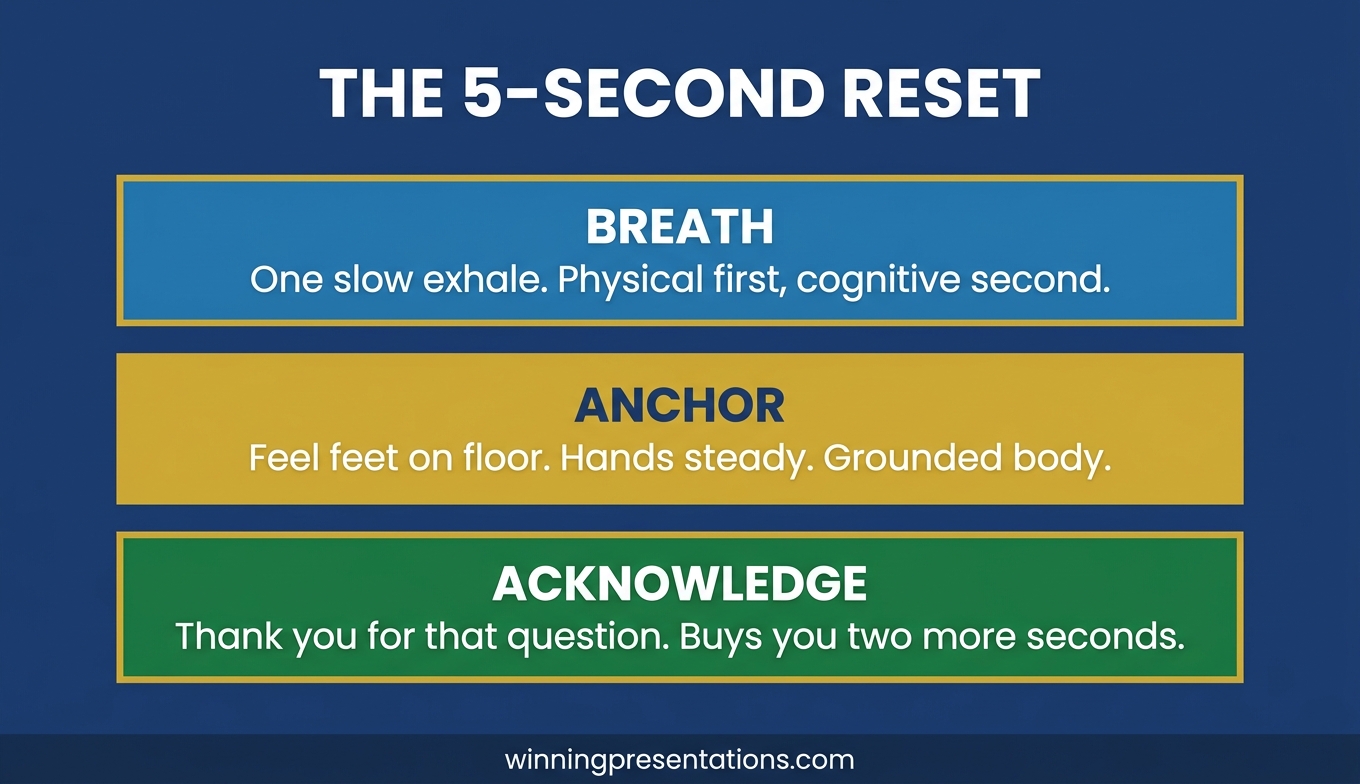
An effective reset is not a single action — it is a short sequence of three deliberate steps that together take no more than five seconds. Each step addresses a distinct aspect of the stress response. Done in sequence, they restore physiological composure, re-anchor attention, and buy you the cognitive window you need to choose a response rather than react.

Step 1: Breath (1–2 seconds). The moment the question ends, take a single controlled inhalation through the nose, count of two, and release slowly. This is not a deep diaphragmatic breath — that would be obvious and slow. It is a measured, normal-volume inhalation that signals to your autonomic nervous system that the threat response can stand down. Physiologically, a controlled exhalation activates the vagus nerve and begins to lower heart rate within seconds. Behaviourally, it interrupts the rushed inhale that audiences read as nerves.

Step 2: Anchor (1–2 seconds). Use a small physical anchor to redirect attention away from the internal stress response and into the external environment. Effective anchors are subtle: the feel of a pen between your fingers, the pressure of your feet on the floor, a glance at a single point on your notes. The anchor does two things. It pulls your focus out of your own body’s alarm system, and it gives you a consistent physical cue that you associate with composure through repetition. Over time, the anchor itself becomes a trigger for the calm state.

Step 3: Acknowledge (1–2 seconds). Open your answer with a short verbal acknowledgement of the question — not a stall, not a hedge, but a sentence that confirms you have heard and understood. Examples: “That’s an important question, and I want to answer it directly.” “Let me take that in two parts.” “I appreciate you raising that — here is how I would frame it.” The acknowledgement serves three purposes simultaneously. It gives your prefrontal cortex another one to two seconds to engage. It signals respect to the questioner, which often de-escalates hostility. And it gives you a cognitive runway into the structured answer that follows.

Together, the three steps form a sequence that fits inside the natural pause audiences expect between a question and an answer. The sequence is: Breath → Anchor → Acknowledge → Answer. Executives who build this into a reflex report that the reset becomes automatic within six to eight weeks of deliberate practice.


The 3-part Q&A micro-reset framework showing breath step, anchor step, and acknowledge step with timing and physiological purpose of each

How long should the pause between a question and an answer be? Between three and five seconds is the natural range for a considered response at executive level. Anything shorter reads as reactive. Anything longer begins to read as uncertainty. The three-part reset is calibrated to fit inside this window, so the pause looks like judgement rather than hesitation.

The Difference Between a Reset and Stalling

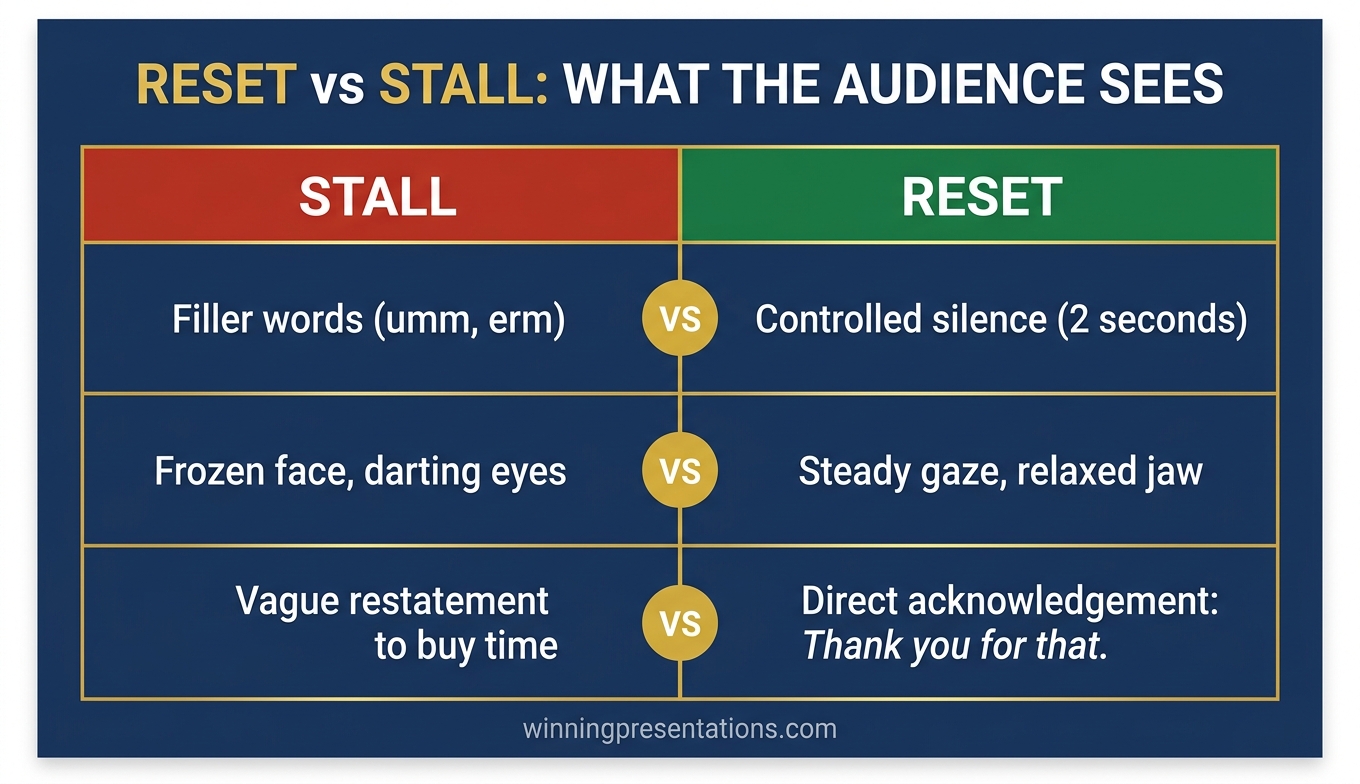
The instinct under pressure is often to buy time with verbal filler — “that’s a great question,” long throat-clearing, or a restatement of the question back to the room. These tactics feel like a reset but are actually stalling. The audience reads them correctly: you are not thinking, you are delaying. Once that perception lands, the credibility cost of your subsequent answer is substantial.

A genuine reset is physiologically and behaviourally different. It is short — five seconds, not fifteen. It is silent in its first two steps, and the verbal acknowledgement step is tight and purposeful, not a hedge. It moves you into the answer, rather than holding you in a holding pattern.

The test is simple. A stall delays the answer. A reset prepares the answer. If the audience cannot distinguish your pause from thoughtful engagement, you are executing a reset. If they are shifting in their seats, checking the chair’s face, or beginning to smell weakness, you have drifted into stalling. The cue is your body’s state: a reset ends with you calmer and more focused than when the question landed; a stall ends with you more agitated because the pressure has compounded while you searched for words.

Stalling also has a corrosive second-order effect: it trains you to associate pauses with panic. Over time, presenters who stall habitually develop an aversion to silence itself, which degrades their delivery long after the Q&A ends. A disciplined reset does the opposite — it teaches you that silence is an asset you can use deliberately, which is a pattern also central to the bridging technique in Q&A, where controlled pauses are part of the structural move, not a sign of struggle.

If you want a structured set of response frameworks to go with the reset reflex, the Executive Q&A Handling System provides templates for answering after the reset lands — including bridging structures, pre-mortem question libraries, and hostile-question response patterns.

How to Use the Reset Without Looking Frozen

The fear many executives have about pausing is that it will look like paralysis. This is a real risk — a poorly executed reset can look worse than a rushed answer. The difference comes down to three execution choices.

Keep the face neutral-engaged. During the reset, your face should show engagement, not blankness or a defensive hardening. Slight forward lean, a small nod of acknowledgement, eyes on the questioner or moving calmly between the questioner and the wider room. The goal is an expression that reads as “I am considering your question with the seriousness it deserves,” not one that reads as “I have stopped functioning.”

Keep the hands deliberate. Nervous hands — shuffling papers, tapping the lectern, touching the face — broadcast the internal stress response that the reset is meant to interrupt. The simplest solution is a physical anchor that occupies the hands purposefully: holding a pen, resting one hand on the lectern, or holding a clicker still. Deliberate stillness is far more composed than fidgeting, and it supports the anchor step of the reset.

Keep the eyes calm. Under threat response, eyes tend to dart or lock. Neither looks composed. Practice a soft, steady gaze: on the questioner during the breath step, drifting to a neutral point during the anchor step, returning to the questioner as the acknowledgement begins. This pattern is natural enough to read as engaged thinking and slow enough to mask the internal work of the reset.

Executives who find the reset feels mechanical in the first few attempts are experiencing exactly what should happen. Deliberate sequences always feel mechanical before they become automatic. The point is not to perform the reset visibly — the point is for the reset to become invisible through repetition, leaving only a composed executive who happens to take a thoughtful three to five seconds before answering hard questions.


Reset versus stalling comparison table showing behavioural markers of a composed micro-reset against the audience-visible signals of a panicked stall

Answer Tough Questions With Structure, Not Reflex

The Executive Q&A Handling System includes the full response library — reset drills, bridging frameworks, hostile-question playbooks, and pre-mortem templates — for board, investor, media, and regulator Q&A.

£39 — instant access.

Get the Executive Q&A Handling System →

A Drill to Build the Reflex Under Pressure

Knowing the reset intellectually is not the same as having it available when your heart rate is climbing in a live Q&A. The reflex is built through deliberate practice in conditions that approximate the stress of the real setting. Reading about the reset will not install it. The following drill will.

Step 1: Build a hostile question bank. Write down 20 questions that would genuinely rattle you if asked in your next board, investor, or media setting. These are not generic challenge questions — they are the specific ones you dread. Include questions about personal judgement, assumptions, credibility, decisions you made that did not land well, and anything a well-informed adversarial questioner would raise. This tough question response framework approach — building your own worst-case library — makes the practice meaningful rather than abstract.

Step 2: Practise the reset in isolation first. Record yourself on video. Have a colleague read one question at a time, with the hostile tone intact. Your only job on the first pass is to execute the reset — breath, anchor, acknowledge — without rushing into the answer. Watch the recording. Check facial composure, hand stillness, and eye behaviour. Repeat until the three steps take consistently between three and five seconds and look deliberately composed, not mechanical.

Step 3: Add physiological load. Do the drill after 30 press-ups, or after sprinting on the spot for 45 seconds. Elevated heart rate approximates the physiological state you will be in during live Q&A. If the reset holds under that load, it will hold in the boardroom. If it collapses, you have found the work you actually need to do.

Step 4: Combine reset with structured answer. Once the reset is stable, extend the drill to include a structured answer after the acknowledgement. Practise bridging from the reset into a clear, two- or three-sentence response. This is the full sequence: breath → anchor → acknowledge → answer. Run through the full sequence on all 20 questions. The goal is not perfect answers — the goal is consistent composure, so that your judgement is what shapes the answer rather than your alarm system.

Twenty minutes of this drill, three times a week, for six weeks, is enough to make the reset reflexive for most executives. It is a small investment for a skill that can determine how you are photographed, quoted, and remembered in your most consequential public moments.

When the Reset Fails — and How to Recover

Even well-practised executives occasionally meet a question that overrides the reset. It may be unusually personal, factually ambushing, or timed cruelly. When this happens — and it will — the priority shifts from composure to recovery.

The single most effective recovery move is explicit. A short, honest line — “That question landed harder than I expected. Let me think about it for a moment.” — is almost always received better than a fumbled answer delivered through visible stress. Audiences forgive a moment of honest composure-gathering far more readily than they forgive a defensive or incoherent response. The trick is to do it once, briefly, and then deliver a clear answer. Recovery is not a second reset — it is a reset made audible.

The second recovery move is to write down, immediately after the Q&A, exactly what triggered the override. Was it a specific word? A tone? A reference to a decision you still feel conflicted about? Each override you document becomes material for your next question bank. Over time, the set of questions that can blow through your reset shrinks toward zero — not because the questions become easier, but because you have pre-rehearsed the specific ones that exploit your remaining vulnerabilities.

This discipline — treat every override as data, not failure — is the quiet difference between executives who plateau after their first difficult Q&A and those who keep getting harder to rattle year after year. The reset is the tool. The drill installs it. The review after overrides sharpens it. Together, they turn emotional regulation in Q&A from a wish into a reliable reflex.

Frequently Asked Questions

What is the 5-second reset in Q&A?

The 5-second reset is a structured three-step sequence used between receiving a difficult question and beginning to answer. It consists of a controlled breath, a physical anchor, and a short verbal acknowledgement. The purpose is to interrupt the amygdala-driven stress response that narrows executive thinking under pressure, so that the answer is shaped by judgement rather than reaction. Done well, the reset fits inside the natural pause the audience expects between a question and a considered response.

Does pausing before answering make me look uncertain?

A three-to-five-second pause reads as considered engagement, not uncertainty — provided your face, hands, and eyes remain composed during the pause. Uncertainty is communicated by fidgeting, darting eyes, tightened expression, or verbal filler. Calm stillness during a short pause reads as executive-level thinking. The pause only becomes problematic when it extends past five or six seconds or when the body language during the pause broadcasts internal panic. A well-executed reset is, in fact, one of the clearest signals of composure an audience can receive.

How do I stop my face giving me away during hostile questions?

The facial response to hostile questions is driven by the same stress cascade that narrows your thinking — which means the reset addresses both at once. The breath step lowers the physiological activation that produces the micro-expression. The anchor step redirects attention away from the internal alarm system. Over time, the combined effect is a softer, more neutral facial response during the opening seconds. Video practice is essential here. Most executives significantly underestimate what their face is doing and only see it clearly when they review footage.

How long does it take to build the reset into a reflex?

With deliberate practice — 20 minutes, three times a week, using a hostile question bank and ideally some physiological load — most executives report the reset becoming reflexive within six to eight weeks. The first two weeks feel mechanical. Weeks three and four introduce stability. By week six, the sequence runs without conscious effort in moderate-pressure settings, and by week eight it typically holds in the live high-stakes settings it was designed for. The timeline can be shorter for executives who already have meditation or breathwork experience, and longer for those whose Q&A history includes a specific traumatic incident they are still processing.

Join The Winning Edge

Free weekly newsletter for executives who present under scrutiny. Q&A handling, composure techniques, and structural frameworks for board, investor, and media settings — delivered every Thursday.

Subscribe Free →

Read next: If the anxiety you feel in Q&A is compounded by a wider sense that you are being tested for a role you are not sure you deserve, see Imposter Syndrome and Promotion Anxiety: How Senior Executives Stay Composed Under Internal Scrutiny for the cognitive framework behind long-term composure.

Next step: If your next board, investor, or media Q&A is already on the calendar, build your 20-question hostile bank this week and begin the reset drill. Emotional regulation in Q&A is not a personality trait — it is a reflex, and it is trainable.

Mary Beth Hazeldine is the Owner & Managing Director of Winning Presentations. With 25 years of corporate banking experience at JPMorgan Chase, PwC, Royal Bank of Scotland, and Commerzbank, she advises executives across financial services, healthcare, technology, and government on structuring presentations and handling Q&A in high-stakes scenarios.