Tag: hostile audience

26 Mar 2026
Corporate boardroom viewed from behind a presenter facing a challenging question from an executive across the table

The Board Member Who Tried to Destroy My Credibility in 30 Seconds

Hostile questions in board meetings are often about power, not information. The most effective response framework combines tactical pauses, structured bridge statements, and strategic redirection—giving you time to compose your thoughts whilst maintaining board-room authority. When challenged publicly, the goal isn’t to win the argument but to demonstrate calm, credibility, and control.

Katrin, a CFO at a mid-cap insurance firm, was presenting quarterly results to her board. Halfway through, Martin—a particularly vocal shareholder director—interrupted with a pointed attack: “These numbers don’t stack up. Either your team can’t count or you’re hiding something. Which is it?” The room went silent. Katrin felt her pulse spike. Her instinct was to defend sharply. Instead, she paused, breathed, and replied: “That’s a fair question, Martin. I appreciate the directness. Let me address both the calculation you’ve flagged and the data we’re seeing.” She took him to the detailed schedule, showed her working, and invited him to identify the specific line that troubled him. By the time Martin had found nothing, Katrin had repositioned the entire moment—she was the professional with answers, and he was the one asking for evidence. The board noticed. Not because she won an argument, but because she stayed composed and showed command.

The Executive Q&A Handling System offers frameworks and response structures designed for handling challenging board room questions.

Explore the System →

Understanding Hostile Questions in the Boardroom

Hostile questions are rarely about missing information. They’re about power, distrust, or agenda. A shareholder questions your strategy not because they genuinely don’t understand it, but because they want to undermine it in front of the board. A non-executive director challenges your financial assumptions not to learn, but to position themselves as the critical thinker. Understanding this distinction changes how you respond.

When someone delivers a hostile question, they’re signalling one of three things: they lack confidence in your competence, they disagree with your direction, or they’re trying to build credibility by appearing rigorous. The tone—sarcasm, incredulity, a loaded premise—signals intent before content.

The trap is reacting to the tone rather than addressing the substance. If you become defensive, emotional, or counter-aggressive, you’ve handed control to the questioner. They’ve successfully rattled you. Instead, your job is to separate the emotional content from any legitimate underlying issue, then respond to the legitimate issue with calm authority.

Master Q&A Under Pressure

The Executive Q&A Handling System

Four proven frameworks that work in any boardroom:

  • Response structures that buy you composure time without sounding evasive
  • Bridge statements that redirect loaded questions to your territory
  • Deflection techniques for questions you can’t or shouldn’t answer
  • Question categorisation to separate substance from posturing

Get the System → £39

The Three-Part Response Framework

The most effective response to a hostile question has three components: acknowledge, clarify, answer. This isn’t capitulation. It’s tactical.

Part 1: Acknowledge. Before you answer, signal that you’ve heard the question. Not agreeing with the tone—acknowledging the question itself. “That’s a direct question, and I appreciate the challenge” or “I understand why that matters to you.” This does two things: it gives you five seconds of breathing room, and it signals to the board that you’re confident enough to listen without becoming defensive.

Part 2: Clarify. Before answering, reframe. “What I’m hearing is a concern about our cash conversion cycle. Is that right?” This serves three purposes. First, you’re confirming you understand. Second, you’re removing any loaded language and restating it in neutral terms. Third, you’re subtly taking control of the narrative—you’re the one defining what the question is about. If the questioner interrupts and says “No, that’s not what I meant,” you’ve already improved your position.

Part 3: Answer. Now you answer the question you’ve clarified, not the loaded version that was asked. You’re not being evasive—you’re being precise. You’re answering the substantive question, grounded in fact, with evidence if you have it. The tone is assured, not rushed.

This framework works because it buys you time, removes emotional charge, and establishes you as the authority. Learn more about answering from evidence first—it transforms how boards perceive your credibility.

Bridge Statements That Redirect Loaded Questions

Some questions contain a false premise. “Aren’t we overexposed to the Asian market?” might assume a fact not in evidence. The questioner has built an assumption into the question, hoping you’ll defend against it and inadvertently validate the premise.

A bridge statement lets you reject the assumption without sounding evasive. For example: “I’d reframe that. We’re not overexposed—we’re strategically positioned. Here’s the data.” You’ve rejected the premise, offered your framing, and then provided evidence. The board hears that you’re not hiding something; you have a different view based on numbers.

Effective bridges use phrases like: “I’d look at it differently,” “The data shows something different,” “That’s one way to frame it, but the reality is,” or “I appreciate the concern, and here’s what we’re actually seeing.” Each one takes the loaded question and moves it to territory where you can answer with authority.


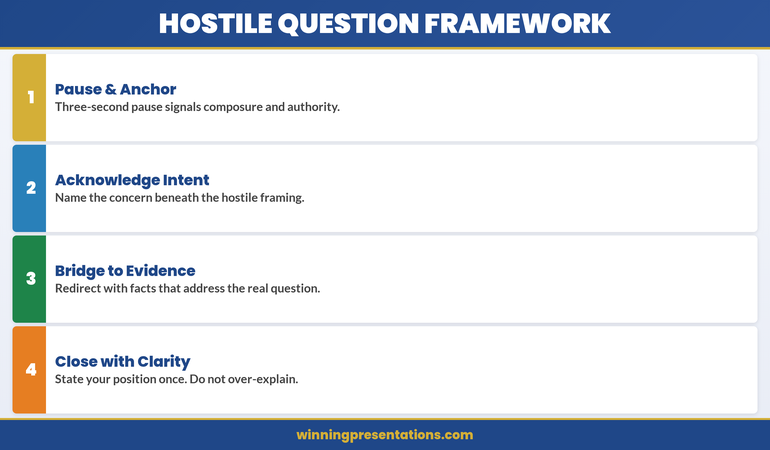
Hostile Question Framework infographic showing four stacked response cards: Pause and Anchor, Acknowledge Intent, Bridge to Evidence, and Close with Clarity — each with a concise tactical description

Before You Answer

1. Genuine information gap or test? Curious questions sound different from challenging ones.

2. What’s the underlying concern? Surface words might not reveal the actual issue.

3. What narrative is this trying to create? Understand the questioner’s intent before answering.

Maintaining Authority When Challenged Publicly

Authority doesn’t come from being right (though that helps). It comes from how you carry yourself when you’re being attacked. The board is watching not your answer, but your composure.

When you respond to a hostile question, use these tactical elements: pause before answering (signals you’re thinking, not reacting), maintain steady eye contact (with the questioner first, then the board), keep your voice level (no rise in pitch, no pace increase), and use declarative statements, not questions (say “The reality is” not “Don’t you think that might mean”). Each one signals control.

If you don’t know the answer, authority means saying so calmly. “That’s a specific number—let me come back to you with the exact figure” sounds stronger than either guessing or becoming evasive. You’ve acknowledged the question, shown you take it seriously, and bought yourself time to deliver accurate information. The board sees competence and integrity, not weakness.

The mistake most executives make is trying to over-answer hostile questions. More words, more detail, more justification. This reads as defensive. Instead, answer what’s asked, provide your evidence, and stop. If they want more, they’ll ask. Your brevity signals confidence. See how to stay composed even when ambushed—these principles apply to any audience size.

When to Stand Firm, When to Concede

Not every challenge deserves the same response. If a questioner has spotted a genuine error or gap in your thinking, the move is to acknowledge it and explain how you’ll address it. This actually builds authority—you’re confident enough to learn in real time.

If a questioner is challenging your decision or strategic direction, your job is not to convince them—it’s to explain your reasoning clearly, acknowledge their concern has been heard, and move on. You don’t need everyone to agree. You need the board to see that you’ve thought it through and you’re not rattled by dissent.

If a question is out of bounds (confidential, speculative, or not your area), you can deflect with: “That’s outside what I can comment on in this forum” or “I’ll address that separately with the appropriate committee.” You’re not being evasive; you’re being responsible. The board respects boundaries.


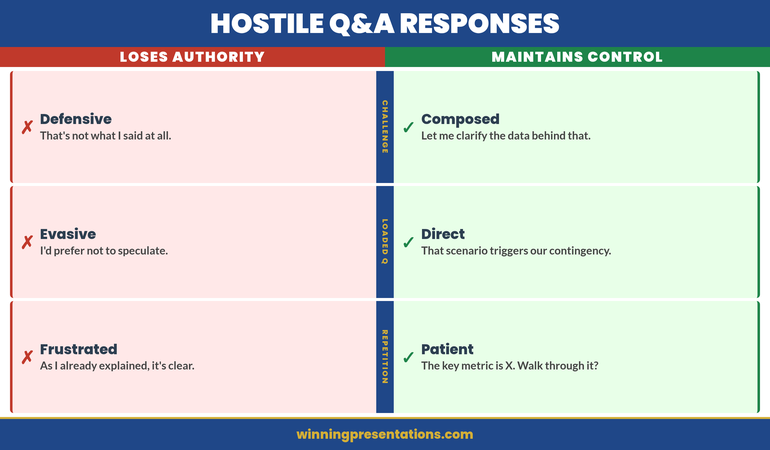
Hostile Q&A Responses split comparison infographic contrasting authority-losing responses (defensive, evasive, frustrated) against authority-maintaining responses (composed, direct, patient) across three challenge types

Frequently Asked Questions

What if the hostile questioner is a majority shareholder or board chair?

Your approach doesn’t change—if anything, it’s more important to stay composed and professional. The power dynamics are already known; demonstrating that you don’t rattle under pressure is actually what builds their confidence in your leadership. Use the same framework: acknowledge, clarify, answer. The only adjustment is your pacing—you might want to be slightly more thorough in your response to show you’re taking their question seriously, but never to the point of over-explaining.

How do I prepare for hostile questions I can’t anticipate?

You prepare for the framework, not specific questions. Know your three-part response structure cold. Practise acknowledging without agreeing, clarifying without defensiveness, and answering with confidence. Anticipate your key vulnerabilities—areas where the board is most likely to push back—and have your evidence organised. Develop contingency answers for your riskiest points—this gives you the confidence to handle almost anything.

What if I lose my composure in the moment?

Pause. Acknowledge it if necessary: “That’s a fair challenge—let me take a breath and answer properly.” This is not weakness. The board will respect your willingness to slow down and think rather than react emotionally. Most of the executives who perform best in hostile Q&A do so because they’ve learned to recognise the moment they’re about to lose composure and they pause. That pause is the skill.

Get Board-Ready Insights Every Week

The Winning Edge newsletter gives you frameworks, case studies, and tactical Q&A prep for executives who present to boards, investors, and high-pressure rooms.

Subscribe Now

Related Article

Managing Visible Anxiety: Why Trembling Hands Undermine Board Credibility — read how to manage the physical signs of stress during high-stakes presentations.

About the Author

Mary Beth Hazeldine is Owner & Managing Director of Winning Presentations. With 24 years of corporate banking experience at JPMorgan Chase, PwC, Royal Bank of Scotland, and Commerzbank, she advises executives across financial services, healthcare, technology, and government on structuring presentations for high-stakes funding rounds and approvals.

23 Feb 2026
Professional woman standing alone presenting to a boardroom of seated sceptical executives — presenting when the room has already decided against you

The Presentation You Give When the Room Has Already Decided Against You

Quick answer: When the room has already decided against your recommendation, a traditional presentation — background first, evidence second, ask at the end — guarantees rejection. The audience spends every slide building their counter-argument. The reversal framework works differently: acknowledge the objection first (proves you understand their position), reframe the decision criteria (shifts what they’re evaluating), present evidence against the NEW criteria (makes your recommendation logical under their reframed perspective), and make the ask inevitable. The room doesn’t change their mind — you change what they’re deciding about.

47 Slides. A Competing Internal Team. A Room That Had Already Said No.

The biotech company had 47 slides. The board had already been briefed by a competing internal team pushing an alternative approach. Every decision-maker in the room had seen the counter-proposal first — and had been nodding along to it for two weeks.

My client walked in knowing the room had pre-decided. Not hostile in a confrontational way. Worse. Politely certain they’d already found the better option.

We cut the 47 slides to 12. Not by removing information — by restructuring the logic. The first slide didn’t present the recommendation. It acknowledged the competing proposal’s strongest argument. The second slide reframed the decision criteria — not “which approach is cheaper?” but “which approach reduces regulatory risk in the first 18 months?” By slide 4, the room was evaluating a different question than the one they’d walked in with.

They approved the recommendation. £4.2 million in funding. From a room that had walked in ready to say no.

Not because the presentation was persuasive. Because the structure changed what the room was deciding about. That’s the difference between presenting to a hostile room and reversing one.

🚨 Presenting to a resistant room this week? Quick 60-second check: Does your first slide acknowledge their current position — or does it launch straight into YOUR recommendation? If it launches into your pitch, you’ve lost them by slide 2. They’re not listening. They’re building their counter-argument. → Need the exact reversal templates? The Executive Slide System (£39) includes the decision-reframing structure that turns hostile rooms into approvals.

Why Traditional Presentations Guarantee Rejection in a Hostile Room

When an audience has already decided against your recommendation, every element of a traditional presentation works against you. Here’s the structural problem:

Background slides confirm their position. You open with context: market data, project history, the problem you’re solving. The hostile audience doesn’t hear “context.” They hear “here’s why I think you’re wrong” — and they start mentally rehearsing their objections. By the time you reach slide 5, they’ve already formulated three reasons to reject you. Your background became their preparation time.

Evidence slides trigger counter-evidence. You present your data, your ROI projections, your implementation plan. Each data point the audience disagrees with hardens their resistance. In a neutral room, evidence builds your case. In a hostile room, evidence triggers an adversarial response — they’re not evaluating your data, they’re looking for the flaw that justifies their pre-existing position.

The late ask gives them an easy exit. After 20 slides of background and evidence, you finally ask for the decision. By now, the hostile audience has had 20 slides to build their “no.” The ask becomes a formality — they deliver the rejection they’ve been preparing since slide 1. You never had a chance because the structure gave them 20 minutes to fortify their opposition.

This is why “just present the facts and let them decide” fails catastrophically in a hostile room. The facts aren’t evaluated neutrally. They’re filtered through a pre-existing conclusion. The decision-first slide approach addresses this by restructuring when the audience encounters the key question — but in a hostile room, you need to go further. You need to change the question itself.

Diagram showing how traditional presentation structure guarantees rejection in hostile rooms — background confirms opposition, evidence triggers counter-arguments, late ask enables prepared rejection

The 4-Slide Reversal Framework That Changes What the Room Is Deciding

The Reversal Framework doesn’t try to persuade a hostile room to agree with you. It changes what they’re deciding about — so your recommendation becomes the logical answer to a different question.

Here’s how the 12-slide biotech presentation worked, condensed to its 4-slide core logic:

Slide 1: The Acknowledgement. Not your recommendation. Not your evidence. An honest acknowledgement of the room’s current position and why it makes sense. “The Phase 2 approach has clear cost advantages and faster initial timelines. I understand why it’s the preferred option.” This does something no traditional opening does: it disarms the audience. They walked in expecting you to argue against their position. Instead, you validated it. The adversarial dynamic breaks. For 30 seconds, the room stops preparing their counter-argument — because you’re not arguing. You’re agreeing. That 30-second window is where the reversal begins.

Slide 2: The Reframe. This is the architectural pivot. You don’t challenge their conclusion — you challenge the criteria they used to reach it. “But the decision criteria should include regulatory risk in the first 18 months — not just cost and speed. Here’s why.” You’re not saying they’re wrong. You’re saying the question is incomplete. This is psychologically powerful because it doesn’t require the audience to admit they were wrong about anything. They weren’t wrong about cost. They weren’t wrong about speed. They just weren’t evaluating the full picture. Nobody’s ego is threatened. The decision criteria simply got bigger.

Slide 3: Evidence Against the NEW Criteria. Now — and only now — you present your evidence. But mapped to the reframed criteria, not the original ones. The competing proposal wins on cost. Your proposal wins on regulatory risk, which you’ve just established as the criterion that matters most. The room evaluates your evidence against the expanded criteria and sees that your recommendation is the logical answer — not because you argued better, but because the question changed. At board-level presentations, this reframing technique is particularly effective because boards are conditioned to evaluate decisions against multiple criteria.

Slide 4: The Inevitable Ask. Restate the reframed decision criteria. Show how your recommendation satisfies them. Make the ask. “Given the regulatory risk profile, I’m recommending we proceed with the Phase 3 approach at a cost of £4.2M.” By this point, the ask doesn’t feel like a pitch. It feels like the obvious conclusion to the framework the room has already accepted. They’re not “changing their mind” — they’re making a different decision because the decision criteria changed.

Four slides. Acknowledge → Reframe → Evidence → Ask. The room walks in ready to say no. They walk out having approved — because you didn’t fight their position. You expanded it.

The Reversal Framework — including the acknowledgement template, the criteria reframe formula, and the evidence-mapping structure — is built into the Executive Slide System, with templates designed for steering committees, boards, and senior leadership meetings where pre-decided resistance is the norm.

The Slide Structure That Reverses Pre-Decided Rooms

The Executive Slide System gives you the Reversal Framework — the slide architecture that turns hostile rooms into approvals by changing what the audience is deciding about, not by arguing harder.

  • ✓ The Acknowledgement Slide template — disarm resistant stakeholders in the first 30 seconds
  • ✓ The Criteria Reframe formula — shift the decision question so your recommendation becomes the logical answer
  • ✓ Evidence-mapping templates — present data against the reframed criteria, not the ones you’ll lose on

Get the Executive Slide System → £39

Built from 24 years of executive presentations at JPMorgan, PwC, RBS, and Commerzbank — including high-stakes approvals where the room walked in ready to say no.

How to Reframe Decision Criteria Without the Room Realising

The reframe is the most critical slide in the Reversal Framework — and the most misunderstood. It’s not manipulation. It’s not a trick. It’s adding a decision criterion the room hasn’t considered, making their evaluation more complete rather than less.

Here’s the technique, broken down into three steps:

Step 1: Identify the criteria the room is currently using. In the biotech case, the room was evaluating on cost and speed. Those were the two criteria the competing team had presented — because they won on both. Your first task is to name the criteria the room is using, even if nobody has stated them explicitly. “The current evaluation is focused on cost and implementation speed — and the Phase 2 approach wins on both.”

Step 2: Introduce the missing criterion with a consequence. Not “here’s another thing to consider.” That’s too weak. Instead: “But there’s a criterion missing from this evaluation that changes the calculus entirely: regulatory risk in the first 18 months.” The word “consequence” is important. You’re not adding a nice-to-have. You’re introducing something that materially changes the outcome. The room’s attention shifts because you’ve signalled danger — there’s something they haven’t evaluated that could hurt them.

Step 3: Make the missing criterion the decisive one. Show — with evidence — why the missing criterion outweighs the existing ones. “A regulatory delay costs £800K per month. The Phase 2 cost advantage is £1.2M total. One regulatory setback eliminates the entire cost saving and creates a £2.4M exposure.” The maths makes the reframe concrete. The room isn’t changing their mind — they’re responding to new information that makes the previous evaluation incomplete.

This works because you’re not saying “you were wrong.” You’re saying “you were right — but incomplete.” That’s a much easier psychological position for decision-makers to accept, especially at the steering committee level where nobody wants to appear to have been manipulated or to have missed something obvious.

The 4-Slide Reversal Framework showing Acknowledge, Reframe, Evidence against new criteria, and Inevitable Ask — turning hostile rooms into approvals

Reading the Room: How to Know If the Reversal Is Working

The Reversal Framework creates observable shifts in the room’s behaviour. Knowing what to watch for helps you calibrate your delivery in real time.

Signal 1: The uncrossing. Hostile audiences have closed body language — crossed arms, leaned back, minimal eye contact. When the Acknowledgement Slide lands, you’ll see a physical shift. Arms uncross. Posture shifts forward slightly. One or two people make eye contact. This happens because you’ve broken the adversarial expectation. They expected a fight. You gave them validation. The physiological response is an opening — literally.

Signal 2: The note-taking shift. In a hostile room, decision-makers take notes to build their counter-argument (“didn’t account for X,” “timeline unrealistic”). When the Reframe Slide lands, the note-taking changes character. Instead of writing objections, they start writing the new criterion. They’re no longer building a case against you. They’re processing the reframe. Watch for the moment someone writes down your reframed criterion — that’s the moment the reversal is working.

Signal 3: The internal glance. After the Reframe Slide, watch for decision-makers glancing at each other. Not the hostile “can you believe this?” glance. The “did we miss this?” glance. This is the most powerful signal because it means the room is collectively realising their previous evaluation was incomplete. They’re checking whether their colleagues had considered the missing criterion. If nobody had, your reframe has just created a shared gap that only your recommendation fills.

Signal 4: Questions shift from challenges to logistics. In a hostile room, questions sound like “Where did you get those numbers?” and “Isn’t the alternative cheaper?” After a successful reversal, questions shift to “What’s the implementation timeline?” and “How soon can we start?” When questions move from challenging your premise to planning the execution, the room has decided — even if they haven’t formally voted yet.

The Reversal Framework templates inside the Executive Slide System include the acknowledgement opener, the criteria reframe formula, and the evidence-mapping structure — plus AI prompts to build your reversal deck in 25 minutes so you’re prepared even when you discover the resistance the morning of the meeting.

Stop Losing Recommendations to Rooms That Decided Before You Spoke

You’ve walked into meetings where every face said no before you opened your mouth. You’ve watched good proposals die because the room had already committed to the alternative. The Executive Slide System gives you the reversal architecture that changes what they’re deciding about.

  • ✓ Stop presenting evidence to rooms that have already decided to ignore it
  • ✓ Stop losing budget approvals because a competing proposal was briefed first
  • ✓ Stop watching strong recommendations die because the room was pre-committed to “no”

Get the Executive Slide System → £39

The same reversal framework used by the biotech team that secured £4.2M from a board briefed against their proposal — 47 slides became 12, and the room that walked in ready to say no walked out having approved.

Common Questions About Presenting to Hostile Audiences

How do you present when the audience has already decided against you?

You don’t try to change their mind — you change what they’re deciding. The Reversal Framework uses four slides: Acknowledgement (validate their current position to disarm the adversarial dynamic), Reframe (introduce a decision criterion they haven’t considered that shifts the evaluation), Evidence (present your data against the reframed criteria where your recommendation wins), and Ask (make the recommendation inevitable under the expanded framework). The key psychological insight: people don’t resist changing their mind when they feel they’re making a better decision, not a different one. The reframe gives them new information that makes their previous evaluation incomplete — and your recommendation becomes the logical completion.

Can a presentation actually reverse a pre-decided room?

Yes, but not through better arguments or more data. Pre-decided rooms have already evaluated your type of evidence and reached a conclusion. Adding more of the same evidence reinforces their existing framework. The Reversal Framework works because it changes the evaluation framework itself — introducing a criterion the room hasn’t considered that shifts which option is logically superior. The biotech case study is typical: the room had decided on cost and speed grounds. The reframed criterion (regulatory risk) didn’t make them wrong about cost — it made cost insufficient as a decision factor. No ego threatened. No position reversed. Just a more complete evaluation that changed the answer.

What’s the best structure for presenting to resistant stakeholders?

The worst structure is the most common one: background → evidence → ask. In a resistant room, background gives stakeholders time to prepare their objections, evidence triggers counter-evidence, and the late ask enables the rejection they’ve been building toward. The best structure for resistant stakeholders is: acknowledge → reframe → evidence against new criteria → inevitable ask. This works because the acknowledgement breaks the adversarial dynamic (they expected a fight, you gave validation), the reframe expands the evaluation criteria (nobody’s wrong, the question just got bigger), and the evidence against the NEW criteria positions your recommendation as the logical answer to a question the room accepts as legitimate.

Is the Executive Slide System Right For You?

✓ This is for you if:

  • You regularly present to rooms where the audience has already formed an opinion — boards, steering committees, or leadership teams briefed by competing proposals
  • You’ve had good recommendations rejected because the room was pre-committed to an alternative
  • You want a structural framework for reversing resistant audiences — not motivational advice about “staying confident”
  • You need to build a reversal deck quickly, sometimes with hours of notice

✗ This is NOT for you if:

  • Your audience is neutral or supportive — the Reversal Framework is specifically for pre-decided resistance (neutral audiences need decision-first structure, not reversal architecture)
  • You’re looking for body language or delivery coaching (this is a slide structure framework)
  • Your presentations don’t involve a specific recommendation or ask (the framework is built around reversing a decision, which requires a decision to reverse)

47 Slides Became 12. A Hostile Room Became a £4.2M Approval. The Framework Is Now Available as Templates.

Every template in the Executive Slide System was built in boardrooms, steering committees, and programme governance meetings where the room walked in pre-decided — across 24 years at JPMorgan, PwC, RBS, and Commerzbank.

  • ✓ Reversal Framework templates — Acknowledge, Reframe, Evidence, Ask — built for pre-decided audiences
  • ✓ AI prompts to restructure your existing deck into reversal architecture in 25 minutes
  • ✓ Before/after examples from real executive presentations where the room started hostile and ended with approval

Get the Executive Slide System → £39

Used by programme directors, VPs, and department heads presenting in environments where the answer was “no” before they walked in — and “yes” before they walked out.

Frequently Asked Questions

What if the room won’t engage at all — stone-faced silence?

Stone-faced silence is actually better than active hostility — it means the room is waiting, not fighting. The Acknowledgement Slide is particularly powerful here because it breaks the expectation. The room expects you to pitch. When you validate their position instead, the silence shifts from resistant to curious. They’re listening to see where you’re going. The Reframe Slide then gives them something to evaluate — a new criterion they hadn’t considered. Stone-faced rooms often break into engagement at the reframe because you’ve introduced genuine new information. If the silence persists through the Evidence Slide, ask a direct question: “Does the regulatory risk factor change how you’d evaluate the two options?” This forces a response and makes the reframe explicit.

Does this work when my own manager is against the recommendation?

Yes, and it’s actually more important in this scenario. When your manager disagrees, a traditional “here’s why I’m right” presentation creates a direct conflict with someone who controls your career. The Reversal Framework avoids direct conflict entirely. You acknowledge your manager’s position (validating their thinking), introduce an additional criterion (not contradicting them — expanding the evaluation), and let the evidence speak to the expanded criteria. Your manager doesn’t have to admit they were wrong. They have to decide whether the new criterion changes the calculus — and if your evidence is strong, the answer is yes. The key: never frame it as “you missed this.” Frame it as “there’s new information that wasn’t available when the initial evaluation was done.”

What if I’ve already presented this recommendation and it was rejected — can I try the Reversal Framework on a second attempt?

Yes, but the Acknowledgement Slide becomes even more critical. You need to acknowledge the previous rejection explicitly: “Last quarter, I recommended the Phase 3 approach and the committee decided against it. The cost and speed evaluation was sound.” Then introduce what’s changed: “Since then, three things have shifted that change the risk profile…” The reframe works because you’re not saying the previous decision was wrong — you’re saying the conditions have changed. This gives decision-makers a psychologically safe way to reverse course: they made the right call with the information they had. Now the information is different. Second-attempt reversals have the highest success rate when you can name the specific change that makes the previous decision incomplete.

Get Weekly Presentation Intelligence

Reversal frameworks, decision-reframing techniques, and the slide architecture that turns resistant rooms into approvals — delivered every week for senior professionals who present in high-stakes environments.

Join the Newsletter

Related: If the hostile room triggers anxiety — the dread of walking into a meeting where every face says no, the fear of public failure — that’s a separate problem with a separate fix. Read Glossophobia at the C-Suite: Why Successful Executives Still Struggle for the clinical techniques that break the executive anxiety cycle.

Also today: If the problem isn’t collective resistance but a specific colleague actively sabotaging your presentation — feeding contradictory data to decision-makers or lobbying against you before the meeting — the structural defence is different. Read The Executive Who Tried to Sabotage My Client’s Presentation for the framework that makes sabotage structurally irrelevant.

Your next step: Think about your next meeting where the room might not be on your side. Check your deck: Does Slide 1 acknowledge their current position? Does Slide 2 introduce a criterion that changes the evaluation? If you’re leading with your recommendation instead, you’re presenting to a room that’s spending your entire deck building their “no.”

The room has already decided. Your structure needs to change what they’re deciding about. Build the reversal deck before the meeting — not after the rejection.

Get the Executive Slide System → £39

About the Author

Mary Beth Hazeldine is the Owner & Managing Director of Winning Presentations. With 24 years of corporate banking experience at JPMorgan Chase, PwC, Royal Bank of Scotland, and Commerzbank, she has delivered and supported high-stakes presentations in boardrooms where the room walked in pre-decided — steering committees, programme boards, and executive governance meetings where the default answer was “no” and the slide structure had to change it.

A qualified clinical hypnotherapist and NLP practitioner, Mary Beth has trained thousands of executives and supported high-stakes funding rounds and approvals across banking, consulting, and corporate environments.

Book a discovery call | View services