

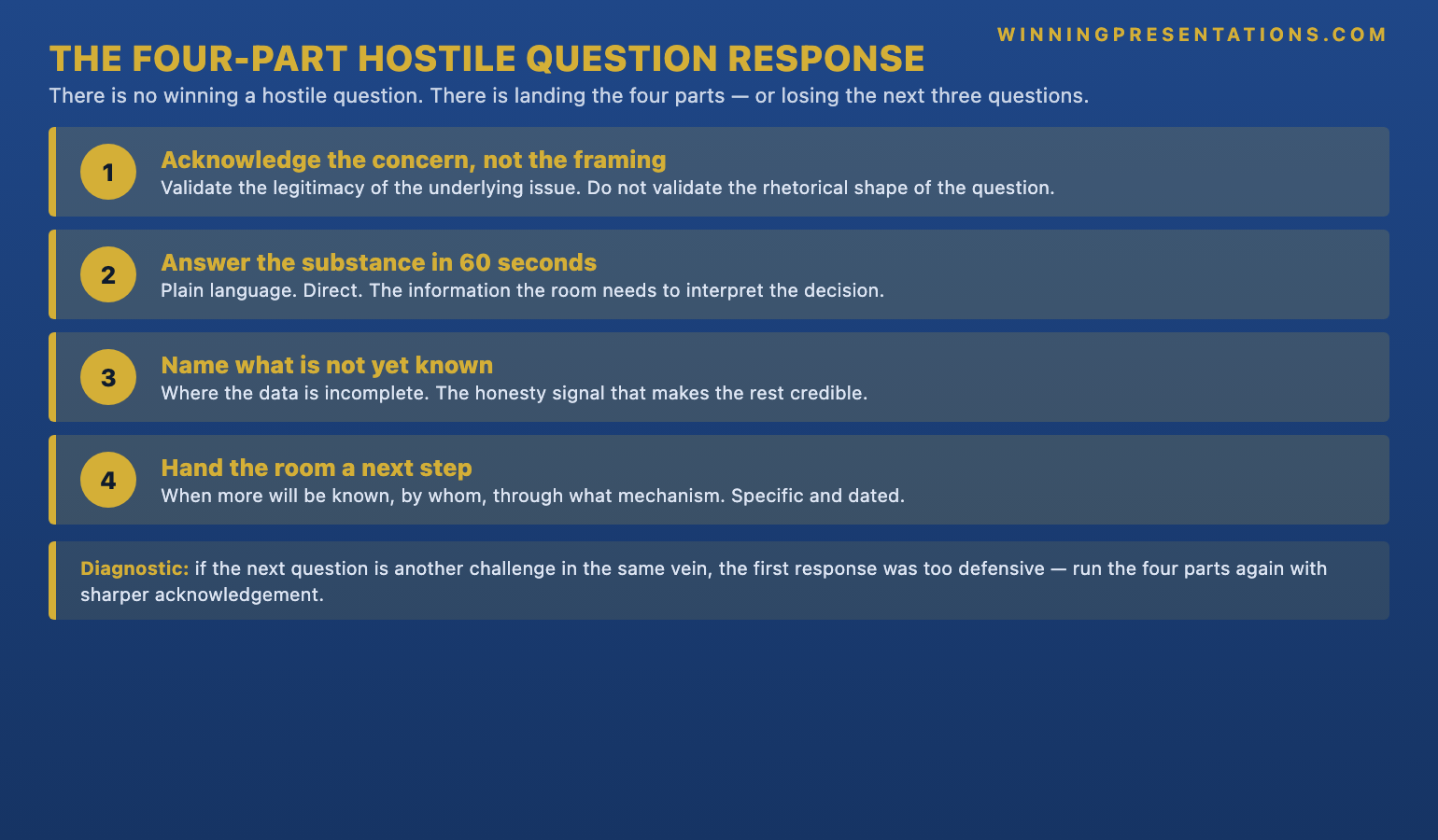
Quick answer: The hostile all hands question is not the threat senior leaders treat it as. It is a four-part response problem, and the response that lands the room has the same four moves every time. (1) Acknowledge the legitimacy of the concern underneath the question — not the framing, the concern. (2) Answer the substantive question, if there is one, directly and in plain language, in sixty seconds. (3) Name what is not yet known — the part where the data is incomplete and the decision is genuinely open. (4) Hand the room a next step — when more will be known, who will say it, and through what mechanism. The diagnostic is what happens next: if the next question in the queue is substantive, the response landed; if the next question is another challenge in the same vein, the first answer was too defensive and a second pass is required. The leader is never trying to win the exchange. There is no winning a hostile question. There is only landing the four parts, or not.
JUMP TO:
- Why the defensive answer damages the leader more than the question does
- The four-part hostile-question response
- Part one: acknowledge the concern, not the framing
- Part two: answer the substantive question in sixty seconds
- Part three: name what you do not yet know
- Part four: hand the room a next step
- What to do before the next all-hands with a hot topic
- Frequently asked questions
In 2016, a divisional managing director at a publicly-listed mid-cap industrials manufacturer was running the quarterly all-hands. The format was hybrid — around two hundred and forty employees in the room in the company’s headquarters auditorium, another six hundred or so dialled in across three regional offices and a manufacturing site. The agenda was the usual: half-year results, the year-ahead operating plan, a Q&A. The managing director had been in post for fourteen months. Eight weeks earlier, the board had announced a restructure that cut roughly seventy roles across two support functions, with the cuts landing disproportionately in one regional office. The communications team had prepared the all-hands carefully. The first thirty-five minutes had gone smoothly. Then the Q&A opened, the moderator invited the first question, and a woman stood up at the back of the auditorium — mid-thirties, lanyard, a printed sheet of notes in her hand — and asked, loud enough that the question did not need the roving microphone: “You told us in March that the restructure was about reducing duplication. Two of my colleagues were made redundant from a team that did not duplicate anything. How are you going to explain that to the rest of us, and why should we believe what you say in the next thirty minutes?”
(This article was created with AI assistance; all stories and insights are based on 35 years of real client work.)
The room went still. The moderator’s eyes flicked to the side of the stage, where the chief people officer was standing. Two of the regional offices, watching on screens, would not have heard the question clearly; the moderator asked the employee to repeat it for the people on the back row and for the dial-in. She repeated it, slightly louder, slightly slower. The managing director’s first instinct — visible in the half-second pause, in the slight lift of the shoulders, in the breath taken before the first word — was to defend the decision. He defended it. He explained the methodology the operating committee had used to identify the roles in scope. He named the consulting firm whose framework had been applied. He noted that the board had reviewed and approved the methodology twice. He said the right things, technically. The room heard a leader explaining why the methodology was correct rather than a leader hearing what the employee had actually asked. The next question in the queue, when the moderator moved on, was another challenge in the same vein. So was the one after that. The Q&A never recovered. The communications team spent the following six weeks running a series of remediation sessions across the regional offices that had been pre-empted only by a different answer in the first sixty seconds of the auditorium Q&A.
This piece walks through what should have happened in that first sixty seconds, the four-part response that handles a hostile all hands question without defending, the second-order effects on the rest of the Q&A queue, and the preparation move that any senior leader can do the day before a town hall with a hot topic on the agenda. The framework will not let a leader “win” a hostile question — there is no winning — but it will keep the room available for the substantive conversation that the leader actually wants to have, instead of converting the rest of the Q&A into a sequence of escalating challenges.
Before the next all-hands with a hot topic, a one-page structural check is worth running.
The Executive Presentation Checklist walks through the structural moves that hold a town hall together when the Q&A turns hostile — the acknowledgement language, the sixty-second substance answer, the named next step. Free download, no email gate.
Why the defensive answer damages the leader more than the question does
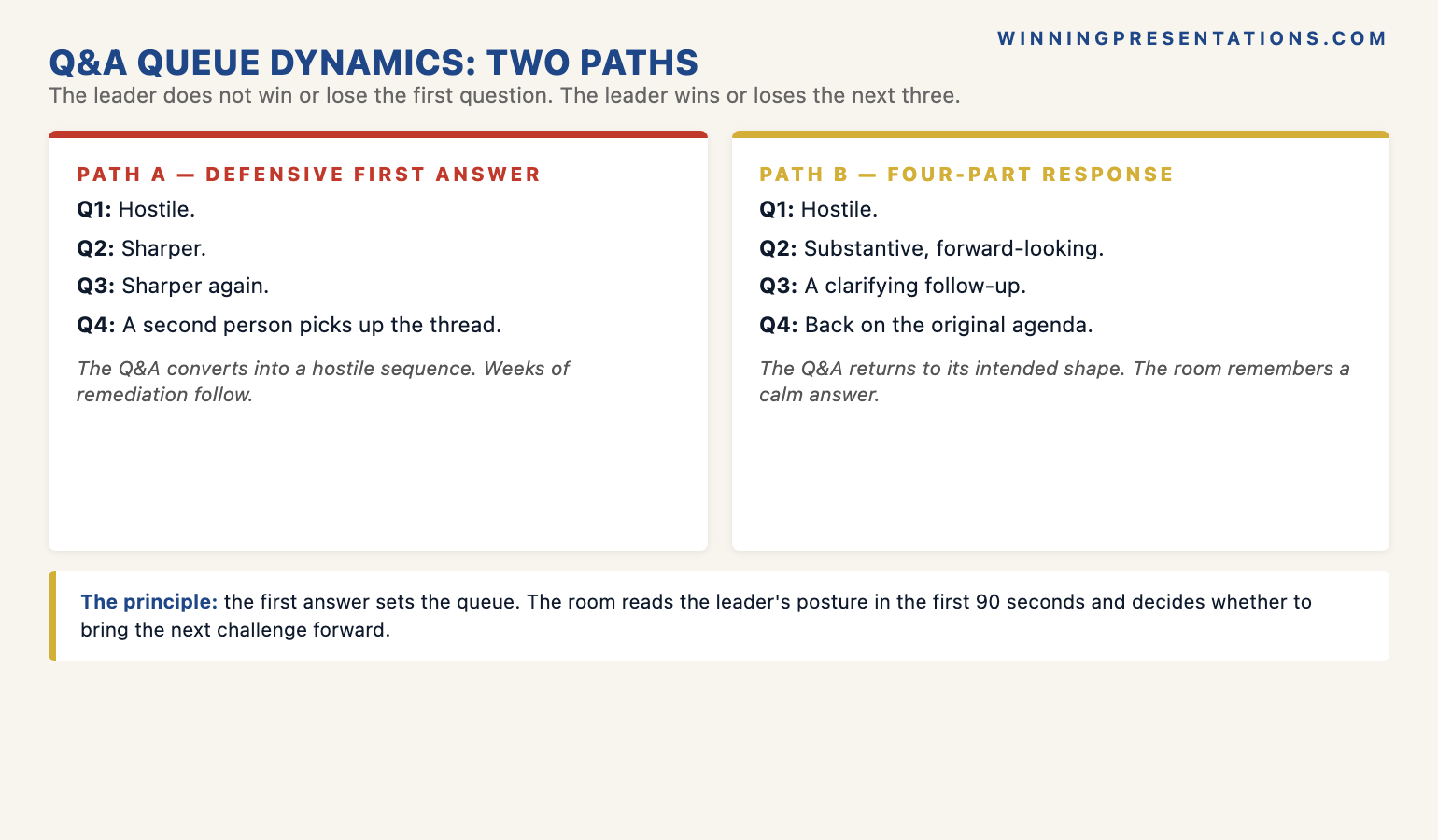
The single most consistent error senior leaders make under a hostile all hands question is to treat the question as the threat. The question is not the threat. The question is the event. The threat is the response, and the defensive response is the move that converts a single hostile question into a hostile Q&A. The mechanism is straightforward and visible in every all-hands recording that has ever gone wrong. The employee asks a pointed question. The leader hears the framing — the implied accusation, the rhetorical edge — and responds to the framing rather than to the concern underneath it. The response sounds, to the room, like a leader who is more interested in defending the decision than in hearing what people are actually experiencing. The room registers that. The next question in the queue is not a continuation of the agenda; it is a continuation of the unresolved exchange, because the room has just been shown that the leader will not engage with the substance.
The damage compounds for a structural reason worth understanding. In an all-hands, the audience is not a single counterparty; it is a few hundred individuals, most of whom did not have a hostile question to ask before the Q&A started. The room watches the first exchange and adjusts its own behaviour accordingly. If the first exchange is handled well, the people in the queue who had ambiguous questions tend to ask the substantive version of their question rather than the challenging version. If the first exchange is handled defensively, those same people ask the challenging version, because the room has just been shown that the leader is unwilling to hear the substantive version honestly. The shift is not conscious on the part of the questioners. It is a group-level read of what the room will tolerate. The leader who responds defensively to the first hostile question does not just lose that exchange; the leader loses the next three or four questions, and the Q&A converts into something the leader cannot bring back without a much larger remediation effort afterwards.
A second piece of damage is harder to see in the moment and shows up in the corridor afterwards. The defensive response signals, to the more senior people in the room, that the leader is not yet operating at the level of composure the role requires. The senior audience — the operating committee, the non-executive directors who occasionally attend, the senior people from the regional offices — will read a defensive answer not as evidence the leader cared about the decision, but as evidence the leader could not absorb a hostile question without becoming the question. The professional damage from a defensive all-hands answer often exceeds the reputational damage of the underlying decision, because the underlying decision was a board call with a defensible rationale, and the defensive answer is a personal capability signal. Senior leaders who have spent careers building a reputation for composure can undo a meaningful portion of it in a single ninety-second exchange. Handling tough questions walks through the broader composure pattern, and the all-hands version of it is a specific case of that pattern under more public conditions.
The four-part hostile-question response
The response that lands a hostile all hands question has four parts, in the same order every time. The order matters; the parts are not interchangeable. The leader who tries to start with the substantive answer and add the acknowledgement afterwards lands neither. The leader who acknowledges and then refuses to name what they do not yet know reads as evasive. The leader who hands the room a next step without first naming the gap reads as deflective. The four-part order is the order that gives the room what it needs in the sequence it needs it.
The four parts are: (1) acknowledge the legitimacy of the underlying concern, not the framing of the question; (2) answer the substantive question if there is one, directly, in plain language, in sixty seconds; (3) name what you do not yet know — the part where the data is incomplete or the decision is genuinely open; (4) hand the room a next step — when more will be known, who will say it, by what mechanism. The diagnostic comes immediately after the response: the next question in the queue is either (a) substantive, or (b) another challenge in the same vein. If (b), the first answer was too defensive in one of the four parts, and a second pass is required. The leader is not trying to win the exchange. There is no winning a hostile question. There is only landing the four parts, or not.
In 2020, a chief executive at a different organisation — a privately-held professional-services firm I worked alongside that year — ran a virtual town hall during the first wave of pandemic-related operational changes. The firm had paused its summer internship programme three weeks earlier; around forty offers had been rescinded. The first question in the Q&A, asked over the platform’s chat function and read aloud by the moderator, came from a senior associate: “Three of the interns I had agreed to mentor have been told their offers are gone. What does that say about the firm’s word, and how do you expect any of us to recruit confidently next year?” The chief executive paused for two seconds — a deliberate pause, the kind the room notices — and started with acknowledgement. He named the legitimacy of the concern: that rescinding offers had a cost the firm had not properly accounted for, that the senior associate was right to raise it, that the people who had spent time building the offers were owed an answer that did not minimise that cost. He then answered the substantive question in plain language: the offers had been rescinded because of a specific cash-flow stress test the operating committee had run in week two of the lockdown that showed a six-month liquidity risk if utilisation dropped below a stated threshold. He named what the firm did not yet know: whether the threshold would be breached, whether the offers could be reinstated in autumn if the threshold held, whether the firm could commit financially to a different intern model in the following year. He handed the room a next step: the chief operating officer would write to every rescinded intern within fourteen days with a named contact and an explicit re-offer commitment if the threshold held, and the senior associate group would receive the same update before the public communication went out. The next two questions in the queue were substantive: one on the recovery timeline, one on the long-term recruitment model. Neither was a further challenge. The remediation work afterwards was meaningful but bounded; it did not require six weeks of regional remediation sessions, because the Q&A had not been allowed to escalate.
Part one: acknowledge the concern, not the framing
The acknowledgement is the part most senior leaders get wrong, and they get it wrong in two specific ways. The first is to skip it entirely — to start with the substantive answer because the leader has been trained, often over decades, to deal with substance and treat emotion as a distraction. The second is to acknowledge the framing rather than the concern. Acknowledging the framing sounds like: “I understand that you are angry, and I am sorry you feel that way.” That sentence is corporate apology theatre. It does not engage with the substance of what the person is upset about. It engages with the fact that they are upset, which is visible to the entire room already. The room hears a leader managing the optics of an exchange rather than hearing the exchange itself, and the response fails.
Acknowledging the concern is different. The concern is the thing underneath the question — the actual issue the person is raising. In the industrials manufacturer example, the framing of the question was the accusation that the leader had said one thing in March and done another. The concern underneath was that two colleagues had been made redundant from a team the employee did not believe had been duplicative, which meant the employee did not trust the methodology that had been used, which meant the employee could not trust the next thirty minutes of operating-plan material to be based on a sound methodology. The acknowledgement that would have landed is one that named the concern in those terms: that the methodology used for the restructure had clearly not been explained well enough at the time, that the employee was right to say so, and that the team in question had not been duplicative in the colloquial sense and the leader could see why that framing had felt misleading. The acknowledgement does not concede that the decision was wrong. It concedes that the explanation was insufficient, which is almost always true and almost always defensible.
The acknowledgement is short. Three sentences at most. Longer than that and it starts to read as performative, as a leader spending more time on the apology than on the substance. Shorter than two sentences and it does not land — the room registers it as token language. The discipline is to name the specific concern, name the specific gap in the original explanation, and stop. Then move to the substance.
Part two: answer the substantive question in sixty seconds
Not every hostile question contains a substantive question. Some are framed entirely as challenges, with no answerable question underneath. Most contain a substantive question that can be extracted with a little discipline. In the industrials manufacturer example, the substantive question was: what is the basis on which the team in question was assessed as duplicative, and does that basis withstand scrutiny? In the professional-services pandemic example, the substantive question was: on what specific operational basis were the offers rescinded? The leader’s job in part two is to find the substantive question inside the framing and answer that question directly, in plain language, in sixty seconds. If the question is genuinely a pure challenge with no substantive content, the leader names that — “the question is fundamentally about whether you can trust the leadership of the firm, and that is not something I can answer for you in one sentence; what I can do is” — and moves to part three or part four. Most of the time, however, the substantive question is there. The leader who cannot find it either has not prepared, or is too defensive in the moment to listen for it.
The sixty-second discipline is harder than it sounds. The temptation under pressure is to over-explain — to add context, to name the people involved, to walk through the chronology, to defend the methodology by listing every input. The room hears any of those moves as a leader filibustering. The sixty-second answer is the answer that names the substance, the answer that names the rationale in one sentence, the answer that names the constraints in one sentence, and stops. It is uncomfortable to deliver because it feels under-explained; it lands in the room precisely because it does not feel over-explained. Q&A preparation for executive presentations covers the sixty-second answer in more depth and is the partner piece to this one for any leader who wants to drill the pattern before a real all-hands.
The substantive answer also has to use vocabulary the employee uses, not vocabulary the leadership team uses internally. “Duplication” was the corporate term. The employee did not believe the team was duplicative. The substantive answer is one that names what the assessment actually was — capacity utilisation across two functions that had partially overlapping scope on a specific class of work — rather than restating that it was duplication. The translation is what makes the answer land. The room hears a leader who has done the work of translating the corporate decision into language an ordinary employee can engage with. The leader who repeats the corporate vocabulary sounds like a leader reading from a brief.
Part three: name what you do not yet know
The third part is the part senior leaders most often skip, and skipping it is what makes the response sound, however slightly, like a closed argument rather than an open exchange. Naming what you do not yet know is the move that signals to the room that the leader is not pretending to have the full picture. Every decision a senior leader takes has parts where the data is incomplete or the outcome is uncertain or the policy will need to evolve. The leader who acts as though every part of the decision is settled and defensible sounds like a leader who has stopped listening. The leader who names the gaps openly sounds like a leader who is still in the work.
The discipline here is to name the gap specifically. Not “there are things we are still working on” — that is the corporate hedge and the room hears it as a hedge. The specific version is: “what we do not yet know is whether the assessment we used will hold up across two further teams that the operating committee is reviewing this quarter; if those reviews show that the basis for assessment was wrong in any of those cases, we will need to revisit the original decision, and I am committing in this room to do that publicly.” The specific gap, the specific consequence of the gap, the specific commitment about what happens if the gap turns out to matter. The leader is not making a new commitment; the leader is naming the conditional commitment that is already true, and the room hears that the leader has thought through the failure modes of the original decision.
Naming what you do not yet know is also the part that protects the leader if the original decision is later partially overturned or modified. The leader who claimed in the all-hands that the decision was fully sound and the methodology unimpeachable cannot, six months later, quietly adjust the methodology without the all-hands being remembered as the moment they were wrong. The leader who named the conditional gap in the all-hands can adjust the methodology six months later in line with the conditional commitment they already made publicly. The structural cost of part three is roughly zero. The structural value of part three is meaningful, both in landing the response and in preserving the leader’s authority over the longer cycle.
Tough questions land or fail in the first sixty seconds — and the difference is the framework, not the personality.
The Executive Q&A Handling System is the response library senior leaders use to handle the hostile question, the ambiguous question, the personal question, and the loaded-with-an-agenda question without defending, redirecting, or escalating. Tough questions, calm authority, decision-safe answers in 45 seconds. Frameworks for hostile, ambiguous, personal, and challenge questions. Lifetime access, instant download. £39.
- The four-part hostile-question response and its diagnostic — with the exact language patterns to use in the acknowledgement, the substance answer, the gap-naming, and the next-step close
- The five most common defensive moves senior leaders fall into — and the verbal substitutes that get the room back
- The ambiguous-question framework — how to handle a question that has three possible meanings without picking the wrong one and losing the room
- The personal-attack framework — how to respond when the question is aimed at the leader rather than the decision
- 16 worked examples drawn from real town halls, board Q&As, and investor calls — with the response that landed and the defensive response that would have failed
- Lifetime access, lifetime updates — £39
Part four: hand the room a next step
The fourth part is the part that closes the response in a way that gives the room somewhere to go. The first three parts are about engagement with the question. The fourth part is about the tempo of what happens after the question. Without part four, the response ends in mid-air; the room has heard acknowledgement, substance, and gap, but has not been told what happens next, and the absence of a named next step is what allows the room to escalate. Part four is short. It names when more will be known, who will say it, and by what mechanism. Three things, in one or two sentences.
“When” is the part most leaders soften, and softening it is the most common single failure mode in part four. The temptation is to say “in due course” or “soon” or “as soon as we have more information.” Those phrases are non-answers; the room hears them as a refusal to commit. The specific version is “by the end of this month” or “at the next all-hands in eleven weeks” or “within fourteen days of the operating-committee review on the eighteenth.” A specific date or window is what makes the next step real. If the leader does not know the specific date, the leader names the date by which they will know the specific date: “I will commit, by the end of this Friday, to the date by which we will publish the further review.” The recursive commitment is awkward to deliver and it lands — the room hears a leader treating their own timeline as a public commitment rather than a private intention.
“Who” matters because it transfers the cost of follow-through from “the company” to a named person, which is the structural element that holds the commitment to its calendar. “The chief people officer will write” is more credible than “we will communicate.” The named person is the structural artefact that prevents the next step from disappearing into the corporate diary. “By what mechanism” is the third element — an email, an open meeting, a written briefing to managers, a dedicated channel on the internal platform. The room hears specificity in all three elements as evidence the leader has actually thought through what happens after the all-hands, not just what happens in the all-hands.
The diagnostic for the whole four-part response sits at the boundary between part four and the next question in the queue. After the response, the moderator moves to the next question. The next question is either substantive — a different topic, a forward-looking question, a follow-up that takes the substance seriously — or it is another challenge in the same vein as the first one, often from a different person in the same regional office or the same employee cohort. If the next question is substantive, the four-part response landed; the leader continues with the four-part pattern for whatever the next question is. If the next question is another challenge in the same vein, the first response was too defensive in one of the four parts — usually too defensive in part one, occasionally too over-explained in part two — and a second pass is required. The leader runs the four parts again on the second question, more carefully. The diagnostic is honest because the room is honest; the room will not pretend to be satisfied if it is not.
What to do before the next all-hands with a hot topic on the agenda
The preparation move is short and concrete. The day before the all-hands, list the three questions you are most afraid to receive. Not the three questions you think the room is most likely to ask — the three you are most afraid of. There is a difference, and it matters. The questions you are most afraid of are usually the ones where the framing is sharpest, where the underlying concern is most legitimate, and where the defensive response is most tempting. Write the four-part response to each of the three questions, in full sentences. Not bullet points, not headers, not a structure diagram — full sentences, the way you would actually say them in the room. Read them aloud. The reading-aloud step is the one that surfaces the language that sounds good on paper and sounds rehearsed or hollow in the room.
Then put them away. The four-part responses are not what you will deliver in the room. You will not deliver them as written, you will deliver them as practised. The act of having written them in full sentences, read them aloud, and refined them once means that the language patterns are available to you in the moment, in the auditorium, when the question lands and the room goes still. The leader who has practised the four-part response on three hot-topic questions the day before walks into the all-hands with a different posture from the leader who has not. The leader has heard themselves acknowledge the concern, name the substance, name the gap, and hand the room a next step, on at least three rehearsed questions. The leader has the pattern. The pattern is what lets the leader respond to the actual question — which will almost certainly be different from the three rehearsed questions in some material way — without falling back on the defensive instinct.
The preparation also includes one structural conversation with the moderator before the all-hands. The moderator’s job is to hold the Q&A; the moderator’s job is not to protect the leader from hostile questions. Brief the moderator that you would prefer hostile questions over softball questions, that you will take questions from the dial-in as well as the room, and that if a question is repeated for clarity by the back row or the dial-in audience, the moderator should not paraphrase — the moderator should ask the questioner to repeat the question themselves. Paraphrased hostile questions almost always come back to the leader softer than the original, and the softer paraphrase invites a softer answer, and the room hears the gap between the question they actually asked and the question the leader answered. Have the questioner repeat their own question. The room hears the leader engaging with what was actually asked, not with a sanitised version.
The four-part response is one of sixteen frameworks in the Q&A Handling System — covering hostile, ambiguous, personal, technical, hypothetical, and loaded-agenda questions.
Try it for fourteen days. If the next town hall, board Q&A, or investor exchange does not feel measurably more controlled, Gumroad’s refund policy is one click. The system is £39, lifetime access, instant download — the price of a moderate paperback against the cost of a Q&A that converts into six weeks of regional remediation.
The leader who answers the substance with calm authority gets the room back. The leader who defends, redirects, or escalates loses the room and the next three questions. The difference between the two leaders is not personality; it is the four-part pattern, practised once on three hot-topic questions the day before. The cost of the practice is forty-five minutes the day before the all-hands. The cost of not practising is the six-week remediation cycle that the industrials manufacturer ran across three regional offices because the first sixty seconds of the auditorium Q&A went the wrong way. There is no winning the hostile all hands question. There is only landing the four parts, or not, and the difference shows up in the next three questions in the queue.
Frequently asked questions
What if I genuinely think the question is unfair — am I supposed to validate something I disagree with?
You are not validating the framing; you are acknowledging the concern underneath the question, which is almost always more legitimate than the framing. The discipline is to separate the two. The framing of a hostile question is often rhetorical, sharp, or implicitly accusatory; you do not need to agree with the framing. The concern underneath is usually a real experience an employee is having — uncertainty about a decision, a sense that an explanation was insufficient, a worry about what comes next. You can acknowledge the concern honestly without conceding the framing. The acknowledgement language is “I can see why this feels [X]” or “the explanation in March was clearly not sufficient on this point, and you are right to raise it” — not “you are right that the decision was wrong.”
What is the single most common defensive move senior leaders fall into during hostile questions?
Over-explaining the methodology. The leader hears a challenge to a decision and responds by walking the room through every input that went into the decision — the consulting framework, the committee reviews, the board approval, the data sources. The room hears a leader filibustering. The over-explanation feels, to the leader, like rigour; it reads, to the room, like defensiveness. The fix is the sixty-second substance rule. Name the substance in one sentence, the rationale in one sentence, the constraints in one sentence, and stop. If the room wants more detail it will ask, and the second question will give you a more specific target to answer against than the original hostile framing did.
Doesn’t the four-part response take too long for a live all-hands — won’t the room lose patience?
The four-part response is shorter than the defensive response it replaces, not longer. The acknowledgement is two to three sentences. The substance answer is sixty seconds. The gap-naming is one to two sentences. The next step is one to two sentences. The whole response runs about ninety seconds to two minutes, which is roughly the same length as the defensive over-explanation that fails to land. The room does not lose patience with a measured two-minute response; the room loses patience with a four-minute over-explanation that does not engage with the question. The four-part pattern is more efficient because each part is doing specific work; the defensive response is inefficient because most of its words are doing the same work over and over.
How does this work differently in a virtual town hall where I cannot read body language?
The four-part structure is unchanged; the diagnostics are different. In a virtual town hall, you cannot read body language, but you can read the chat queue, the question-submission tool, and the second-order signals that come from the moderator. After a four-part response, the next question in the queue still tells you whether the response landed — substantive follow-up versus another challenge in the same vein. The discipline that has to be added for virtual is a deliberate two-second pause before each part one acknowledgement; on video, the pause reads as composure, whereas in-person the pause is read with the leader’s posture and is less load-bearing. Brief the moderator in advance not to paraphrase challenging questions submitted in the chat; have them read the question verbatim.
Should I prepare the four-part response in writing, or won’t that make me sound rehearsed?
Write them in full sentences and read them aloud, then put them away. The risk of sounding rehearsed comes from delivering written responses verbatim, not from having written them. The written rehearsal is what surfaces the language that sounds polished on paper and hollow in the room, and lets you correct it the day before rather than in front of two hundred and forty people. In the room you will deliver the pattern, not the script; the pattern is what you have practised. Leaders who try to extemporise the four parts without rehearsal land them inconsistently; leaders who rehearse them in writing land them reliably and sound natural doing so, because the language has already been smoothed by the read-aloud step.
The Winning Edge — weekly newsletter
The Winning Edge is a weekly (Thursday) newsletter for senior professionals who present at the executive level. One short email a week, focused on the structural moves that separate Q&As that land from Q&As that escalate. Join the list →
For the broader picture across slides, storytelling, confidence, and delivery, the seven-product Complete Presenter bundle is the library most senior leaders find useful as a single set — £99, lifetime access.
About the author
Mary Beth Hazeldine is Owner & Managing Director of Winning Presentations Ltd. With 24 years of corporate banking experience at JPMorgan Chase, PwC, Royal Bank of Scotland, and Commerzbank, she advises executives across financial services, healthcare, technology, and government on handling high-stakes Q&A — town halls, board exchanges, investor calls, and the moments when a single hostile question can shift the room.