

Quick Answer
Saying “I don’t know” in an executive Q&A is not a credibility risk — fabricating or hedging an answer you do not have is. An honest acknowledgement of a knowledge gap, delivered with composure and a clear commitment to follow up, signals analytical rigour and professional integrity. The executives who build the strongest long-term credibility in Q&A are those who are consistently accurate, not those who are never uncertain.
In This Article
- The credibility myth: why executives resist saying “I don’t know”
- When honesty wins the room
- How to frame an honest answer without undermining authority
- The follow-up commitment: turning a gap into a demonstration
- Handling partial knowledge: what you know and what you don’t
- When “I don’t know” is not the right response
- Preparing for honest Q&A in advance
- Frequently asked questions
Astrid had been the Group Finance Director for four years when she presented the annual results to the full board. The presentation had been prepared meticulously. Every number had been stress-tested. The narrative was clear. She had rehearsed the likely questions with her team.
Then the Non-Executive Chairman asked a question she had not anticipated — a specific query about the pension liability calculation methodology that her actuarial team handled directly. Astrid knew the conclusion of the calculation. She did not know the precise methodology behind it.
She had two options. She could construct a plausible-sounding answer from the elements she did know and hope the Chairman would not press further. Or she could say, clearly and without apology: “I know the output of that calculation and I’m confident in the number. The methodology question is one for my actuarial team — I’ll send you a direct briefing note by end of day tomorrow.”
She chose the second. The Chairman nodded and moved on. Afterwards, he told a colleague that Astrid was one of the most trustworthy senior managers he had encountered in a boardroom setting. The reason he gave: she never guessed.
Preparing for executive-level Q&A?
The Executive Q&A Handling System is a structured approach to predicting, preparing for, and responding to the questions that matter most in high-stakes meetings — including how to handle the ones you cannot fully answer.
The Credibility Myth: Why Executives Resist Saying “I Don’t Know”
The instinct to avoid admitting a knowledge gap in an executive setting is understandable. In many organisational cultures, being the person with the answer is associated with authority, preparation, and competence. Being the person without the answer can feel like exposure — a signal to the room that you are not as across the brief as your role requires.
This instinct is mostly wrong, and importantly, it is wrong in proportion to the seniority of the audience. Junior stakeholders may expect a presenter to be encyclopaedic. Senior executives, who have conducted hundreds of Q&A sessions themselves, tend to evaluate a different quality: reliability. They are not asking themselves “does this person know everything?” — that is not a realistic standard at any level of an organisation. They are asking: “Can I trust what this person tells me?” And trust is built through accuracy, not omniscience.
An executive who gives a confident but inaccurate answer to avoid admitting uncertainty creates a specific kind of credibility problem. If the inaccuracy is discovered — in the meeting, in a subsequent review, or when the decision based on that answer produces a poor outcome — every previous statement they have made is retrospectively questioned. A single fabricated answer does more damage to credibility than ten honest admissions of limited knowledge.
The executives who maintain the strongest Q&A reputations over time are not the ones who always have the answer. They are the ones who are never wrong about what they know.
When Honesty Wins the Room
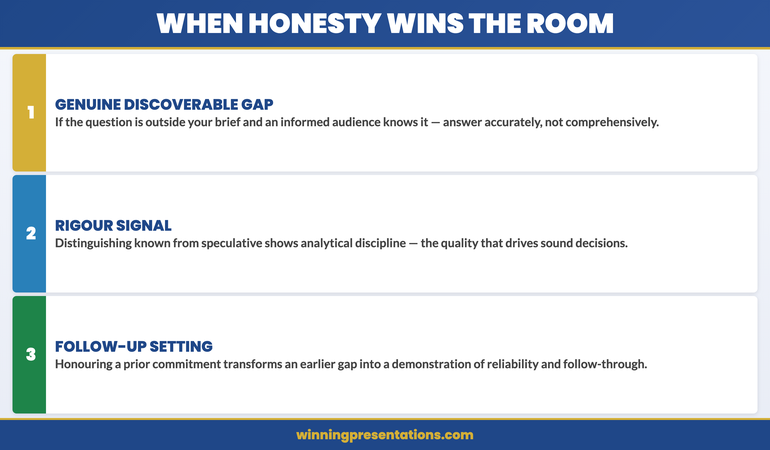
There are specific conditions in which an honest acknowledgement of a knowledge gap does more than protect credibility — it actively builds it. The first is when the gap is genuine and discoverable. If the question requires information that is genuinely outside your brief, and an informed audience member would recognise that fact, saying “that sits with my technical team rather than directly with me — I’ll get you the precise figure” is not weakness. It is accurate scope management. An attempt to answer it anyway would be visible and would undermine the parts of the Q&A where you do have genuine authority.
The second condition is when the honest answer demonstrates analytical rigour. “I don’t have sufficient data to answer that confidently yet — we’re three weeks into the monitoring period” is not an admission of failure. It is a signal that you distinguish between what is known and what is speculative — which is exactly the quality that drives sound decision-making. A board or committee that receives this answer typically respects it. They have encountered the alternative too often: confident assertions delivered ahead of the evidence.
The third condition is a follow-up setting — a presentation that follows a prior meeting where a commitment was made. If you promised to return with specific data and you are now doing so, the explicit acknowledgement that a previous question was outside your knowledge and has now been addressed signals follow-through. It transforms an earlier limitation into a demonstration of reliability.
How to Frame an Honest Answer Without Undermining Authority
The difference between an honest answer that builds credibility and one that appears as unpreparedness lies almost entirely in framing. Three structural elements determine which it becomes.
First, state what you do know before acknowledging what you do not. “The contract is currently in its second year of a three-year term — the specific break clause mechanics are something I’d want to confirm with Legal before giving you a definitive answer.” This structure demonstrates knowledge within your scope, then accurately bounds what lies outside it. It prevents the common misreading of “I don’t know” as “I know nothing about this topic.”
Second, be specific about the gap rather than vague. “I’m not sure” reads as uncertain. “I don’t have the Q3 breakdown with me — I can have it to you by close of business tomorrow” reads as organised. Specificity about what you do not know, and a specific commitment for when you will, converts a limitation into a process signal.
Third, maintain physical composure. An honest answer delivered with hesitation, lowered eye contact, or a apologetic tone reads as embarrassment — which confirms the questioner’s suspicion that the gap was a failing rather than a boundary. The same words delivered with steady eye contact and a settled tone read as professional precision. The authority of the answer comes from the delivery as much as the content.
The Executive Q&A Handling System
A structured system for predicting and handling the questions that define executive credibility. The Executive Q&A Handling System — £39, instant access — includes frameworks for preparing comprehensive question banks, structuring responses under pressure, and managing the questions you cannot fully answer.
- Question prediction frameworks for high-stakes meetings
- Response structures for difficult, partial, and hostile questions
- Preparation playbooks for board, committee, and investor settings
- Techniques for managing credibility when knowledge is incomplete
Designed for executives who present to boards, committees, and senior investment panels.
The Follow-Up Commitment: Turning a Gap Into a Demonstration
The follow-up commitment is what separates an honest answer from a deflection. An executive who says “I’ll get back to you on that” without specifying when, how, or to whom leaves the questioner with a vague promise rather than a reliable commitment. An executive who says “I’ll send you the confirmed figure directly by tomorrow morning, copied to the Chair” has converted a knowledge gap into a visible process of accountability.
The follow-up commitment also reframes the dynamic of the Q&A moment. When a question cannot be fully answered in the room, the audience’s attention shifts from the gap to the response to the gap. A specific, confident commitment captures that attention and directs it toward a positive signal: this person handles incomplete situations with precision, which is exactly how they will handle the programme they are proposing.
Always honour the commitment, and always do so by the deadline you named. An honest answer followed by a missed follow-up produces a credibility outcome significantly worse than either alone. The missed follow-up reframes the original admission as evasion in retrospect. Conversely, an honest answer followed by a timely, accurate follow-up is one of the most effective credibility-building sequences available in an executive presenting context.
If you are preparing a comprehensive question bank before a high-stakes meeting, the article on structuring Q&A answers with the STAR method provides a useful companion framework for the questions you can fully answer. The Executive Q&A Handling System covers both preparation and in-the-moment handling across all question types.
Handling Partial Knowledge: What You Know and What You Don’t
Most Q&A knowledge gaps are not total. The more common situation is partial knowledge: you understand the principle or the conclusion but not the precise mechanism; you know the figure for last year but not the current year; you know the general direction of the regulation but not the specific implementation date. How you manage that partiality determines whether the answer reads as informed or evasive.
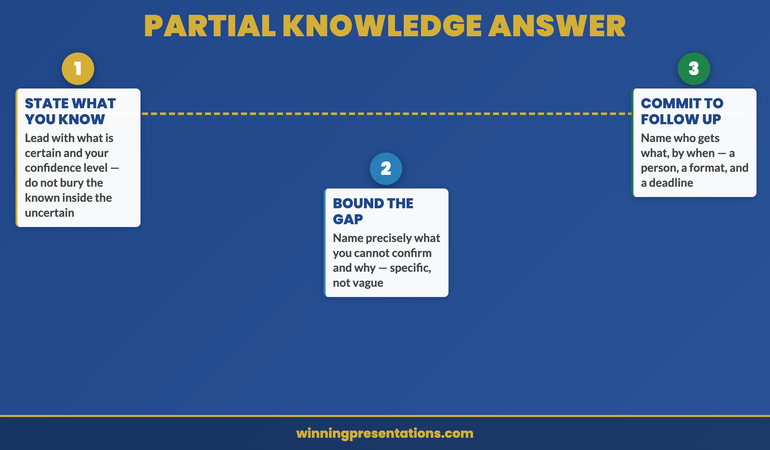
The structure for partial knowledge answers has three components. State what you know with confidence, including the level of confidence: “The overall direction here is clear — the regulation moves in our favour.” Then bound the partial gap precisely: “The implementation date I’d want to verify before committing to it — my understanding is Q4, but I know there have been recent consultation updates.” Then offer a disposition: “I can confirm that by the end of the week.”
This three-part structure works because it separates what is established from what is uncertain, and treats each appropriately. The questioner receives accurate information about your actual knowledge state — which is exactly what they need to evaluate the reliability of your answer. An attempt to present partial knowledge as complete knowledge fails on this dimension and creates trust problems when the gap becomes apparent.
A related technique is to use epistemic language accurately: “My understanding is…”, “I believe the figure is… but let me verify”, “to the best of my knowledge…” These phrases are not hedges of weakness. They are precision instruments that allow you to communicate exactly what your confidence level is, which allows the audience to calibrate accordingly.
When “I Don’t Know” Is Not the Right Response
There are situations where admitting a knowledge gap is not the optimal choice, and understanding them prevents overuse of the technique to the point where it undermines preparation credibility.
The first situation is when the gap is in core material that you should reasonably be expected to know. If you are presenting a business case and a committee member asks what the total budget request is, “I’d need to check” is not an honest answer — it is a preparation failure. There are categories of question for which the honest answer requires preparation, not admission. Know the boundaries of your own brief thoroughly enough that you can distinguish between what is genuinely outside your scope and what is simply inadequately prepared.
The second situation is when the question is a testing question rather than an information-seeking one. Some senior executives ask questions they already know the answer to, specifically to test whether you do. In these cases, a confident, accurate answer demonstrates mastery. An honest “I don’t know” is technically honest but fails the test it was designed to pass. Distinguishing between testing questions and genuine information requests requires reading the questioner — their tone, their prior statements, their domain expertise. If they clearly know the answer already, they are testing you.
The third situation is when the answer requires a judgement rather than a fact. “What do you think will happen to the market over the next twelve months?” is not a knowledge gap question. It is a judgement question. “I don’t know” is an evasion here. The appropriate response is an honest assessment of your view, with appropriate calibration: “My judgement, based on what we’re seeing in the data, is X — though there are two or three scenarios that could change that.”
Prepare for the distinction between these question types in advance. The article on recognising fishing questions in Q&A covers how to read the intent behind questions rather than simply their surface content. Pre-meeting stakeholder alignment conversations can also surface likely questions in advance, so you can prepare substantive answers rather than relying on honest admission in the room.
Preparing for Honest Q&A in Advance
The most effective Q&A practitioners are not the ones who are best at improvising under pressure. They are the ones who have thought most rigorously about what they do and do not know before they walk into the room. This preparation has two components: mapping the question space, and mapping the knowledge boundary.
Mapping the question space means systematically identifying every question that is plausible given the material you are presenting, the audience you are presenting to, and the context of the meeting. For a financial presentation, this includes detail questions about the numbers, methodology questions about how they were calculated, strategic questions about whether the conclusion is the right one, and risk questions about what happens if assumptions do not hold. For each category, prepare the substantive answer. For the ones you cannot fully answer, prepare the honest framing and the follow-up commitment.
Mapping the knowledge boundary means being explicit with yourself — before the meeting — about the precise edges of what you know. Not in general, but for this specific presentation and this specific audience. The CFO will ask different questions than the Chief Operating Officer. The edge of your knowledge looks different in each conversation. Knowing where that edge is, in advance, means you will not discover it with surprise in the room. You will encounter it exactly where you expected it, and you will have a composed and specific response ready.
The Executive Q&A Handling System
A structured system for predicting and handling executive Q&A — including the questions you cannot fully answer. £39, instant access.
Designed for executives preparing for board, committee, and investor Q&A sessions.
Frequently Asked Questions
Does saying “I don’t know” damage your credibility with a senior audience?
Not when it is framed correctly. Senior executives evaluate reliability above all other qualities in a Q&A setting. An honest acknowledgement of a knowledge gap, delivered with composure and a specific follow-up commitment, signals exactly the quality they are looking for: the discipline to distinguish between what is known and what is speculative. What damages credibility is a confident answer that turns out to be inaccurate — which retroactively undermines everything else the executive has said in the room.
How do you avoid looking unprepared when you don’t know the answer?
The most effective technique is to state clearly what you do know before acknowledging the gap. “The overall financial position is solid — the specific covenant calculation for that structure is one I’d want to confirm with the treasury team before giving you a definitive figure.” This structure demonstrates knowledge within your scope, then accurately bounds what lies outside it. It prevents the conflation of “I don’t know this one detail” with “I am not across this brief.” Composure in delivery reinforces that this is a boundary, not an oversight.
What if the question you can’t answer is about something you feel you should know?
There are two situations here. If you genuinely should know it and do not, that is a preparation gap — acknowledge it honestly, commit to following up, and use the experience to calibrate your preparation more thoroughly for the next meeting. Do not compound the preparation gap by constructing an answer you are not confident in. If the question is in genuinely ambiguous territory — neither clearly inside nor clearly outside your scope — err on the side of honesty and specificity: name exactly what you know, name exactly what you would need to confirm, and make the commitment clearly.
The Winning Edge — A Newsletter for Executives Who Present
Every Thursday: one structured technique for executive presentations and high-stakes Q&A. Written for senior leaders who need to communicate with precision and authority.
If you are preparing for a major presentation and want to manage the anxiety that comes with difficult Q&A, read the companion article on cognitive restructuring for presentation anxiety.
About the Author
Mary Beth Hazeldine is the Owner and Managing Director of Winning Presentations. With 25 years of corporate banking experience at JPMorgan Chase, PwC, Royal Bank of Scotland, and Commerzbank, she advises executives across financial services, healthcare, technology, and government on structuring presentations and handling high-stakes Q&A with precision and authority.