Tag: high-stakes presentation

28 May 2026
High-Stakes Presentation: The 72-Hour Protocol Senior Leaders Use

High-Stakes Presentation: The 72-Hour Protocol Senior Leaders Use

Quick answer: Senior leaders treat the 72 hours before a high-stakes presentation as a structured protocol, not a panicked sprint. Day 1 (T-72 to T-48): final slide audit, message-discipline pass, internal stakeholder pre-read. Day 2 (T-48 to T-24): full out-loud rehearsal, hostile Q&A drill, technical setup test. Day 3 (T-24 to T-0): light review only, sleep priority, last-90-minute body and breathing protocol. The goal is not more preparation. It is reducing decision-load and protecting your nervous system in the room.

Henrik runs strategy at a mid-cap industrial group in Frankfurt. Three days before his board presentation on a €240m acquisition recommendation, he was still rebuilding slide 14. He had eight versions of the same waterfall chart on his desktop. Two of them contradicted each other on synergy assumptions. The CFO had sent a note that morning asking three sharp questions about goodwill amortisation. Henrik opened his laptop at 11pm to start drafting answers and realised, with genuine alarm, that he could not remember whether he had eaten dinner.

This is the pattern most senior leaders fall into before a high-stakes presentation. Not lack of preparation — too much, too late, in the wrong order. The slide deck becomes a moving target. The narrative blurs. The body, which needs to be calm in the room, is instead burning through cortisol three nights running. By the time the meeting starts, the presenter has used 80% of their cognitive capacity on the deck and 20% on the actual audience.

The protocol below is what changes. It is not a productivity hack. It is a structure for the final 72 hours that protects two things: message discipline and nervous-system reserve. Both matter. Either one missing, and a strong proposal can land flat in front of an audience that should have approved it.

If you want a structured framework, not a checklist:

Senior professionals presenting decisions to boards and executive sponsors use The Executive Buy-In Presentation System — a self-paced programme covering the structure, psychology, and preparation that earns serious approval.

Explore The Executive Buy-In Presentation System →

Why 72 hours, not 7 days

The instinct of less experienced presenters is to extend the runway. A week of prep. Two weeks. The thinking is that more time equals more confidence. In practice, the opposite happens. Long runways encourage tinkering — adding slides, changing taxonomy, second-guessing the core argument. The deck swells. The narrative softens. The presenter ends up over-prepared on details and under-prepared on the two questions the senior audience will actually ask.

Senior leaders who present regularly converge on a 72-hour window because it forces a different mode. At T-72 the deck has to be substantively complete. The remaining time is not for content creation — it is for compression, rehearsal, and recovery. The protocol below assumes you arrive at T-72 with a draft you would defend if pressed. If you do not have that, you have a different problem. Stop reading this and finish your draft.

For deeper structural rules on what an executive deck needs to contain before T-72 even begins, see the 15-minute board presentation template and the 31-point first board presentation review.

Day 1 (T-72 to T-48): audit and message discipline

The first 24 hours of the protocol have one job: lock the message. Not the slides. The message.

Open a blank document. Without looking at your deck, write three sentences:

  1. What I am asking the audience to decide or do — phrased as a single ask in plain language.
  2. The single strongest reason they should agree — not three reasons, one.
  3. The objection I am most worried about — phrased as the audience would phrase it, not as you would dismiss it.

If you cannot write all three in under ten minutes, your deck has a clarity problem and no amount of polishing in the next 48 hours will fix it. You need to compress the argument before you touch a slide.

Once you have those three sentences, walk through your deck slide by slide and ask, of every slide: does this slide help the audience say yes to the ask? Slides that do not earn their place at this stage come out, regardless of how much work went into them. Senior leaders are ruthless here. Decks that present at C-suite level usually need to lose 30-40% of their slide content in the final 72 hours, not add to it.
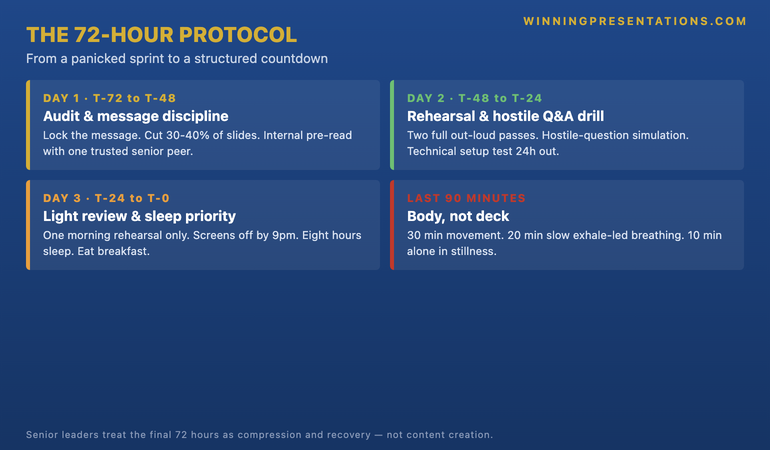
The 72-Hour Protocol infographic showing four stages: Day 1 audit and message discipline, Day 2 rehearsal and hostile Q&A drill, Day 3 light review and sleep priority, and the last 90 minutes body and breathing protocol — each stage with its core focus.

The other Day 1 task is the internal pre-read. Send your deck or executive summary to one trusted colleague who is senior enough to push back honestly. Not a peer. Not someone whose job depends on agreeing with you. Ask them one question only: “If you were in that room, what would stop you saying yes?” Their answer becomes your hostile Q&A material for Day 2. You do not need a long meeting — a 20-minute conversation gives you 80% of what you will hear in the actual room.

Day 2 (T-48 to T-24): rehearsal and hostile Q&A

Day 2 is rehearsal day. This is where most senior leaders cut corners and pay for it in the room. The temptation is to “talk through” the deck mentally — mouth the words, picture the flow, trust that on the day it will come together. It will not. Mental rehearsal builds confidence in your knowledge of the deck. It does not build the muscle memory that lets you handle interruption, redirect questions, or recover when a senior board member cuts you off mid-slide.

You need to rehearse out loud, on your feet, in the same posture you will use in the actual room. If you will be standing, stand. If you will be presenting from a seated position around a board table, sit and rehearse from your chair. The body learns the room. Practising in conditions that do not match the actual setting trains the wrong nervous-system response.

Stop relying on instinct in the room.

The Executive Buy-In Presentation System is a self-paced programme — 7 modules walking you through the structure, psychology, and delivery that get senior approval. Built for senior professionals presenting decisions to boards, investment committees, and executive sponsors. Monthly cohort enrolment, optional recorded Q&A calls. £499, lifetime access to materials.

  • The decision-readiness framework that earns senior approval
  • Stakeholder analysis and pre-meeting positioning protocols
  • The slide structures that hold up under board scrutiny
  • Hostile question handling and recovery techniques
  • Optional bonus Q&A calls (recorded — watch back anytime)

Explore The Executive Buy-In Presentation System →

Designed for senior professionals across financial services, healthcare, technology, and government.

Run the deck twice. First pass: full presentation, no interruptions, target time. Most decks run 25-40% over on first rehearsal. Cut accordingly. Second pass: presentation with simulated interruptions. Either ask a colleague to interrupt you with three pre-loaded questions, or set a timer to ring twice during your run-through and pick up wherever you are. The skill is not delivering uninterrupted — it is recovering cleanly when you are interrupted.

Then comes the hostile Q&A drill. Take the objection your trusted colleague raised on Day 1. Add the three sharpest questions you can imagine the most senior person in the room asking. For each, prepare a 30-second answer with this structure: direct answer first, then evidence, then implication. Not the other way around. Senior audiences want the conclusion before the argument. If you find yourself building up to the answer, you are losing the room before you have started.

The technical setup test belongs in Day 2, not Day 0. Open the deck on the actual machine you will present from. Test the projector, the cable, the remote, the screen-sharing. Confirm the file plays, fonts render, embedded video runs. Do this 24 hours out, not 30 minutes before. Technical problems discovered at T-30 minutes burn the cognitive reserve you need for the room.

Day 3 (T-24 to T-0): light review and sleep

The final 24 hours are the hardest to manage because every instinct screams “more rehearsal”. This is wrong. The final 24 hours are recovery. Your nervous system needs to be calm in the room, and that is built in the day before, not in the hour before.

One full run-through in the morning of Day 3, in your normal voice, at normal pace. That is your final substantive rehearsal. After that, you stop creating and start protecting.
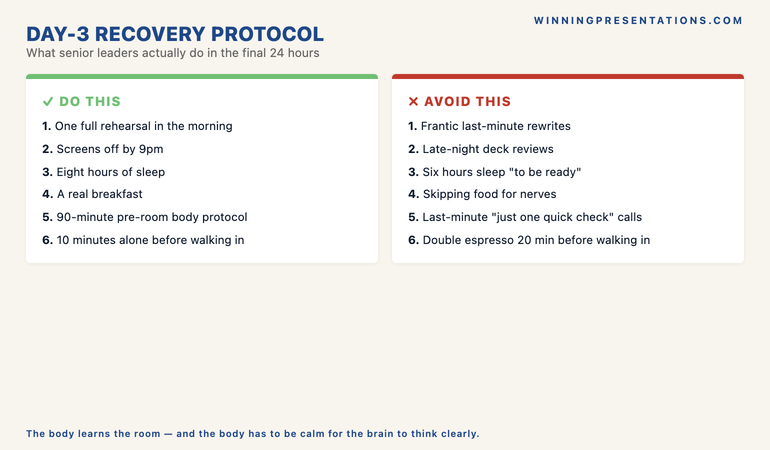
The Day-3 Recovery Protocol comparison: what senior leaders DO in the final 24 hours (light review, screen cutoff at 9pm, 8 hours sleep, one full breakfast, 90-minute breathing protocol) versus what burned-out presenters DO (frantic rewrites, no sleep, skipped meals, last-minute slide changes) — split-screen layout.

Sleep is the single highest-leverage variable in the final 24 hours and it is the one most senior leaders treat as optional. Sleep deprivation does not just feel bad. It measurably reduces working memory, slows recall under pressure, narrows attention, and amplifies the body’s stress response. A presenter who has slept six hours instead of eight is operating with a cognitive deficit roughly equivalent to mild intoxication. That is the deficit they bring into a room where every word matters.

Screens off by 9pm the night before. No deck reviews after dinner. No “just one more pass” to check a number. The number is what it is. If you spot something wrong at 11pm, write it on a single piece of paper, put it on top of your bag, and deal with it in the morning. The brain reviews while you sleep — give it a clean problem to solve, not a panicked one.

Eat breakfast. A real one. Most presenters skip food on the morning of a high-stakes meeting because of nerves. Going into a 90-minute board presentation in a fasted, caffeinated, stress-elevated state is a recipe for the trembling-hands, dry-mouth, racing-heart cluster that makes presenters look less competent than they are.

The 8-slide CFO presentation template covers the structural side of the same problem: when the deck is right, you have less to remember in the room and your nervous system has a smaller load to carry.

The last 90 minutes

The 90 minutes before you walk into the room are reserved for body, not deck. By this point, if your deck is not ready, no amount of last-minute review will help. Cramming at this stage measurably hurts performance. The brain consolidates information overnight and during quiet review windows — frantic re-reading of slides at T-30 minutes overwrites recall, it does not strengthen it.

What works:

  • 30 minutes of physical movement if possible — a walk outside, stairs, anything that activates the body and burns off excess cortisol. The body cannot be calm and tense at the same time. Movement resets the baseline.
  • 20 minutes of slow breathing — extended exhale (4 counts in, 6-8 counts out). This activates the parasympathetic nervous system and lowers heart rate. Five minutes does almost nothing. Twenty minutes resets the autonomic baseline.
  • 10 minutes alone before entering the room — no phone, no last-minute conversations, no quick “anything I should know?” Conversations at this stage transfer other people’s anxiety into your nervous system. Stand still. Breathe. Walk in calm.

Want the slide structure that goes with the protocol?

The Executive Slide System gives you 26 templates, 93 AI prompts, and 16 scenario playbooks for board, investment committee, and executive decision presentations. £39, instant access — pairs naturally with the 72-hour protocol when your deck still needs structural work before T-72.

Get the Executive Slide System — £39 →

What senior leaders never do in the last 72 hours

Three patterns separate experienced senior presenters from the rest. None of them are about the deck. All of them are about decision-load.

They do not change the deck after T-24. Late changes introduce errors that the rehearsal did not stress-test. The slide that gets reworked the night before is the slide that gets the wrong number on it. If something is genuinely wrong at T-24, fix it and rehearse the affected section twice. If it is a refinement, leave it.

For more on what one of those high-stakes decision slides should actually contain, see the partner article on the £10M decision slide — what must be on it, what must be off.

They do not consult others in the last 24 hours. Senior leaders learn to stop seeking reassurance the day before. Last-minute consultations introduce other people’s framing, other people’s anxieties, other people’s questions about whether the deck is “ready”. The deck is as ready as it is going to be. Reopening that question 16 hours before the meeting just reignites the cortisol cycle.

They do not let calendar churn into T-0. The hours before a high-stakes presentation get blocked. No back-to-back meetings. No “just one quick call”. No interruptions that fragment attention. The brain needs a quiet runway to consolidate the rehearsal work into automatic recall. A morning of frantic meetings before a 2pm board presentation guarantees a depleted, scattered presenter walks into that room.

Frequently asked questions

Is 72 hours enough preparation for a board presentation?

Yes — if the deck is substantively complete at T-72. The 72-hour protocol is for compression, rehearsal, and recovery, not content creation. Building the deck itself usually takes one to three weeks of work. The 72 hours start when the deck is ready to present, not when you start drafting.

What if I am asked to present with less than 72 hours notice?

Compress the protocol. The structure still works at T-48 or even T-24 — the priorities just collapse. Day 1 work (message discipline) stays. Day 2 work (rehearsal and hostile Q&A) becomes a single concentrated session. Day 3 work (sleep and recovery) is non-negotiable. Cut Day 2 short before you cut Day 3.

How many times should I rehearse the full presentation?

Twice in full on Day 2, once on the morning of Day 3, then no more. Three full out-loud rehearsals is the point of diminishing returns for most senior presenters. Beyond that, you are not improving — you are draining cognitive reserve you need in the room.

Should I memorise my opening line?

Yes. The first 30 seconds are the highest-stakes part of any senior presentation. Memorise the opening verbatim — not the full deck, just the opening. Knowing exactly how you will start removes the most common point of nervous-system collapse and gives you a calm runway into the rest of the presentation.

The framework that holds when the room turns hostile.

Designed for senior professionals who present decisions to boards, investment committees, and executive sponsors. The Executive Buy-In Presentation System — 7 self-paced modules covering the psychology and structure that earn serious approval. £499, lifetime access to materials.

Explore the programme — £499 →

Get The Winning Edge newsletter

A weekly note from Mary Beth on the structure, psychology, and preparation that earns senior approval. One idea, one application, one specific scenario — every Thursday morning.

Subscribe to The Winning Edge →

Not ready for the full system? Start here instead: download the free Executive Presentation Checklist — a single-page reference for what every senior presentation needs before it leaves your desk.

Next step: Block 72 hours in your calendar before your next high-stakes presentation. Not “prep time” — three labelled blocks (T-72, T-48, T-24) with the protocol tasks above. The structure does the work.

About the author

Mary Beth Hazeldine is Owner & Managing Director of Winning Presentations Ltd, founded in London in 1990. With 24 years of corporate banking experience at JPMorgan Chase, PwC, Royal Bank of Scotland, and Commerzbank, she advises executives across financial services, healthcare, technology, and government on structuring presentations for high-stakes funding rounds and board approvals.

15 Apr 2026
Male executive reviewing a structured presentation outline at a glass desk, city skyline behind him

Executive Presentation Outline: The Five-Part Structure That Builds Any High-Stakes Deck

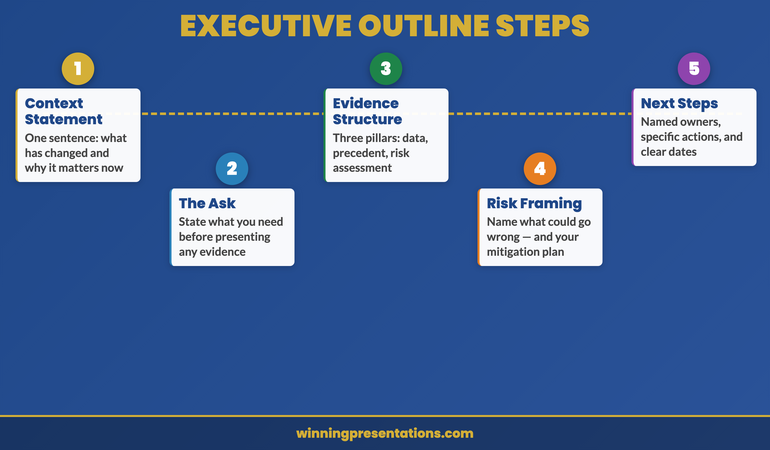
Quick answer: An executive presentation outline has five mandatory components regardless of topic: context statement, recommendation, three-part evidence structure, risk framing, and next steps. Getting the outline right before building slides is the difference between a deck that builds itself and one requiring eight revisions. The structure forces clarity on what you are actually asking for — and why — before a single slide is designed.

Kwame had a reputation in his division for building decks fast. When colleagues had a board submission due Friday, they would glance over at his desk by Tuesday and see a nearly finished presentation sitting in PowerPoint, polished and structured. They assumed it was natural fluency — some innate ability with slides he had always possessed.

Then came the quarterly review that changed his thinking entirely. He had built the deck in his usual way — starting with the title slide and working forward, slide by slide. The content was solid. The data was accurate. But in the room, the CFO stopped him eleven slides in and asked, “Kwame, what are you actually asking us to decide today?” He didn’t have a clean answer. The meeting ended without resolution and he was asked to come back the following month.

That week, he stopped opening PowerPoint first. Instead, he drafted a five-line outline on paper before touching his laptop. Context. Recommendation. Three evidence points. Risk. Next steps. Every deck he built from that point started on a single sheet. His reputation for speed didn’t change — but the outcomes in the room did. Decisions started being made on the day, not deferred.

If your decks are taking too long to build — or landing without the clarity you intended — it’s rarely a slide design problem. It’s a structure problem. The Executive Slide System gives you the frameworks, outline templates, and AI prompt cards to plan and build high-stakes presentations with confidence.

Explore the System →

Why Most Executive Presentations Fail Before the First Slide

The most common mistake in executive deck preparation is opening PowerPoint before you have clarity on structure. It feels productive — templates fill up, slides get labelled, transitions get applied. But without a deliberate outline in place first, you are essentially writing the second draft before completing the first one.

Senior decision-makers — board members, investors, C-suite stakeholders — evaluate presentations not just on content quality but on structural logic. They want to know, within the first two minutes, what you are asking them to consider and why it matters now. If your deck buries the recommendation in slide fifteen, you have already lost the room’s sharpest thinkers, who will have jumped ahead, formed their own conclusions, and stopped listening to your narrative.

Structure also protects you against scope creep. When you begin building slides without an outline, every interesting data point feels includable. Every supporting chart earns its place. Before long, a 10-slide board presentation becomes a 28-slide information dump. The outline is the editing tool — it forces you to decide what is load-bearing and what is background noise. For a deeper look at how to frame the beginning of any executive presentation, this guide on how to start a presentation covers the critical first moments in detail.

The five-part framework described in this article applies across presentation types: capital allocation requests, strategic updates, operational reviews, project sign-offs, and investor briefings. The components stay constant; only the content within them changes.


STOP REBUILDING DECKS FROM SCRATCH

Build executive slides that get past slide 3

The Executive Slide System gives you 26 templates, 93 AI prompts, and 16 scenario playbooks designed for senior presenters. Drop your content into a structure that already works — finance committees, board approvals, steering meetings, capital reviews. £39, instant access, lifetime updates.

Get the Executive Slide System →

£39, instant access. 26 templates, 93 AI prompts, 16 scenario playbooks. Designed for executive presenters.

The Five-Part Executive Presentation Outline

Every effective high-stakes deck shares the same underlying architecture, regardless of topic or audience. The five components below form the load-bearing structure. Remove any one of them and the deck becomes harder to follow, easier to challenge, and less likely to generate a decision on the day.

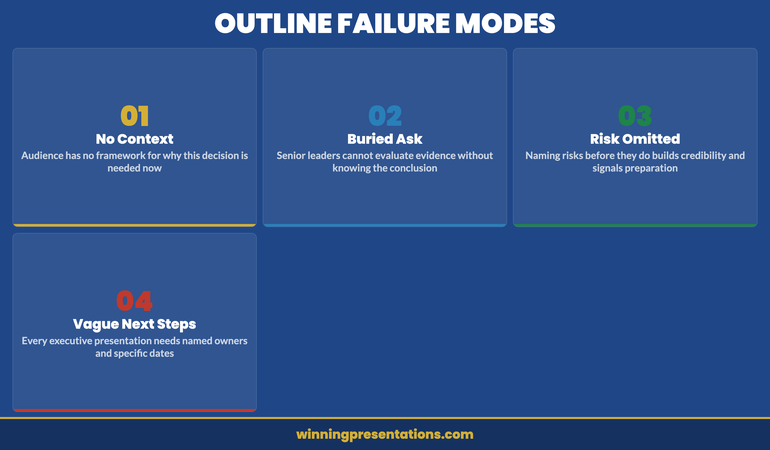
1. Context statement. One to three sentences establishing why this topic matters now. Not background — context. The context statement answers the question “Why are we having this conversation today?” It connects the presentation to a specific business condition, deadline, or strategic pressure.

2. Recommendation. A single, clearly stated ask or proposed course of action. This comes second — not at the end. Senior audiences do not need to be walked to a conclusion; they need to know where you are headed so they can evaluate your evidence against your recommendation as they listen.

3. Three-part evidence structure. Three distinct reasons, data points, or strategic rationales that support your recommendation. Not two, not seven. Three is the cognitive limit for retention under pressure, and it forces you to prioritise your strongest arguments rather than presenting everything you know.

4. Risk framing. An honest acknowledgement of what could go wrong, what you have considered, and how you propose to manage it. This section is frequently omitted. Its omission is what causes the sharpest person in the room to derail your presentation with a challenge you have not addressed.

5. Next steps. Specific, time-bound actions that follow a yes decision — or clarity on what happens if the decision is deferred. This closes the loop and transforms a presentation into a decision instrument rather than a status update.


Five-part executive presentation outline diagram showing context, recommendation, evidence, risk framing, and next steps in sequence

The Context Statement: One Sentence That Changes Everything

Most presenters open with background. They explain the history of a project, recap previous decisions, or summarise the market landscape before getting to the point. This approach respects the audience’s knowledge less than it should. Board members and senior leaders do not need a history lesson — they need to know immediately why this presentation is happening today and what it requires from them.

A well-formed context statement is crisp and specific. Compare these two openings:

Weak: “As you will know, our operations in the northern region have been under review for the past eighteen months following the restructure in 2024. Today I want to take you through where we have landed.”

Strong: “The northern region restructure closes on 30 April. This presentation outlines the three decisions that need board approval before that date.”

The second version creates a decision frame immediately. It tells the audience what kind of meeting this is — a decision meeting, not a status update — and it makes the deadline explicit. Every executive in the room now knows what is expected of them before the second slide appears.

When writing your context statement during the outlining phase, ask yourself two questions: What is the specific business pressure creating urgency? And what kind of response do I need from this audience? Your answers should shape a single, declarative sentence that opens your deck. For context on how the executive summary slide fits into this structure, see this guide on the executive summary slide.

Building Your Evidence Structure Around the Decision

The evidence section is where most presentations either earn or lose their credibility. The instinct — particularly for analytically trained leaders — is to present all the data and let the audience draw their own conclusions. This approach hands control of the narrative to whoever in the room is most inclined to challenge you.

An effective evidence structure is built backwards from the recommendation. Start with what you are recommending, then ask: what are the three most compelling reasons a rational, sceptical senior executive should agree with this? Those three reasons become your evidence pillars. Each pillar should be expressible as a single, declarative sentence before you attach any data or analysis to it.

In practice, this means your outline for the evidence section looks like this before you open a single data file:

Evidence 1: The financial case — [one sentence stating the financial rationale]
Evidence 2: The strategic fit — [one sentence connecting to existing priorities]
Evidence 3: The timing imperative — [one sentence explaining why now and not later]

Each of these then becomes a section of your deck, with supporting data underneath. The discipline is in the ordering: you state the point first, then support it — not the other way around. This is the pyramid principle applied to outline architecture, and it is the difference between a deck that reads as a confident recommendation and one that reads as a hesitant data dump.

The Executive Slide System gives you pre-built outline frameworks for the executive presentations most likely to need structural clarity — including capital requests, strategic reviews, and board sign-offs where the evidence structure is the difference between a yes and a deferral.

Risk Framing: The Section Most Executives Leave Out

Omitting the risk section from your presentation outline is one of the most common — and most costly — errors in high-stakes communication. The instinct behind the omission is understandable: you are trying to build confidence in your recommendation, and explicitly surfacing risks feels counterproductive. But senior decision-makers operate differently. They are looking for evidence of judgement, not just advocacy.

A well-structured risk section demonstrates three things simultaneously: that you understand the complexity of the decision you are asking for; that you have done the work to anticipate objections; and that you are a trustworthy steward of the organisation’s resources. These three signals matter as much as the financial case.

In your outline, plan for two to three specific risks — not generic disclaimer language. Vague risk acknowledgements (“there are of course some uncertainties we will monitor”) read as evasion. Specific ones (“the primary execution risk is integration timeline, which we have addressed by bringing the programme manager’s start date forward by six weeks”) read as competence.

For each risk in your outline, draft three elements: the risk itself, your mitigation, and the residual exposure after mitigation. This three-part format prevents the risk section from feeling like a panic list. It shows that you have thought past identification to management. When a board member raises a risk you have already addressed, the credibility gain is significant. When they raise one you have not, your mitigation instinct has to work much harder.

If you are presenting to an audience that may be hostile to your recommendation, the risk framing section becomes even more important. See this article on presentation structure for hostile audiences for specific techniques when the room is divided.


Executive presentation outline risk framing section showing risk, mitigation, and residual exposure structure

Executive Slide System — £39, instant access

Stop Starting From Scratch. Build Faster With the Right Templates.

The Executive Slide System includes outline templates specifically structured for the moments where clarity matters most — board approvals, capital allocation, strategic pivots, and operational reviews. Each template is pre-loaded with the five-part framework so you start every deck in the right place.

Get the Executive Slide System →

Testing Your Outline Before You Build

The outline is a testable document — and testing it before opening PowerPoint is where the real time saving happens. A five-minute outline review at the planning stage is worth sixty minutes of deck revision at the delivery stage. There are three tests worth running on every outline before you commit to building.

The “so what” test. Read your recommendation aloud to someone outside your immediate team — a trusted colleague, a coach, a peer from another division. If their immediate response is “so what?” or “what are you asking me to do?”, your recommendation is not specific enough. A good recommendation names an action, an amount, and a timeline. “I am recommending we proceed” is not a recommendation. “I am recommending board approval of £2.4m for Phase 2, with a go-live target of Q3 2026” is.

The coverage test. Does your evidence section cover financial, strategic, and operational dimensions — or is it heavily weighted towards one category? A purely financial case is vulnerable to strategic objections. A purely strategic case is vulnerable to financial ones. The most resilient outlines have evidence that addresses multiple decision-making lenses so that different stakeholders in the room find their priorities served by at least one pillar.

The one-minute summary test. Can you summarise your entire outline — context, recommendation, three evidence points, primary risk, and next step — in under sixty seconds, out loud, without notes? This is not a presentation rehearsal. It is a clarity check. If you cannot summarise the outline in a minute, the deck will not land cleanly in thirty. Conduct this test before you build a single slide. The clarity you develop in this sixty-second exercise will shape every content decision that follows.

If your presentation is heading to a board or a senior governance committee, the testing phase also needs to include a stakeholder mapping review. Who in the room will champion the recommendation? Who will probe hardest? Where does the power to say yes actually sit? These political considerations belong in the outline phase — not discovered mid-delivery. For board-specific structural guidance, see this article on board agenda presentations.

The outline is not a planning formality. It is the most important document you will produce in the presentation process — and it is the one most leaders skip. The leaders who do not skip it are the ones whose decks consistently drive decisions rather than deferring them.

Need the outline templates rather than building from scratch? The Executive Slide System (£39, instant access) ships with the five-part outline pre-loaded across 26 slide templates, 93 AI prompt cards, and 16 scenario playbooks — including capital requests, board sign-offs, and strategic pivots.

Frequently Asked Questions

How long should an executive presentation outline be?

An effective executive presentation outline should fit on a single page — typically five to eight bullet points covering context, recommendation, three evidence pillars, risk, and next steps. It is a planning document, not a content document. If your outline runs to multiple pages before you have built any slides, you are writing the presentation twice. The outline exists to establish the logic and sequence of your argument; detailed supporting content belongs in the deck itself, not the planning document.

Should the recommendation come at the start or end of an executive presentation?

For executive audiences, the recommendation comes at the start — specifically, as the second element after your context statement. This is the direct opposite of the narrative build used in consumer or public-facing communication. Senior decision-makers are time-pressured, context-rich, and scepticism-prone. They evaluate your evidence more effectively when they know what they are being asked to approve. Burying the recommendation at slide fifteen signals that you are not confident in your ask, or that you are hoping to build enough momentum to make the recommendation impossible to refuse — both of which undermine trust.

How do you outline a presentation when you don’t know the outcome yet?

When the recommendation is genuinely uncertain — exploratory briefings, scenario planning sessions, or strategic option reviews — the five-part structure adapts rather than breaks. Replace the recommendation slot with a “decision frame”: a clear statement of what options you are asking the audience to consider and what criteria they should use to evaluate them. Your evidence section then presents the case for each option rather than a single path. The risk and next steps sections remain the same. This approach maintains the structural clarity of the framework while respecting the genuinely open nature of the decision.

Ready for the deeper buy-in framework?

The Executive Buy-In Presentation System

A self-paced programme on Maven covering the structure, psychology, and stakeholder analysis behind senior approvals. 7 modules with optional recorded Q&A sessions — no deadlines, no mandatory attendance. £499, lifetime access to materials.

Explore the programme →

Get more executive communication strategies every Thursday. The Winning Edge is a weekly newsletter for senior leaders who want sharper presentations, stronger boardroom presence, and clearer communication under pressure.

Subscribe to The Winning Edge →

Free resource: The Executive Presentation Checklist — a one-page reference covering the key structural and delivery checks before any high-stakes presentation. Download it and use it before your next board or leadership team meeting.

Download the Free Checklist →

About the Author

Mary Beth Hazeldine

With 25 years of corporate banking experience at JPMorgan Chase, PwC, Royal Bank of Scotland, and Commerzbank, Mary Beth Hazeldine has spent 16 years coaching senior leaders to communicate with the clarity and authority their roles demand. She works with executives who need to perform under pressure — in board rooms, investor meetings, and high-stakes leadership settings where the quality of the presentation determines the outcome.