

Quick answer: When a senior board member interrupts with “just give me the facts”, they almost never mean raw numbers. They mean the structural narrative behind the numbers — compressed into one or two sentences. Presenters who hear “facts” and respond with data lose the room; presenters who hear “facts” and respond with the compressed storyline keep it. The four-step response — Pause, Acknowledge, Compress, Resume — is the move experienced senior presenters use under cross-examination. The interruption is rarely an attack. It is a request for editorial leadership.
JUMP TO:
- Why “just give me the facts” is the most misread interruption
- Three signals that decode what they actually want
- The four-step response framework: Pause, Acknowledge, Compress, Resume
- Sample language that works at senior committee level
- When “just give me the facts” actually does mean raw data
- Frequently asked questions
Idris, a divisional managing director at a UK insurance group, was seven slides into a strategy update when the chair leaned forward and said, “Idris, just give me the facts.” Idris did what most senior leaders do in that moment. He heard the word “facts” and reached for data. He pulled up the numbers behind slide 7, walked the chair through the three-year revenue trajectory, then offered to share the underlying actuarial model. Within ninety seconds, two non-executives had glazed over and the chair had turned to a side conversation with the CFO.
The chair had not asked for numbers. The chair had asked Idris to step out of the slide and tell him, in one or two sentences, what the strategy actually was — what was changing, why now, and what it meant for the next eighteen months. The “facts” the chair wanted were narrative facts. Idris had given him data points. By the time he realised the gap, the room had decided this was not the meeting where the strategy would be backed.
“Just give me the facts” is the most misread interruption in board presentations. Senior board members rarely want raw data when they say it. They want the structural narrative behind the data, expressed in compressed form. The leader who can decode that request in real time keeps the room. The leader who responds with numbers loses it.
If you want a structured way to handle board interruptions like “just give me the facts”:
The Executive Q&A Handling System is a structured Q&A handling framework with techniques designed for hostile questions and the difficult moments that derail presentations — the interruption at slide 7, the cross-examination, the “let’s cut to the chase” moment. Self-paced, instant access.
Why “just give me the facts” is the most misread interruption
The phrase trips presenters because it sounds literal. The word “facts” carries an implicit instruction — drop the framing, drop the context, give me the underlying data. Most leaders take the instruction at face value. They reach for the next layer of analysis, the source numbers, the underlying model. They are doing exactly what the interruption appears to ask for. And they lose the room.
The reason is that the word “facts”, in senior committee usage, almost never means data. It means signal. The chair is signalling that the current pace of the presentation is too slow, that the level of abstraction is too high, or that the structure is meandering. “Just give me the facts” is the polite version of “land this for me”. The board member has decided that the deck is not going to deliver the headline at the pace they need it, and they are taking executive control of the conversation by demanding compression.
Read literally, the interruption asks for more detail. Read structurally, it asks for less. The presenter who responds with more data confirms exactly what the chair was reacting against — too much information, not enough editorial. The presenter who responds with one compressed sentence — the strategy in a line, the trade-off in a line, the recommendation in a line — gives the chair the editorial leadership they were asking for. The room snaps back into attention.
This is the move “walk me through the numbers” shares with “just give me the facts”. Both interruptions sound like requests for data. Both are usually requests for narrative. Decoding the structural ask — rather than the literal one — is the central discipline of senior Q&A.
Three signals that decode what they actually want
The phrase “just give me the facts” travels under three different intents, depending on who says it and when in the presentation it lands. Reading the right intent in real time is what separates the presenter who keeps the room from the one who loses it.
Signal 1 — the slide number. When the interruption lands early — slide 3, slide 4 — it almost always means “you are walking through context I have already read in the pre-read; jump to the substance”. The board member is signalling that the meeting time should not be spent on material they have already absorbed. The right response is to compress everything from the current slide forward into a single sentence and continue from the load-bearing slide. When the interruption lands late — slide 12, slide 15 — it usually means “I am losing the thread; pull this back to the headline”. The right response is to compress the argument so far into one sentence, name the recommendation, and let the room re-engage from there.
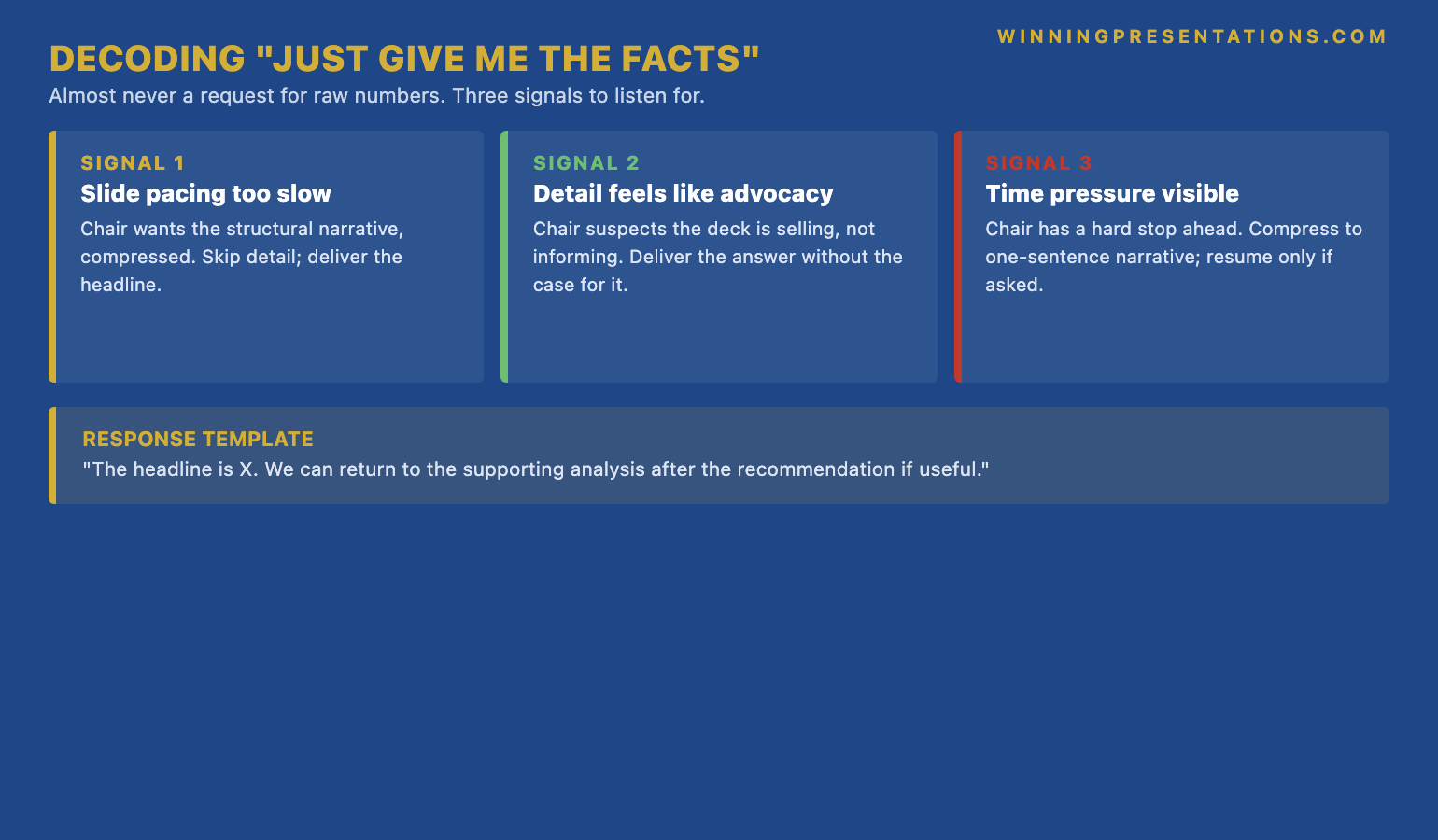
Signal 2 — the speaker’s seniority and role. Chairs and senior non-executives almost always mean “compress to narrative”. They have read the pack, they want the headline, and they are asking the leader to take editorial control. CFOs and committee members with sector specialism sometimes do mean “show me the numbers” — particularly if the interruption follows a claim that contains a specific figure. Reading the speaker matters. A chair asking for facts is asking for story; a CFO asking for facts after a margin claim is asking for the underlying calculation.
Signal 3 — the tone and the words around the phrase. “Just give me the facts” delivered with a slight smile and a hand gesture toward the deck is almost always editorial — “speed this up”. “Just give me the facts” delivered flat, with no smile, immediately after a specific claim, is more often analytical — “back that number up”. The lean of the speaker, the eye contact, and the half-sentence that usually follows (“…what is actually changing here?”, “…what is the headline?”, “…where is the £40m?”) tell the presenter which intent is in play. Most experienced senior presenters listen for the half-sentence before responding, even if it costs them a one-second pause.
The four-step response framework: Pause, Acknowledge, Compress, Resume
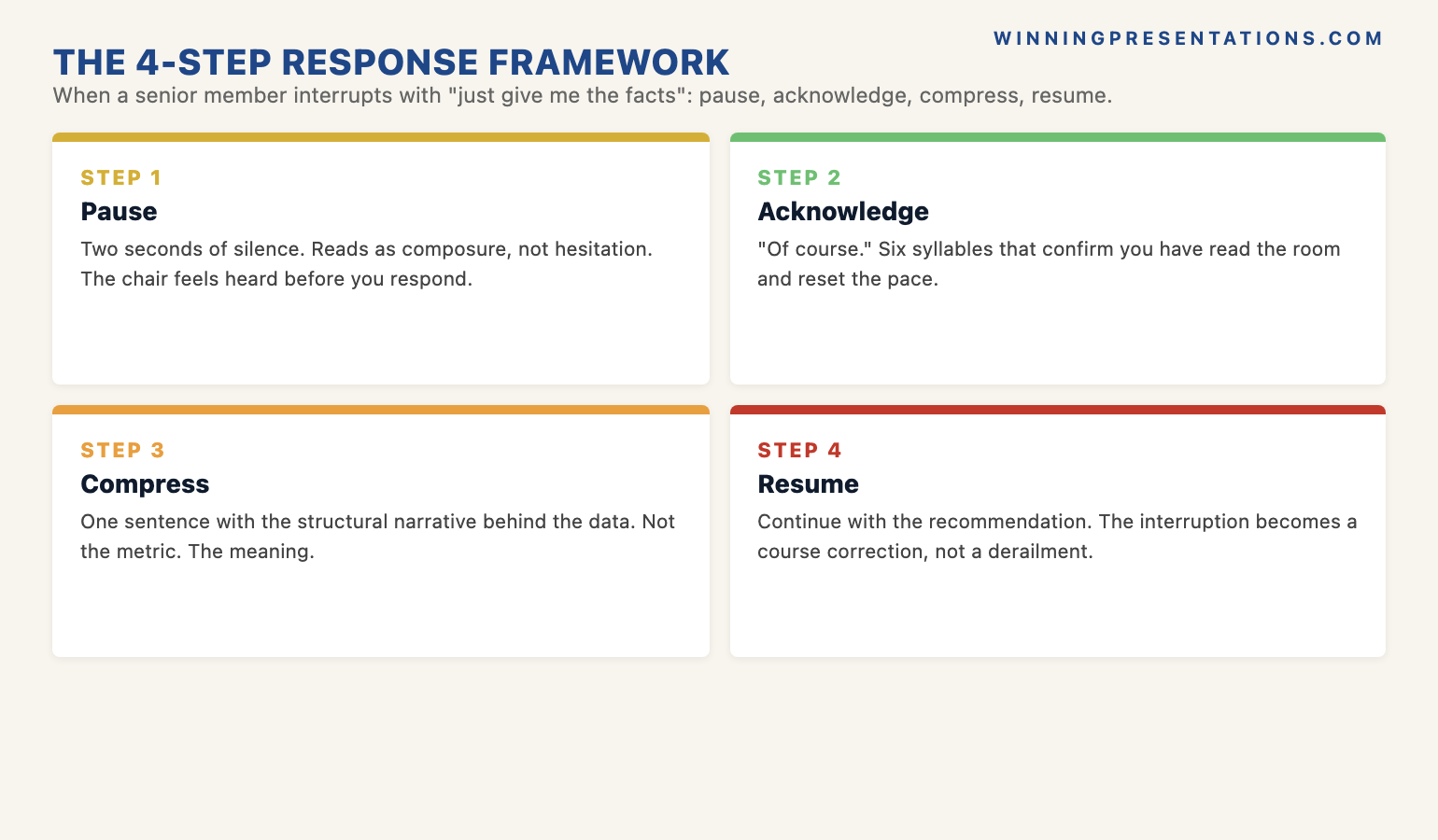
The four-step framework — Pause, Acknowledge, Compress, Resume — is the move experienced senior presenters use under this kind of cross-examination. Each step does specific work. Skipping any step weakens the response.
Handle the interruptions and hostile questions that derail board presentations.
The Executive Q&A Handling System is a structured Q&A handling framework with techniques designed for hostile questions, interruptions, and the difficult moments that derail presentations at senior level. Designed for senior professionals who present to boards, executive committees, and investment panels. £39, self-paced, instant access, no subscription.
- Structured frameworks for handling the moments that derail presentations — interruptions, hostile questions, cross-examination, “let’s cut to the chase”
- Techniques designed for the difficult question patterns senior leaders meet at board and committee level
- Sample language and response patterns calibrated for senior committee tone, not generic Q&A advice
- Designed for senior professionals presenting to boards, executive committees, and investment panels
Step 1 — Pause. One full second before responding. Most leaders skip this step because it feels uncomfortable. The pause does three things at once. It signals that the presenter heard the interruption rather than reacting to it. It buys the half-second the presenter needs to decode which intent — editorial or analytical — is in play. And it tells the room that the leader is in command of the pace, not being dragged by it. Skipping the pause and rushing into a response is the single most common mistake in board Q&A.
Step 2 — Acknowledge. A short sentence that lands the interruption rather than ignoring it. Not a thank-you. Not an apology. An acknowledgement: “fair point — let me pull this back to the headline”. The acknowledgement does the structural work of accepting the chair’s editorial authority. The presenter is not pushing back against the interruption; they are hearing it and adapting. Senior audiences read this move accurately. It signals confidence.
Step 3 — Compress. One sentence that delivers the structural narrative the interruption was asking for. Not a paragraph. Not three points. One sentence. “We are reallocating £40m from the legacy book into the new platform over eighteen months, with phase-1 in Q3, because the legacy unit economics will not survive the 2027 regulation change.” The compression is the hardest step. It requires the presenter to know — before they walk into the room — what the one-sentence version of their argument is. Leaders who have not pre-built the compression cannot deliver it under pressure.
Step 4 — Resume. A short sentence that hands the meeting back to the structure: “I can either expand on the £40m allocation or move to the trade-offs slide — which is more useful?” The resume step is often skipped. It matters. It tells the chair that the presenter heard the interruption, delivered the compressed answer, and is now offering the chair editorial control over the next move. Most chairs, given the choice, will say “move on”. A handful will ask for the expansion. Either way, the presenter is back in command of the agenda.
For a related discipline on handling the funding-comparison version of this interruption, see “why fund this over X?”, which uses a similar compression-and-resume structure.
Sample language that works at senior committee level
Sample language matters because senior committees are tone-sensitive. The right move delivered in the wrong register reads as defensive. The phrases below are calibrated for board and executive-committee tone — measured, confident, not performatively humble.
Acknowledgement phrases that work: “Fair point — let me land the headline.” “Useful — the short version is this.” “Right — the core of it is that…” “Understood — pulling this back…” Each carries the structural acknowledgement without slipping into apology. Phrases to avoid: “Of course — I’m sorry, I should have…” (apologetic), “Yes, well, the thing is…” (defensive), “If you’ll allow me to finish…” (combative). The chair is offering editorial direction; the response should accept that direction rather than push against it or grovel under it.
Compression sentences that work follow a structural pattern: change + reason + horizon. “We are [doing X] because [reason] over [time horizon].” “We are exiting the legacy product line because the regulatory cost has crossed the revenue line, with full exit by Q4 2027.” “We are moving from a four-region to a two-region operating model because the cost of duplicated headcount no longer justifies the local optimisation, with implementation through 2026.” The pattern is short enough to deliver under pressure and structured enough to be remembered by the room.
Resume phrases that work: “I can expand on [specific point] or move to the recommendation — which is more useful?” “Happy to take that into the trade-offs slide if helpful, or move to the close.” “I can hold the detail for the appendix and move us to the decision — would that work?” Each phrase hands the editorial decision back to the chair without abdicating control of the agenda. The presenter is offering structured options, not asking for permission to continue.
The next board interruption is coming. Pre-build the compressed narrative now, not in the room.
The Executive Q&A Handling System gives senior leaders the structured frameworks to prepare for the interruptions and hostile questions that derail board presentations — before the meeting, not during it. Self-paced, instant access. £39.
When “just give me the facts” actually does mean raw data
The exception exists, and it is rare. About one time in seven, “just give me the facts” is a literal request for the underlying numbers — usually from a CFO or sector-specialist non-executive, almost always immediately after a specific claim, and almost always in a tone that lacks the editorial impatience of the more common version.
The diagnostic is structural. If the interruption follows a numerical claim — “this generates £14m of margin uplift” — within one or two sentences, and the speaker is the financial or analytical specialist on the committee, the request may genuinely be for the source data. The presenter who hears that intent and has the underlying number ready demonstrates command of the detail. The presenter who responds with narrative compression in this case sounds evasive — exactly the opposite of the right move for the more common editorial version.
The discipline is to listen for the half-second after the phrase. A literal “just give me the facts” usually carries on: “…what is the actual margin number?”, “…what was the like-for-like comparison?”, “…what did the modelling assume?” An editorial “just give me the facts” carries on differently: “…what is changing?”, “…what is the headline?”, “…where is this going?” The same five words signal opposite requests. Listening for the second half of the sentence — and pausing the half-second needed to hear it — is what allows the presenter to respond accurately rather than by reflex.
For more on the underlying confidence work that supports this kind of real-time decoding, see CFO presentation nerves, which covers the preparation that makes the half-second pause feel possible rather than terrifying.
The closely related move — handling boards that ask for the story rather than the data — is covered in the partner article on the three-story minimum for board presentations.
Frequently asked questions
What if I genuinely do not have the one-sentence compression ready in the moment?
Buy time honestly rather than dishonestly. “Let me give you the cleanest version of that — one moment” is far stronger than fumbling through an attempt at compression that does not land. The pause itself signals seriousness. What does not work is filling the gap with more data while the brain catches up; the room reads that move as evasion. The structural fix is upstream — pre-build the one-sentence version of the argument before the meeting, rehearse it out loud, and treat it as the load-bearing sentence of the entire presentation. If the compression is not ready before the room, it will not arrive in the room.
Is it ever right to push back on the interruption rather than accept it?
Rarely, and only with care. Pushing back works in one specific scenario — when the interruption lands at a moment where compression genuinely loses important nuance, and the presenter has the standing in the room to ask for thirty seconds. The phrase that works: “Happy to compress — but the next sentence is the one that matters; may I land it before I summarise?” The move signals confidence rather than defensiveness. It works for senior leaders with established credibility in the room. For a presenter who is newer to the committee, accepting the interruption and adapting is almost always the safer move.
What if the chair interrupts again with the same phrase later in the meeting?
A second “just give me the facts” later in the same meeting is a stronger signal — usually that the level of compression in the first response was not enough. The right move is to compress harder, not to repeat the previous response. If the first compression was a sentence, the second response should be half a sentence. “Net of all this — we are recommending the £40m allocation, with the trade-off being a 4 per cent margin compression in 2026.” Senior committees rarely interrupt with the same phrase three times. If they do, the presentation has a structural problem that needs addressing offline, not in the room.
Does this framework work for hostile questions, or only for editorial interruptions?
The four-step framework — Pause, Acknowledge, Compress, Resume — works for both, but the compression sentence carries different weight in a hostile question. With editorial interruptions, the compression is the structural narrative. With hostile questions, the compression is usually the honest concession plus the structural answer. “You’re right that the 2024 forecast missed by 12 per cent — what we changed is the underlying methodology, and the 2026 outlook is built on the revised model.” The move is the same; the load on the compression sentence is heavier. Hostile questions reward presenters who can hold both the concession and the case in one breath.
The Winning Edge — weekly newsletter
The Winning Edge is a weekly newsletter for senior professionals who present at the executive level. One short email a week, focused on the structural moves that separate decks committees back from decks they defer. Subscribe to The Winning Edge →
About the author
Mary Beth Hazeldine is Owner & Managing Director of Winning Presentations Ltd. With 24 years of corporate banking experience at JPMorgan Chase, PwC, Royal Bank of Scotland, and Commerzbank, she advises executives across financial services, healthcare, technology, and government on structuring presentations for high-stakes funding rounds, board approvals, and strategic decisions.