

Quick answer: A vision presentation to senior leaders is the act of selling a future that has not happened yet. It works when the deck does three things in sequence: (1) names the structural shift that makes the current trajectory inadequate, (2) describes the future state in operational terms — not adjectives, (3) shows the first move that would commit the organisation to the path. The vision decks that fail try to sell the future on inspiration. The vision decks that earn buy-in sell it on internal logic the room can audit.
JUMP TO:
Astrid, a divisional CEO at a North American healthcare group, walked into the executive committee with a vision deck for the next five years. The deck was beautifully designed. The opening slide read “Reimagining how we deliver care to our patients.” The second slide named four “pillars of transformation”. The third slide had a hexagonal diagram with twelve interconnected concepts. By slide six the executive chair, a former CFO, asked the only question that mattered: “Astrid, can you tell me what specifically would be different on a Tuesday morning in any of our facilities if we did this?” Astrid hesitated. The chair leaned back. The committee moved on to the next agenda item.
The vision was sound. Astrid had spent four months developing it with two of the strongest people on her team. The committee did not reject it because it was wrong. They deflected it because it was inaccessible. Senior leaders cannot back a vision they cannot translate into operational reality. The hexagonal diagram was the deck’s tell — when a vision needs that level of conceptual scaffolding to be communicated, it has not yet been pressure-tested into something the committee can either fund or refuse.
Vision presentations to senior leaders are different from operational presentations. They are different from strategy presentations. They are also different from the keynote-style “vision” that consultants and motivational speakers deliver. A vision presentation in a senior boardroom is the act of selling a future that does not exist yet — and the audience is people whose entire careers have taught them to be sceptical of futures that do not exist yet.
If you want the framework for getting senior leaders to back a vision:
The Executive Buy-In Presentation System is a self-paced programme that teaches the structure, psychology, and delivery moves senior professionals use when they need a board, executive committee, or senior stakeholder group to back a decision.
Why most vision decks fail with senior leaders
Senior leaders have a particular relationship with vision. By the time someone is sitting on an executive committee, they have backed visions that worked, backed visions that did not, and refused visions that, in retrospect, they should have backed. The pattern recognition is sophisticated. They are not impressed by polish. They are not moved by inspiration. They are listening for something specific — the structural logic that distinguishes a vision that could happen from a vision that, on closer inspection, cannot.
Vision decks that fail share three patterns. The first is over-reliance on conceptual framing. Pillars, pyramids, hexagons, three Cs, four Ps, six lenses. Each of these is a way of organising thinking; none of them is a vision. Senior audiences read framework-heavy decks as a sign that the leader has done the conceptual work but not the translational work. The structure is the scaffolding; the vision is what the scaffolding describes.
The second pattern is adjective-led future state. “Customer-obsessed,” “agile,” “world-class,” “market-leading,” “digitally native,” “data-driven.” Adjectives describe an aspiration; they do not describe a future. A vision is something a leader can describe in operational terms — what changes about how decisions get made, how money flows, how customers experience the organisation, how the organisation looks at itself. Adjectives are placeholders for that work.
The third pattern is the missing first move. A vision deck that ends at the future state without showing what the organisation would commit to in the first six months reads as theoretical. Senior audiences need to see the first concrete move because that move is how they assess whether the leader has thought past the vision into execution. Without it, the vision is unbacked. With it, the vision becomes a decision the room can either approve or refuse.
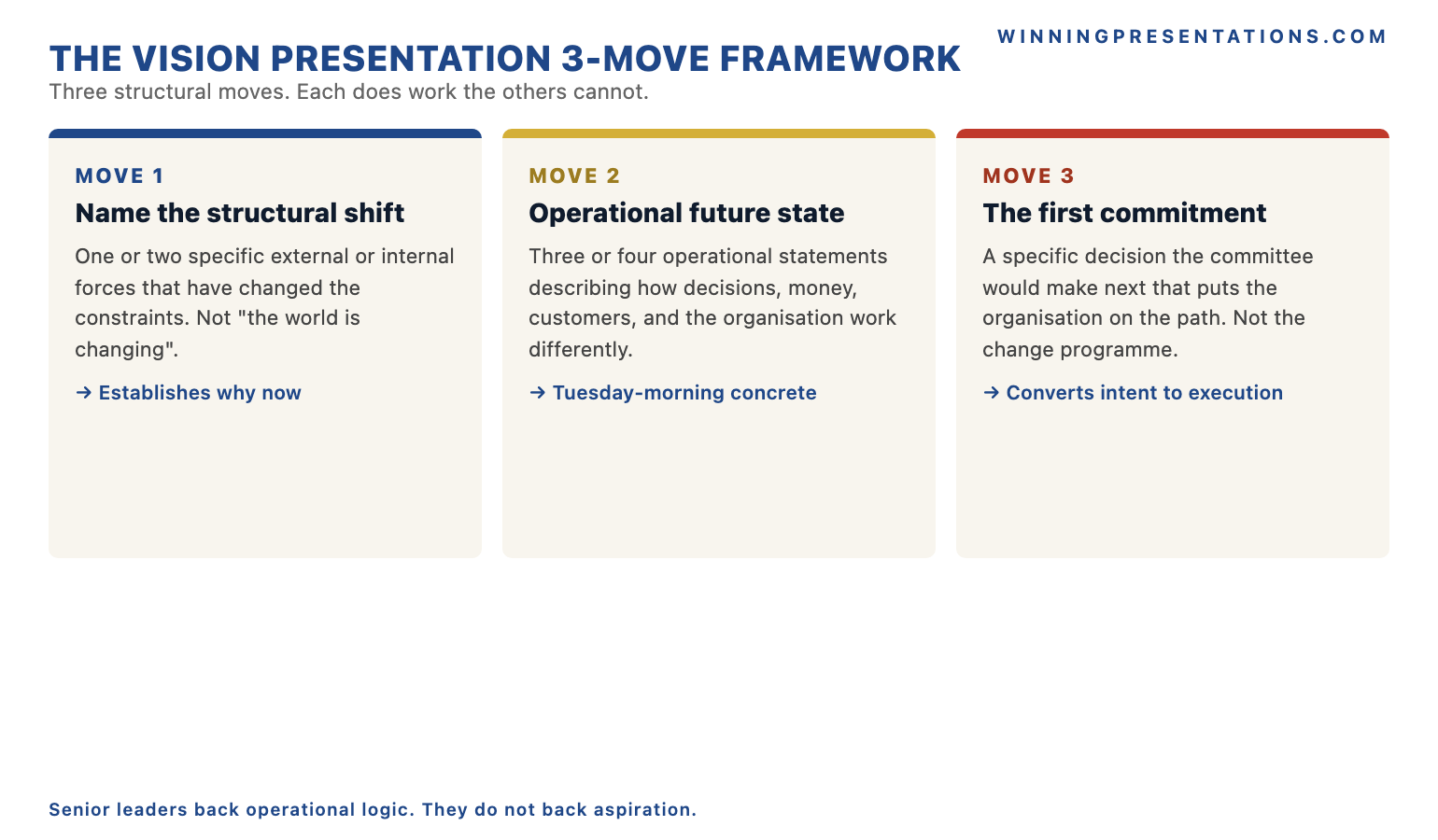
Move 1: Name the structural shift
The opening of a vision presentation is not the inspirational hook. It is the diagnostic move that establishes why the current trajectory will not be enough. Without this, every claim that follows lands as ambition rather than necessity.
The structural shift is one or two specific external or internal forces that have changed the constraints under which the organisation has historically operated. Not “the world is changing” — that is a placeholder, not a shift. Not “customer expectations are evolving” — same problem. The disciplined version names the specific shift: a regulatory change that compresses margin in the legacy business; a technology shift that has lowered the cost of distribution by an order of magnitude; a competitive entrant whose unit economics make the historical operating model uncompetitive at scale; a workforce shift that has changed the talent supply for senior product roles.
One specific structural shift is more powerful than three vague ones. Senior audiences are listening for the leader’s diagnosis of why now. If the diagnosis is precise, the rest of the deck inherits credibility. If the diagnosis is general, the rest of the deck has to compensate — and usually cannot.
Walk into the room with a framework for earning buy-in.
The Executive Buy-In Presentation System is a self-paced programme — 7 modules covering the structure, psychology, and delivery moves senior professionals use to secure board-level approval for strategic decisions, multi-year visions, and major initiatives. Monthly cohort enrolment, optional recorded Q&A sessions available. £499, lifetime access to materials.
- 7 modules of self-paced content covering buy-in psychology and structure
- Optional live Q&A / coaching calls (fully recorded — watch back anytime)
- No deadlines, no mandatory session attendance
- New cohort opens every month — enrol whenever suits you
- Designed for senior professionals presenting to boards, executive committees, and senior stakeholder groups
Move 2: Describe the future state operationally
The future state is the slide most vision decks try hardest on and get most wrong. The instinct is to make it inspiring. The discipline is to make it concrete. Senior leaders will not be inspired into backing a vision; they will be persuaded into it by recognition.
The operational test for a future state description: can the audience describe a Tuesday morning in the organisation five years from now? If the answer is yes, the future state is concrete. If the answer is “the organisation will be more agile and customer-centric,” the future state has not been written yet — what has been written is a placeholder for the actual thinking.
Concrete future state language describes how decisions get made differently, how money flows differently, what customers experience differently, and what the leader’s own week looks like differently. “By 2030, two-thirds of revenue comes from products launched in the previous five years.” “The senior leadership team is structured around customer journeys, not product lines.” “Decisions about pricing are made weekly, not annually, and at the level of the customer segment, not the corporate average.” “Sixty per cent of distribution moves through digital channels owned by us, not by intermediaries.” Each statement is operational. Each is testable. Together they describe a future that the audience can either fund or push back on.
A useful structural pattern for this slide: three or four operational statements, each of which describes one dimension of the future state — commercial, operating model, customer, organisation. Not seven dimensions. Not all the dimensions of the business. The three or four where the future is most different from the present. For more on the underlying logic, see how senior leaders structure five-year strategy presentations as narrative arc.
Move 3: Show the first commitment
The third structural move is the one most often missing from vision decks. After the diagnosis and the future state, the question every senior decision-maker is privately asking is: what would commit the organisation to this path? Not “what is the change programme” — that is a separate document. Not “what are the workstreams” — that is execution detail. The question is more pointed than that. What is the first thing the organisation would do in the next six months that would make turning back materially harder than going forward?
The first commitment is a specific decision the executive committee would make if they backed the vision. It is one of: a major capital allocation, a senior leadership change, a market entry or exit, a portfolio decision, a partnership or acquisition, a structural reorganisation. The commitment is large enough that the organisation cannot quietly walk it back, and concrete enough that the committee can imagine the press release.
The commitment is not the same as the change programme. The change programme is the year-by-year sequence of actions. The first commitment is the gate that opens the rest of the programme — the structural decision that signals the organisation has crossed from intent to execution. Senior audiences listen for this slide carefully because it is where they can tell whether the leader has thought past the vision into the consequences of backing it.
If you also need help turning the underlying analysis into narrative:
The Business Storytelling Mini-Course (£29, instant access) is a separate resource — frameworks for structuring narrative around financial and strategic data. Useful when the vision needs the underlying numbers to feel like a story, not a spreadsheet.
What senior leaders are actually listening for
Most preparation for vision presentations is spent on the slides. The more useful preparation is on what senior audiences actually listen for. There are four signals senior leaders track during a vision presentation, often unconsciously, and they account for most of what determines the outcome.
The first signal is whether the leader has internalised the diagnosis. A leader who reads the structural shift slide is using someone else’s diagnosis. A leader who can speak about the structural shift without slides — and answer pointed questions about it — has internalised it. The second is invisible to the audience. The first is unmistakable.
The second signal is whether the future state is operational or aspirational. The diagnostic question senior audiences run privately is the one Astrid faced: “What specifically would be different on a Tuesday morning?” If the leader can answer that question fluently, the future state has been written. If the answer takes more than ten seconds or returns to adjectives, it has not.
The third signal is the relationship between the vision and the leader. Senior audiences are evaluating whether the leader is the right person to execute the vision they have just described. The strongest vision presentations make this evaluation easy by demonstrating the qualities the audience needs to see — strategic clarity, operational realism, willingness to commit, ability to handle pushback. The presentation itself is the audition. The slides are secondary.
The fourth signal is what the leader does when challenged. Vision presentations almost always include a moment when a senior member of the audience challenges a specific claim — often pointedly. How the leader handles that moment matters more than the rest of the presentation combined. A leader who absorbs the challenge, addresses it directly, and either updates the position or defends it cleanly signals seniority. A leader who deflects, over-explains, or visibly destabilises signals the opposite. For more on handling these moments specifically, see strategic presentation skills training online.
Common mistakes that lose the room
Three patterns recur in vision presentations that fail with senior audiences. The first is opening with the vision rather than the diagnosis. A vision presentation that begins with “Our vision is to be…” has surrendered the diagnostic work that earns the vision its right to be heard. The opening should establish why the vision is needed; the vision itself can come on slide three or four. The structure feels counterintuitive but works because senior audiences listen most carefully when they can see why the conversation is happening.
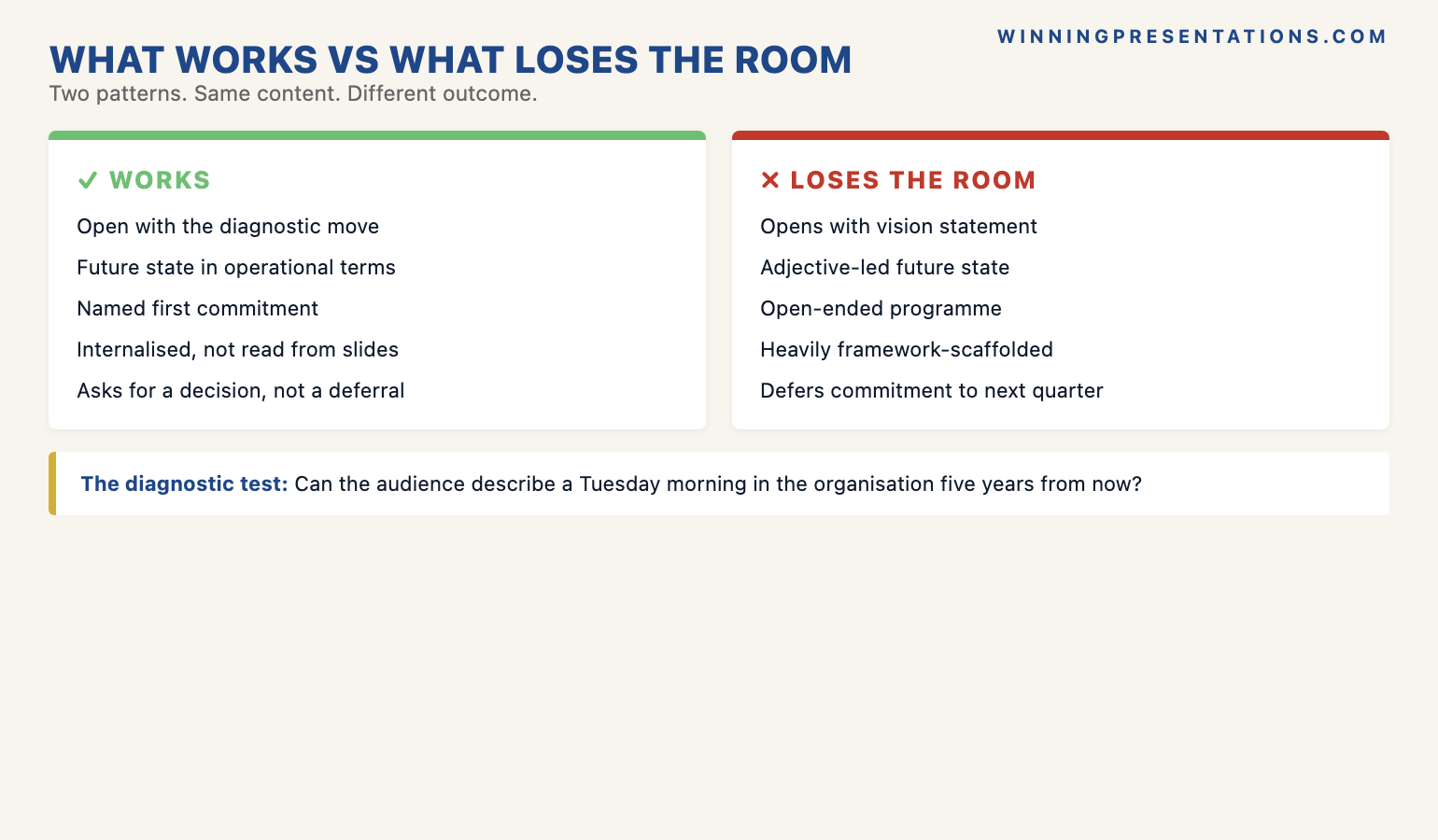
The second is the false sense of risk reduction from including everything. The instinct is that more content equals more credibility. The opposite is true at senior audience level. A vision presentation with twenty slides is, by demonstration, a vision the leader has not yet compressed into its essentials. Senior audiences read length as signal. They will privately discount vision decks above ten slides; the discount accelerates beyond fifteen.
The third is the absence of a forcing function. Vision presentations that end with “we will continue to refine the strategy and report back next quarter” telegraph that the leader is not yet asking for a decision. Senior audiences respond to that signal by deferring engagement. The presentation that ends by naming the first commitment — and asking the committee to back it — gets the conversation it deserves. Even if the answer is no, a clear no is more useful than another quarter of further refinement.
The Executive Buy-In Presentation System — for senior decisions that need backing.
7 self-paced modules covering buy-in structure, psychology, and delivery. Monthly cohort enrolment, optional recorded Q&A calls, lifetime access to materials. Designed for senior professionals presenting to boards, executive committees, and senior stakeholder groups. £499.
Frequently asked questions
How long should a vision presentation to senior leaders run?
Twelve to fifteen minutes for the prepared content. The slot in most senior committees is 30 to 45 minutes — the rest is for discussion, which is where the actual decision happens. Vision presentations that try to fill the full slot with prepared content signal that the leader does not yet trust the discussion. The strongest format is short, structured, and willing to leave the room time to push back. The pushback is where senior audiences make up their minds.
Should I include financial projections in a vision presentation?
Sparingly, and only at the level needed to anchor the future state. Three or four headline numbers — typically revenue, margin, and one or two strategic indicators — are enough for the room to evaluate the magnitude of the change being proposed. Detailed projections by year, by line, by region, belong in an appendix. A vision deck that includes a full financial model in the body is a deck that has not yet decided whether it is selling vision or budget.
What if the senior committee asks for more conservative options?
Welcome the question. It is a sign the committee is engaging with the vision rather than dismissing it. The disciplined answer is to acknowledge that more conservative options exist, name the trade-off they involve — usually a slower path that preserves more current-state earnings but accumulates structural risk over time — and ask the committee whether they want to formally evaluate one of those alternatives. That conversation almost always strengthens the original vision because the alternatives, examined directly, often look less attractive.
Should the vision presentation be the same as the press release?
No. The press release is for external audiences and carries a different set of constraints — investor language, regulatory care, brand positioning. The internal vision presentation should be more concrete, more operationally specific, and more honest about the structural choices involved. Senior internal audiences will distrust a deck that reads as if it is being workshopped for a corporate communications team. They want the version of the vision that is being discussed in the room, not the version that will eventually appear on the website.
The Winning Edge — weekly newsletter
The Winning Edge is a weekly newsletter for senior professionals presenting at the executive level. One short email a week covering the structural moves that distinguish presentations senior committees back from presentations they defer. Subscribe to The Winning Edge →
Not ready for the full Buy-In System? Start here instead: download the free Pyramid Principle Template — the framework behind every executive briefing where the conclusion comes first.
About the author
Mary Beth Hazeldine is Owner & Managing Director of Winning Presentations Ltd. With 24 years of corporate banking experience at JPMorgan Chase, PwC, Royal Bank of Scotland, and Commerzbank, she advises executives across financial services, healthcare, technology, and government on structuring presentations for high-stakes funding rounds, board approvals, and strategic decisions.