

Quick answer: The comparison question — “why should we fund this over X?” — is the question every funding proposal faces, often phrased differently but always asking the same thing. The structured answer has three parts: acknowledge the alternative as a legitimate use of capital, name the criterion that distinguishes the two, and connect that criterion to a strategic priority the room has already endorsed. The answer that disparages the alternative loses. The answer that elevates the criterion wins.
Jump to:
Tomas had been presenting a transformation programme for forty minutes. The case was solid. The room had been engaged. The chair leaned forward and asked the question every senior presenter eventually meets. “I’m not arguing with the substance, but why should we fund this over the data platform investment that’s already on the agenda for next quarter?” Tomas had not prepared for the question in those exact terms. He had spent forty minutes on his proposal and zero on the alternative. He answered for eleven seconds, awkwardly, and the meeting moved on. The proposal was deferred for a month.
The comparison question is not a question about the proposal. It is a question about the alternative. Most senior presenters answer the wrong one. They defend their case again, in different words, and the room hears them not engaging with the question that was actually asked. The board reads this — accurately — as a sign that the presenter has not done the comparative thinking. Even when the underlying proposal is sound, the answer to the comparison question often determines whether the room approves it or defers.
The question almost always comes at senior level because senior decision-making is comparative. Boards do not approve proposals in absolute terms. They approve proposals against an opportunity-cost frame. Every yes implies a no to something else. The room is asking, often informally, what the something-else is and why this proposal beats it. The answer needs to be ready before the question is asked.
If you face comparison questions in funding decisions
The Executive Q&A Handling System covers the structured answers senior presenters use for the hardest questions in board and investment committee Q&A — including the comparison question. Tough questions, calm authority, decision-safe answers in 45 seconds. £39, instant download.
Why the comparison question always comes
Senior decisions are made under capital constraints. Even in well-resourced organisations, the marginal pound goes to one initiative at a time. The room knows this. So when a proposal lands, the unspoken question is not “is this a good idea” — it is “is this a better idea than the next-best use of the money”. The comparison question makes the unspoken explicit. It is the room’s way of testing whether the presenter has thought about the proposal in the same comparative frame the room has to operate in.
There are three common forms of the question. The literal version — “why this over X” — is the easiest to recognise and the easiest to prepare for. The structural version — “what’s the trade-off if we approve this” — is asking the same thing, framed as opportunity cost. The political version — “I’m not sure this is the right priority right now” — is the same question dressed as judgement. All three want the same answer: a reasoned argument for why this proposal earns the marginal pound over the named or implied alternative.
The presenters who answer well have done the work in advance. They know what the alternative is, they have framed the comparison neutrally, and they have a single clear distinguishing criterion ready. The presenters who answer poorly defend the proposal again rather than engaging the comparison. The room reads the difference instantly. Even when the proposal is the same, the proposal that comes with a credible comparative answer survives the meeting in a way that the proposal without one does not.
The three-part answer that works
A structured answer to the comparison question has three parts, delivered in sequence, each doing specific work. Senior presenters who use this structure consistently find that the question stops being a threat and becomes an opportunity to reinforce the case.
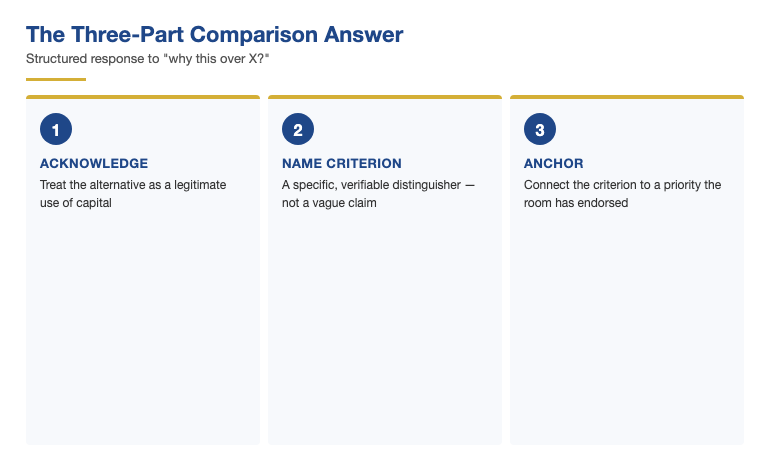
Part one — acknowledge the alternative as legitimate. Open the answer by treating the alternative as a serious option that deserves capital on its own merits. “The data platform investment is a strong proposal — I’ve reviewed the business case and the timing is reasonable.” This costs nothing and earns enormous credibility. The room is watching to see whether the presenter is capable of comparative judgement or whether they will simply attack the alternative. Acknowledgement signals the former.
Part two — name the criterion that distinguishes the two. Move quickly to a single clear criterion that separates the proposal from the alternative. “The distinguishing question is which of the two unlocks the regulatory milestone we have to meet by Q4. This proposal does. The data platform supports it but does not meet the milestone on its own.” The criterion has to be specific, has to favour the proposal, and has to be one the room can verify. Vague criteria — “this is more strategic” — collapse on inspection. Specific criteria — “this meets the regulatory milestone” — hold up.
Part three — connect the criterion to a priority the room has already endorsed. Close the answer by anchoring the criterion to a strategic priority the room is already committed to. “Meeting the Q4 regulatory milestone is the third commitment in this year’s plan, signed off in March.” The room is not being asked to make a new judgement about priorities — it is being asked to apply a priority it has already endorsed. That is much easier to approve than a fresh prioritisation argument.
The whole answer takes thirty to forty-five seconds. It does not run long. It does not feel rehearsed. It feels like the natural answer of someone who has thought about the proposal in the same comparative frame the room operates in. Senior presenters who deliver it consistently find that the comparison question stops feeling like an ambush.
Three wrong answers most presenters give
Wrong answer one — defending the proposal again. The most common failure. The presenter answers the comparison question by re-asserting the strengths of their own proposal in different words. The room reads this as not engaging with the question. The credibility of the proposal drops, even when the substance has not changed. Re-asserting is not answering.
Wrong answer two — disparaging the alternative. The second most common failure. The presenter argues that the alternative is weaker, less strategic, or poorly timed. This loses for two reasons. First, the alternative usually has supporters in the room, and disparaging it makes them defensive — they will then argue against the presenter’s proposal in retaliation. Second, the room is asked to compare two options, and the answer that runs down the other one signals that the presenter does not have a positive case strong enough to stand on its own. Senior decision-makers read this pattern instantly.
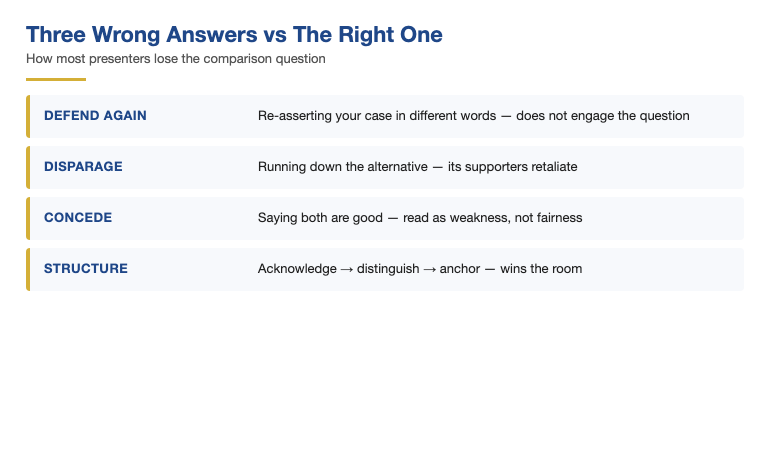
Wrong answer three — conceding both are equally good. The third failure mode is false neutrality. The presenter says something like “honestly, both proposals are strong — I’d be happy to see either approved.” This may be diplomatic but it is fatal. The room is asking the presenter to make the case. A neutral answer signals that the presenter has not done the comparative thinking and is leaving the prioritisation to the room. The room expects the presenter to advocate. Neutrality is read as weakness, not as fairness.
All three wrong answers share a common cause — the presenter has not prepared for the comparison question and is improvising. Improvisation rarely produces the right answer because the right answer requires comparative analysis that takes time. A prepared answer takes thirty seconds to deliver and an hour to construct. The construction has to happen before the meeting. The room cannot tell the difference between a confident improvisation and a confident preparation, but it can tell the difference between a confident answer and an unprepared one.
For senior professionals who face comparison and prioritisation questions
The Executive Q&A Handling System — calm authority, decision-safe answers in 45 seconds
The Executive Q&A Handling System gives senior presenters the structured answer patterns for the hardest questions in board and investment-committee Q&A — including comparison, prioritisation, and trade-off questions. Designed for the moments where you need a calm, authoritative answer in under a minute and cannot afford to improvise.
- Structured answer patterns for tough Q&A — comparison, prioritisation, trade-offs, scrutiny under pressure
- Decision-safe answers in 45 seconds, designed for senior boards and investment committees
- Calm-authority delivery framework — the structural moves that hold up under scrutiny
- Instant download, lifetime access, designed for executive use
£39 · Instant download · Lifetime access · Designed for executive Q&A
How to prepare for the question before the meeting
Preparation for the comparison question takes about ninety minutes. The work is concentrated in three steps, and the answer falls out of the steps almost automatically.
Step one — list the three most likely alternatives. In any senior funding decision, the room is implicitly comparing your proposal against a small number of alternatives — typically two or three. Identify them. They are usually obvious from the agenda, the recent committee discussions, or a quick conversation with the chair or sponsor. The alternatives might be other initiatives requesting capital, deferral of the decision, or a smaller-scoped version of your own proposal.
Step two — find a single distinguishing criterion for each. For each alternative, identify one criterion that genuinely separates your proposal from it. The criterion has to be specific, verifiable, and favourable. “Strategic alignment” is too vague. “Meets the Q4 regulatory milestone” is specific. “Unlocks the M&A integration timeline” is specific. “Closes the customer-attrition gap surfaced in March’s review” is specific. One distinguishing criterion per alternative is enough.
Step three — anchor each criterion to a previously-endorsed priority. For each criterion, find the strategic priority, decision, or commitment the room has already made that the criterion connects to. The room is not being asked to invent new priorities — it is being asked to apply existing ones. Anchored criteria carry far more weight than free-standing ones. The work of finding the anchor is what makes the answer feel inevitable when delivered in the meeting.
Once the three steps are done, you have a comparative answer ready for any of the most likely alternatives. The answer takes thirty to forty-five seconds in the room, sounds prepared but not over-prepared, and reframes the discussion from “is this proposal good” to “does this proposal meet the criterion that matters most given the priorities we have already endorsed”. The reframe is what shifts the room. For the broader Q&A discipline that comparison questions sit inside, see the related discussion of voice control in executive Q&A.
Delivery in the room — three rules
Rule one — slow down at the start of the answer. The pace at which you start the answer signals confidence. Slow openings — “Yes, that’s the right comparison to draw” — read as senior. Fast openings sound defensive. Take the half-second before answering. The room reads the half-second as composed thinking, not as hesitation.
Rule two — name the alternative explicitly, do not euphemise. If the chair asks why this over the data platform investment, the answer should use the words “the data platform investment” — not “the alternative” or “the other proposal”. Naming the alternative explicitly signals that you are engaged with the actual comparison, not deflecting. It also gives the answer specificity that vague phrasing lacks.
Rule three — close the answer cleanly. End the answer at the strategic anchor. Do not drift past it into additional defence. Do not open new arguments. The answer ends when the criterion has been connected to the priority the room has endorsed, and the next thing said should be “happy to take the next question”. A clean close signals that the answer is complete. A drifting close signals that the presenter does not know when the answer should end. Senior presenters end clean.
Frequently asked questions
What if I genuinely think the alternative is the better priority?
Then the proposal should not be in the meeting in its current form. The comparison question is testing whether you have done the comparative thinking — and the answer to “do I genuinely believe this is the better priority” should be yes before you walk into the room. If the answer is no, the work is to reshape the proposal until it is genuinely the better priority, or to defer it. Presenting a proposal you do not believe in compared to the alternatives is unsustainable at senior level — the room reads it, and it damages future credibility.
How do I handle the question if the alternative has not been formally proposed yet?
The same way. The room is comparing your proposal to whatever capital alternatives exist, formal or informal. Sometimes the alternative is “doing nothing” or “waiting six months”. Both deserve the structured answer. Acknowledge the option, name the criterion that argues against it (typically the cost of delay or the value of acting now), and connect that criterion to a priority the room has endorsed. The structure is the same. The specificity makes the difference.
Can I include the comparison answer in the deck rather than waiting for the question?
Sometimes. For high-stakes proposals where comparison is certain, a single slide near the end — “How this fits alongside other priorities” — pre-empts the question and signals that you have done the comparative thinking. For most proposals, the answer is better held for the Q&A. Including it in the deck risks making the proposal look defensive, as if it can only stand by being compared favourably. Hold the answer until asked, but make sure it is ready.
What if the chair persists after my answer?
A persistent follow-up usually signals that the chair is not satisfied with the criterion or the strategic anchor. The right response is not to repeat. The right response is to engage the underlying concern. “I think the question behind the question is whether the regulatory milestone is the right anchor — let me come back to that with one more piece of evidence.” Persisting often becomes constructive when treated as a request for more depth rather than as opposition. Senior chairs often ask twice deliberately, to see whether the answer holds up under second pressure. A composed second answer wins more rooms than a perfect first one.
Companion programme for senior buy-in scenarios
For the broader buy-in framework that sits behind comparison questions
The Executive Buy-In Presentation System is a self-paced framework for senior professionals who need to secure approval from boards, executive sponsors, and reluctant stakeholders — the broader context that comparison questions arise inside. 7 modules, monthly cohort enrolment, optional recorded Q&A. £499, lifetime access.
- 7 self-paced modules covering stakeholder analysis, case construction, and the structures that earn senior approval
- Optional live Q&A calls — fully recorded, watch back any time
- Monthly cohort enrolment — enrol any time, start with the next cohort
- Lifetime access to all materials, no subscription, no expiry
£499 · Self-paced · Lifetime access · Next cohort enrolment opens monthly
The Winning Edge — weekly
One short note each Thursday on board-level presentation patterns, structural shortcuts, and the behaviours senior presenters use under scrutiny. Written for professionals who do not have time for newsletters that read like newsletters.
Want a starting point first? The free Executive Presentation Checklist covers the structural fundamentals senior presenters use before preparing comparative Q&A.
For a wider view of how comparison questions sit inside board approval dynamics, see the related piece on the board approval presentation framework — the structural ground that comparison answers are built on.
Next step: Take the next senior funding presentation on your calendar. Spend ninety minutes preparing the three-part answer for each of the two most likely alternatives. The work is small. The difference in the room is large.
Mary Beth Hazeldine is the Owner & Managing Director of Winning Presentations. With 25 years of corporate banking experience at JPMorgan Chase, PwC, Royal Bank of Scotland, and Commerzbank, she advises senior professionals across financial services, healthcare, technology, and government on structuring presentations for high-stakes board meetings, investment committees, and executive sessions. She speaks German and works extensively with the German-speaking financial markets.