

Forty-seven seconds.
I know the exact length because a colleague recorded the presentation on her phone. When I watched it back that evening—hands still shaking, convinced my career was over—I counted every silent second.
Except it wasn’t forty-seven seconds of silence. It was forty-seven seconds of me pausing, looking at my notes, taking a breath, and resuming. On the recording, it looked deliberate. It looked like I was letting a point land before continuing.
Inside my body, it was a different story entirely. My mind went white. My throat closed. I couldn’t remember the next sentence, the slide I was on, or—for a genuinely terrifying moment—why I was standing in that room at all.
The audience saw a confident pause. I experienced a full nervous system shutdown. That gap between what you feel and what they see is the most important thing to understand about freezing mid-presentation—and the key to recovering from it.
Quick Answer: When you freeze mid-presentation, your audience almost never perceives it the way you do. Research on time perception during anxiety shows that what feels like an eternity to the presenter typically registers as a natural pause to the audience. The recovery isn’t about preventing the freeze—it’s about understanding the perception gap, using a physical reset to re-engage your nervous system, and having a bridge phrase ready that buys you time without signalling distress.
⏱️ Presenting This Week? Your 30-Second Freeze Recovery Protocol
Memorise this three-step sequence before your next presentation. It works whether you freeze for three seconds or thirty:
- Feet (3 sec) — Press both feet firmly into the floor. This grounds your nervous system and interrupts the dissociation response.
- Breath (5 sec) — One slow exhale through your mouth. Not a deep breath in—the exhale activates your parasympathetic nervous system.
- Bridge phrase (immediate) — Say: “Let me come back to that point” or “The key thing here is…” and glance at your slide. Your brain will re-engage.
Total time the audience notices: 5-8 seconds. What they see: a presenter gathering their thoughts. What you’ve done: rebooted your nervous system.
🎯 Is This Your Pattern?
- You’ve frozen during a presentation and the memory still makes you anxious weeks or months later
- The fear of freezing again is now worse than the original fear of presenting
- You over-prepare and over-rehearse specifically because you’re terrified of going blank
- You avoid certain presentation settings (all-hands, board meetings, Q&A) because the freeze risk feels too high
- You’ve started declining speaking opportunities that could advance your career
This article explains what’s actually happening in your nervous system when you freeze, why it’s far less visible than it feels, and how to recover in real time.
In This Article:
The Perception Gap: What You Feel vs. What They See
After my forty-seven-second freeze, I asked three people in that room what they noticed. Their answers changed how I think about presentation anxiety entirely.
The first said he didn’t notice anything unusual. The second said she thought I’d paused to let the data on the slide sink in. The third—my manager—said she noticed I seemed to lose my train of thought briefly but recovered well.
Three people. Three different perceptions. None of them matched what I experienced.
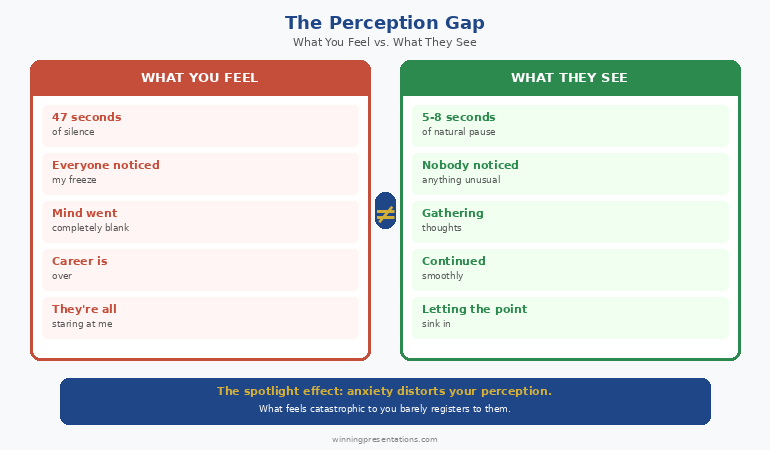
This is what psychologists call the spotlight effect—our tendency to overestimate how much other people notice our internal states. In a presentation context, it’s amplified by anxiety, which distorts time perception and magnifies self-consciousness.
Here’s what the perception gap actually looks like in practice:
What you feel: “I’ve been standing here in silence for an eternity. Everyone can see I’ve forgotten everything. My career is over. They’re all staring at me.”
What they see: “She paused for a moment. Maybe gathering her thoughts. Okay, she’s moving on.”
I’ve worked with hundreds of executives who describe their freeze in catastrophic terms—”the worst moment of my professional life,” “a complete public meltdown,” “everyone saw me fall apart.” When I ask if anyone in the audience mentioned it afterward, the answer is almost always the same: no one said a word.
What’s Actually Happening in Your Nervous System
Freezing mid-presentation isn’t a failure of preparation or competence. It’s a physiological response—your nervous system doing exactly what it’s designed to do when it perceives threat.
As a clinical hypnotherapist who spent five years struggling with presentation terror before training to understand it, I can tell you that the freeze response follows a predictable neurological sequence:
Stage 1: Threat Detection
Your amygdala—the brain’s threat detection system—registers something as dangerous. In a presentation, this could be a hostile facial expression, an unexpected question, a moment of silence, or simply the awareness that many people are watching you. The trigger is often unconscious.
Stage 2: Sympathetic Activation
Your nervous system floods with adrenaline and cortisol. Heart rate spikes. Muscles tense. Blood diverts from your prefrontal cortex (where speech and logic live) to your limbs (where fight-or-flight lives). This is why you can’t think clearly—your thinking brain has literally been de-prioritised.
Stage 3: The Freeze
When fight and flight are both impossible (you can’t punch anyone, you can’t run away), your nervous system defaults to freeze. Speech stops. Movement stops. Time distortion begins. You are not “forgetting your presentation.” Your brain has temporarily shut down the functions that make presenting possible.
Stage 4: Spontaneous Recovery
This is the part nobody mentions: the freeze is temporary. Your nervous system will regulate itself. The adrenaline will metabolise. Speech will return. The question isn’t whether you’ll recover—it’s how long the gap lasts and what you do during it.
Understanding this sequence matters because it reframes the freeze from a personal failure to a biological event. You didn’t freeze because you’re bad at presenting. You froze because your nervous system did its job.
For more on managing the pre-presentation anxiety that often triggers freezing, see my guide on calming nerves before a presentation.
⭐ The Freeze Response Isn’t Random. Neither Is the Fix.
Conquer Speaking Fear is a structured programme built around the neuroscience of presentation anxiety—including the freeze response, the avoidance cycle, and the recovery techniques that work under real pressure.
What’s inside:
- The nervous system reset protocol for real-time freeze recovery
- Hypnotherapy-informed techniques for rewiring the threat response
- The confidence-building sequence that reduces freeze frequency over time
Get Conquer Speaking Fear → £39
Addresses the root cause, not just the symptom. Instant download.
The 3-Part Recovery Protocol That Works Mid-Presentation
I’ve tested dozens of freeze recovery techniques—with myself, with clients, and in real presentation situations. Most of them don’t work because they require cognitive effort at exactly the moment your cognitive brain has gone offline.
The protocol that works targets the body first, the breath second, and the words last. Here’s why that order matters.
Step 1: Ground (2-3 seconds)
Press your feet hard into the floor. If you’re at a lectern, press your fingertips onto the surface. If you’re holding notes, squeeze them.
This isn’t metaphorical. Physical sensation sends a signal to your nervous system that you are safe, here, and in your body. The freeze response involves a form of dissociation—you feel disconnected from yourself. Physical grounding interrupts that disconnection.
What the audience sees: you standing still for two seconds. That’s it.
Step 2: Exhale (3-5 seconds)
One long, slow breath out through your mouth. Not in—out.
Most freeze recovery advice says “take a deep breath.” This is backwards. When you’re in freeze, your chest is already tight and your breathing is shallow. Trying to breathe deeply creates more tension. But a long exhale activates your vagus nerve, which triggers your parasympathetic nervous system—the system that calms you down.
What the audience sees: you taking a natural breath between points.
Step 3: Bridge (immediate)
Use a bridge phrase that buys you time while your brain re-engages. This isn’t about finding the exact word you lost. It’s about getting any words out of your mouth, because speech itself tells your nervous system that the freeze is over.
The bridge phrase connects back to your presentation without revealing that you lost your place. It creates continuity where there was a gap.
What the audience sees: a presenter emphasising a key point before continuing.
The entire sequence takes 5-10 seconds. On the rare occasion someone notices, they’ll interpret it as a thoughtful pause.
Bridge Phrases: The Words That Buy You Time
Bridge phrases are pre-memorised sentences that restart your speech engine without requiring you to remember where you were. They work because they’re overlearned—you’ve rehearsed them so many times they’re stored in procedural memory, not the declarative memory that goes offline during a freeze.
Backward bridges (reconnect to what you just said):
“So the key point there is…” — then glance at your slide. Your brain will fill in the blank.
“Let me put that differently…” — buys you time to rephrase whatever you were saying.
“And that’s exactly why this matters…” — works whether you remember the point or not.
Forward bridges (skip ahead to the next section):
“But here’s what’s really important…” — jump to whatever you remember next.
“Let me move to the part that affects you directly…” — resets the audience’s attention.
“I want to make sure we cover…” — look at your next slide and continue from there.
Engagement bridges (redirect to the audience):
“I’m curious—has anyone experienced this?” — gives you 15-20 seconds to regroup.
“Before I continue, any questions on that point?” — legitimate pause while you recover.
“Take a moment to think about how this applies to your team.” — buys you 10 seconds minimum.
Pick three bridge phrases. Practise them until they’re automatic. The goal isn’t elegant delivery—it’s reliable delivery under stress. When your cognitive brain goes dark, these phrases are the torchlight that gets you moving again.
For more on what to do when your mind goes completely blank, including the 10-second recovery technique, see my guide on what to do when your mind goes blank during a presentation.
⭐ Build the Nervous System Resilience That Prevents Freezing
Recovery techniques handle the moment. Conquer Speaking Fear addresses the pattern—rewiring the threat response that triggers freezing so it happens less often and resolves faster when it does.
Get Conquer Speaking Fear → £39
Addresses the root cause, not just the symptom. Hypnotherapy and NLP techniques for lasting change. Instant download.
Why Prevention Fails (And What to Do Instead)
I need to be honest about something: you cannot fully prevent the freeze response. And attempting to is often what makes it worse.
Here’s the trap most people fall into after a freeze: they over-prepare. They memorise every word. They rehearse twenty times. They create backup notes for their backup notes. And then they walk into the presentation with a new anxiety layered on top of the original one—the fear that all that preparation might fail.
Over-preparation creates rigidity. Rigidity makes you more vulnerable to freezing, not less. Because if you’ve memorised a script and you lose your place, there’s nowhere to go. You haven’t practised recovering. You’ve only practised perfection.
What actually reduces freeze frequency over time isn’t more preparation. It’s three things:
1. Desensitisation through graduated exposure
Start with low-stakes speaking situations and build up. Team meetings before all-hands. Small groups before large audiences. Each successful experience rewires your nervous system’s threat assessment—this situation is survivable, not dangerous.
2. Recovery rehearsal
Practise freezing on purpose. Mid-rehearsal, stop speaking. Use the ground-exhale-bridge protocol. Resume. Do this until recovery feels automatic. You’re training your nervous system to treat the freeze as a speed bump, not a cliff edge.
3. Threat reappraisal
The freeze happens because your amygdala classifies the presentation as dangerous. Cognitive reappraisal—consistently reframing the audience as allies rather than evaluators—gradually shifts that classification. This isn’t positive thinking. It’s systematic rewiring of the threat detection system.
For a deeper look at building lasting presentation confidence rather than relying on willpower, see my guide on presentation confidence.
What to Do After You’ve Frozen (The 24-Hour Window)
What happens in the twenty-four hours after a freeze determines whether it becomes a one-off event or a recurring pattern.
Most people replay the freeze on a loop. They catastrophise. They convince themselves everyone noticed. They start dreading the next presentation before it’s even scheduled. This creates what psychologists call a conditioned anxiety response—the memory of the freeze becomes a trigger for future freezing.
Here’s what to do instead:
Within one hour: Write down exactly what happened—factually, not emotionally. “I paused for approximately 15 seconds during the third section. I used a bridge phrase and continued.” Facts disrupt the catastrophic narrative your anxiety wants to write.
Within four hours: Ask one trusted person who was in the room what they noticed. Not “did you see me freeze?”—that plants the idea. Ask “how did you think the presentation went?” Their answer will almost certainly not mention the freeze.
Within twenty-four hours: Present again—even if it’s a five-minute update in a team meeting. The longer you wait, the larger the freeze looms. Getting back in front of an audience quickly tells your nervous system that presenting is still safe.
This twenty-four-hour protocol is based on the same principle used in trauma recovery: early, controlled re-exposure prevents the event from becoming consolidated as a trauma memory. A freeze doesn’t have to define your relationship with presenting. But only if you don’t let it.
What causes freezing during a presentation?
Freezing during a presentation is a nervous system response, not a failure of preparation. Your amygdala detects a threat (many people watching, high stakes, unexpected moment), floods your body with stress hormones, and when fight or flight aren’t possible, defaults to freeze. Blood diverts from your prefrontal cortex—where speech and logic live—to your limbs. The result: speech stops, thoughts disappear, and time distorts.
How long does a presentation freeze actually last?
Most presentation freezes last between 3 and 15 seconds, though they feel significantly longer to the presenter due to anxiety-driven time distortion. Studies on the spotlight effect show that audiences rarely notice pauses under 10 seconds and typically interpret longer pauses as deliberate. What feels like a catastrophic failure to you often registers as a thoughtful moment to them.
Can you prevent freezing during presentations?
You can reduce the frequency and severity of freezing, but completely preventing it isn’t realistic or even necessary. The most effective approach combines graduated exposure (building up from low-stakes to high-stakes speaking), recovery rehearsal (practising the ground-exhale-bridge protocol until it’s automatic), and having reliable bridge phrases memorised. Managing the freeze matters more than preventing it.
⭐ Stop Living in Fear of the Next Freeze
Conquer Speaking Fear gives you the complete system—real-time recovery techniques for the moment it happens, plus the deeper nervous system work that reduces how often it happens. Built from clinical hypnotherapy and 24 years of working with executives who freeze, shake, and shut down under pressure.
Get Conquer Speaking Fear → £39
Clinical hypnotherapy and NLP techniques for presentation anxiety. Addresses the root cause, not just symptoms. Instant download.
Frequently Asked Questions
Is freezing during a presentation a sign of a bigger problem?
Not usually. Freezing is a normal nervous system response that many confident, experienced presenters encounter at some point. It becomes a concern only when it creates a persistent avoidance pattern—when you start declining opportunities or over-preparing to the point of exhaustion. If freezing is occasional, recovery techniques are sufficient. If it’s happening repeatedly and limiting your career, working with a specialist in presentation anxiety can help address the underlying pattern.
Should I tell the audience I froze?
In most professional settings, no. The perception gap means they likely didn’t register it as a freeze. Drawing attention to it serves your need for emotional honesty but undermines your credibility. Use a bridge phrase, continue, and debrief privately afterward. The exception is very small, trusted groups where acknowledging a brief pause might feel more authentic than pretending it didn’t happen.
Will beta blockers prevent freezing?
Beta blockers manage the physical symptoms of anxiety (racing heart, shaking hands) but don’t directly address the freeze response, which is a dissociative neurological event rather than a purely cardiovascular one. Some people find beta blockers helpful as one part of a broader approach, but they don’t replace nervous system reconditioning. Consult your GP before considering any medication for presentation anxiety.
How is freezing different from losing your train of thought?
Losing your train of thought is a cognitive event—you forget what comes next but can still speak, look at your notes, and recover within seconds. Freezing is a neurological event—your speech, movement, and sometimes awareness temporarily shut down. The recovery approach is different: cognitive blanking responds to notes and prompts, while a full freeze requires a physical reset (grounding, exhale) before your brain can re-engage with language.
Get Weekly Speaking Confidence Insights
Evidence-based techniques for presentation anxiety, freeze recovery, and building lasting confidence—from a clinical hypnotherapist who’s been there.
📋 Free: Executive Presentation Checklist
A quick-reference checklist that helps you prepare for any presentation—including the recovery protocol covered in this article.
Related: If you’re presenting strategy to your CEO this week and the freeze fear is already building, start with the format—having the right structure reduces cognitive load, which reduces freeze risk. Read the strategy presentation format your CEO actually wants for the 12-slide decision-first structure.
The Bottom Line
Forty-seven seconds. That’s how long my worst presentation freeze lasted. I was certain it ended my credibility. It didn’t. Nobody mentioned it. The presentation achieved its objective. And the recording proved that what I experienced as a catastrophe looked, from the outside, like a pause.
You will freeze again. Maybe not today, maybe not next month. But at some point, your nervous system will do its job and temporarily shut down your speech in a high-stakes moment. That’s not a question of preparation or skill—it’s biology.
The question that matters isn’t “how do I prevent this?” It’s “what do I do in the eight seconds between the freeze and the recovery?” Now you know: ground, exhale, bridge. And keep presenting.
About the Author
Mary Beth Hazeldine is the Owner & Managing Director of Winning Presentations. With 24 years of corporate banking experience at JPMorgan Chase, PwC, Royal Bank of Scotland, and Commerzbank, she has presented in boardrooms across three continents—and frozen in a few of them.
A qualified clinical hypnotherapist and NLP practitioner, Mary Beth combines executive communication expertise with evidence-based techniques for managing presentation anxiety. She has trained senior teams and coached high-stakes presentations across banking, consulting, and corporate leadership.