Tag: founder pitch deck

04 Jun 2026
Startup founder presenting a structured pitch deck to investors in a glass-walled meeting room, navy and gold editorial photography

Pitch Deck Template for Startups Download: Investor-Ready Slide System

If you are looking for a pitch deck template for startups that holds up in front of an investor — not a free PowerPoint download you have to redesign before sending — The Executive Slide System is a structured set of 26 templates, 93 AI prompts, and 16 scenario playbooks designed for senior decision-makers. Instant download, £39, single payment.

This page explains what the system contains, how the templates apply to a startup pitch, and what differs between a generic deck on Google and one built for investor scrutiny. If you are evaluating options before downloading, the detail below is written to help you decide.


Startup founder presenting a structured pitch deck to investors in a glass-walled meeting room, navy and gold editorial photography

Short on time? If you would rather skip the analysis and see the template system directly, view The Executive Slide System on Gumroad — instant download, single payment, designed for senior decision-makers including investors. The remainder of this page is for founders who want context first.

Why Free Startup Pitch Templates Fail in Investor Meetings

Most pitch deck templates available to download follow the same well-worn shape: title slide, problem, solution, market size, traction, team, ask. The structure is everywhere because Sequoia, Y Combinator, and Guy Kawasaki have all published versions of it. The problem is not that the structure is wrong — it is that everyone is using the same one, and investors have seen it a thousand times. By slide three, the partner across the table is half-listening, half-checking whether the numbers match their pattern.

The deeper issue is that a generic template assumes a polished narrative will carry the room. It will not. Investors at seed and Series A are reading for one thing: can this team execute? The slide architecture either signals competence and clarity in the first thirty seconds, or it does not. A founder who opens with “the problem” instead of the recommendation buries the lead. A founder who shows a pretty traction chart without explicit conversion logic loses the partner who reads decks for a living. Free templates optimise for visual polish; investor decks need structural rigour.

A Slide System That Works for Investor Audiences

The Executive Slide System is structured around how senior decision-makers — including investors — take in information. The templates start with the recommendation and the ask, follow with the supporting evidence, and finish with implications and the decision frame. The 16 scenario playbooks adapt that core structure to specific situations, including investor pitches, capital requests, and board approvals — situations where structure decides whether the proposal lives or dies.

It was built by Mary Beth Hazeldine, who spent 24 years in corporate banking at JPMorgan Chase, PwC, Royal Bank of Scotland, and Commerzbank before taking over Winning Presentations in 2023. The slide structures draw on the presentations she designed and advised on for capital allocators, investment committees, and senior executives. The deliverables are practical: editable slide files, scenario-by-scenario walkthroughs, and AI prompts for ChatGPT and Microsoft Copilot to help you populate the templates with your real numbers and narrative quickly. The executive slide templates overview is a useful broader reference if you want to compare the system against a generic template kit.

What the Download Includes

  • 26 slide templates — covering recommendation slides, market and evidence slides, traction summaries, financial frames, risk slides, and decision-asks designed for senior audiences
  • 93 AI prompts — for ChatGPT and Microsoft Copilot, mapped to each template and scenario so you can populate slides with your real content fast
  • 16 scenario playbooks — including investor pitches, capital requests, board approvals, and the other situations founders face when raising or reporting
  • Master checklist — pre-meeting review of structure, evidence, and Q&A readiness before you walk into the partner meeting
  • Framework reference — the underlying structure principle behind the templates, so you can adapt them when an investor conversation does not fit a playbook exactly
  • Three-file delivery — instant download, no subscription, no recurring charge

Price: £39 — instant download, single payment.

Build a Pitch Deck That Earns the Second Meeting

The Executive Slide System gives you the senior-level structure, the scenario playbooks, and the AI prompts to turn your raise narrative into a deck investors will read past slide three — without rebuilding from a blank slide every time you adapt to a new fund.

  • 26 templates and 16 scenario playbooks for investor pitches, capital requests, and senior reviews
  • 93 AI prompts for ChatGPT and Microsoft Copilot, mapped to each template
  • Master checklist and framework reference so the system adapts to each investor conversation
  • £39, instant download, single payment, no subscription

Get The Executive Slide System → £39

Designed for senior professionals, including founders presenting to investment committees and partners

How Investor Decks Differ From Internal Pitch Decks

A founder pitching to a partner is in a different room than a founder pitching to their own board. Internal pitch decks can assume context — the audience already understands the product, the market, and the team. Investor decks have to establish all three in the first five slides without sounding like a sales pitch. The templates account for this. The recommendation slide names the round and the ask in one line. The market slide is sized in a way that survives diligence rather than the inflated numbers that get torn apart in the second meeting.

Investor partners read pattern. They have seen hundreds of decks in the same shape, and they pattern-match against the ones that worked. A clean recommendation, a defensible market sizing, an honest traction frame, and a credible team slide signal a founder who has thought it through. Sloppy or inflated framing signals the opposite — and the meeting is lost before Q&A. The professional presentation course overview covers the underlying principle behind why structure carries more weight than design.

Stop rebuilding the deck for every fund you meet.

The Executive Slide System gives you the templates, scenario playbooks, and AI prompts to adapt your investor narrative for each fund without restarting from a blank slide. £39, instant download.

See The Executive Slide System → £39

Is This the Right Template for You?

The Executive Slide System is designed for you if:

  • You are a founder preparing for seed, Series A, or growth-round investor meetings, or other senior-level pitch situations
  • You want a structured system that adapts across investor conversations, not a single deck or a stylised PowerPoint theme
  • You face multiple senior audiences — investors one week, your own board the next, a strategic partner after that — and need templates that cover the range
  • You use ChatGPT or Microsoft Copilot and want AI prompts mapped to specific slide tasks like drafting market frames or structuring traction logic
  • You prefer a single-payment download to a subscription template tool

It is probably not the right fit if:

  • You need pre-designed brand graphics and a stylised theme rather than a structural template kit
  • You want a bespoke pitch deck design service or one-on-one coaching session
  • Your primary need is delivery confidence or anxiety management rather than slide structure
  • You are pitching to a consumer or social-media audience rather than senior decision-makers

If the fit looks right and you want context on how the templates work in a related senior scenario, the board presentation course overview walks through one of the playbook scenarios in more detail.

One payment, instant download, yours to keep.

No subscription, no recurring charge, no expiry. Download today, edit the templates for your raise, and use the same system across every investor conversation. The Executive Slide System — 26 templates, 93 AI prompts, 16 scenario playbooks. £39, single payment.

Download The Executive Slide System → £39

Frequently Asked Questions

Is the pitch deck template available as an instant download?

Yes. The Executive Slide System is delivered as an instant download from Gumroad for £39, single payment. Buyers receive three files — templates, AI prompts, scenario playbooks, master checklist, and framework reference. There is no subscription and no recurring charge. The same system serves founders raising in the UK, Europe, North America, and other markets.

Does the template cover seed, Series A, and growth-round pitches?

The templates are structural, not stage-specific. The recommendation, market, traction, financial, and decision-ask slides apply across raise stages — what changes between seed and growth is the substance and the specificity of the supporting evidence. The 16 scenario playbooks include investor pitches, capital requests, and board approvals, so the system covers the conversations a founder has across the company life-cycle.

How are the AI prompts used with the pitch deck templates?

There are 93 AI prompts for ChatGPT and Microsoft Copilot, mapped to specific templates and scenarios. They cover tasks like drafting recommendation language, structuring traction evidence, sizing the market defensibly, generating Q&A banks for partner meetings, and stress-testing arguments. You paste the prompt into your AI tool, add the relevant context from your situation, and use the output to populate the template. The prompts assume no prior AI experience — instructions are step-by-step.

Will the templates work in PowerPoint, Keynote, and Google Slides?

The templates are delivered in editable formats designed to work with PowerPoint and equivalent slide software including Keynote and Google Slides. The structure is what carries the system, not the visual styling — so even if your startup has a brand design you want to apply, the System gives you the slide architecture and you dress it in your own visual language.

Is this only for technology startups?

No. The structural principles apply equally to founders in technology, healthcare, financial services, deep tech, consumer, and B2B services. What matters is the audience: anyone presenting to investors, an executive committee, or a senior steering group benefits from the same architecture.

The Winning Edge — weekly newsletter for senior professionals

Short, practical essays on executive slides, investor and boardroom communication, and AI-assisted preparation. One email a week.

Subscribe to The Winning Edge →

About the Author

Mary Beth Hazeldine is the Owner & Managing Director of Winning Presentations. With 24 years of corporate banking experience at JPMorgan Chase, PwC, Royal Bank of Scotland, and Commerzbank, she advises senior professionals across financial services, healthcare, technology, and government on structuring presentations for investor meetings, board approvals, executive committees, and capital requests.

04 May 2026
Series A Pitch Deck Length: Why 12 Slides Beats 25 Every Time — featured image

Series A Pitch Deck Length: Why 12 Slides Beats 25 Every Time

Quick Answer: The right series A pitch deck length is 12 slides, not 25. A Series A lead partner will skim your deck in under four minutes on the first pass, read four slides closely, and decide whether to take the meeting. A 25-slide deck dilutes the four slides that matter. A 12-slide deck forces you to choose them. Put everything else in a clearly structured appendix.

Priya was three days out from her first Series A partner meeting when she sent me the deck. Twenty-seven slides. Her seed deck had been fourteen, and she had doubled the weight because “there is so much more to show now — traction, cohorts, pipeline, expansion logic, the moat.” All true. None of it was on a single slide she could point to and say: this is the headline.

We ran the rehearsal on the Sunday. I asked her to open the deck, pick the slide her lead investor candidate would stop on, and tell me why that slide made the round. She paused. She clicked forwards. She clicked back. Around slide nine, the lead partner — who in rehearsal I was playing — leaned back and asked: “what’s the headline here?” She could not answer. Not because she did not know the business. Because the deck had no centre of gravity.

That meeting moved from a partner call to a recorded async review. Narrower path, lower chance of conversion. Three weeks later we rebuilt the deck around twelve slides. Not because twelve is magic — because twelve forces you to pick the four slides the partner will actually read, and protect them.

If you are cutting a Series A deck down to its real shape

The Executive Slide System includes scenario playbooks for investor pitches, partner meetings and fundraising reviews — structural templates designed for audiences who decide on four slides.

Explore the System →

Why series A pitch deck length is a signal, not a constraint

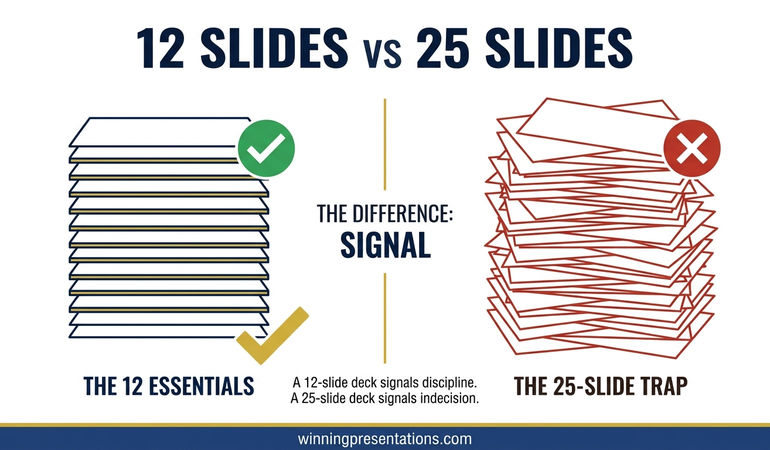
Most founders treat deck length as a packaging problem — how much content can I fit without losing the reader. That framing misses what the deck does. The deck is a signal of how the founder thinks. A 25-slide deck signals that the founder cannot prioritise, or has not yet earned the right to because the narrative is not tight enough.

A 12-slide deck signals the opposite. The founder has made the hard editorial calls. The four numbers that matter are on the slides, and the rest is supporting detail. Investors do not read this as a gap. They read it as maturity.

When a founder cannot cut from 25 to 12, it is almost never because the extra 13 slides are essential. The founder is using the deck to hedge — adding slides in case a partner asks a specific question, in case the market framing is weak, in case traction alone will not carry it. Each hedge is a tell. For the related question of slide order rather than count, the partner article on investor pitch deck slide order covers the sequence that holds up under a partner read.

What VCs actually do with a 25-slide deck

Most founders assume the partner will read linearly, absorbing the argument. That is almost never what happens. A partner has 45 to 90 seconds to form an initial judgement, and four to six minutes if the first pass is positive. Inside that window, they do three things.

First, they go to the slide that signals stage. For Series A, that is traction — revenue shape, retention or cohort data, and the curve. If that slide is on page 3 they find it in three seconds. If it is on page 17 inside “our journey so far,” they skim past and decide the deck is not stage-appropriate.

Second, they go to the slide that signals defensibility. Not the product slide — the moat slide. Whatever makes this business hard to replicate by a better-funded incumbent eighteen months from now. Product advantage at Series A is rarely the defensibility.

Third, they read the ask and use of proceeds. How much, against what milestones, over what runway. A £12m raise against vague milestones reads worse than a £6m raise against crisp ones.

Those are the four slides — traction, defensibility, ask, and the narrative setup that connects them. Everything else in a 25-slide deck is noise the partner filters through. A 12-slide deck makes the filter unnecessary.

Infographic comparing a 25-slide Series A pitch deck that dilutes the four decision slides against a 12-slide deck that protects traction, defensibility, ask and narrative setup

THE EXECUTIVE SLIDE SYSTEM — £39

Stop shipping a 25-slide deck that hides the four slides the partner actually reads

The Executive Slide System is 26 presentation templates, 93 AI prompts, 16 scenario playbooks, a master checklist and a framework reference. The investor pitch playbook is built for decision-stage audiences who skim before they read — with the 12-slide structure, title architecture and appendix navigation pattern this article describes. £39, instant access.

Get the Executive Slide System →

Designed for founders preparing Series A, Series B and growth-stage investor presentations.

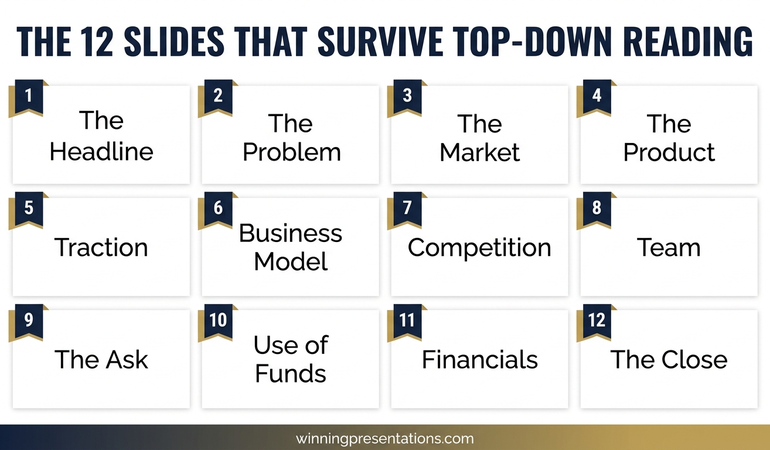
The 12 slides that survive top-down reading

The twelve-slide structure is not arbitrary. It is the minimum coherent set that answers the questions a Series A partner asks on the first read. Each slide earns its place by being the shortest honest answer to one question the partner cannot skip. The twelve questions, in order:

  • What problem is being solved, and for whom?
  • How big is this market, and why is it ready now?
  • What is the product, in one screen?
  • What traction does that product already have?
  • How does the business make money, and what are the unit economics?
  • Who is the team, and why this team?
  • What is being asked for, and what does it buy?
  • What do the financials project, and against what assumptions?
  • What are the plausible exits, and what shape do they take?
  • Why is this defensible against well-funded incumbents?
  • What is the go-to-market motion that gets you to Series B?
  • What is the close — the one sentence the partner takes to the partnership meeting?

Each is one slide. Not a section. Not a sub-deck. When a founder tells me a topic needs two slides to do justice, the founder has not yet found the sentence that collapses it. That sentence exists. It is the editorial work.

For the complete structural reference including title architecture and layout patterns, the investor pitch deck template walks through the slide-level design.

Slide-by-slide: the 12 you need

1. Problem. Framing from the customer’s perspective, with one quantified cost of the status quo. Not “enterprises struggle with X.” A specific operational cost a specific buyer already pays.

2. Market. Bottom-up sizing. Target buyers, average contract value, addressable revenue. Top-down “it’s a $42bn market” numbers read as lazy at Series A.

3. Product. One screenshot that communicates what the product actually does. Not three. Not a feature grid. The screen the user spends 80% of their time on.

4. Traction. The single most important slide. Revenue curve, retention or cohort shape, and one signal of velocity. This is where the round is won or lost.

5. Business model. How you charge, the contract shape, gross margin and one unit economic ratio (LTV/CAC, payback period, contribution margin). If the economics are not yet clean, say so openly and show the trajectory.

6. Team. Three to five faces maximum. For each, one line: the relevant experience that matters for this company. Investors hire the team that can execute this specific plan.

7. The ask. Round size, valuation range (optional), use of proceeds in three buckets (product, GTM, team), and the runway this buys in months. Specific milestones, not categories.

8. Financials. Three years of projected revenue, gross margin and burn. Flagged as model, not forecast. Include the two or three assumptions the model is most sensitive to.

9. Exit. Plausible acquirers or comparable outcomes, with a rough scale. Not a promise — a demonstration that the founder has thought about what a 10x outcome looks like.

10. Defensibility. The moat. Data network effects, switching costs, regulatory position, distribution lock-in, proprietary data asset — whichever applies. If none apply, the founder needs to know that before the meeting.

11. GTM. The go-to-market motion that gets you from this round to the next. Sales-led, product-led, partnership-led or hybrid — and the specific next hires and channels that make it real.

12. The close. One sentence the partner takes into the Monday partnership meeting. Usually a reframing of the opportunity in the language of the fund’s thesis. Written last, because it is the whole deck compressed into a line.

For founders still shaping the narrative before slide-level choices, the pitch deck storyline guide covers how to sequence the twelve questions into a single argument.

Slides to never include in the 12 (and where they go instead)

Stacked cards infographic showing four types of slide that belong in the Series A appendix rather than the main 12: competitor matrix, roadmap, detailed org chart and press coverage

The slides founders most often over-include are competitive landscape, detailed roadmap, press and logos, and the history-of-the-company slide. Each has a place. None belong in the twelve.

Competitive landscape. A 2×2 matrix with your logo in the top right is almost always weaker than one sentence inside the defensibility slide that names the two real competitors and what you do differently. The matrix goes in the appendix.

Detailed roadmap. A quarter-by-quarter roadmap is either aspirational theatre or premature specificity. The GTM slide covers strategic direction. Detailed roadmap belongs in a data room, not a first-read deck.

Press and logo walls. Customer logos can earn a small line on the traction slide. A full page of press hits reads as marketing, not evidence.

Company history. The founding story, the pivots, the previous names — none of it answers a partner question. If the founding story is strong, it comes out verbally. A slide for it signals the founder has run out of harder material.

The appendix is where these slides live — labelled A1 through A6, navigable in under two seconds. When a partner asks about the competitive set, the roadmap or the regulatory position, you jump straight there. The main twelve stay clean. This is how investor pitch deck mistakes most often get corrected at the structural level.

The discipline of cutting from 25 to 12

The cut from 25 to 12 is not a compression exercise. It is a decision exercise. Print every slide as a thumbnail, lay them on a table, and for each ask two questions — which of the twelve partner questions does this slide answer, and is it the single strongest answer I have?

Any slide that does not answer one of the twelve comes out. Any slide that does but is not the strongest version comes out. The remaining slides are merged, rewritten and reordered until each of the twelve positions has exactly one slide in it.

The work that feels like cutting is actually clarifying. A founder with 25 slides will usually find that two product slides collapse into one better slide, three go-to-market slides compress into one clearer structure, and five team slides become one with the people who matter.

Priya cut her 27-slide deck to 12 in three working days. The round moved from a deferred partner call to a live partner meeting inside two weeks. The meeting opened with the lead asking her to walk him through slide 4 — the traction slide. The slide was already there, already clean, already the strongest version of the answer. The deck had a centre of gravity for the first time.

FOR FOUNDERS PREPARING A SERIES A DECK

The full structural library for investor presentations

The Executive Slide System gives you 26 templates, 93 AI prompts and 16 scenario playbooks — including the Series A investor playbook with the 12-slide structure, question-led titles and the appendix navigation pattern. £39, instant access, no subscription.

Get the System →

Frequently Asked Questions

Is 12 slides too short for Series A?

No. Decks shorter than ten often feel under-argued at Series A; decks longer than fifteen dilute the four slides that matter. The range that reliably holds a partner’s attention is 12 to 15, with 12 as the cleaner target.

Where do unit economics go if they deserve more than one slide?

They do not, in the main twelve. The business model slide carries the headline ratio and contract structure. Cohort analysis, payback curves and sensitivity tables go in the appendix. If the unit economics need three slides to tell the story, the headline number is not yet strong enough — a product or pricing problem, not a slide problem.

Should I have a separate appendix deck or keep it in the same file?

Same file, clearly divided. A separator slide between slide 12 and A1 signals the end of the main argument. Appendix slides are numbered A1 to A6 or A8, with a short index on the separator so founder and partner can navigate instantly. A separate file fragments the meeting.

What about visual density per slide?

One idea per slide, expressed in one headline sentence at the top, with supporting evidence below. Dense slides with six charts read as research dumps. Sparse slides with one chart and one sentence read as conclusions. Partners respond to conclusions.

Presentation playbooks, delivered Thursdays

The Winning Edge newsletter covers the structures real executives and founders use for high-stakes meetings — investor, board and senior stakeholder. One issue per week, typically read in four minutes.

Subscribe to The Winning Edge →

Not ready for the full system? Start here instead: download the free Executive Presentation Checklist — a one-page structural review to run over any deck before you send it to a partner.

Partner post: Once you have the twelve slides chosen, the order you put them in changes how the deck reads. The investor pitch deck slide order guide covers the sequence that holds up under a partner read.

Related reading: If the deck has already gone out and come back with a no, the pitch rejection recovery guide for founders covers the next move. For the partner meeting itself, steel-manning hostile investor questions covers how to handle the pushback that follows a strong deck.

Your next step: Print every slide in your current deck as a thumbnail and lay them on a table. For each slide, write on a sticky note which of the twelve questions it answers. Any slide without a sticky note comes out. Any question without a slide needs one.

About the Author

Mary Beth Hazeldine, Owner & Managing Director of Winning Presentations, advises executives across financial services, healthcare, technology and government on structuring presentations for high-stakes funding rounds, board approvals and stakeholder buy-in. With 24 years of corporate banking experience at JPMorgan Chase, PwC, Royal Bank of Scotland and Commerzbank, she works at the intersection of finance, language and decision psychology.