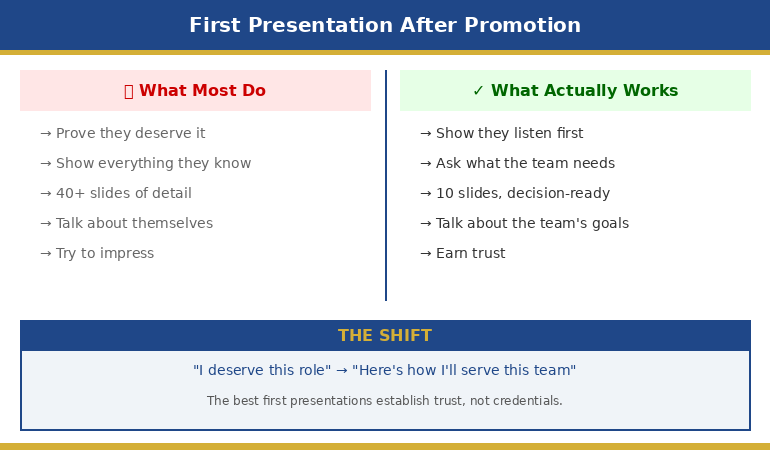
Quick Answer: Contractors, consultants, and new hires face a presenting as outsider credibility gap that has nothing to do with content quality. The room decides whether to trust you in the first 90 seconds — before your data lands. The fix isn’t more preparation or better slides. It’s a specific slide structure that establishes authority through insight, not introduction. Lead with what you see that insiders can’t. That’s your structural advantage.
In this article:
- Why the credibility gap exists (and why experience doesn’t close it)
- The 90-second window: what the room is actually deciding
- The Credibility Architecture: 4 slides that close the gap
- The outsider’s hidden structural advantage
- The 3 mistakes outsiders make (that insiders never would)
- When someone in the room doesn’t want you there
- Frequently asked questions
I spent 24 years walking into boardrooms where nobody knew my name.
At JPMorgan, I was the London person presenting to the New York desk. At RBS, I was the new hire presenting to a team that had worked together for a decade. At Commerzbank, I was the external consultant brought in to restructure a process the existing team had built.
Every single time, I felt it. That moment before you speak where the room is scanning you — not your slides, not your data — you. Deciding whether you’re worth listening to before you’ve said a word.
The worst was Frankfurt, 2009. I’d been hired to present a risk framework to a steering committee of twelve. I had six weeks of analysis. I had perfect slides. I opened with “Thank you for having me. Let me introduce myself and walk you through my background.”
Three people checked their phones. One left for coffee. I’d lost the room in eleven words.
The next time I walked into that room, I opened differently. I opened with what I’d found — an insight they didn’t have. The same people who’d ignored me were asking questions by slide two.
The content hadn’t changed. The structure had.
🚨 Presenting to a team that doesn’t know you this week? Quick check: Does your first slide lead with insight (what you’ve found) or introduction (who you are)? If it’s introduction, you’re giving the room permission to tune out. → Need the exact outsider-ready slide structure? Get the Executive Slide System → £39
Why the Credibility Gap Exists (And Why Experience Doesn’t Close It)
Here’s what nobody tells you about presenting as outsider credibility: the problem isn’t competence. It’s category.
When you’re internal, you’ve already been sorted. The room knows your track record, your department, your relationship to the decision-maker. They’ve decided — at least partially — whether to take you seriously before you stand up.
When you’re external, you haven’t been sorted yet. You’re in a holding pattern. The room is running a parallel process during your presentation: half their brain is evaluating your content, half is evaluating you.
This is why the same analysis, presented by an insider and an outsider, lands completely differently. The insider gets the benefit of the doubt. The outsider has to earn it — and they have about 90 seconds to do it.
Experience doesn’t automatically close this gap. I’ve watched consultants with 20 years of expertise get ignored because they opened with credentials instead of insight. The room doesn’t care about your CV. They care about whether you understand their problem.
How do you build credibility in a presentation when you’re new?
Not with a “my background” slide. Not with name-dropping previous clients. Those are defensive credibility moves — they try to prove you belong. What works is offensive credibility: demonstrating insight the room doesn’t already have. When you lead with “Here’s what I’ve found,” you skip the credibility queue entirely. You become useful before you become trusted — and usefulness creates trust faster than any CV slide.
The 90-Second Window: What the Room Is Actually Deciding
Research on first impressions in professional settings shows a consistent pattern: people form judgements within seconds, then spend the rest of the interaction confirming those judgements.
In a presentation, the 90-second window isn’t about your content. It’s about three unconscious questions every person in the room is asking:
1. “Does this person understand our world?” Not your world. Not your methodology. Theirs. If your first slide talks about your process, your framework, your approach — you’ve answered “no.” If your first slide talks about their challenge, their deadline, their risk — you’ve answered “yes.”
2. “Are they going to waste my time?” Outsiders over-explain. It’s a defence mechanism — you feel like you need to justify your presence. But every minute of context-setting is a minute the room is deciding you don’t have anything new to say.
3. “Do they have something I don’t?” This is the golden question. If your opening signals you’ve seen something the room hasn’t, every executive in that room leans forward. Not because they trust you. Because they’re curious. And curiosity buys you the next ten minutes.
The executives who present like CEOs understand this instinctively. They lead with the insight, not the introduction. As an outsider, you need to do the same — but with even more precision.
The Credibility Architecture: 4 Slides That Close the Gap
After two decades of presenting as the outsider, I developed a structure I now teach to every contractor, consultant, and new hire I work with. I call it the Credibility Architecture — and it’s the opposite of how most outsiders present.
Most outsiders present like this: Introduction → Background → Methodology → Findings → Recommendation.
The Credibility Architecture: Insight → Implication → Evidence → Ask.
Here’s what each slide does:
Slide 1: The Insight — Open with what you’ve found that the room doesn’t know. Not your conclusion. Not your recommendation. The single most surprising or important thing your analysis revealed. “Your Q3 attrition is 40% higher in the first 90 days than industry benchmark — and it’s concentrated in one department.” That’s an insight. “We conducted a comprehensive analysis of your attrition data” is a process description. One creates curiosity. The other creates boredom.
Slide 2: The Implication — What does this insight mean for their business, their timeline, their risk? This is where you demonstrate judgement. Anyone can present data. Only someone who understands the business can explain what the data means. “At current rates, this costs you £2.3M annually in recruitment and lost productivity — and it accelerates in Q1 when your biggest client renewal is due.”
Slide 3: The Evidence — Now you earn the right to show your methodology. The room is curious. They want to know how you got here. This is where your analysis, your data, your process belongs — after they care, not before.
Slide 4: The Ask — What do you need from the room? A decision, a budget, a next step? The decision slide structure works regardless of whether you’re internal or external — because it focuses on the business outcome, not your authority to request it.

⭐ Walk Into Any Room and Own It — Even When Nobody Knows You
The Executive Slide System gives you 22 proven slide structures that establish authority through structure, not reputation. Whether you’re a contractor, consultant, or new hire — the templates put your insight first and your credentials where they belong: implicit in the quality of your slides.
Includes:
- Executive Summary template — the insight-first structure that earns trust in 90 seconds
- Board Meeting Opener — designed for first-time presentations to unfamiliar audiences
- 15 scenario playbooks including “First Presentation as New Leader” with exact template + prompt + checklist
- 51 AI prompts that sharpen your outsider insight into executive-ready language
Get the Executive Slide System → £39
Built from 24 years of presenting as the outsider — at JPMorgan, RBS, PwC, and Commerzbank.
The Outsider’s Hidden Structural Advantage
Here’s something most outsiders don’t realise: you have an advantage that insiders don’t.
Insiders are trapped by context. They know the politics, the history, the unspoken rules — and that knowledge constrains what they’re willing to say. They self-censor. They hedge. They present what’s politically safe rather than what’s analytically true.
You don’t have that constraint. You can say the thing nobody in the room is willing to say — because you don’t have a promotion to protect or a relationship to preserve.
The best outsider presentations I’ve seen — and the ones that led to follow-on contracts, permanent roles, and reputation-building moments — all shared one quality: they said the uncomfortable thing with data behind it.
“Your top performer in sales is actually your biggest risk — their client relationships are personal, not institutional, and when they leave, you lose 60% of that revenue.” Nobody internal would say that. An outsider with the data can.
This is why the Credibility Architecture starts with insight, not credentials. Your unfamiliarity with the politics isn’t a weakness. It’s the reason they hired you. Use it.
The outsider advantage only works if your slide structure supports it. Generic templates signal “I grabbed this from Google.” Decision-first templates signal “I know how executive meetings work.” The Executive Slide System gives you the structure that makes your insight land — whether the room knows you or not.
The 3 Mistakes Outsiders Make (That Insiders Never Would)
What’s the biggest mistake outsiders make in executive presentations?
Mistake 1: The credentials dump. “Before I begin, let me share a bit about my background.” This is the outsider’s security blanket — and it’s a credibility killer. Every minute you spend justifying your presence is a minute the room isn’t learning from you. Insiders never do this because they don’t need to. You shouldn’t either — but for a different reason: your insight is a better credential than your CV.
Mistake 2: Over-qualifying every statement. “Based on our preliminary analysis, and bearing in mind the limitations of the data set, we believe there may be an opportunity to…” Outsiders hedge because they’re afraid of being wrong in a room where they have no political cover. But hedging signals uncertainty — and uncertainty from an outsider is fatal. If you’re not confident enough to state a clear recommendation, the room won’t be confident enough to act on it.
Mistake 3: Presenting your methodology before your findings. This is the biggest one. Outsiders lead with process because they think it builds credibility: “Here’s how thorough we were.” But the room doesn’t care about your process. They care about your conclusions. Lead with what you found. If they want to know how you got there, they’ll ask — and that question is a sign of engagement, not skepticism.
If you’re managing anxiety about presenting to a room that doesn’t know you, it’s worth understanding that much of that anxiety comes from structural uncertainty — not knowing whether the room will engage. When your slides demand engagement (because the insight is too interesting to ignore), the anxiety drops. For more on managing the physical stress of presenting under pressure, see the guide to presenting bad news without destroying credibility.
⭐ Stop Being the Outsider They Politely Ignore
The difference between “thank you for your input” and “when can you present to the board?” isn’t your analysis. It’s your slide structure. The Executive Slide System gives you the decision-first architecture that makes executives engage — regardless of whether they know you.
What’s inside for outsider presentations:
- Insight-first Executive Summary template — opens with what you found, not who you are
- Board Meeting Opener — designed for first-time presentations to unfamiliar audiences
- Stakeholder credibility framing prompts for “new to the room” situations
- Scenario 10 playbook: First Presentation as New Leader — exact template, prompt, and checklist
Get the Executive Slide System → £39
Built from 24 years of presenting as the outsider — to unfamiliar boardrooms at JPMorgan, RBS, PwC, and Commerzbank.
Every project status update you deliver as a contractor is a credibility opportunity — or a credibility leak. The Executive Slide System includes the exact structure that turns routine updates into reputation-building moments.
When Someone in the Room Doesn’t Want You There
Sometimes the credibility gap isn’t passive — it’s active. Someone in the room has been lobbying against the project you’re working on. Or they wanted a different consultant. Or they feel threatened by an external person doing work they think should be done internally.
I’ve been in this room more times than I can count. At PwC, I once presented a process redesign to a team whose manager had explicitly told the steering committee it wasn’t needed. He sat in the front row with his arms crossed for my entire presentation.
Here’s what works:
Don’t acknowledge the dynamic. The moment you say “I know some of you may be skeptical about bringing in outside help,” you’ve made the political tension the centrepiece of the room’s attention. Present as if every person in the room is there to learn from your findings.
Address their likely objection in your data — by slide 3. If someone thinks this project is unnecessary, your insight slide needs to include the evidence that makes it necessary. Don’t argue with them. Let the data do it. “The current process costs £340K annually in manual workarounds — that’s 4.2 FTEs” is harder to argue with than “we believe there’s an opportunity to streamline.”
Give them an on-ramp. The hostile person needs a way to engage without losing face. Frame your recommendations as building on what already exists: “The team has built a solid foundation. This proposal extends it.” Now they can support you without admitting they were wrong to oppose you.
How should a consultant present to a client’s leadership team?
The same way an insider would — but with more precision. Lead with what you’ve found (the insight), not what you’ve done (the process). State your recommendation clearly (no hedging). And give the room a specific decision to make. The format isn’t different. The margin for error is smaller.
Is This Right For You?
✓ This is for you if:
- You’re a contractor, consultant, or new hire presenting to a team that doesn’t know you
- Your analysis is strong but the room doesn’t engage the way you expect
- You want a slide structure that earns trust through insight, not credentials
✗ This is NOT for you if:
- You present exclusively to your own team and already have internal credibility
- You’re looking for design templates (this is structure and logic, not visual design)
⭐ The Structure That Got Me Invited Back to Every Room I Walked Into
In 24 years of presenting as the outsider — across JPMorgan, PwC, RBS, and Commerzbank — I built the frameworks that turn first impressions into lasting authority. The Executive Slide System is that structure, now available as templates and AI prompts you can use before your next meeting.
Inside:
- 22 executive slide templates — including Executive Summary, Board Opener, and Strategic Recommendation
- 51 AI prompts — 3 per template (Draft → Refine → Executive Polish)
- 15 scenario playbooks — find your exact situation, follow it like a recipe
- 6 checklists covering structure, clarity, logic, and decision readiness
Get the Executive Slide System → £39
Instant download. 30-day money-back guarantee. Used by contractors, consultants, and new hires presenting to unfamiliar leadership teams.
Frequently Asked Questions
How do I present confidently when I don’t know the internal politics?
You don’t need to know the politics to present effectively. You need to know the business problem. Focus your preparation on understanding the specific challenge, the numbers behind it, and what a good outcome looks like for the decision-maker. The Credibility Architecture puts your analysis front and centre — which means the room engages with your findings rather than evaluating your political position. The politics become irrelevant when the insight is strong enough.
Should I acknowledge that I’m new or external?
No — or at least, not as a standalone moment. Saying “As some of you know, I was brought in three weeks ago to…” signals that you consider your outsider status a limitation. Instead, let your first slide do the work. When you open with a specific insight about their business, you implicitly signal that you’ve done the work. The room doesn’t need to know how long you’ve been there. They need to know whether you have something they don’t.
What if someone in the room is hostile to external presenters?
Address their likely objection in your data by slide 3 — before they raise it. If they think your project is unnecessary, include the cost or risk data that makes it necessary. If they feel threatened, frame your recommendations as extensions of existing work. The goal isn’t to win them over in the presentation. It’s to make opposition feel unjustified to everyone else in the room. For more on navigating political dynamics, see the scenario playbook for presenting when someone is undermining you.
📬 The Winning Edge — Weekly Newsletter
One executive presentation insight per week. Real scenarios, real structures, no filler. Written for contractors, consultants, and corporate presenters who present to people they need to impress.
Related: If your first outsider presentation didn’t land the way you hoped, read Presenting After Failure: The 3 Words That Saved a VP’s Career — the recovery structure that rebuilds credibility fast.
Your next presentation to a room that doesn’t know you is on your calendar. You already have the analysis. Now get the structure that makes them listen.
About the Author
Mary Beth Hazeldine is the Owner & Managing Director of Winning Presentations. With 24 years of corporate banking experience at JPMorgan Chase, PwC, Royal Bank of Scotland, and Commerzbank, she has delivered high-stakes presentations in boardrooms across three continents.
A qualified clinical hypnotherapist and NLP practitioner, Mary Beth combines executive communication expertise with evidence-based techniques for managing presentation anxiety. She has trained thousands of executives and supported presentations for high-stakes funding rounds and approvals.