Quick answer: Many senior presenters cannot tell stories in board presentations because two decades of corporate training have rewarded bullet-point clarity, audit-friendly language, and risk-averse vocabulary — and those rewards systematically erode the storytelling instinct. The pattern is structural, not personal. The leader is not weak, anxious, or insufficiently charismatic. The system around them has shaped a habit of compression that strips narrative out before it reaches the slide. Recognising the pattern as training rather than deficit is the first move. Rebuilding the instinct is the second.
JUMP TO:
Kenji, a regional director at a global insurer, sat in his office the night before a board presentation and tried to write the opening. He wanted to tell the room about a single client meeting that had reshaped his thinking on the strategy he was about to recommend. The story was clear in his head — the room, the conversation, the moment the client said the thing that made everything click. He had told it twice over dinner the week before, and people had leaned in.
He opened his deck and began to type. What came out was three bullets. “Client engagement insight. Strategic implication. Recommendation.” He read it back and could not find the story anywhere in it. He tried again. Three more bullets. The instinct was gone. By all measures Kenji was excellent at his job, articulate at dinner, persuasive in one-to-one meetings. But when the slide opened, something inside him reached for compression and the narrative went missing. He was not anxious. He was not under-prepared. He had been trained, over twenty-two years of corporate work, to remove the very thing he was trying to put back.
This article is for senior leaders who recognise that pattern. The premise is simple: storytelling does not disappear because of personal weakness or insufficient confidence. It disappears because the corporate environment systematically rewards a different mode of communication, and rewarded behaviours become reflex. Once you can see the structural cause, the path to rebuilding the instinct opens.
If the in-the-moment overwhelm is the part that is breaking your delivery:
Conquer Your Fear of Public Speaking is a structured programme for managing presentation anxiety, designed for senior professionals who freeze, lose their thread, or default to bullet-reading when the pressure rises. Self-paced, instant access. Techniques designed for in-the-moment overwhelm.
The four corporate-training patterns that erode storytelling
The instinct does not vanish all at once. It is worn down, over many years, by four patterns that operate quietly in the background of senior corporate life. Each pattern is rational on its own terms — each was introduced for a reason. Together, they remove the conditions under which narrative can survive.
The first pattern is the bullet-point default. Most senior leaders have spent the bulk of their careers in environments where the dominant document is a slide deck, and the dominant slide is a bulleted list. Bullets reward parallel structure, compression, and the removal of connective tissue. They penalise the very things that make a story work — the named character, the moment of tension, the small specific detail that makes the abstraction land. Twenty years of writing bullets retrains the mind to think in bullets. By the time the leader sits down to write a narrative opening, the muscle they need has been replaced by a different muscle entirely.
The second pattern is the precedent-deck culture. In most large organisations, the way new presentations are built is by opening a previous deck and editing the slides. The slides that get re-used are the ones that survived previous committees. They survived because they were defensible — clean structure, balanced bullets, no rhetorical flourish that a senior reviewer might mark as “too marketing”. Over time, the surviving template defines the house style, and the house style is the opposite of narrative. The leader writing a new deck is not starting from a blank page. They are starting from a stack of precedent that has already filtered storytelling out.
The third pattern is the audit-language tax. In financial services, healthcare, government, and any other regulated environment, written communication is shaped by the prospect of being read by an auditor, regulator, or legal reviewer. Audit-safe language is precise, hedged, and stripped of anything that could be misread. It is also stripped of the things that make stories memorable. After a decade of writing in language designed to survive a regulator’s review, the senior leader has internalised the filter. The filter does not switch off when the audience changes. The same hedged, stripped language that protects the organisation in writing arrives, unbidden, in the board presentation that needed warmth.
The fourth pattern is the risk-averse vocabulary. Senior corporate environments reward leaders who do not overpromise. The vocabulary of strong narrative — concrete claims, vivid description, named outcomes — sits uncomfortably close to the vocabulary of overpromise. Leaders learn to soften. “We saw a meaningful improvement” replaces “the team turned the quarter around in six weeks”. The softening is rational in isolation; it protects against being wrong. Cumulatively, it strips the texture out of every story the leader might have told. By the time the senior position is reached, the vocabulary of vivid narrative has been pruned. The leader knows the words exist; they just no longer reach for them.
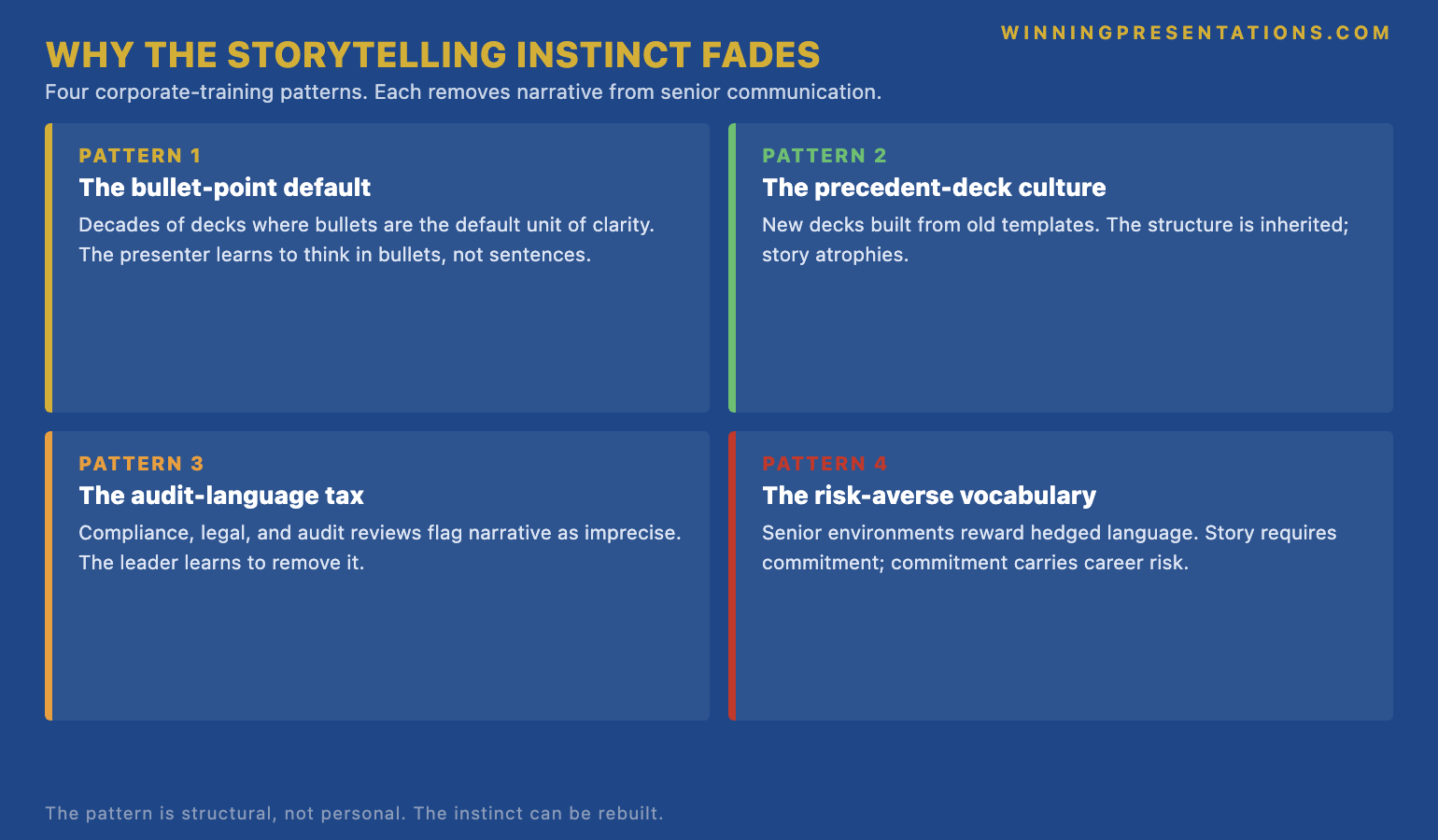
The four patterns reinforce one another. The bullet-point default shapes the slides. The precedent culture preserves the bullets. The audit-language tax strips warmth from the words. The risk-averse vocabulary removes the texture that would have made the story land. Twenty years of all four operating together is what produces the senior leader who used to be able to tell stories and now cannot. For more on what storytelling for senior audiences actually looks like when the instinct is intact, the long-form guide on storytelling for business presentations sets out the structures that survive in executive contexts.
The unconscious self-editing that strips narrative out
What makes the loss difficult to spot is that it does not happen in conscious memory. The leader does not sit down, think of a story, and decide to delete it. The deletion happens earlier, before the story even reaches the screen. There is a moment of narrative thought — the named client, the moment of tension, the specific detail — and then a corporate filter kicks in, and what arrives at the bullet is the compressed abstraction. The thought never made it through.
Rebuild the parts of presentation delivery that years of corporate training have worn down.
Conquer Your Fear of Public Speaking is a structured programme for senior professionals who recognise that the in-the-moment overwhelm — the freeze, the lost thread, the default to reading bullets — is what breaks delivery in the room. Self-paced, instant access, no subscription. £39.
- Designed for senior professionals managing presentation anxiety in high-stakes settings
- Techniques designed for in-the-moment overwhelm — the moments where preparation alone is not enough
- Self-paced format built for leaders who cannot block out a full training week
- Instant access on purchase; revisit any section before the next presentation
The filter has three components. First, a compression instinct: the thought arrives, and the mind reaches for the shortest version of it. Second, an audit-safety check: anything specific is softened to anything defensible. Third, a parallel-structure preference: the compressed, softened version is reshaped to fit the bullet structure of the slide above and below it. By the time those three operations have run, what was a story is a label. “The Tuesday meeting where Naveen said the partnership would not survive another quarter without a structural change” becomes “client engagement insight”. The leader did not edit the story out. The filter did, in the half-second between thought and slide.
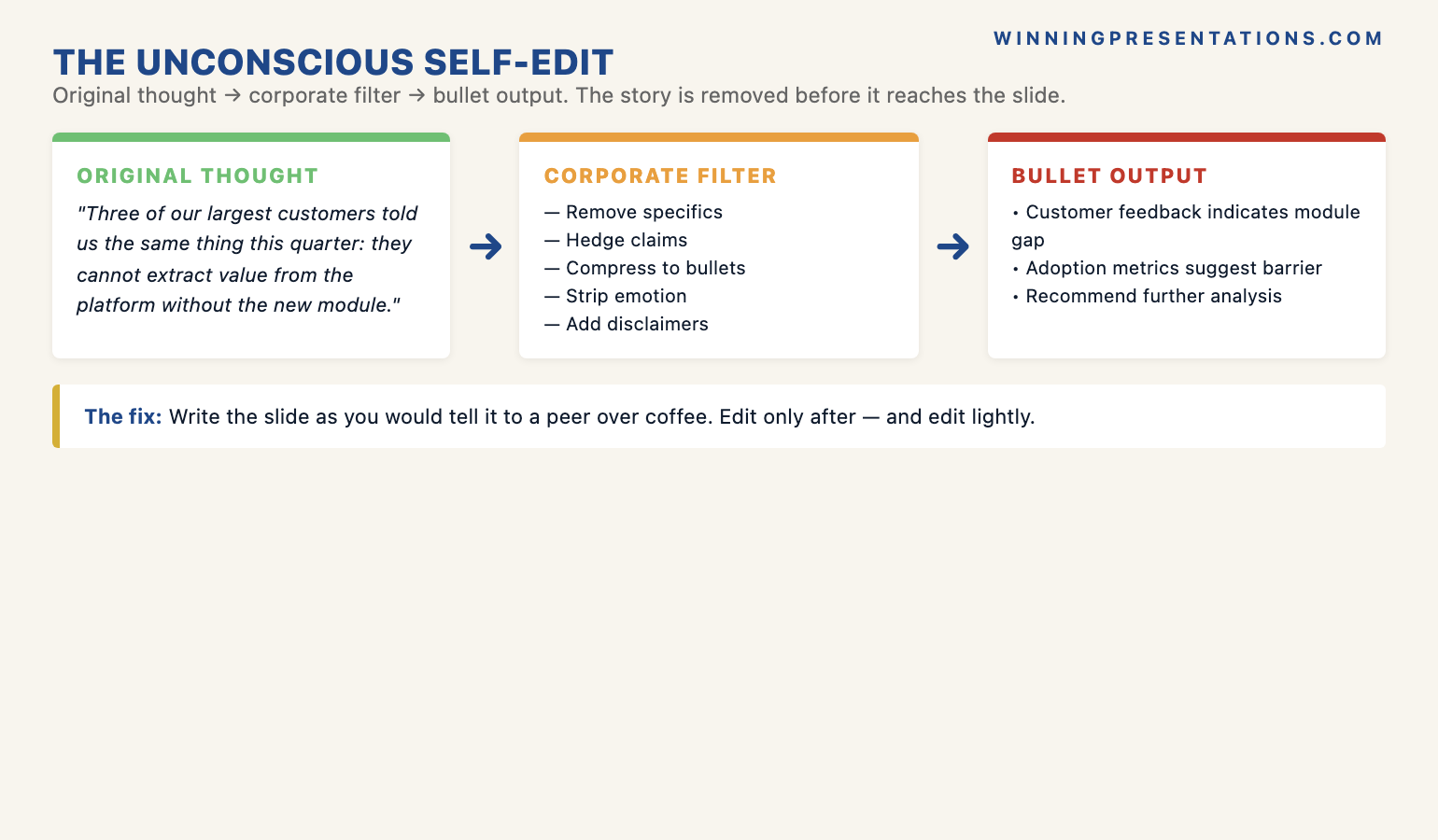
The good news in this diagnosis is that the filter is not the leader. It is a layer that has been added on top of the leader. Layers can be loosened. The instinct that wrote the story in the first place is still there — it spoke at dinner the week before. What changes between dinner and the deck is the activation of the filter. Interrupt the filter and the story comes back. The four moves below are designed to do exactly that.
The four moves that rebuild the instinct
The first move is to write the story before opening the deck. Pen and paper, or a blank text document — anywhere that does not have bullets pre-formatted into the layout. Write the story the way it would be told over dinner. One paragraph. Named person, specific moment, the small detail that makes it real. Once the paragraph exists outside the deck, it can be brought into the deck without going through the bullet filter. The deck adapts to the story rather than compressing it.
The second move is to keep the named character in the slide. Not “the client” — Naveen. Not “the team” — the regional finance team in Madrid. The corporate filter strips proper nouns first because they feel specific in a way that audit-safe language avoids. Resist the strip. Senior audiences do not punish proper nouns; they remember them. The named character is the single most efficient anchor a story has, and protecting it through the editing process is the simplest way to test whether the filter has run.
The third move is to allow one vivid detail per story. Not three. Not five. One. The detail that makes the moment land — the timestamp on the email, the phrase the client used, the look on the face of the COO when the number landed. The risk-averse vocabulary will try to remove the detail on the grounds that it is “not strictly necessary”. The detail is strictly necessary, because without it the story is an abstraction and the audience has nothing to hold onto. One vivid detail per story is the discipline; more becomes self-indulgent, fewer is bullet land.
The fourth move is to read the slide out loud before the meeting. The corporate filter is a written-language filter; it operates strongly in typing and weakly in speaking. Reading the slide aloud forces the spoken-language part of the brain into the editing loop, and it will catch the over-compressions the typed pass missed. Most leaders who do this notice within thirty seconds that two or three bullets sound dead aloud. They rewrite those bullets in the way they would have said them, and the story comes back. The full discipline behind these moves — and the structural frameworks that underpin them — is set out in the partner article on business storytelling for executive presentations.
If the gap is structural — you know the story is in there, you just need a framework to get it out:
The Business Storytelling Mini-Course is a self-paced programme covering frameworks for narrative structure around executive data. Designed for senior leaders who recognise the instinct has eroded and want a structured way to rebuild it. Instant access, no subscription. £29.
Why this matters more than delivery training
Most presentation training that senior leaders are sent on is delivery training — gestures, eye contact, vocal projection, breath control. Delivery training is useful when the underlying problem is delivery. It is the wrong tool when the underlying problem is that the deck has had its narrative removed before the leader walked into the room. A leader presenting bullet-point compressions with excellent vocal projection is still presenting bullet-point compressions. The audience leaves remembering the projection, not the message.
Rebuilding the storytelling instinct is upstream work. It happens at the deck, not at the lectern. It is also less visible to the leader and to the organisation, which is part of why delivery training tends to be commissioned first. A leader who has lost the storytelling instinct does not feel a sharp pain in the meeting; they feel a vague flatness afterwards. The committee was polite. The deck was professional. Nothing memorable happened. The flatness is the symptom, and the structural cause sits in the four patterns above. No amount of vocal projection rescues a deck that has been pre-stripped of narrative.
The Track B angle on this matters too. Many senior leaders interpret the flatness as a confidence problem and start working on confidence — breathing exercises, mindset reframes, anxiety management. Those tools are valuable in their place, but they do not address a structural editing problem. If the filter is removing the story before it reaches the slide, no amount of confidence work changes what the audience hears. For senior leaders who experience a related anxiety pattern — the limbo after a decision presentation has been deferred — the article on post-board presentation limbo anxiety covers a different but related corporate pattern.
How to recognise the pattern in your own deck
There are five quick tests. The first: open the deck and count proper nouns. If there are fewer than three across the whole presentation, the audit-safety filter has been running. The second: read each slide aloud and listen for the dead bullets — the ones that sound like a label rather than a sentence. Most decks have at least four. The third: ask whether any slide names a specific moment in time — a Tuesday, a meeting, a phone call, a decision point. If no slide does, the precedent-deck culture has flattened the timeline into abstractions. The fourth: count the vivid details. One per major argument is the floor. Zero is the symptom.
The fifth test is the most uncomfortable. Send the slide as a written document to a trusted colleague who does not work in your industry, and ask them what they remember an hour later. If they remember the structure but cannot recall a single specific, the deck is doing what corporate training trained it to do. The structure survived; the story did not. That is the diagnostic. The patterns above are the cause. The four moves are the response. Recognising the structural origin of the gap is what makes the rebuild feel like a reasonable project rather than a personal failing. It also makes the work easier, because the leader is no longer fighting their own confidence; they are loosening a layer of training that can be loosened. For senior leaders facing a related variant of the same pattern in evaluation contexts, the article on performance review presentation anxiety covers how the corporate filter shapes self-presentation as well as outward presentation.
Frequently asked questions
Is the lost storytelling instinct a sign of a deeper confidence problem?
Usually not. The pattern this article describes is structural — twenty years of corporate training shaping a writing reflex. Most senior leaders who recognise the pattern can tell stories perfectly well in conversation, at dinner, in one-to-one meetings. The instinct is intact in spoken contexts and absent in written-deck contexts. That asymmetry is the giveaway. A genuine confidence problem would show up across all contexts, not just the deck. If your storytelling works in the corridor and disappears on the slide, the cause is the slide environment, not your underlying capability. That said, in-the-moment delivery overwhelm is a separate problem worth addressing on its own terms if it is present.
My organisation’s culture is very risk-averse — won’t named characters and vivid details get flagged in review?
Sometimes, but less often than leaders fear. The risk-averse vocabulary has usually been internalised by the writer well before any actual reviewer would have applied it. Test it: include a named character and a single vivid detail, send the deck through your usual review process, and see what comes back. In most cases reviewers either accept the specifics or trim them lightly. The pre-emptive self-editing is doing more work than the actual review. Start with one named character per major argument — that is generally well within what a normal review process tolerates, and it is enough to bring the narrative back to life.
How long does it take to rebuild the instinct once you start working on it?
A few presentations, generally. The four moves are simple to describe and uncomfortable to execute, because the corporate filter has the weight of two decades of practice behind it. The first deck written with the moves consciously applied tends to feel awkward — the leader is fighting their own habit. By the third or fourth deck, the moves start to feel less effortful. By the time a senior leader has done six or seven decks with deliberate narrative attention, the filter has loosened to the point where the story arrives at the slide without an active intervention. The instinct does not have to be rebuilt from scratch; it has to be permitted to operate again.
What about senior audiences who explicitly want bullets?
Many senior audiences say they want bullets and respond more strongly to narrative once it is in front of them. The stated preference for bullets is often a preference for compression — they do not want to sit through a forty-slide deck. Compression and storytelling are not opposites. A three-slide deck with one named character and one vivid detail per slide is more compressed than a fifteen-slide bullet deck and lands harder. The discipline is to keep the story tight rather than to remove it. If a specific senior audience truly does prefer pure bullets, structure the deck to their preference, and embed the narrative in the spoken delivery instead — the spoken layer is harder for the corporate filter to strip.
The Winning Edge — weekly newsletter
The Winning Edge is a weekly newsletter for senior professionals who present at the executive level. One short email a week, focused on the structural moves that separate decks committees engage with from decks that land flat. Subscribe to The Winning Edge →
About the author
Mary Beth Hazeldine is Owner & Managing Director of Winning Presentations Ltd. With 24 years of corporate banking experience at JPMorgan Chase, PwC, Royal Bank of Scotland, and Commerzbank, she advises executives across financial services, healthcare, technology, and government on structuring presentations for high-stakes funding rounds, board approvals, and strategic decisions.