Tag: executive slide system

28 Feb 2026
Executive leading a focused meeting with engaged colleagues and data on laptop screen

This Meeting Should Have Been an Email. Here’s the Presentation Structure That Proves It Shouldn’t.

47 slides. 12 presenters. 90 minutes. Zero decisions. I sat through that monthly business review at RBS for three years before someone finally said what everyone was thinking: “Why are we all here?”

Quick Answer: Most mandatory update meetings fail because they present information that could have been read in advance. The fix isn’t better slides or more engaging delivery — it’s restructuring the meeting around decisions instead of updates. Every standing meeting should answer one question: “What do we need people in the room to decide?” If the answer is nothing, it genuinely should be an email. If there IS a decision, the entire presentation structure changes — and the meeting becomes the 15 minutes everyone wishes it was.

🚨 Running a recurring update meeting this week? Quick check: How many of your slides present information that could be read in advance? If more than half your deck is context-setting, you’re running an email disguised as a meeting.

→ Need the exact decision-meeting templates? Get the Executive Slide System (£39)

The turning point came when a VP I was coaching at JPMorgan showed me her calendar. She had eleven recurring meetings per week. Seven of them were “updates.” She was spending 40% of her working week sitting in rooms watching people read slides that she could have absorbed in five minutes.

“The worst part,” she told me, “is that three of those meetings actually DO need a discussion. But by the time we get to the discussion item, everyone’s checked out because they’ve sat through 45 minutes of status reports.”

She asked me to help her restructure her own team’s monthly update. Not the content — the format. We stripped out everything that could be sent as a pre-read, restructured the remaining slides around the two decisions she needed that month, and cut the meeting from 60 minutes to 20.

Her boss’s feedback after the first one: “That was the best update I’ve had all quarter. What changed?”

What changed wasn’t her data. It wasn’t her delivery. It was that she stopped presenting information and started presenting decisions.

Why 80% of Update Meetings Are Genuinely Wasted Time

Let’s be honest about what happens in most recurring update meetings. Someone opens a deck. They walk through slides that show project status, metrics, and activity since the last meeting. The audience listens politely, asks one or two questions that could have been answered via email, and leaves having made no decisions and taken no actions they wouldn’t have taken anyway.

This isn’t a presentation problem. It’s a structural one.

How do you make mandatory meetings engaging? You make them necessary. The reason most update meetings feel like they should have been emails is because they should have been emails. They contain information, not decisions. And information delivery doesn’t require synchronous human presence.

The test is simple: at the end of your meeting, can you point to a decision that was made BECAUSE people were in the room? If the meeting would have produced the same outcome as an email thread, you’ve just consumed 10 person-hours (10 attendees × 1 hour) for the cost of a 5-minute read.

At RBS, I calculated that our monthly cross-functional update consumed roughly 2,400 person-hours per year across the business. When we finally restructured the format, we recovered about 1,800 of those hours. Not by cancelling meetings — by making the remaining meetings genuinely meeting-worthy.

The Decision-Meeting Conversion: How to Restructure Any Update

Every update meeting can be converted to a decision meeting. Even the ones that feel purely informational. The trick is finding the decision hiding inside the update.

Step 1: Ask “So what?” For every piece of information in your current deck, ask “So what? What does the audience need to DO with this information?” If the answer is “nothing — they just need to know,” that’s a pre-read item. Remove it from the live presentation.

Step 2: Find the hidden decisions. Almost every update contains an implicit decision that never gets surfaced. “Project X is two weeks behind schedule” contains a hidden decision: Do we add resources, adjust the deadline, or accept the delay? Most presenters share the status and move on. The audience absorbs the information, feels vaguely concerned, and does nothing. Surface the decision, and the meeting has a purpose.

Step 3: Restructure around decisions, not topics. Instead of organising your meeting by project or department (which encourages information dumps), organise it by decision required. “We need to decide on three things today: resource allocation for Project X, go/no-go on the Q2 pilot, and timeline approval for the client migration.” Now everyone in the room knows exactly why they’re there.

Why do update meetings waste time? Because they’re structured around topics (“here’s what happened”) instead of decisions (“here’s what we need to resolve”). Restructuring around decisions doesn’t just make meetings shorter — it makes them the thing that requires human presence: collaborative judgement calls that can’t happen asynchronously.

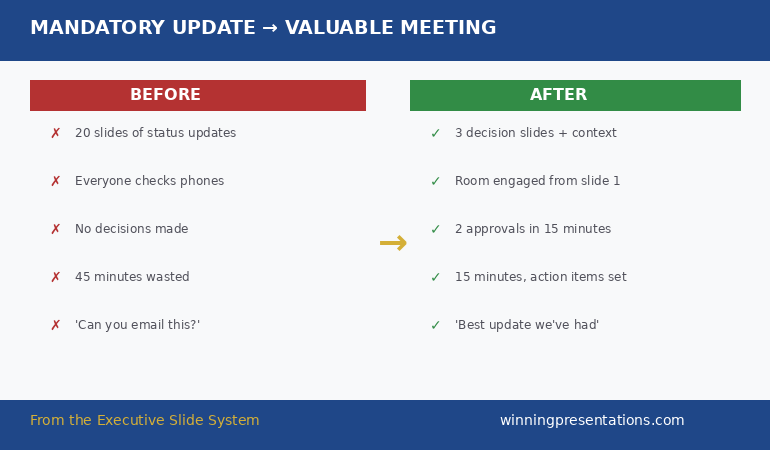
Before and after comparison showing mandatory update transformed from 20 status slides and no decisions to 3 decision slides and 2 approvals in 15 minutes

The Update Meeting Format That Gets Decisions in 15 Minutes

Your recurring meetings don’t need to be longer — they need to be structured around decisions instead of information. The Executive Slide System gives you:

  • The project status update template — pre-built to lead with decisions required, not activity completed
  • The executive summary template — the single-slide format that replaces 15 slides of background context
  • 51 AI prompts to restructure any existing meeting deck — including prompts that extract the hidden decisions from your status updates
  • The quarterly business review framework — the same structure that turned 90-minute reviews into 20-minute decision sessions

Get the Executive Slide System → £39

Restructured from monthly reviews at JPMorgan and RBS — where meeting time was too expensive to waste on information that should have been an email.

The Pre-Read Strategy That Eliminates 70% of Your Slides

The single biggest transformation you can make to any recurring meeting is implementing a pre-read. Not a “here’s the deck in advance” pre-read — that just means people skim the same slides they’d have seen live. A structured pre-read that contains all the information, so the meeting only contains the discussion.

What goes in the pre-read: Status updates. Metrics. Dashboards. Anything where the audience needs to absorb information before they can have a useful conversation. The pre-read should be a 1-2 page document (not a 20-slide deck) sent 24 hours before the meeting with a clear instruction: “Read this before we meet. The meeting will focus on the three decisions outlined at the top.”

What stays in the meeting: Decisions. Trade-offs. Disagreements that need resolution. Anything where human judgement, debate, or collaborative problem-solving adds value that an email thread cannot.

What’s the difference between an email update and a meeting update? An email update shares information. A meeting update requires human interaction to resolve something. If your audience can fully process and respond to your update asynchronously, it belongs in an email. If there’s a genuine question where the answer depends on multiple people’s input or requires real-time negotiation, that’s a meeting.

When I helped restructure the VP’s monthly update at JPMorgan, we moved 14 of her 18 slides into a pre-read document. The meeting deck became 4 slides: one executive summary, two decision slides, and one “next steps with owners.” The meeting went from 60 minutes to 20 minutes — and the decisions actually got made instead of deferred.

If your update meeting is due this week and you want to restructure it around decisions instead of slides, the Executive Slide System includes the project status and QBR templates already structured for decision-first presentations.

The 3-Slide Update That Replaced a 20-Slide Deck

This is the exact structure that turned the VP’s monthly update from a 60-minute information dump into a 20-minute decision session.

Slide 1: The Executive Summary. One slide that answers: What happened since last meeting? What’s on track? What’s not? What do we need to decide today? This replaces 10+ slides of status updates. If anyone wants the detail, it’s in the pre-read. This slide gives everyone the same starting point in 60 seconds.

Slide 2 (and 3 if needed): The Decision Slide(s). Each decision gets its own slide. The structure: What’s the issue? What are the options? What’s the recommendation? What’s the risk of each option? This format forces clarity. If you can’t fill in this structure, either the decision isn’t ready to be made or it isn’t really a decision.

Slide 3 (or 4): Next Steps with Owners and Dates. Every action item has a name and a date. Not “Team to follow up” but “Sarah to present revised timeline by March 7th.” This slide is also your meeting minutes — screenshot it and send it to attendees immediately after. No separate minutes document needed.

Three slides. Twenty minutes. Two decisions made. Compare that to twenty slides, sixty minutes, and “Let’s take this offline.” If you’re looking for the framework behind this structure, the project status update framework explains the full approach.

What a decision-first meeting agenda looks like:

1. Executive summary — what changed, what’s at risk, what we decide today (60 sec)
2. Decision #1 — options, recommendation, risk of each (5 min)
3. Decision #2 — options, recommendation, risk of each (5 min)
4. Next steps — owner + date for every action (2 min)

The Executive Slide System includes pre-built templates for each of these slides, with AI prompts to populate them from your existing data.

When You’re One of Five Presenters (And Everyone Else Still Uses 20 Slides)

This is the reality most people face. You don’t own the meeting format. You’re one presenter among several, and you can’t control what everyone else does. But you CAN control your section — and the contrast will be noticed.

When the four other presenters spend 15 minutes each walking through status slides, and you spend 4 minutes presenting one decision slide and asking for a specific resolution, you become the person leadership wants running more meetings.

I saw this happen repeatedly in banking. The director who cut her update from 12 slides to 3 didn’t just save time — she signalled that she respected the room’s time and had executive-level communication skills. Within six months, she was asked to restructure the entire divisional update format.

Start with your own section. Be the proof that it works. The format spreads because people in the room experience the difference and want it for their own updates.

Whether you own the whole meeting or just a 10-minute section, the decision-first templates in the Executive Slide System give you the structure that turns your slot into the part people actually pay attention to.

Stop Running the Meeting Everyone Dreads

Your team’s time is too valuable for 60-minute information dumps. The Executive Slide System gives you the decision-first format that transforms recurring updates:

  • 22 executive templates (15 executive + 7 framework) — including the project status and QBR formats built for decisions, not status reports
  • The pre-read + decision-slide structure that cut monthly reviews from 60 to 20 minutes at JPMorgan
  • 51 AI prompts — including “restructure this status update around the hidden decisions” to transform any existing deck

Get the Executive Slide System → £39

The same structure that recovered 1,800 person-hours annually at a global bank — by making meetings worth attending.

How to Make the New Format Stick

The biggest risk with restructuring a meeting isn’t getting the format right — it’s regression. After two or three successful short meetings, someone will say “Can we add a quick update on X?” and within a month, you’re back to 45 minutes of status slides.

Here’s how to prevent that:

Set a time limit and enforce it. “This meeting is 20 minutes. We have two decisions to make.” State it at the start, every time. When someone tries to expand into information-sharing, redirect: “Great question — can you add that to the pre-read for next month so we can discuss it if needed?”

Send the pre-read consistently. The moment you stop sending the pre-read, people start bringing their information to the meeting instead. Make the pre-read non-negotiable. 24 hours before. Every time.

End with a decision count. Close every meeting with: “We made 2 decisions today. Actions are assigned.” This reinforces that the meeting’s purpose is decisions, and it gives leadership a metric they care about — meeting productivity.

If you’re also dealing with the broader challenge of all-hands meetings that destroy morale, the same decision-first principle applies at scale — but with additional considerations around messaging and tone.

Is the Executive Slide System Right for Your Update Meetings?

This is for you if:

  • You run or present in recurring update meetings that consistently overrun and produce few decisions
  • You’ve heard “this could have been an email” (or thought it yourself) about your own meetings
  • You want a decision-first meeting format you can implement this week
  • You need templates that work for project status, QBRs, and leadership updates

This is NOT for you if:

  • Your meetings are already decision-focused and running under 20 minutes
  • You’re looking for meeting facilitation skills (this is about presentation structure, not group dynamics)
  • You don’t have any recurring meetings to restructure

From 90-Minute Status Reports to 20-Minute Decision Sessions. Built From 24 Years of Corporate Banking Meetings.

I’ve sat through thousands of update meetings across four global banks. The Executive Slide System is built from the formats that actually worked — the ones where decisions got made and people left feeling their time was respected:

  • 22 templates covering every executive meeting scenario — from weekly team updates to quarterly board reviews
  • The pre-read + decision-slide system that consistently cuts meeting time by 60-70%
  • The weekly leadership update format already structured for decision-first delivery

Get the Executive Slide System → £39

Instant download. Restructure your next meeting before it happens.

Frequently Asked Questions

What if my manager requires the current meeting format?

Don’t ask permission to change the format — demonstrate the alternative. Run one meeting using the decision-first structure and let the results speak. When the meeting finishes in 20 minutes with clear outcomes, the format sells itself. If your manager is specifically attached to the current structure, propose a “pilot” for one month. Frame it as efficiency, not criticism.

How do I handle a meeting where I’m one of five presenters and I can’t control the overall format?

Control your own slot. When four colleagues spend 15 minutes each on status slides and you spend 4 minutes on one decision, leadership notices. Be the contrast. Over time, others will follow your lead — or leadership will ask you to restructure the whole meeting.

Can this decision-first format work for virtual meetings?

Virtual meetings actually benefit MORE from this approach because attention spans are shorter online. Send the pre-read 24 hours before. Open the call with “We have two decisions to make in the next 15 minutes” and you’ll have the most engaged virtual meeting your team has ever had. The structure is the same — it just matters even more when people are one click away from their inbox.

What if there genuinely are no decisions to make this month?

Then cancel the meeting and send an email update instead. This sounds radical, but it builds enormous credibility. “No decisions needed this month — here’s your update via email. See you next month.” Your team will respect you for it, and leadership will trust that when you DO call a meeting, it’s because there’s a genuine reason to be in the room.

The Winning Edge Newsletter

Weekly strategies for executive presentations that get decisions, approvals, and buy-in. Trusted by thousands of executives.

Subscribe free →

Optional free resource: 7 Presentation Frameworks guide — choose the right structure for any meeting type.

Also today: If your company is going through a restructure and you need to present your team’s case to leadership, read the reorg presentation structure that protects your department.

Your next recurring meeting is on the calendar. It doesn’t have to be the one people dread. Restructure it around decisions, and it becomes the 15 minutes everyone actually wants to attend.

→ Get the Executive Slide System (£39) and transform your next update meeting.

About the Author

Mary Beth Hazeldine is the Owner & Managing Director of Winning Presentations. With 24 years of corporate banking experience at JPMorgan Chase, PwC, Royal Bank of Scotland, and Commerzbank, she has delivered high-stakes presentations in boardrooms across three continents.

A qualified clinical hypnotherapist and NLP practitioner, Mary Beth combines executive communication expertise with evidence-based techniques for managing presentation anxiety. She has trained thousands of executives and supported presentations for high-stakes funding rounds and approvals.

Book a discovery call | View services

14 Feb 2026
Executive presenting to engaged boardroom audience during first leadership presentation after promotion

The Presentation You Give After Getting Promoted (Most Get It Wrong)

Quick answer: Your first presentation after a promotion isn’t about proving you deserve the role — it’s about showing your team you understand what they need. The leaders who earn trust fastest open with listening, not credentials. Structure your first deck around three things: what you’ve heard, what you’ll prioritise, and what you need from them.

Three weeks after getting promoted to Managing Director at a global bank, a client of mine — let’s call him David — stood up in front of his new team and delivered what he thought was the perfect first presentation.

Forty-two slides. Every restructuring initiative mapped. Every metric benchmarked. Every strategic pillar colour-coded. He’d worked on it for three weekends straight.

The room was silent when he finished. Not impressed-silent. Uncomfortable-silent.

Afterwards, a trusted colleague pulled him aside: “David, nobody in that room wanted your strategic vision. They wanted to know if you’re going to fire them.”

He’d answered questions nobody was asking, and ignored the only question that mattered: What does this change mean for me?

I’ve watched this pattern repeat across dozens of newly promoted executives. The instinct after a promotion is to prove you belong. But your audience already knows you got the role. What they don’t know is whether you’ll listen, whether you understand their reality, and whether working for you will be better or worse than what came before.

That’s what your first presentation needs to answer.

Your First Deck Sets the Tone for Everything That Follows

The Executive Slide System gives you the exact structure, slide order, and decision frameworks that earn trust in your first presentation — not your fifteenth.

Get the Executive Slide System → £39

Built from 24 years in corporate banking + executive training work — designed for senior-stakeholder audiences.

The Mistake Almost Every New Leader Makes

The promotion presentation trap works like this: you’ve just been told you’re good enough. Your brain immediately begins building a case to confirm that judgment. So your first instinct is to demonstrate competence.

That instinct creates presentations that:

Lead with your strategic vision (before anyone’s asked for it). Showcase deep analysis (proving you’ve done your homework). Reference your previous successes (establishing credentials). Cover everything (because you don’t know what matters yet).

The problem isn’t that any of this is wrong. It’s that it’s premature.

PAA: What should I present in my first meeting as a new leader?
Your first presentation should focus on three things: what you’ve heard from the team so far, what you plan to prioritise in the short term, and what you need from them to succeed together. Save strategy for later — trust comes first.

Your new team isn’t evaluating your intellect. They already know you’re capable — the promotion proved that. They’re evaluating your character. Specifically: do you listen? Do you understand what it’s actually like in the trenches? Will you protect them or throw them under the bus when things go wrong?

A 42-slide strategic masterpiece answers none of those questions. A 10-slide trust-building presentation answers all of them.


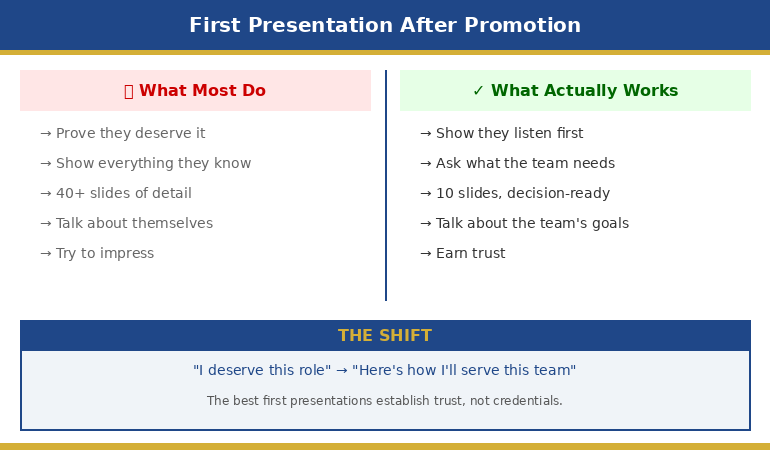
Before and after comparison showing common first presentation after promotion mistakes versus trust-building approach

If you’re preparing your first presentation in a new role, the Executive Slide System (£39) includes the exact slide frameworks that establish credibility without the 40-slide trap.

The Trust-First Presentation Structure

In 24 years of corporate banking — across JPMorgan Chase, PwC, Royal Bank of Scotland, and Commerzbank — I’ve observed that the leaders who earn trust fastest after a promotion share one trait: they present what they’ve learned, not what they already know.

The trust-first structure flips the typical presentation on its head:

Traditional post-promotion deck: Here’s my vision → Here’s my plan → Here’s what I need from you → Questions?

Trust-first deck: Here’s what I’ve heard from you → Here’s what I think matters most → Here’s what I need help understanding → What am I missing?

The shift is subtle but powerful. The traditional structure positions you as the expert arriving with answers. The listening-led structure positions you as a leader who arrived with questions — and actually listened to the answers.

PAA: How do I make a good first impression after being promoted?
The strongest first impression comes from demonstrating that you’ve spent your first days listening, not planning. Reference specific things team members told you. Acknowledge the challenges they face. Show that your priorities reflect their reality, not just your ambitions.

David — the MD from my opening story — rebuilt his presentation using this structure. The second version was 10 slides. He opened with direct quotes from one-on-one meetings he’d had with every team member in his first two weeks. The energy in the room was completely different. People leaned forward. They felt seen.

Stop Building Decks That Impress. Start Building Decks That Earn Trust.

The Executive Slide System includes the Leadership Transition Trust Deck (10 slides), recommendation-first formats, and decision frameworks designed for high-scrutiny senior audiences. Customise in 30 minutes.

Get the Executive Slide System → £39

Designed for senior stakeholders in high-scrutiny environments where clarity earns trust.

The 10-Slide Order That Works

Here’s the slide structure I recommend to every newly promoted executive. Notice what’s not here: no org chart, no biographical slide, no “About Me” section.

Slide 1 — The Listening Slide: “In my first [X] days, I’ve had conversations with [number] of you. Here’s what I heard.” Three to five direct themes, paraphrased from actual conversations. This slide alone earns more trust than 20 slides of strategy.

Slide 2 — The Acknowledgement: Name the elephant. If there was a difficult departure, restructuring, or period of uncertainty before your arrival — acknowledge it. Don’t paper over it. Your team will respect the honesty.

Slide 3 — The Three Priorities: Not twelve priorities. Not seven strategic pillars. Three things you’ll focus on in the next 90 days. Fewer priorities signal confidence. More priorities signal anxiety.

Slides 4-6 — One Slide Per Priority: Each slide answers: What’s the problem? What’s the first step? Who’s involved? Keep these tight. You’re not presenting solutions — you’re presenting direction.

Slide 7 — What I Won’t Change: This is the slide most new leaders forget. Your team is terrified you’ll break what’s working. Tell them explicitly what stays the same. It costs you nothing and earns enormous goodwill.

Slide 8 — What I Need From You: Specific, concrete asks. Not “I need your best effort.” More like: “I need honest feedback in our one-on-ones, even when it’s uncomfortable.”

Slide 9 — How to Reach Me: Your actual communication preferences. When to email, when to walk in, when to escalate. This practical slide signals you’re approachable, not just saying you are.

Slide 10 — The Question Slide: Not “Any questions?” but a specific prompt: “What’s the one thing I should know that nobody will tell me unprompted?” Then be quiet. Let the silence work.

The entire thing should take 15 minutes to deliver — maximum. The remaining 45 minutes should be conversation. That ratio — 25% presenting, 75% listening — is exactly what a team-first leader looks like.

Want this exact 10-slide deck as a ready-to-customise template? It’s inside the Executive Slide System (£39) — look for the Leadership Transition Trust Deck.

What to Say in Your Opening (3 Scripts You Can Use Today)

The number-one search behind “first presentation after promotion” is simply: what do I actually say? Here are three opening scripts I’ve used with clients, each suited to a different situation.

Script 1 — The Listening-Led Opening (best for most situations):
“Over the past [two weeks / ten days], I’ve had one-on-one conversations with [number] of you. I asked everyone the same question: what’s the one thing that frustrates you most about how things work right now? Three themes came up consistently. I want to walk through all three today — and I want your honest reaction to what I’m proposing we do about them.”

Script 2 — The Steady Confidence Opening (best when the team needs reassurance):
“I know transitions create uncertainty, so let me be direct about three things: what’s not changing, what I’m planning to look at first, and how I want us to work together. I’ll take about 15 minutes to walk through that, and then I want the rest of this hour to be your questions — the harder, the better.”

Script 3 — The Reset Opening (best when you were promoted over internal candidates):
“Before I get into any slides, I want to acknowledge something. I know this transition isn’t straightforward for everyone in this room, and I respect the contributions that got this team to where it is. I’m not here to overhaul what’s working. I’m here to build on it — and I need your help to do that well. Here’s what I’ve heard so far.”

The Best Closing Question (Pick One)

How you close matters almost as much as how you open. Don’t end with “Any questions?” — it invites silence. Try one of these instead:

Option A: “What’s the one thing I should know about this team that nobody will tell me unprompted?”

Option B: “If you could change one thing about how we operate — starting tomorrow — what would it be?”

Option C: “What am I missing? What haven’t I asked about yet?”

Then be quiet. Count to ten in your head if you have to. The silence is where the real answers live.

What to Cut (Even If It Feels Important)

The hardest part of your first presentation after promotion isn’t what to include — it’s what to leave out. Everything you cut will feel important. Cut it anyway.

Cut your background slide. They already know your CV. They read the announcement email. If you spend three minutes on your career history, you’ve just told the room that your credentials matter more than their concerns.

Cut the 90-day plan. I know this feels counterintuitive. But a detailed 90-day plan in week two tells people you’ve already decided what matters — before you’ve listened long enough to know. Share priorities, not plans. The plan can come at day 30.

Cut the vision statement. “Our vision is to become the premier…” Stop. Nobody remembers vision statements. They remember whether you asked about their workload and whether you followed through.

Cut the benchmarking data. Your team doesn’t care how your new division compares to your old one. Comparisons feel like judgment.

PAA: How many slides should my first presentation as a new manager have?
Aim for 10 slides maximum, delivered in 15 minutes or less. Your first presentation should prioritise listening over presenting. The shorter your deck, the more time for the conversation that actually builds trust.

If you’re struggling to cut, ask yourself this: “Am I including this because my team needs to hear it, or because I need to say it?” That question eliminates half the slides in every post-promotion deck I’ve ever reviewed.

The First Five Minutes That Set Your Tenure

How you open your first presentation becomes the story people tell about you. Not what you said on slide 7. Not the Q&A. The first five minutes.

One client of mine — newly promoted VP at a tech company — opened with: “I’ve spent the last two weeks asking every person in this room what frustrates them most. Three themes kept coming up. I want to talk about all three today.”

That single opening accomplished more than any strategy presentation could: it demonstrated humility, preparation, and commitment to action.

Compare that with the typical opening: “I’m thrilled to be in this role. Let me share my background and then walk you through my strategic vision for the next twelve months.”

The first opening says: I’m here for you. The second opening says: I’m here for me.

Your team will decide in those first five minutes whether you’re a leader who listens or a leader who lectures. Every promotion presentation I’ve helped executives build starts with what they heard, not what they think.

If you’re also managing the anxiety that comes with presenting in a new role — especially at a higher level where the scrutiny feels sharper — you’re not alone. I’ve written about why introverted executives often present more effectively than their extroverted peers, and the reasons might surprise you.

Your Promotion Was the Hard Part. Don’t Let Your First Deck Undo It.

The Executive Slide System includes the Leadership Transition Trust Deck, decision frameworks, and the exact slide order covered in this article. Built from 24 years in corporate banking — designed for high-scrutiny audiences where trust is the currency.

Get the Executive Slide System → £39

Includes the 10-slide trust deck template. Customise and present in under an hour.

Frequently Asked Questions

Should I present my strategic vision in my first week?

No. Presenting a strategic vision before you’ve spent meaningful time listening signals that you’ve already made up your mind. The most effective newly promoted leaders present priorities (not plans) in the first two weeks, then share a more developed strategy at the 30-day mark after genuine consultation.

What if my boss expects a detailed strategic presentation right away?

Have a direct conversation with your manager about timing. Most senior leaders will respect the argument that a well-informed 30-day strategy will outperform a rushed week-two vision. If they insist, deliver the strategic overview but frame it explicitly as preliminary and subject to revision after team consultation.

How do I handle the team if I was promoted over internal candidates?

Acknowledge the situation directly in your opening remarks. Something like: “I know this transition isn’t easy for everyone, and I respect the contributions every person in this room has made.” Then prove through your presentation structure — by featuring what you’ve heard from the team, not what you’ve planned alone — that you’re not here to override, but to build on what exists.

What’s the biggest mistake in a post-promotion presentation?

Talking about yourself. The moment you spend more than 60 seconds on your background, experience, or credentials, you’ve made the presentation about validation rather than trust. Your team already knows you were chosen. What they need to hear is that you understand their reality and that your priorities reflect what they care about.

📬 The Winning Edge Newsletter

Weekly executive presentation strategies, slide structures, and career-critical communication insights. No fluff.

Subscribe free →

🎯 Free: Executive Presentation Checklist

The pre-presentation checklist I give every executive before a high-stakes meeting. Covers structure, messaging, and audience preparation.

Download free →

Related: If the promotion has made presenting feel more high-stakes than ever, read Why Introverted Executives Present Better Than Extroverts — the research on this is counterintuitive and worth understanding before your next big moment.

Your first presentation after a promotion isn’t a performance. It’s a conversation with a few slides. Keep it short. Keep it human. Keep it about them. The strategic brilliance can come later. Right now, trust is the only currency that matters.

The Executive Slide System (£39) gives you the exact structure to make that first deck your strongest.

About the Author

Mary Beth Hazeldine is the Owner & Managing Director of Winning Presentations. With 24 years of corporate banking experience at JPMorgan Chase, PwC, Royal Bank of Scotland, and Commerzbank, she spent over a decade delivering high-stakes presentations before training others to do the same.

A qualified clinical hypnotherapist and NLP practitioner, Mary Beth combines executive communication expertise with evidence-based techniques for managing presentation anxiety. She has trained thousands of professionals and helps leaders structure decision-focused decks that earn trust quickly.

Book a discovery call | View services