

Quick answer: CEO presentation style is structurally different from middle-management style in five ways — top-down sequencing rather than bottom-up build, point of view rather than balanced analysis, peer framing rather than reporting, density restraint rather than detail saturation, and decision-close rather than open discussion. CEOs present to other CEOs, board chairs, and senior peers — and the style reflects the audience. Middle managers presenting up the chain who imitate the style without earning it tend to read as posturing. The style works when the underlying authorship and clarity is there to carry it.
Jump to:
A senior director attended a board meeting recently as an observer. Her CEO presented for nine minutes. She had presented the same topic to the executive committee the previous week, and her version had run twenty-eight minutes. The content was the same. The data was the same. The conclusions were the same. What was structurally different, watching the CEO speak, was the order in which the information arrived, the density of each slide, and the way the meeting closed. The CEO had used the recommendation as the headline, named the trade-off in the second sentence, and ended on a single decision — three things that had been buried in her own version of the same case.
The director’s reaction was not “she should have done what the CEO did”. The director already knew that. Her reaction was something more interesting — that CEO presentation style is not a stylistic choice. It is a structural response to the audience. CEOs present to other CEOs, board chairs, executive committees, and senior peers. The audience reads quickly, decides fast, and rewards economy. The style reflects who is in the room and how they read.
The reverse is also true. Middle managers presenting up the chain who imitate CEO style without earning it tend to read as posturing — the style is recognisable as borrowed, the underlying authorship is not yet there, and the room responds by becoming sceptical. The style works when the substance is there to carry it. Understanding the structural shifts is the first step. The second step is knowing when to use them and when not to.
For senior leaders building the deck their CEO would present
The Executive Slide System gives you 26 slide templates, 93 AI prompts, and 16 scenario playbooks for senior presenters — including the recommendation slides, trade-off layouts, and decision-close formats that match how top executives present to peers. £39, instant download.
Why CEOs present differently from middle managers
A middle manager presenting up the chain is making a case to people who have decision rights and who need to be persuaded. The audience expects evidence first, conclusions second, asks third. The deck builds. The narrative shows the work. The middle manager’s job is to demonstrate that the case is sound — and the style reflects that posture. There is appropriate humility in the build, the consideration of alternatives, the careful framing.
A CEO presenting to peers — other senior executives, board members, investor counterparts — is in a different role. The audience already accepts the CEO’s authorship. They do not need to see the work. They need to know the recommendation, the trade-off, and the decision being asked for. The style reflects the assumed authorship — recommendations arrive first, the build is implicit, the decision closes the meeting. Confidence is not performed. It is structural.
The shift is consequential because it changes the deck’s job. A middle manager’s deck is doing argumentation work. A CEO’s deck is doing decision-framing work. Different jobs produce different shapes — and the shape that suits one job rarely suits the other. The middle manager who shifts to CEO style without the underlying authorship tends to skip the build the room actually wants. The CEO who shifts to middle-manager style tends to bury the recommendation and lose the room’s patience.
Five structural shifts in CEO style
The five shifts below are what change between middle-management presentation style and CEO presentation style. They are structural rather than cosmetic — and they show up in the deck’s order, density, and close, not in the choice of fonts or colour palette.
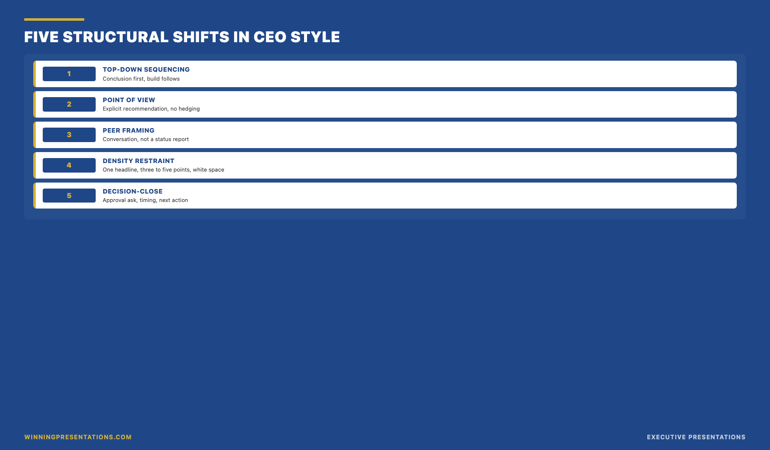
Shift one — top-down sequencing rather than bottom-up build. CEO decks open with the conclusion. The recommendation arrives on slide one, the case follows, the evidence supports. Middle-management decks open with the build — context, methodology, analysis, and the recommendation eventually emerges. The two sequences serve two different reading habits. CEOs read top-down because they are being asked for decisions. Middle managers build because they are being asked to demonstrate rigour. Imitating the top-down sequence without the underlying conclusion-clarity produces a deck that opens strongly but cannot back the headline up — and the room reads the gap immediately.
Shift two — point of view rather than balanced analysis. CEO presentations carry an explicit point of view. “We should do X. The case is Y. The trade-off is Z. I am asking the board to approve.” Middle-management presentations tend to carry a balanced posture — “Here are the options, here are the considerations, here is what we think”. The balanced posture is appropriate when the speaker is informing rather than recommending. When the speaker is recommending, the point of view has to be visible. CEOs do not hedge. The hedge that feels appropriate at middle-management level reads as indecision at CEO level.
Shift three — peer framing rather than reporting. CEOs frame their presentations as peer conversations rather than as reports. “I want to walk you through where I think we are and what I’m asking you to approve” is peer framing. “I’d like to update you on the project status” is reporting framing. The framing is consequential because it sets the room’s expectations. Peer framing produces a meeting where the room engages substantively. Reporting framing produces a meeting where the room receives information passively and the substantive conversation gets pushed elsewhere.
Shift four — density restraint rather than detail saturation. CEO slides carry less. One headline, three to five supporting points, white space. Middle-management slides tend to carry more — every relevant data point, footnotes, source attributions, secondary considerations. The density difference reflects the audience. CEOs read at altitude — they are testing whether the case coheres, not whether it survives footnote-level scrutiny. Middle-management audiences may genuinely need the density. CEO audiences punish it.
For the slide structures top executives use to present to peers
The Executive Slide System — 26 templates, 93 AI prompts, 16 scenario playbooks for senior presenters
The structures top executives use are templated. The Executive Slide System gives you the recommendation slide, the trade-off slide, the alternative-considered slide, the controls slide, and the decision-close slide — designed for executive committee and board-level audiences who read top-down and decide quickly.
- 26 slide templates for the structures executive committees and boards expect
- 93 AI prompts to draft, refine, and tighten executive content
- 16 scenario playbooks covering common high-stakes presentation situations
- Master Checklist and Framework Reference for repeatable structural quality
£39 · Instant download · Lifetime access
Shift five — decision-close rather than open discussion. CEOs end on the decision. “I am asking the board to approve £X today, with implementation starting Q3, and I will report back at the next quarterly meeting.” Middle-management decks tend to end on questions or thank-yous. The decision-close is what produces sign-off in the meeting rather than in a follow-up email that may or may not arrive. The close is one of the highest-leverage moments in the deck — and CEO style treats it as such.
How top executives sequence information
The sequencing CEOs use follows the audience’s reading order, not the analytical journey that produced the conclusions. The deck is reverse-engineered from the question the audience is mentally holding, not from the chronological order of the work. Senior presenters tend to sequence in the same way almost without thinking — and the sequence is recognisable across functions, industries, and topics.
Sentence one — what is being recommended. The recommendation in commitment terms. Not the project name, not the analysis title. The recommendation, in one sentence, as if the rest of the deck did not exist. “Today I’m recommending we approve £X for an eighteen-month investment in Y, with first measurable outcome by Z.” If the recommendation cannot be said in one sentence, the work behind it is not yet done.
Sentence two — what the trade-off is. The implication of the recommendation, named honestly. “This requires reallocating two FTEs from programme A, which slows that programme by approximately one quarter — and I’m recommending the trade because the value at stake in B is materially larger over the same window.” The trade-off sentence is what distinguishes peer framing from reporting framing. Peers name trade-offs. Reporters describe options.
Sentence three — why this decision now. The timing rationale. Why is the room being asked this today rather than next quarter. “The window for this decision closes at the next funding cycle review in Q3, and a decision today gives the implementation team six months of runway.” Timing is one of the most underused framing elements in middle-management decks. CEOs use it almost universally. The structural patterns of board presentations follow the same sequencing — recommendation, trade-off, timing, evidence — for the same reasons.
The free Executive Presentation Checklist
The structural checklist senior presenters use before designing any executive deck
Before the deck gets built, senior presenters work through the structural questions that determine whether the deck will hold. The free Executive Presentation Checklist covers the audience-reading, recommendation-clarity, and trade-off questions every executive presentation needs to answer in advance. Download the checklist →
When imitation fails (and what works instead)
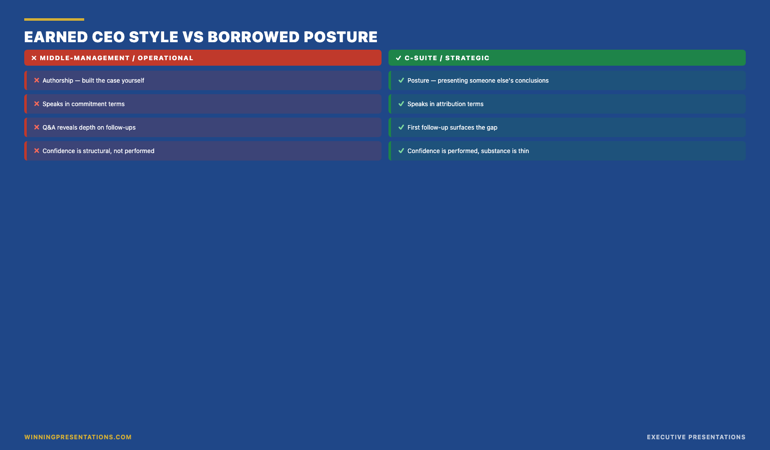
Middle managers who imitate CEO style without earning it produce a recognisable failure mode. The deck opens with a confident recommendation that the underlying analysis cannot support. The Q&A surfaces the gap — a question on the trade-off produces a vague answer, a question on the alternative produces a stuttering response, a question on the timing produces a “we’ll come back to that”. The room reads the gap and treats the presenter as someone who has borrowed the style without doing the work.
The fix is not to abandon CEO style. It is to earn it through preparation. The five structural shifts work for any presenter who has done the underlying work — the recommendation has been written cleanly in one sentence, the trade-off has been named honestly, the alternative has been considered seriously, the timing has been thought through. The work below the slides has to be there. When it is, the style is structural rather than performative. When it is not, the style is recognisable as borrowed and the room responds accordingly.
Authorship reads through the slides. A presenter who has authored the proposal — built the case, weighed the alternatives, made the call — speaks differently from one who is presenting someone else’s conclusions. The first speaks in commitment terms. The second speaks in attribution terms (“the team’s analysis suggests…”, “the working group recommends…”). The room reads the difference. CEO style requires authorship — and authorship is built in the preparation, not in the delivery.
Style without substance reads as posture. The opposite of authorship is posture — confident delivery, clean slides, sharp recommendation, but the underlying work is not there. Posture is recognisable in the Q&A. The first follow-up question reveals it. The fix is preparation, not delivery polish. A presenter who has done the work but delivered it modestly will outperform a presenter who has not done the work but delivered it confidently. Confidence without substance produces less credibility than substance without confidence.
The earned shift happens gradually. Middle managers move toward CEO style as their authorship builds. Each successful executive committee presentation reinforces the next one. The shift is not flipped on. It is built one presentation at a time, with each one slightly more recommendation-led, slightly more trade-off-explicit, slightly more decision-closed than the last. Rushing the shift produces the imitation failure mode. Earning it produces a presenter who is ready for board-level work when the opportunity arrives.
Frequently asked questions
Should I use CEO style if I’m presenting up to my CEO?
Selectively, and only on the proposals you genuinely authored. CEOs respond well to direct, peer-framed recommendations from senior reports who have done the work — and respond poorly to senior reports who imitate the style on a topic they have not yet mastered. The cleanest approach is to use the top-down sequencing and the explicit trade-off (shifts one and two), without yet adopting the full peer framing (shift three). The deck reads as serious without overclaiming the relationship.
How does CEO style change for an investor audience versus a board audience?
The structural shifts are the same. The vocabulary changes. Investor audiences want capital allocation language — IRR, hurdle rates, time-to-cash, downside cases. Board audiences want governance and trade-off language — fiduciary fit, organisational implications, executive accountability. The recommendation-first sequencing, point of view, peer framing, density restraint, and decision-close all hold across both. The CEO who presents the same proposal to both audiences typically uses the same deck shape, with two or three slide variants in the appendix to handle audience-specific framing.
What if my CEO presents in a different style than this?
Some CEOs use a more discursive style — long anecdotes, narrative-led structure, less density restraint. The discursive style works when the speaker has either deep substantive credibility or a particular relationship with the audience that makes narrative effective. It is harder to imitate than the structured style. For most senior presenters, the structured CEO style is the more reliable model — it works regardless of the speaker’s personal credibility, and it produces decisions more consistently. The discursive style is a recognisable variant, not a default.
Does CEO style work in non-Western corporate cultures?
The structural elements travel well — recommendation-first sequencing and explicit trade-offs are recognisable in most senior business cultures globally. Some cultures favour more relational opening (a brief acknowledgement of the room before the recommendation lands), and some favour less direct decision-close framing. The variations are stylistic, not structural. The seven patterns of executive committee reading habits are remarkably consistent across financial services, healthcare, technology, and government in most major markets.
Companion templates for executive presentations
Build the deck the way top executives present to peers — with the structural templates that match the style
The Executive Slide System covers 26 templates, 93 AI prompts, and 16 scenario playbooks — the recommendation slide, the trade-off slide, the decision-close slide, and the structural patterns top executives use when presenting to peers.
£39 · Instant download · Lifetime access
The Winning Edge — weekly
One short note each Thursday on board-level presentation patterns, structural shortcuts, and the behaviours senior presenters use under scrutiny. Written for professionals who do not have time for newsletters that read like newsletters.
Want a structural starting point first? The free Executive Presentation Checklist covers the structural fundamentals senior presenters use before designing the deck.
For the companion piece on what executive committees are reading for, see what C-suite executives actually want in presentations — the seven patterns that define the audience the CEO style is built for.
Next step: Take the next executive committee deck on your calendar. Read slide one. Is the recommendation visible in the first sentence? If not, rewrite slide one. Read slide two. Is the trade-off named? If not, add the slide. The shift toward CEO style starts with the first two slides — everything else flows from those.
Mary Beth Hazeldine is the Owner & Managing Director of Winning Presentations. With 25 years of corporate banking experience at JPMorgan Chase, PwC, Royal Bank of Scotland, and Commerzbank, she advises senior professionals across financial services, healthcare, technology, and government on structuring presentations for high-stakes board meetings, executive committees, and investor sessions. She speaks German and works extensively with the German-speaking financial markets.