

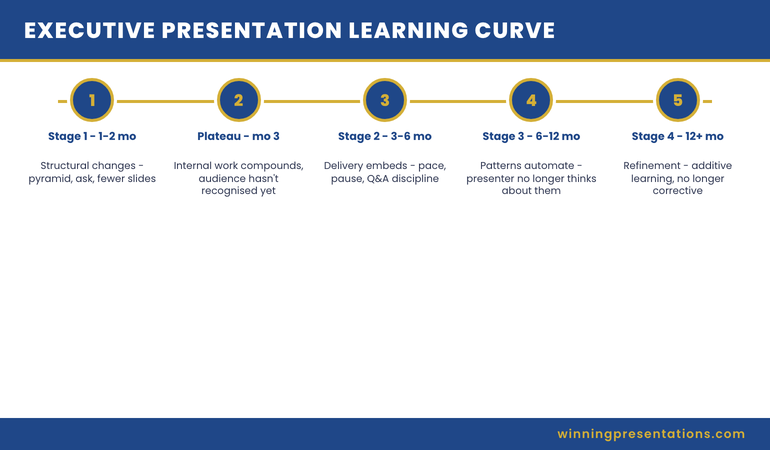
Quick answer: The realistic learning curve for executive presentations runs in three stages. First cycle (one to two months): structural changes are visible — pyramid-led openings, clearer asks, fewer slides. Three cycles (three to six months): the room sees a different presenter — calmer pace, sharper Q&A handling, more deliberate use of pauses. One year (six to twelve months): patterns embed and the presenter no longer thinks about them. The biggest plateau hits around month three when delivery feels unchanged but structural work is still compounding.
Jump to:
Bernadette had been told by her CEO that her presentations to the executive committee needed work. She was a finance director with technical depth that nobody questioned. The feedback was about structure and delivery, not content. She enrolled in a presentation programme on a Sunday afternoon, hoping the next quarterly review — six weeks away — would land differently.
It mostly did not. The deck looked tighter. The opening was sharper. Two of the senior committee members commented on the change. The CEO, however, said nothing. Bernadette interpreted the silence as failure. It was not. The CEO had noticed. He simply did not consider the change material yet. The thing he was actually waiting for — the third quarter, when she would face a hostile question on a strategic capex item — had not happened.
When the third quarter came, Bernadette handled the question without flinching. The CEO sent a short email afterwards. “Different presenter than six months ago.” That was the moment the work landed. The work itself had been done in week six. The recognition arrived in week twenty-two.
This timing pattern is the most underestimated thing in senior presentation development. The work compounds invisibly. The recognition lags. Most senior professionals who give up on presentation training do so in the gap between the work and the recognition — which is exactly the wrong moment to give up.
If you want results that compound across a full year
The AI-Enhanced Presentation Mastery programme is the self-paced framework senior professionals use to embed presentation patterns across multiple cycles. 8 modules, 83 lessons, 2 optional live coaching sessions (fully recorded). £499, lifetime access.
Why senior presenters need a different curve
Generic presentation skill curves do not apply at executive level. Most published timelines are built around early-career or mid-career presenters whose skill base is still being formed. They show rapid early progress because the starting point is low. Senior presenters do not have that profile. The starting point is already competent. The improvements that matter are subtler, slower, and visible only in specific scenarios — under pressure, in front of the right audience, on the harder questions.
There is a second reason. Senior presenters do not present often enough to compress the curve. A junior consultant might give twelve presentations a month. A senior director might give twelve presentations a year, four of which are strategically important. The cycle for embedding a change is therefore three to four times longer simply because the rehearsal opportunities are scarcer. Patience is structural, not psychological.
A third factor: the audience changes. Senior presentation work is judged not against an absolute bar but against the room’s prior expectation of you. The bar is therefore moving. Improvement that would be obvious to a fresh observer is invisible to a board that has watched you for three years and updated its mental model only slowly. The asymmetry is real and it is one of the reasons senior presenters often feel they are running uphill against perception.
Stage one: first cycle (1–2 months)
The first cycle is structural. The presenter learns to lead with the conclusion, name the ask, footnote sources, prepare for the seven most-feared questions, and stop at forty-five seconds per answer. None of this is about delivery. All of it is about the architecture of the deck and the architecture of Q&A.
Three things change visibly within six to eight weeks. The opening slide states a recommendation rather than a context. The pre-FAQ section of any briefing exists, where it did not before. And the deck contains roughly thirty per cent fewer slides than the version before training, with a longer appendix that the presenter actually knows how to navigate.
Stage one is also when most senior presenters underestimate themselves. The structural work is real, but the room often does not notice it explicitly because the changes are upstream of the moments the audience reacts to. The presenter feels the difference when preparing the deck. The audience feels the difference when something goes wrong and the presenter handles it cleanly — which has not happened yet at this point in the cycle.
If you stop here, you keep most of the value. The structural changes do not unembed. A presenter who has learned to lead with the conclusion does not unlearn it. The scaffolding is permanent. Stage two is what builds on top of it.
For senior professionals using AI to build executive-grade presentations
AI-Enhanced Presentation Mastery — the framework that compresses the learning curve
The AI-Enhanced Presentation Mastery course is a self-paced programme for senior professionals using AI (including Copilot) to build presentations. 8 modules, 83 lessons walking you through prompt design, workflow patterns, and the editorial judgement that separates AI-drafted slides from board-ready ones. Two optional live coaching sessions are fully recorded so you can watch back any time. Many senior presenters use the framework to compress the structural work of stage one and free coaching time for stage two and three.
- 8 modules and 83 lessons — self-paced, no deadlines, no mandatory live attendance
- 2 optional live coaching sessions with Mary Beth — fully recorded, watch back at your own pace
- Monthly cohort enrolment — enrol any time, start with the next cohort
- Lifetime access to all course materials
£499 · Self-paced · Lifetime access · Next cohort enrolment opens monthly
Stage two: three cycles (3–6 months)
Stage two is when delivery starts to change visibly. The presenter slows down. The pauses lengthen. The voice carries lower. The eye contact extends from a glance to a steady look. None of this is conscious by the third cycle — it is the result of the structural confidence that stage one built. When the deck is solid, the presenter no longer needs to rush.
Three behaviours embed reliably across cycles three to six. First, the answer-then-evidence pattern in Q&A — instead of explaining around a question for ninety seconds and arriving at a conclusion, the presenter delivers the conclusion in the first sentence and the evidence in the next two. Second, the pre-mortem habit — before any senior briefing, the presenter spends twenty minutes asking what the worst question would be and how to answer it. Third, the deliberate handoff — the presenter learns when to bring in the room rather than continue speaking, which is the single most powerful executive presence move available and almost the last one to embed.
The room starts to comment around month four. Comments are usually indirect — “she’s grown into the role”, “the briefings are sharper this quarter”, “I noticed something different in the way he handled the audit committee question”. Direct praise is rare. Senior audiences process change as a quiet recalibration of expectations. The presenter is upgraded in the room’s mental model, but the upgrade is rarely articulated. Reading the indirect signals correctly is itself a skill that develops in stage two.
For senior professionals also working in AI-assisted contexts — where Copilot, ChatGPT, or generative tools shape the early drafting work — stage two is when the AI workflow stops feeling clunky. The presenter has internalised which steps to delegate to the model, which steps to do manually, and how to edit AI output to executive altitude. The same six-month learning curve applies, scaled to AI workflows specifically. See the related discussion of structured presentation frameworks for senior presenters working at this altitude.
Stage three: one year (6–12 months)
Stage three is when the patterns become invisible to the presenter. Stage one and stage two felt like work — deliberate effort, conscious correction, slight discomfort. By month nine or ten, the work has automated. The presenter no longer thinks about leading with the conclusion. They no longer plan the seven worst questions — they assume the answers exist. The pace of the room becomes an instrument they play rather than a metronome they fight.
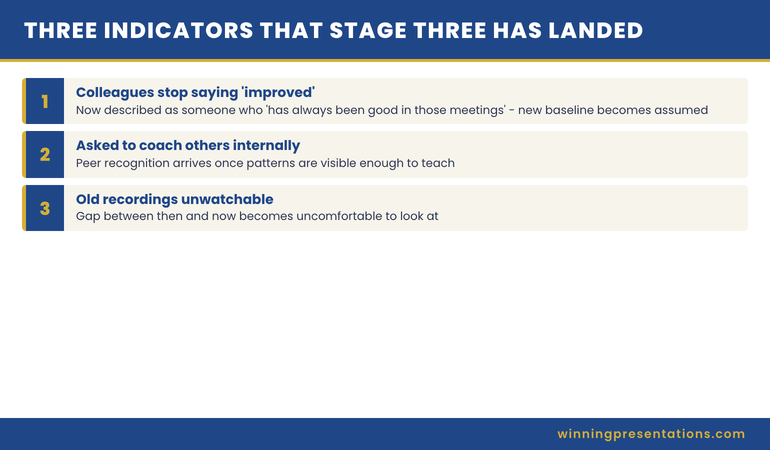
Three indicators usually mark the end of stage three. The first is when colleagues stop describing the presenter as someone “who has improved” and start describing them as someone who “has always been good in those meetings”. Memory is short and the new baseline becomes the assumed one. The second is when the presenter is asked to coach someone else inside the organisation — peer recognition arrives once the patterns are visible enough to teach. The third is when the presenter starts to find old recordings or old decks unwatchable. The gap between then and now becomes uncomfortable to look at.
There is a final stage, sometimes called stage four by the senior presenters who find it. It is the stage where the learning becomes additive rather than corrective. The presenter no longer needs to fix anything specific. They are now refining — exploring different opening structures for different audiences, experimenting with how appendices are referenced, varying pace deliberately to see what the room responds to. This is the stage at which most senior presenters who have invested in coaching across cycles find their sharpest improvement, even though the underlying skill base looks identical from the outside.
The plateau that breaks most senior presenters
There is a predictable plateau that arrives around month three. It feels exactly like failure. The structural changes are in place, but the audience has not yet recognised them, and the presenter is no longer feeling the rapid early progress of stage one. The new work feels harder than it did at the start. The praise has gone quiet. Most senior presenters who give up do so in this window.
The plateau is structural, not psychological. It exists because the work that compounds in stage two is invisible by definition. Slowing the pace, lengthening the pause, watching the chair instead of the slides — these are not things the presenter feels themselves doing. They are things the room feels them doing. The plateau is the gap between the internal experience of the presenter and the external recognition of the audience. Closing the gap takes another two to four months.
Three things help the presenter stay through the plateau. First, an external structure — a programme, a coach, a peer cohort — that confirms the work is happening even when the audience has not commented. Second, a journal or simple log that records what was different in each presentation, because the presenter’s own memory of the early work fades faster than the trajectory itself. Third, an explicit checkpoint at month four where the presenter reviews their own deck from month one and sees the difference in the artefact rather than in the room.
How AI tools reshape the curve
AI-assisted presentation tools — Copilot, ChatGPT, generative deck builders — change the shape of the curve but not its length. Stage one (structure) compresses, because the model can produce a structurally adequate draft in minutes. Stage two (delivery and Q&A) is unchanged, because the model cannot rehearse a presenter through the seven worst questions in real time. Stage three (embedded patterns) is unchanged for the same reason.
There is a new failure pattern that AI introduces. The presenter relies on AI for the structural work, skips the internalisation, and then stumbles in stage two when the room exposes the gap between the polished deck and the under-rehearsed delivery. The deck is board-ready. The presenter is not. The mismatch is visible immediately and is one of the recurring observations in senior AI-assisted presentation work.
The right pattern is to use AI for drafting but to internalise the structure manually. Re-build the deck once, by hand, after the AI draft. Walk through the logic three times. Read the difficult slides aloud. Run the seven-question pre-mortem yourself, even though the AI could generate it for you. The structural work needs to be in the presenter’s memory, not in the model. The model produces the artefact. The presenter still has to be in the room.
Frequently asked questions
How long before my board notices a difference?
Usually three to four cycles. A senior board recalibrates expectations slowly, and praise is rare even when the recalibration has happened. Indirect signals (different question patterns, fewer follow-ups, faster decisions) usually appear in the second or third cycle. Direct comments are uncommon. If you wait for explicit praise, you will conclude the work is failing when it is succeeding.
Why is the early progress so quick and then everything stalls at month three?
Stage one delivers structural changes that the presenter feels and the audience partially notices. Stage two delivers delivery and Q&A changes that the audience feels and the presenter does not. The plateau at month three is the gap between the two. It is not failure — it is the curve flattening before stage two compounds. Hold through it.
Do I need a coach across the full year, or just stage two?
Most senior presenters who succeed at the full curve combine a structured programme for the framework and a coach for the high-stakes meetings inside the cycle. Stage one is well-handled by a programme. Stage two benefits most from coaching on specific meetings rather than continuous coaching. Stage three needs only occasional refresher contact, often once or twice a year.
What if I only present three or four times a year?
The curve still applies but is stretched longer in calendar time. Three cycles of structural work might span eighteen months instead of six. The compensation is that each presentation matters more, so the structured preparation per meeting carries more weight. A self-paced framework works better than time-pressured cohort work for this profile, because the calendar control matters.
Maven cohort enrolment — closing this week
Build the framework that compresses stage one and supports the year-long curve
The AI-Enhanced Presentation Mastery course is the structured programme for senior professionals using AI to build executive-grade presentations. 8 modules, 83 lessons, monthly cohort enrolment, 2 optional live coaching sessions (fully recorded). The current cohort closes this week — enrolment then re-opens with the next monthly cohort.
- 8 self-paced modules covering prompt design, workflow patterns, and AI-assisted executive writing
- 83 lessons — work through at your own pace, no deadlines, no mandatory attendance
- 2 optional live coaching sessions — fully recorded, watch back any time
- Lifetime access to all materials
£499 · Self-paced · Lifetime access · Next cohort enrolment opens monthly
The Winning Edge — weekly
One short note each Thursday on board-level presentation patterns, structural shortcuts, and the behaviours senior presenters use under scrutiny. Written for professionals who do not have time for newsletters that read like newsletters.
Want a starting point first? The free Executive Presentation Checklist covers the structural fundamentals senior presenters embed in stage one.
For a wider view of how this fits into senior presentation development, see the related piece on presentation confidence for introverts — the temperament dimension that runs alongside the skill curve.
Next step: Mark the date six months from today. Schedule a thirty-minute review with yourself for that date. If you are still doing the structural work — leading with the conclusion, naming the ask, preparing the seven worst questions — you are on the curve. The recognition will arrive in cycle three or four. Hold through the plateau.
Mary Beth Hazeldine is the Owner & Managing Director of Winning Presentations. With 25 years of corporate banking experience at JPMorgan Chase, PwC, Royal Bank of Scotland, and Commerzbank, she advises senior professionals across financial services, healthcare, technology, and government on structuring presentations for high-stakes board meetings, investment committees, and executive sessions. She speaks German and works extensively with the German-speaking financial markets.