
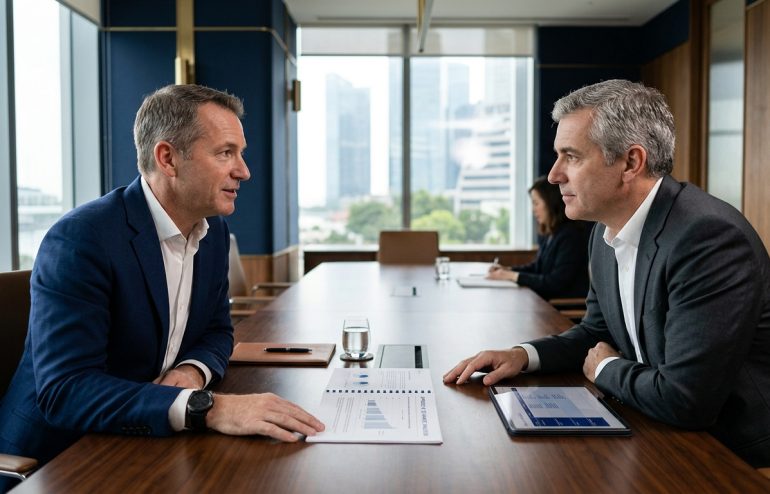
Quick answer: An executive mirroring your posture mid-presentation usually signals one of three things: unconscious rapport, deliberate observation, or a calibrated test of how you handle being read. Junior presenters interpret the mirror as warm agreement and accelerate; senior presenters notice the mirror, hold their structural pace, and use it as information rather than as validation. The subtle response is to notice the mirror without acknowledging it, to maintain your own posture rather than match the mirror back, and to read which of the three signals is most likely based on three contextual cues — the executive’s seniority in the room, the moment in the meeting, and what was just said immediately before the mirror appeared. The mirror is rarely meaningless and rarely as positive as it feels.
JUMP TO:
Anneliese, a chief commercial officer at a Berlin-headquartered software group, was four minutes into a quarterly business review with her chief executive when she noticed something specific. The chief executive, who had been sitting slightly back with his arms folded, slowly leaned forward, uncrossed his arms, and placed both hands on the table — the exact posture Anneliese had been holding since the meeting began. For a junior presenter, the moment would read as warm engagement: the chief executive is leaning in, opening up, mirroring. Anneliese had spent enough years at this level to register it differently. The mirror arrived not on her opening, not on the variance slide, but on the sentence she had spent the most preparation rehearsing — the one explaining why a previously approved investment had slipped six months. The mirror was not warmth. It was attention.
The interpretation matters because the response differs. The junior reading — warm engagement — invites the presenter to accelerate, to take the perceived alignment as licence to move past the difficult slide. The senior reading — calibrated attention — invites the presenter to slow down, to make sure the explanation is delivered in its rehearsed form, and to anticipate the question that is now near-certainly coming. Anneliese held her pace, finished the sentence at the same deliberate cadence she had begun it, and waited. The question arrived twelve seconds later, framed as a probe rather than a challenge. She had been ready for it; the team had spent four hours on the answer the previous week. The meeting moved on. Had she misread the mirror as warmth and skipped past the explanation, the question would still have arrived, but at a moment less prepared.
This piece walks through the three signals a senior executive mirroring your posture typically carries, the three contextual cues that tell you which signal is most likely, the subtle response pattern that holds the room, the three common mistakes presenters make when mirrored, and the specific case of the mirror that precedes a difficult question. The aim is to give senior presenters a more accurate read of one of the most commonly misinterpreted nonverbal signals in executive meetings.
If reading senior nonverbal signals well is the gap, the wider Q&A discipline is worth a look.
The 10 Questions Every CFO Asks (+ Scripts) is a free one-page reference of the structural questions senior finance leaders use — including the ones that often follow a posture mirror — with the response structure that holds up. Free download.
The three signals a posture mirror typically carries
The first and most charitable interpretation is unconscious rapport. The behavioural literature is clear that humans in extended conversation often drift toward similar postures without intending to — a phenomenon sometimes called postural congruence, sometimes called isopraxis. The drift is unconscious, slow, and tends to track an underlying state of agreement or shared engagement. When a senior executive’s posture drifts toward yours over the course of a meeting, the most likely explanation is that the meeting is going well, the executive is engaged, and their nervous system is registering the conversation as low-threat. This reading is correct often enough that it is worth holding as the baseline interpretation.
The second interpretation is deliberate observation. Some senior executives — particularly those with backgrounds in negotiation, intelligence, sales, or executive coaching — have learned to mirror posture deliberately as a way of focusing their own attention on what the presenter is doing. The mirror is not for the presenter’s benefit; it is a private technique the executive uses to enter a state of close observation. The mirror often appears at a specific moment — the recommendation sentence, the assumption explanation, the answer to a probe — and signals that the executive is now paying very close attention. This is neither warm nor hostile; it is calibrated focus, and it usually precedes a substantive question or comment.
The third interpretation is a calibrated test. A small number of senior executives use postural mirroring as a way of testing how well the presenter reads the room. The premise is that a senior presenter should notice the mirror, should not be flattered by it, and should not match the mirror back. The mirror is brief, the executive is paying attention to whether the presenter’s pace or content changes in response, and the read becomes part of the executive’s assessment of the presenter’s seniority. This is the rarest of the three readings but worth holding as a possibility, particularly with executives known for deliberate observational practice. For the broader discipline behind reading senior rooms in real time, see our executive presence for senior leaders piece.
Reading the context: three cues that tell you which signal it is
The first cue is the executive’s seniority in the room. A peer-level executive mirroring you is most likely unconscious rapport; an executive two or three levels above you mirroring you is more likely deliberate observation or calibrated test. The asymmetry is structural: peers tend to drift into postural congruence as a function of equality, while senior executives in a room they chair or sponsor tend to maintain a distinctive posture as a function of role. When the senior executive deliberately abandons their distinctive posture for yours, the move is more conscious than unconscious.
The second cue is the moment in the meeting. A mirror that appears in the opening minutes — particularly during context-setting or relationship-building — is more likely unconscious rapport. A mirror that appears precisely when you reach a difficult slide, name a delayed milestone, or explain a missed assumption is more likely deliberate observation. The timing alignment is the giveaway. Unconscious rapport is gradual and topic-independent; deliberate observation is sharp and topic-dependent. A presenter who tracks the timing of the mirror over the course of the meeting gets a usable read of which interpretation is more likely.
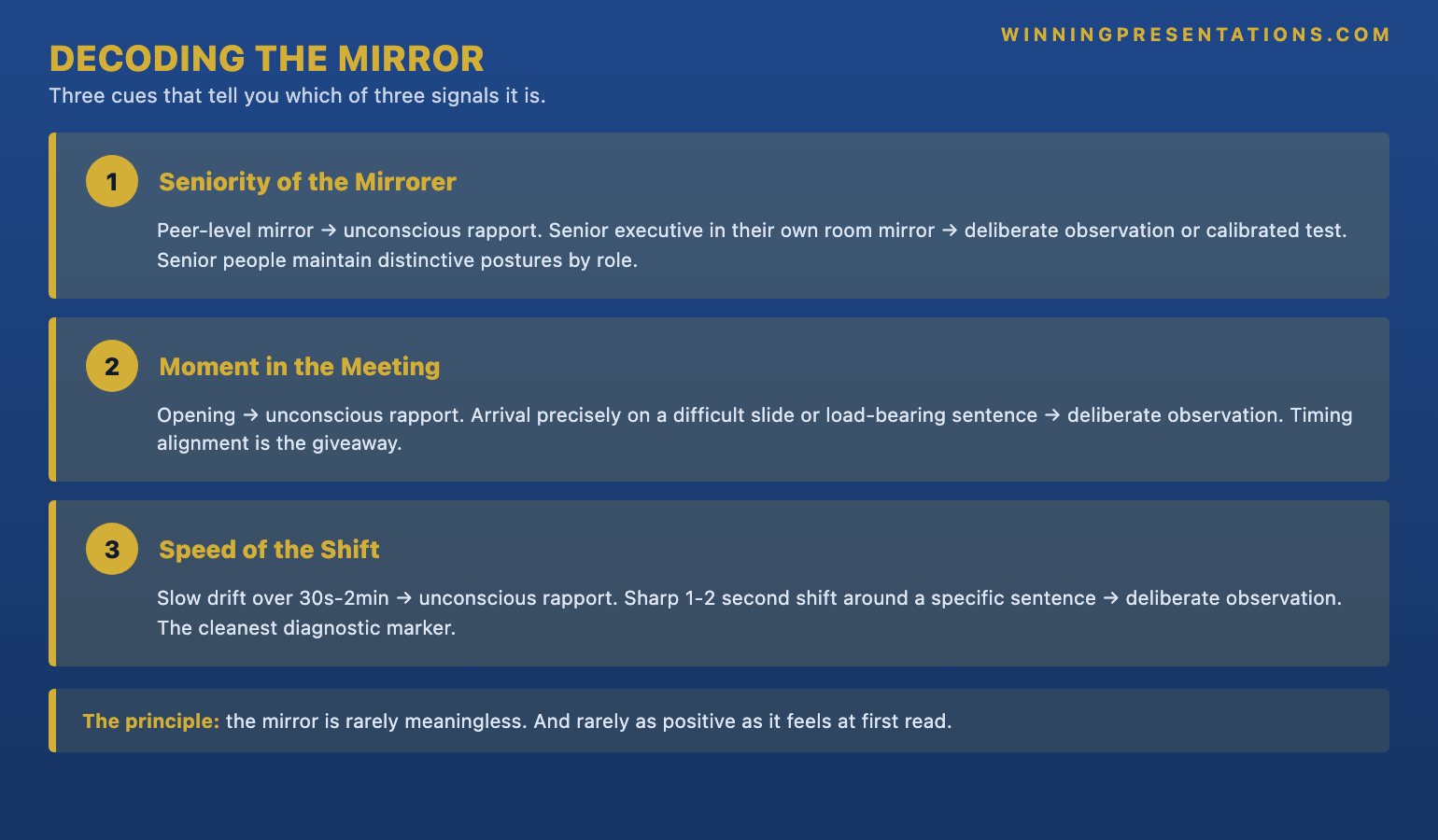
The third cue is the speed of the mirror. Unconscious rapport produces slow postural drift — the executive does not arrive at the matched posture in one move; they drift toward it over thirty seconds to two minutes, often without noticing. Deliberate observation tends to produce a sharper move — the executive shifts to the matched posture in one or two seconds, usually around the moment of a specific sentence. Calibrated tests tend to produce the sharpest move of all, often with a brief eye-contact moment to register that the mirror has been adopted. The speed of the postural shift is one of the cleanest diagnostic markers.
A presenter who reads these three cues in combination — seniority of the mirrorer, moment in the meeting, speed of the shift — can usually identify which of the three signals is most likely within about ten seconds. Anneliese’s read in the example above was based on all three: chief-executive level, arrival precisely on the difficult sentence, and a deliberate two-second shift rather than a thirty-second drift. The combination read as deliberate observation, which is what the meeting then confirmed.
The subtle response pattern that holds the room
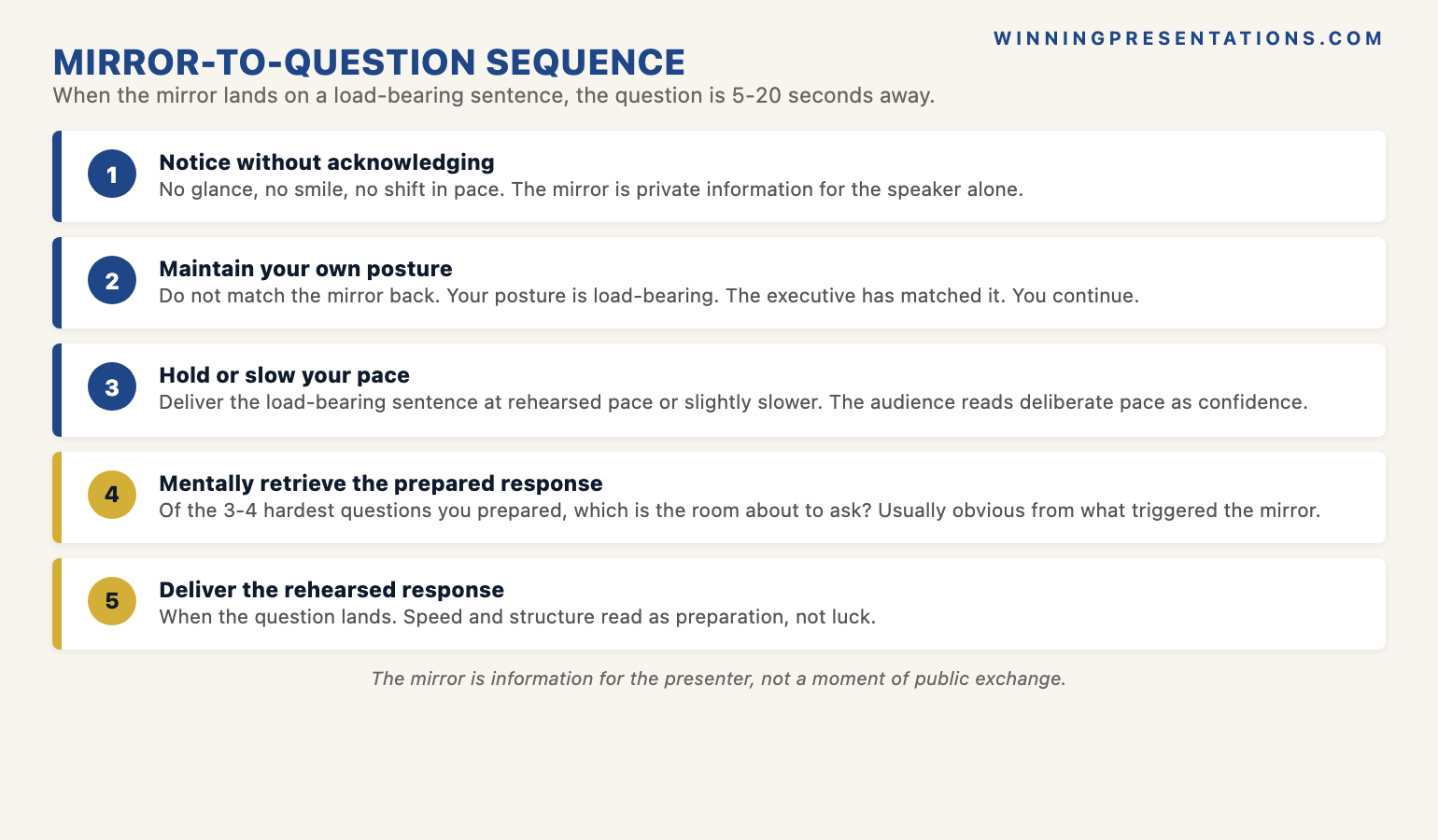
The response pattern is built on three principles. The first is to notice the mirror without acknowledging it. A senior presenter who reacts visibly to a mirror — by smiling at the executive, leaning in further, or adjusting their own posture in response — converts what was a private signal into a public exchange, and usually does so to the presenter’s disadvantage. The executive who was making a calibrated observation now sees that the presenter has noticed and has changed behaviour, which can read as too eager. The executive making an unconscious mirror is now made aware of it and may break the postural congruence, which can read as the meeting cooling. In both cases the acknowledgment costs more than the mirror was worth.
The second principle is to maintain your own posture rather than match the mirror back. A presenter who is being mirrored — particularly if the mirror is the deliberate-observation variety — is in a useful structural position because the executive has temporarily committed to the presenter’s physical frame. Reflecting the mirror back by adjusting your own posture to match the executive’s new position cancels the asymmetry and tells the executive their move has been noticed and responded to. Holding your own posture, by contrast, keeps the structural advantage with you. Your posture is the load-bearing one; the executive has matched it; you continue.
The third principle is to slow down rather than accelerate. The intuitive response to perceived agreement — which any mirror feels like in the moment — is to speed up, take the agreement as licence, and move past the difficult slide while the room is warm. The senior response is the opposite: when the mirror appears on a load-bearing sentence, deliver that sentence at the same pace or slightly slower than rehearsed. The audience reads the deliberate pace as confidence; the executive who is observing reads it as preparation. The presenter who slows down when mirrored usually emerges with more credibility, not less.
The structured library for the question that almost always follows the mirror.
The Executive Q&A Handling System is a structured library of question typologies, response patterns, and recovery sequences for the questions senior committees and executives actually ask — including the calibration probes, drill-downs, and reframe questions that often follow a posture mirror. Designed for senior professionals who present at the executive level.
- The complete question-type taxonomy that senior committees use — and the response structure for each
- The “four-line response” pattern for line-item and assumption probes
- Recovery sequences for the moment when a question lands harder than expected
- Scenario playbooks for finance committees, audit committees, board, and exec sponsor
- £39, instant download, lifetime updates
The three common mistakes presenters make when mirrored
The first common mistake is to take the mirror as agreement and accelerate the meeting. The pattern goes: presenter notices the mirror, registers it as warm engagement, feels the relief of perceived alignment, and skips the next two minutes of prepared explanation on the grounds that “the room has it”. The explanation that was about to land does not land. The question that was prepared for does not get pre-empted. The executive asks the question anyway, often with sharper framing because the explanation never arrived. The presenter has converted a useful moment into an awkward one by reading the mirror as warmth rather than as attention.
The second is to mirror back. The presenter notices the mirror and, in an attempt at rapport-building, adopts the executive’s new posture themselves, or matches the executive’s micro-expressions. The mirror exchange becomes mutual, the asymmetry collapses, and the moment loses its meaning. Worse, the mirror-back can read as imitation of seniority — the presenter trying to match the executive’s stance rather than holding their own. Senior executives reading the move often note it as a presence weakness rather than as rapport. The discipline is to leave the mirror one-way.
The third is to acknowledge the mirror verbally. Some presenters, particularly those with NLP or coaching backgrounds, have been taught to surface postural rapport explicitly — “I can see we are aligned on this” or similar. In executive meetings the verbal acknowledgement reads as forced and almost always costs the presenter credibility. Senior executives experience the surfacing as manipulative or as evidence that the presenter has read too many books on body language. The mirror, if it carries information, is information for the presenter alone. The discipline is to use the information privately and to continue the meeting as if nothing happened.
When the mirror precedes a difficult question
The single most useful pattern for senior presenters is the observation that, in deliberate-observation cases, the posture mirror almost always precedes a substantive question. The window between the mirror appearing and the question landing is typically five to twenty seconds. During that window, the presenter has time to do two things: finish the current sentence at the rehearsed pace, and mentally retrieve the prepared response to the most likely question the mirror is signalling. The question is usually predictable from the substance of what was just said — the assumption, the variance, the timing, the counterparty, the missed milestone.
The internal preparation move is to ask, in the five seconds between the mirror appearing and the next sentence: “Of the three or four hardest questions I prepared, which one is the room about to ask?” The answer is usually obvious from the sentence that triggered the mirror. The presenter retrieves the prepared response structure, completes the current explanation, and waits. When the question lands — typically as a probe rather than a challenge — the response is ready. The audience reads the speed and structure of the response as preparation, not as luck.
The pattern does not apply universally. Mirrors that arrive during context-setting, during a relationship moment, or as gradual drift over a long meeting are usually unconscious rapport and do not predict an imminent question. The discipline is to read the cues described above — seniority, moment, speed — and use the question-prediction pattern only when those cues suggest deliberate observation. Used selectively, the pattern is one of the most reliable signals senior presenters can build into their in-room repertoire. For the closely related discipline behind handling the questions themselves, see our Q&A handling system overview.
Frequently asked questions
Should I deliberately mirror executives to build rapport?
Generally no. Deliberate mirroring by a junior or peer-level presenter is one of the most common errors in coached body-language work, and senior executives often notice it and find it slightly distasteful. The natural unconscious drift toward postural congruence happens on its own when the meeting is going well; deliberate technique applied to it tends to convert a useful unconscious dynamic into a noticeable performance. The exception is during informal moments — pre-meeting coffee, side-conversation, end-of-meeting walk to the door — where matching general energy and pace is legitimate. In the formal meeting itself, hold your own posture and let any congruence happen naturally.
What if multiple executives mirror me at the same time?
Multiple simultaneous mirroring is almost always unconscious rapport rather than deliberate observation; deliberate observation does not synchronise across multiple senior people. The reading is usually positive — the meeting is going well, the room is engaged, and the substance is landing. The response is unchanged: notice it, maintain your own posture, hold the pace. The structural moves that work for single-mirror cases work for multi-mirror cases too. The one variation is that multi-mirror cases occasionally precede a constructive question rather than a probing one, so the prepared response set might be skewed toward refinement questions rather than challenge questions.
Does this advice apply to virtual meetings?
Partially. Posture mirroring in virtual meetings is harder to read because the visible frame is shoulders-up rather than full-body, and the camera angle distorts subtle postural shifts. The deliberate-observation mirror still happens — senior executives sometimes lean toward the camera at precise moments — but the diagnostic cues are weaker. In virtual meetings, lean more heavily on the other signals: facial micro-expressions during specific sentences, the moment when an executive’s camera frame fills more of the screen, and the brief eye-contact moments that often precede a sharp question. The response principles are the same: notice without acknowledging, maintain your own register, slow down rather than accelerate.
Is this body-language reading reliable enough to act on?
It is reliable enough to use as one input among several, not reliable enough to use as the sole basis for a decision. A senior presenter who reads the mirror as deliberate observation and prepares for an imminent question is making a small-cost low-risk preparation move — at worst, the question does not arrive and the preparation was unused. The reverse error — assuming the mirror means warm agreement and skipping prepared explanation — is higher cost. The asymmetric cost is what makes the read worth using. Treat the mirror as one signal among several; do not stake the meeting on the interpretation; do invest the small preparation cost when the cues align.
The Winning Edge — weekly newsletter
The Winning Edge is a weekly newsletter for senior professionals who present at the executive level. One short email a week, focused on the structural moves that separate decks committees back from decks they defer. Subscribe to The Winning Edge →
Not ready for the full Q&A handling system? Start here instead: download the free 10 Questions Every CFO Asks (+ Scripts) — the one-page reference of questions finance leaders use, with the response structure that holds up.
About the author
Mary Beth Hazeldine is Owner & Managing Director of Winning Presentations Ltd. With 25 years of corporate banking experience at JPMorgan Chase, PwC, Royal Bank of Scotland, and Commerzbank, she advises executives across financial services, healthcare, technology, and government on structuring presentations for high-stakes funding rounds, board approvals, and strategic decisions.