

Quick answer: “Why should we promote you?” is not a question about you. It is a 60-second test of whether you can frame a structural argument under pressure. The answer that fails: a list of personal accomplishments. The answer that wins: a one-sentence statement of the role and the gap, two sentences of evidence that you are already operating at that level, and one sentence handing the question back to the panel as a structural decision they need to make. Total: about 60 seconds. The candidates who answer this question well are the ones who refuse to treat it as a question about themselves.
JUMP TO:
Rafaela was eight minutes into her promotion panel interview when the chair leaned forward and asked, gently, “So — why should we promote you?” She had been bracing for it. She had prepared a tight three-minute answer covering her tenure, her business outcomes, her relationships across the leadership team, and her readiness for the new band. She delivered it cleanly. The chair nodded politely and moved on. Two weeks later, the role went to her colleague. The feedback she received afterwards was specific: “Strong answer. Felt rehearsed. Did not change our read on the case.”
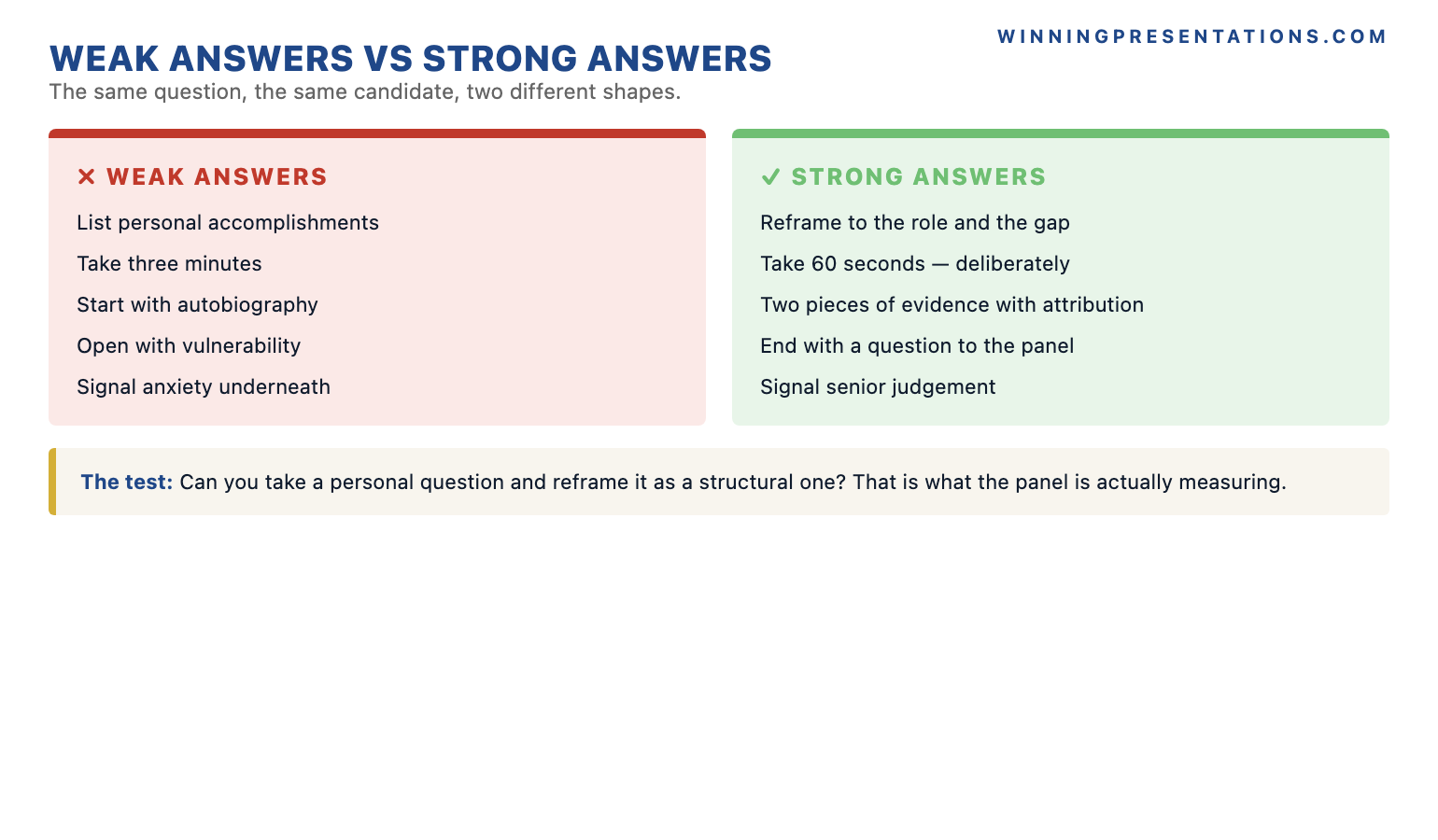
Rafaela’s answer was not the wrong content. It was the wrong shape. “Why should we promote you?” is a question that looks like an invitation to make your case and is, structurally, a test of whether you can resist that invitation. Candidates who treat it as the slot to deliver their personal pitch sound prepared but rehearsed. Candidates who treat it as a question about the role — and answer in 60 seconds, not three minutes — sound senior.
This article is about the structure that produces the second kind of answer. It is short on purpose. The answer itself is short on purpose. The point of both is the same.
For the broader pattern of senior Q&A under pressure:
The Executive Q&A Handling System covers tough questions, calm authority, and decision-safe answers in 45 seconds — built for senior professionals facing committee, board, and panel Q&A.
What the question is actually testing
Promotion panels do not ask “why should we promote you?” because they want a structured answer to a literal question. They have your CV, your performance reviews, your previous deck, and the views of the people who have worked with you. They know the answer to the literal question better than you do.
What they are testing is something more specific: how you behave when given a question that invites self-promotion. Senior professionals who can resist that invitation — who can take a personal question and reframe it as a structural one — pass the test. Senior professionals who answer the question as asked, no matter how well, fail it.
This is also why the question almost never appears in writing on the agenda. It comes up live, usually mid-way through the panel, often gently. The gentleness is part of the test. A direct, harsh framing would invite a defensive response from anyone. The gentle framing is calibrated to make you relax into self-justification. Candidates who relax into it sound like middle managers. Candidates who refuse the bait and reframe the question structurally sound like senior leaders.
The three failure patterns
Three failure patterns account for almost all weak answers to this question. Naming them explicitly is the first step in avoiding them.
The autobiographical answer. “I joined the company in 2019. I have been promoted twice. I have built strong relationships across the leadership team. I have led major initiatives in three regions…” The autobiographical answer is the most common failure mode. It is also the easiest one to spot from the panel side: it sounds rehearsed because it usually is, and it answers a question the panel did not actually ask. They do not need your CV. They need to see how you handle a question that does not have a comfortable answer.
The achievement list. “In the last twelve months I delivered the strategic review for the regional team, owned the customer-segmentation framework now in use across four product lines, and led the response to the Q3 commercial issue.” Closer than autobiographical, because at least the content is structural. But still answering the wrong question. The achievement list signals “I have done a lot,” not “I am operating at the next level.” Panels can tell the difference, even when candidates cannot.
The vulnerability answer. “Honestly, I am not entirely sure I should be promoted yet — I think I have more to learn — but here is why I think I am ready…” The vulnerability answer is sometimes praised in popular advice as authentic. In a senior promotion panel it almost always backfires. The panel is not looking for vulnerability; they are looking for senior judgement. A candidate who opens with their own uncertainty about the case has handed the panel a reason to defer. They will use it.
The 60-second answer structure
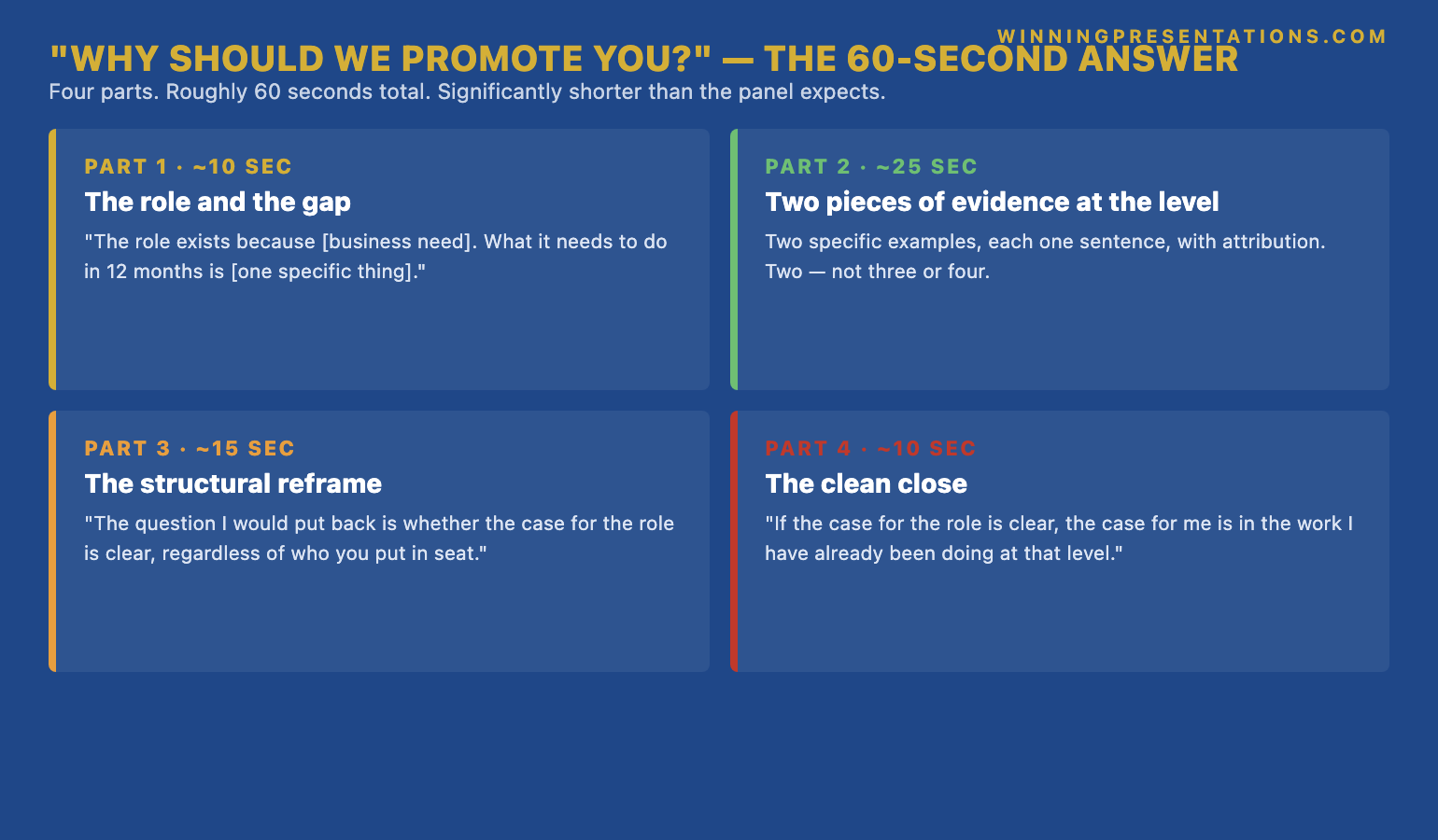
The structure is four parts, total 55–65 seconds:
Part one (≈10 seconds): the role and the gap. “The role exists because [specific business need], and what the role needs to do in the next twelve months is [one specific thing].”
Part two (≈25 seconds): two pieces of evidence that you are already operating at that level. Not three. Not four. Two specific examples, each one sentence long, with attribution. The discipline of two is critical — it signals that you can pick the load-bearing examples, not that you are searching for evidence.
Part three (≈15 seconds): the structural reframe. “So the question I would put back to the panel is whether the case for the role itself is clear enough that approving it is the right structural decision now, regardless of who you would put in seat.” This sentence is the move that separates this answer from every other answer the panel will hear that day.
Part four (≈10 seconds): the close. “If the case for the role is clear, the case for me is in the work I have already been doing at that level. I am happy to take more questions on either.”
Total: about 60 seconds. Significantly shorter than the panel expects. That brevity is part of the signal. Long answers to this question signal anxiety; short answers signal confidence. The compression is deliberate, not accidental.
For the questions that test seniority, not knowledge.
The Executive Q&A Handling System is built for the moments when the question itself is the test — committee, board, panel, and investor Q&A where how you answer matters more than what you say. £39, instant access.
- The 45-second answer architecture for senior Q&A
- Bridge and reframe techniques that work without sounding political
- The categories of question that test composure rather than content
- Recovery patterns for when the room turns sharper than expected
- Designed for senior professionals across financial services, healthcare, technology, and government
Get the Executive Q&A Handling System — £39 →
Instant download. No subscription.
Two worked examples
Two examples in different contexts. Both follow the four-part structure exactly.
Example one — Senior Strategy Manager → Director of Strategy, financial services:
“The director role exists because the strategic agenda has expanded beyond what one MD can manage alongside operational delivery, and what the role needs to do in the next twelve months is take ownership of the cross-regional planning cycle that currently lives across three desks.
In the last year I have led the strategic prioritisation that the executive committee approved in March, and I have owned the integration planning for the acquisition that closes in Q3 — both of which sit at the level the new role would carry day-to-day.
So the question I would put back to the panel is whether the case for the role itself is clear enough that approving it is the right structural decision now, regardless of who you would put in seat. If the case for the role is clear, the case for me is in the work I have already been doing at that level. I am happy to take more questions on either.”
Example two — Senior Engineer → Engineering Lead, technology company:
“The lead role exists because the platform team has grown to the point where the architectural decisions need a single accountable owner, and what the role needs to do in the next twelve months is build the technical roadmap for the migration we have been deferring.
Over the last year I have led the technical design for the payments rewrite that shipped in Q1, and I have been the de facto reviewer on cross-team architectural proposals — both of which the new role would formally own.
So the question I would put back to the panel is whether the platform team needs a lead now, regardless of who you would put in seat. If the answer to that is yes, the case for me is in the architectural work I have already been doing at that level. I am happy to take more questions on either.”
Both answers are about 60 seconds when delivered at executive pace. Both treat the question as a question about the role, not the candidate. Both close by handing the panel a structural question they have to answer either way.
For the broader pattern of how to handle hostile or difficult questions in senior settings, see the hostile question playbook for boards. The structural reframe move applies in both promotion panels and board Q&A.
Handling the follow-up questions
Most panels respond to the structural reframe with one of two follow-ups. Both are testable; both have clean answers.
Follow-up one: “Granted, but assume the role exists. Why you and not someone else?” This is the panel acknowledging that the structural reframe has worked, and now asking the personal question they intended to ask. The answer here is shorter than the original answer. “Two reasons. First, I have been carrying the operational scope of the role for the last six months in addition to my own remit. Second, the work that needs to happen in the first 90 days is work I have already started — the new lead would either be repeating work I have done or extending it. Either way, the time-to-impact is shorter with me.” Two reasons, each one sentence. Stop.
Follow-up two: “What if we don’t think the case for the role is clear?” This is the panel testing whether you can hold position when the reframe is challenged. The answer is to engage with the case for the role substantively, briefly. “If the case for the role isn’t clear, the more useful conversation is what would need to be true for it to be — which is something I would want to be involved in either way, given the operational picture I have from inside.” This response acknowledges the panel’s point without retreating from your case, and positions you as a useful contributor to their thinking even if the role itself is not approved.
For the slide structure that goes with the case:
If the panel asks for a follow-up presentation or written case after the interview, the Executive Slide System gives you 26 templates and 93 AI prompts designed for senior decision presentations. £39, instant access. Pairs naturally with the Q&A side — get the structural answer right first, then build the deck that supports it.
Frequently asked questions
Isn’t 60 seconds too short an answer for a major question?
No — and that’s part of the test. Long answers to “why should we promote you” almost always read as anxious. Short answers read as confident. Senior professionals across financial services, technology, and consulting consistently calibrate to 60 seconds because the brevity itself is the signal of executive discipline. If the panel wants more, they will ask.
What if the panel pushes back on the structural reframe?
Welcome the pushback. It means the reframe has landed and they now want to engage with the underlying question. The follow-up — usually some version of “okay, why you?” — is easier than the opening because it is a more honest question. Answer it in two reasons, one sentence each, then stop.
Should I rehearse this answer word-for-word?
Rehearse the structure. Memorise the four parts and the rough timing. Do not memorise the words — that is what produces the rehearsed-sounding answer that fails. Practise running the structure with different evidence each time, so the words emerge fresh in the room and the structure stays load-bearing.
What if my answer doesn’t get the question I prepared for?
Most variants — “what makes you the right person for this role?”, “what’s the case for stepping up?”, “why now?” — are the same question in different wrapping. The four-part structure works for all of them. Listen for the question’s intent, not its exact wording, and apply the structure. The reframe move (“the question I would put back to the panel…”) works for any version of the question.
When the question is the test, not the content.
The Executive Q&A Handling System covers tough questions, calm authority, and decision-safe answers in 45 seconds. £39, instant access.
Get The Winning Edge newsletter
A weekly note from Mary Beth on the structure, psychology, and preparation that earns senior approval. One idea, one application, one specific scenario — every Thursday morning.
Next step: Open a blank document. Write the four parts of your answer to “why should we promote you” for the next role you would want. If it runs longer than 75 seconds when you read it aloud, cut it. The discipline is the answer.
About the author
Mary Beth Hazeldine is Owner & Managing Director of Winning Presentations Ltd, founded in London in 1990. With 24 years of corporate banking experience at JPMorgan Chase, PwC, Royal Bank of Scotland, and Commerzbank, she advises executives across financial services, healthcare, technology, and government on structuring presentations for high-stakes funding rounds and board approvals.